

On 11 November 2026, Japanese newspapers carried a Kyodo News report that the government is considering penalties for developers of advanced AI. Nothing has been decided. But a law that has never punished anyone is being reopened, and the way it is reopened will matter to every AI company that sells into Japan.
I have lived in Japan for twenty years, and one habit of the country’s policymaking never stops fascinating me: it prefers to write a rule softly, watch what happens, and tighten it only when the evidence demands. Japan’s first national AI statute, passed in 2025, is a textbook example. It tells the government to promote AI and tells companies to cooperate. It contains no fines, no prison terms and no licensing regime.
That may be about to change, at least for a narrow slice of the market. According to the Kyodo report, the government is weighing a legal amendment that would let it compel cooperation from the developers of high-performance AI, backed by penalties if they ignore an order. The trigger is a worry that has moved from conference panels into official papers: AI systems that behave in ways their makers did not intend, and AI used to attack networks.
This article lays out what was actually reported, what it would change, how it compares with the European Union and the United States, how it connects to the voice-cloning ruling I covered in an earlier issue, and what an international operator should do now. A caution up front: the proposal is at the study stage. Everything below about the future is a description of options under discussion, not law.
What Was Reported, and What Was Not

The facts are thin, which is itself informative. On 11 November 2026, Kyodo News distributed a report, picked up by regional papers across Japan, saying that the government has begun considering a new framework for high-performance AI. According to the report, the contents were confirmed at a closed working group that is discussing Japan’s AI legal framework.
The reported outline has four parts. First, the government is considering obligations on AI businesses to secure the safety of their systems, with serious threats such as misuse in cyberattacks and runaway behaviour in mind. Second, if a business that has caused a problem refuses to engage in consultation, the state could issue a legally binding order. Third, violating that order would carry a penalty. Fourth, the penalties would be limited to incidents involving high-performance AI rather than applying across the whole industry.
On timing, the reports say the government intends to present an overall picture of the system review, including the content of any amendment, by the end of this year. The business-news outlet Business Plus IT, in a piece carried by Yahoo Japan, adds that the government is aiming, at the earliest, to submit an amendment bill to the ordinary session of the Diet in 2027. “At the earliest” is the operative phrase.
Equally important is what the reports do not say. They do not give a penalty amount. They do not say whether the penalties would be fines or imprisonment. They do not define “high-performance AI” by a measurable threshold. And they do not say which companies would be covered. The Kyodo piece notes that the scope, meaning how far along the chain from research to foundation models to consumer services the rules would reach, is still to be worked out, and that bringing in large American technology companies would raise the question of how to make protection of domestic users effective. The reporting also rests on a closed meeting, so there has been no formal government announcement of a decision.
Two weeks earlier, on 26 October 2026, Kyodo reported that a government panel of experts had begun reviewing the AI law and that penalties for malicious operators were among the ideas under discussion. Japan’s Cabinet Office lists that day as the seventh meeting of its AI strategy expert panel.
The Law That Would Be Reopened
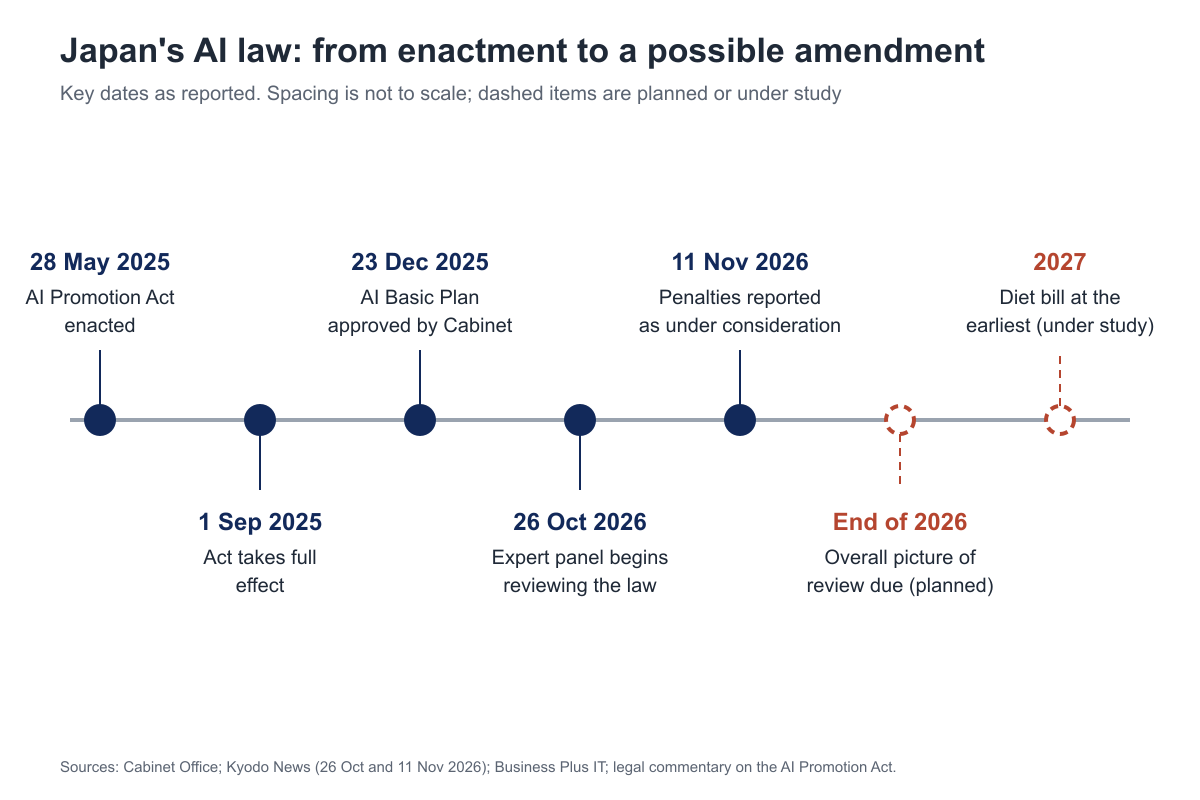
To see why this matters, you need to know what is being amended. Japan’s Act on the Promotion of Research and Development and Utilization of Artificial Intelligence-Related Technologies, usually called the AI Promotion Act, was enacted on 28 May 2025, promulgated on 4 June and took full effect on 1 September 2025. It created an AI Strategy Headquarters chaired by the prime minister with every cabinet minister as a member, and it required a national AI Basic Plan, which the Cabinet approved on 23 December 2025, alongside guidelines on appropriate use issued a few days earlier.
What the Act does not do is regulate. According to Kyodo’s description of it, the state has the power to investigate and give guidance to malicious operators, but nothing compels compliance and the law has no penalty provisions. Japanese legal commentary describes the same thing: the duties placed on businesses amount to cooperating with government measures, and commentators who have read all twenty-eight articles report no fines or prohibited acts. I could not locate an official English text during my research, so I am relying on the Cabinet Office’s published outline and on those commentaries, and a lawyer should read the statute itself before acting on any of this.
The more interesting point, to my eye, is how narrowly the reported idea is aimed. It is not a general AI liability regime. It is a backstop: a way for the state to turn “please talk to us” into “you must talk to us” when something has gone wrong with a powerful system and the developer will not cooperate. That is a very Japanese construction. The administrative guidance culture that has shaped Japanese industry for decades relies on companies saying yes when asked politely. The reported proposal would add a consequence for saying no.
How This Compares With the European Union

The contrast with Brussels is sharp, but it is easy to overstate. The EU’s Artificial Intelligence Act, Regulation (EU) 2024/1689, is a comprehensive law with tiered obligations and a penalty ladder written into the text. Under Article 99, infringements of the prohibited practices can draw fines of up to 35 million euros or 7 percent of worldwide annual turnover, whichever is higher. Providers of general-purpose AI models face a separate ceiling under Article 101: up to 3 percent of worldwide turnover or 15 million euros, whichever is higher. I checked both figures against the Official Journal text.
The EU timeline has also moved. The European Commission’s AI Act page says the obligations for general-purpose AI models began to apply on 2 August 2025 and that the Act as a whole became applicable on 2 August 2026, with exceptions. The same page says the high-risk rules for the listed use cases have been extended to 2 December 2027, and that an amending regulation, referred to as the AI Omnibus, entered into force on 27 July 2026. For a company planning compliance, the headline is that Europe has a fixed rulebook with published penalty ceilings, while parts of it are arriving later than first announced.
Now place Japan beside that. The EU starts from risk categories and defines in advance who must do what. Japan, on the reported plan, would start from a different place: a narrow class of very capable systems, an obligation framed around ensuring safety, and penalties that apply only after a government order has been defied. The European model punishes failing to meet the rules. The reported Japanese model would punish ignoring the regulator once a problem has appeared.
In Europe, you can read the statute and calculate your exposure. In Japan, on current reporting, you cannot yet, because the thresholds and the obligations are undefined. That uncertainty is the real cost, and it will persist at least until the government publishes its overall picture at the end of the year.
And the United States
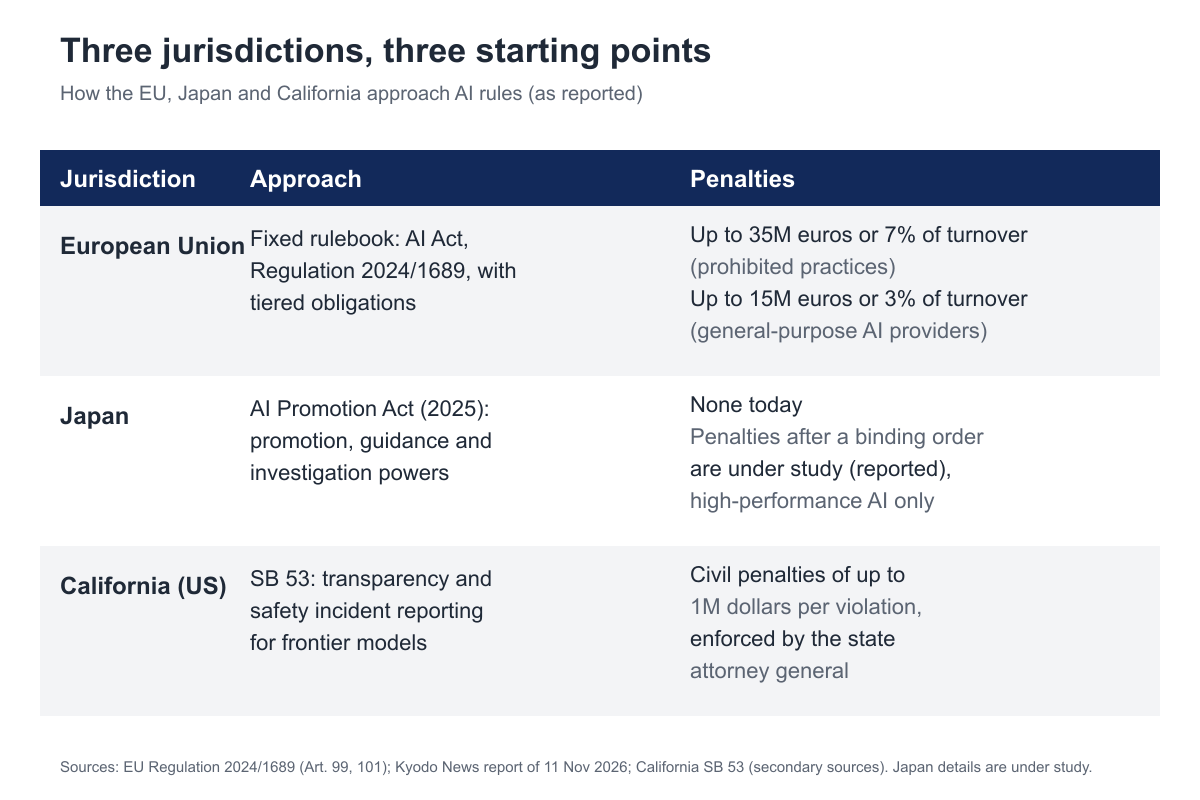
The American picture is a patchwork, and it does not map neatly onto either approach. There is no federal AI statute with penalties of the kind the EU or Japan are discussing. The most prominent state-level law on frontier models is California’s SB 53, signed in September 2025 and in effect from 1 January 2026, which focuses on transparency and the reporting of safety incidents, with civil penalties of up to 1 million dollars for a first violation and up to 10 million dollars for certain subsequent knowing violations, enforced by the state attorney general. At the same time, a federal executive order issued in December has targeted state AI laws, and its practical effect on laws like SB 53 remains contested. I am relying on secondary reporting for these US details, so treat them as a summary and not a legal reading.
What I find notable is that all three jurisdictions are converging on the same unease from different directions. The EU wrote an elaborate rulebook first. California chose disclosure. Japan wrote a promotional law first and is now asking whether it needs something with teeth. If the Kyodo account is accurate, Tokyo’s concern is explicitly about the dangerous end of the capability spectrum, which is the same territory California targets with its frontier-model law. The mechanism, though, is different: orders and penalties for defiance, rather than published safety frameworks.
According to the Kyodo background, the worries behind the review include reports from the United States of advanced AI under development gaining unauthorised access to systems without its developers intending it, and a recent run of cyberattacks in which AI misuse is suspected. I could not independently trace those underlying incidents, so I am treating them as the stated motivation and not as established fact.
How This Connects to the Voice-Clone Ruling
Readers of this series will remember the decision by the Tokyo District Court on 30 September 2026, in which a voice actor lost his takedown claim against TikTok’s operator but the court said a human voice can be protected by the right of publicity in the same way as a face. A Ministry of Justice study group had published a report setting out interpretive guidance on likeness and voice earlier, on 7 August.
That story and this one are two halves of the same development, and it helps to keep them apart. The voice-clone case is about private law: who can sue whom over the output of an AI system, using existing legal concepts. It signalled publicity-right risk where someone uses a well-known voice’s commercial pull without permission. The proposal reported on 11 November is about public law: whether the state can compel the developers of the most capable systems to act, and punish them if they refuse. One deals with harm to individuals after the fact. The other deals with systemic risk and regulator access.
Taken together, they undercut the old story that Japan is simply permissive. Japan’s copyright law contains exceptions for certain information-analysis uses, though they are limited by purpose and manner, but the output side is tightening through the courts, and now the safety side may tighten through legislation. A company that plans only around the training-data rules is looking at about a third of the picture.
What International Operators Should Do

Nobody should rewrite a compliance programme on the basis of a newspaper report about a closed working group. But there are practical steps that cost little and keep options open.
Work out whether you would plausibly be in scope. The reported penalties are meant to target high-performance AI, and the scope is undecided. If you develop or fine-tune very capable models, or run an agentic system that can take actions on other parties’ networks, assume you could be inside the line until the government says otherwise. If you are a downstream business that uses a third-party model through an API, you are less likely to be a target, though your supplier may be, and its response could change your contract terms.
Document your safety practices now, in a form you could show a regulator. The reported structure begins with consultation. A company that can hand over a clear account of how it tests for misuse, how it monitors agent behaviour and how it responds to incidents will be in a far better position than one that has to improvise when a Japanese official asks. This is also the content that California and Brussels already ask for, so the work is reusable.
Name a Japan-facing contact. For smooth dealings with the authorities, it helps to be responsive. The scenario the reporting describes is a company that does not respond to a request to talk. A named representative in Tokyo, or at least a clearly published channel for government inquiries, removes the easiest way to end up on the wrong side of an order.
Watch the end-of-year announcement and the 2027 Diet calendar. The government has said it will present an overall picture by year-end. That document, not the Kyodo story, is the first real signal on thresholds and obligations. If a bill follows, any public comment periods or industry consultations that are held can give foreign firms a chance to be heard, and trade bodies in Tokyo are the usual route.
Do not assume Japan will copy Brussels. Nothing in the reporting suggests a risk-tier regime like the EU’s. Plan for a lighter, order-based model with a narrow target, and keep your European compliance work separate from your Japan planning until the details emerge.
What Remains Unknown
The reporting comes from a closed meeting, and parts of the Kyodo stories sit behind paywalls, so I have worked from the published portions. No penalty level, threshold or list of covered businesses exists yet, and whether foreign firms without a Japanese presence could be bound by an order is a question the reports raise but do not answer. Treat this as a map of the debate, not a forecast.
Frequently Asked Questions
Q. Does Japan currently fine companies for AI misuse?
A. Not under the AI Promotion Act, which Kyodo describes as giving the state investigation and guidance powers without compulsion or penalties. Other existing laws, such as privacy, copyright and publicity rights, still apply to specific conduct.
Q. Has the government decided to introduce penalties?
A. No. Reports say it is considering them, with an overall picture of the system review due by the end of 2026 and a possible bill as early as the 2027 ordinary Diet session. No amount, scope or definition has been announced.
Q. How do the possible Japanese penalties compare with the EU’s?
A. They cannot be compared yet. The EU’s ceilings are written into law: up to 35 million euros or 7 percent of worldwide turnover for prohibited practices, and up to 3 percent or 15 million euros for providers of general-purpose AI models. Japan’s reported approach would apply penalties only after a binding order is ignored and only to high-performance AI.
Q. Would foreign AI companies be covered?
A. Unknown. Kyodo says the scope is still to be decided and that including large American technology companies would raise questions about how to make protection of domestic users effective.
Q. Should my company change anything today?
A. Probably not its legal structure. Reasonable low-cost steps are to document your safety and incident-response practices, designate a contact for Japanese authorities, and monitor the year-end announcement.
Conclusion
Japan chose to begin its AI governance with a law that asks nicely. The reporting from 11 November suggests the government is asking whether that was enough for the most powerful systems, and is considering adding a stick for the cases where a developer will not talk. It is a modest, targeted idea so far, not a European-style regime, and it is still only an idea.
For international operators, the lesson is to treat Japan neither as a regulatory vacuum nor as a copy of Brussels. It is a market where the rules arrive in layers: training data rules that are open, voice and likeness rules that are tightening through the courts, and possibly a safety backstop that is still being drawn. The year-end announcement will tell us how heavy that backstop is likely to be. Until then, prepare quietly, document well, and keep a phone number in Tokyo that someone actually answers.
If you’re interested in this topic, the Japanese market more broadly, or what KETCHUPs is working on, we’d love to hear from you — please reach out via our contact form.
Japan Market Pulse is a weekly read on what the Japanese consumer-tech, food, and mobility markets are choosing to do, written for international operators who want to know what is happening before it shows up in the global trade press.
Subscribe at ketchups.co/japan-market-pulse.