


In March 2026, a Kamakura company began selling an electric tuk-tuk to the public for about ¥1 million. In December 2025, a Hiroshima startup delivered the first of its ¥1.1 million single-seat micro-EVs. Neither fits cleanly into Japan’s vehicle categories, and that is exactly why they are interesting.
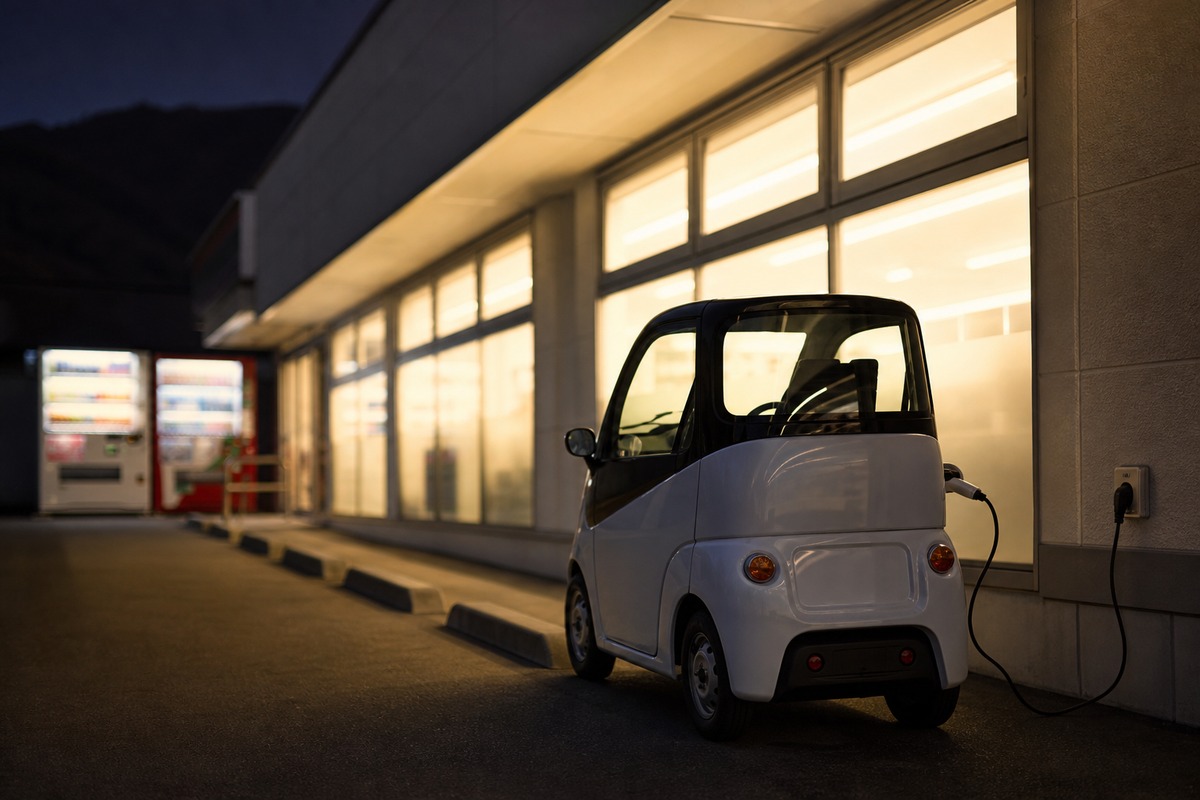
For a century, Japan’s answer to urban transport has been the kei car: small, boxy, tax-advantaged and built to a government-defined size. Now something even smaller is showing up on side streets. A three-wheeled, open-sided electric tuk-tuk idles outside a seaside café. A one-seat box on four wheels, about the length of a large motorcycle, parks beside a convenience store. Neither is a car in the ordinary sense, and neither is a motorcycle or a bicycle.
If you build vehicles, sell mobility services, run a tourism business or simply want to know where urban transport is heading, this segment deserves attention. It is small today. But it sits at the meeting point of three powerful forces: an ageing population that is giving up driver’s licences, short everyday trips that a full-size car handles poorly, and a regulatory system that is improvising.
This article covers what is on sale now and at what price, why the vehicle categories matter more than the vehicles, what Japan has already learned from electric kickboards, what happened to China’s similar “old man’s joy” vehicles, how Europe’s Citroën Ami fits in, and what international businesses should take from all of it.
What Is Actually on Sale
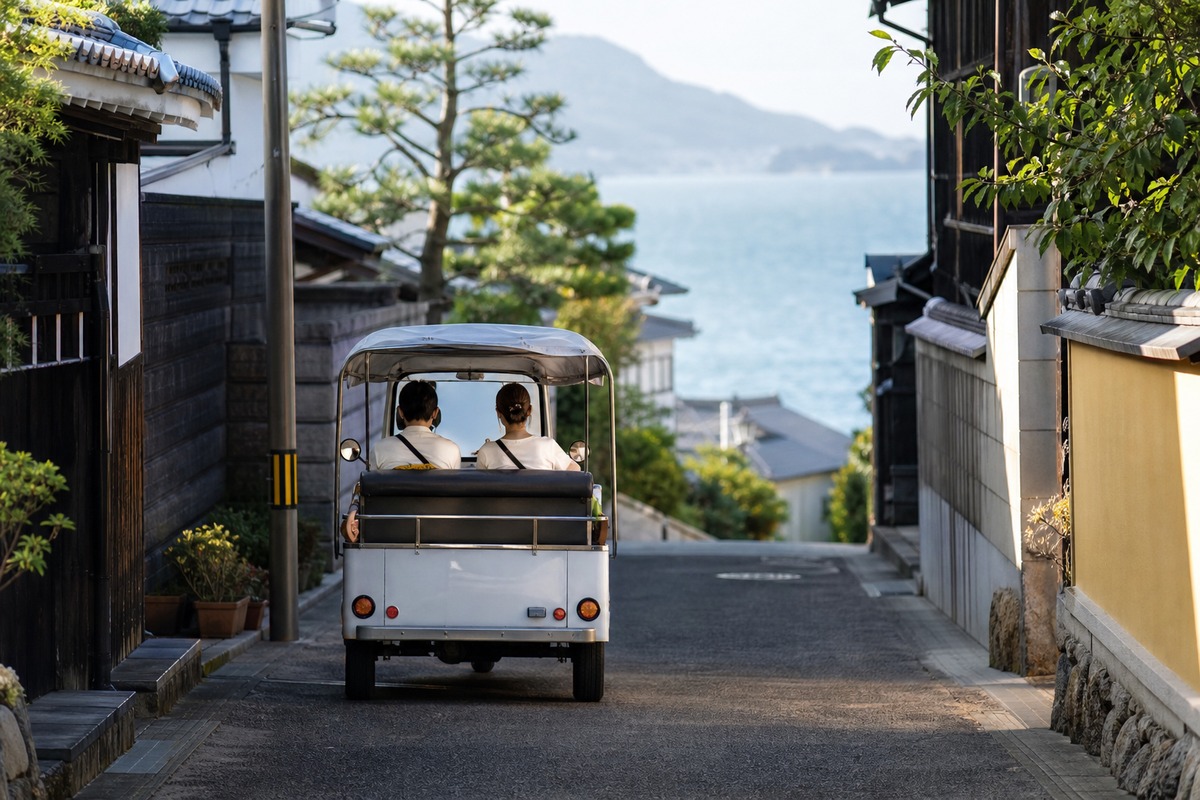
Two products show the shape of the market. Both are new, both are small and both are priced at roughly the cost of a good e-bike with a roof.
The Emobi electric tuk-tuk. The company behind it, eMoBi in Kamakura, spent several years running electric tuk-tuks as rentals and tours in the Kamakura and Shonan areas. On 30 March 2026 it formally began selling the vehicle to individuals and businesses. According to Japanese automotive press, the list price is about ¥1 million. It carries up to three people, tops out at 45 km/h and has a range of roughly 45 km. It runs on swappable batteries that can be charged from a household 100-volt outlet. Sales to individuals are starting in Kamakura, Shonan and the greater Tokyo area, with business sales taken nationwide.
The Mibot. KG Motors, a startup based in Hiroshima, builds a single-seat electric vehicle that it calls a mobility product rather than a car. It measures about 2.49 metres long, 1.13 metres wide and 1.47 metres high, with retro round headlights and a boxy cabin. The price reported by Japanese media is ¥1.1 million including tax. It reaches 60 km/h and is said to travel up to about 100 km on a charge. KG Motors’ published specifications put charging at roughly 11.5 hours from a 100-volt household outlet and about 3 hours from a 200-volt supply. The first unit was delivered on 30 December 2025, the company is aiming for full-scale production from April 2026, and on 16 January 2026 it signed a business partnership with the energy company Idemitsu Kosan to work on next-generation mobility.
Neither company has published sales volumes that I could verify, so it is too early to call this a mass market. What can be said is that products now exist, have prices, are being delivered, and are backed by serious partners.
The Rules Matter More Than the Vehicles
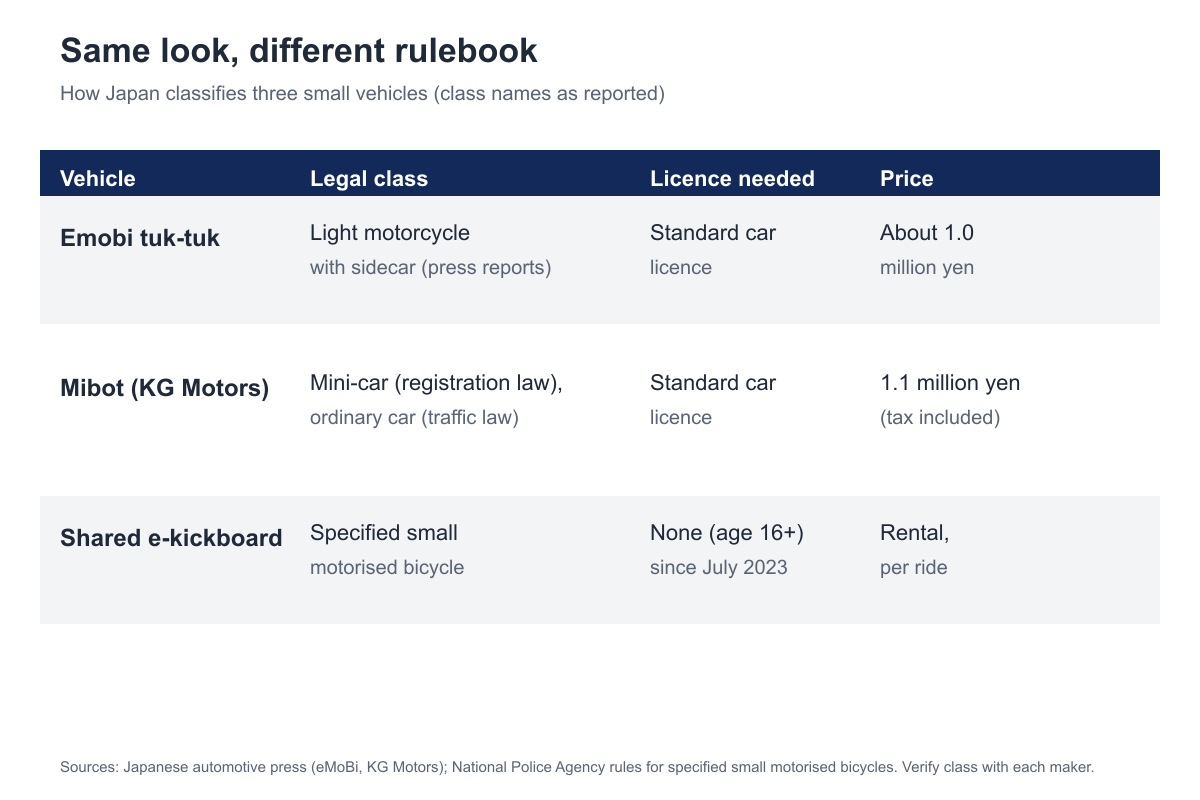
The most revealing detail about these products is not their speed or range. It is how Japanese law classifies them.
Japan sorts road vehicles into narrow categories, and each category carries its own licence, helmet, inspection, tax and parking obligations. The Mibot is a mini-car under vehicle-registration law, a class of motorised bicycle, but road-traffic law treats it as an ordinary automobile, so a standard car driver’s licence is required; it avoids the mandatory inspection regime of a regular car. According to reports, the Emobi, by contrast, is classified as a light motorcycle with sidecar. A standard car licence is enough to drive it, and reports say there is no helmet requirement, even though it is a three-wheeled vehicle you sit in much as you would sit in a small car.
This is the quiet insight in the segment. These vehicles are designed around the rules. A designer can pick a category, build to its limits, and gain a cost structure that a conventional car cannot match: no vehicle inspection for some classes, simple parking requirements, low insurance and tax. The result is that a vehicle that looks like a small car can be legally something else, and the buyer inherits that logic.
It also means that two vehicles which look similar to a customer can differ in speed, licence requirement, safety equipment and where they may be driven. The categories were written for yesterday’s vehicles, and the market is now moving faster than they are. Regulators will eventually have to decide whether to tidy the system or let designers keep arbitraging it.
What Japan Already Learned From Electric Kickboards
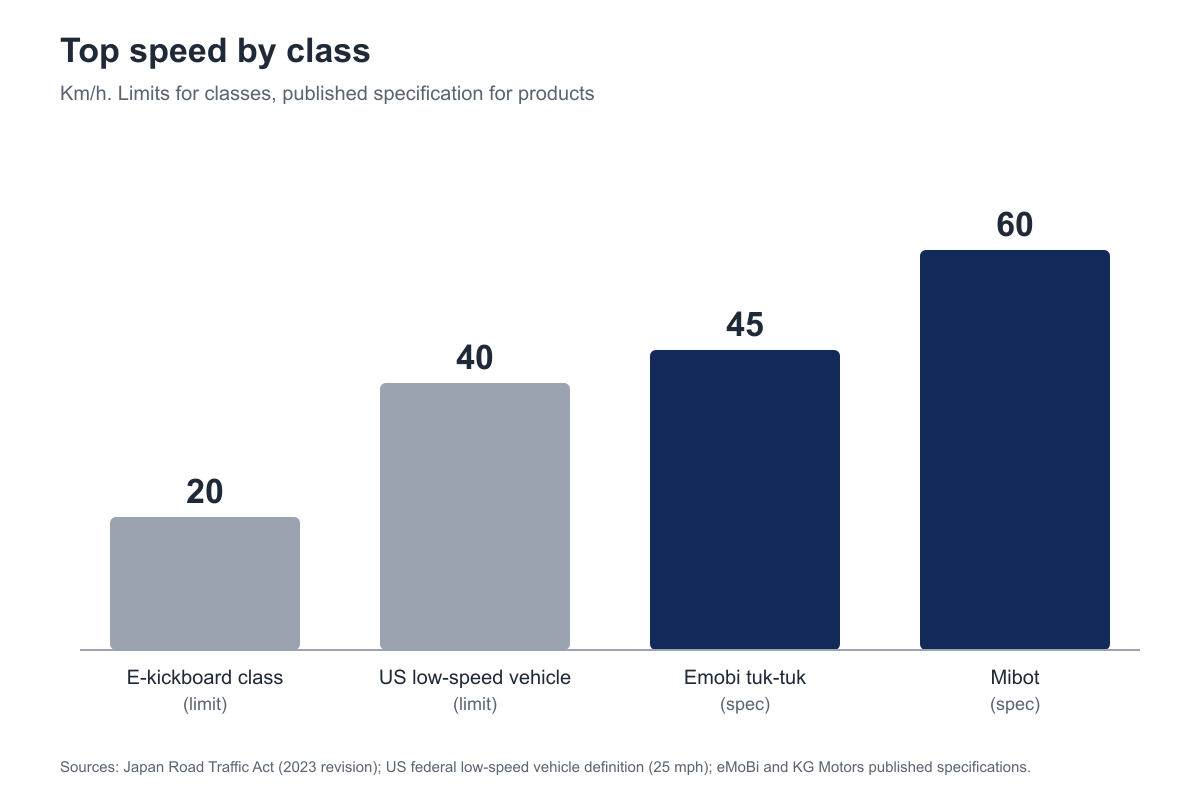
Japan has just run a version of this experiment. On 1 July 2023, a revised Road Traffic Act created a new class called specified small motorised bicycles. Riders aged 16 and over can use them without a driver’s licence, speeds are capped at 20 km/h, and they are generally supposed to use the roadway. This was the legal home for shared electric kickboards.
The results are instructive. In the first year after the rules took effect, the National Police Agency counted 219 accidents involving the new class. For calendar year 2024, one report put the national figure at 338 accidents, with one death. These numbers come from different periods and are not directly comparable, but they show a small base that is growing along with usage. Enforcement shows the compliance problem more clearly: through 2025, police data cited in Japanese press showed tens of thousands of violations by riders of these vehicles, and about 60% of them were for riding in the wrong place on the road.
In other words, creating a new category made access easy, and behaviour then had to catch up. Anyone launching a micro-vehicle business in Japan should assume that enforcement and public perception will follow the same arc. In June 2026, a rider using a shared kickboard service died in a collision with a car in Tokyo’s Kita ward, according to the operator’s own announcement, a reminder that the safety question is not theoretical.
China’s Cautionary Tale
The most direct precedent for Japan’s new tuk-tuks is not in Europe. It is in China.
Across Chinese towns and suburbs, an informal class of cheap, low-speed electric three- and four-wheelers has long served older people. They are nicknamed laotouyue, roughly “old man’s joy”. They offered shelter from rain at a fraction of a car’s price, and for years they sat in a regulatory grey area. Safety was a persistent issue. They often lacked basic protections such as airbags or reinforced frames, and many could not be registered or insured as motor vehicles.
Beijing banned illegal, non-compliant low-speed electric three- and four-wheelers from public roads and parking areas on 1 January 2024. Municipal authorities cited 131 fatal crashes involving illegal electric three- and four-wheelers in 2022, resulting in 138 deaths. The ban came with a transition period and support measures for owners, though the extent of compensation varied by district. Separately, China removed the age-70 upper limit for small-vehicle and moped licences in 2020. At the national level, no dedicated standard for these vehicles has been finalised, according to recent reporting; to run legally they must meet existing motor-vehicle or motorcycle approval requirements. The lesson is not that micro-vehicles fail. It is that demand for cheap, sheltered, short-distance transport is real and persistent, and that unmanaged growth tends to end in a regulatory correction. Japan’s makers appear to be building to existing legal categories rather than around them, which is a more defensible position.
Europe’s Version: The Citroën Ami
Europe has its own category, the quadricycle, and one product has come to define it: the Citroën Ami, a tiny two-seat electric cube. In France it can be driven from age 14 with the right licence, and in Germany from 15 with a moped licence, which has turned it into an unusual car for teenagers and a first vehicle for city dwellers who do not want a conventional car. Citroën has marketed it with low-cost monthly leasing, and one source lists a starting price of €7,990 for the 2025 relaunch.
Seen from Tokyo, the Ami is both an encouragement and a warning. It shows that a regulatory category can build a mass-market product. It also shows that the category largely decides who the customer is. In Europe, the customer skews young. In Japan, the likely early buyers include older drivers living in neighbourhoods where public transport is thin and a full-size car is more than they need, although no buyer data has been published.
Why Japan, Why Now
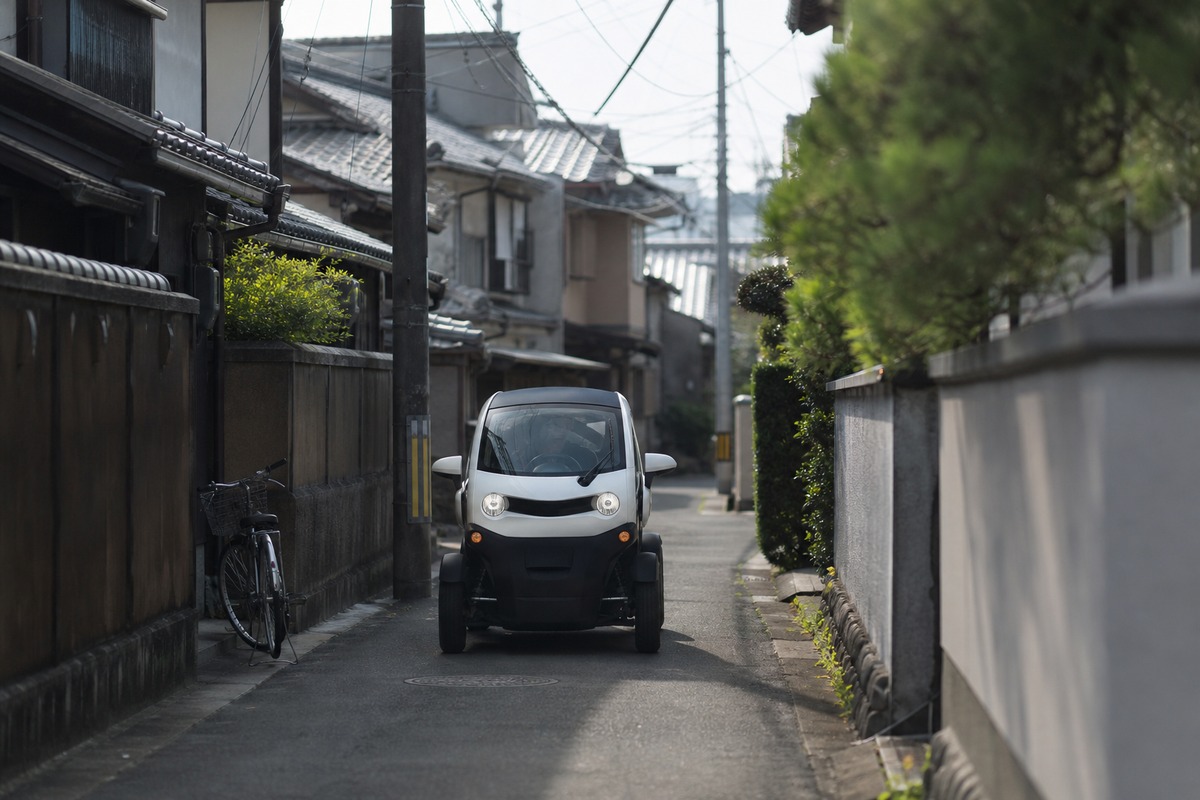
Three conditions are converging.
First, demographics. Japan’s population of drivers is ageing, and whether older people should keep driving is a long-running policy debate. The vehicles being sold today are mostly aimed at people who still have a licence but want less car: one person or two, short distances, home charging, low running costs.
Second, geography. Many Japanese neighbourhoods have narrow streets that were designed before cars. A 2.5-metre vehicle fits where even a kei car feels large. For tourism areas such as Kamakura, an open electric tuk-tuk offers an experience that a bus cannot.
Third, cost. At roughly ¥1 million to ¥1.1 million, these vehicles are priced above a good e-bike but well below a new kei car, with low running costs. For a household that uses a car for supermarket runs and clinic visits, the maths is straightforward.
None of these forces is unique to Japan. That is why the segment is worth watching overseas.
How to Read the Early Signals, and Their Limits
A few cautions are in order. First, there is almost no audited volume data. Manufacturers report deliveries and pre-orders, not market share, and the figures that circulate in the press are not independent. Second, categories can change. A rule revision could add helmet, licence or inspection requirements to a class that is currently light. Third, safety performance is unproven at scale. Open-sided vehicles with three wheels will be judged against kei cars by insurers and by the public, and the first high-profile accident will shape perception.
Finally, the United States offers a useful reference point. Federal rules already define a class of low-speed vehicles, limited to 25 mph (40 km/h); where they may be driven is set by state and local law, often on roads posted at 35 mph or lower. Golf-cart-style vehicles in retirement communities are the typical example. That class exists, but in the United States it does not appear to have produced a mainstream urban microcar market. Japan’s experiment will test whether a better-designed product, aimed at a clear customer, can do what the American category has not.
What International Businesses Should Take From This
Study the category before the product. In Japan, the vehicle category determines the licence, the inspection regime, the helmet rule and the insurance. If you plan to import a small electric vehicle, the first question is which category it falls into, not how fast it goes.
Look at tourism and last-mile first. At eMoBi, the vehicle was first run as rental and tourism fleets, which offer a controlled environment and a clear rental use case. Direct consumer sales are the second wave.
Expect an enforcement cycle. The kickboard experience shows that access, then misuse, then enforcement, then refinement is the usual path. Plan for it.
Watch for partnerships with energy and infrastructure companies. Idemitsu’s tie-up with KG Motors points to a future in which charging, battery swapping and local service networks matter as much as the vehicle.
Do not copy Europe or China directly. Japan’s market has its own customers, geography and rules, and the winning products will be built to Japanese categories.
Frequently Asked Questions
Q. How much does a Japanese electric tuk-tuk cost?
A. The Emobi electric tuk-tuk is reported at about ¥1 million (roughly $6,500 at recent rates), and KG Motors’ single-seat Mibot at ¥1.1 million including tax. Prices and specifications should be confirmed with the manufacturers.
Q. Do you need a special licence to drive one?
A. Reports say the Emobi, classified as a light motorcycle with sidecar, can be driven with a standard car licence, and the Mibot, a mini-car class vehicle, also requires a standard car licence. The e-kickboard class is different: riders aged 16 and over need no licence.
Q. Are they legal on public roads?
A. Yes, within their registered categories. Each class has its own limits on speed, equipment and where it may be driven, so check the class before buying.
Q. Can I buy one outside Japan?
A. I found no announced export plan for either product. Both are being sold in Japan first. These vehicles are not listed on Amazon.com, so there is no retail link to share here.
Q. Why did China restrict similar vehicles?
A. Beijing banned illegal, non-compliant low-speed electric three- and four-wheelers from 1 January 2024, citing road safety. The city reported 131 fatal crashes and 138 deaths involving illegal electric three- and four-wheelers in 2022.
Q. How is this different from a kei car?
A. A kei car is a full car with a government-defined size limit. These vehicles are smaller and often legally classified as motorcycles or mini-cars, with lower cost and fewer obligations.
Conclusion
Japan’s tuk-tuks and micro-EVs are not a revolution yet. They are a small set of products, with unverified volumes, arriving in a legal system that is still deciding what to call them. But they show something real: when a country has an ageing population, narrow streets and a regulatory structure built from many small categories, the next vehicle is likely to be built to a category rather than to a conventional idea of a car.
For international businesses, the practical lesson is to follow the rules, the customers and the early partnerships rather than the hype. The vehicles are worth watching, and the rulebook behind them even more so.
If you’re interested in this topic, the Japanese market more broadly, or what KETCHUPs is working on, we’d love to hear from you — please reach out via our contact form.
Japan Market Pulse is a weekly read on what the Japanese consumer-tech, food, and mobility markets are choosing to do, written for international operators who want to know what is happening before it shows up in the global trade press.
Subscribe at ketchups.co/japan-market-pulse.