

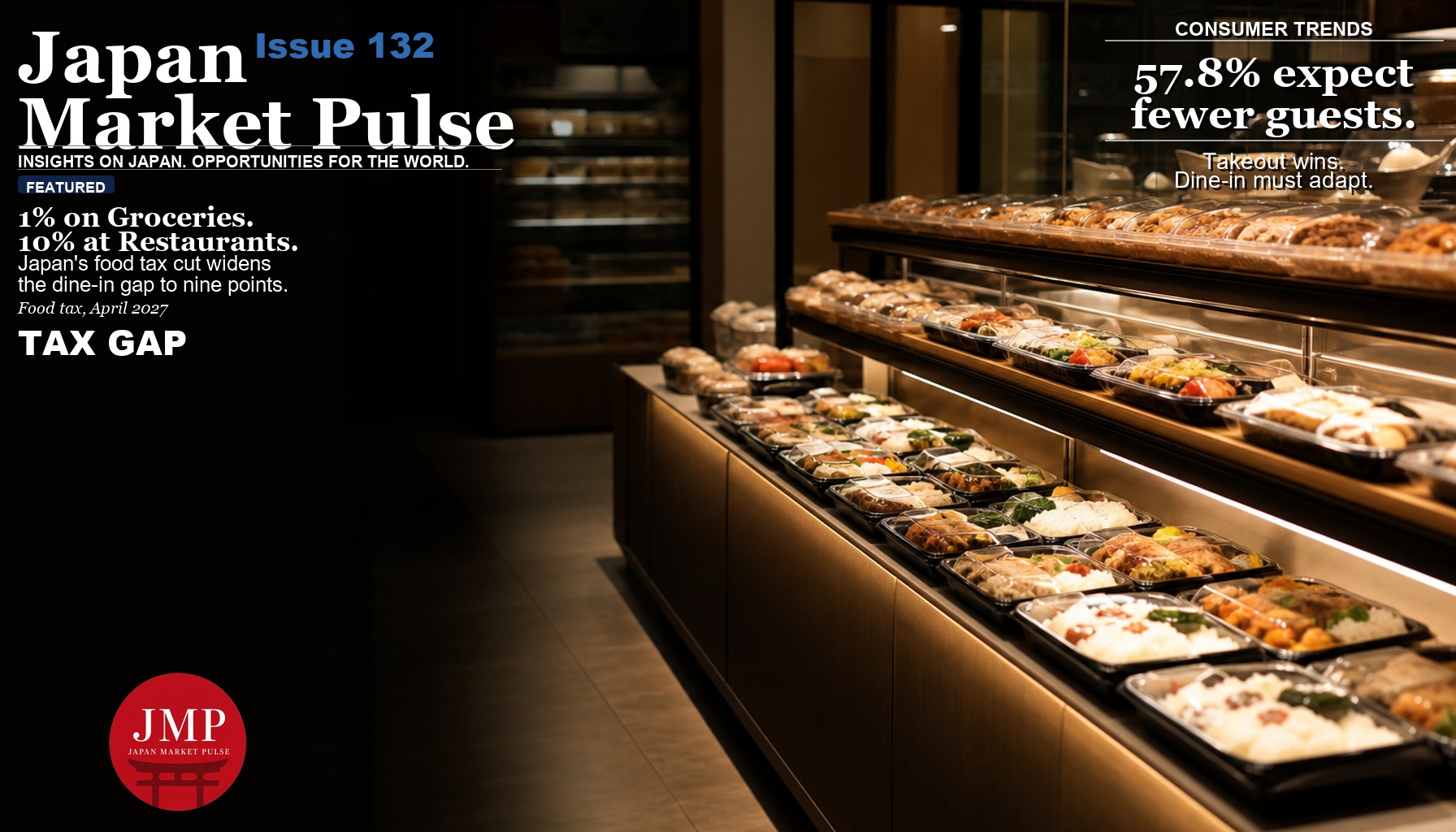
Japan’s government has decided to cut the consumption tax on food and non-alcoholic drinks from 8% to 1% for two years starting in April 2027, the first cut since the tax began in 1989. Meals eaten inside a restaurant stay at 10%, so the tax gap between a supermarket bento and a restaurant lunch will widen from two points to nine. A survey of 204 restaurant companies by the Japan Foodservice Association found 57.8% expect fewer customers in April 2027. Consumers, meanwhile, say they will mostly save the money.
Most consumption tax cuts are sold as a gift to shoppers. Japan’s version is also, quietly, a redesign of how people choose between cooking at home, buying a prepared meal and sitting down in a restaurant. When the tax on groceries and takeout falls to 1% while dine-in stays at 10%, the price signal changes for every lunch, every family dinner and every office bento.
If you sell food or drink in Japan, run a restaurant brand, supply a chain, or plan to enter the market with a packaged product, this matters in different ways. Retailers and makers of ready meals may gain a tailwind. Restaurant operators face a policy that makes eating out look comparatively expensive. And every business that handles food has a cash-register and menu problem to solve by April.
This article covers what the government decided and when, how the tax gap works in yen, what restaurant companies told the government and the public, what happened the last time Japan changed the gap in 2019, what consumers say they will do with the savings, and what international operators should check now.
What Japan Decided, and When
The timeline matters, because the plan moved quickly and parts of it are still going through the legislature.
– Early 2026: Prime Minister Sanae Takaichi’s Liberal Democratic Party fought the February general election promising to suspend the 8% tax on food for two years. It won a landslide. – 5 August 2026: At an extraordinary meeting, the Cabinet adopted a basic policy to cut the consumption tax on food and drink from 8% to 1% for two years from April 2027, according to Kyodo News. It is the first reduction since the tax was introduced in 1989. – 9 October 2026: According to the trade paper Shokuhin Shimbun, the related bill was approved by the Cabinet that day. It still has to pass the Diet. – April 2027 to March 2029: The planned period for the 1% rate.
The 1% is not a typo for zero. The government says that combining the cut with roughly ¥600 billion a year in cash payments to low- and middle-income households makes the tax on food “effectively zero.” The payments correspond to the remaining 1 point of tax. After the two years end, the government intends to introduce a permanent income-linked benefit system in fiscal 2029. Whether the rate returns to 8% afterward is, as Kyodo put it, the focus.
Why 1% rather than 0%? A report published by Japan.co.jp, an English-language outlet that labels its articles as AI-assisted, says retailers and system vendors warned that many payment and accounting systems are not built to handle a zero-rate category quickly, and that a nonzero rate could be introduced in five or six months rather than a year. Treat that as one outlet’s account, not an official explanation. What is documented elsewhere is the timeline pressure: a register-maker official told Jiji Press that revising and rolling out a system across stores generally takes about six months.
The fiscal cost is large. Kyodo reported that the combined national and local revenue loss over two years is expected to approach ¥10 trillion, with no replacement source clearly identified. The prime minister said the government would pursue new revenue from a zero base and review tax breaks and subsidies, and that social security funded by the consumption tax would not be affected.
The Nine-Point Gap, in Yen
Japan has run two consumption tax rates since October 2019: 8% on most food and drink bought to take away or have delivered, and 10% on meals eaten in a restaurant, on alcohol and on most other goods. A convenience-store sandwich eaten at the store’s eat-in counter is taxed at 10%; the same sandwich carried out is taxed at 8%.
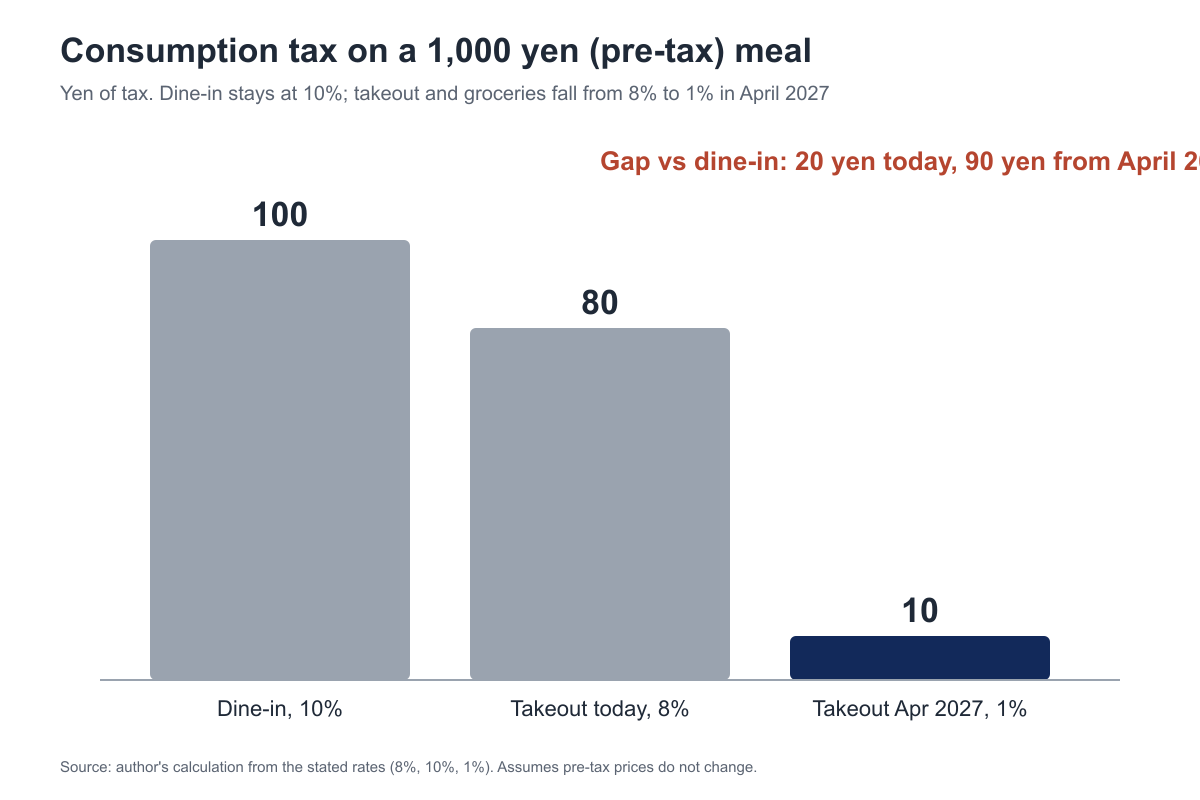
From April 2027, the takeout and grocery rate drops to 1%, and the dine-in rate stays at 10%. On a ¥1,000 pre-tax meal, the tax is:
– Dine-in: ¥100 – Takeout or supermarket, today: ¥80 – Takeout or supermarket, from April 2027: ¥10
The gap between eating in and taking out therefore goes from ¥20 to ¥90 on a ¥1,000 meal. That is a calculation from the stated rates, not a forecast, and it ignores any change in pre-tax prices.
For a shopper, a ¥10,000 pre-tax grocery basket currently costs ¥10,800. At 1% it would cost ¥10,100, a 6.5% reduction at the checkout if the whole cut is passed through and nothing else changes. Reports on the plan note that retailers are not legally required to lower prices by the amount of the cut, so how much shoppers actually see will depend on competition and costs.
A Daiwa Institute of Research study published in January 2026, covering the earlier idea of suspending the tax entirely, estimated an annual revenue loss of ¥4.8 trillion, a GDP boost of only about ¥0.3 trillion and a consumption boost of about ¥0.5 trillion. It also found the benefit tilts toward richer households: the top 20% by income would receive about twice the benefit of the bottom 20%, because they buy more groceries. The 1% plan is smaller than that scenario, so those numbers show the scale of the earlier proposal, not the final one.
The Restaurant Industry’s Warning
The most concrete evidence of how the restaurant sector sees this came on 9 October, when the Japan Foodservice Association (JF) held a press conference together with the national federation of restaurant-sector trade associations and the Osaka Foodservice Industry Association.
Their key findings from a survey of 204 restaurant companies:
– 118 companies, or 57.8%, expect customer numbers to fall in April 2027, the first month of the cut. Family restaurants and pubs (izakaya) were the most anxious. – Of those 118, 78 companies, or 66.1%, said it would take about six months, one year or two years to get back to the level before the cut. – Companies also cited the cost of rewriting, printing and delivering menus, and of updating cash-register systems, with a queue forming at system vendors.
JF chairman Atsushi Mukumoto said eating out is “life infrastructure” for older people and busy people living alone, not a luxury, and that he worries a mood of “eating out is a loss” will take hold if restaurants are the only food business excluded from the cut. The chairman of the national federation said that with raw material and labor costs still rising and prices hard to pass on, a widening gap between home and restaurant meals could hit restaurants hard.
Several large chains had already set out their positions in August, according to Jiji Press. Zensho Holdings, which operates Sukiya gyudon restaurants, said it would strengthen takeaway and delivery, with its finance chief saying the company is ready to accept any circumstances. Royal Holdings said Royal Host is considering menu items offered only for takeaway. The chief executive of Watami, which runs izakaya, said restaurants will lose customers. The industry group asked the government for demand-boosting measures such as premium dining vouchers.
This reaction is not a prediction of collapse. It is a stated expectation from companies that know their own traffic. But it arrives on top of the other pressures on the sector this year: higher ingredient prices, higher wages and, as earlier articles in this series showed, record failure counts among small restaurant operators. A tax change that nudges customers toward home and takeout lands at a thin-margin time.
What Happened in 2019
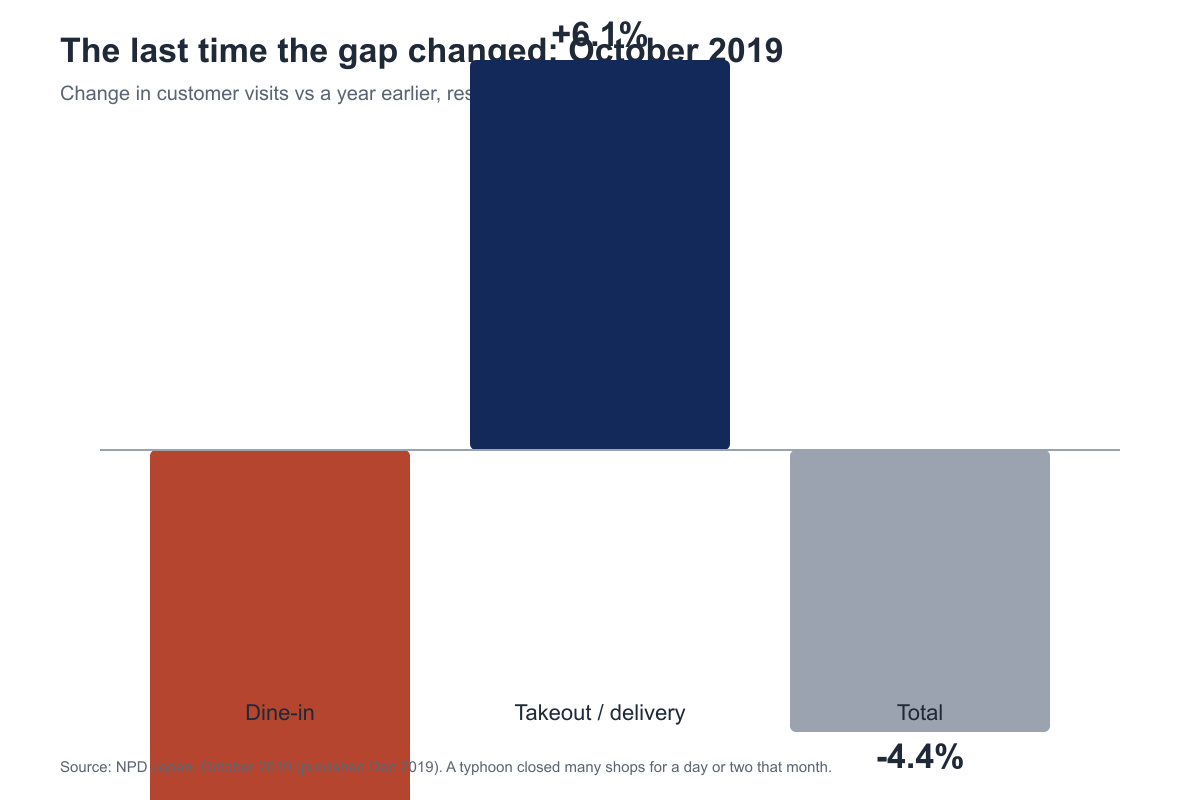
Japan has a recent test of how this kind of gap affects behavior. In October 2019 the consumption tax rose from 8% to 10%, and the reduced 8% rate was introduced for takeout and groceries. For the first time there was a two-point gap between eating in and taking out.
NPD Japan, a research firm that tracks eating-out and prepared-meal markets, reported results for October 2019:
– Restaurant dine-in customer visits fell 7.6%; takeout and delivery visits rose 6.1%; the combined total was down 4.4%. – By sales, restaurant dine-in fell 5.4%, takeout and delivery rose 12.5%, and the combined total fell 2.9%. – At retailers such as convenience stores and supermarkets, eat-in visits fell 21.9%.
NPD noted that a typhoon closed many shops for a day or two that month, which affected totals, and that the tax rise itself made consumers more thrifty, especially homemakers. Dine-in made up about 84% of restaurant sales at the time, so a fall in dine-in visits was significant even when takeout grew.
The comparison has limits. In 2019 the whole tax rate rose and the gap was two points; in 2027 the overall rate on food falls and the gap is nine. Incomes, prices and eating habits are different. But the direction of the 2019 change, with dine-in down and takeout up, is the reason restaurant companies are acting early.
What Consumers Say They Will Do
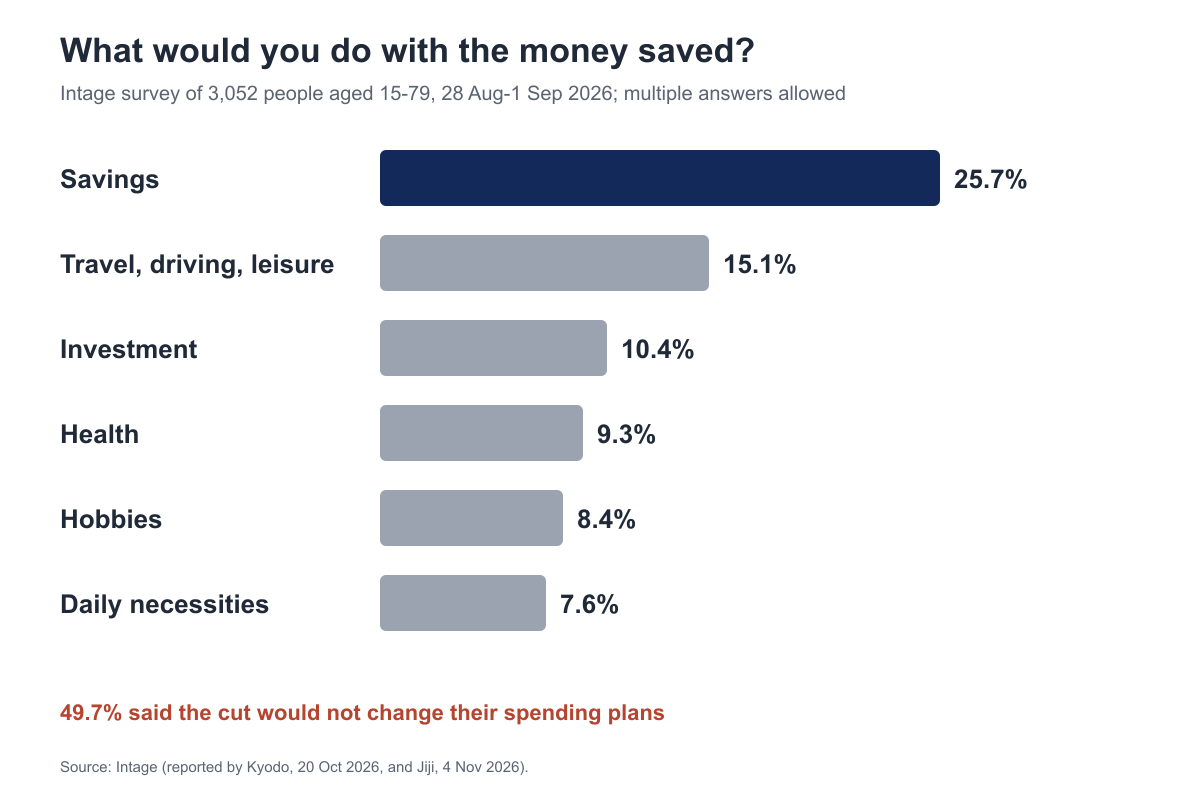
Research company Intage surveyed 3,052 people aged 15 to 79 online from 28 August to 1 September 2026, asking how they would use the money saved from the 1% food tax. Multiple answers were allowed. Kyodo published the result on 20 October, and Jiji followed on 4 November.
– Savings: 25.7% – Travel, driving and leisure: 15.1% – Investment: 10.4% – Health: 9.3% – Hobbies: 8.4% – Daily necessities: 7.6%
On behavior, 49.7% said the cut would not change their spending plans. 32.6% said they would postpone purchases until after the cut. 25.8% said they would buy in bulk once the tax is lowered. An Intage official said consumers seem conscious of saving and worried about the future, while some want to spend on travel and hobbies. The poll was run before the Cabinet approved the bill, but after the basic policy.
A Jiji Press survey in August found 49.1% supported the plan and 31.6% opposed it. Corporate views are cooler: a Teikoku Databank survey of 1,546 companies, carried out when the earlier, full-suspension idea was on the table, found 25.7% thought a food tax cut would be beneficial and 48.2% expected no particular impact. That figure happens to match the Intage savings percentage by coincidence; they come from different surveys.
Two behaviors in the Intage data deserve attention from retailers. The postponed purchases, 32.6%, imply a possible lull in spending on certain goods in early 2027 before the cut takes effect, followed by a rise. And bulk buying favors products that keep, such as frozen, canned, dried and bottled goods.
Who May Gain, Who May Lose

Likely beneficiaries: supermarkets, convenience stores and delivery services, because their food falls to 1% and the restaurant gap widens. Makers of frozen meals, ready-to-heat dishes and packaged sides are also watching. Shokuhin Shimbun reported on 9 November that home-use frozen food makers see next spring’s cut as an opportunity, with staple one-plate meals and pasta selling well.
Likely to adapt: restaurant chains with strong takeaway and delivery capability, which can shift sales toward the 1% category. Chains are also considering takeaway-only menus and more bento products. A restaurant that sells a food item both ways will face two tax rates on one product, which is where menu and register work becomes complex.
Under pressure: dine-in-heavy restaurants, in particular family restaurants and izakaya, and operators with thin margins and little takeaway business. Small operators have fewer resources to adapt quickly, a concern the trade groups raised in their briefing.
In the middle: food makers. Lower consumer prices at the shelf could support volumes, but there is no requirement for pre-tax prices to stay the same, and makers have announced price increases on 20,187 items for 2026 so far, as covered in Japan Market Pulse earlier this month. A tax cut of about 6.5% at the register would offset a good part of recent price increases for shoppers without reversing them.
How to Read These Numbers (and Their Limits)
Several points should be kept in mind before drawing conclusions.
The bill has not yet passed. The Cabinet has approved it, but details such as covered products, funding and what happens after March 2029 can still change in the Diet.
The restaurant survey measures expectations. The 57.8% figure counts companies that expect fewer customers in April 2027. It does not measure actual traffic, and it came from 204 companies surveyed by a trade association that has a stake in the policy debate.
The Intage survey measures intentions. Stated plans for savings and spending are not the same as behavior. The poll was run before the bill was finalized.
Pass-through is not guaranteed. The 6.5% reduction at the checkout assumes the whole cut reaches shoppers with no change in pre-tax prices.
2019 is only a partial guide. The size of the gap, the economic backdrop and eating habits are different now.
What International Operators Should Take From This
Check your menu and price tax logic. If you run a restaurant or cafe in Japan that sells both eat-in and takeout, two rates apply to the same item and the difference is now bigger. Prices in Japan are displayed tax-inclusive, so labels, menu boards, apps and receipts need updating.
Plan cash-register and POS updates early. The register-maker’s estimate of about six months to revise and roll out a system, and JF’s report of a queue at system vendors, point to a crowded schedule in the winter and early spring of 2027.
Think about takeaway and prepared products. If you make or import packaged food, ready meals, frozen foods or beverages that fall under the reduced rate, the new rate may support demand. If your business is eat-in, consider what would make the experience worth the nine-point gap.
Do not assume a uniform effect. Surveys point to cautious consumers. About half said spending plans would not change. Budget for a modest effect, not a boom.
Watch for postponed buying. With about a third of respondents saying they would delay purchases until after the cut, early 2027 sales could look uneven for some goods.
A Practical Checklist for Food and Drink Businesses
1. Map your product list by tax treatment: eat-in, takeout, delivery, packaged retail and alcohol. 2. Ask your POS and accounting vendors for their rollout schedule and book it now. 3. Decide your pricing policy. Will you keep pre-tax prices and let the tax cut flow to customers, or adjust? Retail competition will shape what shoppers see. 4. Review your takeaway offer if you run restaurants: menu, packaging, ordering channels and delivery partners. 5. Prepare communications for staff and customers about two tax rates on the same dish. 6. Stress-test your January to June 2027 sales against a postponed-purchase dip and a gradual recovery.
What to Watch Next
– Diet passage of the bill and any amendments to scope or duration. – Retail pass-through plans: whether big supermarket chains announce price cuts or point-back campaigns tied to April. – Restaurant demand support: whether the government adds dining vouchers or other measures after the industry’s request. – April 2027 traffic data from JF’s monthly survey, the first hard test of the 57.8% expectation. – What happens in March 2029, when the 1% rate is due to end and the planned income-linked benefit begins.
Frequently Asked Questions
Q. What is Japan changing about the food consumption tax?
A. The Cabinet adopted a basic policy on 5 August 2026 to cut the consumption tax on food and non-alcoholic drinks from 8% to 1% for two years from April 2027. The related bill was approved by the Cabinet on 9 October and must pass the Diet. It would be the first reduction since the tax started in 1989.
Q. Will restaurant meals get cheaper too?
A. No. Meals eaten inside a restaurant stay at 10%, as does alcohol. Takeout, delivery and supermarket food fall to 1%, so the gap between dine-in and takeout widens from two points to nine.
Q. How much does the tax gap change on a ¥1,000 meal?
A. Today the tax is ¥100 for dine-in and ¥80 for takeout, a ¥20 difference. From April 2027 it would be ¥100 versus ¥10, a ¥90 difference, if pre-tax prices do not change.
Q. How many restaurant companies expect to lose customers?
A. In a Japan Foodservice Association survey of 204 restaurant companies, 118 (57.8%) expect fewer customers in April 2027, and 78 of those 118 (66.1%) expect recovery to take six months to two years.
Q. What will consumers do with the savings?
A. In an Intage survey of 3,052 people, savings was the top answer at 25.7%, followed by travel and leisure at 15.1% and investment at 10.4%. 49.7% said the cut would not change their spending plans.
Q. Do shops have to pass the tax cut on to customers?
A. Reports on the plan say there is no legal requirement to lower prices by the amount of the cut, so pass-through depends on competition, costs and each company’s pricing decisions.
Q. Is this relevant if I only visit Japan as a tourist?
A. Possibly. Supermarket and convenience-store food and takeout would be cheaper from April 2027, while sit-down meals stay at 10%. For help planning meals and budgets, a Japan travel guidebook can be useful.
Conclusion
Japan’s food tax cut is both a cost-of-living measure and a push in favor of eating at home and buying prepared food. The nine-point gap it creates between a takeout box and a restaurant table is wide, and the restaurant industry says so. Consumers appear cautious, and many say they will save the money. For international food and beverage operators, the practical steps are plain: map your products by tax treatment, book your system updates, and decide how you will price and position takeaway and eat-in. The effect on demand is uncertain, and the evidence from 2019 suggests the direction, even if not the size.
If you’re interested in this topic, the Japanese market more broadly, or what KETCHUPs is working on, we’d love to hear from you — please reach out via our contact form.
Japan Market Pulse is a weekly read on what the Japanese consumer-tech, food, and mobility markets are choosing to do, written for international operators who want to know what is happening before it shows up in the global trade press.
Subscribe at ketchups.co/japan-market-pulse.