

Uniqlo cancelled a planned sock price increase after shoppers pushed back. Saizeriya apologized for adding 20 yen to a baked-rice dish. Household spending fell 6.8% in September, and convenience stores have now lost customers for 15 straight months. Here is what is confirmed, what the numbers do and do not say, and what it means if you sell into Japan.
I have lived in Japan for two decades, and the single most reliable way I have found to read the national mood is to watch what happens when a familiar price changes by a small amount. A hundred yen is less than a dollar at recent exchange rates. In most countries, a hundred-yen increase on a pair of socks would pass without a single comment. In Japan this autumn, it turned into a national conversation, a corporate reversal and an unusually candid look at how fragile pricing power really is in the world’s fourth-largest economy.
The story matters well beyond socks. If you export food, cosmetics, gadgets or household goods to Japan, if you run a restaurant or retail brand there, or if you are simply trying to understand whether Japan’s long-awaited inflation is turning into a durable consumer-spending story, the past three weeks offer a rare cluster of data points. There is a high-profile price reversal. There is an apology for a 20-yen increase. There is a household-spending number that looked alarming at first glance. And there is a convenience-store traffic streak that has now run for more than a year.
I will be careful throughout this issue to separate what is confirmed by reputable reporting from what is interpretation. Some of the headline numbers have a simple, partly weather-related explanation that the official statements themselves point to, and I think a fair reading has to include that. But the pattern across retail, restaurants and convenience stores is consistent enough that it deserves a closer look.
This feature covers the sock reversal, the “apology economy” it belongs to, what the September spending data does and does not tell us, the 15-month convenience-store traffic decline, the luxury counter-trend in department stores, why raising prices in Japan feels like a moral event rather than a business decision, and a practical playbook for international operators.
The Sock That Lasted 11 Days
Start with the facts that several outlets agree on.
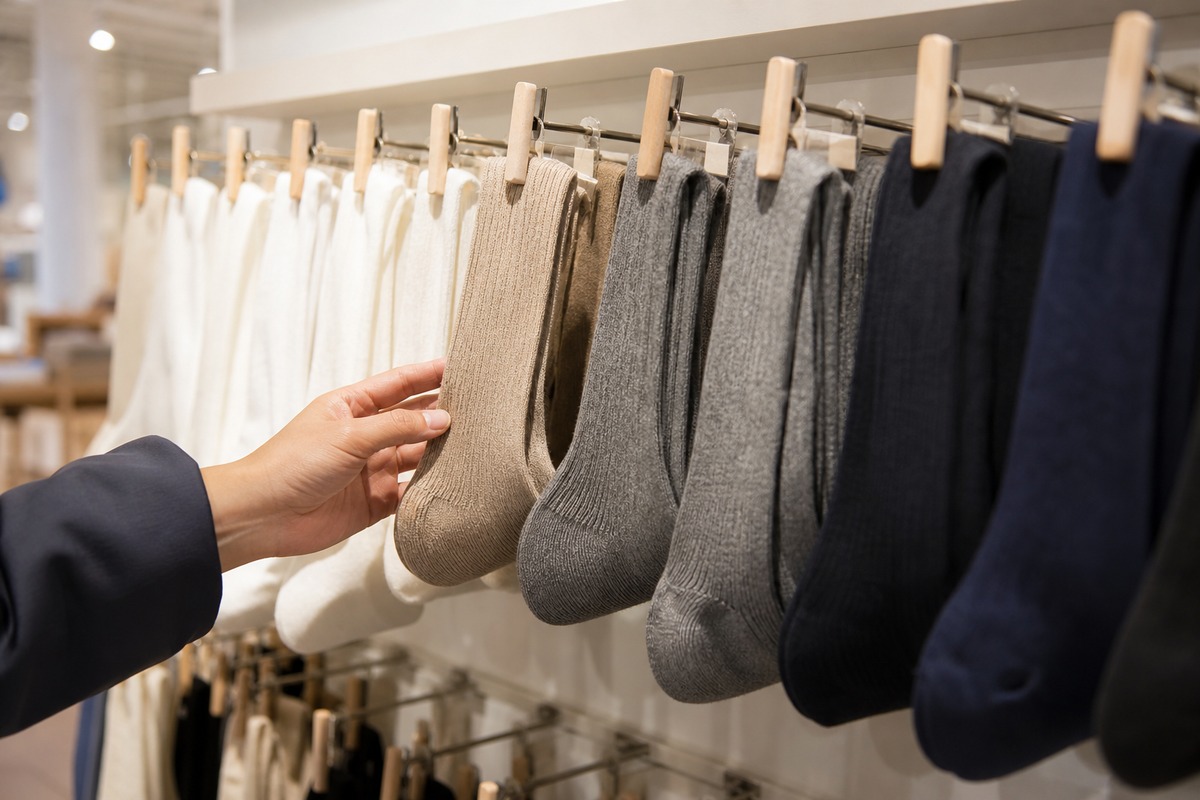
In October, Uniqlo, the flagship chain of Fast Retailing, announced price increases across parts of its clothing range. On 16 October the company announced the changes; on 27 October, 11 days later, it cancelled the planned sock changes amid public objections from shoppers. According to the reporting I found, the socks in question were priced at 290 yen, and the planned change would have taken them to 390 yen, an increase of 100 yen, or nearly 35% on the pair. Nikkei Asia’s coverage described the cancelled move as a planned 10 November increase on a colour socks line.
Fast Retailing’s explanation is the most revealing part. The company said that socks are an essential everyday item and that, in Japan, it had reconsidered the planned price revision. That is a notable sentence from a company that has spent years teaching the market that it can raise prices on jackets, fleeces and knitwear and still hold its customers. Uniqlo did not say its costs had fallen. It said the product category was too basic, too frequently bought and too visible to the shopper’s sense of a fair price.
The reversal was broader than the headline price. According to Japanese trade coverage, the original announcement had also ended Uniqlo’s multi-pair sock deals, such as four colour pairs for 990 yen, from 10 November. That would have raised the effective cost of buying four pairs by roughly 58%. The cancellation covered both the price change and the end of the multi-buy offers, and the company apologized for reversing so soon after the original notice. Price increases on other items, such as its jackets, were reported to go ahead.
Why does this one reversal carry so much weight? Because it comes from Uniqlo. Uniqlo is not a fragile discounter. It is a global brand with a reputation for operational discipline, and it has been one of the few Japanese consumer companies seen as having real pricing power. When a company with that standing steps back from a 100-yen increase on a basic item, other managers read it as a signal. If Uniqlo cannot move a sock, they ask, what can a mid-sized restaurant chain or a regional food manufacturer do?
I think the more useful interpretation is narrower. Uniqlo did not abandon price increases. It reversed one category, where the pushback was strongest, and kept its other adjustments in place as far as the reporting shows. That is a lesson in segmentation: the same shopper who accepts a higher price on a winter coat will resist it on a product bought without thinking, every few months, as part of a routine. Price tolerance in Japan is not a single dial. It is a set of separate dials, one for each category, and the dials for routine purchases are the most sensitive.
The Apology Economy
The sock reversal was not an isolated event. It sits alongside a smaller, quieter and in some ways stranger story: companies in Japan apologizing for raising prices.
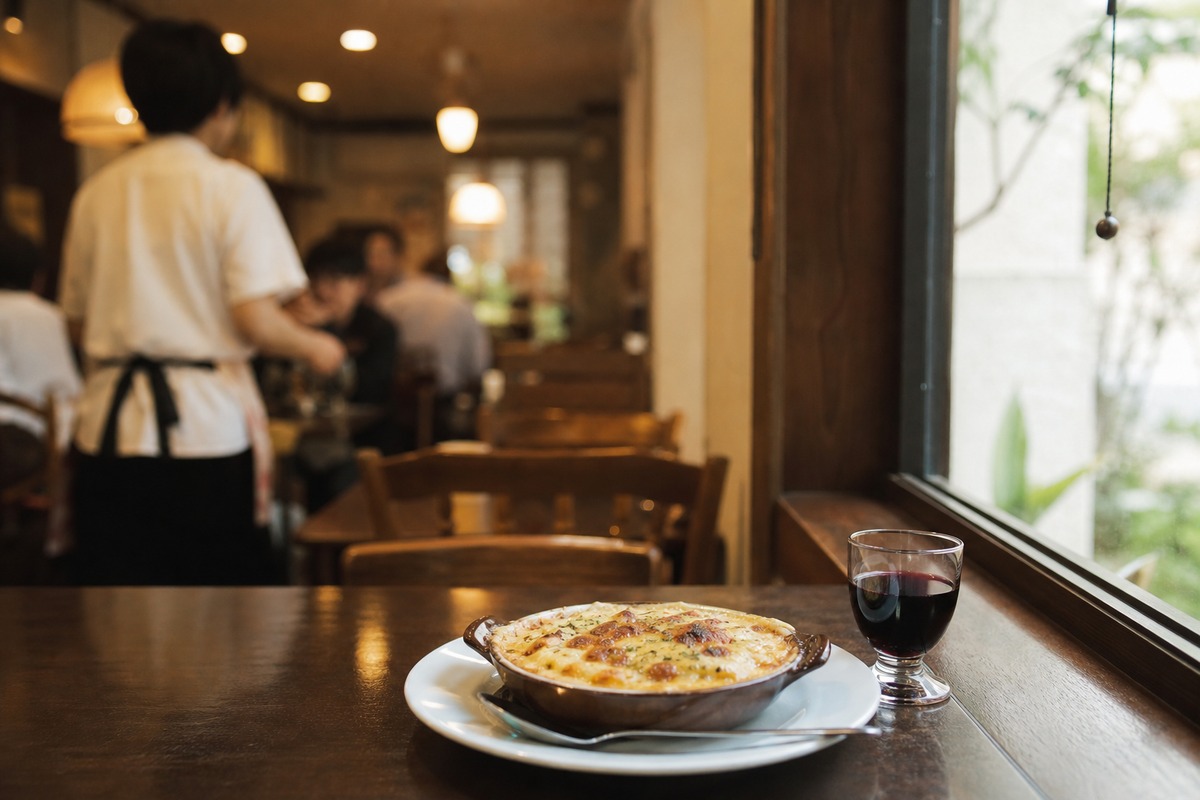
AFP’s recent reporting on the subject, carried widely under a headline about how price hikes are a tough sell in Japan despite inflation, described how Saizeriya, the budget Italian-style family restaurant chain, raised the price of its Milanese-style Doria, a baked rice dish with a cream and meat sauce, by 20 yen and publicly apologized. According to the report, the chain cited insufficient efforts on its own part. The increase affected nearly all of its menu, but the glass of wine at 100 yen was left unchanged, with the company saying it wanted people to be able to enjoy it casually.
Read that again, because it is a remarkable piece of corporate communication. A 20-yen increase, a sum most customers would barely notice, came with an apology, a statement about the company’s own shortcomings and a deliberate decision to protect one anchor item. That wine is a symbol. It is the thing a customer can point to and say that the restaurant still keeps its promise to me.
The same AFP piece quoted a ramen shop owner who said she would rather absorb rising costs than announce a large increase to her regulars. I will not reproduce her words, but the sentiment will be familiar to anyone who has spent time in Japanese neighbourhood restaurants. Many small operators, particularly outside the big cities, treat their prices as a relationship with customers rather than a number on a spreadsheet. Raising them feels like breaking something.
I want to add a note of first-person observation here. In my experience, the apology is rarely only theatre. Japanese managers who apologize for a price increase are often signalling two things at once. One is genuine discomfort, a sense that an unwritten social contract is being strained. The other is a calculated message to the customer: we know this is not ideal, we are not doing it casually, and we have protected what matters most. The apology buys goodwill. Whether that goodwill is enough to hold volumes depends on what the next data release shows.
That tension is exactly what makes the current moment difficult to read. Inflation is real. The Bank of Japan has been moving away from its long period of ultra-loose policy, and consumer prices have run above its 2% target. Teikoku Databank has counted more than 20,000 food and drink items with price increases in 2026. A company in this environment does not have a free choice about whether costs rise. It only has a choice about how, where and when to pass them on. The apology is a way of managing that choice in public.
September’s Spending Plunge: Read the Number Carefully
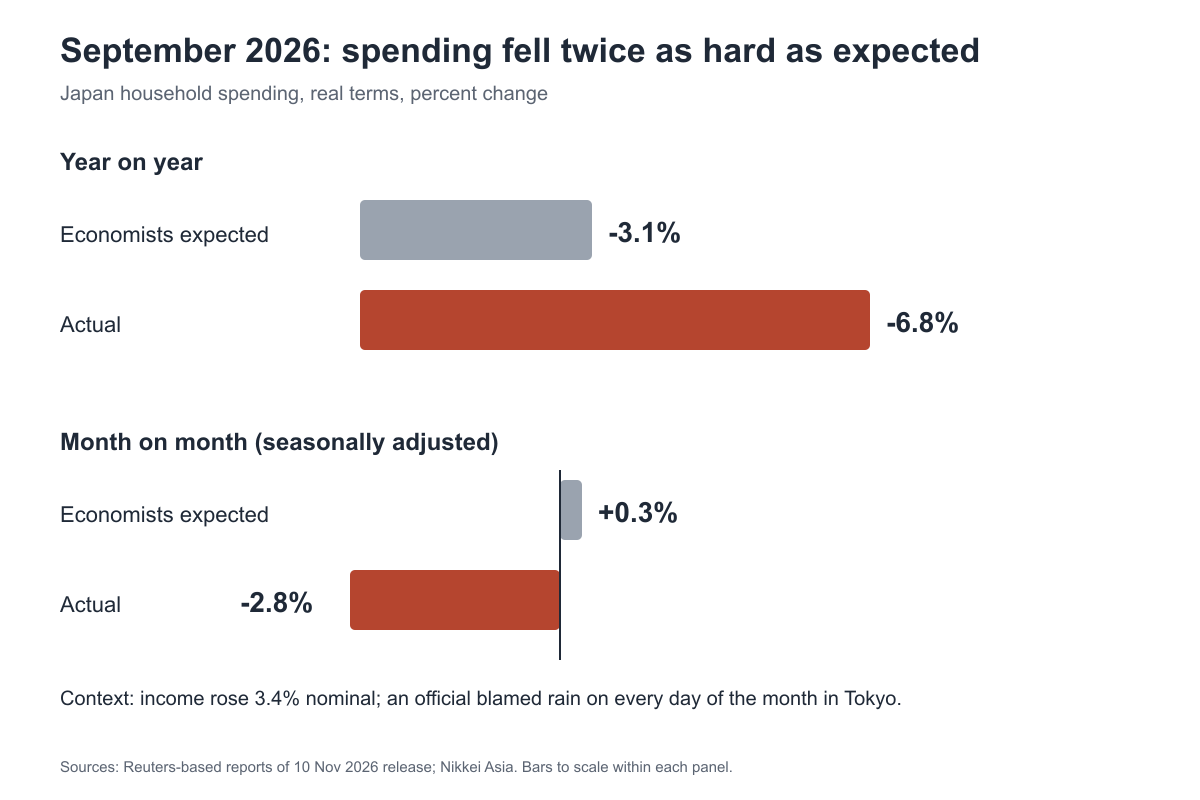
On 10 November 2026, Japan released its household spending data for September. The headline number was ugly. According to Reuters-based reporting and several other outlets, spending fell 6.8% from a year earlier in real terms, far worse than the 3.1% decline economists had expected. Reuters described it as the biggest fall since September 2020, and Nikkei Asia described it as the largest drop since the pandemic. On a seasonally adjusted monthly basis, spending fell 2.8%, against expectations for a small increase of about 0.3%. Reporting also described it as the tenth straight year-on-year decline.
Before drawing sweeping conclusions, three other facts from the same coverage are essential.
First, an internal affairs ministry official blamed poor weather for much of the slump. According to the reports I found, Tokyo recorded precipitation on every single day of September for the first time in history. When it rains every day, people go out less, and spending on dining out, entertainment and shopping suffers. That is a real, temporary factor.
Second, the figure comes alongside rising incomes. One report put household income up 3.4% in nominal terms and 0.9% in real terms from a year earlier. In other words, people were not poorer in a simple sense. They were earning slightly more and spending much less.
Third, the spending figure is an inflation-adjusted measure. One outlet cited a nominal decline of 4.5%. So both the real and nominal figures were negative, which means the drop is not just an artefact of how prices are measured.
My reading is that September was a bad month for two overlapping reasons, one of which will fade and one of which may not. The weather will normalize. The behavioural signal underneath it, a consumer who is earning a bit more but is increasingly careful about what to spend on, is the part worth watching. The Bank of Japan, which held its policy rate at 1.25% in October, is widely expected to consider a rate increase in December, and economists quoted in the coverage noted that weak consumption is a headwind for that plan, though not necessarily a decisive one.
One more data point from the same period supports the cautious-shopper story. The Thomson Reuters/Ipsos Primary Consumer Sentiment Index slipped to 37.67 in November from 38.96 in October. That is a modest move and I would not read too much into a single month, but the direction is consistent.
For operators, the practical point is that a single bad month should not lead to panic. The real question is whether the next two or three releases show a recovery once the weather effect drops out. If spending stays weak in October and November, the story shifts from a rainy month to price fatigue.
Convenience Stores: Fifteen Months of Fewer Customers
If September’s spending number is noisy, the convenience-store data is not. It is one of the cleanest long-run signals of how Japanese shoppers are behaving.
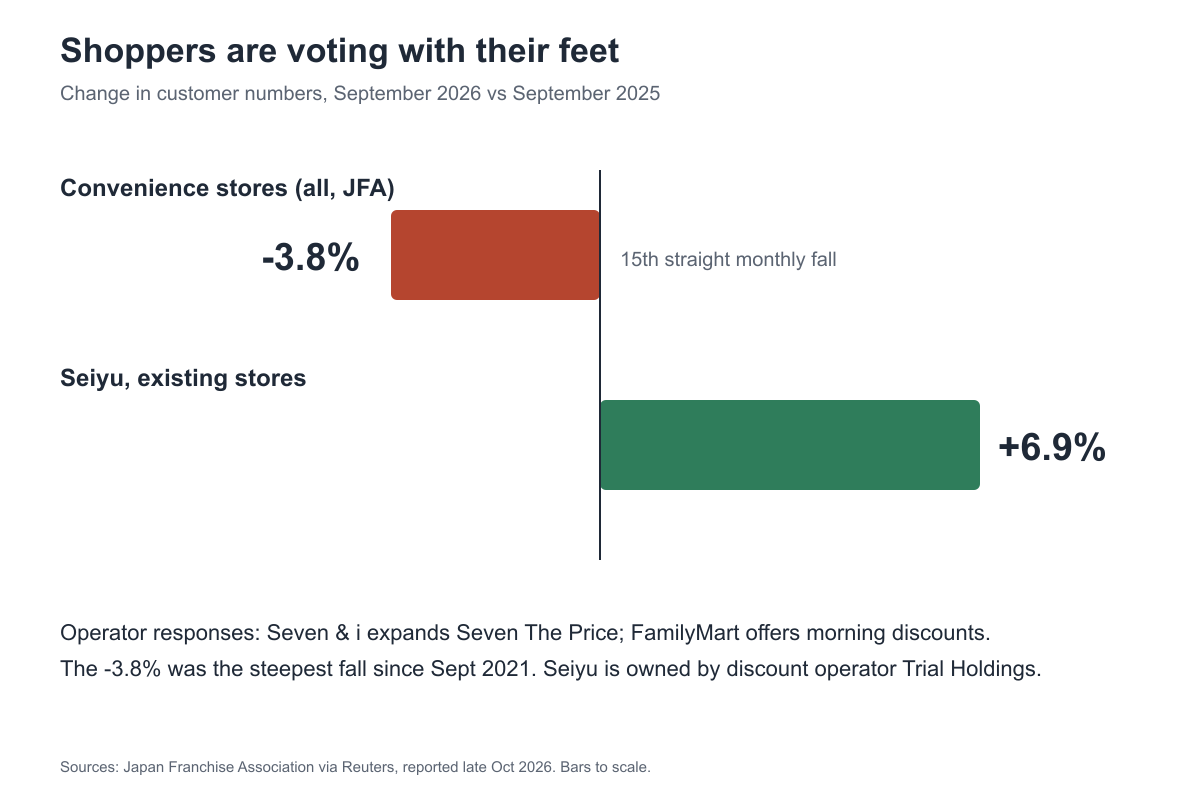
According to figures from the Japan Franchise Association, as reported by Reuters, same-store customer visits at convenience stores fell 3.8% year on year in September. That was the 15th consecutive monthly decline and the steepest fall since September 2021. For a format that built its reputation on being an essential, always-open part of daily life, that is a long and persistent slide.
The reporting points to a specific competitive reason. Shoppers are shifting toward discount supermarkets as inflation pushes everyday costs higher. Seiyu, the supermarket chain acquired last year by the discount operator Trial Holdings, recorded a 6.9% year-on-year increase in customer numbers at existing stores in September. In the same month, the convenience-store category lost almost four percent of its visitors. Those two figures move in opposite directions, which is consistent with a shift toward discount supermarkets: the same shopper who used to pop into a convenience store for lunch and a drink now plans a cheaper trip to a supermarket.
The operators are responding in recognizable ways. Seven & i is expanding its Seven The Price private-label range, a lower-priced line positioned as everyday value. FamilyMart has offered morning discounts to pull in commuters. The reporting also notes Trial’s small-format Trial GO stores in Tokyo and Aeon’s expansion of its My Basket small-store chain, both of which put discount-oriented grocery in the exact neighbourhood locations where convenience stores used to have an advantage. I could not confirm the details of those two store programs beyond what Reuters reported, so I would treat their scale as unknown.
I find this section of the story the most strategically important for international readers. The convenience store is Japan’s most sophisticated retail format, the one that foreign visitors photograph and imitate. The idea that it is losing traffic for 15 months because of price sensitivity is a signal that even the most efficient retail machine in the country cannot fully offset a consumer who has started to trade down. If you are launching a premium snack, a novelty drink or a limited-edition product built around convenience-store distribution, you should ask whether the people walking into those stores are the same people who were walking in two years ago.
Where the Money Still Goes: Department Stores
The picture is not uniformly gloomy, and any honest read has to include the other side.
Lux Research Japan’s weekly luxury report for the week of 4 November 2026 noted that the flash results for October at the major department store groups were strong. Isetan Mitsukoshi, Takashimaya, Daimaru Matsuzakaya and Hankyu Hanshin all beat last year’s October flash figures, and Isetan Mitsukoshi’s October sales were up 12.4%. These are preliminary flash numbers, and I would not extrapolate from them, but they show that demand at the top of the market behaves differently from demand in the middle and bottom.
This is the pattern economists describe as a two-speed or K-shaped consumer economy, and I have written about a version of it in an earlier issue on Japan’s two-speed fashion market. Wealthier households, and inbound visitors with strong purchasing power, keep spending on luxury, food-hall gifts and high-end goods. Price-sensitive households trade down in groceries, apparel basics and everyday convenience purchases.
For an international brand, the implication is that positioning is destiny. A product priced and presented as a premium experience can behave as if there is no spending problem. A product priced as an ordinary everyday good competes against a shopper who is now carefully comparing options. The worst position is the middle: a product that is a little more expensive than the mass alternative without giving the customer a clear reason to pay more.
Why Japan Treats a Price Rise as a Moral Event
To understand the apologies, you have to understand how unusual the last few years are.
For roughly three decades, Japan lived with falling or flat prices. A generation of shoppers learned that prices did not rise, and a generation of managers learned that raising them was dangerous. Companies competed by shrinking packages, changing recipes and quietly removing features rather than by moving the sticker price. The result was an economy where a basic bowl of noodles or a pair of socks cost about the same as it did when the shoppers were students.
That world is now ending, but the habits are not. The Bank of Japan has been normalizing policy, wages have risen at the large companies, and food and daily-service prices have climbed. But a consumer’s sense of what is fair changes more slowly than the data. When a company raises a price today, the customer is not comparing it only with last month. They are comparing it with a reference point formed over decades.
That is why I describe price rises in Japan as moral events as much as commercial ones. In many markets, a company that raises prices is seen as responding to its costs. In Japan, an increase can be seen as a failure of the company’s effort. Saizeriya’s apology, with its reference to insufficient efforts, is a direct acknowledgement of that standard. The company is saying that it tried to hold the price, that it failed and that it knows the customer expected better.
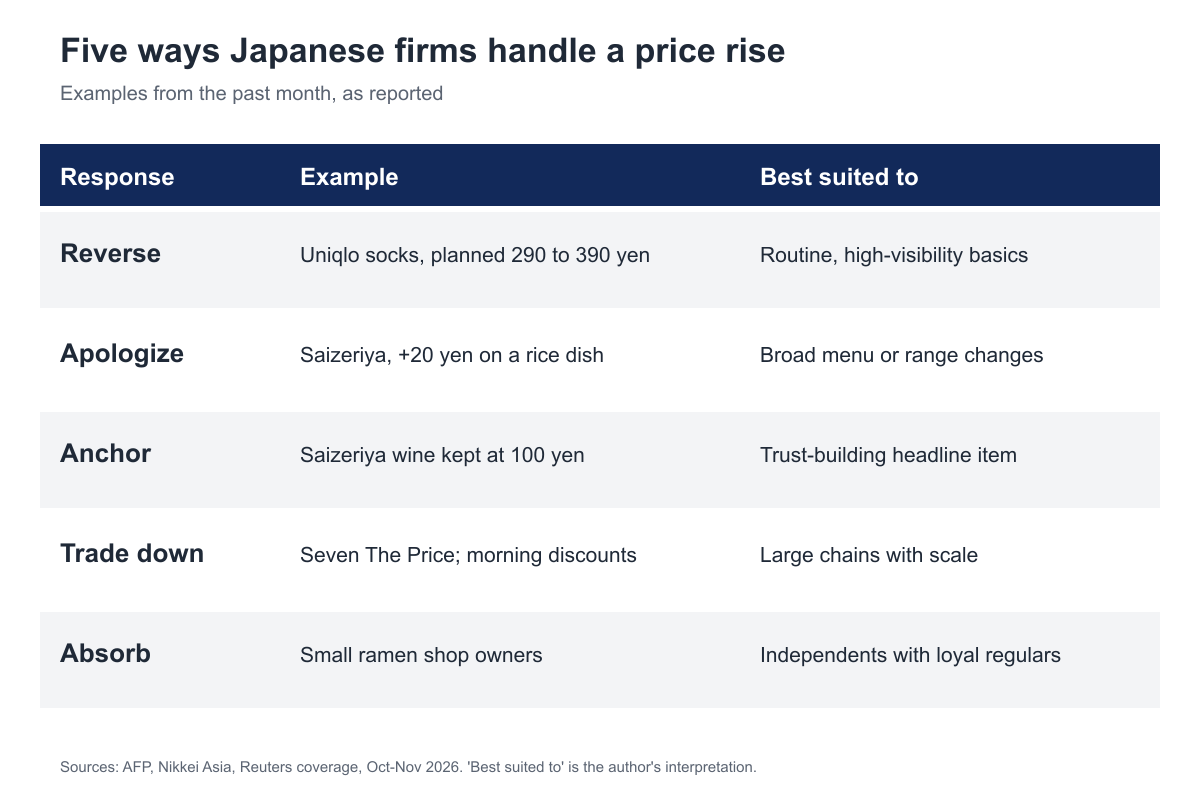
There is a practical way to see how Japanese firms are handling the pressure. In the recent examples, I count five distinct responses: reversing the increase where pushback is strongest, apologizing for increases that go ahead, protecting a visible anchor item, offering lower-priced alternatives for shoppers who trade down, and absorbing the cost entirely, which is common among small independent shops. Each has a different cost, and each suits a different type of business.
What to Do If You Sell Into Japan
Here is how I would translate this moment into action for an international operator. These are my own recommendations, based on the events above and two decades of watching this market, not guarantees.
Segment your price moves by purchase frequency. The sock episode shows that high-frequency, low-ticket items are the most sensitive to price change. If you have to raise prices, prioritize items that are bought rarely, have clear quality differentiation or are given as gifts. Be cautious with staples.
Protect one visible anchor. Saizeriya’s 100-yen wine is a model. If you must raise most of a range, keep one item at the old price and make that choice visible. The anchor does not have to be profitable on its own. Its job is to preserve trust.
Explain the reason, plainly and early. Japanese consumers respond better to a clear, respectful explanation of why costs have risen than to a silent change. Where possible, announce changes in advance, name the cost drivers honestly and avoid language that sounds like a marketing campaign.
Remember that quiet changes count too. Ending a multi-buy deal is, in effect, a price increase, and Uniqlo’s reversal covered exactly that. Shoppers notice thresholds, pack sizes and promotion calendars as much as sticker prices.
Build a trade-down option before you need one. Seven & i’s private-label expansion and FamilyMart’s morning discounts show that even the largest players are building lower-priced paths for customers. If your product has no entry-level version, a competitor will supply one.
Watch channel shifts, not just prices. The 15-month convenience-store decline and the gains at Seiyu suggest that where shoppers go matters as much as what they pay. If your distribution is concentrated in convenience stores, test supermarket and discount-grocery channels now, rather than waiting for the numbers to force the issue.
Wait for two more data points before changing strategy. September’s spending drop has a weather explanation. If October and November show a recovery, the structural story is weaker than the headlines suggest. If they do not, treat price fatigue as the base case for the first half of next year.
Frequently Asked Questions
Q. Did Uniqlo cancel all of its price increases?
A. No. Uniqlo announced the changes on 16 October and cancelled the sock price rise, from 290 yen to 390 yen on its colour socks, and the end of its multi-pair sock deals on 27 October. Increases on other items, such as jackets, were reported to go ahead.
Q. How bad was Japan’s household spending in September 2026?
A. Real household spending fell 6.8% from a year earlier, against an expected decline of 3.1%, and fell 2.8% from the previous month on a seasonally adjusted basis. An official blamed bad weather, with rain recorded in Tokyo on every day of the month. Household income rose in the same period, so the figure reflects cautious spending rather than falling incomes.
Q. Are convenience stores in trouble in Japan?
A. Customer numbers at convenience stores fell 3.8% in September, the 15th straight monthly decline, according to the Japan Franchise Association as reported by Reuters. Operators are responding with private-label ranges and promotions, but they are losing shoppers to discount supermarkets. It is a sign of strain, not collapse.
Q. Is every part of Japan’s consumer market weak?
A. No. Flash figures for October show strong sales at major department stores, including a 12.4% increase at Isetan Mitsukoshi, according to Lux Research Japan. Demand at the premium end appears healthier than demand for everyday goods.
Q. What should a foreign brand do about pricing in Japan right now?
A. Raise prices cautiously and selectively, avoid touching high-frequency staples, keep a visible anchor item at its old price, explain increases clearly and consider adding an entry-level option. Test discount-grocery channels if you rely heavily on convenience stores.
Conclusion
The sock that Uniqlo could not reprice, the doria that Saizeriya apologized for and the convenience stores that have lost customers for 15 months are three views of the same thing. Japan has inflation, but it does not yet have an easy relationship with price increases. The September spending slump is partly a weather story, and I would not read it as a collapse. But the pattern around it is consistent: shoppers are earning slightly more, watching every purchase, and moving toward the channels and brands that make them feel they are not being squeezed.
For international operators, the lesson is to treat price as a relationship rather than a number. Move carefully where the shopper is most sensitive, protect something visible, explain what you are doing and give price-sensitive customers somewhere to go. In a market where a 100-yen change can be reversed in 11 days, how you raise a price can matter as much as whether you do.
This article contains affiliate links. If you purchase through these links, we may earn a small commission at no extra cost to you.
If you’re interested in this topic, the Japanese market more broadly, or what KETCHUPs is working on, we’d love to hear from you — please reach out via our contact form.
Japan Market Pulse is a weekly read on what the Japanese consumer-tech, food, and mobility markets are choosing to do, written for international operators who want to know what is happening before it shows up in the global trade press.
Subscribe at ketchups.co/japan-market-pulse.