
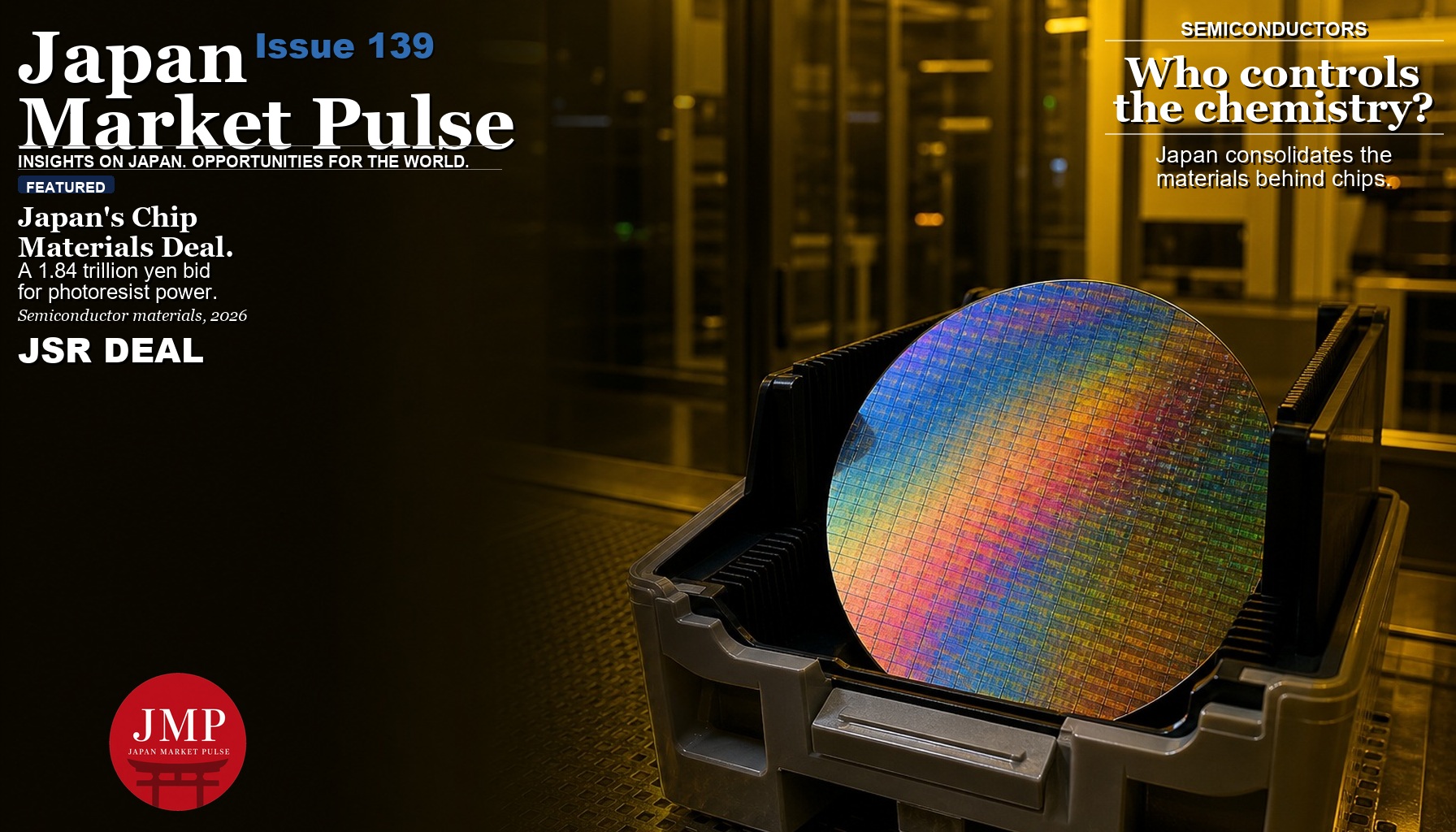
On 9 November 2026, Mitsui Chemicals agreed to buy JSR, one of the world’s two largest photoresist makers, in a deal valued at about ¥1.84 trillion, or roughly $11.6 billion. It is the biggest chemical-industry acquisition in Japan’s history, and the seller’s own president says it is meant to be a starting point for more. For anyone who depends on Japanese materials, the quiet part of the semiconductor supply chain just changed shape.
After twenty years in Japan, I have learned to read Japanese corporate news the way you read weather. Most days it is mild and incremental. Every so often the pressure drops, and you know something larger is moving. This week was one of those moments. Mitsui Chemicals announced that it would acquire JSR, the Tokyo-based maker of photoresists and other semiconductor materials, for a headline price of about ¥1.84 trillion. The figure is roughly $11.6 billion, though that conversion is an approximation and will move with the yen.
Most coverage of the global chip industry still focuses on the glamorous end: fabs, lithography machines, export controls and the race to build capacity in Arizona, Dresden, Kumamoto and Hsinchu. But every one of those factories runs on chemicals, wafers and masks that arrive from somewhere else, and a surprising amount of that somewhere is Japan. This deal is a window into how Japan intends to protect and sharpen that position.
This article walks through what was announced, what JSR actually does, why a government-backed fund and a state development bank are in the picture, where Japan sits in the semiconductor materials chain, what the risks look like, and what international operators who buy, sell or compete in this space should take from it.
What Was Announced
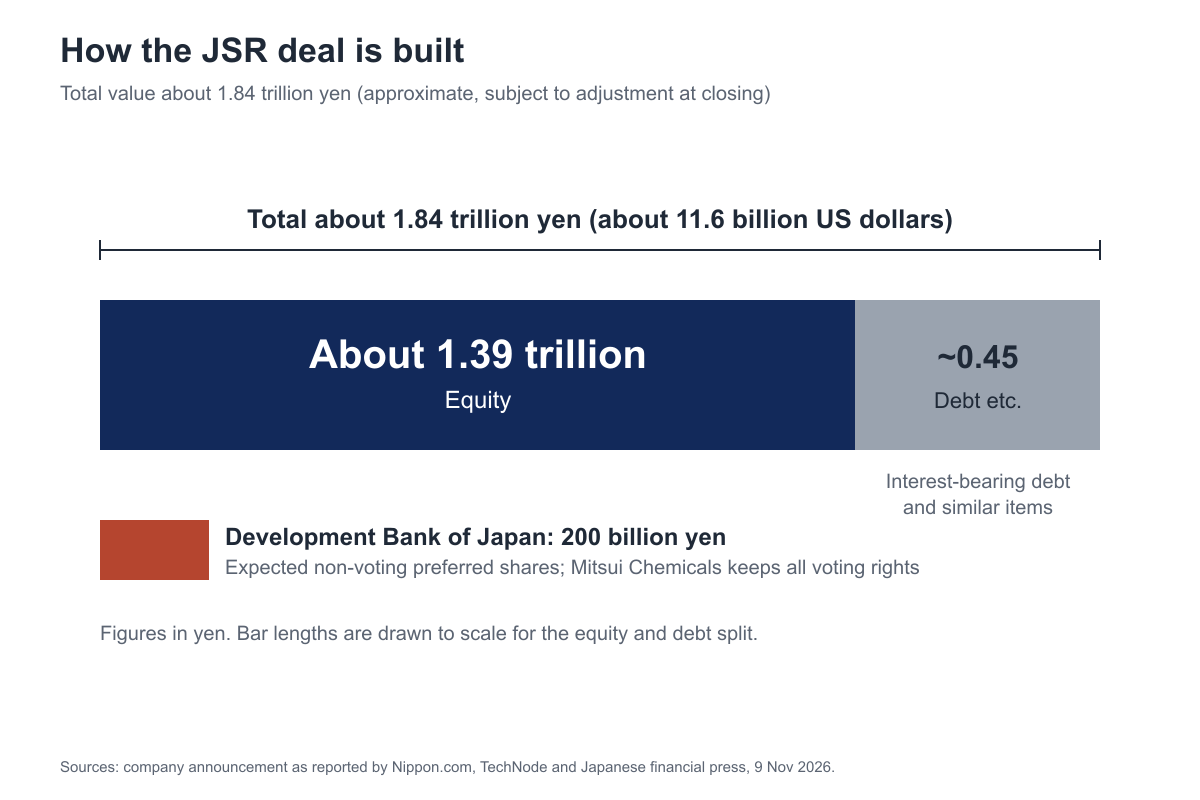
The core terms, as reported by the company and by Japanese and international financial press, are as follows. Mitsui Chemicals signed a share purchase agreement with funds managed by JIC Capital, which is part of the government-backed Japan Investment Corporation. Those funds took JSR private in 2024, so this is a sale after roughly two years of state-backed ownership. The total value is about ¥1.84 trillion, made up of roughly ¥1.39 trillion for the equity and a little under ¥450 billion of interest-bearing debt and similar items that come with the company. The final consideration is subject to adjustment at closing.
The structure is unusual. The Development Bank of Japan, a government-owned lender, will put in ¥200 billion alongside Mitsui Chemicals. After completion, the bank’s stake is expected to be held as non-voting preferred shares, which means Mitsui Chemicals keeps all of the voting rights and consolidates JSR as a subsidiary. In effect, the state is providing patient capital without taking control.
On timing, the companies are aiming to close in the second half of the fiscal year ending March 2028, so roughly late 2027 into early 2028. Completion depends on competition and foreign-investment approvals in Japan and other jurisdictions, and the company has said the schedule could shift with regulatory procedures. Given how sensitive semiconductor materials are, I would not assume that those reviews will be quick or trivial.
What JSR Actually Makes
JSR is not a household name outside the industry, and that is rather the point. Its best-known product is the photoresist, a light-sensitive coating that chipmakers apply to a silicon wafer before exposing it to patterned light. The areas that are exposed become soluble or insoluble, and the pattern of the circuit is carved into the surface. A modern chip can pass through this step dozens of times. If the resist is not consistent, the yield of the whole production line suffers.
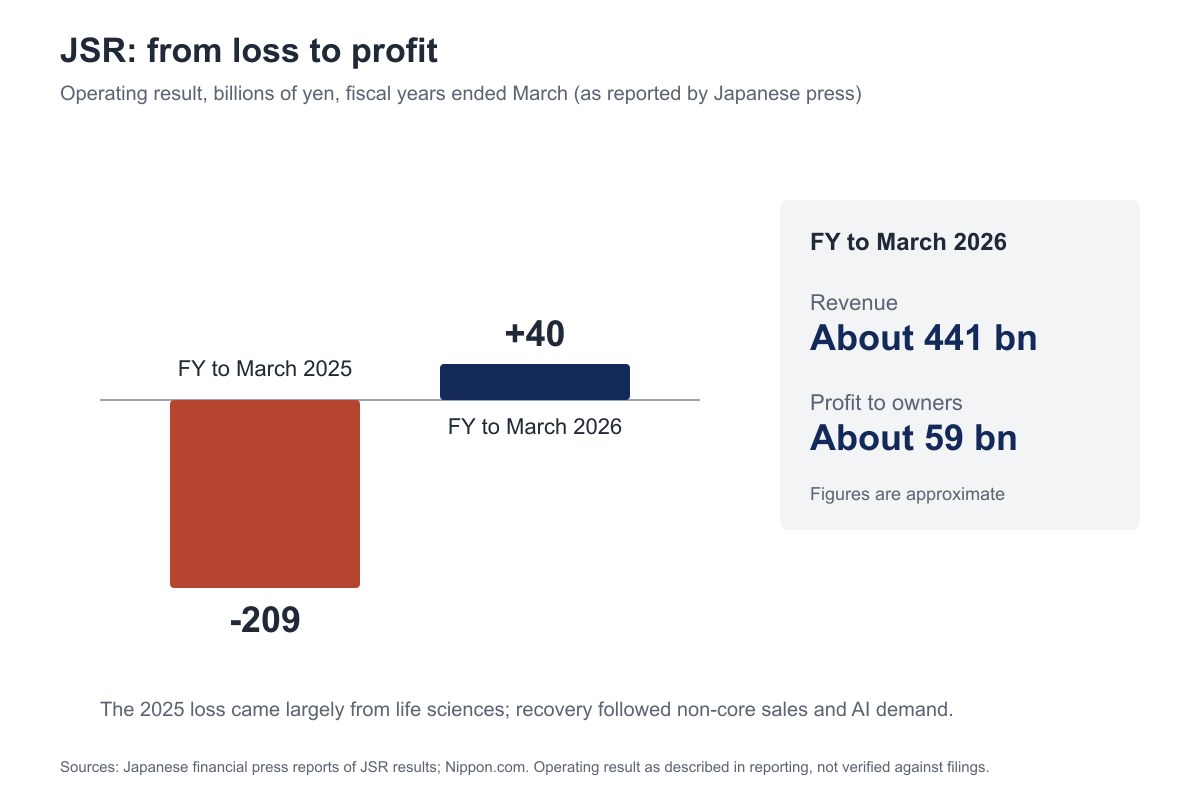
Japanese press describes JSR as the world’s number two photoresist maker, behind Tokyo Ohka Kogyo. The company also owns Inpria, a US developer of metal-oxide resists for extreme ultraviolet lithography, which is the technology used for the most advanced chips. JSR operates in Japan and South Korea and supplies chipmakers around the world. For the year that ended in March 2026, it reported revenue of about ¥441 billion and profit attributable to owners of about ¥59 billion.
The recent history is worth knowing, because it explains the seller’s willingness. After the 2024 take-private, JSR went through a rough patch. Japanese reporting says its operating result swung to a loss of about ¥209 billion in the year to March 2025, largely because of weakness in its life sciences business. It then recovered to an operating profit of about ¥40 billion in the year to March 2026 as it sold non-core units and as AI-related demand lifted its semiconductor materials. The buyer is therefore purchasing a business that has been restructured and is pointing in the right direction, but not a company with a long record of smooth earnings.
Why Mitsui Chemicals, and Why Now
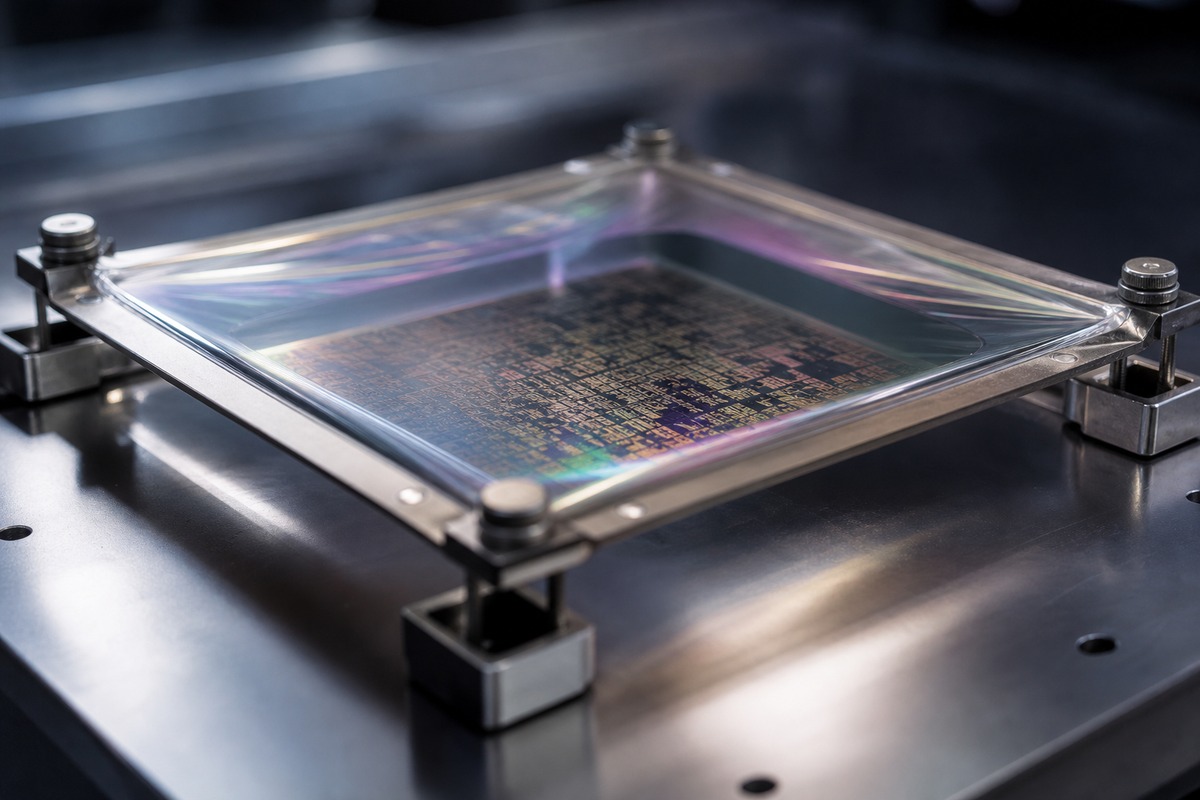
Mitsui Chemicals is a broad chemical group, and in semiconductors it already has a strong but narrow position. It is reported to be the world’s leading maker of pellicles, the ultra-thin protective membranes that sit over a photomask to keep dust off the master pattern. That is an essential product, but a niche one. Mitsui Chemicals’ president, Satoshi Ichimura, was reported as saying that the company needed a broader product line. JSR fills that gap. The company says it plans to combine JSR’s photoresists with its own pellicles and thick-film resists, and to make JSR the core of its ICT solutions business.
Mitsui Chemicals has also set an internal target of about ¥40 billion in additional annual profit from the combination by fiscal 2035. That is a company goal, not a guarantee, and integrations of this size have a way of delivering less than the slide deck promises, or at least later. Treat the number as an indication of ambition rather than a forecast.
The sale process itself is revealing. According to Japanese reporting, several companies approached the seller in the spring, and JIC Capital talked to seven or eight of them. The head of JIC Capital, Shogo Ikeuchi, said the buyer was chosen after weighing policy significance, the feasibility of future industry consolidation, economic terms, financial health and investment capacity. In other words, price was one factor among several, and the question of who could build a platform came first.
The Consolidation Logic
The policy subtext is plain once you read the language. Mr. Ikeuchi described the aim as using this integration as a starting point to link up with other Japanese materials makers and reorganise the industry, with the goal of building a world-class semiconductor materials platform. Japan’s semiconductor materials sector is strong but fragmented. It is made up of a large number of specialised companies, each excellent in a narrow area, often with much smaller revenues than the global chipmakers and equipment makers they supply.
That fragmentation has a cost. A supplier with limited scale has less capacity to fund research into the next generation of materials, less negotiating power with a handful of very large customers, and less ability to offer a bundled package of products.
I would be cautious about reading too much into this. A single deal is not yet a restructuring of an industry, and “a starting point” is a statement of intent, not a plan with names attached. Still, the combination of a government-backed seller, a state bank as co-investor and a stated desire to bring in other domestic players suggests this is meant to be the first of several moves, not an isolated transaction.
Where Japan Sits in the Materials Chain
To understand why this matters outside Japan, it helps to see how concentrated the upstream supply chain is. Industry sources vary in their figures, and I have not been able to reconcile them against company filings, so the following should be read as approximate.
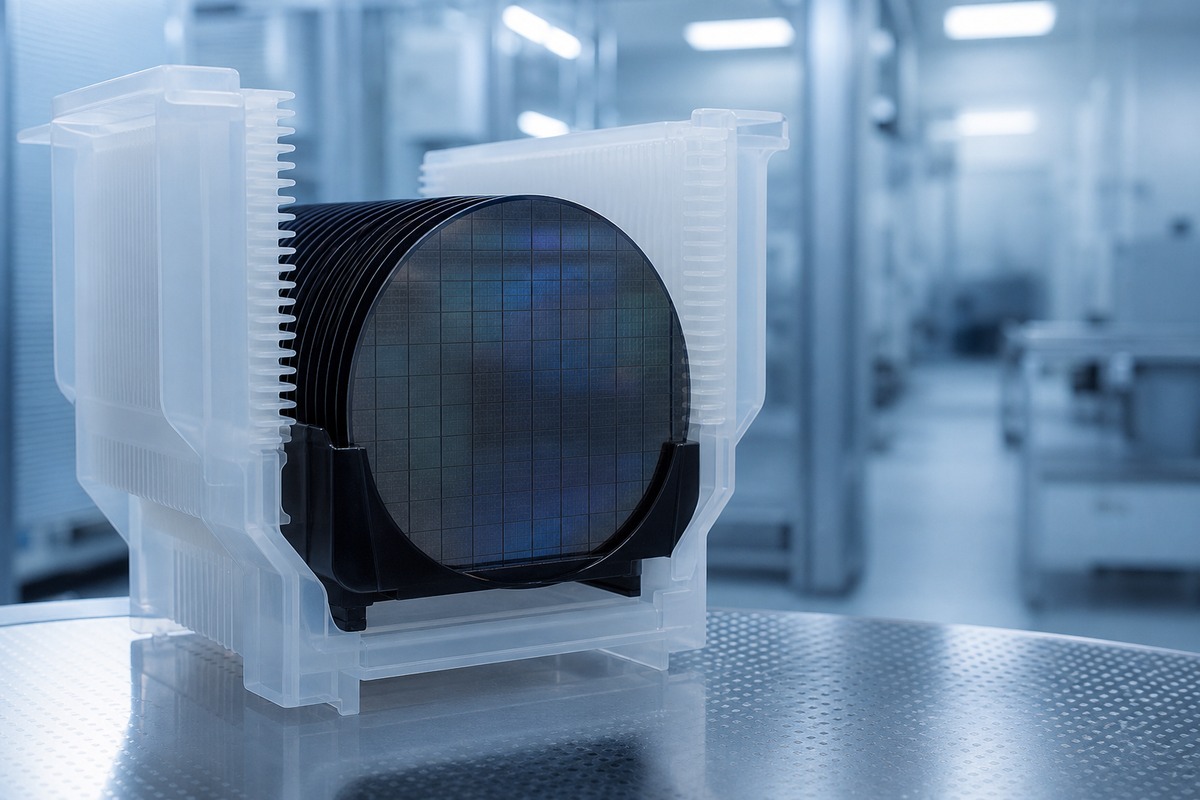
In silicon wafers, the base on which chips are built, two Japanese companies, Shin-Etsu Chemical and SUMCO, are generally described as holding around half of the global market between them. Some sources put the combined share higher, and the exact number depends on how the market is defined. In photoresists, Japanese makers including Tokyo Ohka Kogyo, JSR, Shin-Etsu Chemical and Fujifilm are described in industry reports as holding a large majority of the world market, with estimates running from above 70 percent to as high as 90 percent. In photomask pellicles, as noted above, Mitsui Chemicals is reported to lead.
Those are not small niches. They are the points in the chain where a product has to be extremely pure, extremely consistent and qualified through months of testing before a chipmaker will accept it. Once a resist or wafer is qualified on a line, the customer does not want to change it. That stickiness is why Japanese materials companies often hold their positions for decades, and why a change in ownership or strategy at one of them is worth watching closely.
The Money and the Risks
The financing shows how big this is for Mitsui Chemicals itself. The company has arranged a bridge loan of about ¥1.64 trillion from its main lenders, and it says its ratio of net debt to core earnings is expected to temporarily rise above four times after completion. It plans to refinance through bank loans, bonds and equity, including a shelf registration covering up to ¥150 billion of new shares, and it is considering mezzanine financing that rating agencies may partly treat as equity. Japanese reporting also says the company will freeze further large acquisitions while it digests this one.
The market did not applaud. Reuters-based reports said Mitsui Chemicals shares fell by roughly 8.5 percent on the day of the announcement, and Japanese business press described the drop as reflecting concern about the financial burden. One Japanese business magazine’s headline even cast the company’s leadership as a self-described poor acquirer, which is candid, if not exactly reassuring to shareholders.
Several risks are worth naming. The first is integration: combining two proud, technically sophisticated organisations without losing the engineers who hold the process knowledge is hard. The second is leverage: a debt load that high leaves less room to absorb a downturn in chip demand, and semiconductor cycles are famously sharp. The third is regulatory: approvals in several jurisdictions could add conditions or delays, especially in the current climate of scrutiny over chip supply chains. The fourth is customer response: some chipmakers may be pleased with a more stable supplier, while others may worry about concentration or about a supplier that is distracted. None of these is a reason to think the deal will fail. They are the reasons to expect a long road from announcement to results.
What This Means for International Operators
For readers outside Japan, the practical implications depend on where you sit in the chain. Here is how I would think about it, separating what is known from what is not.
If you are a chipmaker or a fab operator that buys photoresists, treat the next 18 months as a period to keep an eye on your supplier relationships. Nothing about your existing qualified products changes on the day of signing, and the buyer has every commercial reason to keep customers comfortable. But a change of owner often brings a review of product lines, pricing and where production sits. It is sensible to ask your account teams how the integration is expected to affect supply commitments, second sourcing and roadmaps for next-generation resists, and to get those answers in writing where you can.
If you run procurement or supply-chain risk for a company that uses advanced chips, the deal is a reminder that your exposure to Japan is deeper than the names on the chip. A bigger Japanese materials group could be more resilient and better funded for research. It could also be a more concentrated single point of failure for the same materials. Both statements can be true, and the right response is to map which of your critical inputs trace back to a small number of Japanese suppliers.
If you make materials or specialty chemicals and compete with Japanese firms, the message is that scale and breadth are becoming a weapon. Customers increasingly want a partner that can cover resists, pellicles, cleaning chemicals and other consumables with a single qualification effort. A mid-sized specialist should think about whether to focus even harder on a defensible niche or to find a partner. There may also be an opening: if Japan’s own sector reorganises, some suppliers and engineering teams could become available for partnership or hiring.
If you are an investor or a business-development lead looking at Japanese targets, the sale process shows that the seller is thinking about who owns strategic assets, not only how much they pay. Foreign buyers should expect that any approach to a critical materials company will be judged on policy significance as well as price, and should plan for a long review period. Partnerships, long-term supply agreements and joint development are likely to be more welcome than outright control.
What I Am Not Saying
It is easy to over-read a story like this, so a few limits are worth stating. I do not know whether other Japanese materials companies will join this group, and the public statements do not name any. I have not verified market-share numbers against company filings, and the figures vary between sources. I cannot tell you how customers will react or how regulators will rule. The yen-to-dollar conversion is an approximation. And the profit target for fiscal 2035 is the company’s own goal. What is firmly established is the deal itself: the parties, the price range, the structure and the intended timeline.
Frequently Asked Questions
Q. Who is buying whom, and for how much?
A. Mitsui Chemicals is buying JSR from funds managed by JIC Capital, with the Development Bank of Japan co-investing. The total value is about ¥1.84 trillion, or roughly $11.6 billion at an approximate exchange rate. That includes about ¥1.39 trillion for the equity and a little under ¥450 billion of debt and similar items, subject to adjustment at closing.
Q. When will the deal close?
A. The companies are targeting the second half of the fiscal year ending March 2028, subject to competition and foreign-investment approvals in Japan and other jurisdictions. The schedule could change with regulatory procedures.
Q. What does JSR make, and why does it matter?
A. JSR is best known for photoresists, the light-sensitive coatings used to pattern circuits on silicon wafers. Japanese press describes it as the world’s second-largest maker, behind Tokyo Ohka Kogyo. It also owns Inpria, a US developer of resists for extreme ultraviolet lithography.
Q. Does this change supply for chipmakers outside Japan?
A. Nothing changes on signing, and no supply disruption has been announced. Over the longer term, ownership changes can affect product portfolios, pricing and capacity decisions, so customers should ask their suppliers about integration plans.
Q. Is this the start of wider consolidation in Japanese materials?
A. The head of the selling fund has said he wants to use the deal as a starting point for linking with other domestic materials makers. No further transactions have been announced, so this remains an intention rather than a plan.
Conclusion
Mitsui Chemicals’ purchase of JSR is, on its face, a large corporate transaction. Underneath, it is a statement about how Japan wants to hold its place in the part of the chip supply chain that gets the least attention and has the most leverage. While much of the world competes to build factories, Japan is working to make its materials suppliers bigger, broader and better capitalised, with the state quietly providing capital but not control.
For international operators, the sensible response is neither alarm nor complacency. Map your dependence on Japanese materials, talk to your suppliers about what the integration means for you, and watch for the next move. If the seller is right that this is a starting point, there will be more deals, and the companies that understood the first one will be better prepared for the rest.
If you’re interested in this topic, the Japanese market more broadly, or what KETCHUPs is working on, we’d love to hear from you — please reach out via our contact form.
Japan Market Pulse is a weekly read on what the Japanese consumer-tech, food, and mobility markets are choosing to do, written for international operators who want to know what is happening before it shows up in the global trade press.
Subscribe at ketchups.co/japan-market-pulse.