

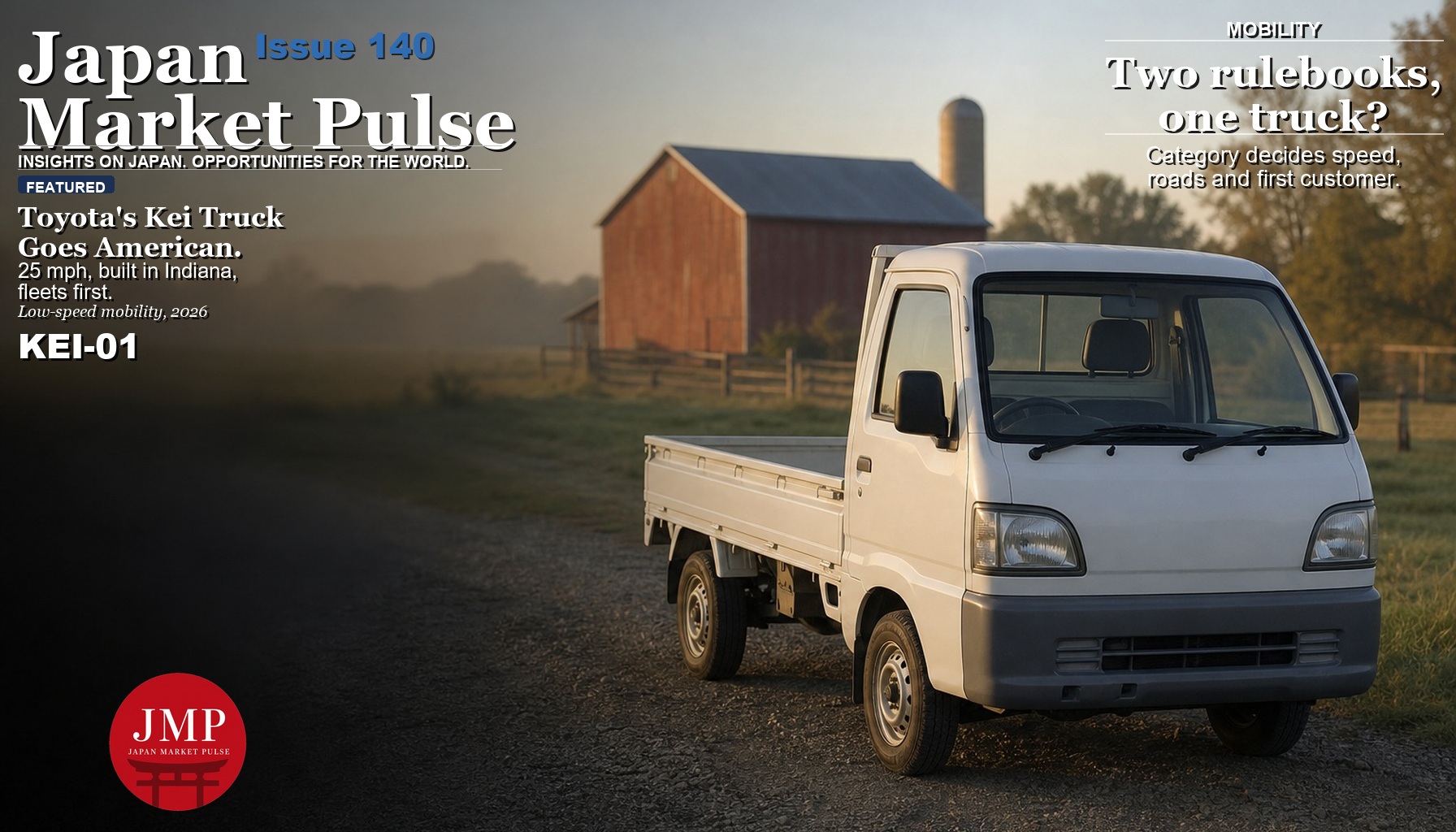
On 10 November 2026, Toyota announced that it will build an ultra-compact kei-style truck in Indiana, capped at 25 mph, under a revived Scion brand. Reuters and Bloomberg both reported it. The first buyers will be fleets, not families. Here is what is confirmed, what is not, and what it tells international operators about the gap between Japan’s small-vehicle rules and America’s.
I have lived in Japan for two decades, and the kei vehicle is the one thing I never get tired of watching. Kei trucks sit in rice-field lanes, outside bakeries and behind construction sites, doing humble work with no fuss. So when the news broke that Toyota would bring one to the United States, built in Indiana and limited to 25 mph, my first reaction was a smile. My second was a question: what exactly is being imported here, the vehicle or only the name?
The answer matters if you build vehicles, supply parts, run a delivery or campus fleet, or sell anything to people who buy small machines for practical work. This is a story about a product, but it is more a story about categories, rules and who the first customer really is.
This article is the second half of a pair. In the previous issue, I looked at Japan’s new wave of tiny electric vehicles, such as a roughly 1 million yen electric tuk-tuk and a 1.1 million yen single-seat micro-EV, and argued that the vehicle category matters more than the vehicle. Toyota’s announcement is the same argument seen from the other side of the Pacific. Here, I cover what Toyota announced, how America’s low-speed vehicle rules work, why Japan’s kei logic does not translate directly, how this relates to Toyota’s earlier micro-mobility concepts, and what international businesses should take from it.
What Toyota Actually Announced
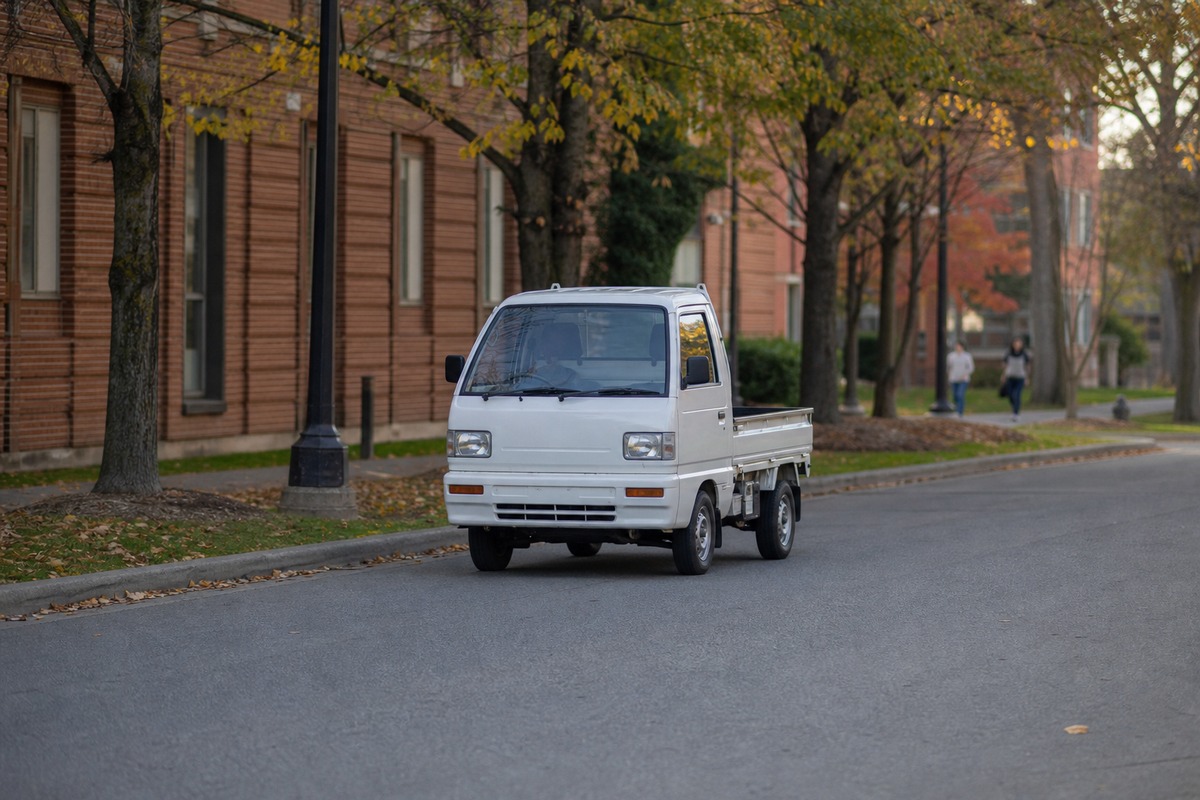
Start with the facts that more than one reputable outlet agrees on.
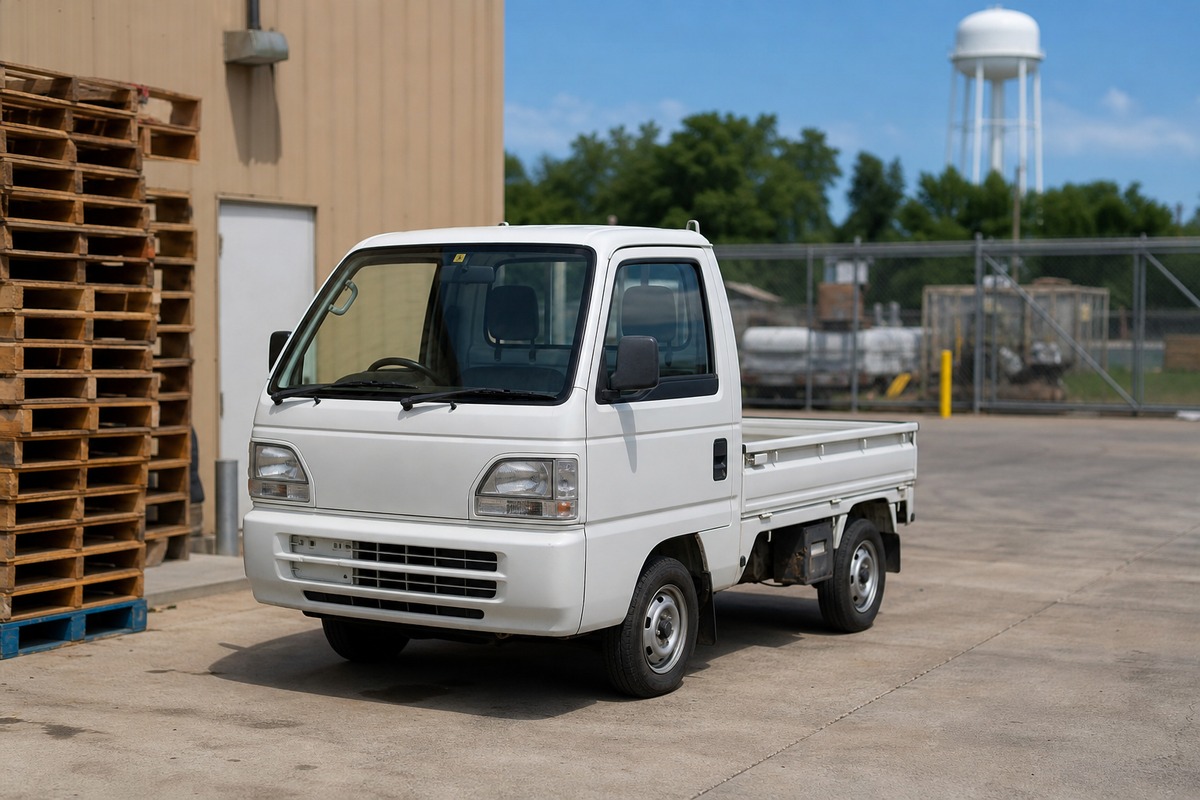
On Tuesday, 10 November 2026, Toyota said it will begin making an “ultra-compact” utility truck called the KEI-01 at its plant in Indiana. According to Reuters, the investment is $34 million and the project will add about 50 jobs. Bloomberg’s report frames the same news as Toyota expanding its US lineup by going small, building a mini vehicle in Indiana and selling it under a revived Scion name. Japan’s Toyo Keizai Online, which carried the Bloomberg-sourced story on 11 November, described the vehicle as a four-wheel-drive ultra-compact utility truck with a small three-cylinder engine and a top speed of 40 km/h.
The reported specifications, drawn from Reuters and Gizmodo coverage of the launch, are as follows:
– A two-seat cab and a flat cargo bed – A 660 cc three-cylinder gasoline engine, an automatic (continuously variable) transmission and four-wheel drive – Right-hand drive, as in Japan – Just over 11 feet (3.35 metres) long and under 5 feet wide – A top speed of 25 mph (40 km/h), designed to meet the federal low-speed vehicle safety requirements – Production in the second half of 2027 at Toyota’s Indiana plant
The sales approach is deliberately narrow. Reuters says the initial rollout is a limited one aimed at fleet customers, with small business owners, delivery fleets, farmers and ranchers, cities, universities and corporate campuses named as potential users. Toyota said it may consider limited retail sales later. A price has not been announced; one report says Toyota plans to disclose pricing closer to the late-2027 launch.
Two details deserve a caution. First, several Japanese outlets, including a Yomiuri-syndicated report and a Japanese car site, say the truck is based on the Daihatsu Hijet, with parts shipped from Japan and final assembly in Indiana. I could not find that base-vehicle detail in the Reuters text I read, so I treat it as reported by Japanese media rather than confirmed by Toyota. Second, one report says the truck cannot be driven on highways; that follows from a 25 mph cap, but I would confirm the exact operating restrictions with Toyota and with state regulators before building any plan around them.
The brand angle is also real. Toyota is reviving Scion, the youth-oriented brand it retired about a decade ago. The KEI-01 is described as its first vehicle. Alongside it, Toyota showed two other concepts, an off-road side-by-side and a portable minibike, which suggests the brand is meant to be a home for small, personal, utility-minded machines rather than a single product.
Why the Headline Says “Microcar” but the Product Is a Truck

If you saw this story circulate as “Toyota to build a 25 mph microcar in the US,” note the nuance. The product is a kei-style truck, not a passenger city car. That distinction shapes everything that follows.
In Japan, about a third of the 3.7 million new cars sold last year were kei cars, according to Reuters. The kei category covers passenger cars, vans and small trucks built to a government-defined size and engine limit, with tax and parking advantages. The truck is the most iconic piece of that world on working roads. It is cheap, tough and highly practical, and it is the version of Japan’s small-vehicle culture that Americans have already discovered through used imports.
What Toyota is proposing, then, is not to copy the Japanese passenger kei car for American commuters. It is to take the working end of the kei idea, the small truck, and fit it into the one American legal box that allows a vehicle this small and this simple: the low-speed vehicle.
How America’s Low-Speed Vehicle Rules Work
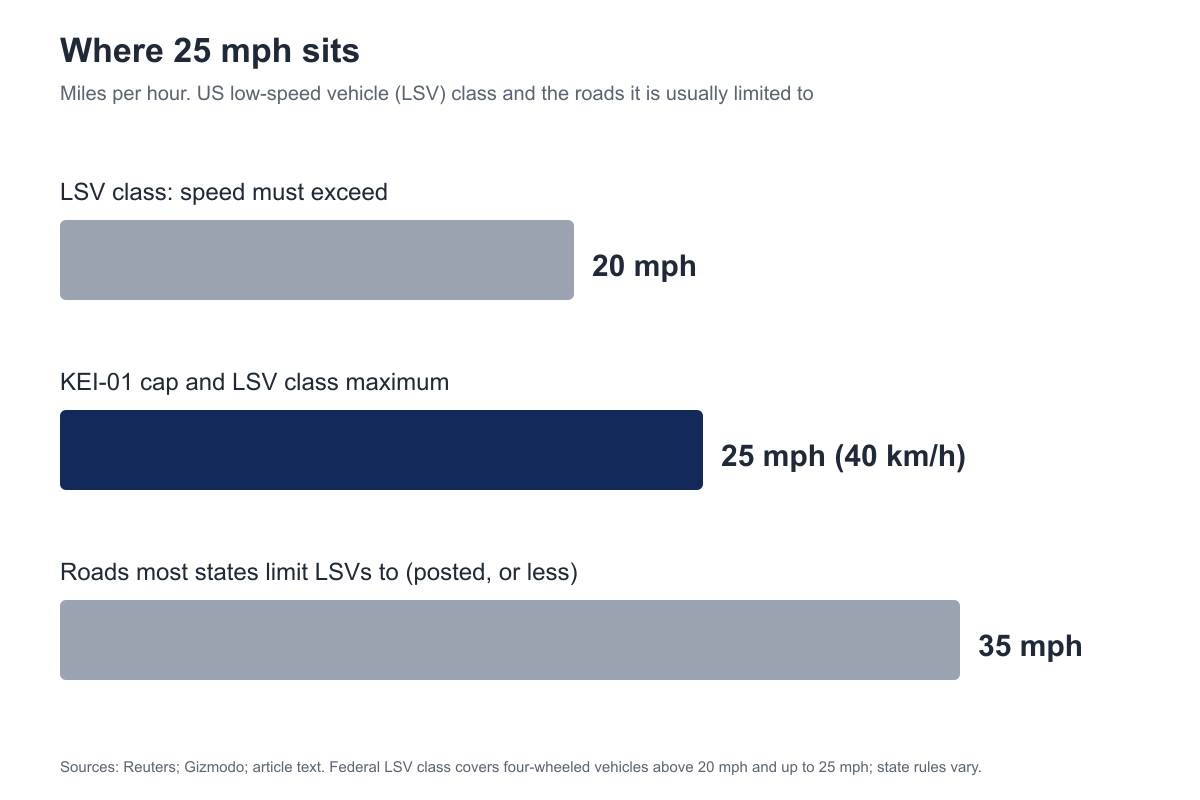
The United States has had a federal class for low-speed vehicles for decades. In plain terms:
– It applies to four-wheeled vehicles with a top speed above 20 mph and no more than 25 mph. – The vehicles must meet a defined list of basic equipment requirements, such as lighting, mirrors and seat belts. – It is a federal vehicle-safety category, but states decide where these vehicles may be driven. In most states they are restricted to roads posted at 35 mph or less, and some states add their own rules.
The typical American LSV is a golf-cart-style vehicle in a retirement community, a resort or a university campus. As Gizmodo notes, the class does not require the same crashworthiness standards as a conventional passenger vehicle, which is exactly why it is cheaper to build but also why it is limited to slow roads.
That is the real catch with the KEI-01. In Japan a kei truck can drive on expressways and national highways. In the United States, this one, by design, cannot do most of what a normal truck does. It is a campus, farm, municipal and last-mile tool.
I made a similar point in the previous issue. The US low-speed class exists, but it has never produced a mainstream urban microcar. The category is real; the mass market is not. Toyota is not claiming to change that. It is offering a purpose-built, factory-quality product for the places where the category already works.
The Politics: A Promise, a Post and a Condition
The reason this is a headline rather than a footnote is politics. Reuters says President Donald Trump encouraged the move and had wanted kei cars sold in the United States, but has said he wants them assembled domestically. Another report quotes a social-media post from January in which Trump said he had approved tiny cars to be built in America, after a visit to Japan. Gizmodo adds that he had called Japan’s tiny vehicles “really cute.”
Read together, the message is clear: the door is open to the kei idea, but only on American soil. For a foreign automaker, that makes a $34 million Indiana line a political signal as much as a manufacturing decision. The sum is small by industry standards. Reuters puts the jobs at about 50. This is a pilot, and a pilot is exactly the right size for a company that wants to test demand, regulators and public reaction without a large commitment.
I would not read more into the politics than the sources support. The reports describe encouragement and a stated preference for domestic assembly. They do not describe a regulatory change that makes imported Japanese-spec kei cars broadly legal, and they do not tell us the exact path Toyota used. If you need to know how the rules apply to a product, read the rules, not the headline.
Toyota’s Earlier Micro-Mobility Thinking
This is not Toyota’s first look at small vehicles. A few reference points help.
In March 2025, Toyota unveiled the FT-Me concept in Brussels: a two-seat electric micromobility vehicle about 2.5 metres long, aimed at European cities. It fits Europe’s L6e quadricycle category, with a top speed of 45 km/h, and Toyota said it was targeting at least 100 km of range. It was a concept, and reports differ on whether it will go into production.
Japan’s own experience is also relevant. Toyota showed the C+pod, a very small two-seat electric vehicle designed for short trips, in Japan in recent years, and it is the type of product the previous issue described in the context of Japanese micro-EVs. I have not verified sales volumes for it here, so I mention it only as part of the broader pattern.
What is interesting is how different the logic is across the three markets. In Europe, the quadricycle category produces a small electric car for city dwellers. In Japan, categories produce a three-wheeled tuk-tuk for tourists and a single-seat box for older residents. In the United States, the low-speed class produces a work truck for a fleet manager. The same company can sit in all three conversations and give each a very different answer, because the rulebook is different each time.
Japan Versus America: Two Rulebooks, Two Customers
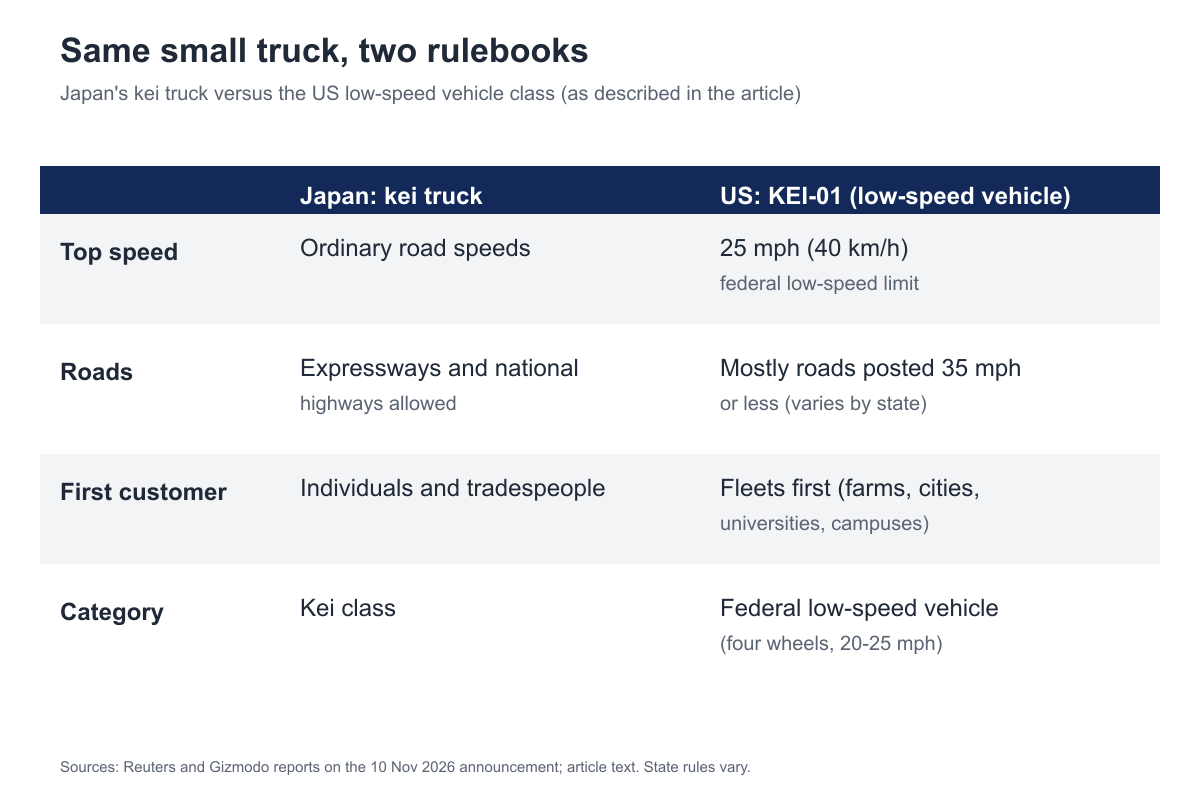
It helps to put the two systems side by side.
Japan. The category determines licence, helmet, inspection and parking. Designers build to a category and gain a cost structure the ordinary car cannot match. The customers are often older people in thin-transit neighbourhoods, small tourism operators, farmers and tradespeople. The vehicles share roads with full-size traffic and the kei truck runs at ordinary speeds.
United States. The category determines the maximum speed, the equipment list and, through state law, the roads. The customer is an institution: a fleet buyer with a defined route, a defined site and a risk manager. The vehicle is slow by definition, so the use case has to fit a 25 mph world.
Two consequences follow.
First, the Japanese logic of a vehicle that is cheap because it avoids regulation does not carry across. In Japan, a kei truck is a normal vehicle that happens to be small. In America, the same truck becomes a special-purpose machine because it is capped at 25 mph. It competes not against a pickup but against a golf cart, a utility terrain vehicle or a small electric work vehicle.
Second, the buying decision changes. A farmer or a campus facilities manager is comparing total cost, parts, service and reliability. That is where a Japanese manufacturer’s reputation for durable small machines can matter. It is also where the missing information, price, payload in real use and service network, will decide whether the pilot becomes a business.
What We Do Not Know
Let me be direct about the limits of what has been reported.
– Price. Not announced. – Volume. Not announced. The Indiana investment and job count suggest a small run, but that is an inference. – Retail. Toyota says it may consider limited retail sales later. There is no timetable. – Base vehicle. Japanese media say Hijet-based. Reuters, as I read it, does not say so. – State rules. Where it may be driven depends on state law. Expect variation. – Demand. No independent demand data exists. The fleet categories named are plausible, not proven.
I would also not assume that this opens the door to Japanese-spec kei imports at scale, or that every Japanese automaker will follow. Those are possibilities, and they are good questions to ask, but nothing in the reporting I read answers them.
What International Businesses Should Take From This
Read the category before the product. The KEI-01 is interesting because of what it is not allowed to do. If you are bringing a small vehicle, a component or a service to a new market, find out which regulatory class it lands in first. The class decides speed, roads, equipment, insurance and customer.
Sell to institutions first. Toyota chose fleets, not consumers, for the opening round. That is a lesson for any foreign company entering a market with an unfamiliar product: institutions buy against a use case, run controlled environments, and give you data. Consumers are the second wave.
Assume localisation is part of the price of admission. The political message was that tiny vehicles are welcome if they are built in America. Whatever you sell, think early about local assembly, local sourcing and local jobs, even at a pilot scale.
Use a pilot to learn the rulebook. A $34 million, 50-job line is cheap compared with a full launch. It buys regulatory learning, brand testing and a reference customer list. If your own product depends on rules that vary by state or by municipality, a limited rollout lets you discover which differences matter.
Do not copy Japan’s playbook directly, and do not expect Japan’s customer. The Japanese kei truck wins because it is legal, cheap and fast enough to be a normal vehicle. A 25 mph American version is a different product serving a different buyer. The lesson from the previous issue applies in reverse: the winning product is built to the local category, not to a foreign idea of the vehicle.
Watch the competition in the same class. Gizmodo notes that other small-vehicle products, such as Fiat’s Topolino and a startup’s electric buggy, are also chasing small-vehicle buyers. The segment is not empty. A well-known name does not guarantee a place in it.
Frequently Asked Questions
Q. What did Toyota announce?
A. On 10 November 2026, Toyota said it will build the KEI-01, an ultra-compact utility truck, at its Indiana plant, selling it under a revived Scion brand. Reuters reports a $34 million investment and about 50 jobs, with a limited fleet rollout starting in the second half of 2027.
Q. How fast does it go, and where can it be driven?
A. Its top speed is 25 mph (40 km/h), designed to meet federal low-speed vehicle requirements. In most states, vehicles in this class are limited to roads posted at 35 mph or less, though state rules vary.
Q. Can I buy one?
A. Not at first. The initial rollout targets fleets such as farms, municipalities, universities and corporate campuses. Toyota says it may consider limited retail sales later. No price has been announced.
Q. Is it the same as a Japanese kei truck?
A. It is kei-style: a 660 cc engine, a tiny footprint and right-hand drive. Japanese outlets report it is based on the Daihatsu Hijet, but I could not confirm that from the English-language wire reports. A Japanese kei truck can drive at normal road speeds. This version is capped at 25 mph.
Q. What does this mean for the American small-vehicle market?
A. It is a test, not a transformation. The low-speed class has existed for years without producing a mainstream urban microcar, and Toyota is aiming at fleets rather than commuters. Whether it grows depends on price, service, state rules and demand, none of which is known yet.
Conclusion
Toyota’s KEI-01 is a small vehicle with a large amount of context around it. It is a Japanese idea, a political promise and an American legal category meeting in one Indiana factory. The confirmed facts are modest: a 25 mph truck, $34 million, about 50 jobs, fleet customers first, second half of 2027. The unconfirmed parts, price, volume, retail plans and base vehicle details, are exactly where the business case will be decided.
For international operators, the practical lesson is the same one I drew in the previous issue, now from the opposite side. Follow the rules, the customers and the first partnerships rather than the hype. In Japan, a rulebook built from many small categories produced tuk-tuks, single-seat boxes and kei trucks that move at ordinary speeds. In America, a single low-speed class produces a slower, narrower, fleet-first product. Same instinct, very different vehicle. The rulebook is the story.
If you’re interested in this topic, the Japanese market more broadly, or what KETCHUPs is working on, we’d love to hear from you — please reach out via our contact form.
Japan Market Pulse is a weekly read on what the Japanese consumer-tech, food, and mobility markets are choosing to do, written for international operators who want to know what is happening before it shows up in the global trade press.
Subscribe at ketchups.co/japan-market-pulse.