

Asahi Group said on 13 November that Super Dry volume outside its home markets rose 33% in the first nine months of 2026, while Japan fell 2.5% to 48.81 million cases. Behind the gap are a decade of European acquisitions, a ransomware attack that emptied Japanese shelves, and a domestic market that is simply getting smaller. Here is what is confirmed, what Asahi did not disclose, and what a foreign operator can take from it.
When people outside Japan think of Japanese beer, most of them think of one silver can. Asahi Super Dry has been the country’s best-known beer export for decades, and for most of that time it was a story about a Japanese product travelling abroad in small volumes, in sushi restaurants and in duty-free shops. The numbers Asahi published this month describe something different. The brand is now growing fastest in places where almost nobody speaks Japanese, and it is shrinking, slowly, in the one place where it was invented.
On 13 November 2026, Asahi Group Holdings released its results for January to September. According to the company’s release, global brand volume for Asahi Super Dry rose 33% year on year, and Peroni Nastro Azzurro rose 6%, both measured outside what Asahi calls the home markets. A trade report of the same week put Super Dry volume in Japan at 48.81 million cases for the nine months, against 50.08 million cases in the same period of 2025, a fall of 2.5%. Six months earlier, in the half-year release, Super Dry’s overseas growth had been reported at 31%. The pace is not slowing; it is picking up.
I have covered Japanese consumer brands for many years, and I have rarely seen a single pair of numbers say so much about where a country’s industries are heading. A domestic market that shrinks by a few percent a year does not collapse. It simply stops being a place where a large company can plan on growth. So the company does what a rational company does. It builds, buys and ships its way into markets that are still growing, and it uses the one asset it owns outright, a brand, to carry the weight.
This issue goes through the details. It covers what Asahi actually said, and what it did not, the long history that made the 33% possible, the European acquisitions that built the distribution behind it, the domestic market and the 2025 cyberattack that complicated it, the gap between headline growth and underlying profit, and what operators selling into or out of Japan can reasonably take from the pattern. I will mark clearly where I am relying on company statements or trade reporting rather than on figures I could check against a primary table.
The Beer That Moved Out
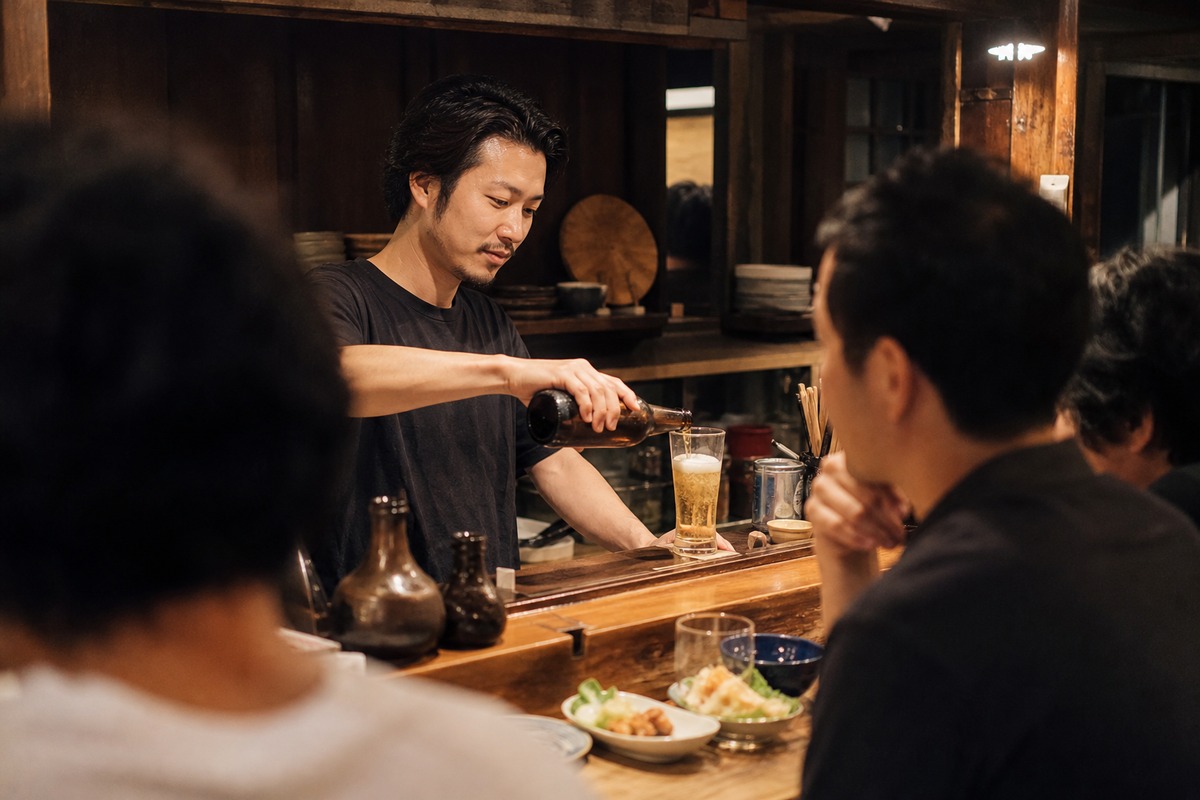
Super Dry launched in Japan in 1987 and changed what Japanese drinkers expected from a mass-market lager. It was crisp, with a sharp finish that suited food, and the “dry” positioning gave it a clear identity at a time when the domestic beer market was crowded with similar bitter lagers. It became the leading beer brand in Japan around 1997, roughly a decade after launch, and Asahi took the top spot in the overall beer market the following year; the company has held a leading position for much of the time since. That was the Japan story, and for a long time it was the only story.
The first thing to understand about the 2026 numbers is that they are not an export story in the traditional sense. A Japanese company shipping cans from a Japanese factory to a distributor abroad would be a small business, limited by freight cost, shelf life and the sheer expense of moving liquid. Asahi’s overseas Super Dry does not appear to work only that way. The company brews part of it under licence and in its own plants in several regions, using the recipe and the brand rather than the physical product from Japan. Asahi does not disclose what share of overseas volume is made locally. A trade report on the nine-month figures noted that the overseas number reflects volume growth in those markets and not necessarily shipments leaving Japan. That distinction matters, because it tells you what kind of asset is travelling. It is a brand and a process, not a product.
For international readers this is the most transferable lesson in the whole story. The brands that scale beyond a small domestic base are usually those that can be reproduced locally under one identity, with the supply chain adapted to each region. Japan has produced several of these in food, beverages, apparel and household goods. It has produced far fewer in electronics and hardware, where the product itself, not a recipe or a style, is the thing being sold.
Asahi’s own description of the growth is also worth reading carefully. According to the company’s release, the chief executive attributed the nine-month results to Super Dry, in particular in China, Europe and North America, plus cost efficiency and favourable currency effects. In other words, the growth is geographically broad enough that no one country accounts for it. Asahi did not publish an overseas case count in the materials I could review, nor a country-by-country breakdown, so I cannot tell you how large the overseas base actually is. A 33% increase on a small base is a different thing from a 33% increase on a large one. That limit is a theme I will return to.
Thirty-Three Percent: Reading Asahi’s Number Carefully
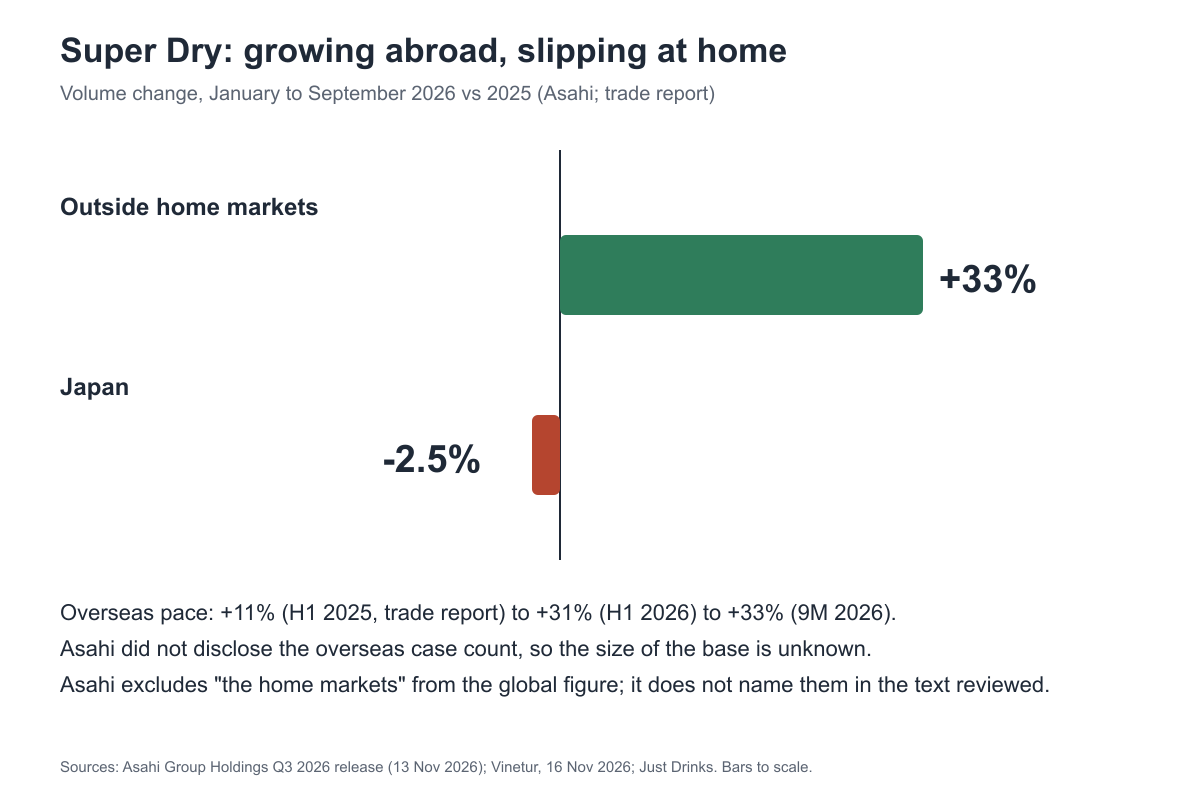
Here is the core data as it stands. Super Dry volume outside the home markets rose 33% in the first nine months of 2026, compared with 31% for the first half and, according to a trade report on Asahi’s 2025 interim results, about 11% for the first half of 2025. So the overseas growth rate has roughly tripled in a year. Peroni Nastro Azzurro, the Italian premium lager Asahi owns, rose 6% on the same basis. Japan’s Super Dry volume fell 2.5%.
Three things should be said before anyone treats those figures as a clean success story.
First, Asahi’s release carries a footnote explaining that the global brand figures exclude the home markets. The company does not name those markets in the text I reviewed. A reasonable reading is that Japan is one of them, but readers should not assume that every other Asahi market is included in the overseas total. For a precise comparison you would want the company’s full supplementary tables, which I could not extract from the file as published.
Second, a volume figure is not a revenue figure and it is not a profit figure. Asahi did not give a price or margin for the overseas growth. The group-level numbers, which I turn to in a later section, show that profit growth is far weaker than volume growth once currency is stripped out.
Third, the base matters. In 2025 the group’s Japanese business was knocked out in late September by a cyberattack, and the effects ran into 2026. That makes the Japanese comparison messy in both directions. Overseas, the base was unaffected, because the company has said the attack was limited to its Japanese operations and that beer made overseas was not hit. So the attack did not directly disrupt the overseas comparison. The Japanese 2.5% decline, on the other hand, sits against a first-nine-months base that was largely pre-attack, which makes it a weak result for a business that was, in the first quarter of 2026, still recovering lost customers. A trade report earlier this year said Super Dry volume in Japan was down 9% in January 2026 against January 2025, so the nine-month figure of 2.5% suggests a partial recovery through the year.
Putting those three points together, the fair summary is that Super Dry is growing quickly outside Japan, that the gap with the home market is wide, and that the size of the overseas base remains undisclosed. That is still a strong story. It just is not an unqualified one.
Why Super Dry Travels

Why does a lager designed for Japanese food and Japanese drinking habits sell in Shanghai, Milan and Chicago? I think four reasons stand out, and they are as much about marketing and positioning as about the liquid.
The first is that Super Dry is a flexible style. A light, crisp lager with a clean finish is one of the few beer styles that crosses cultures easily. It pairs with spicy food in China, with seafood in southern Europe and with the kind of casual bar snack that dominates the United States. It does not demand an acquired taste.
The second is that the Japan association carries a premium. In many markets, a beer that signals Japanese origin is placed in the upper part of the price range, next to imported craft or European premium lagers. That is a lever Asahi can pull without changing the product, and the group’s own numbers suggest it is doing so: the company reported that the average sales unit price for its beer, beer-like and non-alcoholic beer-taste products rose 2.1% in the nine months, which it attributes to premiumisation.
The third is that Asahi has built a global brand portfolio in which Super Dry sits alongside other premium names rather than competing with them. In Europe the group owns Peroni, Pilsner Urquell and Grolsch, among others. That lets distribution partners, restaurants and retailers work with one supplier across several price points. For a small bar or a regional supermarket chain, a supplier that can deliver a premium Italian lager, a Czech pilsner and a Japanese dry lager under one contract is easier to deal with than three separate importers.
The fourth is the one that is hardest to copy: local production, where it is used. Brewing a brand under licence in the target region cuts freight costs, reduces carbon emissions in the supply chain, shortens the time to shelf and avoids many tariffs. It also keeps the product fresher, which matters for beer more than almost any other packaged drink. A beer that has spent weeks in transit is harder to keep fresh than one brewed within a few hundred kilometres of the glass.
None of these four advantages is unique to Asahi, and each is available to competitors. What makes Asahi’s position distinctive is that it combined them over roughly a decade, through a deliberate and expensive acquisition programme in Europe, which I turn to next.
Europe: The Ten-Billion-Euro Foundation
The business that supports the 33% was not built from Japan. It was bought, in two large steps, from companies that were forced to sell.
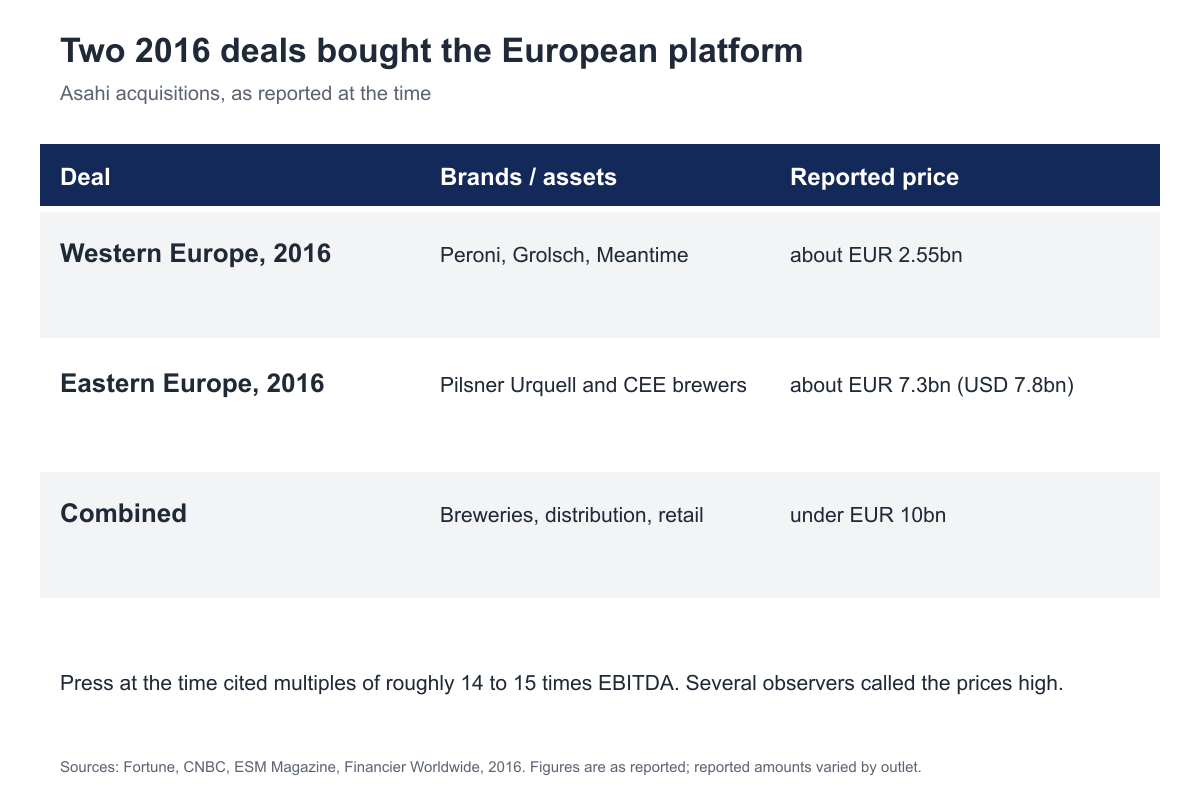
In 2016, Asahi agreed to buy the Peroni, Pilsner Urquell and Grolsch brands, and associated businesses, as part of the regulatory-driven asset sales that accompanied the merger of the two largest global brewers. Press coverage at the time put the first deal, covering Peroni, Grolsch and the UK craft brand Meantime, at about 2.55 billion euros. A second agreement, announced in December 2016, covered the former SABMiller brewing businesses in Central and Eastern Europe, including Pilsner Urquell, at roughly 7.3 billion euros, or about 7.8 billion US dollars. Press reports at the time described the prices as high for the sector. One cited a multiple of around 15 times earnings before interest, tax, depreciation and amortisation for the first deal, and another a multiple in the range of 14 to 15 for the second. Together the two deals come to a little under 10 billion euros.
At the time, a number of observers argued that Asahi had paid too much. The company was buying slow-growing, mature European businesses at prices that implied faster growth than the region could deliver. I think that criticism was reasonable in 2016. The 2026 data suggests the reasoning behind the purchase was different from the headline price. The point was not the earnings of the acquired brewers. The point was what the brewers came with: breweries, distribution contracts, bar and retail relationships, and a sales force able to put a new brand on a shelf.
That is exactly what the Super Dry numbers appear to reflect. A Japanese brand that wants to enter Germany, Italy, Poland or the Czech Republic from scratch must find an importer, convince a retailer to give it space and spend heavily on marketing before it earns a return. A Japanese owner that already controls a brewer, a distributor and a set of retail relationships in those countries can introduce the brand in a fraction of the time. Europe is widely described as Asahi’s largest region outside Japan, though I have not checked an exact share against the company’s annual report, so I do not put a figure on it here.
For any founder or operator watching from outside, the strategic point is a simple one. Asahi did not become a global brand by being a better exporter. It became one by buying the infrastructure that exporters usually have to rent. That is an expensive route, and not one most companies can take. But it shows why partnership and distribution deals, which are often treated as an afterthought in small-company export plans, are in practice the main constraint.
There is also a quiet link with China. The CEO’s reference to China as a key growth market for Super Dry in 2026 echoes the pattern I have seen in other Japanese consumer brands. The most reliable growth in the past few years has often come not from Japan’s own population but from the middle-class consumers of nearby Asian economies who associate Japanese brands with quality and safety. Asahi has not given a China-specific number, so I will not guess at one.
At Home: 48.81 Million Cases and a Shrinking Market
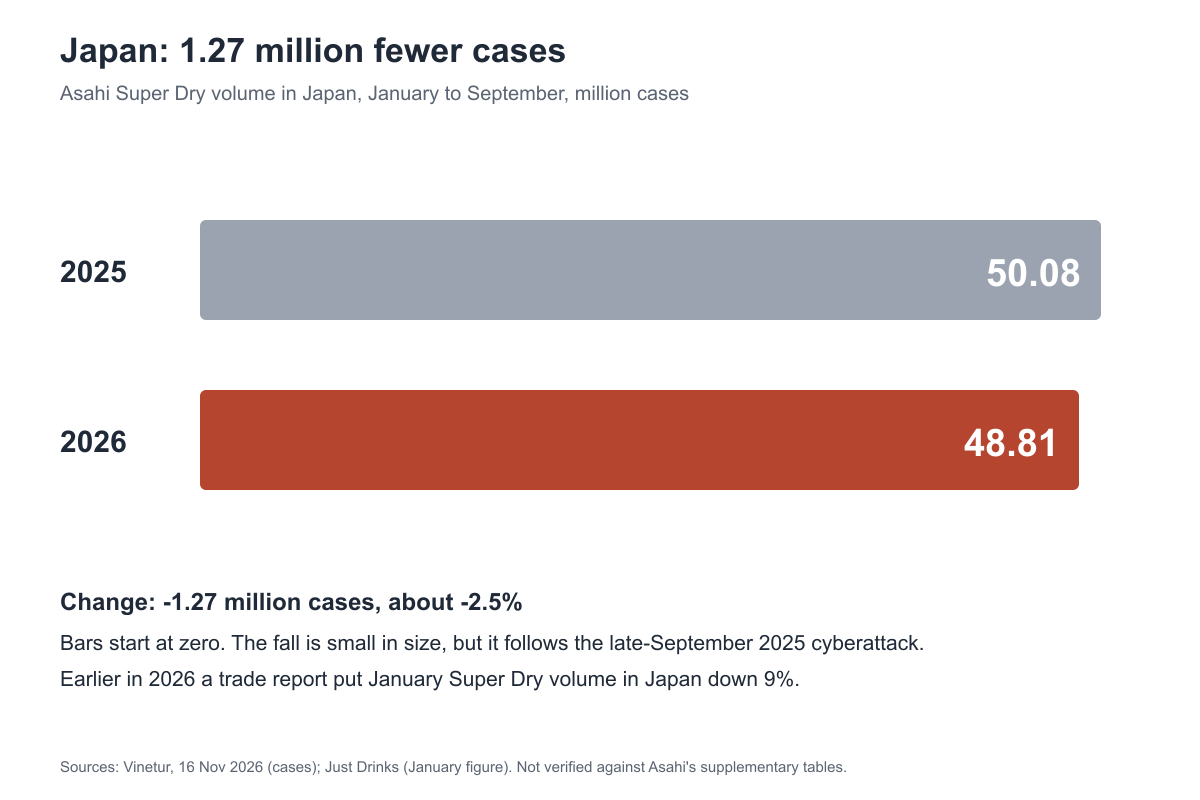
Now the other half of the picture. In the first nine months of 2026, Japan’s Super Dry volume was 48.81 million cases, against 50.08 million cases a year earlier. The decline of 1.27 million cases is about 2.5%.
It would be easy to read that as a company problem. It is more accurately a country problem, with a company problem layered on top. Japan’s population has been shrinking for years, and the number of people in the heaviest-drinking age groups is falling. Younger Japanese adults drink less than their parents did, and are more likely to choose non-alcoholic or low-alcohol options. The beer category has also lost share for years to other drinks. These are long-running trends, not new ones.
There is a regulatory factor too. Japan’s beer tax system has for years given different rates to beer, to the cheaper beer-like products known as happoshu, and to a third category. These rate differences are being unified in stages, and the final step took effect in October 2026. That makes true beer slightly cheaper relative to the substitutes, which should help a brand like Super Dry over time. I covered the mechanics of that change in an earlier issue and will not repeat them here, but it is worth noting that the tax change arrived at the same moment the company was still working through the aftermath of the cyberattack.
Domestic share is where the 2025 attack leaves its mark. Bloomberg reported in November 2025 that rival brewers had been gaining ground while Asahi struggled to restore operations. A comparison with a year earlier will carry that effect for some time. When a product disappears from shelves, even for a few weeks, some of the customers who switch do not come back. Others return slowly. The 2.5% decline is smaller than the January figure, which suggests the recovery is under way, but I would wait for a comparison base that is not distorted by the attack before drawing firm conclusions about the Japanese side of the business, and a share figure alongside the volume figure would help.
For international sellers, the domestic Japanese beer story is a useful reminder of what a mature, shrinking market looks like. It is not empty or inactive. It is still the largest single market for the product, with a large installed base of loyal customers. But growth in volume terms is not available, and every gain comes at the expense of a competitor or from price. That is a very different environment from the one that existed when Super Dry launched in 1987, and it explains why the company looks abroad.
The 2025 Cyberattack and the Share It Cost

It is impossible to understand the 2026 Japanese numbers without the events of late September 2025.
On 29 September 2025, Asahi’s systems in Japan were disrupted by what the company later confirmed was a ransomware attack. The ransomware group known as Qilin claimed responsibility. Production and shipments from the company’s Japanese breweries stopped for several days. According to press reports, six breweries restarted on 2 October, with limited shipments following and call centres slated to partially restart the following week. For a time, wholesalers reported receiving only a small fraction of their normal orders. One wholesaler cited in coverage said it was receiving about 10 to 20% of normal volumes.
Asahi stated that the attack was limited to its Japanese operations and that beer brewed overseas was not affected. That is consistent with the way the 2026 overseas numbers look, since the attack seems to have left no mark on them.
Two points are worth drawing out. The first is that the cyberattack revealed how dependent Japanese food and beverage distribution still is on manual and semi-manual processes. Press accounts described the company going back to pen and paper to process orders in the weeks after the attack. A modern global brewer was, for a few weeks, running part of its Japanese order handling with systems more like those of a generation earlier. That is not unique to Asahi. It is a common feature of Japanese corporate IT, which tends to combine very sophisticated physical logistics with older back-office systems.
The second point is that the attack gave rivals a window. Competing brewers gained share while Asahi supplies were constrained, and a trade report in late 2025 described domestic Asahi sales as declining at a double-digit rate in the period after the attack. Some of that share has since come back, but not all. It also coincided with the annual year-end peak, when beer volumes are highest.
There is a follow-up worth mentioning. On 22 October 2026, Asahi said it had temporarily suspended certain group websites and systems as a precaution after identifying a critical vulnerability in a widely used web programming language. The company said no unauthorised access or data breach had been detected. I mention this not to suggest any new incident, because the notice says there was none, but because it shows how much the company’s security posture has changed since 2025. A year ago a vulnerability like that might have been left for a patch cycle. Now it triggers a pre-emptive shutdown.
Premium Prices, Fewer Cases: What the Profit Line Says
The most important sentence in Asahi’s nine-month release is not the one about Super Dry. It is the contrast between reported and constant-currency numbers.
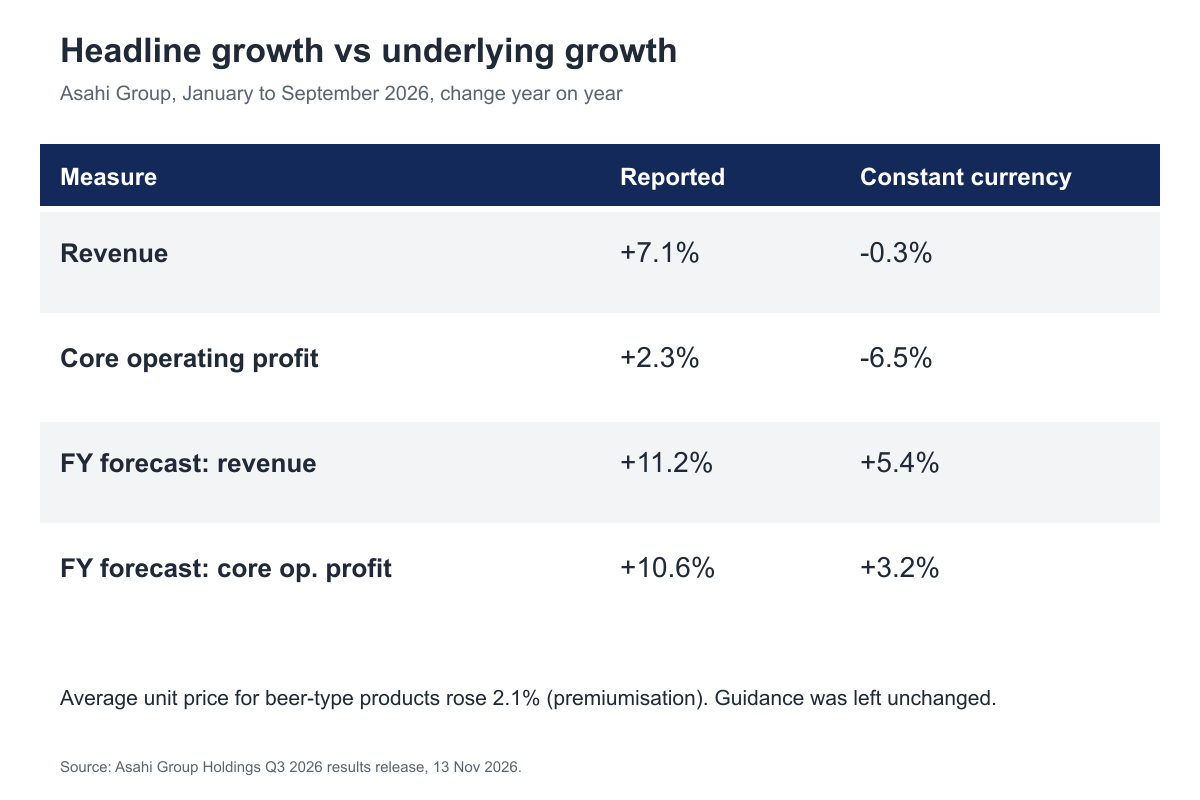
Reported revenue for January to September rose 7.1%. On a constant-currency basis, which removes the effect of exchange rates, revenue fell 0.3%. Reported core operating profit rose 2.3%. At constant currency, it fell 6.5%. In other words, the underlying profit trend is negative, and the positive headline results come largely from favourable currency movements, probably the weaker yen against the euro and other currencies, though the release text I reviewed did not itemise the sources.
The company’s full-year guidance remained unchanged. It expects revenue to rise 11.2% on a reported basis and 5.4% at constant currency, and core operating profit to rise 10.6% reported and 3.2% constant currency. To hit those full-year constant-currency numbers after a nine-month decline in core operating profit, the final quarter would need to be much stronger than the first three. That is possible, because the fourth quarter is seasonally strong and the comparison with the attack-affected fourth quarter of 2025 is easy. But it is a stretch, and I would watch the February 2027 results for any change in guidance.
What does this mean for the 33% figure? It means that the volume growth abroad is real but that it is not yet translating into profit growth at group level. Several things could explain that gap. The 2025 cyberattack left cost and volume effects in Japan. Currency effects can distort comparisons in both directions. Launching and promoting a brand in a new market costs money before it earns any. And a growing brand sold at promotional prices is a different thing from one sold at a premium. The company points to premiumisation, as shown by the 2.1% rise in average unit price, but that is a group-wide average across all products and regions, not a specific figure for Super Dry overseas.
For operators, the lesson is the usual but important one: volume growth is a necessary condition for a brand to scale, but not a sufficient one. A brand that grows 33% but earns lower margins in each new market can still make a company worse off. The test is whether the brand eventually earns the same or better margin as it does at home. Asahi has not yet shown that, at least in the figures I could check.
One more item belongs here. Asahi said it will continue working to complete its acquisition of the East African operations of Diageo. That is a reminder that the strategy is still an acquisition-led one. The company is not content to let Super Dry grow organically alone; it is continuing to buy regional platforms. That may be sensible, but it also raises the stakes on integration and debt, which is an issue I would watch as interest rates shift.
What Other Japanese Brands Can Copy, and What They Cannot
It is tempting to read the Asahi story as a template. Japanese consumer companies are facing the same shrinking home market, and most of them have talked about expanding overseas for years. Which parts of Asahi’s approach can others reuse?
Some parts transfer well. A brand with a clear identity that can be reproduced locally is the most portable asset. Instant noodles, soy sauce, snack foods, cosmetics and certain kinds of clothing have followed variations of the same path. The pattern of building a local manufacturing and distribution base in a few large regions, rather than shipping everything from Japan, makes sense for any category where freight is expensive, where freshness matters or where tariffs are high.
Other parts do not. The scale of Asahi’s acquisitions is not repeatable by smaller firms. The regulatory-driven sale of European assets in 2016 was a specific opportunity, created by the merger of two giants, and such opportunities do not come around often. Even for large Japanese groups, buying established brands and sales networks costs a great deal, and not every acquirer sees returns.
A third group of lessons concerns timing. Asahi started its overseas push in earnest around a decade ago. The payoff is arriving now, and even now it is not showing up in constant-currency profit. A smaller company that expects its first overseas year to deliver profit is likely to be disappointed. The right comparison is a five-to-ten-year horizon.
There is also a cautionary note. Any strategy that depends on one hero brand carries concentration risk. If Super Dry’s momentum in China or Europe slows, there is no obvious second brand of equal size in the portfolio to take over. Peroni’s 6% growth is solid, but it is not 33%. Brand portfolios are valuable partly because they smooth these swings, and Asahi has fewer of them than the largest global brewers.
Finally, the Asahi story is a reminder that a strong domestic position can be a weakness as well as a strength. For decades, Japanese companies could earn good returns without leaving their home market. That habit has delayed the overseas investment many of them now need. The firms that moved first, like Asahi, are now seeing the results, while those that waited face a more expensive and more crowded field.
What to Do If You Sell Into or Out of Japan
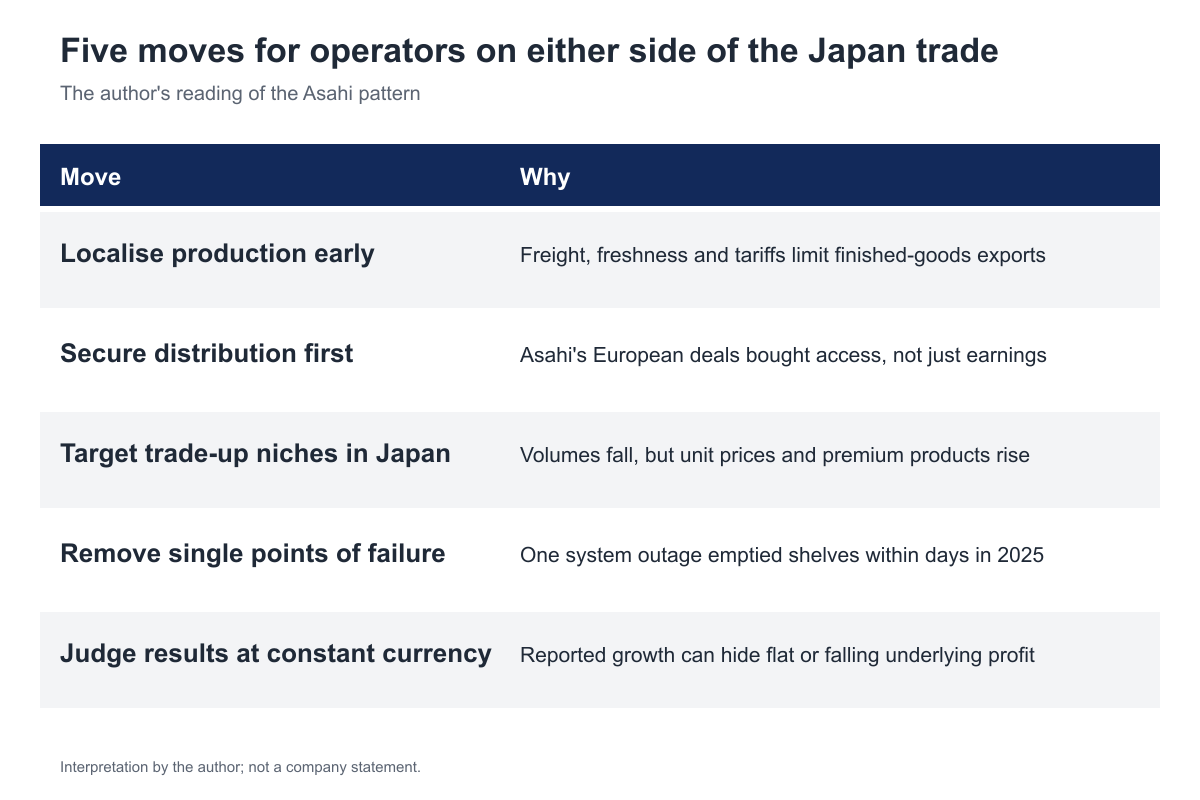
For operators on either side of the Japan trade, the Asahi data suggests several practical moves.
If you export a Japanese brand abroad, plan to localise production sooner than you expect. Shipping finished goods from Japan can establish a brand, but the growth stage usually requires local production or at least local packaging and finishing. Asahi’s overseas volume is largely built on this model, and the economics of freight and freshness make it hard to avoid for any product with a short shelf life.
Buy or partner for distribution before you spend on marketing. Asahi’s European acquisitions were mainly about access. A smaller company can approximate that with a long-term partnership or a joint venture with an established local distributor, but only if the agreement gives the partner a stake in the brand’s success. A simple importer contract rarely does.
If you sell into Japan, do not assume that a falling total market means no opportunity. Beer volume is falling, but the company’s own data shows unit prices rising and premium products gaining. In a shrinking market, the opportunity is in categories where consumers trade up: craft, imported, low-alcohol and non-alcoholic options. A foreign brand that fits one of those categories can grow even when the whole category shrinks.
Build resilience into your Japanese supply chain. The 2025 attack showed that a single point of failure in order handling can empty store shelves within days. If your Japanese distribution depends on one wholesaler, one system or one warehouse, ask what happens if it fails. Retail partners now ask suppliers about this more often than they used to.
Treat constant-currency numbers as the real ones. If you are a Japanese exporter whose profit looks healthy because the yen is weak, ask what the result would be at a neutral exchange rate. Asahi’s gap between reported and constant-currency results is a model case of why this matters.
Watch the fourth-quarter result. Asahi has kept its full-year guidance, which implies a strong final quarter. The February 2027 release will show whether the overseas growth is converting into profit. If it is not, the story shifts from a growth story to a cost and integration story, and the lessons I have drawn here need to be revised.
Frequently Asked Questions
Q. How much did Asahi Super Dry grow outside Japan in 2026?
A. According to Asahi Group Holdings’ results released on 13 November 2026, Super Dry volume outside the home markets rose 33% in the first nine months of the year. The growth rate was reported at 31% for the first half. The company did not disclose absolute overseas case numbers in the materials reviewed.
Q. What happened to Super Dry sales in Japan?
A. A trade report on the nine-month results put Japanese Super Dry volume at 48.81 million cases, against 50.08 million cases a year earlier, a decline of about 2.5%. The domestic business was also affected by a ransomware attack in late September 2025, which disrupted production and shipping in Japan.
Q. Is Super Dry made in Japan for overseas markets?
A. Not only. Asahi brews part of it under licence and in its own facilities in several regions, and does not disclose the local-production share. A trade report noted that the overseas growth figure reflects volume in those markets, not necessarily shipments leaving Japan.
Q. Why did Asahi buy European beer brands?
A. In 2016 Asahi agreed to buy Peroni, Pilsner Urquell and Grolsch, along with associated brewing and distribution businesses, for a combined price of a little under 10 billion euros. The deals gave the company breweries, retail relationships and sales teams across Europe, which it can use to build brands such as Super Dry.
Q. Is Asahi’s profit growing as fast as its volume?
A. No. For January to September 2026, reported core operating profit rose 2.3%, but at constant currency it fell 6.5%. The full-year forecast remains an increase of 10.6% reported and 3.2% constant currency, which implies a stronger final quarter.
Q. Was Asahi’s overseas business hit by the 2025 cyberattack?
A. The company has said the attack was limited to its Japanese operations and that beer made overseas was not affected.
Conclusion
Asahi’s nine-month numbers describe a company that has made a deliberate choice: let the home market settle at a lower level and put its growth into brands that can be produced and sold elsewhere. A 33% rise in Super Dry volume outside Japan, set against a 2.5% fall at home, is the most visible sign of that choice. It rests on a decade of expensive European acquisitions, a brand that travels easily and a premium that comes with its Japanese origin.
It is also an unfinished story. The overseas base remains undisclosed. Profit at constant currency is falling. The 2025 attack still shapes the domestic comparison. And the company’s guidance for the final quarter asks a lot. If the fourth quarter delivers, the case for the strategy becomes strong. If it does not, the 33% will look more like a marketing number than a financial one.
For international operators, the practical conclusion is that Japan’s best-known consumer brands are no longer Japanese products with overseas sales. They are global brands with a Japanese home market, and the home market is getting smaller. That changes who the real competitors are, who the real partners might be, and where the next opportunities lie.
This article contains affiliate links. If you purchase through these links, we may earn a small commission at no extra cost to you.
If you’re interested in this topic, the Japanese market more broadly, or what KETCHUPs is working on, we’d love to hear from you — please reach out via our contact form.
Japan Market Pulse is a weekly read on what the Japanese consumer-tech, food, and mobility markets are choosing to do, written for international operators who want to know what is happening before it shows up in the global trade press.
Subscribe at ketchups.co/japan-market-pulse.