

On 10 November 2026, Amazon’s Ring announced a self-flying indoor security drone for about $249.99, roughly ¥40,000. ITmedia NEWS described it with the wry slang term “jitaku keibiin,” which means a person who never leaves the house, and noted that Ring has not said whether Japan will get it.
Every country has a word for the person who stays home all day. In Japan the joke is that such a person is a “home security guard,” a job title nobody applied for. So when Ring, the Amazon-owned smart-home brand, unveiled a small drone that patrols the inside of your house and flies to wherever an alarm goes off, the Japanese tech press could not resist. ITmedia NEWS ran the story under a headline asking whether this was a real “home security guard.”
I have lived in Japan for twenty years, and the joke landed with me for a different reason. This is a country where homes are small, many people rent, and the instinct to watch over an elderly parent or a pet from afar is very strong. A flying camera that learns your floor plan sounds like either the perfect fit or a product built for a different kind of house. Which it is depends on facts that are not yet known.
This article sets out what Ring actually announced, what is confirmed about its availability, how it compares with the security products Ring already sells in Japan, why Japanese housing both helps and hurts the idea, where the legal and privacy questions sit, and what international operators should take from it.
What Ring Actually Announced
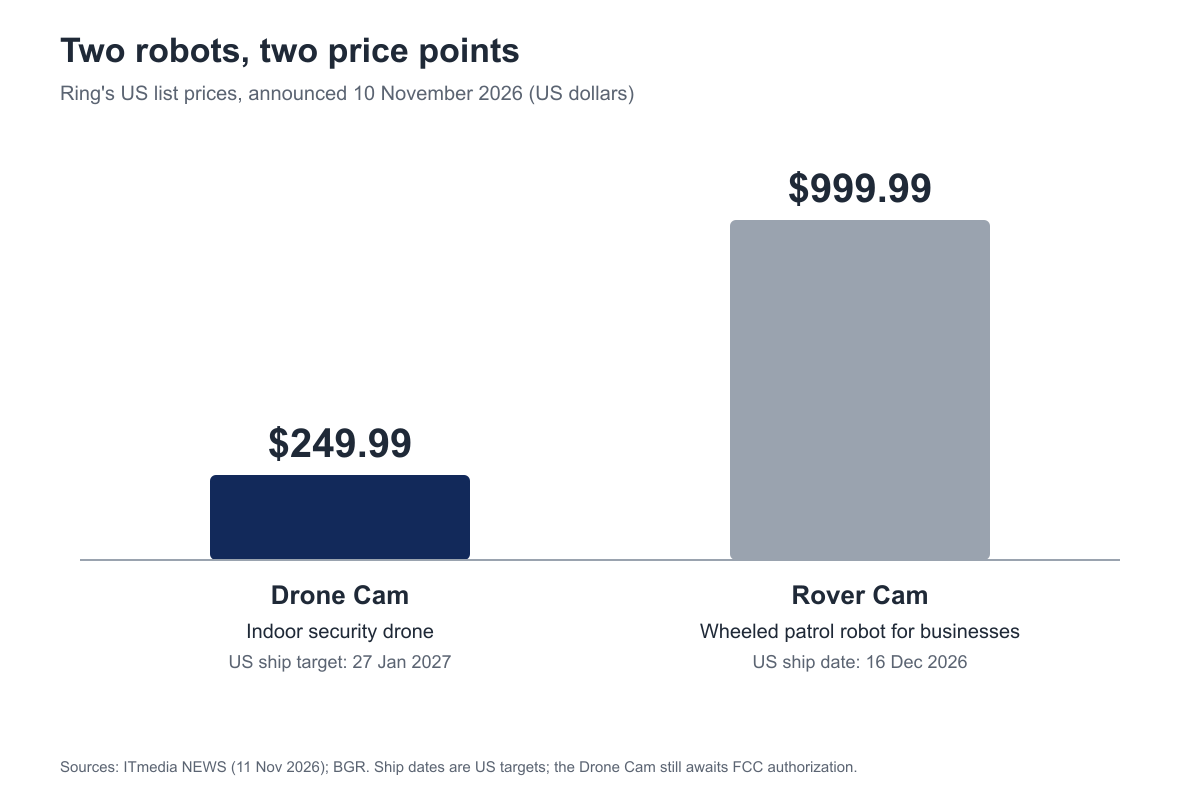
Ring announced two robots at once. The one that matters here is the Ring Drone Cam, an indoor drone priced at $249.99 in the United States. ITmedia converts that to about ¥40,000, which is the figure Japanese readers saw. The conversion is approximate, and the yen amount will move with the exchange rate.
According to ITmedia and to US tech coverage, the Drone Cam uses a Ring system called AI Pilot. During setup you carry the device around the home so it can map the layout. It then proposes watch spots, such as a side door or the end of a hallway, and steers around furniture on its own. You can launch it on demand, on a schedule, or let it respond automatically when another Ring camera, sensor or alarm is triggered. It records 2K video with a 148-degree field of view, rotates a full 360 degrees, and carries two LEDs for dark rooms. When it is not flying it sits in a dock with its camera off.
The second product is the Ring Rover Cam, a wheeled patrol robot aimed at businesses. It costs $999.99, about ¥160,000 according to ITmedia, and is scheduled to ship in the United States on 16 December 2026. The Drone Cam is slated to ship in the United States on 27 January 2027, but US coverage is clear that this is a target. The Drone Cam has not yet received authorization from the US Federal Communications Commission, and the device cannot be sold until it does.
Two further details are worth noting. Scheduled flight routes and video review require a paid Ring Protect subscription, according to BGR, so the sticker price understates the running cost. And Ring describes several privacy design choices: the camera switched off while docked, recording only while airborne with an LED showing when it is rolling, and an encryption scheme it calls “Throw Away the Key.”
The Product Has Been Promised Before
The idea is not new, and anyone who follows smart-home gadgets will recall that. Ring first showed an indoor flying camera, the Always Home Cam, in 2020, with a promised price of $249 and a ship date the following year. It then went through an invitation-only early-access phase, and at CES 2023 the company’s founder said it would be widely available in 2024, citing technical problems such as detecting mirrors and windows. It never reached general retail.
That history should temper expectations. The November 2026 announcement is the most concrete yet, with a price, a ship date and a new name, but a US launch still depends on regulatory clearance, and I could not find any confirmed plan for other countries. A German-language source updated in early 2026 described the earlier device as US-only and invitation-only, with no European launch. That is a single source, so treat it as indicative rather than established.
Is It Coming to Japan? Not Confirmed
This is the question every Japanese reader asks first, and the answer is that nobody outside Ring knows. ITmedia states plainly that Ring has not disclosed plans to sell the Drone Cam in Japan. I found no Japanese-language announcement of a price, date or regulatory filing for the product.
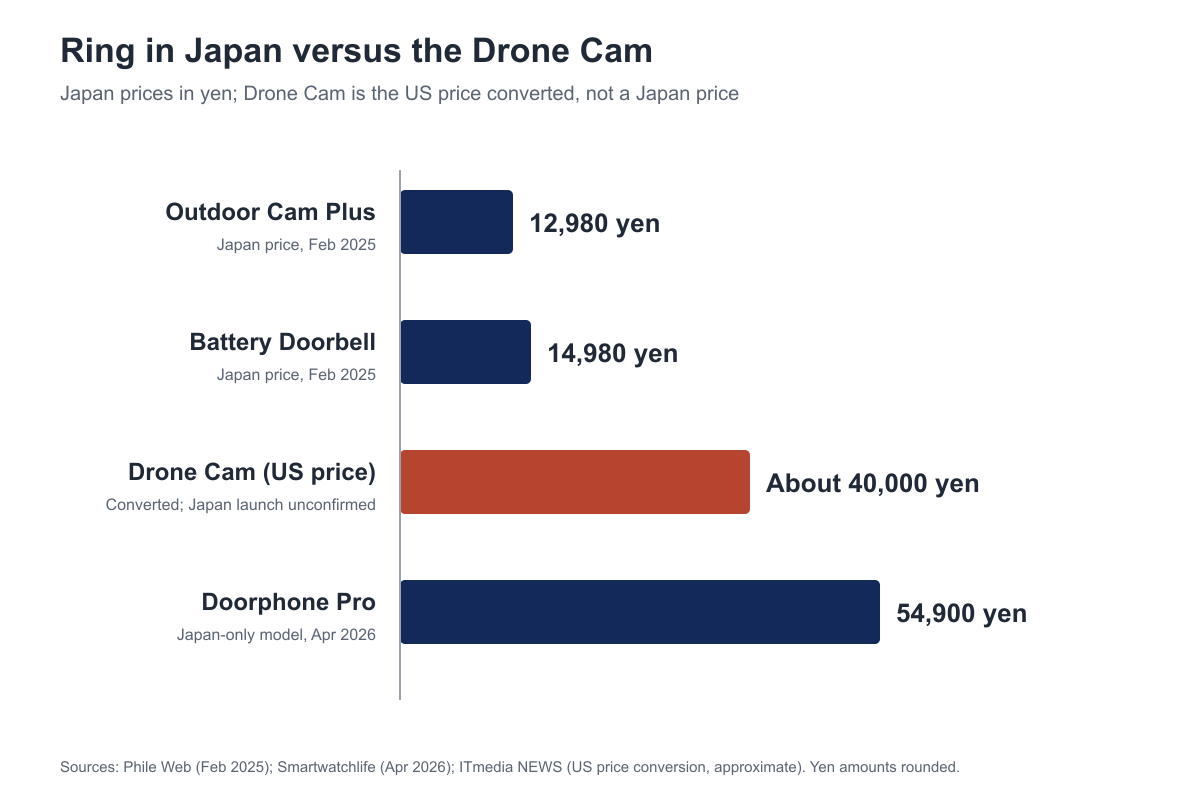
What is confirmed is that Ring is a real and growing presence in the Japanese market, which makes an eventual launch plausible but not certain. Ring has been sold in Japan since April 2022. In February 2025 the Battery Doorbell went on sale at ¥14,980 on Amazon.co.jp, and the Outdoor Cam Plus at ¥12,980 opened for pre-orders with shipping that spring. In April 2026 it announced a Japan-only product, the Ring Doorphone Pro, priced at ¥54,900. Reports describe it as the first Ring device developed under a “Designed for Japan” concept, designed to replace and reuse the existing intercom equipment in Japanese homes. In October 2026 Ring announced a battery-powered 4K outdoor camera, which went on sale on 5 November at ¥15,980 including tax.
So Ring has shown it will adapt hardware to Japanese wiring and housing. A drone raises harder questions than a doorbell, because it involves radio certification, indoor flight safety and the privacy of people other than the owner. Whether Ring or Amazon Japan will take those on is unannounced, and it would be speculation to say otherwise.
What Japanese Homes Offer a Flying Camera
Set the availability question aside and ask whether the product fits. Japanese housing cuts both ways.
On the encouraging side, the average Japanese dwelling is small. The 2023 national housing survey from the Statistics Bureau puts the average floor area at about 91 square metres per dwelling, and that figure includes large detached houses in the countryside. A city apartment is typically far smaller. A drone that must map the home and pick patrol routes has an easier job in a compact layout, and a single device could in principle cover the whole space from its dock. For someone living alone in a one-room apartment, though, the practical question is what a flying camera adds over a fixed one, since a single wide-angle camera already sees most of the room.
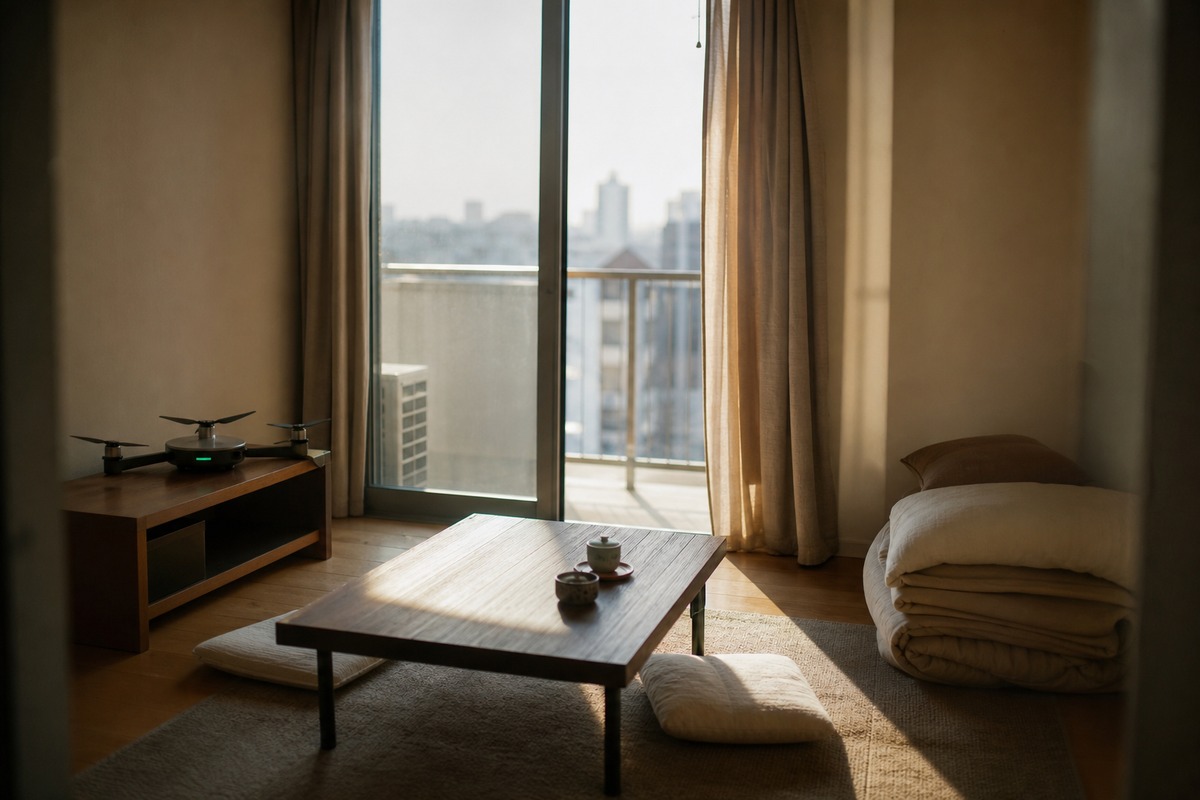
On the discouraging side, Japanese homes are full of things drones dislike. Floors are often covered in low furniture and floor cushions, and bedding may be laid out and put away daily. Sliding doors, thin curtains, reflective balcony glass and tight corridors add to the complexity, and Ring itself has cited mirrors and windows as long-standing technical challenges. A flying object with audible propellers in a small room will also be far more noticeable than a wall-mounted camera.
Then there is the renter question. A large share of Japanese households rent, and by my own back-calculation from prefectural statistics, owner-occupied homes make up roughly six in ten households nationally. That is an estimate rather than an official figure, but it points to a very large rental population. Renters tend to avoid drilling holes or running wiring, which favours devices that sit on a shelf and plug into a wall. A dock fits that pattern. A noisy drone launching at midnight in a lightly built apartment block is another matter, and neighbours who hear it may not be as tolerant as the owner.
Who Would Actually Buy It
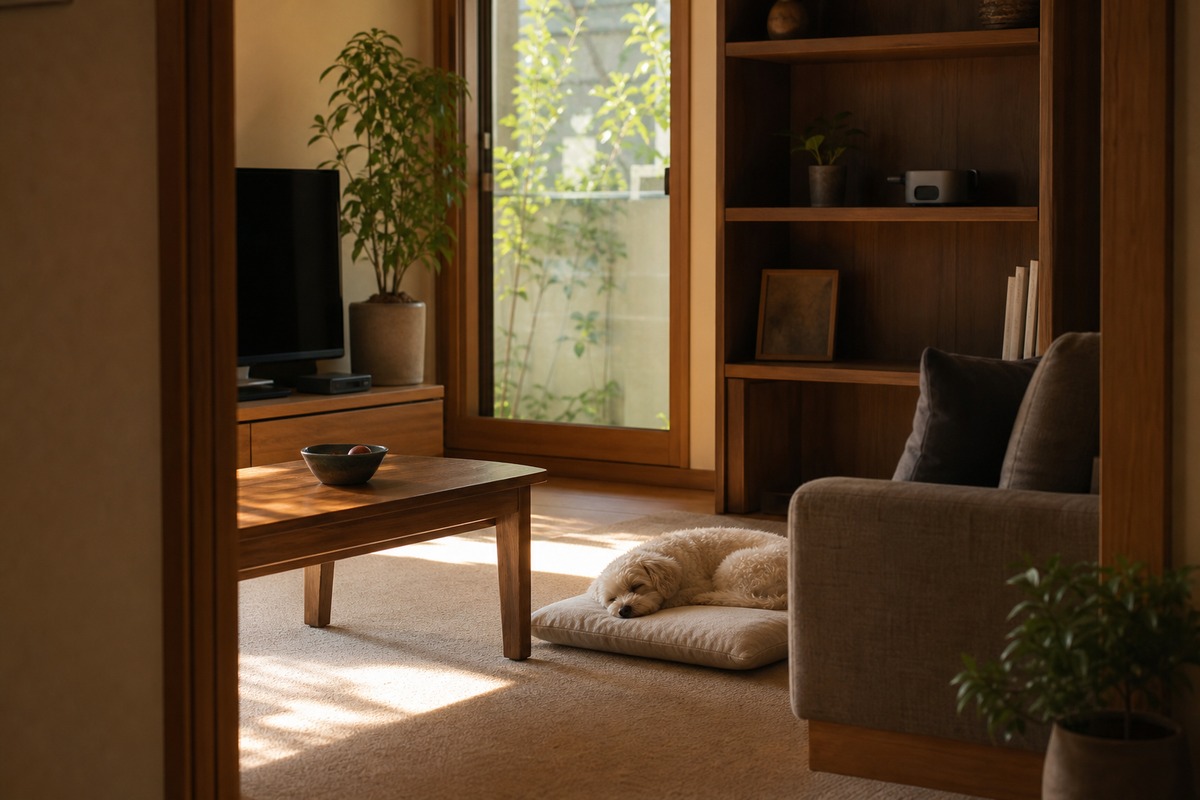
The strongest pull for home cameras in Japan, in my experience and in how Japanese retailers tend to market them, is not burglary. It is watching over family and pets: an elderly parent living alone in another prefecture, a dog left for the day, a child coming home from school. This is my observation rather than measured data, but it shapes how a flying camera is likely to be received.
A drone that patrols on a schedule and responds to alarms is built around intrusion. A drone that can be summoned to check whether grandmother is in the kitchen is a different product, and it comes with a different set of concerns, since the person being watched may not welcome a machine that follows them from room to room. Ring’s design, which limits recording to flight time and shows an indicator light, reads as an attempt to answer that concern, but it is the kind of feature that matters more to the person being watched than to the buyer.
Price is the other filter. About ¥40,000 is roughly three times what Ring charged in Japan for its outdoor cam at launch, and the paid subscription is on top of that. For many households, a handful of cheaper fixed cameras would cover the same rooms. The drone’s appeal is reach: one device that goes where the incident is, rather than one camera per room. Whether that is worth the premium in a small home is an open question that only sales data can answer.
Privacy and Rules: What I Could and Could Not Confirm
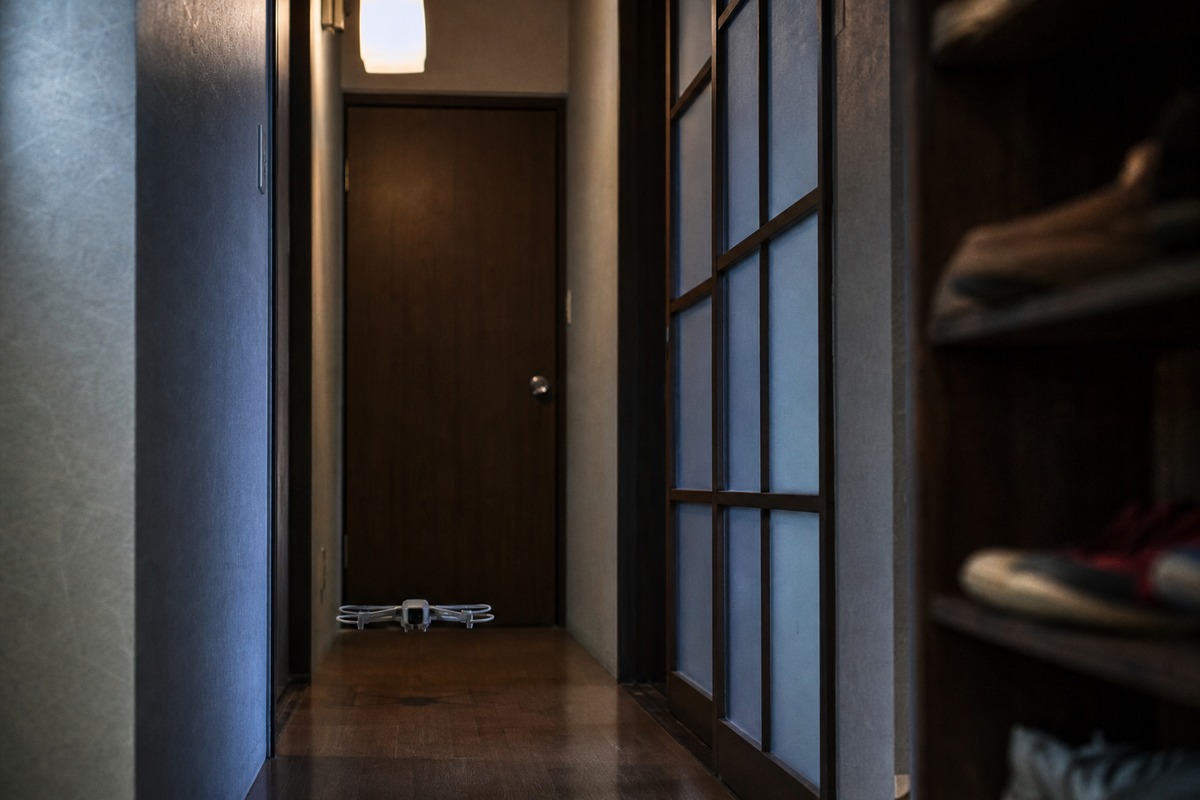
A home robot that flies and films raises legal questions in any country. For Japan, I want to be precise about what I verified and what I did not.
On aviation law, Japan’s Ministry of Land, Infrastructure, Transport and Tourism describes its rules as applying to unmanned aircraft of 100 grams or more, with separate regimes for airspace and flight methods, and the framework is built mostly around outdoor flight. According to the ministry, flight inside an enclosed indoor space falls outside the Act’s flight rules. A company planning to sell such a device would still need to check radio-law technical conformity, product safety and personal-data handling separately.
On privacy, Japan has the Act on the Protection of Personal Information, and footage of identifiable people can fall within it. How that applies to a camera that a householder operates inside their own home, and what changes when guests, cleaners or caregivers are filmed, is a question for Japanese counsel. I am not offering a legal opinion. What I can say is that Japanese consumers are generally sensitive about being filmed, and a device that moves toward people on its own initiative will be judged on social acceptability as well as legal compliance.
There is also a hardware-certification layer. Radio equipment sold in Japan generally needs to meet Japanese technical standards, and I have not seen any statement from Ring about that for the Drone Cam. This is another reason a Japanese launch cannot be assumed.
The Competitive Context
Ring is not alone in the broader field of home monitoring, and the market it would be entering is fragmented. Japanese buyers can already choose from fixed pet cameras, pan-and-tilt indoor cameras and a growing range of home robots. Each approaches the same need, watching over the home and the people in it, from a different direction. Ring’s argument is that a drone covers the space better and ties directly into an existing alarm system, but it would be entering a field where convenience, price and noise tolerance matter at least as much as capability.
That is also why the story resonates beyond Japan. The hardware is arriving faster than the norms around it, and the countries that have already normalised home cameras will not necessarily be the ones that welcome a camera that moves.
What International Operators Should Take From This
Treat the headline as a signal, not a product. The drone has a price and a US ship date, but it has no FCC authorization yet, no announced Japan plan and a history of slipping. Anyone building a Japan strategy around it is planning on air.
Watch Ring’s Japan localisation pattern. Ring has moved from importing its US range to developing a Japan-only doorbell around local wiring. If you sell smart-home hardware, that sequence shows how a foreign brand wins here: first the easy products, then Japan-specific engineering.
Design for care, not only for crime. The likeliest Japanese demand for home cameras is about family and pets. Products and marketing that lead with burglary may miss the people who actually buy.
Make privacy features visible and physical. Shutters, indicator lights and off-by-default cameras are not just compliance details. They are selling points, and they shape whether neighbours and family members accept a device at all.
Check the legal layers separately. Aviation rules, personal-data rules and radio certification are three different regimes. I could confirm none of the three for this device in Japan, and a launch plan should secure written advice on each.
Price the subscription, not just the hardware. A ¥40,000 drone plus a monthly plan is a different proposition from a ¥13,000 outdoor camera. Japanese consumers compare total cost carefully, and subscription fatigue is a risk.
Frequently Asked Questions
Q. How much does Ring’s indoor security drone cost?
A. In the United States the Ring Drone Cam is priced at $249.99, which ITmedia put at about ¥40,000. That conversion is approximate. Scheduled flights and video review require a paid Ring Protect plan, so the total cost is higher.
Q. Will the Ring Drone Cam be sold in Japan?
A. Not confirmed. ITmedia reports that Ring has not announced any Japan launch. Ring does sell other products in Japan through Amazon.co.jp, so a launch is possible, but no price, date or certification has been published.
Q. When does it ship?
A. US shipping is planned for 27 January 2027, but the device has not yet received FCC authorization and cannot be sold until it does. Treat the date as a target.
Q. Is it legal to fly a drone inside a house in Japan?
A. According to the ministry, indoor flight falls outside the Civil Aeronautics Act’s flight rules, which are framed around outdoor airspace and flight methods. Radio-law conformity, product safety and personal-data handling still need separate checks.
Q. What about the Ring Rover Cam?
A. It is a wheeled patrol robot for businesses at $999.99, about ¥160,000 according to ITmedia, with US shipping planned for 16 December 2026. No Japan plan has been announced.
Conclusion
Ring’s indoor drone is a clever product with a punchy Japanese nickname, and it taps something real: the desire to know what is happening in your home when you are not there. But the facts that matter for Japan are the ones that remain unconfirmed. There is no Japanese launch plan, no Japan price, no statement on certification, and radio-law, product-safety and privacy checks still to come, even though the ministry says indoor flight falls outside the aviation flight rules. The product itself has a history of delays, and the US sale still awaits regulatory clearance.
What is solid is the context. Ring is investing in Japan, small homes make mapping easy and clutter makes flying hard, and the likeliest demand is about family and pets rather than burglars. For international operators, the lesson is to read the signal, watch Ring’s localisation, and treat every claim about Japan as unconfirmed until a Japanese announcement says otherwise.
If you’re interested in this topic, the Japanese market more broadly, or what KETCHUPs is working on, we’d love to hear from you — please reach out via our contact form.
Japan Market Pulse is a weekly read on what the Japanese consumer-tech, food, and mobility markets are choosing to do, written for international operators who want to know what is happening before it shows up in the global trade press.
Subscribe at ketchups.co/japan-market-pulse.