


On 11 November 2026, Japan’s Fair Trade Commission approved a commitment plan from Amazon Japan over a rule that, in the regulator’s words, risked restricting how sellers set prices. The plan runs for five years, it comes with no finding of a violation, and it deliberately leaves one big question untouched. Here is what it changes, what it does not, and what an overseas seller should do next.
I have lived in Japan for twenty years, and one thing I have learned is that the country’s regulators rarely announce dramatic punishments. They prefer negotiated outcomes, monitored for years, with the paperwork written so carefully that nobody has to say anyone was guilty. The decision announced this week is a textbook example. It is also, quietly, one of the more interesting pieces of platform regulation anywhere in the world right now, and anyone selling on Amazon in Japan, or planning to, should read it closely.
The short version is this. For years, sellers on Amazon.co.jp were told, in effect, that they would not win the most prominent purchase spot on a product page unless their price was at or below what Amazon called a “competitive price”. The Japan Fair Trade Commission, known as the JFTC, suspected that this condition broke the Antimonopoly Act. Amazon Japan responded not with a fight but with a plan to change how its product pages work. The JFTC accepted it.
This article walks through what is publicly confirmed, how the Japanese procedure works, what the earlier Amazon commitment in 2020 looked like, and what practical lessons follow for operators outside Japan.
What the JFTC Actually Announced
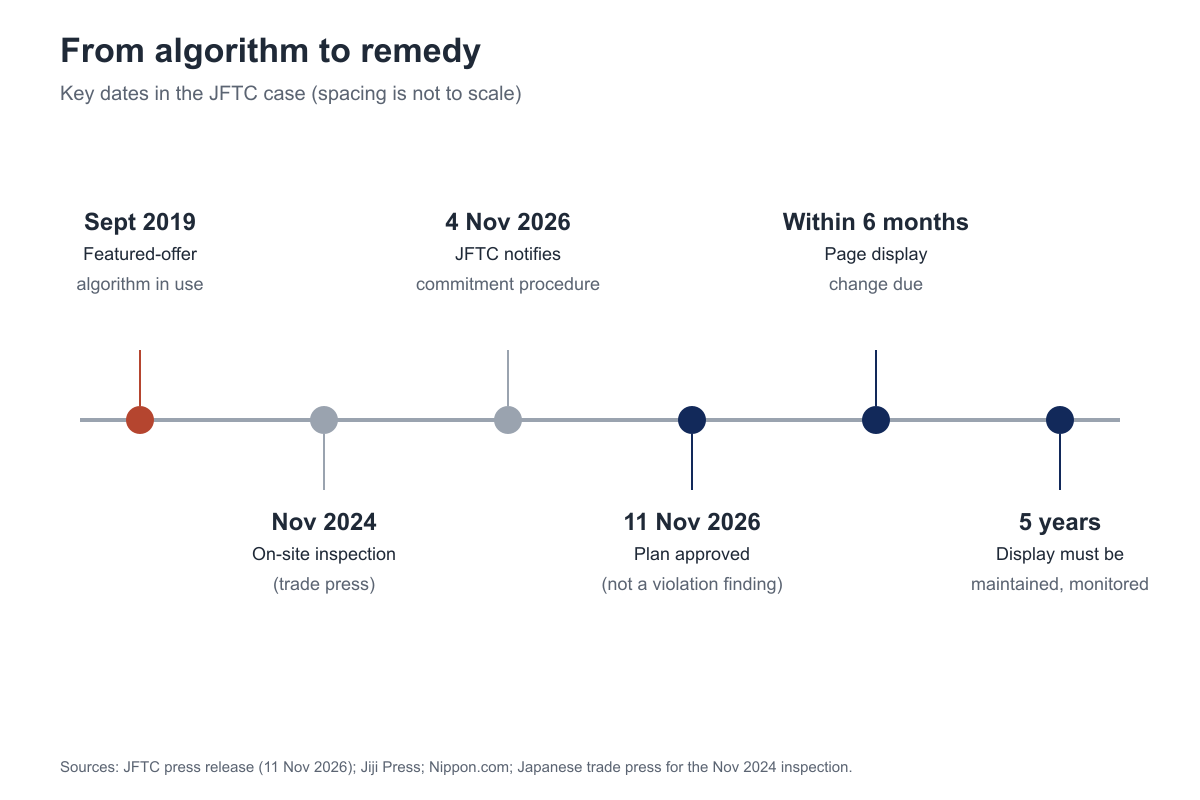
The primary source is the JFTC’s own press release, dated 11 November 2026. It says the commission approved a commitment plan submitted by Amazon Japan G.K., the company that operates Amazon.co.jp. The JFTC had notified Amazon Japan that it was opening the commitment procedure on 4 November 2026, so the approval came just seven days later.
The conduct at issue concerns what Amazon calls the “featured offer” on a product detail page, the single listing that gets the prominent purchase button. According to the JFTC, Amazon Japan has used an algorithm since September 2019 to decide which seller gets that position. Sellers whose price was above a “competitive price” were not eligible. Amazon told them why, through Seller Central or by email, and told them they would have to price at or below that level to qualify.
The JFTC suspected that this was a restrictive trading condition, an unfair trade practice under Article 19 of the Antimonopoly Act. Its concern was threefold: that the rule could limit sellers’ freedom to set their own prices, that it could weaken rival online shopping sites, and that it could harm fair competition. Jiji Press, in a report carried in English by Nippon.com, described the same story as Amazon having pressed sellers to lower prices. The commission had carried out an on-site inspection of Amazon Japan in November 2024, which was widely covered by the Japanese trade press at the time.
Two points need emphasis before going further. First, the JFTC states explicitly that approving the plan is not a finding that Amazon Japan violated the law. Second, the approval is conditional. If Amazon Japan does not carry out the plan, the JFTC can revoke the approval and resume its investigation.
What Amazon Japan Has Promised to Change

The plan is more specific than the headlines suggest. The core change is to the product page. When no seller’s offer satisfies the competitive-price condition, the page will show the lowest-priced purchasable offer, calculated including shipping. It will display that offer’s price, its delivery terms, who ships it, who sells it, and a visible purchase entry point. Help pages for both sellers and consumers will explain the display and the purchase route.
Jiji Press and Nippon.com report that the product pages will be updated within six months, and the JFTC says the new display must then be maintained for five years from its start date. In practical terms, this means that the cheapest offer on Amazon itself will be clearly visible to shoppers even when that price does not match or beat prices on competing sites.
The plan also includes governance measures that are typical of Japanese commitments. Amazon Japan must adopt the measures through its board or equivalent decision-making body, notify sellers, and train relevant staff. It must introduce an Antimonopoly Act compliance guideline specifically about sellers’ pricing, run regular training, and have its legal staff audit compliance on a regular basis. A third party approved by the JFTC will monitor implementation and report to the commission, including annual reporting on the five-year display measure and on training and audit results.
The JFTC’s release says each measure has its own implementation deadline. The public coverage I could verify gives only the six-month deadline for the display change, so I will not claim a precise date for when shoppers will first see the new pages.
How Japan’s Commitment Procedure Works
Overseas readers sometimes assume that a regulator approving a company’s own plan is a soft outcome. It is better understood as a different trade. Under the commitment procedure, the JFTC tells a company that it suspects a violation and that the company may propose measures to remove the suspected problem. If the commission finds the plan sufficient and likely to be carried out, it approves it. There is no penalty order and no formal finding of illegality. In exchange, the company changes its behaviour, usually faster than a contested case could, and accepts monitoring.
For regulators, the appeal is speed. The on-site inspection in this case took place in November 2024, and the approval arrived two years later. A fully litigated case against a global platform could take much longer, and in the meantime sellers would continue to operate under the disputed rule. For companies, the appeal is avoiding a legal finding, which can attract private claims and reputational damage.
The JFTC also describes the result as a world first. According to Jiji Press, citing the commission, regulators in the United States, Germany and Canada have filed lawsuits or opened investigations over Amazon’s competitive-price practices, and the Japanese plan means improvements here will arrive ahead of those elsewhere. I would treat that comparison with care, since the legal systems and the evidence differ. But the sequencing is notable: Japan reached a remedy while other jurisdictions are still arguing about the question.
A Second Commitment for Amazon Japan
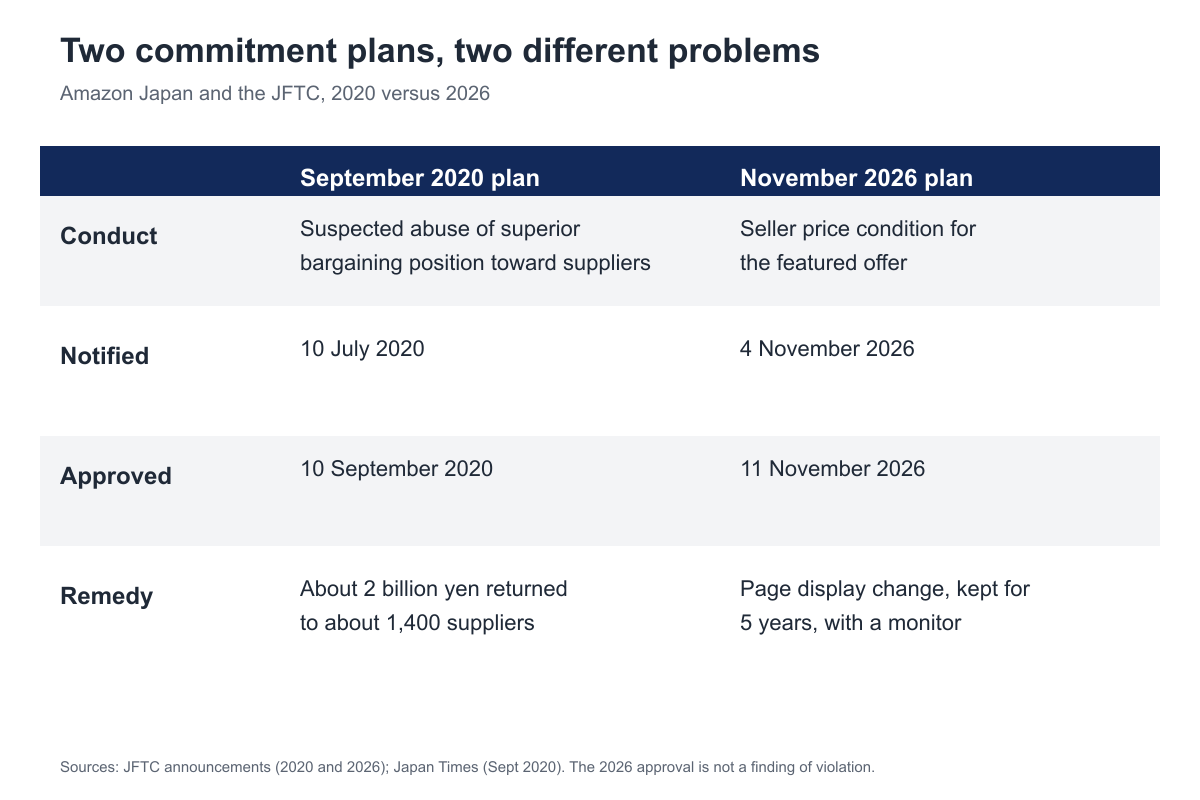
This is not the first time Amazon Japan has used the commitment route. In September 2020, the JFTC approved a different commitment plan from the same company. That earlier case concerned suspected abuse of a superior bargaining position toward suppliers, with suspected conduct including pressing suppliers to cover part of discounts, to take back excess inventory, and to pay sums calculated as a percentage of purchase amounts under labels such as sponsorship fees. Under the plan, roughly ¥2 billion was to be returned to about 1,400 suppliers, according to the JFTC’s announcement and international coverage. The JFTC notified Amazon Japan of the procedure on 10 July 2020 and approved the plan on 10 September 2020.
Among the approvals I could identify, the November 2026 decision is therefore the second commitment plan the JFTC has approved for Amazon Japan. I cannot rule out other cases I did not find, so I use that phrase with care. What matters for operators is the pattern: the two cases involve different conduct, supplier relationships in 2020 and seller pricing conditions in 2026, but both ended in negotiated remedies rather than penalties.
What the Decision Does Not Cover
The most important limitation is the one that sellers talk about the least. When the JFTC inspected Amazon Japan in November 2024, Japanese trade press reported that the suspicion also included requiring sellers to use Fulfilment by Amazon, or FBA, to qualify for the featured offer. The November 2026 commitment plan concerns the price condition. The JFTC’s release does not mention FBA, and the coverage I reviewed does not report an outcome on that allegation.
I would not read anything into that silence. It may mean the issue was resolved in some other way, dropped, or simply not part of this procedure. The accurate statement is that the public record I could verify does not say. For a seller, the practical consequence is that the relationship between FBA use and featured-offer eligibility should be treated as unchanged until Amazon says otherwise.
The second limitation is timing. A six-month implementation window means the old logic may remain in place for part of that period. The announcement itself does not turn on a new display tomorrow morning.
The third limitation is more subtle. The plan changes what happens when no seller meets the competitive-price condition. It does not, on the public record, say that Amazon will stop using price competitiveness as an input in deciding who gets the featured offer. Sellers who price well will presumably still be advantaged. What changes is that a seller who is cheapest on Amazon, but not cheapest across the wider internet, will no longer be hidden.
Why This Matters Beyond Japan

Price parity clauses, sometimes called most-favoured-nation clauses, are among the most debated tools in platform competition. The logic from a platform’s perspective is simple: shoppers should find the best price on our site, or they will go elsewhere. The logic from the other side is that if a platform makes sellers keep prices at or below those on rival sites, rivals cannot win customers by offering a cheaper deal. The effect is that prices stay high everywhere, because a seller who cuts prices on a cheaper channel risks losing visibility on the dominant one.
Japan’s case is unusual because the mechanism was not a written clause in a contract. It was an eligibility rule applied by an algorithm and communicated through seller notices. That distinction matters for overseas operators. In many markets, the sharpest restrictions on pricing are not found in the marketplace agreement. They live in ranking, visibility and eligibility rules that sellers experience as outcomes rather than contract terms.
What Overseas Sellers and Brands Should Do

For an American seller on Amazon.com, an international brand planning to enter Japan, or an agency managing Japanese accounts, the decision suggests several practical steps.
Do not change your pricing strategy yet. The new display is not live, the exact start date is not public, and the plan is conditional. Wait for Amazon’s notices to sellers and observe how the product page actually behaves before reworking your price architecture.
Audit your cross-channel pricing anyway. Whatever Amazon’s new display does, shoppers in Japan compare prices across marketplaces, brand sites and retailers. If your Japanese pricing differs sharply by channel, understand why. A price that was set to satisfy an eligibility rule may no longer be the right price when the rule changes.
Keep records of eligibility notices. The JFTC release describes notices sent through Seller Central or by email when a seller failed the price condition. Retain these notices and the dates on which you received them. If the display changes, they will help you separate the effect of the policy from other factors such as advertising, stock or seasonality.
Treat FBA as a separate question. Because the public record does not address the FBA allegation, do not assume that the rules for FBA and featured-offer eligibility have changed. Make decisions about fulfilment on cost, speed and stock risk, as before.
Read the compliance language as a signal. Amazon Japan has committed to a pricing-related compliance guideline, training and audits, with a monitor reporting to the JFTC. For sellers, that creates a documented channel and a standard. If you believe sellers are being pressed on price in ways that conflict with the new guideline, you will have a clearer reference point and a regulator that is paying attention.
Plan for a five-year horizon. Many commitments are short-lived; this one is designed to last. A foreign brand setting up Japanese distribution can build its pricing and channel strategy on the assumption that the lowest Amazon offer will be visible on the page, rather than on the assumption that price matching is required to be seen.
Do not generalise to other platforms. The decision concerns Amazon Japan and Amazon.co.jp. It says nothing about the rules of other marketplaces in Japan or the practices of Amazon in other countries. Each has its own terms.
What I Could Not Confirm
A responsible article should say where the record ends. I did not find a verifiable public figure for how many sellers were affected, how often sellers lost eligibility, or how much revenue changed hands. I did not find a public statement of the exact date the new display will go live. Some Japanese reports describe sellers selling at a loss to qualify for the featured offer; I found that in a single outlet only and have left it out. And I did not find a verified account of the commission’s reasoning on FBA. These gaps will likely narrow as Amazon implements the plan and the monitor begins reporting.
Frequently Asked Questions
Q. Did the JFTC fine Amazon Japan or find that it broke the law?
A. No. The JFTC states that approving the commitment plan is not a finding that Amazon Japan violated the Antimonopoly Act, and the procedure does not involve a penalty order. The commission can revoke the approval and resume its investigation if the plan is not carried out.
Q. What exactly will change on Amazon.co.jp product pages?
A. When no seller’s offer meets the competitive-price condition, the page will show the lowest-priced purchasable offer, including shipping, with its price, delivery terms, shipper, seller and a visible purchase entry point. Japanese and English press report that the page changes are due within six months, and the JFTC says the new display must be maintained for five years.
Q. When did the problem begin and when did the JFTC start looking at it?
A. According to the JFTC, the featured-offer algorithm has been in use since September 2019. Japanese trade press reported an on-site inspection of Amazon Japan in November 2024, and the JFTC notified Amazon Japan of the commitment procedure on 4 November 2026.
Q. Does this affect sellers who use FBA?
A. The public record does not say. Japanese press reported in 2024 that the inspection also covered a suspected requirement to use FBA, but the JFTC’s release on the 2026 plan does not mention it. Treat FBA as unchanged until Amazon states otherwise.
Q. Is this the first time Amazon Japan has settled a JFTC case this way?
A. No. In September 2020 the JFTC approved a different commitment plan from Amazon Japan, which involved roughly ¥2 billion being returned to about 1,400 suppliers. As far as I could verify, the 2026 approval is the second such plan for the company.
Conclusion
The JFTC’s decision will not be remembered for a dramatic penalty, because there was none. It will be remembered, if at all, for the way it handled a very modern problem: a platform’s ranking logic quietly teaching sellers what price they must charge. Japan’s answer was to negotiate a change to what shoppers see, put a monitor in place for five years, and decline to declare anyone guilty.
For overseas sellers and brands, the lesson is practical rather than dramatic. Keep your pricing flexible, keep your records, watch how the new display actually behaves once it is live, and do not assume that every part of the original concern has been resolved. The Japanese market tends to change through steady, negotiated adjustments rather than sudden shocks, and the operators who benefit are usually the ones who read the fine print early.
If you’re interested in this topic, the Japanese market more broadly, or what KETCHUPs is working on, we’d love to hear from you — please reach out via our contact form.
Japan Market Pulse is a weekly read on what the Japanese consumer-tech, food, and mobility markets are choosing to do, written for international operators who want to know what is happening before it shows up in the global trade press.
Subscribe at ketchups.co/japan-market-pulse.