

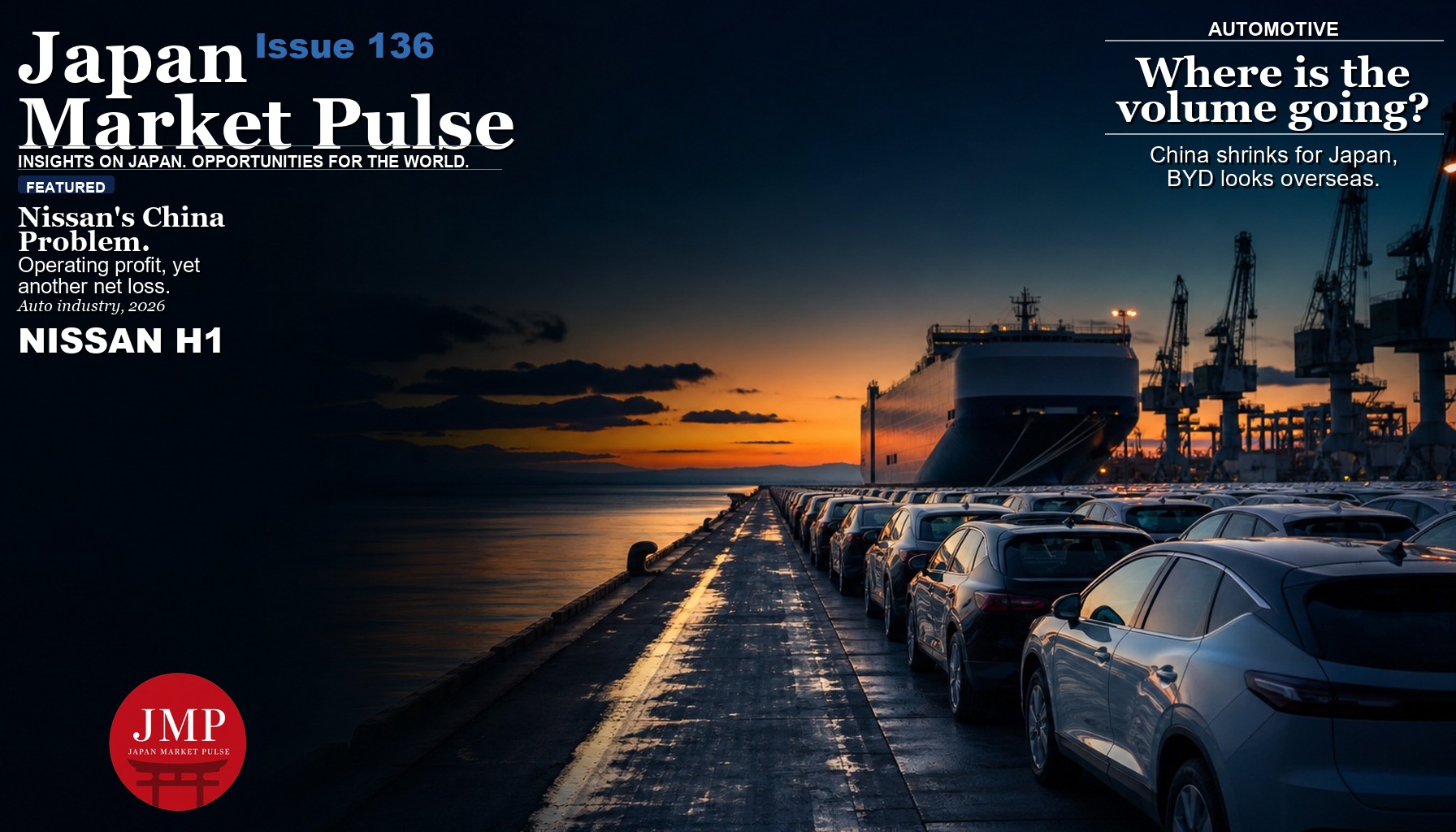
Nissan swung to an ¥80 billion operating profit in the six months to September 2026, yet it still booked a ¥39.7 billion net loss, its second straight interim loss. The sore spot is China, where Japanese brands now hold roughly a tenth of a market in which they once held nearly a quarter.
I have lived in Japan for twenty years, long enough to remember when “Japanese car in China” meant a status symbol and a guaranteed profit line. Nissan’s results for the first half of its fiscal year, published on 11 November 2026, are a useful reminder of how much that has changed. The headline is a loss. The detail is more interesting: Nissan’s consolidated operating result was positive, although its automotive segment still lost money, its American and Japanese sales are improving, and the company is still being dragged down by a single market that no longer behaves the way Japanese executives planned for.
If you supply parts to carmakers, invest in the auto sector, sell into the Chinese market or compete with Chinese brands elsewhere, the story is worth reading closely. It is not only about Nissan. It is about what happens when a country’s largest industry builds its profits around one overseas market, and that market turns local, electric and brutally competitive.
This article covers what Nissan actually reported, why a profit at the operating level still produced a loss at the bottom of the income statement, how Toyota and others fared in China, what BYD is doing by looking outward, and what international operators should take away. Where numbers come from press coverage rather than Nissan’s own filings, I say so, and I have left out anything I could not confirm from at least two sources.
What Nissan Actually Reported
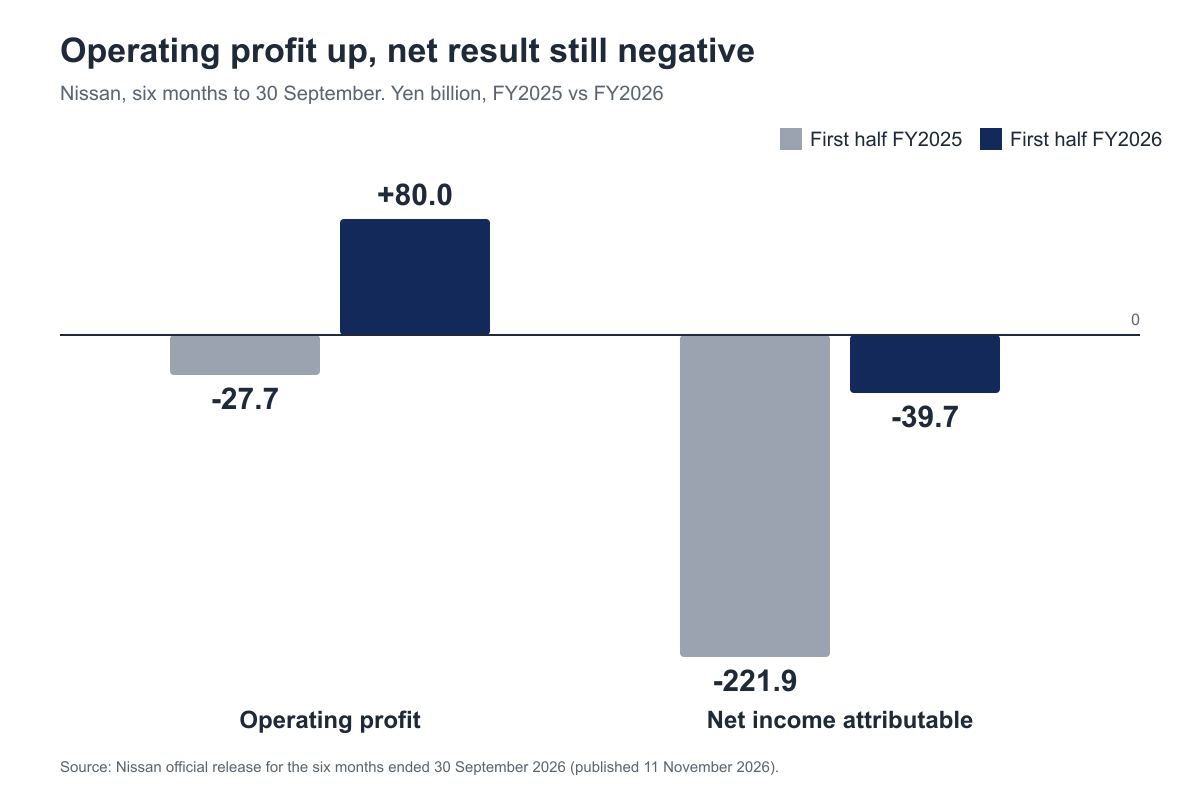
Nissan’s official release for the six months ended 30 September 2026 gives the outline. Net revenue was ¥6.072 trillion, up ¥493.3 billion from a year earlier. Operating profit was ¥80.0 billion, a swing of ¥107.7 billion from an operating loss of ¥27.7 billion in the same period last year. Net income attributable to shareholders was a loss of ¥39.7 billion, compared with a loss of ¥221.9 billion a year earlier. At the exchange rate Nissan used in its own materials, about ¥159 to the dollar, that works out to a loss of roughly $250 million, against an operating profit of roughly $500 million. Those dollar figures are my approximations, not Nissan’s.
Two things stand out. First, the loss is much smaller than last year’s, down by about four-fifths. Japanese press agencies including Jiji Press and Kyodo News described it as the second consecutive year of an interim loss, which is accurate but slightly misses the direction of travel. Second, the gap between the positive operating profit and the negative net result is large. Jiji Press attributed it in part to higher interest payments, and coverage of the results elsewhere points to the same cause. Nissan’s second-quarter net loss was ¥43.5 billion, narrowing from ¥106.2 billion, which the company ascribed mainly to lower restructuring-related items.
Nissan also said that its “Re:Nissan” restructuring plan delivered an additional ¥110 billion in cost savings in the half. It ended the period with automotive net cash of about ¥0.8 trillion and automotive cash and cash equivalents of about ¥2.2 trillion. Global sales for the half were 1.41 million vehicles, which Jiji Press reported as a 4.7% decline, with North America and Japan rising and China falling.
The company kept its full-year forecast of ¥200 billion in operating profit and a ¥20 billion net profit. But it cut its global sales forecast from 3.15 million vehicles to between 2.97 million and 3.0 million, roughly a five percent reduction, and the stated reason is China.
China: The Number That Moves Everything
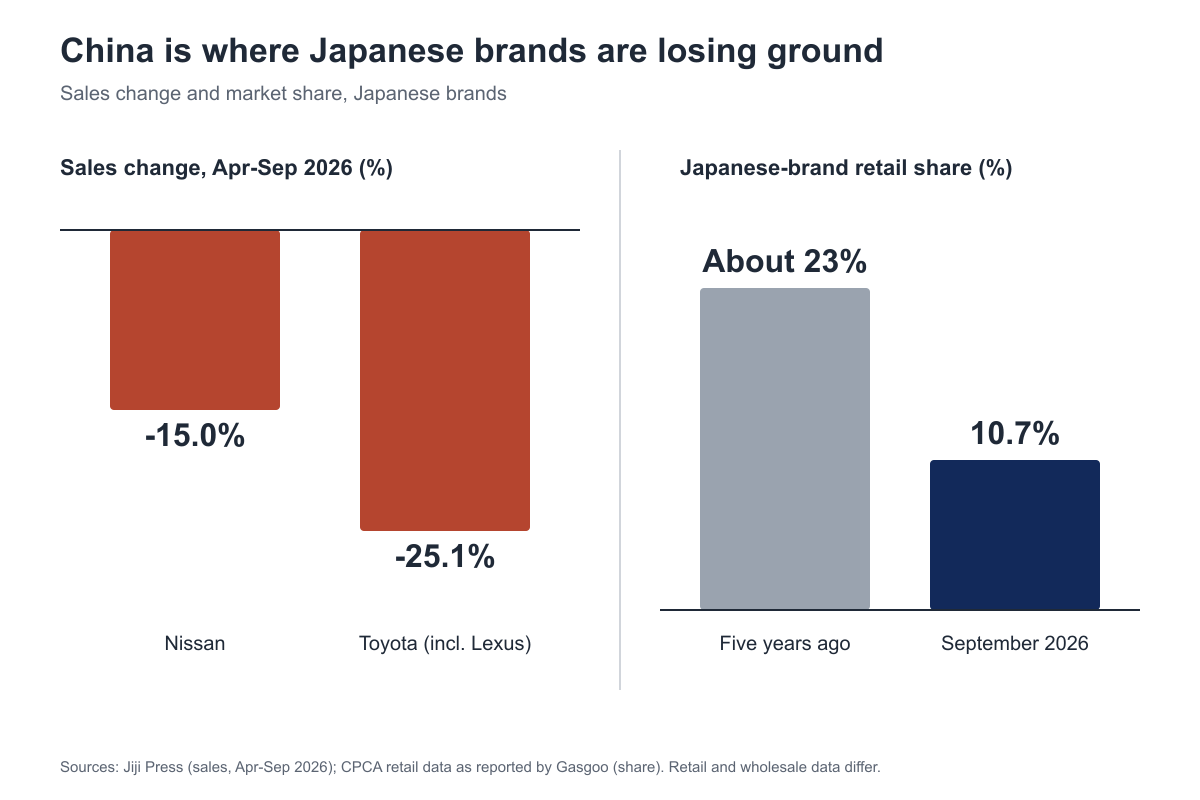
Nissan’s release says that China sales are under greater pressure than it initially expected, citing weaker demand, a faster shift to new energy vehicles and intensifying competition. CEO Ivan Espinosa put it bluntly in the company’s own statement: China remains Nissan’s most significant challenge, and the company needs to stay agile. Jiji Press reported that Nissan’s sales in China fell 15.0% in the half. Investing.com’s summary of the results presentation described Nissan’s retail sales as down 15% in a Chinese market that it said contracted by around 22%. I could not independently verify the market-wide figure beyond that coverage, so treat it as indicative.
The picture is not unique to Nissan. According to Jiji Press, Toyota’s April-to-September sales in China, including Lexus, fell 25.1% to about 680,000 vehicles, a larger drop than its worldwide decline of around 4%. Jiji also reported that Honda’s China sales fell sharply over the period. Japanese-brand retail share in China was 10.7% in September 2026, down 1.4 percentage points from a year earlier, based on figures from the China Passenger Car Association as reported by Gasgoo and Chinese media. Gasgoo adds that the same share was around 23% five years ago. Those figures are retail data, so they will not match wholesale statistics from other bodies, and they should be read as an approximate indicator, not a precise audit.
What is driving the squeeze? Nissan’s own words point to three factors: demand, a faster shift to electric and plug-in vehicles, and intensifying competition. Japanese press coverage of September’s sales adds two more, both of which I could confirm in more than one report: reduced tax incentives hurting new energy vehicle demand, and higher fuel prices tied to instability in the Middle East weighing on gasoline cars. The combination hurts Japanese brands twice. Their strength was petrol and hybrid technology, which has lost its edge in the segment where growth is concentrated, and their China business was historically built on joint ventures whose pricing and product cycles are slower than those of domestic start-ups.
The Mirror Image: BYD Is Looking Overseas

If Japanese carmakers are discovering what it means to be squeezed in China, the biggest Chinese brand is showing where the volume goes next.
BYD reported that its overseas sales from January to October 2026 were about 1.51 million vehicles, up roughly 92% from last year and about 41.6% of its total sales. In October alone, it sold about 170,000 vehicles overseas, more than double the figure of a year earlier, while its domestic sales, estimated by subtracting overseas sales from the total, fell about 10.6%. Over the first ten months its total new energy vehicle sales were about 3.62 million, down about 2.2% from last year. The company has raised its 2026 overseas target to 1.8 million vehicles, up from 1.5 million set at the end of March and 1.3 million at the start of the year, according to reports by China-focused trade publications. A number of those reports also raise questions about BYD’s overseas profitability, which is a reminder that volume is not the same as margin.
The contrast with Japan is worth stating plainly. For two decades, Japanese carmakers sold abroad what they built at home, and later what they built in factories across the United States, Southeast Asia and China. Chinese manufacturers are now doing something different: building a very large home base on electric technology, then exporting the surplus as domestic demand softens. The same market that weakened Nissan is the one making BYD’s overseas push possible. For an operator watching from outside, the question is no longer whether Chinese brands will arrive in your market, but how much price and product pressure they will bring when they do.
Nissan is trying a version of the same idea in reverse. Its release says the company is adjusting production of combustion-engine vehicles and dealer inventory in China, accelerating its N-series lineup of new energy vehicles, and expanding exports. The company has also set up an import-and-export joint venture with Dongfeng, capitalised at one billion yuan and held 60% by Nissan and 40% by Dongfeng, according to trade reports from Gasgoo and Automotive News. In other words, Nissan wants to use its Chinese factories and engineering as a base for the rest of the world, much as BYD does, though with a smaller head start. I found no verified figure for how many vehicles Nissan has actually exported from China so far, so I will not quote one.
The Bright Spots Are Real, and Close to Home

It would be wrong to read the results as a simple tale of decline. Nissan’s release says that sales growth in the United States was driven by American-built models such as the Rogue, Frontier and Pathfinder, and that it raised its outlook for that market. In Japan, the all-new Elgrand and the Kicks are described as gaining customer traction, and the Japanese outlook was also revised upward. Further out, the company points to the Frontier Pro plug-in hybrid in Mexico and the Pixo electric vehicle in Europe as second-half contributors.
That mix tells you something about Nissan’s current strategy. The recovery is being built on markets where Japanese brands still have trust, a dense dealer network and tariff-adjusted manufacturing, rather than on a bet that China will rebound. Nissan also warned that the second half will not benefit from a one-time tariff benefit recognised in the first half, which helps explain why it expects second-half operating profit of ¥120 billion even as it holds the full-year target. The company did not disclose the size of that tariff benefit, so I cannot say how much of the first half’s improvement it explains.
Jiji Press, in its coverage of the same earnings season, reported that Mazda returned to a profit and Mitsubishi Motors narrowed its loss, while other large Japanese carmakers posted higher profits. I have not verified those peer figures independently, and they are presented as reported. The pattern they suggest is nonetheless consistent with Nissan’s own: where Japanese manufacturers are earning money, it is largely outside China.
What This Means for International Operators

If you supply parts or materials to Japanese carmakers, ask where the volume is really going. A supplier whose growth case was built on Japanese-brand production in China has a problem when that production is shrinking by double digits. Check how much of a customer’s volume is tied to Chinese joint ventures, and whether it is moving to export or to plants in the United States and Japan.
If you sell into China, assume local competition sets the price. Toyota’s drop of more than a quarter in the half is the clearest sign that even the strongest foreign brand can lose ground when the market shifts to electric vehicles. Japanese brands were built on reliability and resale value, advantages that matter less when a Chinese rival offers more technology at a lower price.
If you compete with Chinese brands elsewhere, watch the export curve. BYD’s overseas sales are roughly doubling. The same pressure that is hitting Japanese manufacturers in China is likely to show up in Southeast Asia, Latin America, the Middle East and Europe. The trade press tends to focus on the models; the real signal is the shift of volume away from the domestic market.
If you invest, separate operating results from the bottom line. Nissan’s operating profit and net loss tell two different stories, and the gap comes from items below the operating line, which the full financial statements break down. Read the full income statement and the liquidity position, not just the headline. Automotive cash of ¥2.2 trillion and net automotive cash of ¥0.8 trillion give the company room to execute, but they do not remove the need to fix China.
If you are considering a partnership with a Japanese manufacturer, expect a year of reorganisation. Nissan has said it will keep adjusting production and inventory in China while accelerating new models. Counterparts inside such companies are under pressure to cut costs and prove a turnaround, which affects how quickly they can make decisions and what terms they will accept.
Limits of This Analysis
A few cautions apply. Nissan’s release gives no China volume or market share figures, so the China numbers here come from Japanese press agencies and trade reports and should be checked against the company’s detailed data tables. Retail and wholesale statistics for China differ, so share figures vary by source. BYD’s numbers appear in several reports that do not perfectly agree with each other, and the company’s total includes models that are not directly comparable with Nissan’s. Finally, a full-year forecast is a forecast: Nissan’s own plan assumes a second-half operating profit of ¥120 billion without the first half’s one-time tariff benefit, and a deeper China slowdown could change that.
Frequently Asked Questions
Q. Was Nissan profitable at the operating level?
A. On a consolidated basis, yes: operating profit for the six months to September 2026 was ¥80.0 billion, compared with a loss of ¥27.7 billion a year earlier. Nissan’s own segment table, however, shows the automotive business and eliminations at an operating loss of about ¥81.4 billion, with financial services and other items making up the difference. The net loss of ¥39.7 billion arose below the operating line.
Q. How big is the loss in dollars?
A. Roughly $250 million at the ¥159 per dollar rate Nissan used in its materials. This is an approximate conversion, not a figure published by the company.
Q. How badly are Japanese carmakers doing in China?
A. Nissan’s China sales fell 15.0% in the half, and Toyota’s fell 25.1% to about 680,000 vehicles, according to Jiji Press. Japanese-brand retail share was 10.7% in September 2026, compared with about 23% five years earlier, based on China Passenger Car Association data reported by Gasgoo.
Q. Is Nissan still expecting a profit this year?
A. Yes. It kept its full-year forecast of ¥200 billion in operating profit and ¥20 billion in net profit, while cutting its global sales forecast to between 2.97 million and 3.0 million vehicles from 3.15 million.
Q. Where is Nissan growing?
A. The company cites the United States, driven by the Rogue, Frontier and Pathfinder, and Japan, where the new Elgrand and the Kicks are gaining traction. It raised its outlook for both markets.
Conclusion
Nissan’s second consecutive interim loss is smaller, narrower and more explicable than the headline suggests. The company made an operating profit, trimmed its costs and holds substantial cash. But the loss exposes the heart of a larger problem for Japan’s auto industry: China was once the engine of growth, and it has become the place where Japanese brands are losing ground fastest, to local rivals that are now taking their model overseas.
For international operators, the practical lesson is to follow volume rather than logos. Watch where Japanese manufacturers are still making money, watch where Chinese brands are expanding, and read earnings statements below the operating line. The most important car story in Japan this year is not one new model. It is a shift in where the world’s cars will be built, sold and priced.
If you’re interested in this topic, the Japanese market more broadly, or what KETCHUPs is working on, we’d love to hear from you — please reach out via our contact form.
Japan Market Pulse is a weekly read on what the Japanese consumer-tech, food, and mobility markets are choosing to do, written for international operators who want to know what is happening before it shows up in the global trade press.
Subscribe at ketchups.co/japan-market-pulse.