


On 30 October 2026, the Association of Japanese Animations (AJA) announced that Japan’s anime industry reached a record ¥4.4491 trillion (about $28 billion) in 2025, up 15.8%. Overseas markets supplied ¥2.54 trillion, or 57.1%, and grew faster than the domestic market. Separately, AJA estimates the revenue of the animation companies themselves at ¥505.5 billion, about 11% of that total. The distance between those two measures is now the central question of the business.
For most of the last decade, “anime is booming” was a feeling more than a number: crowded convention halls, streaming charts, Japanese films topping box offices in other countries. The numbers have now caught up with the feeling. In late October, Japan’s main anime trade body published its preliminary estimate for 2025, and it crossed ¥4 trillion for the first time. It is the fifth record year in a row.
If you license a character, sell merchandise, run a streaming catalog, plan a collaboration with a Japanese rights holder, or simply want to understand where Japan’s soft-power economy is heading, this is the most useful single dataset of the year. It is also easy to misread. A headline total of ¥4.45 trillion does not mean studios are rich. It measures what viewers and fans are estimated to pay across the whole chain, from tickets and streaming to figures and concerts. The animation companies at the start of that chain take a small slice.
This article covers what AJA announced and how its numbers are defined, how fast the overseas side has grown, what the studio-versus-market gap means, what the government is doing about it, how to read the figures with care, and what international brands and licensors should take from them.
What the Association Announced, and What the Numbers Measure
AJA is the industry body of Japan’s animation production companies. Each year it publishes the Anime Industry Report, and a few weeks before publication it releases preliminary market-size figures. The 2025 figures were presented on 30 October 2026 at TIFFCOM, the content market held alongside the Tokyo International Film Festival, and posted in a press release. The full Anime Industry Report 2026 is due in early December 2026, according to AJA’s announcement.
AJA reports two different measures, and mixing them up is the most common error in coverage:
The anime industry market. This is the broad measure: an estimate of the total amount users pay for anime-related products and services. It includes film and TV distribution, video packages, streaming, merchandising and other secondary uses, advertising and promotion, music, live events, and overseas sales. For 2025 it was ¥4.4491 trillion, up 15.8% on 2024, with both the size and the growth rate the highest AJA has recorded.
The anime business market. This is the narrow measure: an estimate of the revenue of animation production companies. For 2025 it was ¥505.5 billion, up 8.4%, also a record.
Both numbers are growing. They are not the same thing, and the difference between them is the subject of much of this article.
The yen figures convert to roughly $28 billion and $3.2 billion at recent exchange rates. Dollar conversions differ slightly between outlets (Señal News reported $28.2 billion, Screen Daily $28.5 billion), so this article uses yen as the primary unit.
The Headline: Domestic Up 14%, Overseas Up 17%
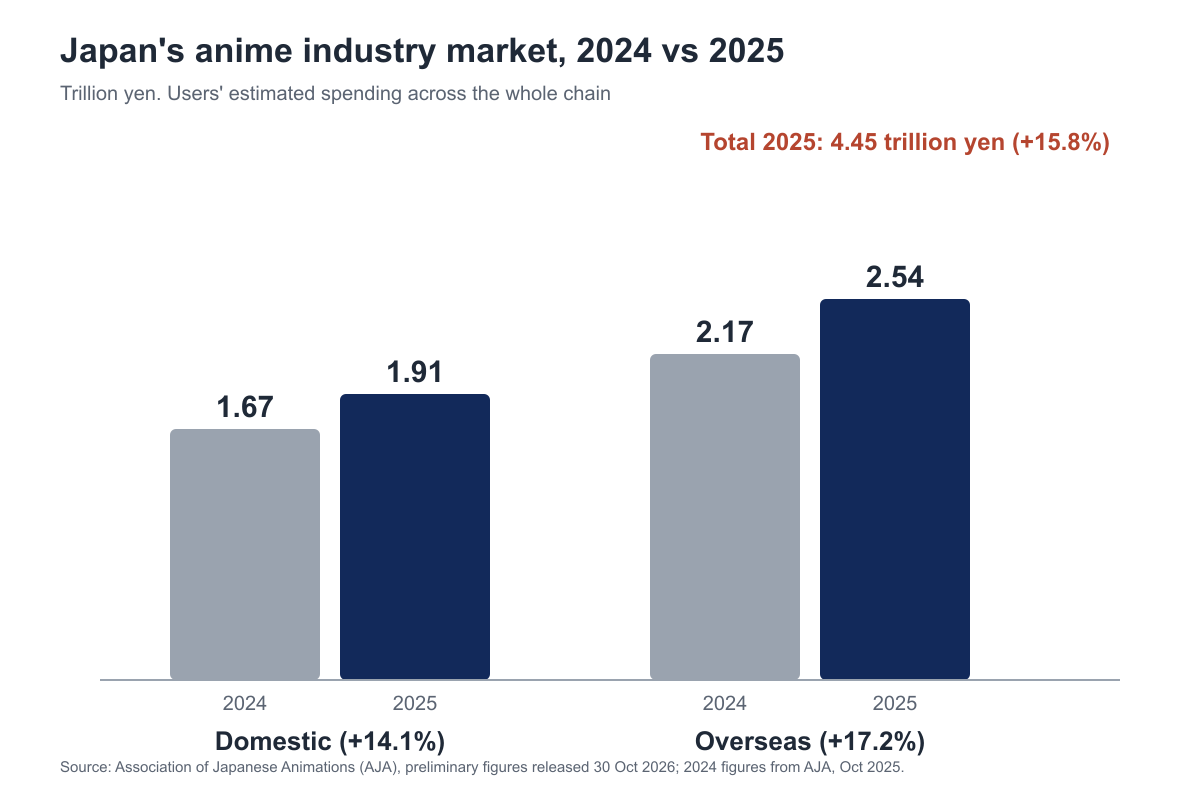
AJA’s split of the broad market for 2025, with 2024 for comparison:
– Total: ¥4.4491 trillion in 2025, up 15.8%. In 2024 it was ¥3.8407 trillion, up 14.8%. – Domestic: ¥1.9065 trillion in 2025, up 14.1%. In 2024 it was ¥1.6705 trillion, up 2.8%. – Overseas: ¥2.5426 trillion in 2025, up 17.2%. In 2024 it was ¥2.1702 trillion, up 26.0%. – Overseas share: 57.1% in 2025, against 56.5% in 2024.
The 2024 figures come from AJA’s release a year earlier, reported by gamebiz.
Two things stand out. First, the overseas market is now ¥636 billion larger than the domestic one, up from a gap of roughly ¥500 billion a year earlier. Second, the domestic market stopped being flat. In 2024 it grew only 2.8%; in 2025 it grew 14.1%. That means the 2025 story is not only “overseas is exploding.” Japan’s own viewers and fans spent substantially more as well. AJA does not break down the cause in its preliminary release, but a strong film year looks like one part of the background. The animated feature Demon Slayer: Kimetsu no Yaiba – The Movie: Infinity Castle earned about $793 million worldwide and is reported by Screen Daily to be the highest-grossing Japanese film of all time.
AJA’s press release says anime has achieved a “breakthrough” abroad: it is no longer unusual for Japanese anime to appear near the top of overseas box-office rankings and global streaming charts.
How Fast the Overseas Side Has Grown

AJA does not give a 2023 figure in this year’s release, but it can be derived from the growth rates it reports. Dividing the 2024 figures by their reported growth rates gives approximate 2023 values: a total of about ¥3.35 trillion, a domestic market of about ¥1.63 trillion, and an overseas market of about ¥1.72 trillion. These are the author’s calculations from rounded percentages and should be treated as approximate.
On that basis, between 2023 and 2025:
– The overseas market grew from roughly ¥1.72 trillion to ¥2.54 trillion, an increase of about 48% in two years. – The domestic market grew from roughly ¥1.63 trillion to ¥1.91 trillion, about 17%. – The total grew by about a third, from roughly ¥3.35 trillion to ¥4.45 trillion.
Señal News reports that overseas spending has now exceeded domestic spending for three consecutive years, that is, 2023, 2024 and 2025. The year-by-year history before 2023 is outside this article’s verified data, so the direction rather than the detail is the safe takeaway: the overseas side has been gaining share, and 2025 continued that trend.
AJA itself cautions that exchange rates and world affairs affect the numbers. That is worth keeping in mind. The overseas figure is a yen estimate of foreign spending, so a weaker yen raises it even when foreign spending is unchanged in local currency.
Two Measures, One Gap: Studio Revenue vs Fan Spending
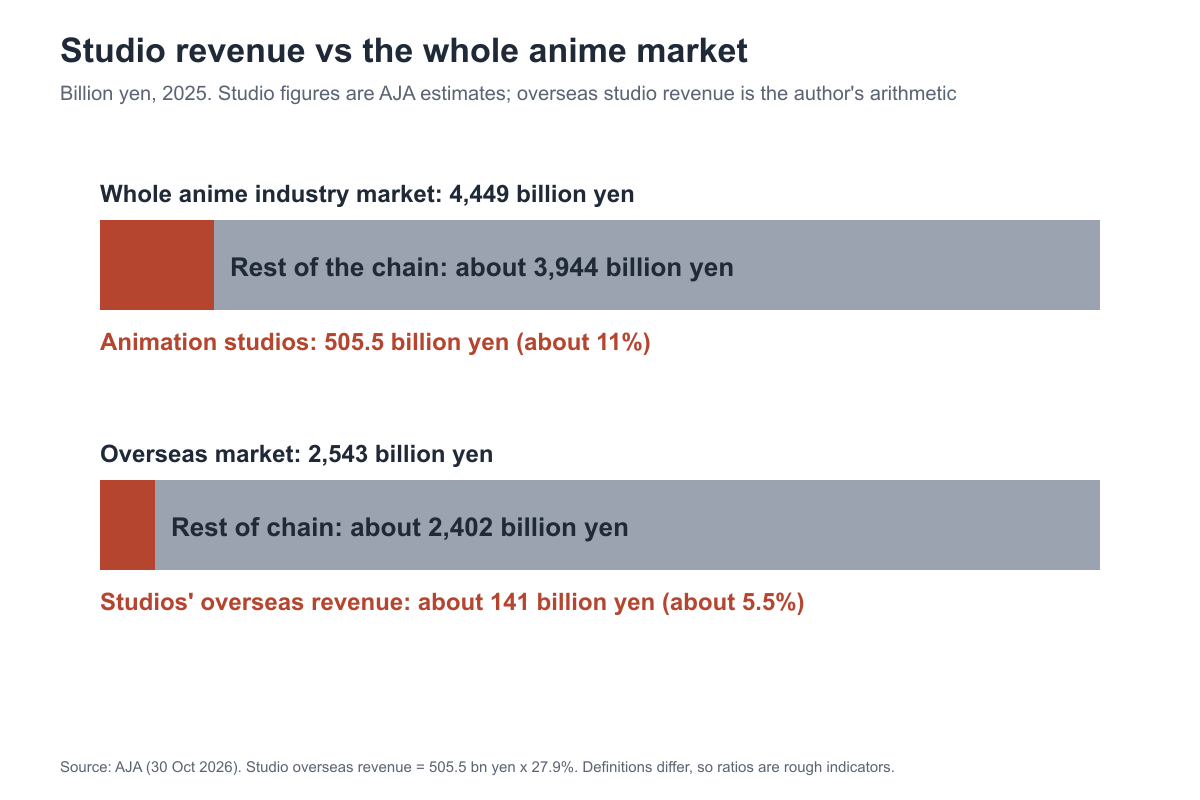
Here is the part most headlines skip. The broad market is ¥4.4491 trillion. The studio market is ¥505.5 billion. Divide one by the other and you get about 11.4%. This is a ratio of two differently defined measures, not a measured revenue share: AJA does not say that ¥11 of every ¥100 a fan spends reaches a studio. But the ratio shows how small the production companies’ own revenue is relative to the whole anime economy around them.
That is not a scandal by itself. Anime is an ecosystem in which toy makers, publishers, music labels, theater chains, streaming services and retailers all earn money, and many of them carry large costs and risks that studios do not. But it does explain why a record year for “anime” is not automatically a record year for the companies drawing it.
AJA also splits the studio market by origin of revenue:
– 2025: 72.1% domestic, 27.9% overseas – 2024: 74.5% domestic, 25.5% overseas
So the overseas share of studio revenue is rising, from 25.5% to 27.9%, which fits the report’s note that more production companies now earn rights income from both Japan and abroad. The press release adds that the domestic part of the studio market includes production fees, which are fixed payments for making a show, rather than income tied to its success.
Now combine the two splits, as a reference ratio only. The author’s arithmetic, using AJA’s rounded figures:
– Studios’ overseas revenue in 2025: about ¥141 billion (27.9% of ¥505.5 billion). – Overseas market in 2025: ¥2.5426 trillion. – The first divided by the second: about 5.5%.
Run the same sum for 2024 (¥466.2 billion × 25.5% ≈ ¥119 billion, against ¥2.1702 trillion) and the ratio is also about 5.5%. In other words, studios’ overseas revenue has grown from roughly ¥119 billion to ¥141 billion, in step with the overseas market, so the ratio between them has not moved.
Two warnings apply, and they matter. These numbers measure different things (the broad market counts estimated user spending across the chain, including distributor and retailer margins; the narrow one counts studio revenue), and they are estimated by different methods. The 5.5% is therefore not a measured share of overseas spending and should not be read as one. What can be said is that, on AJA’s own figures, studio revenue has grown more slowly than the market as a whole (8.4% against 15.8% in 2025), and that the ratio between the overseas measures was stable across two years. Whether it changes depends on how contracts are structured, which international partners are well placed to influence.
Why the Government Cares: A ¥6 Trillion Target
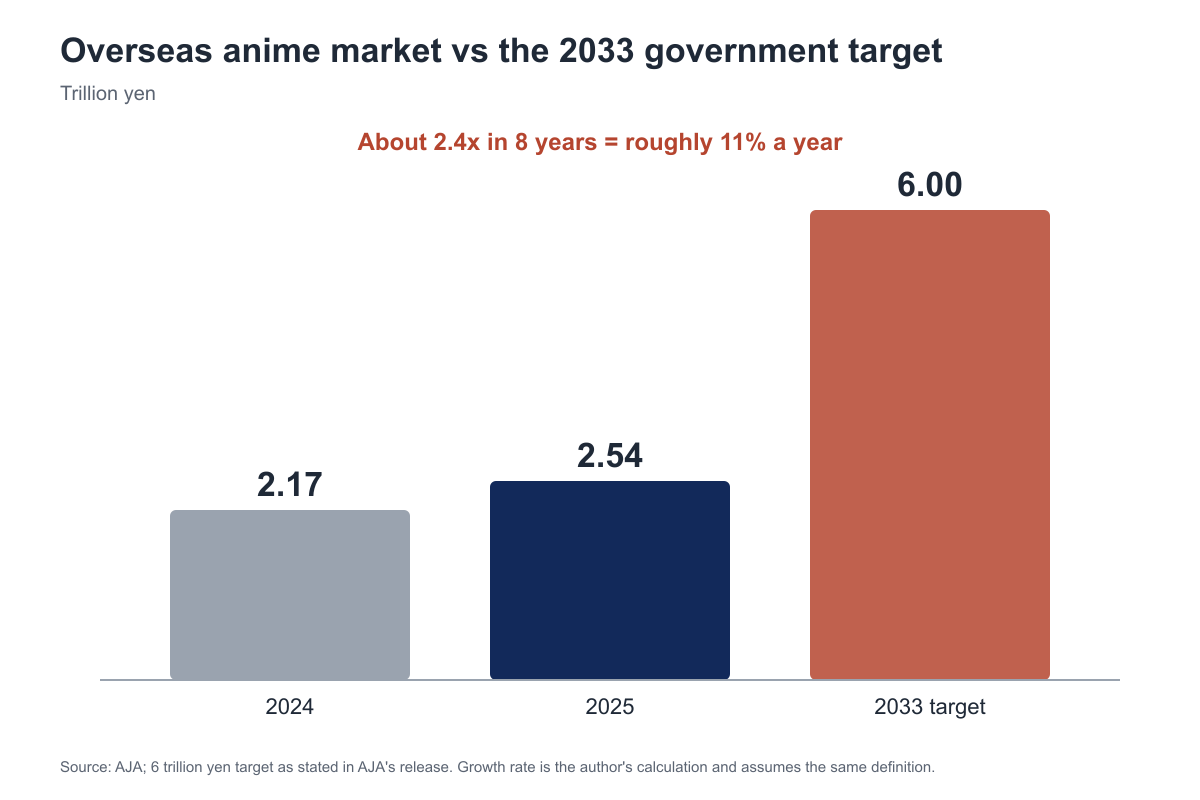
The government has set a goal of ¥20 trillion in overseas sales for Japan’s content industries, including games, anime, manga, live-action film and TV, and music, by 2033. Within that, AJA’s press release says the target for anime is ¥6 trillion in overseas sales.
Anime’s overseas market in 2025 was ¥2.54 trillion. Reaching ¥6 trillion by 2033 means growing it about 2.4 times in eight years, which works out to compound growth of roughly 11% a year. The 2025 growth rate of 17.2% is above that. If it were sustained, the ¥6 trillion mark would arrive around 2031. These are the author’s calculations, not AJA’s forecasts, and they assume the target uses the same definition as AJA’s overseas market, which the sources do not confirm.
The more telling number is the policy money. In an October 16 proposal, AJA noted that content has been placed among the 17 growth fields of the Takaichi cabinet, that related budgets were doubled in the previous fiscal year, and that the fiscal 2027 budget request includes more than ¥250 billion in content-related spending, including a multi-year “creator fund.” AJA also called for a new, unified support body to coordinate four ministries and agencies and for piracy to be treated as a core function.
The Problems the Industry Itself Names

The report is a celebration, but the industry’s own commentary lists obstacles:
Piracy. AJA’s proposal calls online piracy the biggest obstacle to overseas expansion, because it undermines the value of the content itself. It asks for stronger international enforcement and cooperation with local authorities and platforms.
Localization. In free-text answers to AJA’s survey, studios said that expanding into new growth regions requires localization to local language, culture and law, along with anti-piracy measures.
Structure. The press release notes that the domestic part of studio revenue still contains production fees. Moving from fee-based work to rights-based income is one way studios could participate more in the growth, and AJA observes that more companies are doing so.
None of these is new, but it is notable that a record-year announcement leads with them.
How to Read These Numbers (and Their Limits)

– These are preliminary figures. The full report arrives in December 2026 and numbers can be revised. AJA also holds a seminar on 25 December for buyers of the report. – “Market size” is an estimate of user spending. It is not revenue for any one company and not a measure of profit. The estimation methods are described in the report, which costs ¥22,000 and is not free. – Currency matters. Overseas figures are expressed in yen. A weaker yen inflates them, as AJA itself warns. – AJA is an industry body. It represents animation production companies and has an interest in presenting the industry’s strength, and in calling for government support. The figures are the best available, but they are a trade association’s estimate. – Derived figures are approximate. The 2023 values and the 5.5% studio ratio in this article were calculated from rounded percentages, as noted above. – Coverage is inconsistent. One outlet printed the total as ¥4.491 trillion; AJA’s own release says ¥4.4491 trillion. This article uses the AJA release.
What International Brands and Licensors Should Take From This

The demand is outside Japan, and so is the growth. More than half of the market, and the faster-growing half, is overseas. If your product or brand wants to ride anime’s popularity, you are more likely to meet the audience through global streaming and local retail than through Japanese channels.
The money flows through licensing. Because estimated fan spending is so much larger than studio revenue, most opportunities for partners are in merchandising, collaborations, events, music and distribution, not in commissioning animation. Understand who holds the rights and which of them you actually need to deal with.
Expect a more organized counterpart. With government budgets rising and a new support body proposed, Japanese rights holders will have more help and more coordination for overseas deals. A partner that can demonstrate anti-piracy measures and local localization capability will look more attractive.
Localization is a competitive advantage. The studios named it, and the data shows overseas share rising. Partners who can adapt language, cultural references and legal requirements for a market are doing the work the industry says it needs.
A Practical Checklist
1. Identify where you sit on the value chain. Are you a distributor, a merchandiser, a platform, a retailer? Your realistic participation in an overseas fan’s spending depends on that. 2. Ask who the rights holder is. In anime, rights are often shared among production committees. A deal with a studio may not cover merchandise or music. 3. Plan for piracy. If you sell physical goods, ask about counterfeit controls. If you sell digital content, ask about enforcement. 4. Price in yen risk. If you are quoting or contracting in yen, build in a view on the exchange rate. 5. Track the December report. The full figures will break the market into film, TV, streaming, merchandise, music and live events, which will show where the growth is concentrated.
What to Watch Next
– The Anime Industry Report 2026 (early December 2026). It will break down the total by category and show how much of the growth came from film, streaming or merchandise. – The fiscal 2027 budget. Whether the requested content-related funding, including the creator fund, survives the budget process, and whether the proposed unified support body is created. – The overseas share. If it keeps rising above 57.1%, the industry’s center of gravity will have moved further abroad. – Studio profitability. Whether the studio market’s 8.4% growth, slower than the total’s 15.8%, begins to catch up as rights income spreads.
Frequently Asked Questions
Q. How big is Japan’s anime market?
A. AJA’s preliminary estimate for 2025 is ¥4.4491 trillion, up 15.8% and the first time it has exceeded ¥4 trillion. That is roughly $28 billion at recent exchange rates. The narrower measure of animation production companies’ revenue is ¥505.5 billion, up 8.4%.
Q. How much comes from outside Japan?
A. ¥2.5426 trillion, or 57.1%, up 17.2% on 2024. The domestic market was ¥1.9065 trillion, up 14.1%.
Q. Do anime studios earn most of that money?
A. No, at least not on AJA’s measures. The studios’ revenue of ¥505.5 billion is about 11% of the ¥4.4491 trillion broad market. These are two differently defined estimates, so this is a ratio, not a measured revenue share. The rest of the broad market covers distribution, merchandise, music, live events and other businesses.
Q. Is the figure final?
A. No. AJA released preliminary figures on 30 October 2026 and will publish the full Anime Industry Report 2026 in early December.
Q. What is the government’s target for anime?
A. According to AJA’s release, the government aims for ¥20 trillion in overseas content sales by 2033, including ¥6 trillion for anime. Anime’s overseas market was ¥2.54 trillion in 2025.
Q. Is the growth coming only from overseas?
A. No. Overseas grew 17.2%, but the domestic market grew 14.1%, a sharp pickup from 2.8% a year earlier.
Q. Where can I find official figures?
A. AJA’s announcement page and the report itself. For anime merchandise to explore while you research, a search for anime figures on Amazon is a quick way to see what is selling.
Conclusion
Japan’s anime industry crossed ¥4 trillion in 2025 because fans everywhere spent more, and more than half of that spending now comes from outside Japan. The growth is real, broad and, by AJA’s own account, still accelerating overseas. But the record year is not evenly spread. Studio revenue is about 11% of the broad market, and it grew by 8.4% while the market grew by 15.8%. The gap between the two measures is worth watching.
For international brands, the lesson is practical. The opportunity in anime sits in licensing, merchandise, distribution and localization, and it will be organized more tightly as the government spends more and the industry builds a joint support body. For Japan, the open question is whether the money that arrives from abroad reaches the people who create the work.
If you’re interested in this topic, the Japanese market more broadly, or what KETCHUPs is working on, we’d love to hear from you — please reach out via our contact form.
Japan Market Pulse is a weekly read on what the Japanese consumer-tech, food, and mobility markets are choosing to do, written for international operators who want to know what is happening before it shows up in the global trade press.
Subscribe at ketchups.co/japan-market-pulse.