

Aeon reported record first-half sales of ¥5.9 trillion and a record operating profit of ¥130.7 billion on 13 October 2026. Yet its general merchandise stores and its supermarkets both lost money, and the share price hit a new low for the year the next day. The profit came from drugstores, shopping malls and financial services. The company that built its name on the neighborhood supermarket is now earning its living somewhere else.
If you have been to Japan, you have probably walked through an Aeon. It might have been a giant mall with a cinema and a food court, a “MaxValu” supermarket near a train station, or a small “My Basket” shop selling bento and drinks. Aeon is one of the largest retail groups in the country, and it sells everything from groceries and clothing to credit cards and drugstore products under one roof or another.
Its half-year results, published on 13 October 2026, are worth reading closely, because they describe a quiet change in what a Japanese retailer is. The headline numbers look excellent. The detail underneath tells a different story: the stores most people picture when they think of Aeon lost money, and other businesses covered for them.
This article walks through what Aeon reported, which parts of the group earned the profit and which lost it, why the store business struggled, how the company is trying to fix it, how investors reacted, and what the numbers suggest to anyone who sells into Japanese retail or competes with it.
What Aeon Reported: A Record on Top, Losses Underneath
Aeon’s fiscal year ends in February, so the first half of fiscal 2027 covers March to August 2026. According to the company’s results as reported by Japanese trade media on 13 October:
Operating revenue: ¥5,904.1 billion, up 13.8%, a record for a half year
Operating profit: ¥130.7 billion, up 10.7%, also a record for a half year and the second year running
Ordinary profit: ¥108.3 billion, up only 1.7%
Net profit attributable to shareholders: ¥13.3 billion, about 3.3 times the year before
Full-year forecast: unchanged, at operating revenue of ¥12 trillion (up 12.0%), operating profit of ¥340 billion (up 25.7%) and net profit of ¥73 billion (up 0.4%)
Two things stand out. First, the gap between the operating profit growth of 10.7% and the ordinary profit growth of 1.7% shows that weaker non-operating results took back most of the gain. Second, the net profit multiple looks dramatic, but it starts from a very low base. Net profit of ¥13.3 billion on revenue of ¥5.9 trillion is a margin of about 0.2%. The company also booked about ¥4.2 billion of special losses from disasters, including a strong earthquake in Kumamoto Prefecture on 28 July, which was followed by an explosion at Aeon Mall Kumamoto, and heavy rain in Chiba in August.
Part of the revenue growth is also not organic. Aeon took control of the drugstore chain Tsuruha Holdings in January 2026, and Tsuruha’s sales now sit in Aeon’s consolidated numbers. That makes the half-year growth look larger than the growth of the stores that were already there a year ago.
Where the Profit Came From: Three Businesses, Not Stores
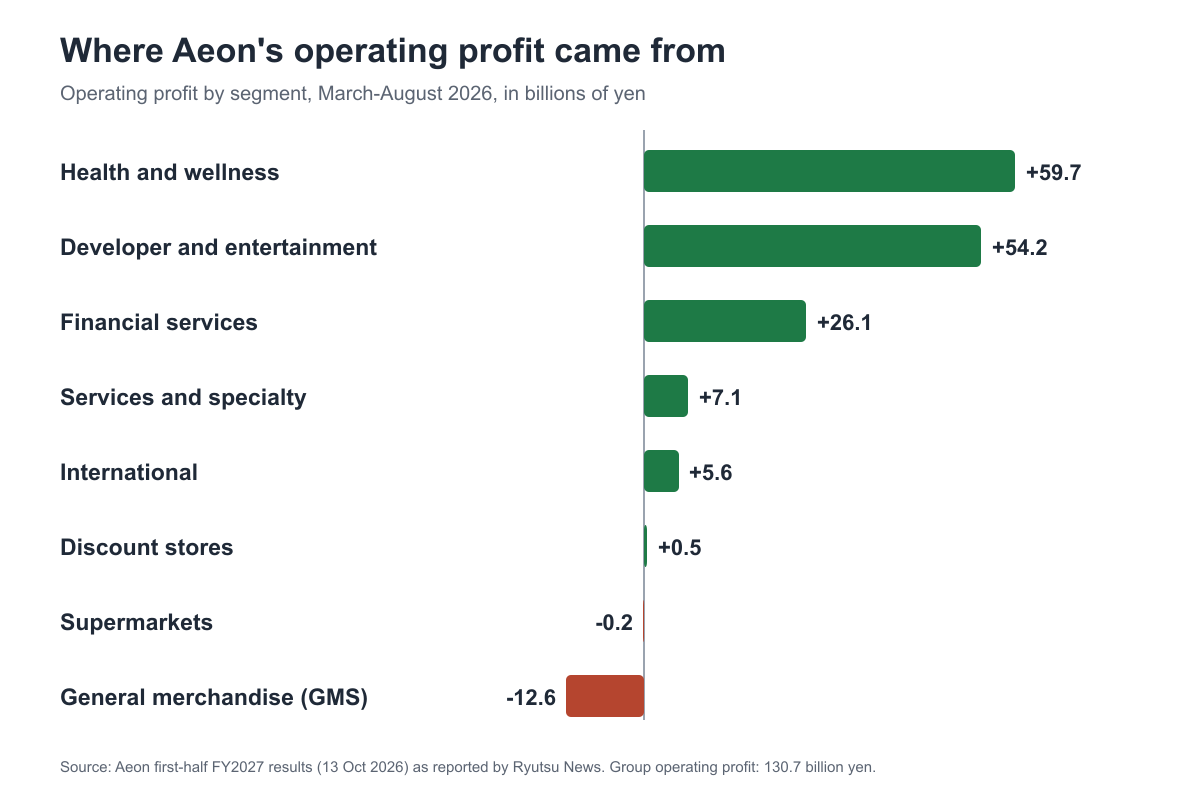
Aeon reports its results in segments. The operating profit by segment for March to August 2026 was:
Health and wellness (drugstores, led by Tsuruha): ¥59.7 billion, up ¥37.0 billion
Developer and entertainment segment (includes Aeon Mall, cinemas and amusement): ¥54.2 billion, up ¥13.2 billion
Financial services (cards, banking, payments): ¥26.1 billion, down ¥0.9 billion
Services and specialty stores: ¥7.1 billion, down ¥1.7 billion
International: ¥5.6 billion, up ¥0.7 billion
Discount stores: ¥0.5 billion, down ¥3.2 billion
General merchandise stores (GMS): a loss of ¥12.6 billion
Supermarkets: a loss of about ¥0.1 billion
Add up the three largest earners (drugstores, malls and financial services) and you get roughly ¥140 billion. That is more than the ¥130.7 billion the whole group earned, because the group-level figure also absorbs the losses in the store businesses and a net adjustment of roughly ¥10 billion, by my arithmetic from the segment table.
The drugstore story is the simplest. Tsuruha brought its network into the group, and Aeon’s health and wellness segment grew its revenue by 87.4% to ¥1.28 trillion. Tsuruha reported 53 openings and 77 closures in the half and ended with 5,652 stores in Japan, so the growth is coming from scale and mix rather than from opening new stores quickly. Drugstores sell cosmetics, over-the-counter medicine and daily goods, categories where Japan’s shoppers have been willing to spend even while they cut back on groceries.
The mall business is the second engine. Aeon Mall’s revenue rose 6.7% to ¥248.4 billion and its operating profit rose 37.9% to ¥44.0 billion. In Japan, the 32 malls that Aeon renovated saw tenant sales rise 6.8%. Mall tenants in dining, amusement and services did well, while apparel was weak. Analysts described this as demand for “close, cheap, short” leisure: a day out that does not need an airplane ticket.
Overseas, Vietnam is the bright spot. Aeon has said it is placing a large share of its growth hopes on the market, and trade press has reported more shopping-center openings and joint drugstore-and-food stores with Tsuruha planned there. We did not verify specific same-store sales or visitor figures against Aeon’s official materials, so none are cited here.
Where It Was Lost: General Merchandise Stores and Supermarkets
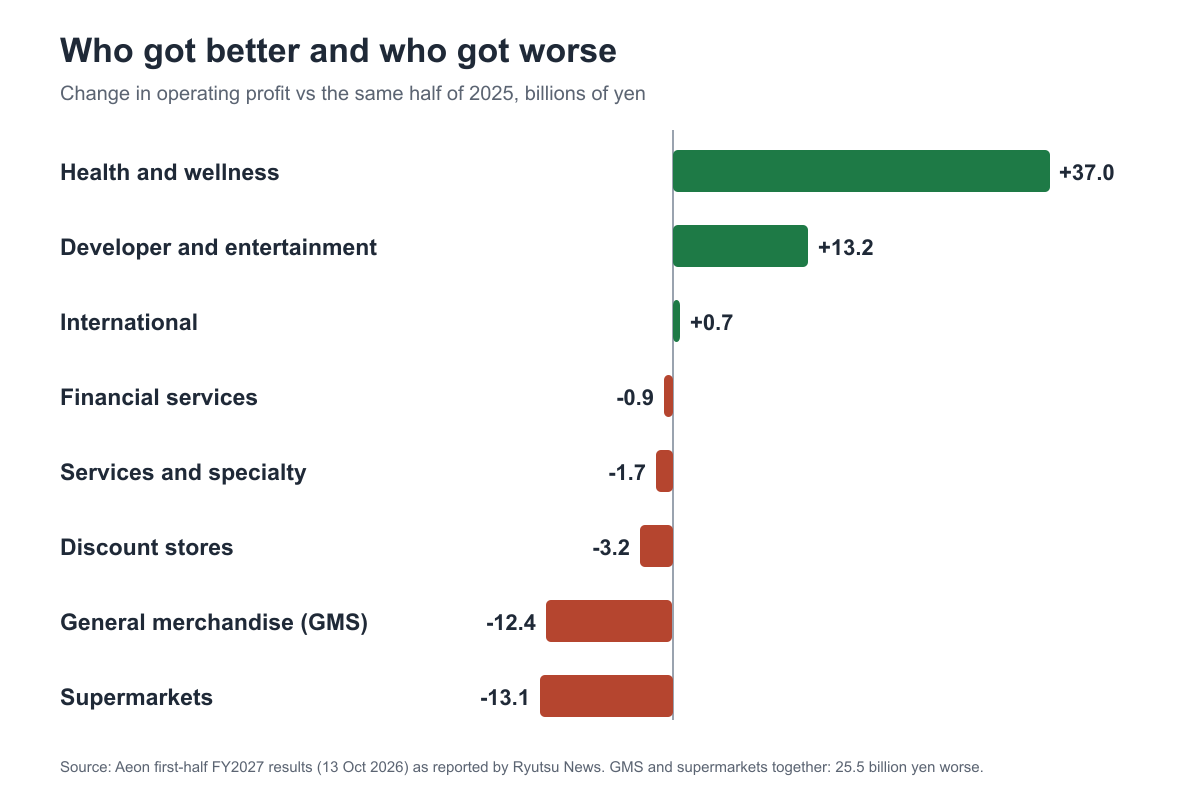
The weak spot is the retail core. Aeon’s general merchandise stores, the big “Aeon” and “Aeon Style” stores that sell food, clothing and household goods under one roof, had revenue of ¥1.87 trillion, up 2.6%. But their operating result swung to a loss of ¥12.6 billion from a loss of only ¥0.2 billion a year earlier, a deterioration of about ¥12.4 billion.
The main operating company, Aeon Retail, tells the same story in more detail. Its same-store sales rose just 0.6%, its revenue rose 2.5% to ¥1.02 trillion, and its operating loss widened to ¥13.3 billion, ¥9.7 billion worse than the year before.
The supermarket segment, which includes regional chains such as Maruetsu and Kasumi in the Tokyo area, fell harder. Revenue slipped 1.2% to ¥1.53 trillion, and the segment moved from a profit of about ¥12.9 billion a year earlier to a loss of about ¥0.1 billion. Together, the two food-and-general retail segments lost about ¥12.7 billion in the half and were about ¥25 billion worse than a year earlier.
The discount-store segment also fell short. Its revenue rose 0.7% to ¥218.7 billion, but its operating profit dropped by ¥3.2 billion to ¥0.5 billion. The company said that it could not absorb higher labor, electricity and delivery costs with sales that were barely growing.
Why the Stores Struggled: Four Pressures at Once
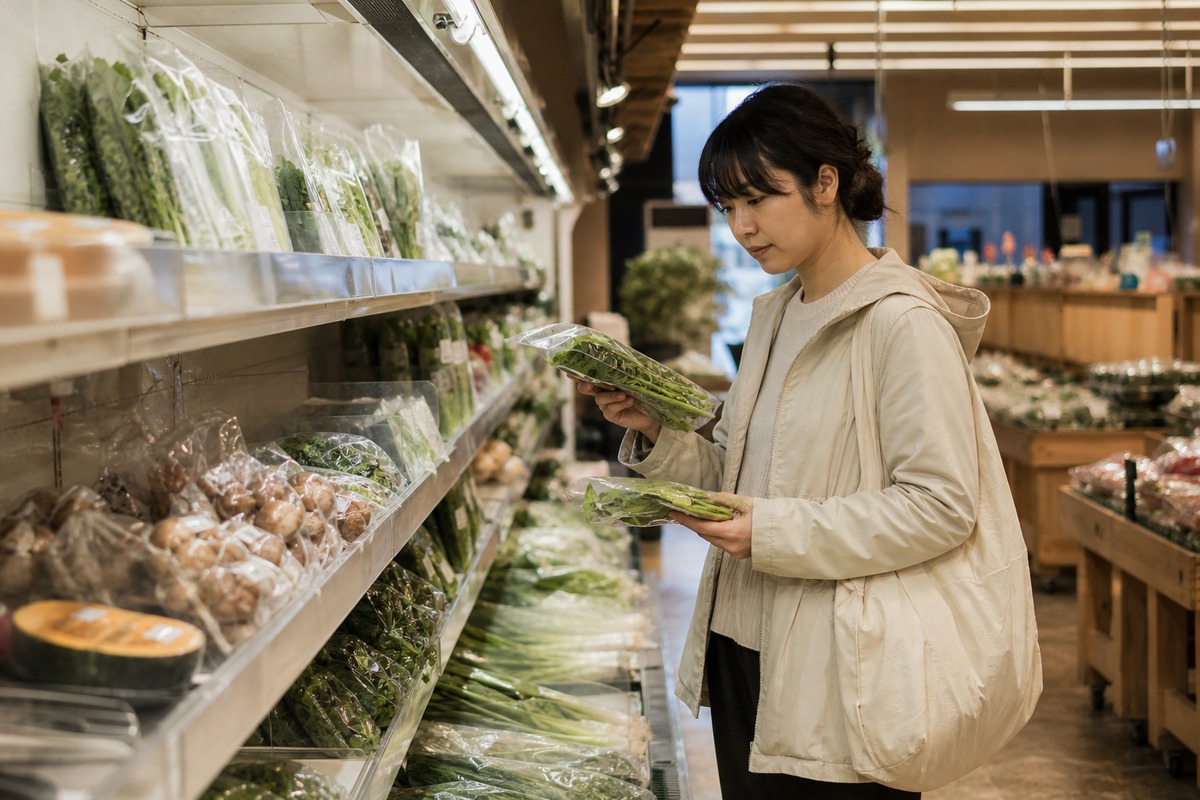
Aeon’s explanation, as relayed by Japanese retail media, combines several causes that arrived together:
A rebound from last year’s rice demand. In 2025, Japan’s rice shortage and the release of stockpiled rice pulled shoppers into supermarkets. In 2026 that special demand faded, which left food sales without a boost in the comparison.
Cautious consumers. Aeon’s president, Akio Yoshida, described the market as polarized: shoppers are careful with everyday spending but still pay for things they see as valuable. The company also pointed to the effect of the Middle East situation on consumer sentiment and thrift.
Weak clothing and home goods. Unsettled weather hurt apparel and “housing and leisure” categories, which are the higher-margin parts of a general merchandise store. When food is the only thing growing, profit per shopper falls.
Price policy and rising labor costs. Aeon had pushed price cuts and promotions to win customers back. Management admitted that the price policy and promotions did not work well enough in the half. At the same time, wages kept rising, and store payroll is one of the largest costs in the business.
An executive vice-president, speaking at the results briefing, said in effect that the company had been unable to communicate the value of its products well, rather than competing on price alone. In plain terms, discounts cost money, and shoppers did not see enough of a reason to come more often or buy more.
What 100 Yen of Sales Earns: A Worked Example
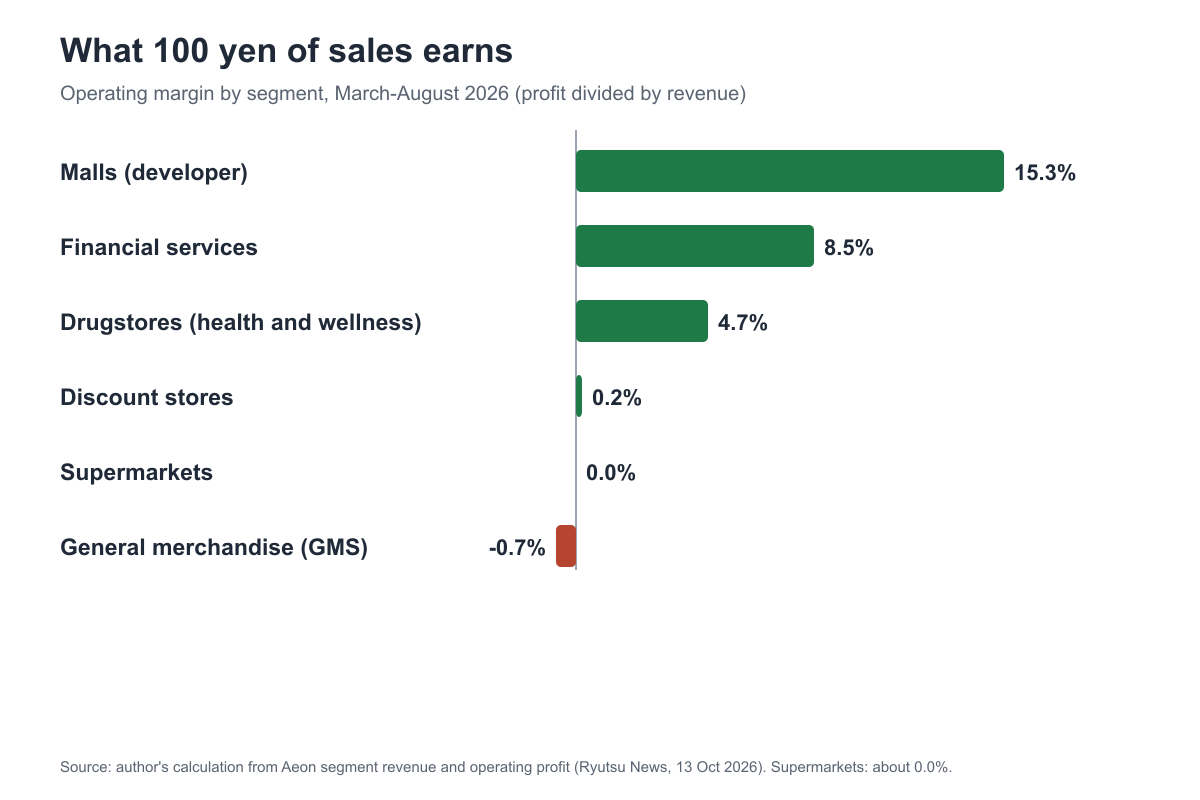
A simple way to see the gap is to look at the operating margin of each segment, which is operating profit divided by operating revenue. Using the segment figures above:
Developer and entertainment segment (malls, cinemas, amusement): ¥54.2 billion on ¥354.2 billion of revenue, about 15.3%
Financial services: ¥26.1 billion on ¥307.7 billion, about 8.5%
Health and wellness (drugstores): ¥59.7 billion on ¥1,277.9 billion, about 4.7%
Discount stores: ¥0.5 billion on ¥218.7 billion, about 0.2%
Supermarkets: roughly 0.0%
General merchandise stores: ¥-12.6 billion on ¥1,865.3 billion, about minus 0.7%
So ¥100 of sales in the developer-and-entertainment segment earns about ¥15 of profit for Aeon (Aeon Mall alone: about ¥18), ¥100 in a drugstore earns about ¥4.7, and ¥100 in a general merchandise store loses about 70 sen. The group’s largest segments by revenue, GMS and supermarkets, which together account for ¥3.4 trillion of the half-year revenue, earned nothing. The segments that earned the profit are much smaller in sales terms.
An analyst commentary in the Japanese press put the longer view this way: over the ten years from fiscal 2017 to fiscal 2026, Aeon’s consolidated operating revenue grew from ¥8.21 trillion to ¥10.72 trillion, about 30%, while the operating margin barely moved, from about 2.3% to about 2.5%. Growing bigger by adding drugstores and malls has not changed how much of each sales yen turns into profit.
Aeon’s Response: Private Label, Prepared Food and Automation
Aeon’s second-half plan, presented by executive vice-president Motoyuki Shikata, has four parts: rebuild its price policy, run promotions that produce results, create reasons to visit the store and strengthen higher-value products, and cut costs through structural reform.
Several specific numbers show where it is putting its effort:
Private label. Sales of Topvalu, Aeon’s own brand, rose 4.5% year on year, and joint purchasing of national brands rose 5.0%. The company plans to raise the number of “mega items,” products with annual sales above about ¥1 billion, from about 100 to about 300. Selling more private label raises the gross margin percentage, and it also suits shoppers who are watching prices.
Prepared food. The “Craft Delica Funabashi” central kitchen increased its supply by 18.7%, and it now supplies 14 group companies. Prepared food is a category that both supermarkets and convenience stores compete on, and Aeon wants a central production base that keeps cost and quality steady.
Online grocery. The web-only supermarket Green Beans has about 1.2 million members. Aeon’s wider e-commerce business reported new customers up 36.6% and sales up 29.2%.
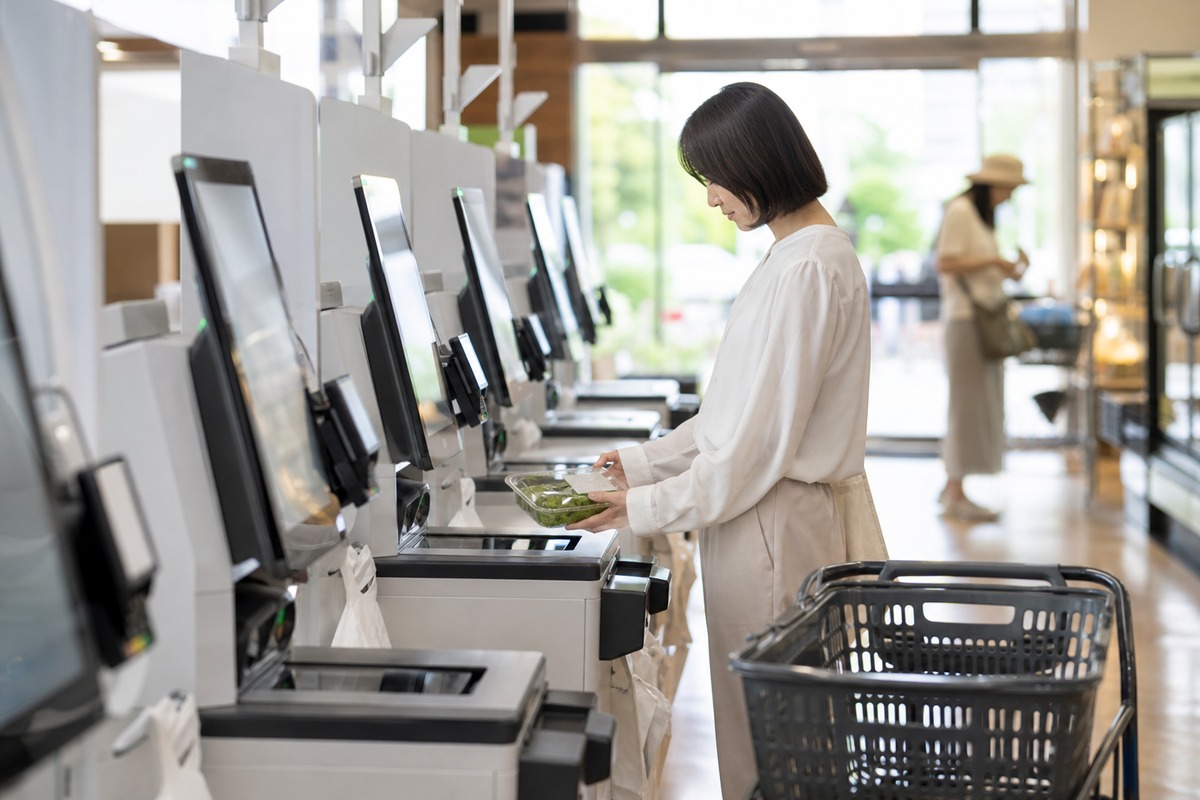
Store automation. Electronic shelf labels, self-checkout and AI-based ordering saved about 1.55 million labor hours in the half at Aeon Retail. In the discount stores, self-checkout use reached about 70%. Labor savings are meant to pay for wage increases, though so far they have not been large enough to keep the retail segments from posting losses.
Small-format shops. The “My Basket” mini-supermarket network, about 1,400 shops according to Aeon’s half-year materials, uses Aeon’s supply chain to compete with convenience stores on price. Aeon’s president said that some stores facing closure could be converted into Aeon-operated drugstores or My Basket shops rather than simply shut.
The Market’s Verdict: Record Profit, Lower Stock
Investors were not persuaded. Aeon’s shares reached a record high of ¥2,920 on 25 November 2025, which is after the three-for-one split of 1 September 2025, so the prices below are directly comparable. The day after the results, 14 October 2026, the stock opened 2.4% lower, touched ¥1,101 at the low and closed at ¥1,125.5, a new low for the year. That is roughly 61% below the peak, by simple arithmetic on the closing price.
Several things worried the market. The first-half operating profit reached only about 38% of the full-year target of ¥340 billion, which leaves a lot to deliver in the second half. Ordinary profit grew by only 1.7%. Analysts who looked at the quarterly split reported that profit in the June to August quarter fell compared with a year earlier, even though the half-year total was a record, which suggests the first quarter did most of the work. And the stock still trades at a high multiple of expected earnings because Aeon has more than a million small individual shareholders drawn by its shopping rewards, so there is a lot of expectation priced into the shares even after the fall. That last point is an analyst’s interpretation, not a figure from the company.
Aeon’s own forecast for the year assumes the second half will be much stronger, with revenue growth of 12% and operating profit growth of about 25.7% for the full year, even though net profit is expected to be flat. The retail segments will need to stop losing money for that to happen.
A Neighbor’s Warning: United Super Markets and 100 Closures
The pressure is not confined to Aeon’s own stores. United Super Markets Holdings, an Aeon group company that operates Maruetsu, Kasumi and Inageya, reported an operating loss of ¥3.3 billion for March to August 2026 and cut its full-year forecast. According to Jiji Press, it plans about 100 store closures by fiscal 2030, and some of those sites may become drugstores or My Basket shops.
That is a notable move for a supermarket operator in a country where food retailing has been steady for decades. It shows that the problem is not only that discounts are costly. It is that the cost base of a large physical store, with its staff, utilities and logistics, has risen faster than the sales those stores can generate. For Aeon, converting a full-size supermarket into a small-format shop or a drugstore is a way to keep the location while cutting the cost.
What International Operators Should Take From This

If you sell products into Japanese retail, or you are thinking about entering it, a few practical points follow from the numbers.
Check which channel actually earns money. If your Japanese partner is a general merchandise store or a supermarket chain, its negotiating room on margin may be thin right now, and it may push private label hard. If your product fits drugstores, which are growing and profitable, the channel economics are much better.
Expect more private label competition. With Topvalu growing and the number of “mega items” set to triple, brands that sit next to Aeon’s own label on the shelf will face more price pressure and more attention from the buyer on cost.
Think small formats and online. My Basket, Green Beans and drugstore conversions show where Aeon is directing its investment. A supplier with products that suit small-format shops, prepared food or online grocery has a better chance of fitting what the retailer wants.
Watch the second-half plan. If the retail segments recover, shelf space and promotion budgets may loosen. If they do not, expect store closures, supplier renegotiations and tighter terms.
Remember that the mall is a different business. The developer and entertainment segment, which is mostly Aeon Mall, earns rent from tenants and runs a margin of about 15%. Brands that operate their own stores inside malls, rather than selling through Aeon’s supermarkets, deal with a different counterparty with different incentives.
What to Watch Next

Four things will tell you whether the retail core is recovering or whether the profit mix is permanently different:
The December and January monthly sales reports from the main Aeon operating companies, which show whether the same-store sales gains from price cuts are turning into customers and basket size
The full-year results in April 2027, which will show whether Aeon can reach its ¥340 billion operating profit target when half of the year has delivered about 38%
The pace of the store conversions and closures at United Super Markets and other group supermarkets
The performance of Vietnam, where Aeon has placed a large share of its growth hopes
Frequently Asked Questions
Q. How much did Aeon earn in the first half of fiscal 2027?
A. For March to August 2026, Aeon reported operating revenue of ¥5,904.1 billion, operating profit of ¥130.7 billion and net profit of ¥13.3 billion. Operating revenue and operating profit were both records for a first half.
Q. Why did Aeon’s supermarkets lose money despite record group profit?
A. The company cited a rebound from last year’s rice-related demand, cautious consumers, price and promotion measures that did not work well enough, weak clothing and home goods sales because of the weather, and rising labor costs. General merchandise stores lost ¥12.6 billion and supermarkets lost about ¥0.1 billion.
Q. Who earns the money at Aeon now?
A. Mostly health and wellness (drugstores, with ¥59.7 billion), developer and entertainment (which includes Aeon Mall, with ¥54.2 billion) and financial services (¥26.1 billion). Together they earned about ¥140 billion, more than the group total.
Q. What is Tsuruha and why does it matter?
A. Tsuruha Holdings is a drugstore operator that Aeon brought under its control in January 2026. It lifted Aeon’s health and wellness revenue by 87.4%, and its network ended the half with 5,652 stores in Japan.
Q. Is Aeon’s forecast realistic?
A. The company kept its full-year target of ¥340 billion in operating profit, but the first half delivered only about 38% of it. Aeon traditionally earns more in the second half, but the retail segments will need to improve for the target to be met. Investors were skeptical, and the stock fell to a new low for the year the day after the results.
Q. Where can I read the original numbers?
A. Aeon publishes its results and presentation materials on its investor relations site. Japanese trade media such as Ryutsu News and Diamond Chain Store Online summarize the segment results, and Jiji Press reported the headline figures in English. For travel and daily life in Japan, a Japan travel guidebook can help you understand local shopping.
Conclusion
Aeon’s first-half results tell two stories at once. At the group level, the company set records for revenue and operating profit, helped by the Tsuruha acquisition, a busy mall business and strong growth in Vietnam. At the store level, its general merchandise stores and supermarkets, the businesses that defined Aeon for decades, lost money and fell well behind the previous year.
For Japan, the lesson is that scale in groceries no longer guarantees profit. Wages, utilities and logistics have risen faster than shoppers will accept price increases, and shoppers are comparing prices more carefully. The retailers that are doing well are the ones with a different model: drugstores that sell higher-margin goods, malls that collect rent, and small shops that cost less to run.
For international brands, the sensible response is to look at where retailers earn their money and to plan accordingly. A partner that is losing money on its core stores will behave differently from one that is growing. The next two quarters at Aeon will show whether its stores can recover, or whether the shift from supermarket company to health, property and financial services group is permanent.
If you’re interested in this topic, the Japanese market more broadly, or what KETCHUPs is working on, we’d love to hear from you — please reach out via our contact form.
Japan Market Pulse is a weekly read on what the Japanese consumer-tech, food, and mobility markets are choosing to do, written for international operators who want to know what is happening before it shows up in the global trade press.
Subscribe at ketchups.co/japan-market-pulse.