

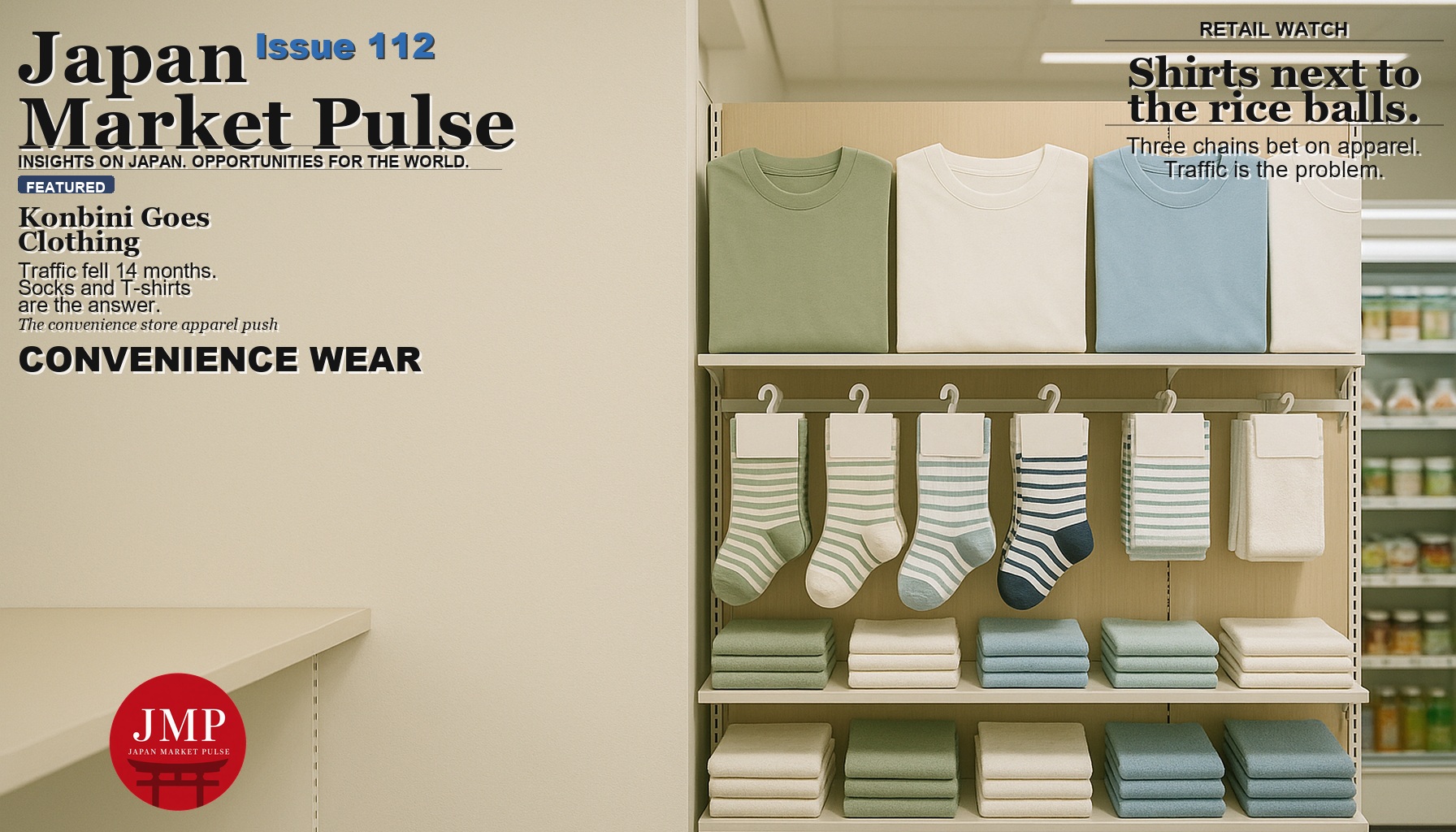
Japan’s convenience stores have lost customers for 14 consecutive months. Same-store traffic, as tracked by the Japan Franchise Association, has fallen year on year every month for more than a year, and the industry’s answer is not another rice ball. It is a T-shirt.
FamilyMart is targeting ¥30 billion in apparel revenue in fiscal 2026, a 50% increase on the previous year. Seven-Eleven Japan launched a limited-edition apparel range of 17 items in 28 variations on 25 September and, according to one trade report, wants to double its clothing sales. Lawson began expanding a new Muji assortment at about 90 Natural Lawson stores in late April. A category that used to be limited to emergency basics is now a line in the strategy deck of all three major chains.
For international operators, this is more than a quirky retail story. It shows how a mature, saturated, franchise-based network responds when the number of visitors stops growing: it stops trying to sell more of the same thing and starts raising the value of every visit. This article sets out why the chains are doing it, how each one is going about it, where the economics are still unproven, and what overseas brands should take from it.
Why a Shop With 50,000 Branches Needs a New Product
Japan has more than 50,000 convenience stores, and annual sales across the industry are roughly ¥12 trillion, according to Japan Franchise Association figures. It is one of the densest retail networks in the world. That density is also the problem: new sites are harder to find, and the population that visits them is shrinking and ageing.
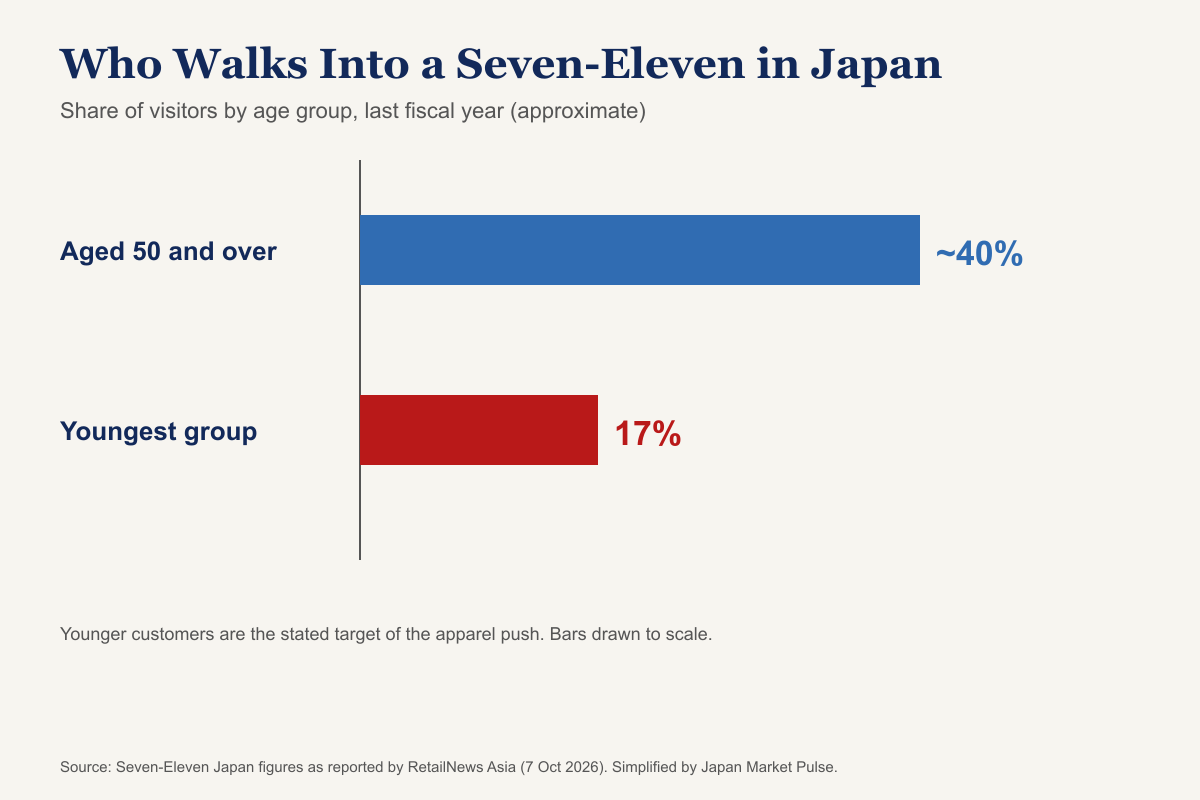
Two numbers frame the issue. The first is the 14-month streak of falling same-store traffic. Rising prices and a shrinking population are the likely backdrop, although the association’s statistics show the decline, not its cause. The second is who is actually walking in. Seven-Eleven Japan said that shoppers aged 50 and over made up roughly 40% of visitors in its last fiscal year, while the youngest customer group in the figures reported by RetailNews Asia made up only about 17%. The exact age band is defined differently across company disclosures, so the direction matters more than the decimal.
An ageing customer base is a slow-moving risk, but it is a real one. Younger shoppers form habits that last decades. A convenience store that cannot reach them today has a weaker franchise in 2035.
So the chains are trying to widen the funnel at both ends: bring in younger shoppers with products they would not expect to find in a konbini, and raise the amount spent per visit once they are there.
FamilyMart: Five Years of Socks, Then a Flagship
FamilyMart was first, and it is furthest ahead. It launched Convenience Wear in 2021, working with the Tokyo designer Hiromichi Ochiai. The first hero product was a pair of unisex crew socks, white with stripes in the chain’s green and blue, thick-pile, inexpensive and sold in a resealable clear pack. According to a Monocle profile, more than 1.4 million pairs were sold in the first year, and the line won a Good Design Award.
The choice of socks was deliberate. Ochiai described socks as a basic staple that suits a store’s image of cleanliness, stability and safety. The initial range also included men’s undershirts, women’s tank tops, eco-bags and small hand towels. Later additions were sweatshirts, stationery, handkerchiefs, packable nylon jackets and long-sleeved cotton T-shirts, and there have been collaborations such as oversized T-shirts with the stylist Akio Hasegawa’s brand Cahlumn, which sold out quickly.
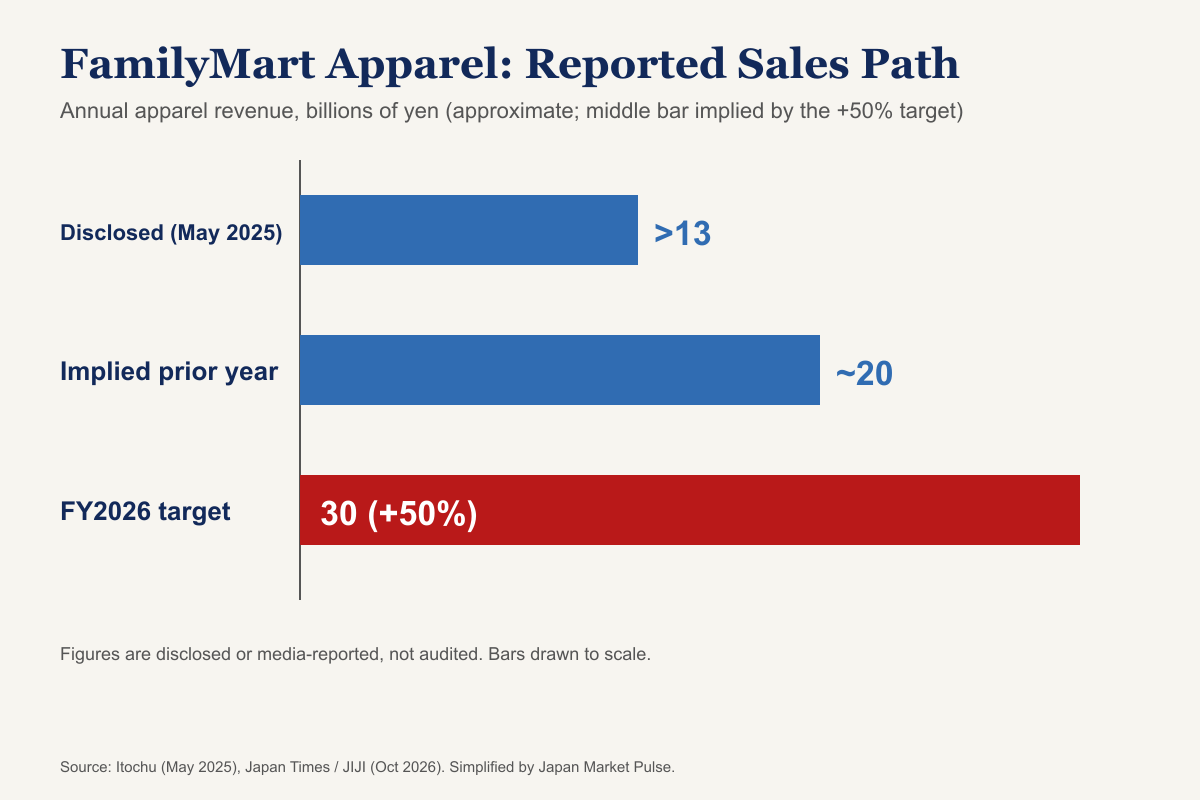
The scale has grown steadily. Sources define fiscal years differently, so the trajectory should be read as approximate: Itochu, FamilyMart’s parent, put Convenience Wear sales above ¥13 billion in a May 2025 disclosure. The ¥30 billion target for fiscal 2026 is described by the Japan Times as a 50% rise, which implies a base of roughly ¥20 billion in the preceding year.
In July 2026, FamilyMart opened a Tokyo flagship with fitting rooms and, according to trade reports, a large apparel lineup. It is a significant move because it changes the format: a product that was an impulse purchase at a till becomes a destination in its own right.
Seven-Eleven: Borrowing a Young Fashion Brand
Seven-Eleven Japan is the largest chain, and about 40% of its visitors are aged 50 or over, so its approach is different. On 25 September it launched a limited-edition range of 17 items in 28 variations with the fashion group And ST, with six Hello Kitty collaboration items scheduled for 23 October. The range uses youth brands, including Lowrys Farm, and covers T-shirts, scarves and hair accessories.
The target is explicit. A merchandising manager, Junko Watanabe, was quoted as saying that attracting younger customers is essential for long-term growth. According to RetailNews Asia, Seven-Eleven aims to double total apparel sales against fiscal 2025 levels, and it is reported to be using lower price points and impulse gift items to bring in younger shoppers.
The structure of the deal matters. By partnering with an established fashion group rather than building a clothing brand from scratch, Seven-Eleven borrows an audience and a design team on a limited-run basis. It is a way to test demand with limited inventory risk.
Lawson: Muji on the Shelf
Lawson has chosen the lightest-touch route. Muji products have been sold in Lawson stores since 2022, and in late April the chain began expanding a new Muji assortment from Ryohin Keikaku at around 90 Natural Lawson stores. It relies on an established brand rather than building its own line.
Brand partnerships may have a practical logic for a franchise system. In general, they may reduce design and markdown risk for the chain, and they can give store managers steadier replenishment rather than leftover stock to manage. Lawson’s approach is also consistent with its wider push toward in-store media and digital signage, where the store is treated as a platform that other brands can use.
Why Clothes? The Economics Behind the Move
The case for apparel in a convenience store rests on three arguments, none of them yet fully proven in the public numbers.
Basket value. A T-shirt or a pair of socks costs far more than a rice ball. If it is added to a visit that was already going to happen, it raises revenue per transaction without requiring more traffic. That is the metric the chains are explicitly chasing.
Margin. Trade press argues that clothing can deliver higher basket values and, in general, carries less waste risk than packaged drinks or boxed meals, though margins by product are not publicly compared. Fresh food in a convenience store has high waste, short shelf life and a brutal markdown cycle. A folded shirt does not spoil.
Operations. Non-refrigerated displays reduce electricity costs for franchisees, and shelf space that was occupied by low-margin items can be reallocated. The question that remains is whether apparel generates enough sales per square metre to beat the products it replaces.
The honest caveat is that the evidence is still thin. The question of whether higher-priced apparel lifts total store receipts without cannibalising convenience sales will be watched in the chains’ results over the coming quarters. Until then, it is a strategy with a credible logic and a short track record.
The Bigger Picture: A Store That Is Becoming a Platform
Apparel is one move in a wider rethink of what a convenience store is. Seven-Eleven has built a coffee business that has sold more than nine billion cups of Seven Café, and it has taken Seven Café Tea from around 90 stores in the Tokyo area and Hokkaido to roughly 2,000 stores by early 2026 and has since reported further expansion, with a plan to reach 10,000 locations by February 2027. At Expo 2025 in Osaka it showed a 2030 store concept with in-store kitchens that prepare items such as pizza on site. Lawson, for its part, has experimented with a “Real×Tech Convenience” concept in which digital signage across shelves analyses customer behaviour in real time.
Seen in that light, clothing is another way of turning a small box into a destination. The chains are borrowing from fast food, from specialty retail and from media at the same time. The common thread is that a store that used to win on convenience alone now has to give people a reason to choose it over the drugstore and the app.
FamilyMart is a useful case because of its scale. According to a 2025 Monocle profile, it operates 16,295 shops in Japan and serves around 15 million customers a day, with annual sales of about ¥3.2 trillion in the fiscal year to February 2025. At that scale, a product that sells to even a small share of daily customers becomes a business worth tens of billions of yen. It also explains why the company has put real creative resources behind the effort, including bringing in the streetwear designer Nigo as creative director in early 2025, although he is reported to be separate from the Convenience Wear line.
What the Shelf Actually Looks Like
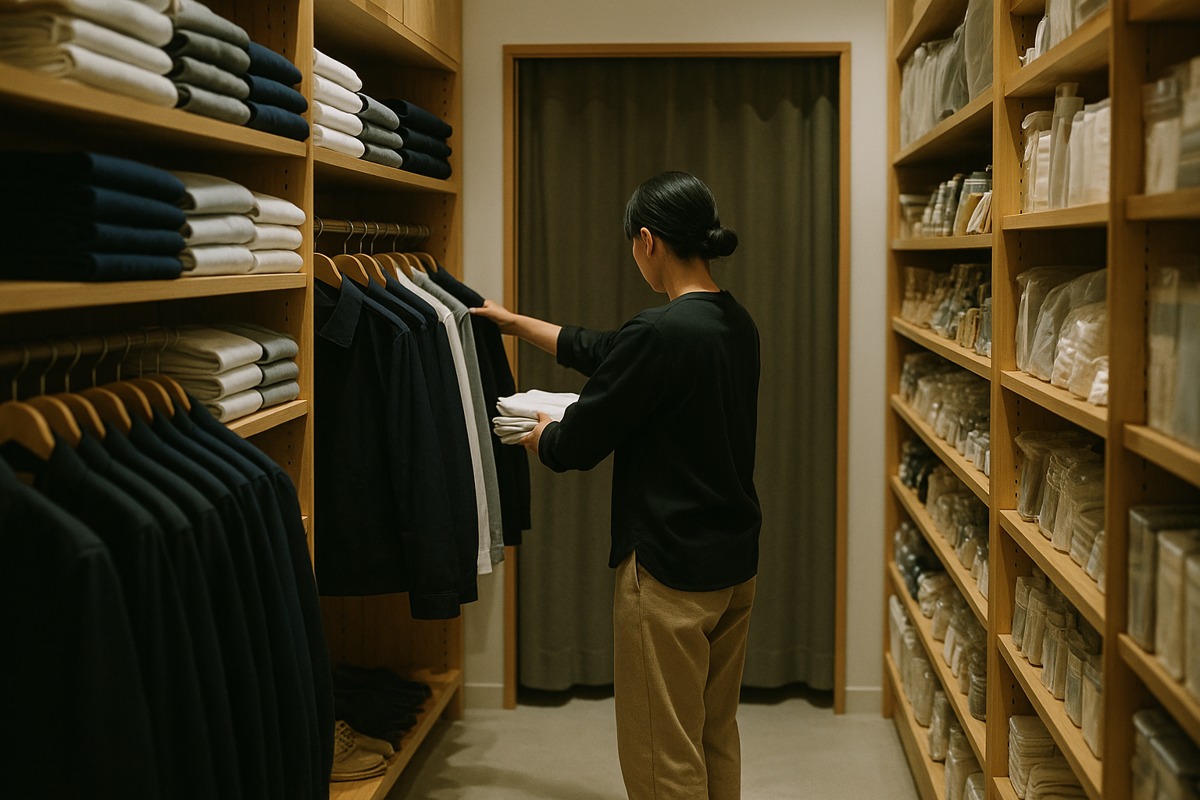
Visiting these stores, the assortment follows a clear logic. At the front are low-price, high-frequency items: socks, handkerchiefs, towels, undershirts. Next come seasonal accessories such as gloves and scarves, which sell on the weather and on gift occasions. Only then do outerwear, sweatshirts and collaboration pieces appear, usually in smaller quantities and in a limited colour palette.
Presentation is part of the product. FamilyMart’s packaging is a tough, resealable clear pack that protects the item from dust and wear under 24-hour lighting, with bold graphics and labels readable in katakana, kanji and English. Colours are basic blacks, whites and greys with seasonal accents, and special editions were made for events such as the Fuji Rock Festival, where staff wore the T-shirts. Hand towels are made in Imabari, Japan’s towel-making centre, which gives a staple item a credible story.
None of this is accidental. The chains are treating apparel as a branded category with its own design language, not as leftover stock next to the umbrellas.
The Risk: A Convenience Store Is Not a Fashion Retailer
There are reasons to be cautious about reading too much into the early success of socks.
First, clothing is a different business. Sizing, returns, seasonal inventory and trend risk are all things a convenience store was not built to handle. Most shops have limited space, and a franchise owner who is already stretched on labour has little capacity for a category that needs folding, hanging and restocking.
Second, the best-selling items are not really fashion. Socks, handkerchiefs and undershirts are staples that customers need and can buy without trying on. The test comes when the chains move into jackets, outerwear and collaboration pieces that require an emotional decision.
Third, the positioning is delicate. FamilyMart’s Convenience Wear is deliberately functional and low-priced, and its designer has said he wants to keep it on the practical side. A line that moves too far toward fashion risks losing the convenience positioning that made it distinctive.
Finally, apparel does not fix the underlying problem. A T-shirt may raise the value of a visit, but it does not stop fewer people from visiting. The 14-month decline in traffic is the cause, and apparel is a response to the symptom.
What Overseas Operators Should Do
The apparel push creates an unusual opening for brands that are not normally associated with convenience retail.
1. Think capsule, not catalogue. Seven-Eleven’s limited 17-item range shows the format: a small, themed, time-limited drop is easier for a franchise network to absorb than a full line. 2. Lead with a staple. Socks, handkerchiefs, towels and travel accessories are low-risk, easy to display and do not need fitting. A distinctive design on a basic item is the proven entry point. 3. Design for the shelf. Packaging that can be hung or stacked, survives 24-hour store lighting and communicates the product in a few seconds is a requirement, not an afterthought. 4. Offer risk-sharing terms. The logic of Lawson’s approach is that brand partners may absorb some design and markdown risk. A partner who can supply steady replenishment and handle unsold stock may have an advantage in negotiations. 5. Watch the winter results. If the fiscal 2026 winter quarter shows that apparel lifts total receipts, expect more space and more partner slots. If it does not, expect the shelf to shrink.
The same pattern may travel. One trade report suggested that Japan’s apparel strategy could serve as a template for franchise operators in South Korea and Taiwan, two markets with dense convenience networks and similar demographics, though that is the publication’s view rather than a company plan.
Frequently Asked Questions
Q. Why are Japanese convenience stores selling clothes?
A. Same-store customer traffic has fallen for 14 consecutive months, according to the Japan Franchise Association. Chains are trying to raise spending per visit and reach younger shoppers, and clothing can lift basket value and carries less waste risk than packaged food and drinks.
Q. How much apparel does FamilyMart sell?
A. FamilyMart targets ¥30 billion in apparel revenue in fiscal 2026, a 50% increase on the previous year. Itochu, FamilyMart’s parent, reported sales above ¥13 billion in a May 2025 disclosure, and a 50% rise to ¥30 billion implies roughly ¥20 billion in the preceding year, though that base is an inference.
Q. What is FamilyMart Convenience Wear?
A. It is a clothing line launched nationwide in 2021 with the designer Hiromichi Ochiai. It began with striped crew socks and now includes undershirts, sweatshirts, handkerchiefs, jackets and collaboration items. The line won a Good Design Award.
Q. What are Seven-Eleven and Lawson doing in apparel?
A. Seven-Eleven Japan launched a limited range of 17 items in 28 variations with the fashion group And ST on 25 September and, according to trade reporting, aims to double apparel sales. Lawson began expanding a new Muji assortment at about 90 Natural Lawson stores in late April.
Q. Can foreign brands sell through Japanese convenience stores?
A. Yes. In many cases this may involve a Japanese distributor or trading-company partner. Limited-edition capsules, staple items such as socks and towels, and packaging designed for a 24-hour shelf are the most realistic starting points.
Conclusion
Japan’s convenience stores spent fifty years winning on speed, proximity and fresh food. With 50,000 stores and a shrinking customer base, adding branches alone is hard to sustain as a growth strategy. They are also trying to grow by changing what a visit is for.
Socks and T-shirts are a modest answer to a large problem. They will not reverse a 14-month traffic decline on their own, and the evidence that they lift total store sales is still being gathered. But the experiment is worth watching, because it shows what a mature retail network does when volume stops growing: it moves up the basket, borrows other people’s brands and treats every square metre of shelf as an audition.
For international brands, the invitation is real. A franchise network of this size is looking for products that are small, distinctive and easy to sell.
If you’re interested in this topic, the Japanese market more broadly, or what KETCHUPs is working on, we’d love to hear from you — please reach out via our contact form.
Japan Market Pulse is a weekly read on what the Japanese consumer-tech, food, and mobility markets are choosing to do, written for international operators who want to know what is happening before it shows up in the global trade press.
Subscribe at ketchups.co/japan-market-pulse.