

Nintendo’s Switch 2 remake of The Legend of Zelda: Ocarina of Time, a game first released in 1998, sold more than 5.2 million units worldwide in its first four days, according to Nintendo. About 810,000 of those were in Japan. Famitsu’s retail tracking puts launch-week sales through Japanese shops at 537,041, roughly two-thirds of that total, even though the packaged edition costs ¥1,000 more than the download. Here is what the numbers do and do not show, and what they mean for anyone selling products to Japanese consumers.
I have lived in Japan for two decades, and one small ritual has never disappeared: the trip to the shop on release day. You can buy almost any game as a download now, often for less money. Yet in Japan, a big release still tends to mean pre-order bonuses at specific chains, displays at the front of electronics stores and a small box carried home on the train. This November, the game at the centre of that ritual was not new. It was a remake of a title that first came out when many of today’s buyers were children, or not yet born.
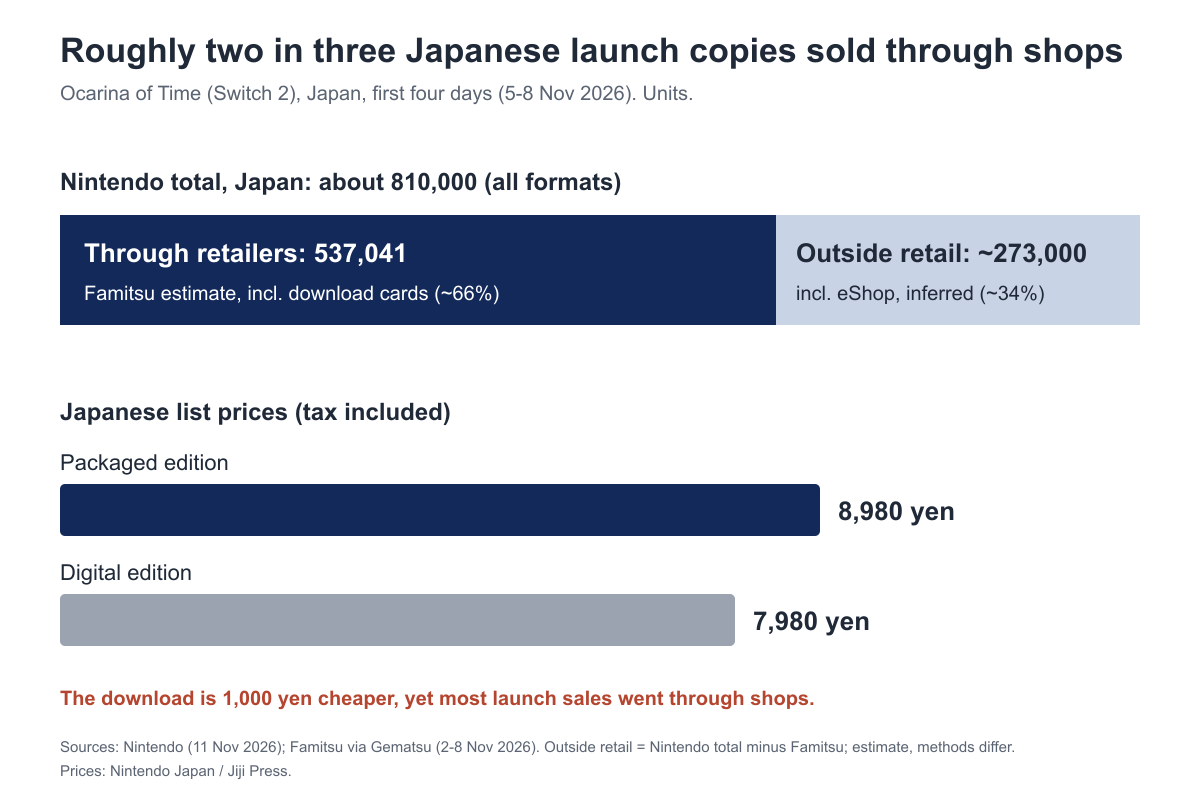
That is the first surprise in this story. The second is in the price list. In Japan, Nintendo sells the packaged edition of the remake for ¥8,980 and the digital edition for ¥7,980, both including tax. A rational shopper might be expected to stay home, click “buy” and save ¥1,000. Yet most of Japan’s launch sales still went through a shop.
This article is about a video game, but it is really about how Japanese consumers buy things they care about. I look at what Nintendo announced, how to read Japan’s sales data carefully, why the shop and the physical copy still matter so much here, what the weak launch of another big title in the same week tells us, and what international businesses should take from it.
The Week a 1998 Game Took Over Japan’s Charts
The remake launched on 5 November 2026, a week after Nintendo released a Zelda-themed special-edition Switch 2 console in Japan, sold without the game, to mark the series’ 40th anniversary. On 11 November, Nintendo said the game had sold more than 5.2 million units worldwide in its first four days, combining physical and digital sales. The company described it as the fastest-selling Nintendo-published Switch 2 game globally, and also in the United States, Canada and Latin America. Nintendo put Japanese sales over the same period at about 810,000 units.
The following day, Famitsu, the Japanese games magazine whose weekly retail tracking is the standard reference for the domestic market, published its chart for 2 to 8 November. The remake opened at 537,041 units. Because the game launched on a Thursday, that figure covers only four days of retail sales. In the following week, 9 to 15 November, it sold another 86,097 units, bringing Famitsu’s total to 623,138.
To put that in context, Wikipedia’s list of best-selling Switch 2 games, as of 9 November, placed the remake behind Mario Kart World at 16.48 million units. Mario Kart, however, has been on sale since the console launched in June 2025 and has been bundled with hardware. For a single new release in four days, 5.2 million is a very large number. For Japan, 810,000 in four days is also large: Famitsu’s cumulative estimate for Switch 2 hardware in Japan was 6,616,858 units as of 15 November.
A rough way to read those two figures together is this: in four days, Japanese buyers bought roughly one copy of the remake for every eight Switch 2 consoles that Famitsu estimates have been sold in the country. That is not a true attach rate, because some people buy more than one copy and some consoles are not in use, but it shows how quickly the game moved through the installed base.
The nostalgia angle is obvious, and it is real. Ocarina of Time is often described as one of the most influential games ever made, and the 40th anniversary of the series gave Nintendo a marketing moment. But nostalgia alone does not explain how the copies were bought. That is where Japan’s numbers become more interesting than the global headline.
Reading the Numbers Carefully
Japan’s games data is unusually rich, but it is also easy to misuse. The two figures in this story come from different sources and measure different things, so it is worth being precise.
Nintendo’s figure of about 810,000 units in Japan is the company’s own count. It includes both packaged and downloadable copies sold during the first four days.
Famitsu’s figure of 537,041 is an estimate of sales through Japanese retailers. It is built from a panel of shops rather than a full count. Famitsu’s software estimates cover packaged copies and also download cards sold in stores (and, for some titles, versions bundled with consoles), but not purchases made directly on the Nintendo eShop. Famitsu does not publish the split between those formats.
Gematsu, a games news site that publishes Famitsu’s charts in English, did the obvious subtraction and estimated about 273,000 digital copies. A more careful reading is this: roughly 273,000 copies sit outside Famitsu’s retail tracking. That gap likely includes many eShop purchases, but it also reflects the different methods, so it cannot be assigned precisely to downloads. That is an inference, not a reported figure, and the two counts use different methods. It also means we cannot say exactly how many buyers chose the cartridge itself, because some shop sales may have been download cards. What the numbers do suggest is that roughly two in three Japanese launch copies were sold through a shop rather than directly online.
That retail share stands out against Nintendo’s own global business. In its results for April to June 2026, Nintendo reported that 61.5% of its software revenue came from digital, with 38.5% physical, according to reports by Kotaku and TechRadar on the company’s figures. That ratio includes add-on content and subscriptions, so it is not a direct comparison with a single game’s launch in a single country. It is, however, a useful signal. Across Nintendo’s global software revenue, digital is the majority. In Japan, for the biggest launch of the season, the shop counter appears to have carried most of the volume.
There is one more detail that matters. Nintendo counts game-key cards, cartridges that contain a key rather than the full game, as physical sales. I did not find a statement that the Ocarina of Time remake uses that format, and nothing in this article depends on it. But when you read physical-versus-digital figures for the Switch 2 era, it is worth remembering that “physical” and “retail” do not always mean the same thing they did in the 1990s.
Why Japan Pays More for the Box
If you have sold products in Japan, the retail result will not shock you. It fits a pattern that shows up across many categories. Here are the reasons I think explain it, starting with the most practical. They are drawn from experience and common industry observation, not from a consumer survey.
The store is still part of the purchase. Japan has a dense network of electronics chains, game shops and general retailers near train stations. Buying a game can be a short detour on the way home. Release-day stock, pre-order bonuses at specific chains and the simple experience of picking up a box all remain part of the culture. A download removes the trip, but for many Japanese buyers, the trip was never the problem.
A physical copy keeps its value. Japan has an active second-hand market for games. A cartridge can be resold, lent to a friend or passed to a younger sibling. A download cannot. For a ¥1,000 difference, the packaged version comes with an exit option. Many buyers seem to think of the extra yen as the price of flexibility rather than a waste.
Storage and ownership feel different. A cartridge can reduce how much console storage a game needs, although save data and updates still use space, and it sits on a shelf as something you own. In a country where collectors’ editions, limited packaging and anniversary goods sell strongly, the box is part of the product.
Gifting and family use. Games are often bought for children, or shared within a household. A physical copy is easier to give, wrap and move between consoles. For a remake of a classic, parents who played the original are an obvious audience, and some of them are buying for the next generation.
Trust in the retail channel. Japanese consumers tend to value clear, physical proof of what they bought. That is visible in everything from paper receipts to boxed accessories. Digital purchasing is growing quickly, but for many buyers the shop still seems to be the natural place for a big, special purchase.
It is also worth looking at the price difference from the buyer’s side. ¥1,000 is about 11% of the packaged price. That is not trivial during a year when many households are counting every purchase. But if a buyer expects to resell the cartridge after finishing the game, even a modest second-hand price can make the physical copy the cheaper option overall. In other words, the decision that looks irrational in a price list can be quite rational in a Japanese household budget. The download is cheaper on day one. The cartridge may be cheaper over its whole life.
This is a pattern I see well beyond games. Japanese consumers often think about the total life of a product: how long it lasts, whether it can be passed on, and what it will be worth later. Brands that only compete on the first price a customer sees can miss that calculation entirely.
None of these reasons is unique to Japan. What is unusual is how strongly they still combine here, even when the digital version is cheaper. That is the part international companies should notice.
The Other Launch That Week
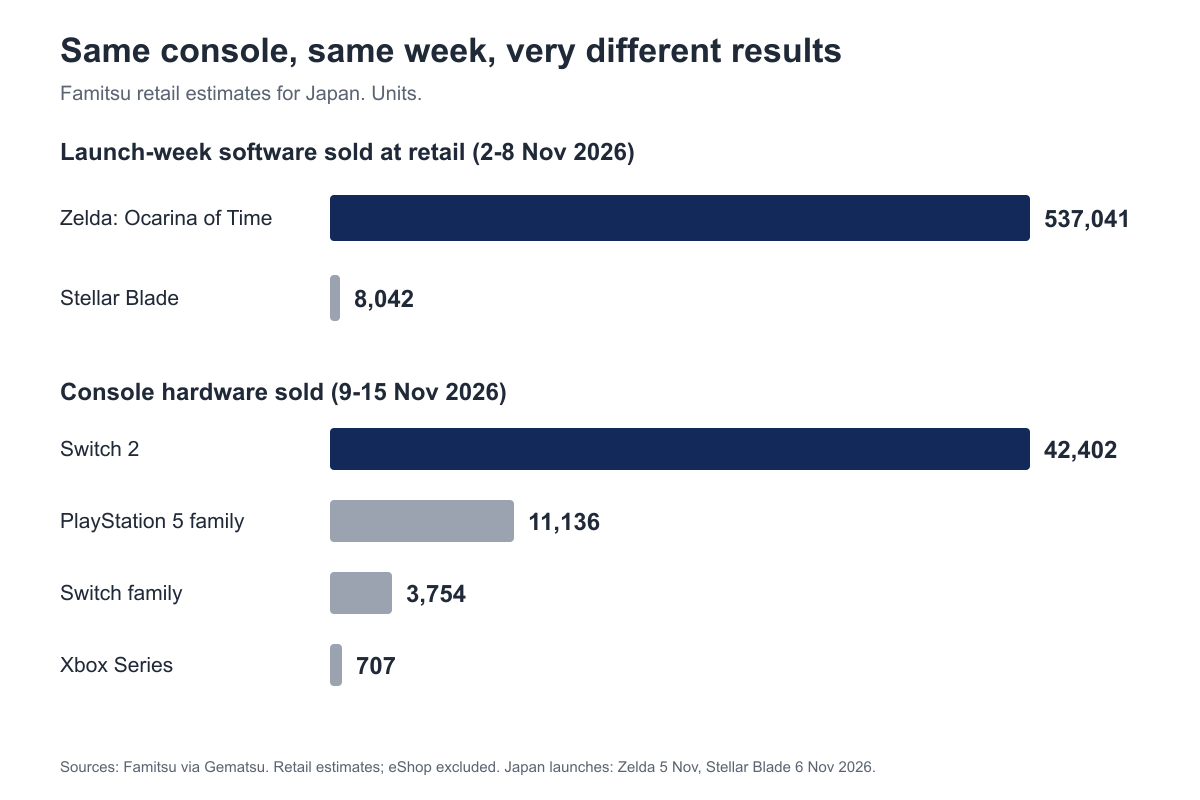
The same Famitsu chart contained a useful contrast. Stellar Blade, a South Korean action game from developer Shift Up that sold well on other platforms, also arrived on Switch 2 that week, launching in Japan on 6 November. Famitsu recorded 8,042 units in its first week and 2,305 in its second, for a total of 10,347.
Those figures do not include eShop sales, and Shift Up has not published Switch 2 numbers. The company said sales were in line with internal expectations and were contributing to growth in cumulative unit sales. Third-party estimates put the game’s PlayStation 5 and PC sales at about 5.4 million copies, excluding Switch 2. So this is not a story of failure. It is a story about fit.
The same console, the same week and the same retail shelves produced two very different results. One title was a Japanese classic with decades of familiarity among local buyers. The other was a well-reviewed foreign title arriving on a new platform after it had already been available elsewhere. In Japan’s retail channel, the familiar title took almost everything.
The hardware chart tells a similar story about platform loyalty. In the week of 9 to 15 November, Famitsu estimated sales of 42,402 Switch 2 consoles, 11,136 PlayStation 5 family consoles, 3,754 original Switch family consoles and 707 Xbox Series consoles. Japan’s console market is concentrated, and it is concentrated around a domestic brand.
For a foreign company, the lesson is not “do not launch in Japan.” It is that the Japanese market rewards familiarity, timing and channel strength more than a strong global track record alone. A product that has already peaked abroad does not automatically carry that momentum into a Japanese shop.
What Remakes Tell Us About Japanese Demand
Remakes and re-releases are not new in Japan. Ocarina of Time itself was remade once before for the Nintendo 3DS in 2011. What has changed is the scale of the audience and the price people are willing to pay for a familiar experience.
There is a broader consumer pattern here. Nikkei Trendy, the Japanese trend magazine, named “pocket consumption” as its defining theme for 2026: a growing willingness to spend on affordable items that offer enjoyment or a sense of reward, even while inflation continues. Japanese households have been cutting back in many areas this year, and earlier issues of this newsletter covered price-hike fatigue and the pressure on supermarkets. Yet a ¥8,980 game sold hundreds of thousands of copies in a few days.
Those two facts do not contradict each other. When budgets are tight, Japanese consumers often become more selective rather than simply spending less. They cut routine purchases and concentrate spending on things that feel certain to deliver value. A remake of a much-loved classic is close to a guaranteed experience. The buyer already knows what the story feels like. The risk is low, and the emotional return is high.
That may also be why the shop and the physical copy fit so well. If you are making a careful, special purchase, you may want it to feel solid. You may also want the option to resell it later. The cartridge offers both. For buyers who choose the box, the ¥1,000 premium buys a sense of ownership that a cheaper download does not.
For marketers, the remake shows that “new” is not the only route to demand in Japan. Familiar brands, returning products and anniversary editions can unlock spending even during a cautious year, provided they deliver real quality rather than nostalgia alone.
What International Businesses Should Take From This
You do not need to sell games to use these lessons. They apply to consumer products, entertainment, publishing, collectibles and many other categories.
Do not assume digital-first behaviour in Japan. Global data may say that most of your customers buy online or download. In Japan, the retail channel can still carry most of the volume for high-interest purchases, even when a cheaper digital option exists. Plan inventory, packaging and retail partnerships with that in mind.
Treat retail as a launch partner, not just a distributor. Japanese chains run their own pre-order bonuses, displays and release-day events. Those programmes shape demand. A foreign brand that relies only on its own online store can miss most of the market.
Price packaging as a feature. Nintendo charges ¥1,000 more for the box in Japan, and shops still carried most of the launch. If your product has a physical form, think about what the packaging adds: resale value, gifting, display, collectability. In Japan, those benefits can justify a premium.
Respect the power of familiarity. The clearest result in this story was the gap between a beloved domestic classic and a successful foreign title launched in the same week. If your brand is new to Japan, build familiarity before you expect momentum. Local partnerships, localisation and long-term presence matter more than a global sales record.
Read Japanese data carefully. Famitsu, POS panels and company announcements measure different things. Before you quote a Japanese market figure in a business plan, check what it includes, what it excludes and how it was collected. Many market-entry mistakes start with a misunderstood number.
Use anniversaries and timing. Nintendo timed the remake to the series’ 40th anniversary, a week after a themed special-edition console went on sale. Japanese consumers respond to seasonal moments and milestones. A well-timed launch can be worth more than a bigger advertising budget.
Frequently Asked Questions
Q. How many copies did the Ocarina of Time remake sell?
A. Nintendo said the Switch 2 remake sold more than 5.2 million units worldwide in its first four days after launching on 5 November 2026, including about 810,000 in Japan. These figures combine physical and digital sales.
Q. How much of Japan’s launch went through shops?
A. Famitsu estimated 537,041 units sold through Japanese retailers in the launch week, including packaged copies and download cards. Compared with Nintendo’s 810,000, that suggests roughly two-thirds went through shops and about 273,000 sit outside Famitsu’s tracking, likely including many eShop purchases. This is an estimate from two different data sources, and the exact cartridge share is not published.
Q. Is the physical version really more expensive in Japan?
A. Yes. Nintendo’s Japanese prices are ¥8,980 for the packaged edition and ¥7,980 for the digital edition, both including tax.
Q. Why do so many Japanese consumers still buy games in shops?
A. Likely reasons include convenient retail stores, a strong second-hand market, gifting and family sharing, console storage, and the feeling of owning a physical item. These factors appear to outweigh the lower digital price for many buyers.
Q. What does this mean for foreign companies entering Japan?
A. Do not assume global digital or online trends apply to Japan. Physical retail, packaging, timing and brand familiarity can matter more here, especially for high-interest consumer products.
Conclusion
The headline number is 5.2 million copies worldwide in four days. The more useful number for international operators is smaller: comparing Nintendo’s total with Famitsu’s estimate suggests that roughly two in three Japanese launch copies were sold through a shop, even though the cheaper download was one click away. That says a great deal about how Japanese consumers buy things they care about.
They are cautious with routine spending, but they will pay for certainty, quality and ownership. They still use physical stores as part of the experience. And they reward familiar brands far more readily than unfamiliar ones, even when the unfamiliar product has done well elsewhere. A 1998 game, remade for 2026, became the clearest demonstration of those habits this autumn. If you want to sell to Japan, it is worth studying what people carried home in that small box.
If you’re interested in this topic, the Japanese market more broadly, or what KETCHUPs is working on, we’d love to hear from you — please reach out via our contact form.
Japan Market Pulse is a weekly read on what the Japanese consumer-tech, food, and mobility markets are choosing to do, written for international operators who want to know what is happening before it shows up in the global trade press.
Subscribe at ketchups.co/japan-market-pulse.