

There is a particular kind of queue you learn to recognise after enough years here. It forms before dawn outside an electronics chain in Ikebukuro or a hobby shop in Akihabara, it is quiet, it is orderly, and a good share of the people standing in it have no intention of ever opening what they are about to buy. I have walked past that queue more times than I can count. Until this year, the shops fought it with the only tools they had: one box per customer, a staff member counting heads, a hand-lettered sign taped to the shutter.
In August 2026, The Pokémon Company reached for a different tool. For priority lotteries and certain product sales on its Japanese online store, and for entry to some official tournaments, it began verifying buyers against the IC chip in their My Number card — the national identity card issued by the Japanese government. You hold your phone against the card, the chip answers, and your Players Club account is now attached to a real, singular, state-registered person.
You can still enter without it. On the thirtieth-anniversary lotteries the company ran a verified lane and an unverified lane, the latter reachable with nothing more than phone verification. It simply told everyone that the large majority of the allocation would go to the verified lane. That is a softer instrument than a hard requirement, and a much sharper one than a sign on a shutter.
It is worth being precise about how unusual that is. This is not a loyalty programme. It is not a phone number, which anyone can buy ten of. It is the same credential Japanese residents use to file taxes and, increasingly, to present at a hospital reception desk. A private entertainment company has wired itself into it in order to sell cardboard.
And on the other side of the Pacific, the largest retailers in the United States are still fighting the identical war with a sign that says: limit one per customer.
The Franchise That Outgrew Its Own Shelves
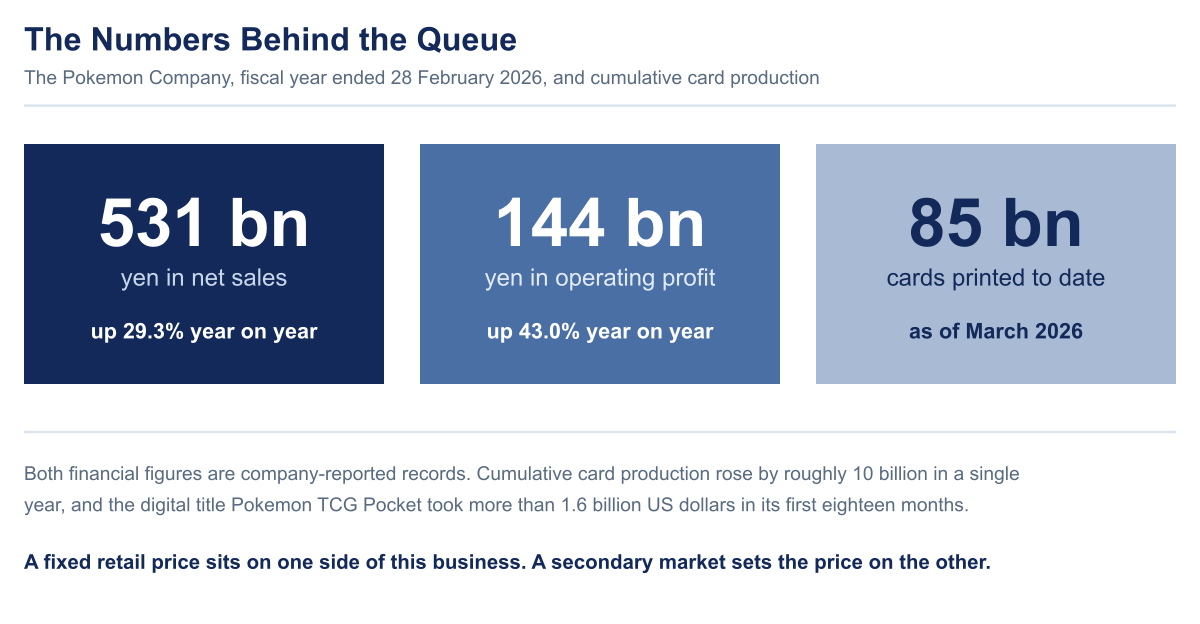
The scale here is the part most people outside the category still underestimate. In the fiscal year ended 28 February 2026, The Pokémon Company reported net sales of ¥531 billion — roughly $3.3 billion — up 29.3% year on year, with operating profit of ¥144 billion, up 43.0%. Both are records. Guinness World Records certifies Pokémon as the best-selling media franchise ever, with cumulative gross revenue across games, licensing, film and merchandise now generally put at around $150 billion, ahead of Star Wars and Marvel.
The trading card game is no longer a side business inside that number. Cumulative production passed 85 billion cards as of March 2026, up roughly 10 billion in a single year. The digital spin-off, Pokémon TCG Pocket, took more than $1.6 billion in gross player spending in its first eighteen months on more than 150 million downloads. October 2026 marks thirty years since the first Japanese expansion pack went on sale, and the card game has run its own worldwide anniversary releases and retail events through the year — inside a wider Pokémon thirtieth-anniversary campaign that has stretched as far as a Super Bowl spot.
Here is the structural problem that creates. A physical trading card pack is a lottery ticket sold at a fixed retail price. The pack costs what the pack costs; the card inside is worth whatever a secondary market decides it is worth, and for a chase card at the top of an anniversary set that can be four figures. Whenever a company prints a fixed-price ticket to a variable-price prize, it is not really selling a product. It is allocating a scarce claim — and it is doing so at a price the market has already declared too low.
Every mechanism that follows, in Japan and in America, is an answer to that one sentence. The two countries just reached for very different answers.
What Japan Actually Rolled Out in August

The Pokémon Company signalled the move in May 2026 and switched it on at the start of August. The scope is narrow and deliberately so: priority lotteries and the purchase of certain items on Pokémon Center Online, plus applications for some official competitive events held in Japan. It is not a gate on the entire store, and it is not a gate on the card shops in Nakano or Akihabara, which continue to sell across the counter to anyone who walks in.
The mechanics are the interesting part. Verification runs through the Digital Agency’s own smartphone app — the Digital Authentication App at launch, replaced by the My Number app from late August. The buyer reads the IC chip in their My Number card with a phone, and the chip returns two things: the user certificate that proves the card is genuinely theirs, and the supplementary card-face data that confirms who they are. The Players Club account is then bound to that verified identity. The company has stated explicitly that it does not obtain or retain the twelve-digit My Number itself, which is the detail that determined whether this was going to be publicly acceptable or a scandal.
What that produces, for the specific releases where demand most exceeds supply, is a lane in which one entry means one human being. Not a limit per transaction. Not a limit per card, per address, per credit card, per phone number — all of which are cheap for a professional reseller to multiply. A limit per person, enforced by the same infrastructure that underpins a tax filing. The unverified lane still exists beside it, and it still takes most of the abuse; the point is that most of the stock no longer sits there.
I want to flag something operators tend to miss here, because it took me a while to see it myself. Pokémon did not build this. The Japanese state built it, over a decade, at enormous political cost and against sustained public suspicion. Pokémon simply became one of the first consumer brands to notice that the plumbing was finished and that it was allowed to connect to it.
The 81.7% That Made It Thinkable
None of this works in a country where the ID is rare. Japan crossed that threshold recently and quietly.
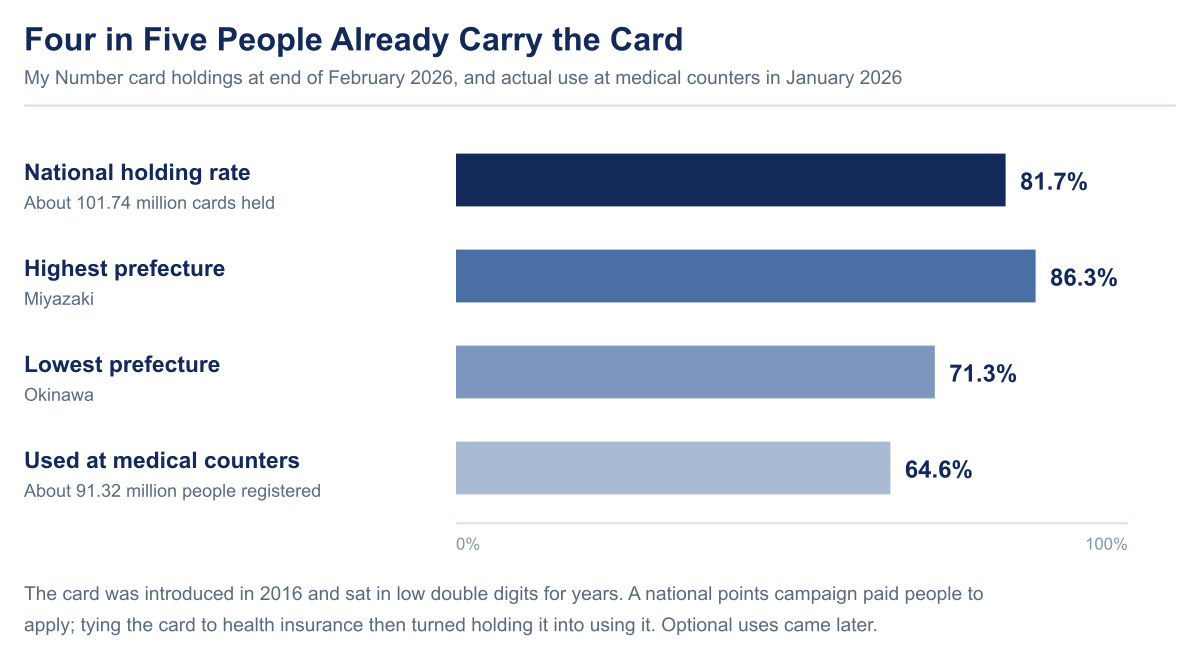
As of the end of February 2026, roughly 101.74 million My Number cards were held in Japan — about 81.7% of the population. Coverage is high nearly everywhere and remarkably flat: Miyazaki leads at about 86.3%, Okinawa trails at about 71.3%, and the gap between the best-covered and worst-covered prefecture is around fifteen points. Tokyo and Kanagawa, for what it is worth, sit slightly below the national average — the metropolitan areas were not the early adopters. Around 91.32 million people have registered the card as their health insurance credential, and actual use at medical counters had reached 64.62% by January 2026 — which is the number that matters, because it measures habit rather than paperwork.
Eighty-one percent is the number that turns an identity check from an exclusion mechanism into an ordinary one. At 30% penetration, requiring the card would have meant serving a minority and infuriating everyone else. At 81.7%, the default assumption flips: the customer has one, and the ones who do not are a manageable exception rather than the bulk of the market.
It is also worth noting how recent this is. The card was introduced in 2016 and spent years stuck at low double-digit adoption. Two different forces moved it. The first was money: the second round of the government’s Mynapoint campaign, which paid people to apply, drove application rates to roughly three-quarters of the population by 2023 — a subsidy, not a conversion. The second was consequence: binding the card to health insurance, and setting a date to retire the old paper certificate, turned a card people had claimed into a card people actually used. Only after both had run their course did it become available for something entirely optional, like buying trading cards.
That sequence matters for anyone modelling digital identity in other markets. Adoption did not come from the identity being useful in the abstract. Cash bought the applications; an unavoidable service bought the habit. You need both, and the second one is the one that lasts.
America Tried Limits. Then It Called the Police.
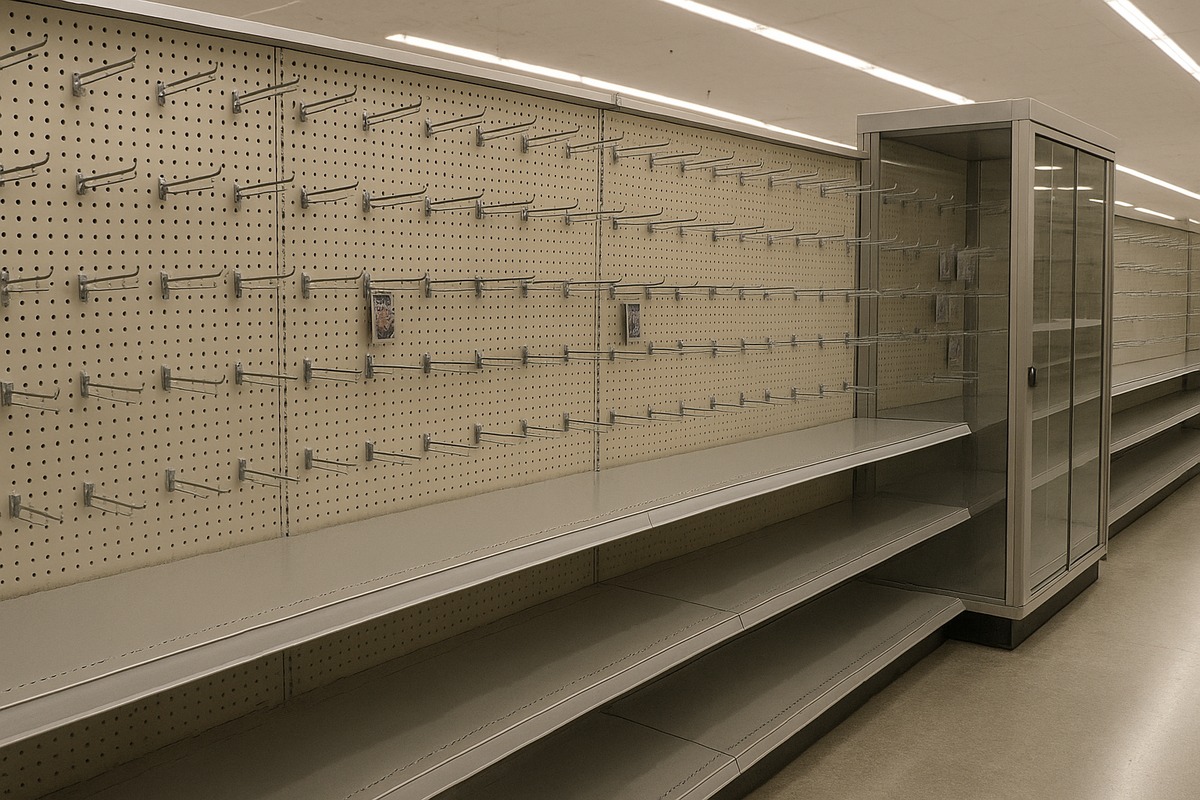
The American response to the same demand shock has been a decade-old retail playbook, applied harder each quarter.
Target suspended in-store trading card sales in May 2021 after safety incidents, then resumed the following month with a limit of two items per customer per day; by 2026, some stores had tightened further. Walmart was widely reported to have set a ceiling of five Pokémon trading card items per customer, in store and online, from November 2025. Costco applies one- to two-unit limits on its drops, with the hottest sets restricted to one per membership per day after resellers began clearing pallets. GameStop has run its own caps since 2025. This is a five-year-old playbook, and it has been getting steadily stricter for five years.
The caps have not held the line, because the underlying arbitrage is too large. In April 2026, CNN documented what it described as an international crime spree built on Pokémon cards — robberies of card shops and thefts from big-box retailers across Southern California, New York, Texas and Massachusetts. One man was arrested in connection with roughly 75 separate thefts from Target stores between July 2025 and February 2026; the reported method was concealing card packs inside taco seasoning packets at self-checkout and reselling on eBay. A card shop in Abbotsford, British Columbia was robbed of about $25,000 of stock with a further $10,000 of property damage. A Costco drop in Mississauga, Ontario ended with coffee thrown across a cart, a car striking a cart and scattering packs across the parking lot, and police attending.
Notice what these caps actually do. A two-item limit prices a reseller’s labour, and that is all. It says: to acquire twenty boxes, you must make ten visits, or recruit ten people, or use ten accounts. If the spread between retail and secondary price is large enough — and for anniversary product it is — then ten visits is simply a Tuesday. The cap raises the reseller’s cost and converts the shortfall into queueing, conflict and, eventually, crime.
Japan’s retailers have improvised inside the same constraint, sometimes creatively. In May 2026 a Bic Camera branch in Ikebukuro drew attention for asking would-be buyers to answer Pokémon questions before selling them a sought-after set, alongside a one-box limit and opening packs at the till. Some shops have taken to clipping the corners of sealed packs so that graded resale value collapses. These are clever. They are also, unmistakably, the improvisations of people who do not have a better tool.
Why a Cap and an Identity Check Are Not the Same Tool
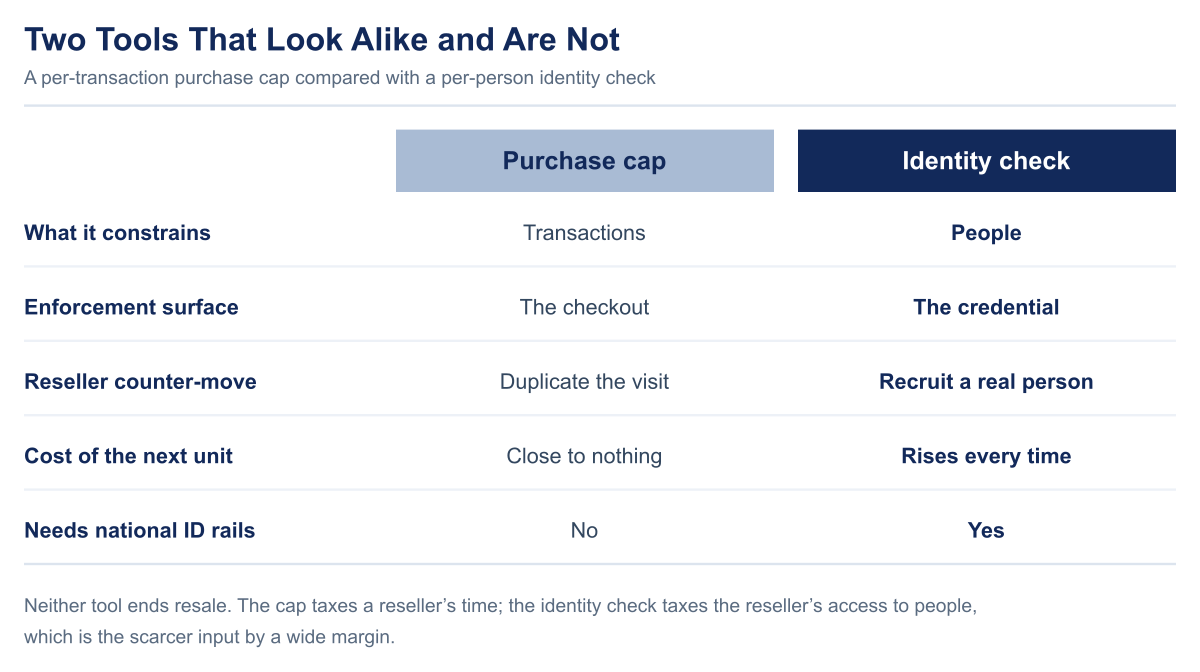
It is tempting to file the My Number requirement as a stricter version of the two-item limit. It is not. They operate on different objects.
A purchase cap is a constraint on transactions. Its enforcement surface is the checkout, and every checkout is independent of every other checkout. The reseller’s counter-move is duplication: more visits, more stores, more accounts, more shipping addresses, more people paid a small fee to stand in a queue. Each of these is cheap, and none of them are illegal. The cap does not fail because retailers enforce it badly. It fails because the thing it constrains is not the thing you are trying to constrain.
An identity check is a constraint on persons. Its enforcement surface is the credential, and the credential is unique by construction — you cannot hold two My Number cards any more than you can hold two of yourself. The reseller’s counter-move is no longer duplication but recruitment: paying real, verified people to enter on your behalf. That is a genuinely harder, slower, more expensive and more exposed operation, and it scales with human beings rather than with browser tabs.
That does not make it perfect. Recruitment happens. Accounts get sold. Nothing here stops a Japanese resident from buying at retail and listing on a marketplace an hour later, and the company has not claimed otherwise. What the mechanism does is change the shape of the cost curve — it converts an activity with near-zero marginal cost into one with a real and rising marginal cost per unit acquired. In allocation problems, that is usually the whole game.
There is a second effect worth naming. The gate applies to a subset of releases, not to the whole catalogue. That is a segmentation decision as much as a security one: the company is separating the products that are being bought to be opened from the products that are being bought to be flipped, and applying friction only to the second group. Ordinary customers buying an ordinary set notice nothing.
The People This Locks Out

Now the uncomfortable half, because there is one.
The My Number card is issued to Japanese nationals and to foreign residents with a registered address in Japan. It is not issued to tourists. And Japan in 2026 has a great many tourists: inbound visitor spending hit a record ¥2.5096 trillion in the second quarter alone, with spend per visitor at an all-time high, helped by a weak yen. A meaningful slice of that spending is people buying Japanese-language card product precisely because it is cheaper here, printed in sets that never receive an English release, and instantly resaleable abroad.
Those buyers are, by design, outside the verified lane for the affected releases. They can still walk into a card shop, and they can still take their chances in the unverified lane. What they cannot reach is the lane holding most of the stock. Overseas collectors ordering through a forwarding service are in the same position. The company has framed the policy as providing fair opportunity to all customers and a safe, secure experience — but fair here plainly means fair to the domestic player, and the trade-off is explicit rather than hidden.
Long-term foreign residents do hold the card, and I want to be careful not to overstate the exclusion: this is a resident-versus-visitor line, not a Japanese-versus-foreign one. But it is still a line, and it lands on a customer segment that is currently growing faster than the domestic one. Very few Western brands would choose to draw it. That Pokémon did tells you something about how confident the company is in the depth of its home demand.
There is a privacy objection too, and it should not be waved away. Reading a government credential to buy a hobby product is a meaningful expansion of what national identity infrastructure gets used for. The company’s insulation — the promise that it takes the certificate, not the number — is the reason the response in Japan has been broadly accepting rather than hostile. It is a narrow reason. Get that detail wrong in another market and the same design becomes indefensible.
What Operators Should Take From This

I think there are three transferable lessons, and only one of them is about Pokémon.
The first is that digital identity infrastructure is quietly becoming a market-entry variable. For years, the differences that mattered when planning a Japan launch were distribution, retail relationships, pricing, packaging and language. Add this one to the list. A market where four in five consumers carry a verifiable state credential can support commerce designs that are simply unavailable in a market where they do not. Allocation of scarce inventory is the obvious case — limited editions, event tickets, launch-day hardware — but so is anything where you currently accept fraud as a cost of doing business because you cannot cheaply tell one customer from ten. If your category has a scalping problem, your Japanese subsidiary now has an option your American one does not.
The second is about sequencing, and it is the one I would put on the front page of a planning deck. Japan did not reach 81.7% by persuading people that identity verification was good. It paid them to apply, then moved an unavoidable service — health insurance — behind the credential so that the card in the drawer became a card in the wallet, and let the optional uses follow years after that. Any operator waiting for a market’s identity rails to be ready should be watching what mandatory service gets attached to them, not what the adoption chart did last quarter. The chart is a lagging indicator of a policy decision made earlier.
The third is the most immediately useful. If you sell anything where retail price and resale price have decoupled, stop investing in per-transaction limits. They are a tax on the reseller’s time, not a barrier, and the evidence from American retail over the past five years is that they convert a pricing problem into a security problem. Storefront caps have coincided with queue conflict, organised theft and staff safety incidents, and have plainly failed to prevent them; what they have not produced is allocation. The alternative is not necessarily a national ID — most markets do not have one available — but it is always something that binds a purchase to a person rather than to a moment: verified accounts with tenure requirements, loyalty identity with real history, in-person collection tied to a named holder, or straightforwardly raising the price and capturing the spread yourself.
That last option deserves a sentence of its own, because it is the one nobody wants to say out loud. Every anti-scalping mechanism described in this article exists because a company chose not to price its product at what the market would pay. Pokémon has decided that keeping cards affordable for children and players is worth building an identity check to defend. That is a legitimate and, I would argue, admirable strategic choice. But it is a choice, and the enforcement cost is the price of making it.
Frequently Asked Questions
Q. Do I need a My Number card to buy any Pokémon cards in Japan?
A. No. Verification applies to priority lotteries and certain product sales on Pokémon Center Online, and to applications for some official tournaments held in Japan. Even there, an unverified entry lane using phone verification has been available, though the company has said most of the allocation goes to verified entrants. Ordinary retail — card shops, electronics chains, convenience stores, general online retailers — is unaffected, and anyone can buy over the counter.
Q. Can tourists still buy Japanese Pokémon cards?
A. Yes, in physical shops. Tourists cannot obtain a My Number card, which is issued to residents, so they cannot reach the verified lane where most of the online allocation now sits. Japanese-language sealed product and singles remain widely available across Tokyo, Osaka and most regional cities.
Q. Does The Pokémon Company see my My Number?
A. The company has stated that it does not obtain or retain the twelve-digit My Number itself. Verification reads the card’s user certificate and card-face data through the Digital Agency’s smartphone app to confirm that the account belongs to a specific real person.
Q. Why does Japan have this option and the United States does not?
A. Because roughly 81.7% of Japan’s population holds a single government-issued digital identity card, and there is a standard app for reading it. The United States has no equivalent national credential, so American retailers are limited to per-transaction tools such as purchase caps, which constrain checkouts rather than people.
Q. Will identity-gated sales actually stop resale?
A. Not entirely. It does not prevent a verified resident from buying at retail and reselling. What it does is remove the cheapest form of scalping — running many accounts, addresses or entries per person — and force resellers into recruiting real verified individuals, which costs far more per unit acquired.
Conclusion
The story that gets told about this policy is that Pokémon is cracking down on scalpers. That is true and it is the least interesting part.
The more useful reading is that a consumer brand has just demonstrated what becomes possible once a country finishes building shared identity infrastructure and lets private companies touch it. For thirty years the trading card business has been trying to solve an allocation problem with signage. In Japan, in August 2026, it stopped trying, and used a credential that four out of five people in the country already had in their wallet.
Everything about that is specific to Japan — the 81.7%, the digital authentication app, the political history that made a national card acceptable, the domestic demand deep enough to absorb excluding visitors. None of it ports directly. But the question it raises ports everywhere, and it is a question I would put to any operator selling scarce inventory into any market: when you cap purchases at two per customer, what exactly do you believe you are counting?
If you’re interested in this topic, the Japanese market more broadly, or what KETCHUPs is working on, we’d love to hear from you — please reach out via our contact form.
Japan Market Pulse is a weekly read on what the Japanese consumer-tech, food, and mobility markets are choosing to do, written for international operators who want to know what is happening before it shows up in the global trade press.
Subscribe at ketchups.co/japan-market-pulse.