

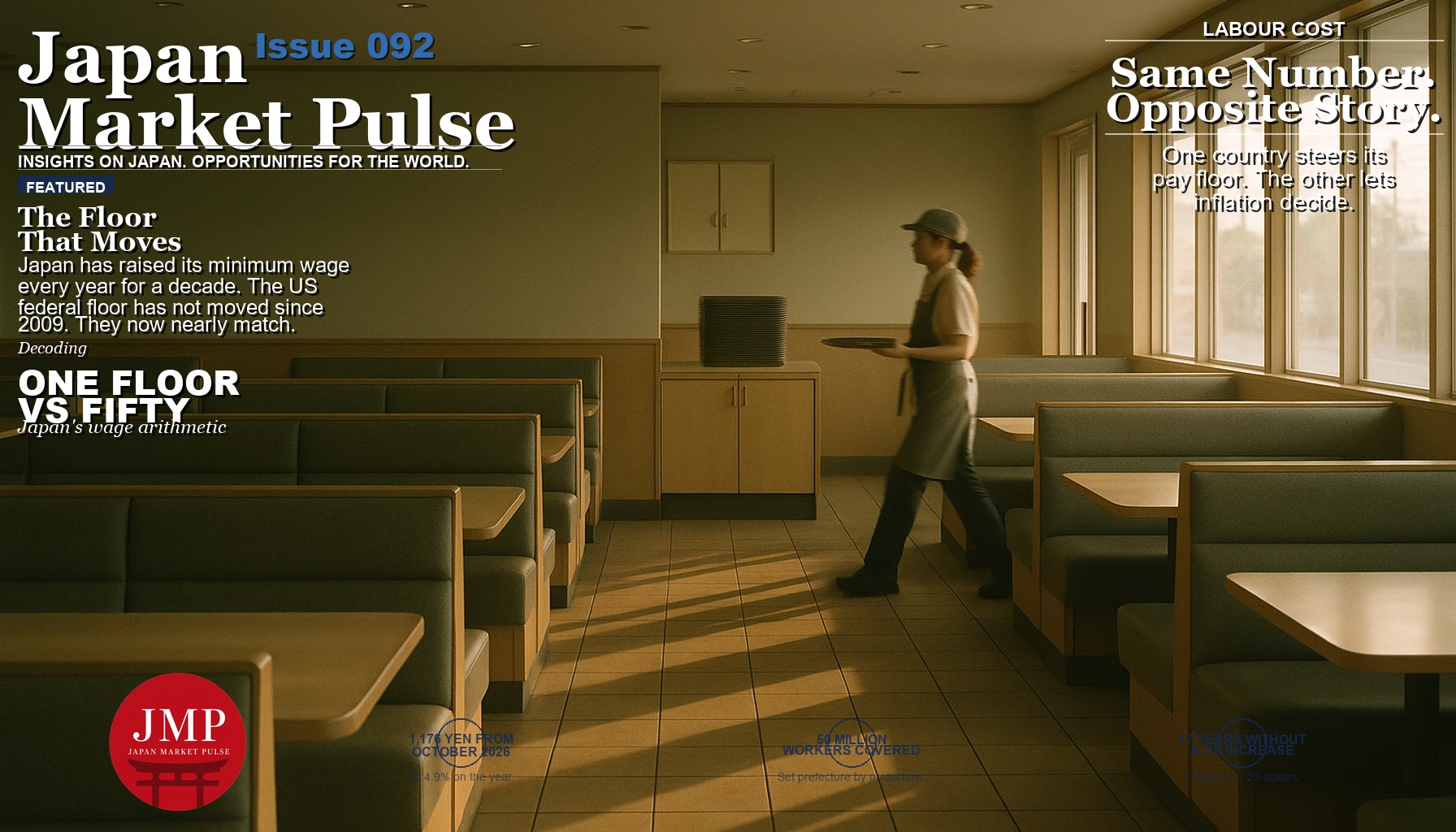
In late July 2026, an advisory panel to Japan’s labour ministry settled on a number that will eventually reach more than fifty million workers: a recommended national weighted-average minimum wage of ¥1,176 an hour, up ¥55, or 4.9 percent, from the previous year. It is a guideline, not a final figure: prefectures can and do go above it, so the eventual weighted average may land a little higher. Prefectural councils spent August arguing over their own figures, and the new floors take effect from October onward, with the exact date differing from prefecture to prefecture.
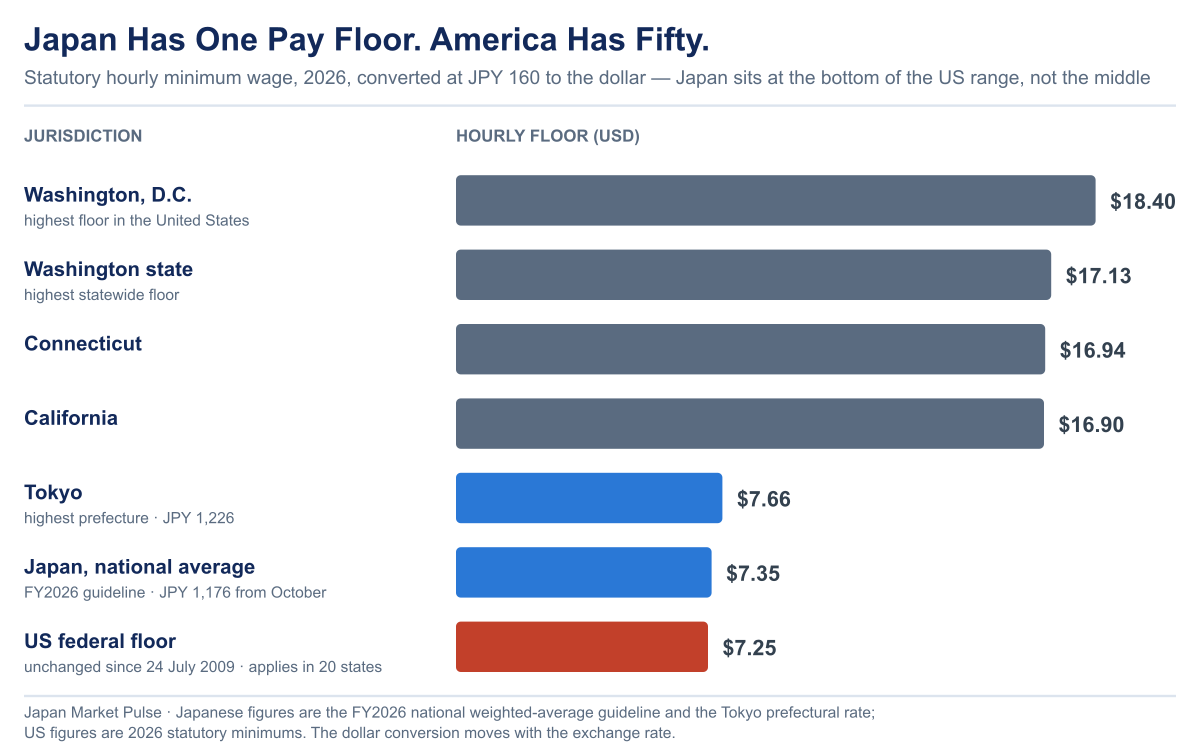
At the exchange rate that prevailed in the last week of August 2026 — roughly ¥160 to the dollar — ¥1,176 converts to about $7.35.
The United States federal minimum wage is $7.25. It has been $7.25 since 24 July 2009.
I have lived in Japan for twenty years, and I have watched a great many statistics about this country get flattened into a single misleading sentence for a foreign audience. This is not one of them, exactly, but it is close, and the way it is wrong is more interesting than the way it is right. Japan has not caught up with America. What has happened is that two countries arrived at nearly the same nominal figure by moving in opposite directions — one raising its floor every single year for a decade, the other leaving it untouched for seventeen — and then a currency market did the rest.
If you employ people in Japan, sell into Japan, or are modelling a Japanese entry for 2027, the number that matters is not $7.35. It is ¥1,176, the trajectory that produced it, and the trajectory that has just been quietly revised downward.
The Two Numbers That Landed in the Same Place
Start with the arithmetic, because it is doing a lot of work and it deserves to be looked at directly.
Japan’s minimum wage is set nationally as a guideline and then finalised prefecture by prefecture. The Central Minimum Wage Council recommends an increase; forty-seven prefectural councils deliberate through August; each prefectural Labour Bureau Director issues the final figure; the new rate takes effect in the autumn. Prefectures are free to go above the guideline, and several did last year. The ¥1,176 headline is a weighted average of what those forty-seven decisions are expected to produce, not a rate that any single worker is paid.
The United States sets a federal floor by statute and then lets fifty states legislate above it. Twenty states have a minimum wage no higher than $7.25 — Alabama, Georgia, Idaho, Indiana, Iowa, Kansas, Kentucky, Louisiana, Mississippi, New Hampshire, North Carolina, North Dakota, Oklahoma, Pennsylvania, South Carolina, Tennessee, Texas, Utah, Wisconsin and Wyoming. Five of those — Alabama, Louisiana, Mississippi, South Carolina and Tennessee — have no state minimum wage law at all, so the federal rate applies by default. At the other end, the District of Columbia is at $18.40 after its July 2026 indexed increase, and Washington state at $17.13, with Connecticut at $16.94 and California at $16.90.
So the honest comparison is not “Japan $7.35 versus America $7.25.” It is “Japan’s entire labour market has one floor that varies by about twenty percent from top to bottom, while America has fifty state floors plus the District, and city ordinances on top, varying by a factor of two and a half.”
The dollar figure is also a currency artefact, and a recent one. The yen has weakened by roughly nine percent against the dollar over the past twelve months; from late July through late August 2026 it moved from near ¥164 to the mid-¥150s and back to around ¥160. Run ¥1,176 through the strong end of that range and you get about $7.58. Run it through the weak end and you get about $7.17. The entire “Japan has caught America” story sits inside a few weeks of currency movement, which should tell you how much weight to put on it as an economic claim.
What it is genuinely useful for is a sanity check on cost. If you are a US operator building a Japanese cost model in dollars, and your assumption is that Japanese entry-level labour is meaningfully cheaper than American entry-level labour, that assumption stopped being true a while ago at the federal floor, and was never true against the states where you would actually open a store. Tokyo’s current rate of ¥1,226 is about $7.66. Seattle is at more than double that. What has changed is not that Japan became expensive; it is that the cheap-Japan premise, which was a reasonable planning assumption in 2015, has been eroded from both ends — by ten years of Japanese increases and by seventeen years of American stasis.
There is one more asymmetry worth stating plainly, because it rarely survives the translation into English-language coverage. The American federal minimum wage has not merely stayed flat in nominal terms. It has lost roughly a third of its purchasing power since it was set, because prices did not stay flat. Japan’s floor has risen by more than a quarter in nominal terms in five years, in a country where consumer prices, until recently, barely moved at all. One of those two floors is being actively managed. The other is being allowed to decay by default.
Five Straight Raises, and the Year Japan Eased Off
Japan has had a minimum wage law since 1959, and the guideline system that produces the national figure discussed here dates to 1978. For most of its life it was a slow, technocratic instrument that moved by a few yen a year and generated no headlines whatsoever. That ended in the early 2020s.
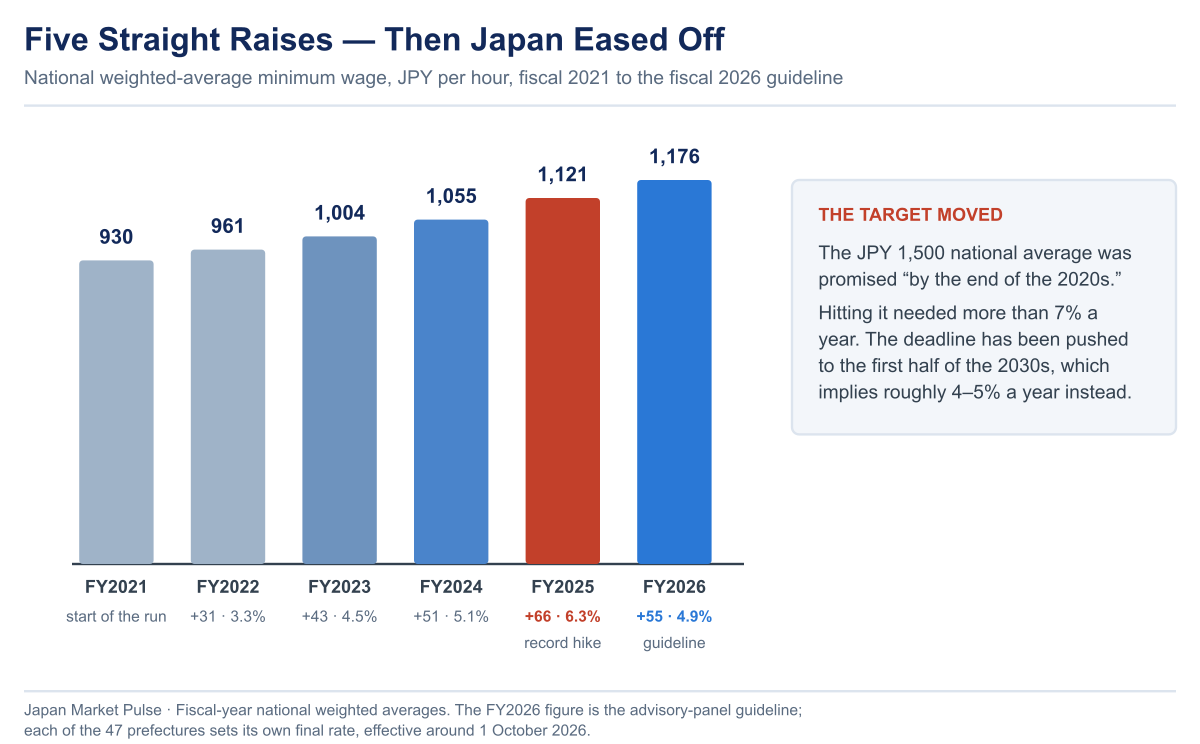
The national weighted average was ¥930 in fiscal 2021. It went to ¥961, then ¥1,004, then ¥1,055, then ¥1,121, and now, on the fiscal 2026 guideline, ¥1,176. The annual increases run ¥31, ¥43, ¥51, ¥66, ¥55. That is a cumulative rise of about 26 percent in five years, in an economy that spent the preceding two decades being lectured by the rest of the world about its inability to generate wage growth.
The fiscal 2025 raise was the largest in the system’s history: ¥66, or 6.3 percent, and it pushed every one of the forty-seven prefectures above ¥1,000 an hour for the first time. That milestone was reported in Japan with genuine emotion. It is difficult to explain to someone who did not live through the deflationary years how strange it felt to see a wage floor described as a national achievement.
And then this year the pace slowed. Fiscal 2026’s ¥55 is a smaller increase in both yen and percentage terms than fiscal 2025’s ¥66. That deceleration is not an accident, and it is the single most important thing in this year’s announcement.
The previous administration, under Prime Minister Ishiba Shigeru, had committed to raising the national average to ¥1,500 an hour by the end of the 2020s. Arithmetic made that target brutal: getting from ¥1,121 to ¥1,500 within the decade required increases of more than seven percent every year, compounding, in a country where the majority of employment sits inside small and midsize firms with thin margins and limited pricing power. Under Prime Minister Takaichi Sanae, the government’s basic policy on economic and fiscal management effectively moved that deadline, pushing the ¥1,500 goal to “as early as possible” in the first half of the 2030s.
Read that as what it is: a government looking at its own small-business base and deciding that the pace of the last three years cannot be sustained without breaking something. The target has not been abandoned. It has been given several more years of runway, which changes the compound rate required from something above seven percent to something closer to four or five — which is, not coincidentally, close to what this year’s guideline delivered.
For anyone modelling Japanese labour costs into 2030, this is the planning number. Not the ¥1,500 headline, and not the 6.3 percent shock of last year. Assume a floor that rises somewhere in the four-to-five percent range annually, with the possibility of a faster year if inflation reaccelerates and a slower one if small-business failures keep climbing.
What ¥1,176 Buys at 7 a.m. in Tokyo
Currency conversion tells you what a Japanese wage is worth to a foreign accountant. It tells you almost nothing about what it is worth to the person earning it, which is the thing that actually determines whether you can staff a shift.
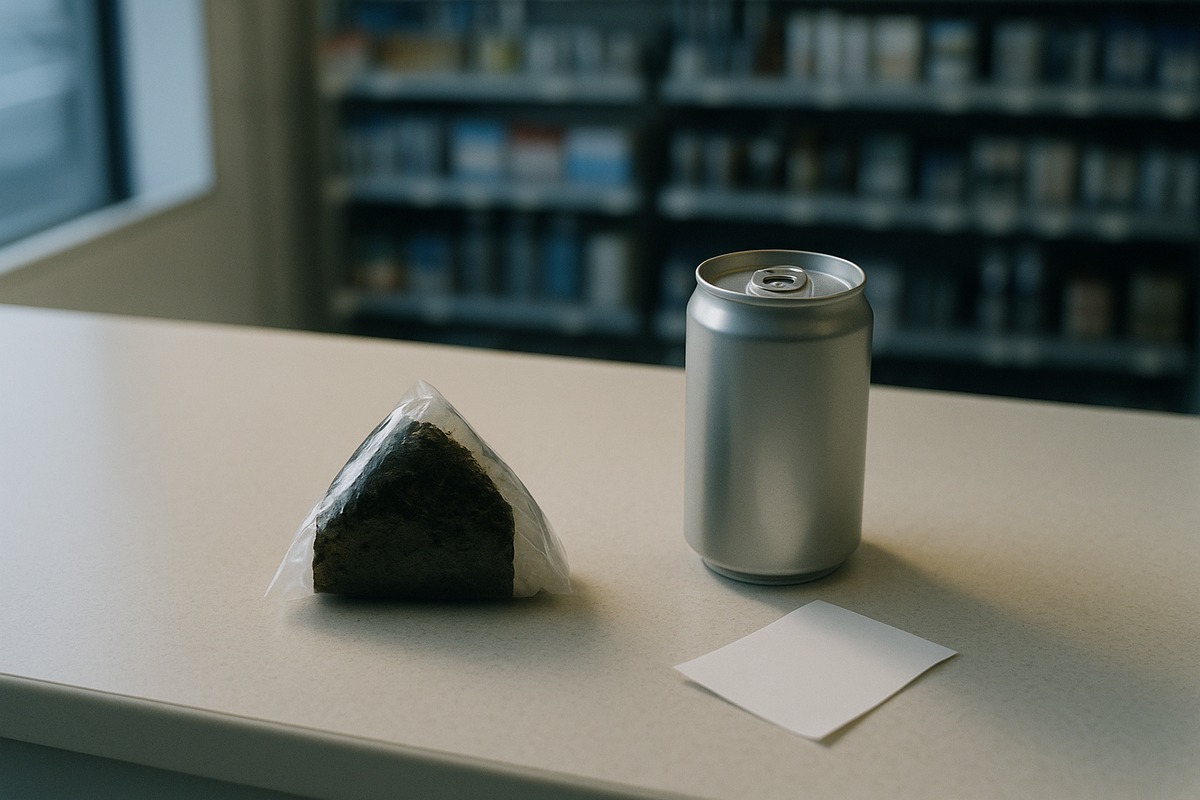
Here is the version I can vouch for personally, from a neighbourhood in eastern Tokyo at seven in the morning. An hour at the new floor buys a rice ball and a canned coffee at the convenience store on the corner with a good deal left over. It buys roughly two and a half single-ride trips on the subway. It does not quite buy lunch at the standing soba counter and the train home in the same hour, but it comes close. In the American cities where the federal floor still applies, an hour at $7.25 does not reliably buy a fast-food combination meal and a bus fare, and it certainly does not buy the equivalent of a subway system that runs on time.
This is why the exchange-rate comparison misleads in both directions. A Japanese minimum-wage hour buys more transport, more safety, more healthcare and more prepared food than an American minimum-wage hour at the federal floor, and it buys dramatically less housing than an American minimum-wage hour in a low-cost state. Japanese part-time workers at the floor are overwhelmingly not sole earners supporting a household; they are students, second earners in a married household, and people over sixty who have left full-time employment and are working two or three days a week. The floor is designed around that assumption, which is both its strength and, as the next section shows, the source of its strangest failure mode.
I have also watched what the raises actually changed on the ground, which is not what the policy debate suggests. The convenience store near my station did not lay anybody off when the floor went past ¥1,000. It cut its overnight staffing from two people to one, put in a second self-checkout terminal, and stopped restocking the hot-food case after ten at night. The bakery two doors down closed on Wednesdays. These are the real adjustments — not headcount reductions but service reductions, absorbed quietly and mostly invisibly, until you notice that the country you are operating in has slightly less of everything available at slightly less convenient hours than it did five years ago.
Japan’s ¥203 Gap and America’s $11.15 One
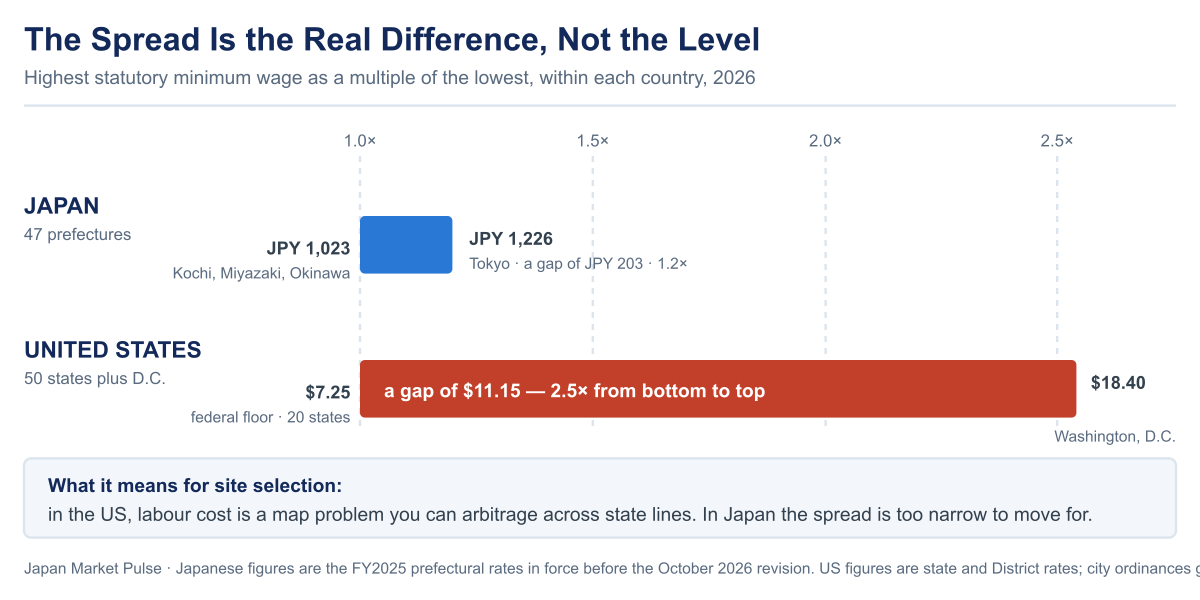
One of the most consequential differences between the two systems is not the level at all. It is the spread.
After the fiscal 2025 revision, Japan’s prefectural minimum wages ran from ¥1,023 — in Kochi, Miyazaki and Okinawa — up to ¥1,226 in Tokyo. That is a gap of ¥203, a ratio of about 1.2 to 1 between the most and least expensive places to employ someone in the country.
In the United States, a worker doing the identical job at the legal minimum earns $18.40 in Washington, D.C. and $7.25 in Dallas. That is a gap of $11.15, a ratio of about 2.5 to 1 — and that is before city ordinances, which push Seattle above $21.
Those two ratios describe two completely different operating environments, and the strategic implications run in opposite directions.
In the United States, the location of your labour is a first-order variable in the business model. Distribution centres, call centres, back-office functions and increasingly food production have been arbitraged across state lines for decades precisely because the floor moves so much. A US operator has a real, legal, structural incentive to place labour-intensive functions in low-floor states, and most large ones have already done so.
In Japan, that lever barely exists. Moving a warehouse from Tokyo to Miyazaki saves you about seventeen percent on the wage floor and costs you a great deal in logistics time, recruiting depth and management overhead. Japanese firms do relocate for labour cost, but the calculation is dominated by land prices, transport distance to Tokyo and Osaka, and — overwhelmingly — by whether anyone is actually available to hire in that prefecture. In much of rural Japan the binding constraint is not the wage floor. It is that the working-age population has left.
Japan’s narrow spread is also, quietly, a political problem. Most of the prefectures at the bottom are losing population — Okinawa, which sits on the lowest rate, is the notable exception and is still growing — and one of the arguments for raising their floors aggressively is to slow the drift of young workers toward Tokyo. Every year the gap narrows a little further, and every year the small businesses in the lowest-wage prefectures argue that the raise they are being handed is calibrated to a Tokyo economy they do not live in. The fiscal 2026 deceleration is, in part, a response to those arguments.
For a foreign operator, the practical takeaway is blunt: do not build a Japanese site-selection model around wage arbitrage. The spread is too narrow for it to matter, and the availability constraint will dominate the cost constraint everywhere outside the major metropolitan corridors.
The Bill Lands on the Smallest Companies
Japan’s employment base is not Toyota and Sony. It is millions of small and midsize enterprises, and it is those firms — restaurants, care facilities, small manufacturers, logistics subcontractors, regional retailers — that pay the minimum wage and absorb every increase directly.
The strain is now visible in the failure statistics. Corporate bankruptcies in Japan, counting cases with debts of ¥10 million or more, totalled 5,346 in the first half of 2026 according to Tokyo Shoko Research — the first time the first-half figure has exceeded five thousand in twelve years. Monthly bankruptcies passed one thousand again in July. Bankruptcies attributed specifically to labour shortage reached a record 442 in fiscal 2025, up 43 percent year on year. The first half of 2026 then produced 237 such failures, up 38 percent on the same period a year earlier and the highest first-half figure since Tokyo Shoko Research began tracking the category in 2013, with rising personnel costs cited in 120 of them — a pace that points at another record year rather than a plateau.
It is important to be precise about causation here, because the easy version of this story is wrong. Japanese small businesses are not failing because the minimum wage went up. They are failing because of a compound squeeze in which the wage floor is one of four jaws: input costs that have risen sharply since 2022, a weak yen that has made every imported component and ingredient more expensive, a labour market so tight that firms must pay well above the floor to hire at all, and — the specifically Japanese jaw — a customer base that has been trained over thirty deflationary years to treat a price increase as a betrayal.
That fourth factor is the one foreign operators consistently underestimate. In most markets, a rising wage floor is passed through to prices with a lag and some margin compression. In Japan, the pass-through mechanism is culturally obstructed. Raising the price of a lunch set from ¥980 to ¥1,080 is not a routine repricing; it is an event that gets discussed, that costs regular customers, and that many owner-operators will delay past the point of solvency rather than execute. The famous ¥100 price points in Japanese retail were defended long past the point where they made commercial sense, and a good deal of the current failure wave is the accumulated cost of that defence.
The government’s answer has been subsidy rather than exemption: grant programmes that pay part of the cost of productivity-improving equipment for firms that raise wages above the floor, plus a range of support for smaller employers. These programmes are real and they are used, but they are applications, not entitlements — which means they systematically favour the small firms that have somebody available to fill in the paperwork, and that is not usually the ten-person restaurant that most needs the help.
The Wall That Eats the Raise
Now for the part of Japan’s labour market that reliably breaks foreign staffing models, and that a rising wage floor makes worse rather than better.
A large share of Japan’s part-time workforce deliberately caps its own annual earnings. The reason is a set of thresholds — the “income walls” — at which tax liability begins, or at which a worker loses dependent status on a spouse’s insurance and pension, or at which a spousal deduction phases out. The best-known thresholds sit at ¥1.03 million, ¥1.06 million, ¥1.30 million, ¥1.50 million and ¥2.01 million of annual income. Crossing one can leave a household worse off in net terms than stopping just below it, so workers stop just below it. Survey work has found that 56.7 percent of married women working part-time or casual jobs deliberately adjust their hours to avoid crossing a wall.
Follow the arithmetic and the perversity becomes obvious. If a worker is targeting a fixed annual income ceiling and you raise the hourly rate, the worker does not earn more. The worker works fewer hours. For workers strictly holding to a fixed ceiling, a 4.9 percent increase in the wage floor translates arithmetically into something close to a 4.9 percent reduction in the hours they make available — concentrated, as bad luck would have it, in exactly the November and December weeks when retail and food service need those hours most. Every autumn, Japanese managers rebuild their December rosters around workers who have hit their ceiling and gone quiet until January.
The government has been chipping at this. The 2026 tax reform raised the tax-free threshold for salaried workers to ¥1.78 million for 2026 and 2027, up from ¥1.6 million, following an agreement with the Democratic Party for the People. That is a substantial move and it will relieve pressure at the lowest wall. The insurance thresholds are moving too, but in a different direction: from October 2026 the ¥88,000-a-month wage test that creates the ¥1.06 million wall is due to be removed, which the labour ministry estimates will bring roughly 1.1 million more part-time workers into the employees’ pension system rather than letting them stop short of it. Taken together with the phased removal of the company-size test and the extension to smaller unincorporated employers, the wider pension reform is estimated to expand coverage by about two million. The twenty-hour-a-week test stays, and so does the ¥1.30 million dependency wall, which is where the sharpest cliff now sits. The walls have been rearranged, not removed.
If you are staffing a Japanese operation with part-time labour, this belongs in your model as a named constraint, not a footnote. Build your annual hour budget bottom-up from per-worker ceilings, assume that a wage increase converts partly into an hours reduction, and staff the fourth quarter as though a measurable slice of your part-time roster will become unavailable in November. Foreign operators who model Japanese part-time labour the way they model American part-time labour — as an elastic pool that expands when you raise the rate — get this exactly backwards.
How Japanese Operators Are Absorbing It
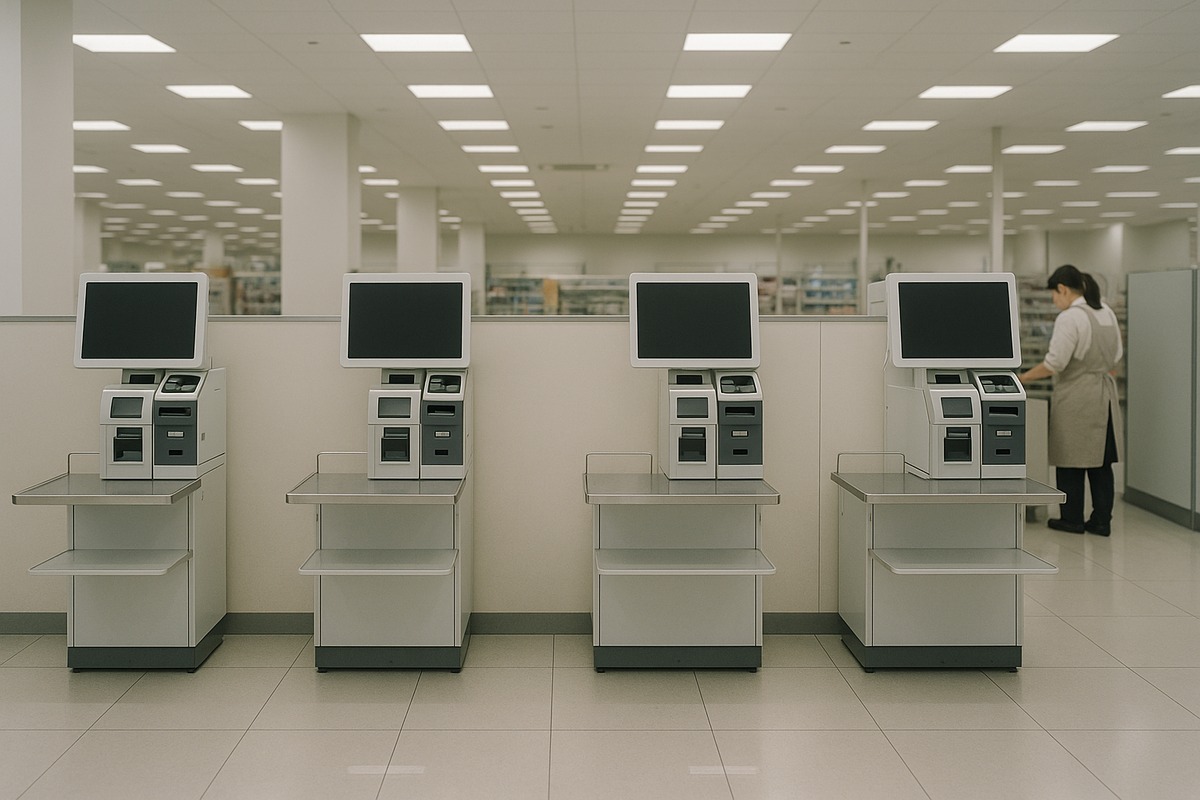
The most instructive thing about the last five years is not the policy. It is watching a national retail and food-service industry re-engineer itself in real time around a floor that will not stop rising.
The most visible answer is automation, and the canonical example is Skylark Holdings, which operates the Gusto and Syabu-Yo chains among others. Skylark has deployed something on the order of three thousand serving robots across its restaurants. The figures most often quoted — table turnover up 7.5 percent, employee step count down 42 percent, table clear-and-reset time down 35 percent — come from the earlier Gusto trials rather than from the full fleet; reporting after the wider rollout has put the turnover gain closer to 2 percent. Both numbers point the same way, and the smaller one is the more useful planning input.
Notice what those numbers describe. Not a headcount reduction — a step-count reduction. The robots did not replace the servers; they removed the walking from the job, which allowed the same number of servers to cover more tables and, incidentally, made the job survivable for the older workers who now make up a growing share of Japanese food-service staffing. That is the Japanese automation pattern in miniature, and it is consistently misread abroad as labour replacement when it is closer to labour extension.
The less visible answers matter more in aggregate. Self-checkout and semi-self-checkout terminals have spread through Japanese supermarkets and convenience stores to a degree that startles returning visitors. Restaurants have moved ordering to tablets and QR codes, which removes a labour step and, as a side effect, raises average check size. Opening hours have been trimmed — the twenty-four-hour convenience store is no longer a certainty, and the franchise fight over that point was one of the defining Japanese retail stories of the last decade. Menus have shrunk. Delivery has been consolidated. Nakashoku, the prepared-food-to-take-home category, has expanded partly because it is less labour-intensive per yen of revenue than dine-in service.
And, finally and most slowly, prices have moved. The psychological barrier around price increases has genuinely cracked since 2022 in a way that veteran observers of this market did not expect to see. It is now possible to raise a price in Japan, explain the reason, and retain the customer. That is a bigger structural change than any of the robots, and it is the main reason the wage floor has been able to rise this fast without a broader collapse in the small-business base.
What Changes If You Employ People in Japan

Pulling this together into the form an operating plan actually needs.
Use ¥1,176 as the fiscal 2026 national baseline, and your own prefecture’s figure as the real one. The national average is a planning abstraction. If you are hiring in Tokyo, your floor was ¥1,226 before this autumn’s revision and is rising; if you are hiring in Kochi, Miyazaki or Okinawa, it was ¥1,023. Check the prefectural figure that takes effect in October, because that is the number you are legally bound by.
Do not staff at the floor. In a labour market this tight, the statutory minimum is a legal boundary, not a market rate. Convenience stores, restaurants and warehouses in metropolitan areas are advertising well above their prefectural floors because they cannot fill shifts otherwise. Budget the floor as a compliance constraint and your actual hiring rate from local job postings.
Model four to five percent annual floor increases through 2030, not seven. The ¥1,500 target has moved into the first half of the 2030s. That is your compound rate.
Budget the fourth-quarter hours cliff. Part-time hours contract in November and December as workers hit their annual income ceilings. The 2026 reform raised the tax-free threshold to ¥1.78 million and the ¥1.06 million wage test is due to go in October 2026, but the ¥1.30 million dependency wall remains.
Treat labour availability, not labour cost, as the binding constraint. Record labour-shortage bankruptcies and a first half with more than five thousand corporate failures are telling you that the scarce input in Japan is people, not yen. A plan that solves for the cheapest prefecture and ignores whether anyone lives there will fail.
Assume your Japanese partners and subcontractors are under margin pressure you cannot see. If you are contracting with Japanese logistics providers, manufacturers or service operators, their labour costs have risen more than a quarter in five years against a customer base that resisted price increases for most of that period. Rate increase requests are not opportunism. Refusing them is how you lose a supplier at the worst possible moment.
Stop pricing Japan as a low-cost labour market in dollars. The exchange rate has flattered your model. If the yen strengthens toward ¥140, the same ¥1,176 becomes about $8.40 without a single policy change, and every dollar-denominated Japanese cost line in your plan moves with it.
Frequently Asked Questions
Q. When does Japan’s new ¥1,176 minimum wage actually take effect?
A. The ¥1,176 figure is the national weighted-average guideline decided by a labour ministry advisory panel in late July 2026. Each of the forty-seven prefectural councils then deliberates through August, and the prefectural Labour Bureau Director sets the final local figure. The new rates take effect from October 2026 onward, with the exact date varying by prefecture. Until your prefecture’s revised rate takes effect, the previous year’s figure remains the legal floor.
Q. Is Japan’s minimum wage really the same as the United States’?
A. Only as a nominal conversion at one moment in time. At roughly ¥160 to the dollar, ¥1,176 is about $7.35 against the US federal floor of $7.25. But twenty US states sit at the federal floor while others are far above it — Washington, D.C. is at $18.40 and Washington state at $17.13 — and Japan’s figure moves with the exchange rate. A meaningful comparison has to account for purchasing power, the cost of housing, healthcare and transport, and the fact that Japan has one floor while the United States effectively has fifty.
Q. Why did Japan slow the pace of increases this year?
A. Fiscal 2026’s ¥55 increase is smaller than fiscal 2025’s record ¥66. The previous administration’s target of a ¥1,500 average by the end of the 2020s would have required annual increases above seven percent, which the government judged too heavy a burden for small and midsize firms. Under the Takaichi administration the ¥1,500 goal was pushed to the first half of the 2030s, which lowers the required annual pace to roughly the four-to-five percent range.
Q. How much does the minimum wage vary across Japan?
A. After the fiscal 2025 revision the range ran from ¥1,023 in Kochi, Miyazaki and Okinawa to ¥1,226 in Tokyo — a gap of ¥203, or a ratio of about 1.2 to 1. For comparison, the US range runs from $7.25 to $18.40 across the states and the District of Columbia — a ratio of about 2.5 to 1, and wider still if you count city ordinances such as Seattle’s. Wage arbitrage between Japanese prefectures is not a viable strategy at that spread.
Q. What is the “income wall” and why does it matter to employers?
A. Japan has a series of annual income thresholds at which part-time workers begin paying tax or lose dependent status on a spouse’s social insurance. Because crossing one can reduce net household income, many part-timers cap their hours to stay below — 56.7 percent of female part-time workers have reported deliberately adjusting their hours. The practical effect for employers is that raising the hourly rate can reduce available hours rather than increase them, with the shortage concentrated in November and December. The 2026 tax reform raised the salaried tax-free threshold to ¥1.78 million for 2026–27, easing but not eliminating the problem.
The Floor Is the Story
It is tempting to read the $7.35 and $7.25 coincidence as a story about Japan catching up. It is not. It is a story about two different theories of what a wage floor is for.
Japan treats its floor as an active instrument of macroeconomic policy — a way to push money into consumption, to make low-wage work viable for an ageing workforce, and to slow the depopulation of its poorest prefectures. It has raised that floor every year for a decade, has just executed the largest increase in the system’s history, and is now deliberately easing off because the small-business base is showing stress. That is a policy being steered, with visible costs, visible trade-offs and a visible argument about pace.
The United States treats its federal floor as a settled statute that a divided legislature cannot move, and has delegated the entire question to the states. The result is a national floor that has lost roughly a third of its value to inflation while nobody voted for that outcome, and a fifty-way patchwork that a company with a capable real-estate team can plan around.
Neither approach is obviously correct, and this is not the place to argue that. But if you operate in both countries, the practical difference is enormous. In America, your labour floor is a map problem. In Japan, it is a calendar problem: a known, announced, single-digit-percentage increase arriving every October, forever, that you can budget for years in advance and that your competitors are budgeting for too.
Of the two, the calendar problem is the easier one to plan around. It is just considerably more expensive to ignore.
If you’re interested in this topic, the Japanese market more broadly, or what KETCHUPs is working on, we’d love to hear from you — please reach out via our contact form.
Japan Market Pulse is a weekly read on what the Japanese consumer-tech, food, and mobility markets are choosing to do, written for international operators who want to know what is happening before it shows up in the global trade press.
Subscribe at ketchups.co/japan-market-pulse.