

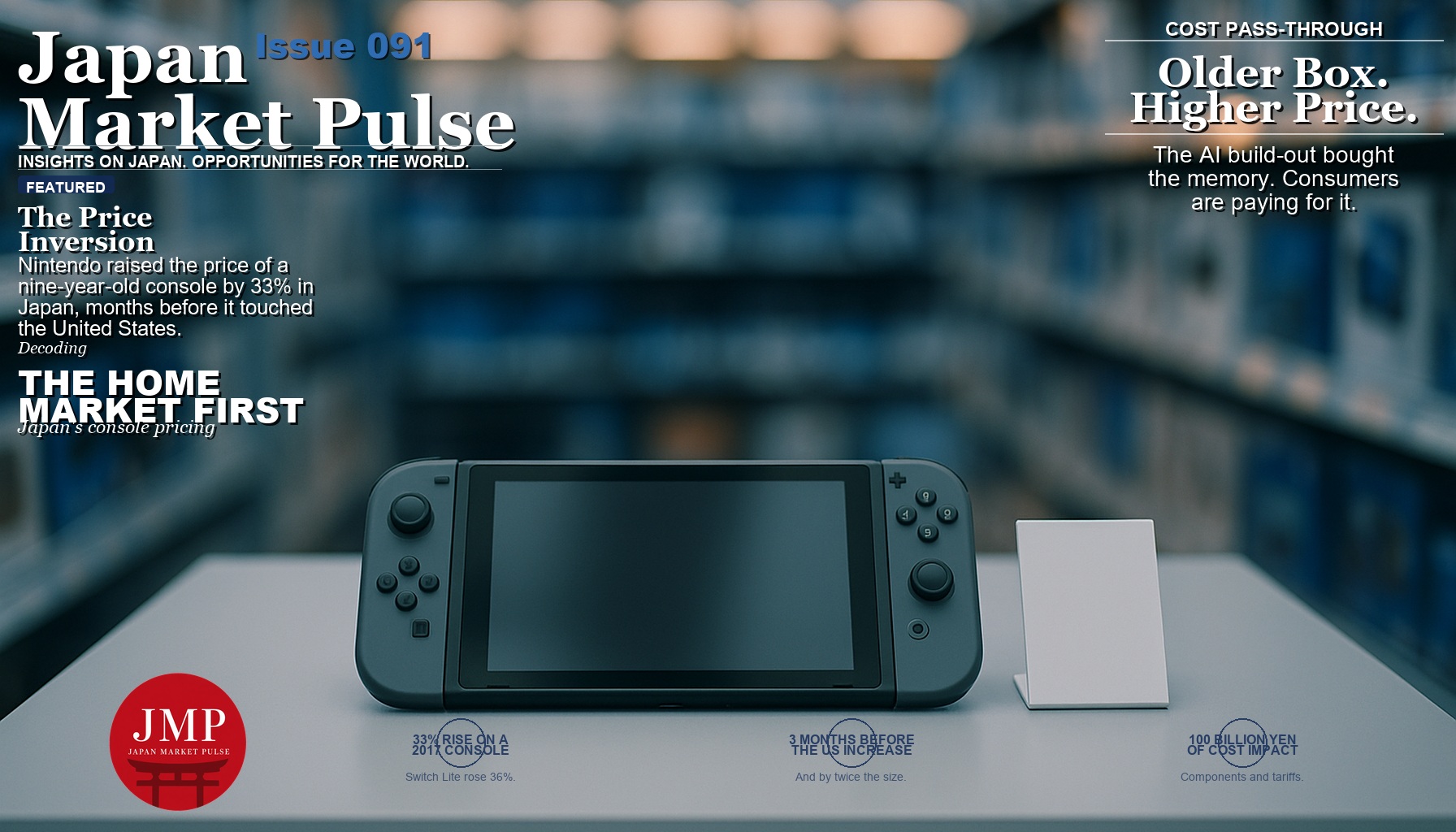
There is a rule in consumer electronics that is so reliable nobody bothers to state it: hardware gets cheaper as it ages. The launch price is the high-water mark. Two years in there is a slim revision, three years in there is a bundle, five years in the thing is a doorbuster. Nobody plans a business around the opposite.
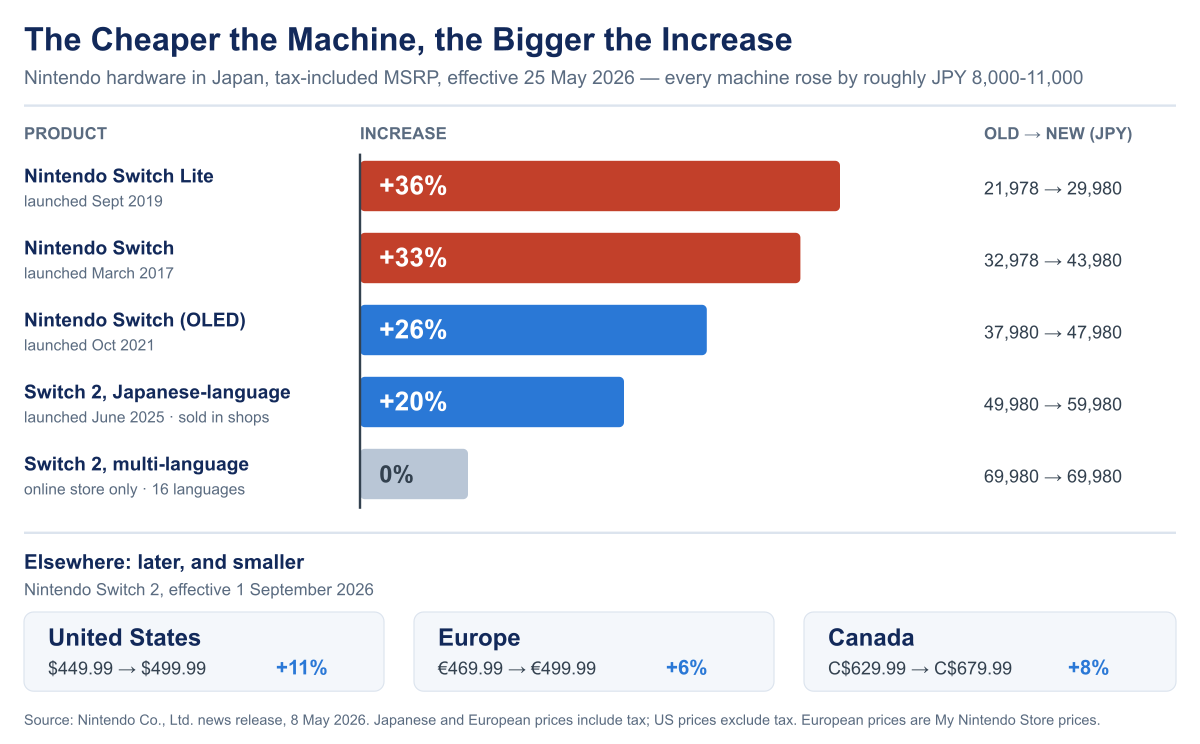
On 8 May 2026, Nintendo published a price revision notice that broke that rule in public. Effective 25 May, in Japan, the original Nintendo Switch — a console that launched in March 2017 and is now nine years old — went from ¥32,978 to ¥43,980. That is an increase of 33%. The Nintendo Switch Lite went from ¥21,978 to ¥29,980, an increase of 36%. The OLED model went from ¥37,980 to ¥47,980, up 26%. And the Nintendo Switch 2 Japanese-Language System, the version sold in ordinary Japanese shops, went from ¥49,980 to ¥59,980, up 20%.
The same notice said the United States price of the Switch 2 would rise from $449.99 to $499.99, and the European My Nintendo Store price from €469.99 to €499.99. Those are increases of 11% and 6%. They took effect on 1 September — just over three months after Japan’s.
So the home market went first, and the home market went hardest. That is not the order these things normally happen in, and the reason it happened has almost nothing to do with games.
The Week a Nine-Year-Old Console Got 33% More Expensive
To understand how strange the Japanese half of this announcement is, you have to hold two things in your head at once.
The first is that the original Switch is not a legacy SKU quietly winding down in a warehouse. Nintendo shipped 3.80 million units across the original Switch family — the standard model, the OLED and the Lite — in the fiscal year ended March 2026, down 64.8% year on year because the Switch 2 arrived, but still a real product line with real volume. The company’s forecast for the year ending March 2027 is another 2.00 million units. All three of those machines were repriced upward in Japan. Nintendo is not clearing stock. It is still manufacturing a nine-year-old console, and it has decided that the correct price for that console in 2026 is a third higher than it was in 2025.
The second is that the Japanese increases were not spread evenly. They tracked starting price almost perfectly, and in the opposite direction. The most expensive machine on sale in shops, the Switch 2, took the smallest percentage increase at 20%. The cheapest, the Switch Lite, took the largest at 36%. In yen terms every machine went up by roughly ¥8,000 to ¥11,000, which means the increase was close to a flat per-unit charge — and a flat charge on a ¥21,978 machine is a much larger percentage than the same charge on a ¥49,980 one.
That shape is diagnostic. A pricing move driven by demand, brand or positioning would concentrate on the product people are queuing for. A pricing move that lands as a near-constant number of yen on every unit regardless of age or margin looks far more like a cost pass-through. Nintendo has not disclosed a per-unit bill-of-materials figure, so this is a pattern consistent with broad cost pass-through rather than proof of one — but it is the pattern you would expect if a component that every machine contains had become more expensive by a similar amount in each box.
Nintendo also did something quietly telling with a product line most people forget it still runs. The company began in 1889 making hanafuda playing cards, and it still sells them. In the same notice, several of those card products stopped having a manufacturer’s suggested retail price at all and moved to “open price,” which in Japanese retail practice means the manufacturer declines to set a reference price and leaves it to the retailer. When a 137-year-old product line stops having a recommended price, the company is telling you it no longer trusts its own cost forecast.
Japan Went First, and Japan Went Hardest
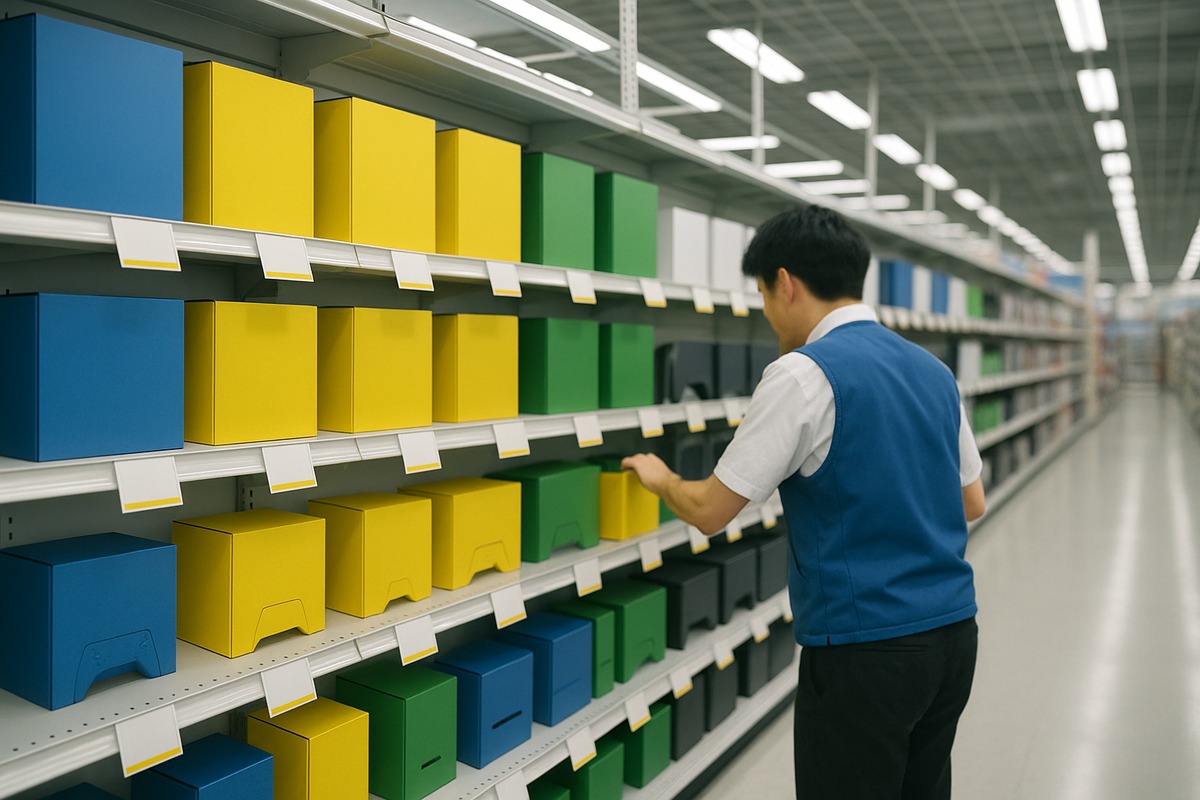
The three-month gap between the Japanese and American increases is the part that should interest anyone selling hardware into more than one country.
Conventional wisdom says you protect the home market. It is where your brand is most exposed politically, where the press coverage is most hostile, where the retail relationships are oldest, and where a price increase reads as a betrayal rather than a market adjustment. The standard playbook is to raise prices in the markets where the currency has moved against you and hold the line at home for as long as possible.
Nintendo did the reverse, and the reason is that Japan had become, by a wide margin, the cheapest major market in which to buy its hardware — and had been for years.
Do the arithmetic at the exchange rate that prevailed through this summer, roughly ¥159 to the dollar. Before the revision, the Japanese-language Switch 2 at ¥49,980 including consumption tax worked out to about $314. The American machine was $449.99 before sales tax. Japan was not slightly cheaper; it was around 30% cheaper, on a tax-inclusive versus tax-exclusive basis, for the identical silicon. After the revision, ¥59,980 is about $377 — still meaningfully below the $499.99 the United States will pay from September.
In other words, Japan absorbed by far the largest increases on the legacy Switch line — 26% to 36%, against nothing comparable announced elsewhere — and one of the steeper revisions on the Switch 2 itself, and it still remains the cheapest major market. Both statements are true, and the gap between them is the accumulated distance the yen has travelled. The company’s own forecast for the year ending March 2027 assumes ¥150 to the dollar and ¥175 to the euro. Those are not the assumptions of a business that expects the currency to come back.
For an international operator the lesson is uncomfortable but clean. If you have been holding a Japanese price flat in yen through the currency’s slide because you did not want the headline, you have been running an unbudgeted discount that compounds every year. Nintendo has just demonstrated what it looks like to stop — and demonstrated that you can take a 33% increase in your home market and still be the cheapest option globally.
Why a Handheld Console Costs More Because of a Data Center
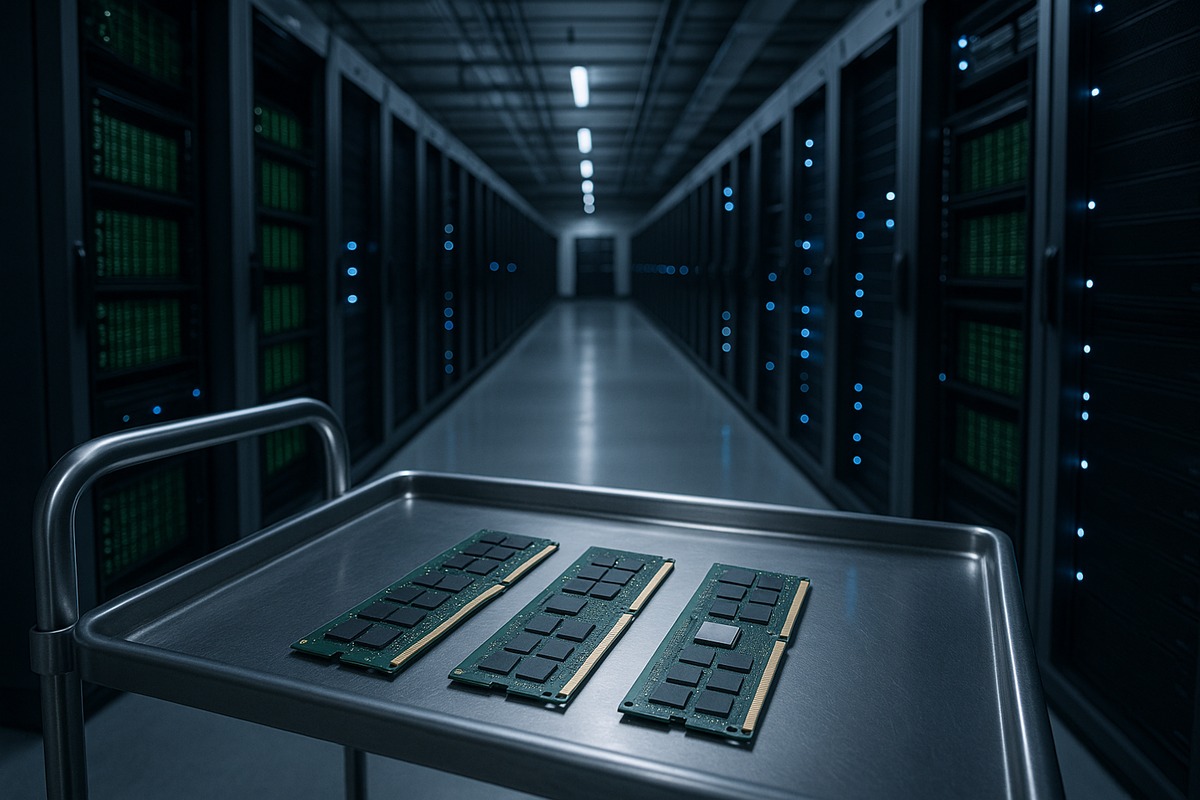
Nintendo did not blame the yen alone. In its results presentation on the same day, the company told investors that its forecast for the year ending March 2027 includes an impact of approximately ¥100 billion on cost of goods sold from rising component prices — memory in particular — and from tariff measures.
One hundred billion yen is not a rounding error. Nintendo’s forecast operating profit for that year is ¥370 billion. The company is telling the market that roughly the equivalent of a quarter of its expected operating profit is being absorbed by component costs and trade friction, and that this is why prices are moving.
Memory is the component Nintendo named first, and AI-server demand is the main reason memory prices have moved the way they have.
The scale of the move is difficult to overstate. According to TrendForce, conventional DRAM contract prices rose 90–95% quarter on quarter in the first quarter of 2026, then a further 58–63% in the second quarter, before moderating to a forecast 13–18% in the third. NAND flash contract prices rose 70–75% quarter on quarter in the second quarter of 2026. TrendForce attributes the run to AI server demand, with cloud service providers locking in supply through long-term agreements — a reversal of the consumer-led memory cycles most hardware makers built their planning around.
This is what a genuine supply reallocation looks like from the outside. Nobody in Kyoto did anything wrong. A different industry, buying a different product, at a price no consumer-electronics bill of materials can match, simply outbid the console business for overlapping memory supply and wafer capacity.
Nintendo is not alone in absorbing it. Sony announced on 27 March 2026 that PlayStation 5 prices would rise from 2 April — the standard disc console to $649.99, the Digital Edition to $599.99 and the PS5 Pro to $899.99, increases of $100, $100 and $150 respectively. Sony’s own wording pointed to continued pressures in the global economic landscape rather than to any single component; some industry coverage linked that broader pressure partly to memory costs. Japanese PS5 prices moved by roughly ¥17,000 to ¥18,000 across the lineup. When two competitors with completely different hardware architectures, margin structures and manufacturing partners raise prices within six weeks of each other, the cause is upstream of both of them.
The margin evidence inside Nintendo’s own numbers is stark. In the year ended March 2026 the company posted net sales of ¥2,313.0 billion, up 98.6%, and operating profit of ¥360.1 billion, up 27.5%. But gross margin fell 21.7 points to 39.3% and operating margin fell 8.7 points to 15.6%. Part of that is mix — hardware carries thinner margins than software, and a launch year is hardware-heavy by definition. But the direction of travel on components is why the company said profitability would be “roughly unchanged” after the price increases rather than improved. The increases are not a margin grab. They are a hold.
Two Switch 2s, One Country, ¥20,000 Apart
The most interesting structural detail in this story is one that most coverage outside Japan has never explained properly, because it does not exist anywhere else.
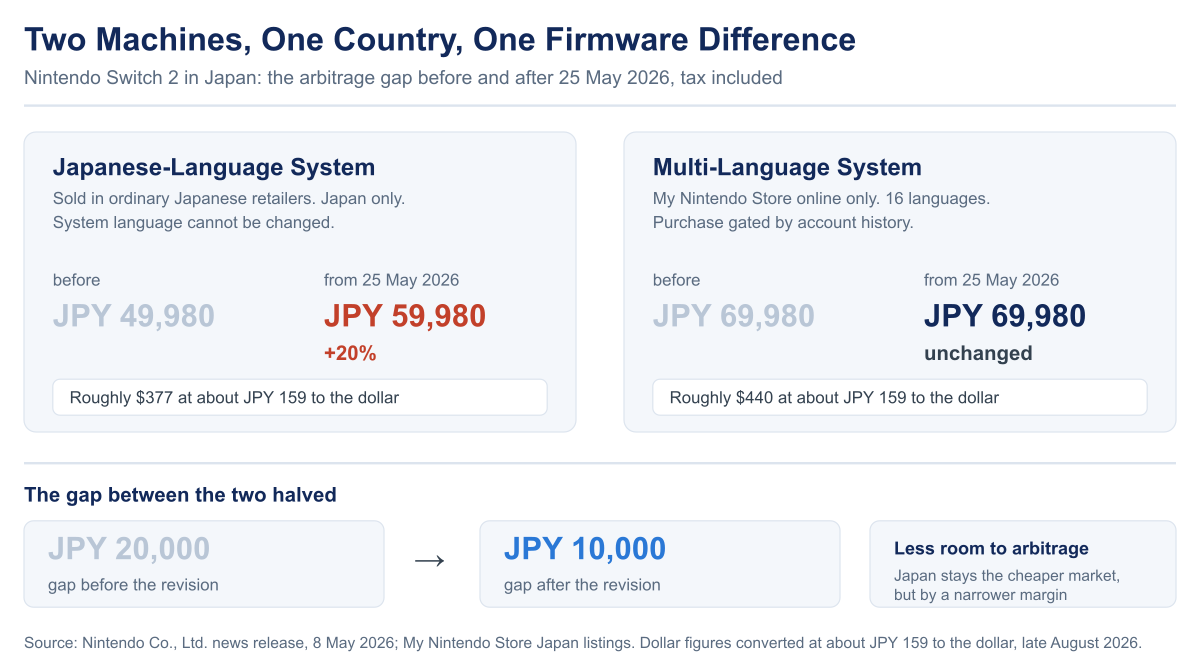
Nintendo sells two different Switch 2 systems in Japan. The one in ordinary shops is the Japanese-Language System, sold only in Japan, whose menus and system language are Japanese. The other is a multi-language system supporting sixteen languages, and it is available only through the My Nintendo Store online. Before the revision the first cost ¥49,980 and the second ¥69,980 — a gap of ¥20,000, roughly $126, for what appears to be the same core hardware differentiated by language and account restrictions rather than by specification.
On 25 May, the Japanese-language system rose to ¥59,980. The multi-language system did not move. The gap halved to ¥10,000.
The purpose of the two-tier structure is not localisation revenue. It is export control. A console priced 30% below its American equivalent in a country receiving record numbers of foreign visitors is an arbitrage waiting to happen, and the cheap SKU is deliberately built to be unattractive to anyone who wants to resell it abroad or use it in another language. Nintendo layered account conditions on top: the initial My Nintendo Store lottery sales required qualifying criteria including accumulated Nintendo Switch software play time and a history of paid Nintendo Switch Online membership — a fairly elegant way of saying “we will sell this to players, not to intermediaries.” Those conditions have since been relaxed, with the play-time requirement reported as dropped around the time of the May 2026 price revision, which is itself a signal that the supply squeeze the gate was built for had eased.
Whether it worked is a fair question, and the honest answer is partially. But the mechanism is worth studying regardless of the outcome, because the problem it solves is becoming universal. Any brand that wants to price for local purchasing power in a weak-currency market, while also protecting its pricing in strong-currency markets, needs some friction between the two. Nintendo’s friction is language plus a store gate plus an account history. Yours might be warranty terms, plug standards, service eligibility or software entitlement. The principle is the same: differential pricing only survives if crossing the boundary costs something.
The narrowing of the gap from ¥20,000 to ¥10,000 is the more revealing move. Nintendo raised the price of the domestic machine and left the export-resistant one alone, which shrinks the incentive to arbitrage from both directions at once. That is a deliberate, quiet piece of pricing architecture, and it is the sort of thing that never appears in a press release.
What Happened the Week the Price Changed
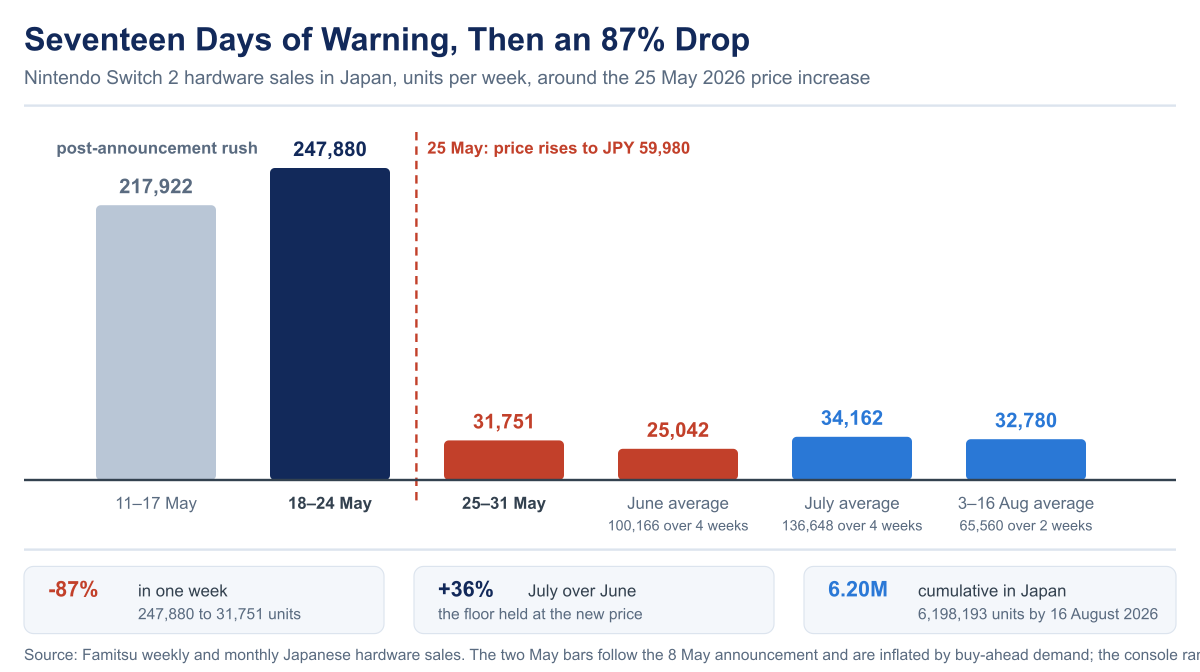
Japan gave the industry an almost laboratory-grade natural experiment, because the increase was announced on 8 May and took effect on 25 May. Seventeen days of warning.
Japanese consumers used them. According to Famitsu’s weekly hardware tracking, Switch 2 sales in the week of 11–17 May came to 217,922 units. The following week, 18–24 May — the last week at the old price — sales rose again to 247,880. Then the price changed, and in the week of 25–31 May the console sold 31,751 units. That is a fall of about 87% in seven days.
The hangover was long. June 2026 came in at 100,166 units for the month, an average of about 25,000 a week. The useful comparison is not the 250,000-unit rush weeks, which were themselves a product of the announcement, but the ordinary weeks before it: Famitsu tracking had the Switch 2 running at roughly 44,000 to 52,000 units a week through April 2026. June, at the new price, was running at about half of that. July recovered to 136,648 units, averaging about 34,000 a week, and the fortnight of 3–16 August ran at 65,560. Cumulative Japanese sales reached 6,198,193 units by 16 August 2026.
Two things are worth taking from that curve, and they point in different directions.
The first is that the pull-forward was enormous and the payback was real. Anyone modelling a pre-increase demand spike should assume that a meaningful share of the spike is borrowed from the following two months, not incremental. Japan’s May total of roughly 712,000 units across the tracked weeks was not a demand signal. It was a calendar effect, and it was created the moment the announcement went out.
The second is that the floor held. July’s run rate, at the new price, was roughly 34,000 units a week — below the 44,000 to 52,000 the console was doing at the old price in April, but recognisably the same order of magnitude, and up 36% on June. A 20% price increase on the flagship did not destroy the category; it reset it. That distinction matters enormously if you are the one deciding whether to raise a price, and it is exactly the distinction that panic in the first two weeks after an increase will hide from you.
What This Means If You Price Hardware for Japan
Four things, in order of how quickly they will bite.
The era of Japan as the world’s cheapest developed market is closing, and closing from the supply side rather than the demand side. For most of the past decade, foreign brands could treat a low yen price as a marketing asset — inbound shoppers, gift buying, the “everything is cheap in Japan” travel-media narrative. When your own bill of materials is denominated in dollars and a fixed component cost lands on every unit, that asset becomes a liability that grows with volume. Nintendo held its Japanese price flat for years and then took the entire correction at once. Taking it in smaller annual increments would have been less painful and less newsworthy.
Memory exposure is now a strategic variable, not a procurement detail. If your product contains DRAM or NAND in any quantity — and in 2026 that includes appliances, cameras, wearables, automotive modules and anything with a screen — your cost base is now partially indexed to data-centre capital expenditure, a demand source that is indifferent to your price ceiling and considerably better funded than you are. Nintendo, a company with genuine scale and long supplier relationships, is absorbing ¥100 billion. Assume your position is worse.
Subscription pricing is where the margin repair actually happens. Nintendo raised Nintendo Switch Online prices in Japan from 1 July 2026: the individual twelve-month plan from ¥2,400 to ¥3,000, the family twelve-month plan from ¥4,500 to ¥5,800. Those are increases of 25% and 29% on a product with no bill of materials at all. Hardware price increases get the headlines; recurring-revenue increases get the margin. If you sell a device with an attached service, the service is the lever with the least consumer friction per yen recovered.
Segment the market before you have to. The two-SKU Japanese structure looks like a curiosity until the day your Japanese price is 30% below your American one and grey-market exporters notice. Building the boundary early — in language, in entitlement, in service eligibility — is cheap. Retrofitting it after your channel has been arbitraged is not, and the retrofit usually requires punishing your legitimate domestic customers to catch the illegitimate ones.
There is a fifth point that sits underneath all of them. Nintendo’s home market is 23.1% of its sales; the Americas are 40.4%, Europe 23.8% and the rest of the world 12.7%. Nearly 77% of the business is outside Japan. A company in that position does not need to protect Japanese pricing for revenue reasons — and yet Japan is where the largest increases landed, because that is where the mispricing had accumulated. The size of a correction is set by how long you avoided making it, not by how important the market is.
Frequently Asked Questions
Q. How much does a Nintendo Switch 2 cost in Japan now?
A. The Japanese-Language System, sold in ordinary Japanese retailers, is ¥59,980 including consumption tax as of 25 May 2026, up from ¥49,980. The multi-language version, available only through the My Nintendo Store online, remained at ¥69,980. At roughly ¥159 to the dollar that is about $377 and $440 respectively, against $499.99 in the United States from 1 September 2026.
Q. Where can I buy a Nintendo Switch 2 outside Japan?
A. The console is sold through mainstream electronics retailers in every launch market, and the Nintendo Switch 2 console is listed on Amazon in the United States. Older hardware in the family, including the Switch Lite, can be found through Nintendo Switch listings. Note that a Japanese-language system bought in Japan cannot have its system language changed, which is the point of that SKU.
Q. Why did Nintendo raise prices on the original Switch, which is nine years old?
A. The pattern is consistent with a component-cost pass-through rather than a positioning decision. Nintendo told investors it has factored roughly ¥100 billion of higher component costs — memory in particular — and tariff impact into its cost of goods sold for the year ending March 2027. Older hardware still in production competes for the same memory supply as new hardware, so a similar per-unit cost increase would land on it too, and that is a much larger percentage of a cheaper machine.
Q. Is the memory shortage going to end?
A. Not on a schedule that helps 2026 pricing. TrendForce data shows conventional DRAM contract prices rising 90–95% quarter on quarter in the first quarter of 2026 and a further 58–63% in the second, moderating to a forecast 13–18% in the third — moderating growth, not falling prices. TrendForce attributes the run to AI server demand and to cloud providers securing supply under long-term agreements, which leaves consumer electronics buying what is left rather than setting the price.
Q. Did the price increase hurt sales in Japan?
A. Sharply and then partially. Famitsu weekly tracking shows Switch 2 sales of 247,880 units in the final week before the increase and 31,751 in the first week after, a fall of roughly 87%. June came in at 100,166 units for the month, but July recovered to 136,648 and cumulative Japanese sales reached 6,198,193 units by 16 August 2026. The spike before the increase borrowed demand from the two months after it.
Conclusion
The detail I keep returning to is the hanafuda cards. Nintendo has been printing them since 1889. They survived the company’s move into toys, into arcade machines, into home consoles, into becoming one of the most recognisable entertainment brands on earth. And in May 2026 Nintendo stopped publishing a suggested price for several of them, because the cost environment had become too unpredictable to guess at.
That is what an input shock looks like when it reaches the bottom of a product line. The Switch 2 price increase is the visible part; a company declining to name a price for a deck of paper cards is the part that tells you how far the uncertainty runs.
For anyone selling physical product into Japan, the actionable version is simpler than the macro story. Japan spent a decade as the market where you could hold a yen price flat and look generous. That decade ended on 25 May 2026, and it ended with the company that had held the line longest taking a 33% increase on its oldest product — in its own home market, ahead of everyone else, in public.
This article contains affiliate links. If you purchase through these links, we may earn a small commission at no extra cost to you.
If you’re interested in this topic, the Japanese market more broadly, or what KETCHUPs is working on, we’d love to hear from you — please reach out via our contact form.
Japan Market Pulse is a weekly read on what the Japanese consumer-tech, food, and mobility markets are choosing to do, written for international operators who want to know what is happening before it shows up in the global trade press.
Subscribe at ketchups.co/japan-market-pulse.