

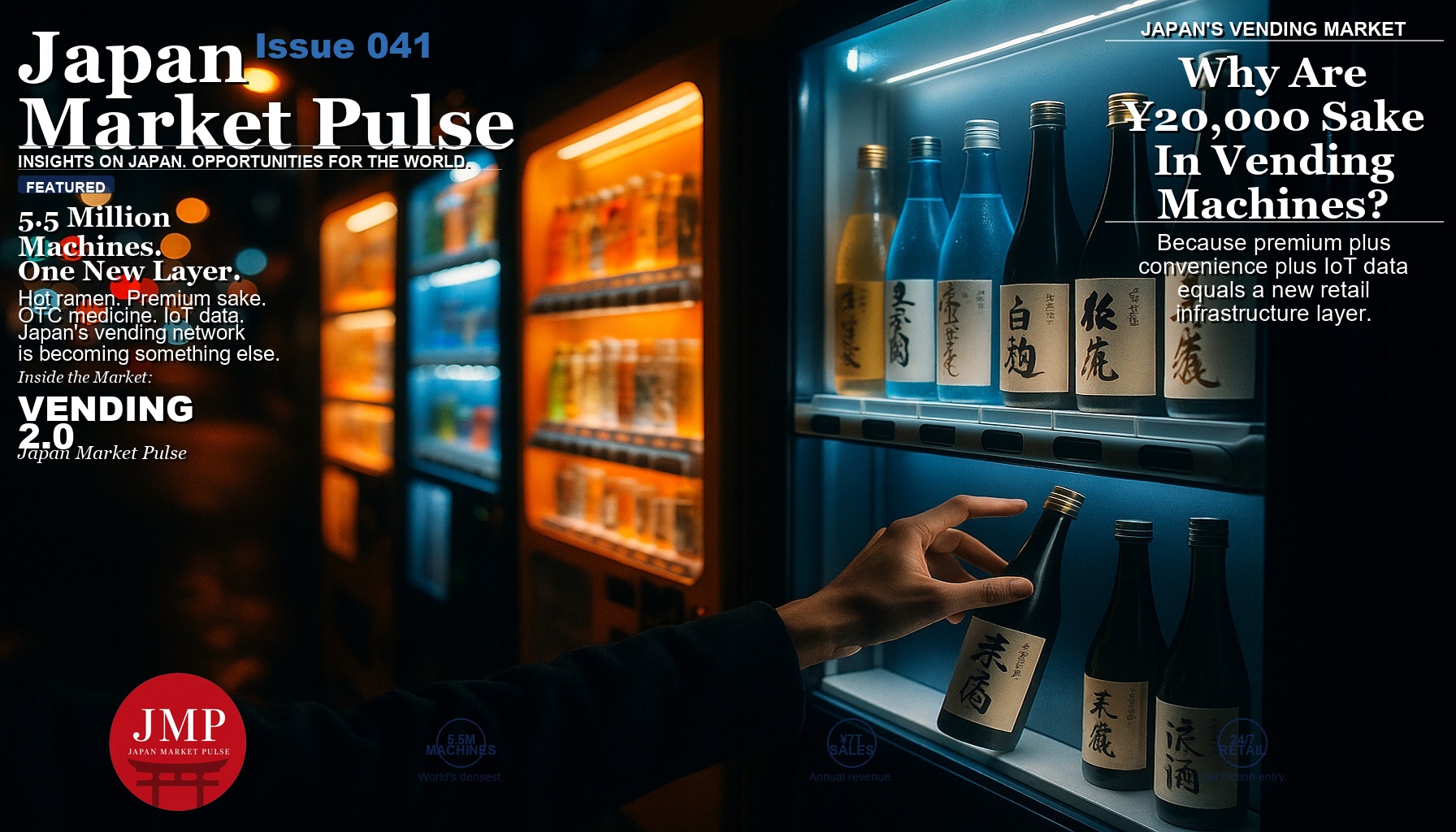
Walk through any major Japanese train station, and within two minutes you will pass at least a dozen vending machines. Step into the basement level of any hospital corridor. Turn down the side street of any residential neighborhood in Osaka, Sendai, or Fukuoka. The machines are everywhere — humming quietly, glowing softly in the dark, always open.
Japan’s 5.5 million vending machines represent the world’s densest automated retail network: one machine for every 23 people. For most foreign visitors, these are novelties — a cold Pocari Sweat between meetings, a warm canned coffee on a cold morning in Kyoto. For those of us who live and work here, they are infrastructure, as unremarkable as streetlights.
But in 2026, something is happening to these machines. They are learning to cook. They are dispensing medicine. They are selling ¥20,000 bottles of local sake in ryokan lobbies at midnight. And for international brands thinking about Japan market entry, this evolution represents something genuinely new: a low-friction, 24-hour, geographically precise retail channel that is finally beginning to advertise its own possibilities.
The Scale of an Invisible Market
The numbers behind Japan’s vending machine economy are genuinely difficult to absorb. With 5.5 million machines generating approximately ¥7 trillion — roughly $47 billion — in annual sales, the industry rivals entire retail categories in countries with twice Japan’s population. The Japan Vending Machine Manufacturers Association tracks this data carefully, and what it shows is a market that has been stable for a long time and is now, finally, in motion.
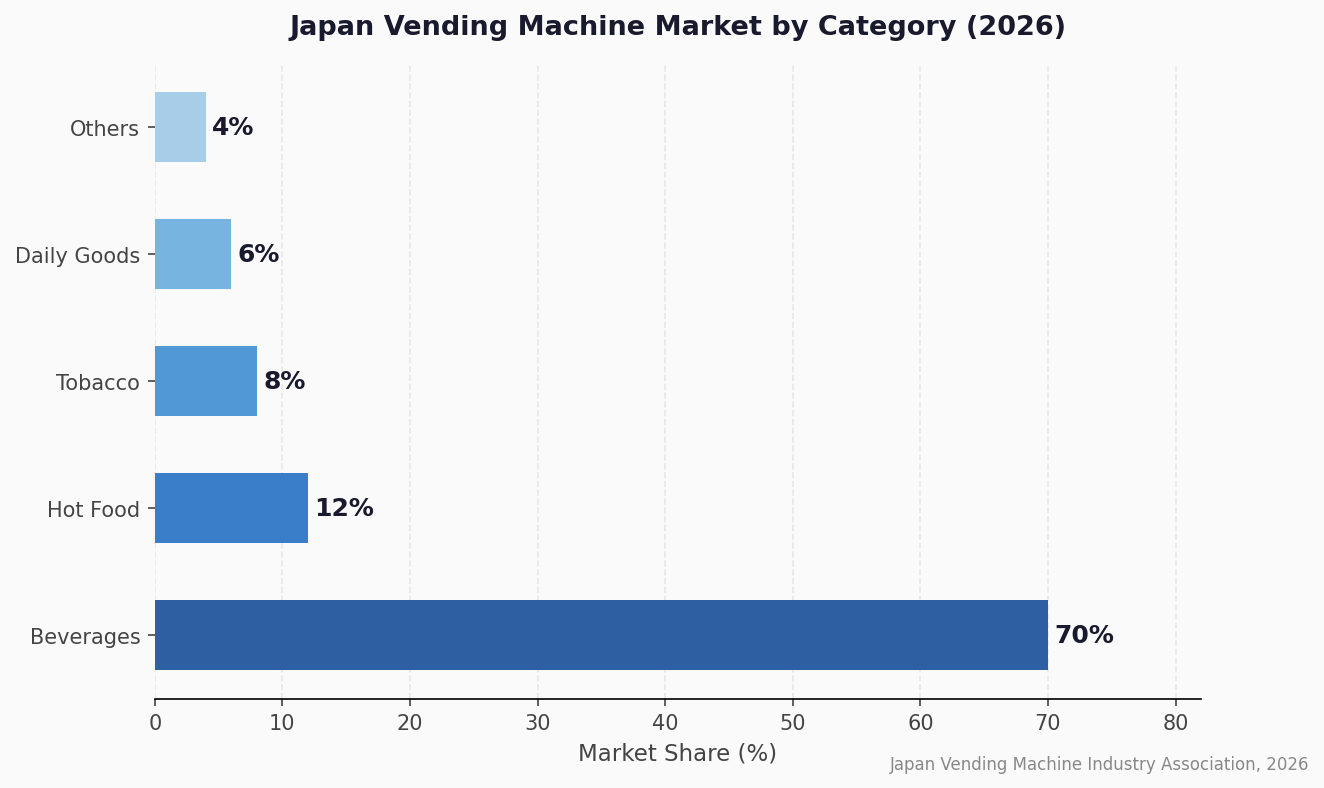
Beverages still dominate, accounting for roughly 70% of all machine units. But the rate of growth in non-beverage categories is accelerating. Food, tobacco, daily necessities, and — increasingly — luxury and specialty items are all claiming territory in a distribution network that, for decades, was primarily a beverage channel.
What makes this interesting is not just the category expansion but the quality of the consumer data being generated. Every vending machine in Japan is, in a real sense, a live market research installation. A product that performs consistently across 50 machines in Osaka tells you something about consumer preference. A product that performs across 500 machines in three different prefectures, with the demographic and locational context that modern IoT systems can provide, tells you something definitively actionable.
Major operators — Suntory with approximately 800,000 machines, Asahi Group with approximately 1.2 million — are now running data analytics teams dedicated to extracting this signal. For brands willing to partner with these networks, the machine is not just a sales channel. It is a research platform with a revenue line.
The Hot Food Revolution That Started with a Pandemic
When Yayoiken, the family restaurant chain with over 400 locations nationally, began deploying warm rice bowl vending machines outside its stores in 2020, the initial framing was defensive: the pandemic had reduced dine-in traffic, and the machines could serve customers who wanted a warm meal without entering the restaurant.
When the pandemic ended, the machines stayed. Sales had not just held — they had grown into a distinct revenue stream for locations where the machines complemented rather than competed with the in-store experience.
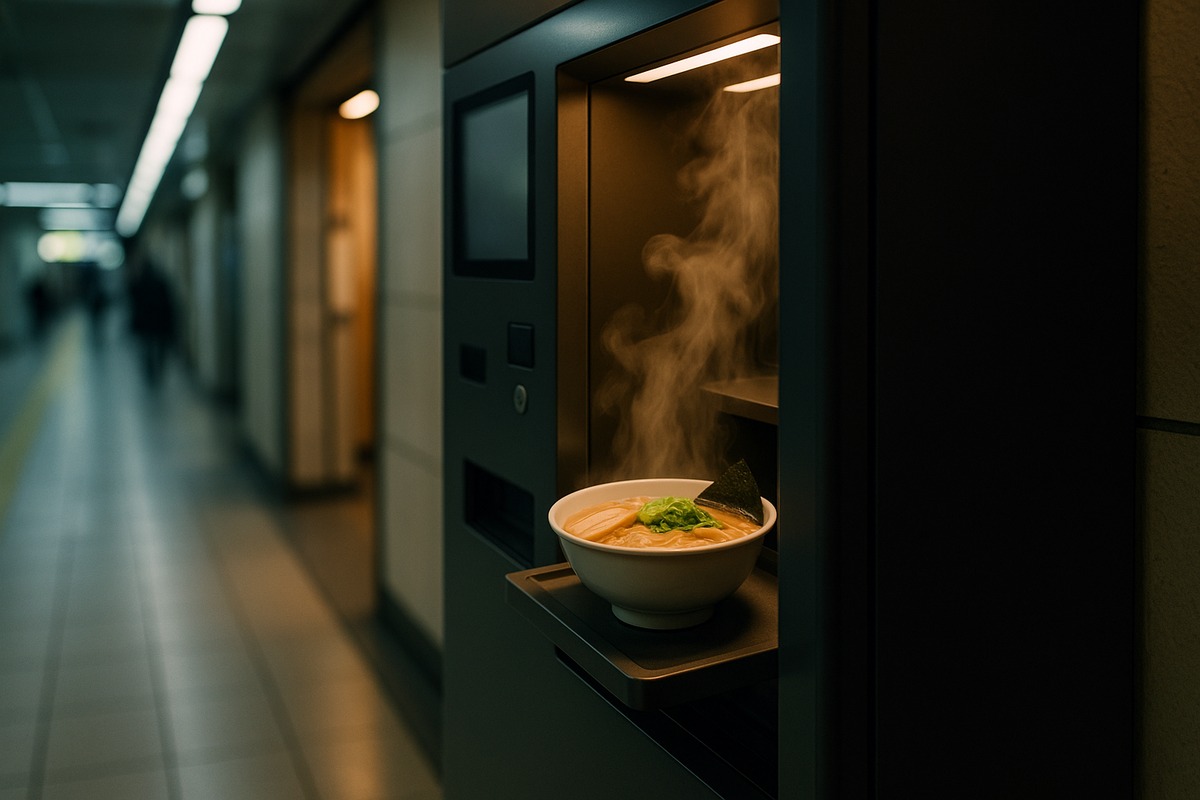
Yayoiken’s rice bowl machines touched off something. By 2023, hot food vending was being treated as a legitimate category expansion rather than a novelty. Ramen vending machines — which dispense a complete bowl, broth and all, at controlled temperatures — appeared in train station corridors in Tokyo and Osaka. Takoyaki machines (octopus balls, the beloved Osaka street food) moved from festivals into airport terminals. Fresh udon became available in machines near construction sites and industrial parks, targeting workers without canteen access.
The food technology behind this is substantial. Fuji Electric, which manufactures a significant share of Japan’s vending hardware, has developed heating and refrigeration systems that maintain food quality for hours and serve it at the correct temperature within minutes of purchase. The supply chain integration required to keep perishable food fresh in a vending network demands a different logistical discipline than beverage distribution.
For international food brands, the hot food vending channel opens an important door. Japanese consumers have now demonstrated they will accept prepared food from a machine if quality is right. That precedent matters for brands testing ready-to-eat formats without committing to a full supermarket distribution agreement.
Premium and Luxury: When ¥20,000 Sake Meets an Automated Dispenser
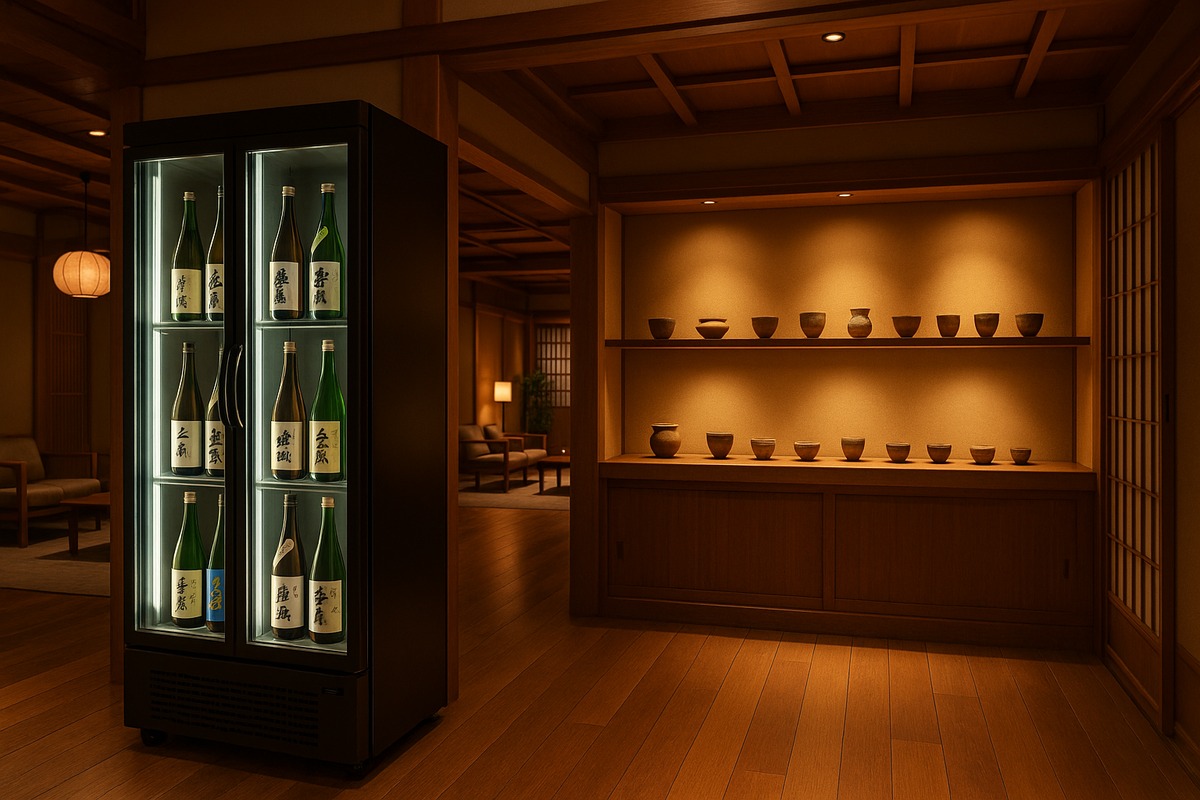
The most counterintuitive development in Japan’s vending market is also the one with the most interesting implications for premium brands. At a growing number of Japanese ryokan, sake vending machines have become a signature amenity.
These are not machines selling ¥200 cans of beer. They are refrigerated glass-fronted dispensers offering 180ml ceramic cups of Jizake — local, brewery-specific sake that might retail for ¥3,000 to ¥20,000 per 720ml bottle at a specialist retailer. The machines display tasting notes, brewing origin, and suggested food pairings. Payment is by IC card or smartphone.
The ryokan sake machine solves a specific Japanese hospitality problem with elegant automation: how to offer guests genuine access to local sake culture without maintaining a full bar operation. For the breweries supplying these machines, it is also a premium retail channel that maintains product positioning while reaching consumers who might not visit a specialty sake shop.
The logic has spread beyond sake. Upscale vending machines now dispense traceable wagyu beef in gift-appropriate packaging, handmade wagashi from specific Kyoto confectionery houses, and limited-edition skincare from premium domestic brands. Airport departure terminal machines sell ¥15,000 cosmetics to time-pressed travelers who missed the duty-free shops. Theme park-adjacent machines carry character goods that “sold out” from the regular gift shop within days of opening.
The common thread: scarcity plus convenience, positioned correctly, works through a vending interface. Japanese consumers have demonstrated that they will pay premium prices through a machine if both the product and the machine’s context are appropriately premium. This is not obvious from the outside — Western assumption tends to equate vending with mass market. In Japan in 2026, that assumption is increasingly outdated.
Healthcare: The Category With the Longest Strategic Tail
For anyone tracking Japan’s long-term consumer market, the healthcare expansion in vending is perhaps the most strategically significant development. Japan’s aging population — with over 29% of citizens now aged 65 or older — is driving a fundamental restructuring of how healthcare products reach consumers.
The traditional Japanese pharmacy was already under strain before the pandemic. Complex OTC regulations and an aging pharmacist workforce had created access gaps, particularly in rural areas and during overnight hours. Vending machines began filling those gaps, first hesitantly and then with growing regulatory support.
OTC medications expanded first. Cold remedies, antacids, and allergy medications are now available in machines across train stations, convenience store adjacencies, and airport terminals in most major urban areas. The machines display dosage information, contraindication warnings, and QR codes linking to pharmacist consultation services — meeting the regulatory requirement for informed purchase without requiring a human pharmacist to be physically present.
Contraceptives followed, and this expansion tells an interesting story about how vending can reduce social friction. Japan’s contraceptive market was historically constrained by the awkwardness of pharmacy counter transactions. By removing the human interaction element, vending distribution expanded access meaningfully, particularly among younger consumers. The category grew in machine networks faster than in traditional pharmacy channels.
The most recent frontier is dietary supplements — protein powder sachets, collagen drink packets, and vitamin blends now appearing in machines near gyms, corporate wellness facilities, and sports venues. The format is ideal for vending: single-dose sachets and individual blister packs fit the channel perfectly and match Japanese consumer expectations for precision packaging.
For international health and wellness brands, the healthcare vending channel is a genuine test-and-learn environment. The challenge is product format — Japanese vending consumers favor precisely packaged, single-dose or short-supply units rather than the large multi-dose containers common in American health retail. Reformatting for the channel is required, but the consumer access it provides is difficult to replicate through any other distribution method.
The Digital Upgrade: Data Is the New Product
Japan was famously slow to adopt cashless payments in face-to-face retail — a quirk of cash culture that surprised many Western observers. But vending machines, freed from the friction of human transactions, were among the fastest-moving areas of Japan’s cashless transition.
As of 2025, the majority of Japan’s major vending networks are IoT-enabled. Machines report real-time sales data, temperature deviations trigger immediate service alerts, and stock levels are managed algorithmically. Suntory reports that IoT upgrades have reduced restocking waste by over 25% across its 800,000-machine network while increasing per-machine revenue through dynamic product placement and promotional pricing.
For brands, the implications go beyond operational efficiency. The data flowing through IoT-enabled machines — product performance by location, by hour, by weather condition, by nearby event calendar — creates a consumer intelligence dataset that is, in many categories, more granular than anything available through traditional retail analytics. A product being tested across 500 machines generates demand curves, regional preference maps, and demographic proxies that can meaningfully inform a broader market entry decision.
The leading operators are now positioning this data access as a service offering separate from the distribution arrangement itself. For brands willing to pay for the data layer explicitly, the vending network becomes something qualitatively different: a market intelligence platform.
What the International Brand Should Know
Japan’s vending machine opportunity is real. The frictions are also real.
Regulation by category. Alcohol vending requires machines to be located away from schools and equipped with age-verification systems. Medications require registration with local health authorities and specific machine certification. Any international brand entering through vending needs local regulatory expertise — this channel cannot be navigated ad hoc.
Brand loyalty is entrenched. Japanese vending consumers have strong purchase habits. Suntory’s canned coffee products, Calpis soft drinks, Kirin beverages — these brands have spent decades building channel loyalty. A new entrant, particularly a foreign brand without existing Japanese equity, should not assume easy substitution. The machine tests product-market fit, but building repeat purchase requires marketing investment beyond the machine itself.
Location access takes time. Prime locations — platform-level train stations, hospital corridors, corporate building lobbies — are typically secured under long-term operator agreements. New entrants should plan to start in secondary locations and build toward prime placement as performance data accumulates.
The partnership structure matters. The dominant model is revenue-sharing with location operators, with machine costs borne by the brand or operator depending on negotiation. The most efficient path for a foreign brand testing the market is usually a co-branded machine arrangement with a local distribution partner who already holds location agreements.
Looking Forward
Three developments are worth watching as Japan’s vending market continues to evolve.
Face-recognition personalization is being trialed by several operators, using demographic inference to suggest products to approaching customers without personal identification. This is technically operational in test installations and will likely see regulated commercial deployment within the next two to three years.
Environmental sustainability is becoming mandatory. Japan has committed to aggressive plastic reduction targets, and the vending channel generates substantial single-use packaging waste. Brands entering the channel now should be developing Japan-compatible sustainable packaging formats — regulatory pressure will only increase.
Subscription and loyalty integration is an emerging opportunity. Suntory’s vending app and Asahi’s cashless loyalty programs are early signs that operators want to build the kind of ongoing customer relationships more typically associated with digital commerce. For brands, integration with these loyalty platforms creates a way to make the vending channel more like owned digital marketing than traditional wholesale distribution.
Japan’s vending machines are not standing still. For brands that understand what they are becoming — not just dispensers but distributed retail, research, and consumer relationship infrastructure — they represent one of the most accessible and data-rich entry points into one of the world’s most sophisticated consumer markets.
This article contains affiliate links. If you purchase through these links, we may earn a small commission at no extra cost to you.
If you’re interested in this topic, the Japanese market more broadly, or what KETCHUPs is working on, we’d love to hear from you — please reach out via our contact form.
Japan Market Pulse is a weekly read on what the Japanese consumer-tech, food, and mobility markets are choosing to do, written for international operators who want to know what is happening before it shows up in the global trade press.
Subscribe at ketchups.co/japan-market-pulse.