

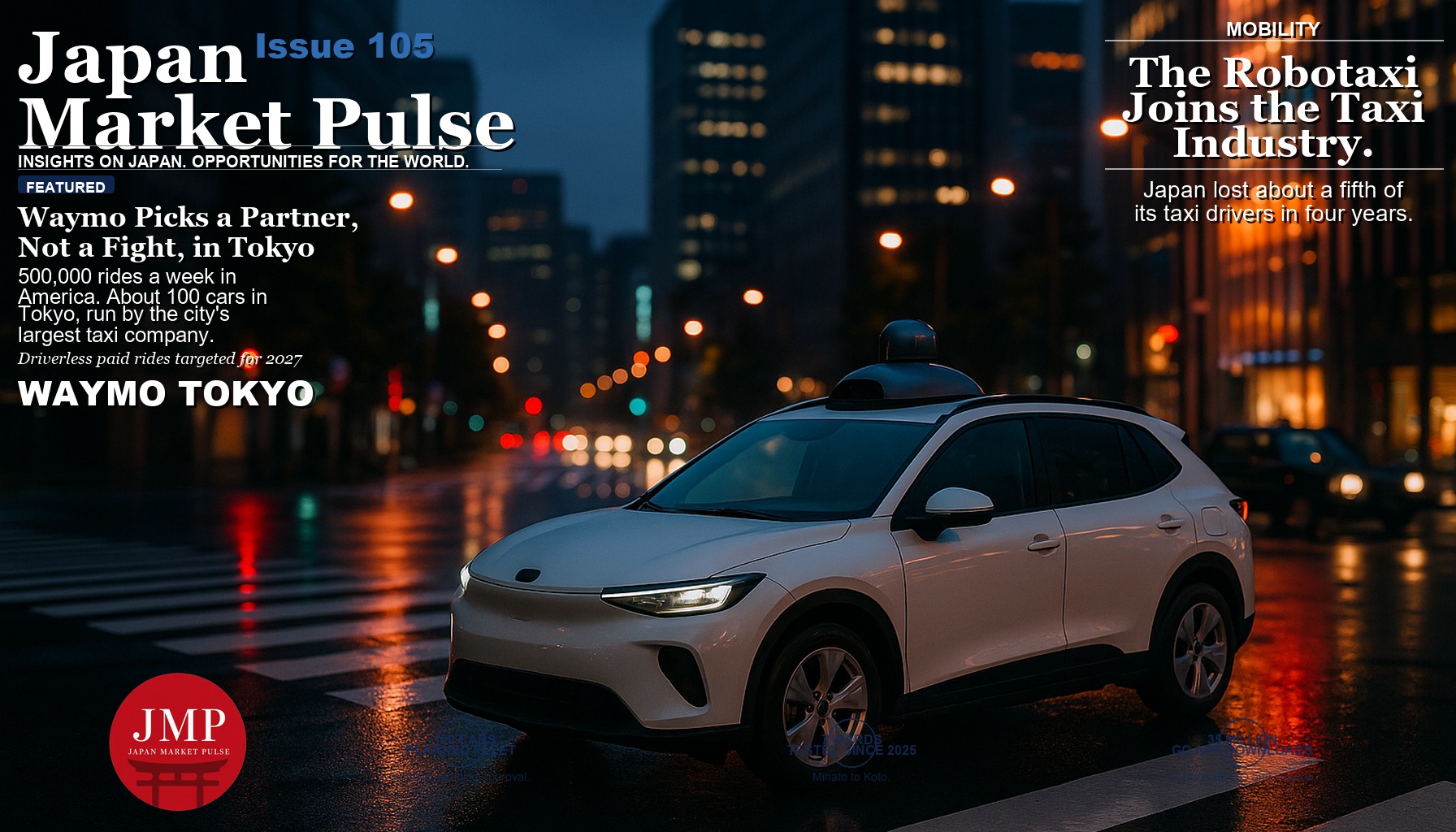
In mid-September, Waymo confirmed something that people in Tokyo’s taxi industry had been quietly expecting since the white Jaguars with the spinning roof domes first appeared on the streets of Minato and Shibuya: it plans to begin fully driverless, paid rides in Tokyo in 2027. It will be the Alphabet-owned company’s first commercial robotaxi service in Asia, and according to the partners, Japan’s first commercial driverless taxi service of this kind.
In the United States, Waymo now says it operates in 15 major cities and serves more than 500,000 paid trips every week, with a stated ambition of passing one million weekly rides by the end of 2026. The Tokyo plan, by comparison, sounds almost modest: roughly 100 vehicles, rolled out in stages, contingent on approval from national and local authorities.
But the size of the fleet is the least interesting number in the announcement. The interesting part is who Waymo is launching with. In San Francisco and Phoenix, Waymo competes with the ride-hailing drivers of Uber and Lyft. In Tokyo, it is launching inside the existing taxi industry — with Nihon Kotsu, the city’s largest taxi operator and a company approaching its hundredth year, running the fleet, and GO, Japan’s dominant taxi-hailing app, integrating the robotaxis alongside ordinary cabs. Riders will be able to book through both the GO app and Waymo’s own app.
I have lived in Japan for twenty years, and for most of that time the Tokyo taxi has been one of the few things I could reliably describe to visiting American friends without exaggeration: the automatic rear door that swings open by itself, the lace seat covers, the driver in a cap and white gloves who will not accept a tip. What I never imagined describing was a Tokyo taxi with nobody in the front seat. The fact that it is coming — and the way it is coming — says a great deal about how Japan absorbs disruptive technology, and about what any foreign company should expect when it tries to bring something radically new into a Japanese market.
A Fleet of 100 in a City Built on Tens of Thousands of Taxis
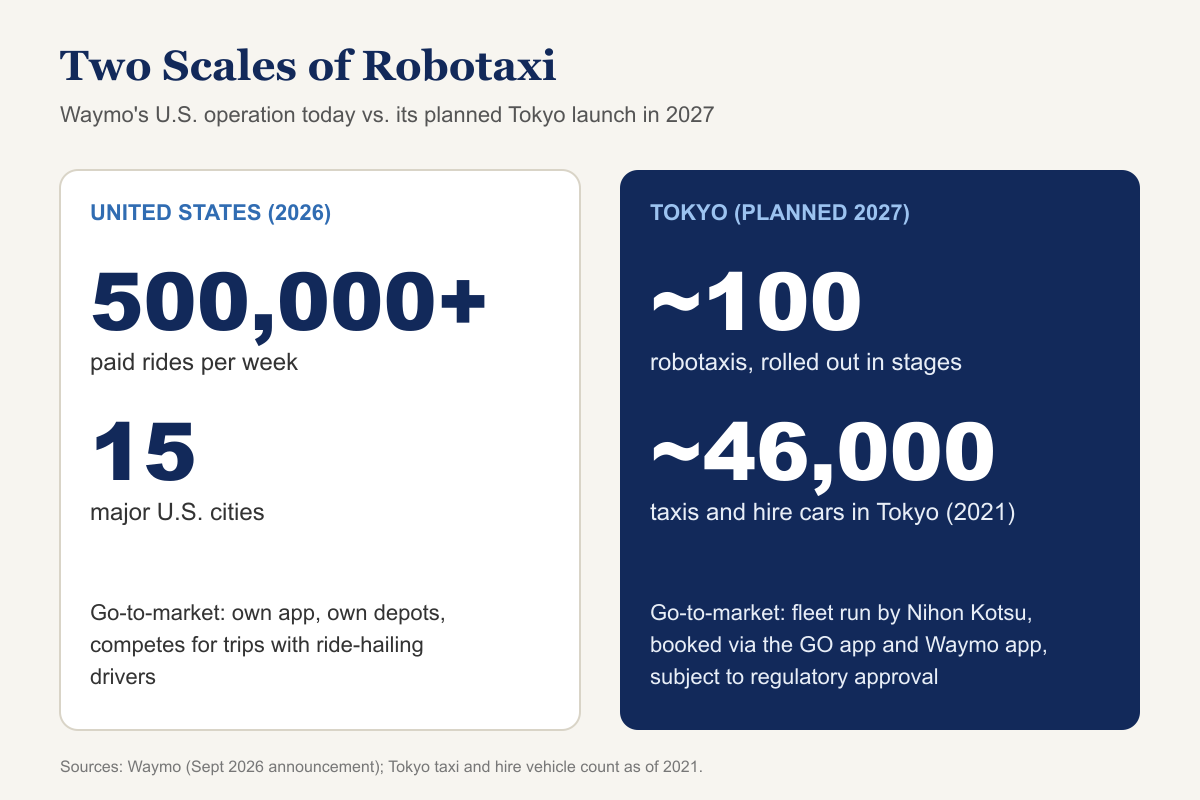
Let’s start with scale, because the gap is striking.
Waymo’s U.S. business has moved well past the demonstration phase. The company describes itself as having delivered tens of millions of fully autonomous commercial trips, and it opened public rides in several new U.S. metros this year alone. Its safety messaging has become equally assertive: co-CEO Tekedra Mawakana pointed to Waymo’s own data showing its vehicles to be more than 15 times safer than human drivers, a comparison Waymo draws from its internal crash analysis.
Tokyo, by contrast, is a market where the taxi is not a disrupted legacy product but a dense, deeply institutionalized public utility. The Tokyo metropolis counted roughly 46,000 taxis and hire vehicles as of 2021. Nihon Kotsu alone runs a taxi fleet in the high thousands, concentrated in the 23 special wards, and has long been the city’s biggest single operator.
Against that backdrop, 100 robotaxis is a rounding error. If every one of them were on the road at once, they would represent a small fraction of Nihon Kotsu’s own fleet, let alone the city’s. Nobody in Tokyo is going to lose access to a human-driven cab in 2027.
That is precisely the point. The Tokyo launch is not designed to prove that Waymo can replace taxis. It is designed to prove that driverless vehicles can operate on Tokyo’s roads under Japanese rules, inside a Japanese operator’s safety culture, and through the booking habits Japanese riders already have. The number of cars matters far less than whether the arrangement works — because if it does, the question in Japan stops being “should we allow this?” and becomes “how fast can we add more?”
Japan Ran Out of Drivers Before It Ran Out of Riders
To understand why an incumbent taxi company would willingly invite a robot competitor into its garage, you have to look at the labor numbers.
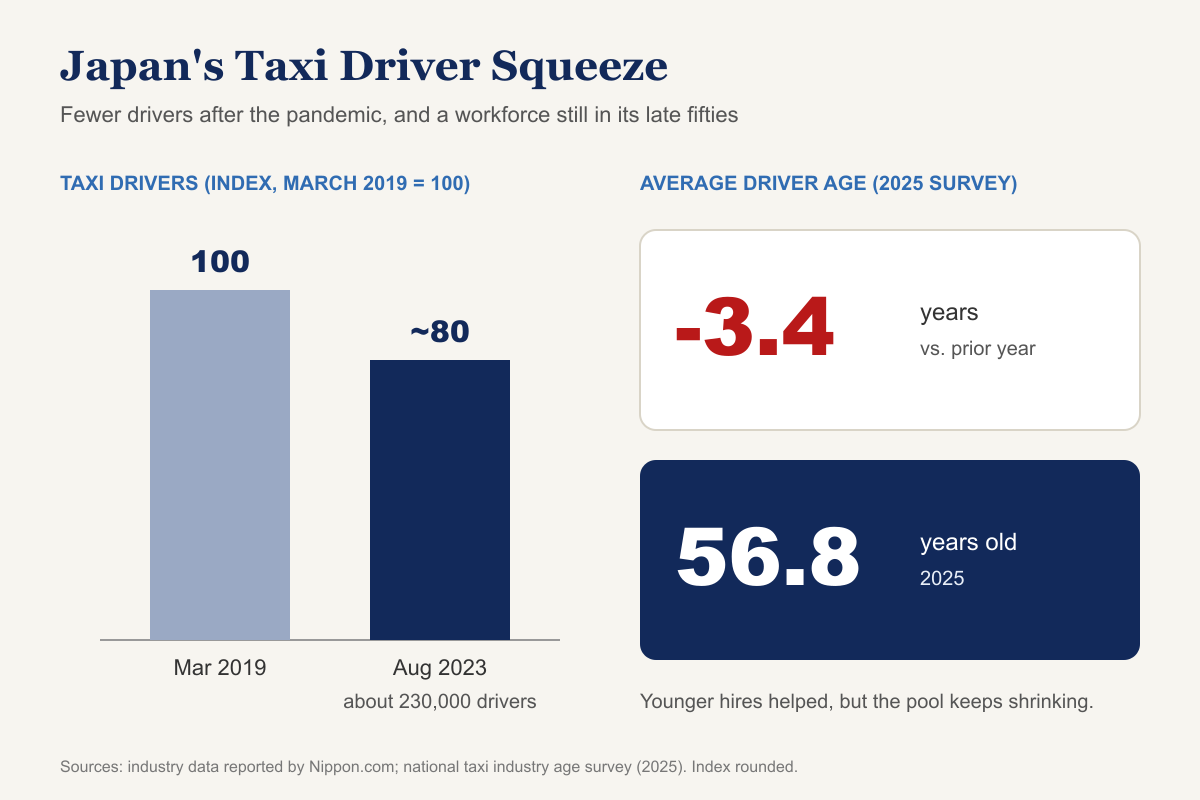
Japan had about 230,000 taxi drivers at the end of August 2023, a drop of roughly 20% from March 2019, according to industry figures reported by Nippon.com. Many drivers who left during the pandemic never came back, and companies struggled to attract younger applicants. At the same time, demand recovered sharply: inbound tourism rebounded to record levels, and the evening hours in central Tokyo and in tourist-heavy cities like Kyoto became notorious for long taxi queues.
The workforce was also old. There has been some genuine improvement recently — better pay driven by the shortage has drawn in younger people, and a 2025 survey put the national average age of taxi drivers at 56.8, down 3.4 years from the year before and back to levels last seen about two decades ago. But an industry where the typical driver is in their late fifties is not one that can count on demographics to rescue it. Japan’s overall working-age population continues to shrink every year.
Japan tried a partial fix. In April 2024, the government introduced a limited, Japan-specific form of ride-sharing, in which ordinary drivers could provide rides in certain areas and time windows — but only under the management of licensed taxi companies. It was a very Japanese compromise: add capacity without letting an outside platform take control of the industry. It helped at the margins, but it did not change the underlying math of a shrinking driver pool.
So when Nihon Kotsu’s leadership talks about addressing future driver shortages while maintaining service quality, it is not corporate boilerplate. For a Tokyo taxi operator, a driverless vehicle is less a threat to its drivers’ jobs than a potential answer to the drivers it cannot hire.
Seven Wards, Left-Hand Traffic, and Streets Without Sidewalks
Waymo did not arrive in Tokyo in September 2026. The partnership with Nihon Kotsu and GO was first announced in December 2024, and the vehicles began driving the city in 2025.
The early phase was deliberately low-key. Trained Nihon Kotsu drivers manually drove Waymo’s Jaguar I-PACE vehicles through seven central wards — Minato, Shinjuku, Shibuya, Chiyoda, Chuo, Shinagawa, and Koto — collecting the mapping and driving data Waymo’s system needed to learn a new city. Over time, the program moved to autonomous driving supervised by Nihon Kotsu crew members. Waymo describes its vehicles as having learned the streets “like a local.”
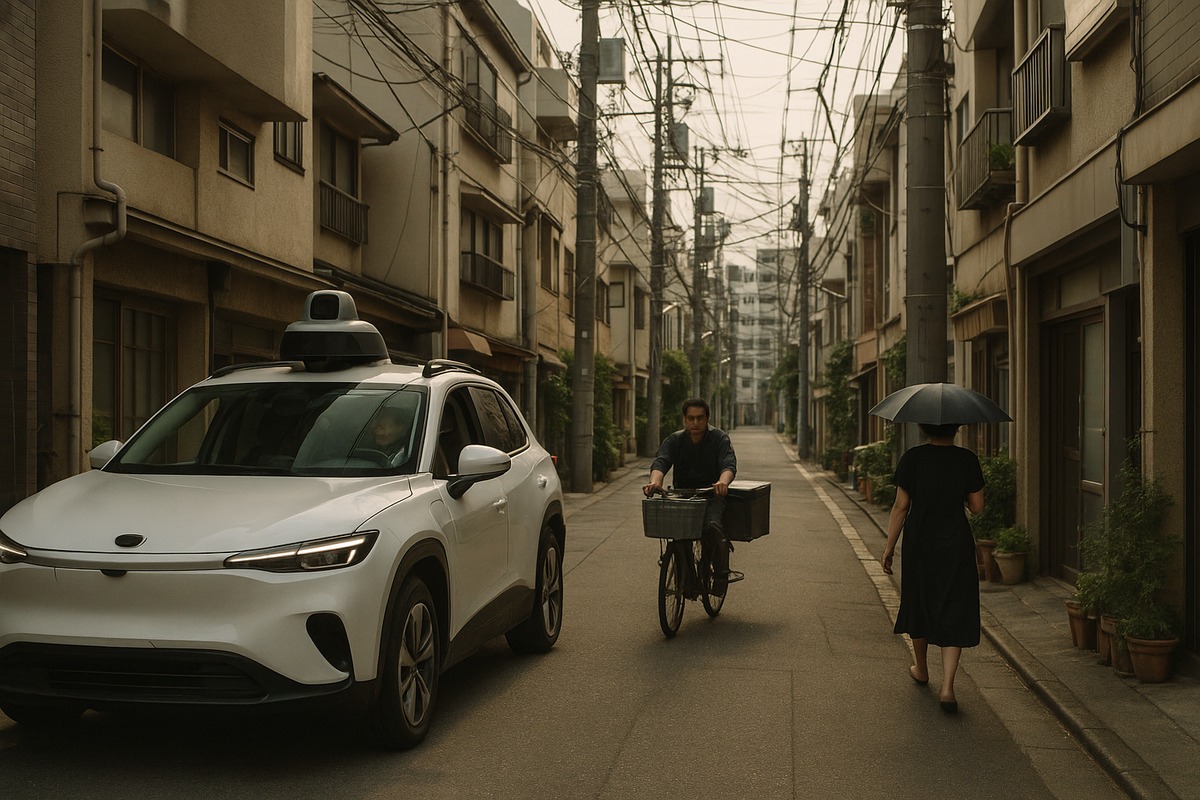
That process matters because Tokyo is a genuinely different driving environment from Phoenix or Los Angeles. Traffic runs on the left. Many residential and commercial side streets have no separate sidewalk, so pedestrians, cyclists, delivery bikes, and cars share the same narrow lane, often with utility poles jutting into the roadway. Cyclists routinely ride on both sidewalks and streets. Intersections in older neighborhoods can be irregular, and taxi drivers are expected to stop exactly where a passenger raises a hand.
The first time I watched one of the Waymo test cars inch down a lane near my old office in Minato, a delivery rider slipped past it on the right while an elderly man with a shopping cart stood in the middle of the road deciding whether to cross. The car simply waited. So, to be fair, would most Tokyo taxi drivers. But it was a useful reminder that the hardest part of urban driving in Japan is often not speed or highways — it’s patience and the constant negotiation of shared space.
Japan’s legal framework is also distinct. Amendments to the Road Traffic Act that took effect in April 2023 created a path for Level 4 driverless operation under specific conditions, and the first approvals went to small, low-speed services such as a route in Eiheiji, Fukui Prefecture. Since then, driverless projects have mostly been shuttles and buses on defined routes. The government’s stated goal is to realize unmanned autonomous mobility services in more than 100 locations nationwide by fiscal 2027. A 24/7 on-demand robotaxi service in central Tokyo would be a far bigger step than any of those early deployments — which is why Waymo and its partners are careful to say the timeline depends on permits and licenses from national and local authorities.
The American Playbook vs. the Japanese Playbook
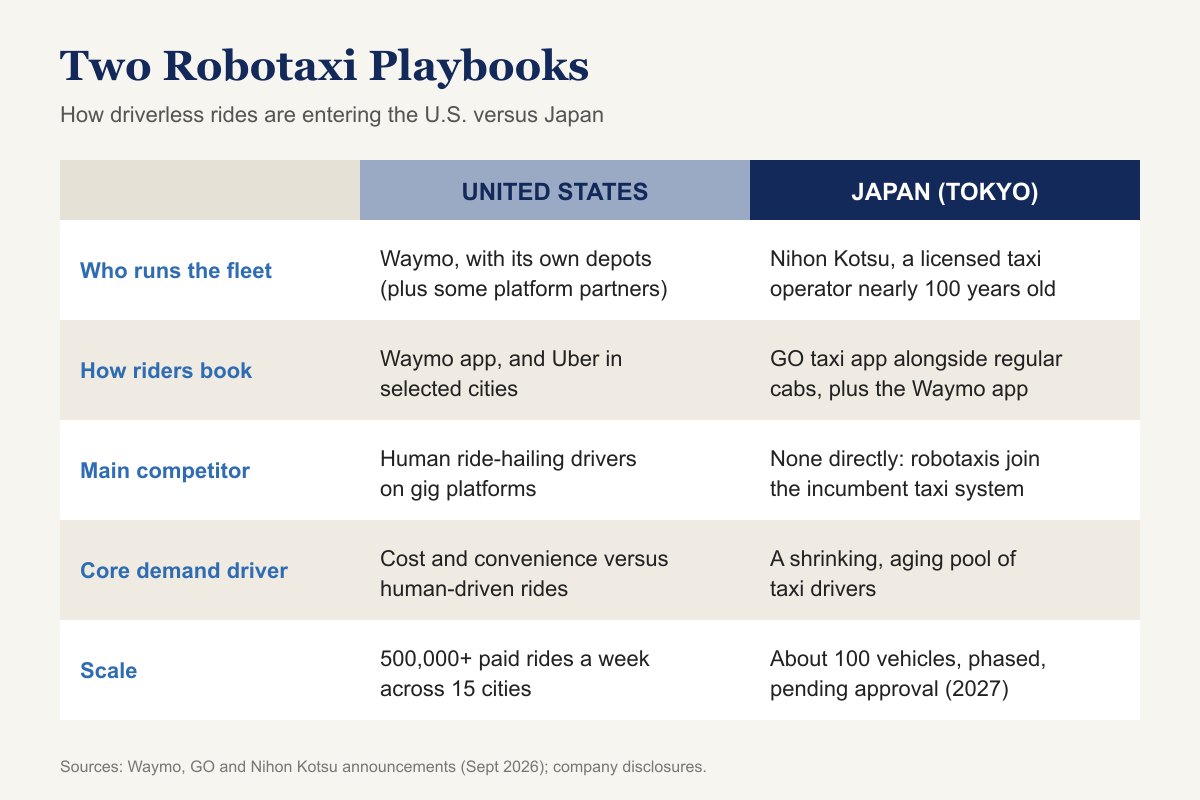
The contrast between how robotaxis are entering the U.S. and how they are entering Japan is the part international operators should study most closely.
In the United States, Waymo’s growth has largely been a story of a technology company going directly to consumers. It builds its own app, runs its own depots, and competes for the same trips that Uber and Lyft drivers take — though it has also partnered with Uber in some cities. Regulation is fragmented across states and cities, and the business model is fundamentally disruptive: autonomous vehicles substitute for gig-economy drivers.
In Japan, the playbook is almost inverted. Uber itself never got permission to run a U.S.-style ride-hailing service with private drivers; its Japanese business works through licensed taxi companies. The 2024 ride-share reform kept the taxi industry in charge. And now the country’s first major robotaxi launch is structured so that each party does the job it is best positioned to do: Waymo provides the driving technology and leads safety validation, Nihon Kotsu handles fleet operations, and GO handles integration with the taxi industry and the booking experience.
For a foreign company, that structure solves several problems at once. It gives the service instant local credibility with regulators, who already know how to supervise licensed taxi operators. It gives Waymo access to depots, maintenance, cleaning, customer support, and staff who know Tokyo’s streets. And it gives riders a familiar front door: a GO app that tens of millions of people have already downloaded.
The trade-off is control and speed. Waymo does not own the local relationships, and it will not scale in Tokyo the way it has in the Sun Belt. But in Japan, attempting the American version — a foreign tech company launching a parallel, app-only fleet that competes head-on with established taxi operators — would almost certainly have met far more resistance. The partnership model is slower, but it is the model the Japanese market is built to accept.
GO: The $1.3 Billion App That Says It Won’t Build Its Own Self-Driving System

If Nihon Kotsu is the legacy half of the partnership, GO is the part investors are watching most closely.
GO Inc. operates Japan’s leading taxi-hailing app. It is available in all 47 prefectures and has been downloaded more than 35 million times. In June 2026, the company listed on the Tokyo Stock Exchange’s Growth Market in the country’s largest IPO of the year so far, with an offering worth ¥88.6 billion, or about $553 million, made up of shares sold by existing shareholders. The offering was priced at ¥2,400 per share, at the top of the marketed range, and was reported to be more than 25 times oversubscribed. After its first day of trading, its market value stood at roughly ¥205 billion, or about $1.3 billion.
When the Waymo announcement landed in September, GO’s shares rose as much as 9.7%, according to The Japan Times, which also noted that the stock had climbed more than 40% since the IPO.
What makes GO strategically interesting is what it has said it will not do. CEO Hiroshi Nakajima has said the company will not invest in developing its own autonomous-driving system. Instead, GO wants to own the operational layer: dispatch software, fleet coordination, payments, and the relationships with taxi companies that any robotaxi service will need in Japan.
It is a bet that in Japan, the scarce asset is not the self-driving stack — which global players like Waymo and Wayve are spending billions to build — but the trusted connection between riders, licensed operators, and regulators. If that bet is right, GO becomes the gateway through which several different autonomous-driving providers might eventually reach Japanese passengers. If it is wrong, it risks becoming a booking layer that the technology companies eventually route around. Either way, it is a very different position from the one Uber and Lyft have held in the United States.
Tokyo’s Robotaxi Race Has More Than One Runner
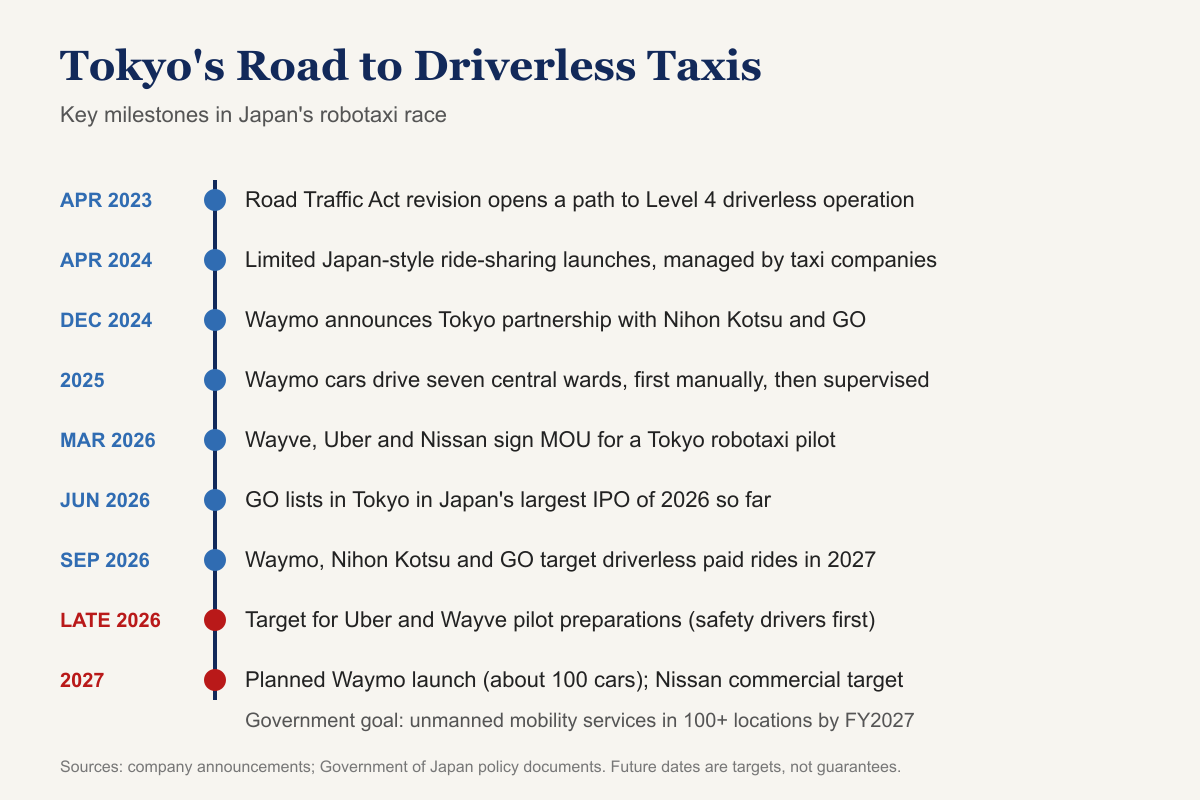
Waymo will not have Tokyo to itself.
In March 2026, Wayve, Uber, and Nissan signed a memorandum of understanding to develop robotaxis and begin preparations for a pilot deployment in Tokyo by late 2026. The vehicle is a Nissan LEAF running Wayve’s AI Driver, available to riders through Uber. Uber has signed an operational partnership with Hinomaru Kotsu, another established Tokyo taxi company, to manage the fleet. The vehicles will start with experienced safety drivers behind the wheel, with fully driverless operation planned for a later stage, subject to regulatory approval.
Notice the pattern: once again, a global technology player, a Japanese automaker, a platform, and a licensed local taxi operator — all in the same arrangement.
Nissan is also pursuing its own path. It ran a pilot in Yokohama from late November 2025 through January, using five Serena vans to carry volunteer riders free of charge with safety staff on board, and it has said it is aiming for a commercial service in 2027. Toyota, Japan’s largest automaker, has separately entered a collaboration with Waymo on personally owned vehicles, and domestic startups such as Tier IV continue to run driverless shuttle trials at locations including Narita Airport.
Put together, 2027 is shaping up to be the year Tokyo moves from supervised experiments to commercial driverless rides — assuming the regulators agree. For the Japanese government, which has been criticized for moving slowly on ride-sharing, having several credible, domestically anchored projects running at once may be the most politically comfortable way to let the technology in.
What International Operators Should Take Away

The Waymo-Tokyo story is not just about cars. It is a case study in how Japan adopts a disruptive business model, and the lessons apply well beyond mobility.
First, in Japan the incumbent is often your channel, not your competitor. Waymo did not try to route around Tokyo’s taxi industry; it plugged into the largest operator and the dominant app. Foreign brands entering Japanese retail, food service, healthcare, or finance face the same choice. The fastest path to scale is frequently a partner that already has the licenses, the logistics, and the customer trust — even if that means giving up some margin and control.
Second, labor shortages are Japan’s most powerful accelerant for new technology. The reason a nearly century-old taxi company is embracing driverless cars is not a love of innovation; it is that it cannot hire enough drivers. The same force is driving automation in convenience stores, restaurants, logistics, and elder care. If your product saves labor, frame it as a solution to a staffing problem, not as a replacement for people. That framing matters to Japanese regulators, unions, and customers alike.
Third, start smaller than you think, then prove it. Roughly 100 vehicles in a city of tens of thousands of taxis is not a market-share play. It is a trust-building exercise. Japanese partners and regulators tend to reward a carefully executed pilot more than an aggressive rollout, and once a model is proven, adoption can move surprisingly quickly.
Fourth, the gateway can be as valuable as the technology. GO’s IPO valuation rests heavily on the idea that the company controlling rider relationships and operator networks will capture value no matter whose self-driving system is in the car. Anyone building a platform business should pay attention: in markets with heavy regulation and strong incumbents, the aggregator that incumbents trust can become the kingmaker.
Frequently Asked Questions
Q. When will Waymo robotaxis be available in Tokyo?
A. Waymo, Nihon Kotsu, and GO plan to begin offering fully driverless paid rides to the public in Tokyo in 2027, with a phased rollout toward a fleet of roughly 100 vehicles. The timeline depends on obtaining permits and licenses from national and local authorities and on completing ongoing technology validation.
Q. How will riders book a Waymo in Tokyo?
A. The partners say riders will be able to hail the vehicles through both the GO taxi app, alongside conventional taxis, and the Waymo app. Specific service areas and fares for the Tokyo launch have not been detailed publicly.
Q. Where has Waymo been testing in Tokyo?
A. Since 2025, Waymo’s Jaguar I-PACE vehicles have been operating in seven central Tokyo wards — Minato, Shinjuku, Shibuya, Chiyoda, Chuo, Shinagawa, and Koto — first driven manually by trained Nihon Kotsu drivers to collect mapping data, and later in supervised autonomous mode.
Q. Is driverless driving legal in Japan?
A. Yes, under specific conditions. Revisions to Japan’s Road Traffic Act that took effect in April 2023 created a framework for Level 4 driverless operation, and early approvals went to low-speed services on defined routes. The government aims to have unmanned autonomous mobility services running in more than 100 locations by fiscal 2027. A commercial robotaxi in central Tokyo will still require its own approvals.
Q. Are other companies planning robotaxis in Japan?
A. Yes. Wayve, Uber, and Nissan are preparing a Tokyo robotaxi pilot by late 2026 using Nissan LEAF vehicles, with the taxi company Hinomaru Kotsu managing the fleet and safety drivers on board at first. Nissan has also tested its own service in Yokohama and is targeting commercial operation in 2027.
Conclusion
On paper, Waymo’s Tokyo plan looks tiny: about 100 cars, in 2027, in a city where the taxi fleet is measured in the tens of thousands, from a company that already handles hundreds of thousands of rides a week in America. But the scale was never the headline. The headline is the structure — a Silicon Valley robotaxi company choosing to enter Japan through the country’s largest taxi operator and its dominant taxi app, rather than in competition with them.
That choice reflects two realities every foreign company in Japan eventually confronts. The first is that incumbents here are not easily displaced, but they can be powerful allies when your product solves their problem. The second is that Japan’s shrinking workforce is quietly rewriting what those problems are. A taxi company nearly a century old is not inviting robots into its fleet because it wants to. It is doing it because, in a few years, it may not have enough people to drive the cars it already owns.
The white-gloved driver is not disappearing from Tokyo anytime soon. But the empty front seat is coming, and it is arriving the Japanese way: carefully, collaboratively, and through the front door.
If you’re interested in this topic, the Japanese market more broadly, or what KETCHUPs is working on, we’d love to hear from you — please reach out via our contact form.
Japan Market Pulse is a weekly read on what the Japanese consumer-tech, food, and mobility markets are choosing to do, written for international operators who want to know what is happening before it shows up in the global trade press.
Subscribe at ketchups.co/japan-market-pulse.