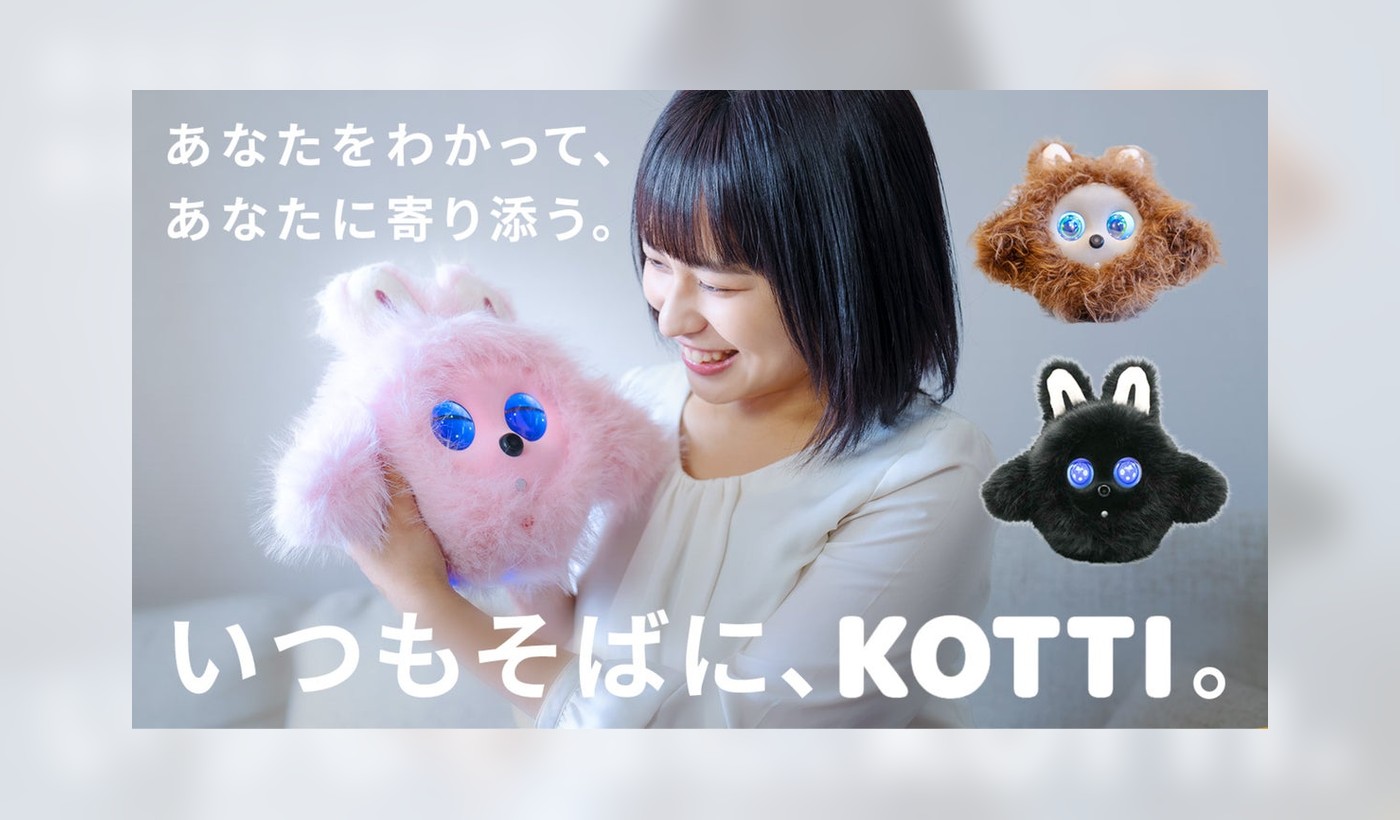
KOTTI’s official product site returned a 404 error while the campaign was actively collecting pledges. What actually explains a 1,498%-of-goal result — and why it isn’t a repeatable playbook.
¥4.49M raised121 backers1,498% of goalMid-campaign snapshot, Jul 18, 2026
KOTTI is a conversational AI plush toy built on ChatGPT (GPT-5.2) and Gemini 2.5 Flash, with seven switchable characters, a custom-character feature, claimed 28-language support, four touch sensors plus gravity and infrared sensors, and a small LCD display. It is executed on Makuake by Mirai MD Inc. (未来MD株式会社), a Tokyo trading company founded in October 2020 with ¥30 million in capital, plus branches in Osaka and Shanghai and an office in Dhaka. Mirai MD’s core business is Japan-China trade and OEM/ODM production support. KOTTI is the company’s sixth Makuake campaign and first outside gadgets and accessories — prior projects covered a handheld fan, a car-wash jet fan, AI smart glasses, and two keyboard products, together raising about ¥12.0 million from 402 backers.
The product is developed by InnoX (上海智杰源创科技有限公司), a Shanghai company the Makuake page describes as founded in 2016. Mass production is handled by GOLDTek, the Shenzhen subsidiary of Taiwan-listed 沅聖科技股份有限公司 (stock code 6638), whose parent is Ennoconn (樺漢科技), a company within the Foxconn (鴻海) group. GOLDTek’s disclosed track record is concentrated in IoT hardware — smart doorbells, smart locks, home security cameras — with no documented history in plush toys or AI robotics specifically.
The campaign runs May 28 to August 28, 2026 (93 days, All-in format) against a funding goal of just ¥300,000. As of a July 18, 2026 snapshot — with five weeks still remaining before close — it had raised ¥4,494,620 from 121 backers, or 1,498% of goal, with 10 backer comments and 8 update posts. These are mid-campaign figures, not a final result, and the total may have grown further by the time the campaign closes.
Backer concentration in two tiers
91
2 tiers
118
Total
121
The zero-marketing anomaly
The most notable finding in the underlying research is what could not be found. KOTTI’s official product site, hotitem.online/kotti, returned an HTTP 404 error at the time of the survey, with or without the “www” prefix, and the domain root resolved to a password-protected login page that reads as a generic ad-agency tool rather than a KOTTI-specific page. No pre-registration form, email capture, or LINE-friend campaign turned up anywhere. The only listed contact points are a support email and a LINE ID tied to a second domain, nexoria-designstudio.com, which itself still displayed a “site under construction” placeholder.
Searches for official social accounts under “KOTTI,” its katakana rendering, and “Mirai MD” across X, Instagram, TikTok, and Facebook turned up nothing tied to the product. A Meta Ad Library query across those terms plus the domain fragment “hotitem” (roughly 220 unrelated hits reviewed) returned zero matching ads, active or historical, in Japan. The one confirmed pre-launch push was a sponsored placement — disclosed as a promotion for Mirai MD — on a lifestyle YouTube channel with about 255,000 subscribers, posted roughly two months before launch, and never mentioned in the campaign’s own update reports. Separately, a channel with about 10 subscribers, apparently self- or agency-run, posted a steady stream of short KOTTI videos, including one showing an in-store display at a Nojima electronics location — a detail that, again, does not appear on the Makuake project page.
The one confirmed external distribution event was a single press release sent through the wire service @Press on May 25, three days before launch. It was picked up or near-syndicated by nine outlets, including Yahoo! News, Impress PC Watch, livedoor News, NewsPicks, TRILL, and woman.excite, plus two pieces of original reporting from ねとらぼ (a disclosed paid tie-up) and Impress AI Watch (independent editorial coverage). No PR TIMES distribution was found, and none of the robotics or gadget trade outlets that typically cover this category — Robotstart, Engadget Japan, GetNavi web among them — carried the story.
What actually explains the result
Three mechanics likely account for most of the raise, none of which require an ongoing marketing operation. First, a ¥300,000 goal is low enough that even modest early sales guarantee a large percentage-of-goal figure — a pattern also seen in other Makuake campaigns that set a small target to generate an early “achieved” badge. Second, of the seven pricing tiers, only two have disclosed backer counts: a 48-hour launch special at ¥37,800 (91 backers) and a “super-super early bird” tier at 42% off, ¥39,800 (27 backers). Together they account for 118 of the 121 total backers — about 97.5% — meaning nearly the entire campaign was carried by two time-limited discounts concentrated in the launch window. Third, Makuake’s own platform traffic, rather than any identifiable external channel, appears to be the main source of remaining exposure; five of the eight update posts went up in the first three days, then the pace slowed to roughly one per month.
One detail complicates a clean read: the two disclosed tiers alone sum to ¥4,514,400, which is ¥19,780 more than the official published total — before even adding the three backers whose tier isn’t disclosed. The likely explanation is cancellations or refunds not reflected in the displayed backer counts, though this was not independently confirmed. It’s a reminder that Makuake’s public-facing totals are a live snapshot with some noise in them, not an audited ledger.
This is an inference, not a proven mechanism — there is no way to isolate how much of the raise came from Makuake’s discovery surfaces versus press syndication versus word of mouth. A separate campaign in this same research series, Gatebox3 — run by a hardware maker with ten years of history, an active pre-registration list, and founder-led social posting — raised roughly 16 times as much from about four times as many backers over a comparable window. That gap is the clearest evidence that KOTTI’s outcome is not a general formula for turning near-zero marketing spend into a large percentage-of-goal result; it is one specific outcome, tied to one low-goal, high-discount structure and one successful press pickup, observed mid-campaign.
Signals that make the playbook risky
404official site during research
0matching Meta ads found
1confirmed wire-release push
First 72 HoursLaunch mechanism, not repeated imagery
D1Audience asset: problem-led page
D2Offer window: no paid-media dependency
D3Proof: compact demand signal
Structured like an executive launch dashboard: audience asset, offer window, and conversion proof are separated for diagnosis.
The takeaway for overseas brands
A headline of “1,498% of goal, no ads, no live website” is easy to read as proof that a minimal-effort Japan crowdfunding launch works. The underlying data supports a narrower claim: a low funding goal combined with two aggressive, time-limited discount tiers can produce a large percentage-of-goal figure even with thin external marketing, provided the campaign is picked up by at least one wire-service release. That is a real, in-principle-repeatable mechanic. It is not the same as KOTTI’s overall approach being a safe or recommended playbook.
Percentage of goal is a weak signal on its own. KOTTI’s ¥4.49M raised sits at roughly 6% of Gatebox3’s ¥73.2M in the same research set, despite the higher percentage-of-goal figure. Absolute total, backer count, and average pledge value tell a more useful story than achievement percentage alone.
Verify a partner’s corporate identity independently before treating a case like this as a model to follow. InnoX, KOTTI’s developer, could not be located in Chinese corporate registries or via an independent company website at the time of research. Everything publicly known about InnoX traces back to the Makuake page’s own self-reported description.
A campaign-only web presence carries real after-sales risk. KOTTI’s official domain was returning a 404 error while the campaign was actively collecting pledges — a warning sign for any brand shipping connected hardware with software or AI dependencies, not a shortcut to copy.
The manufacturing layer, not the marketing layer, is where KOTTI’s story holds up. GOLDTek’s status as a real, Foxconn-affiliated contract manufacturer was independently confirmed, making it a useful reference point for brands scouting Chinese or Taiwanese ODM partners, separate from any judgment about the campaign’s marketing approach.
For a brand entering Japan without ten years of local history — the kind of runway behind Gatebox3’s own high-multiple result — KOTTI’s numbers read as a caution more than a template. The mechanics behind 1,498% of a very low goal are specific to this campaign’s pricing structure and one successful press pickup. They are not evidence that skipping a live website, pre-registration, and independently verified partners is a safe strategy to copy on purpose.
Source: Makuake project page (makuake.com/project/kotti), Meta Ad Library query, @Press release, YouTube data, and Mirai MD Inc. / InnoX / GOLDTek corporate records, compiled by KETCHUPs Inc. Figures are a snapshot as of July 18, 2026; the campaign runs through August 28, 2026, and totals may have grown since.
Planning a launch in Japan?
Tell us about your product and we will come back within 48 hours with an honest read on its fit for the Japanese market – including what comparable campaigns have done.