
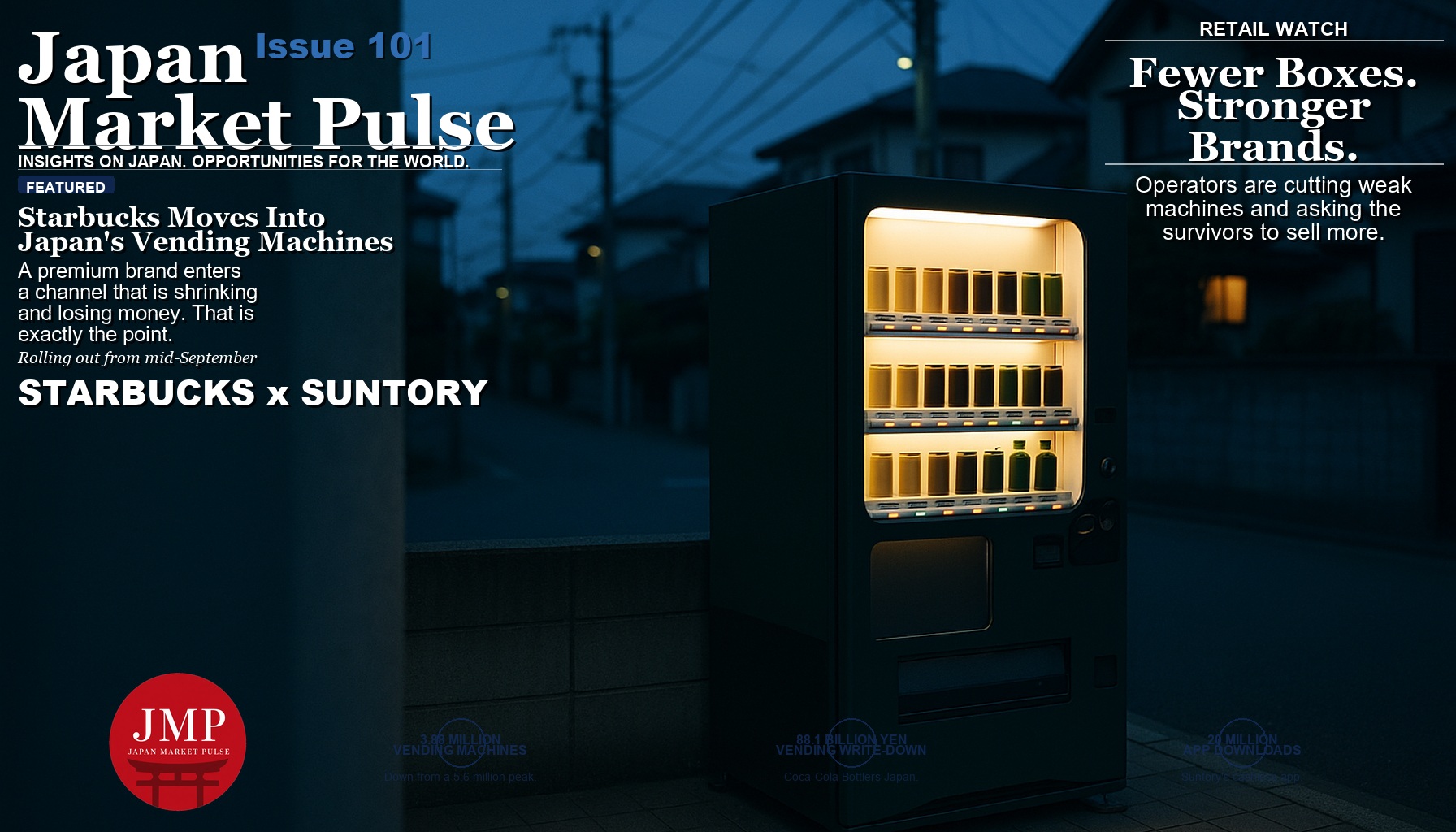
On September 8, Starbucks and Suntory Beverage & Food announced something that had never existed in Japan: a vending machine that sells only Starbucks. The machines are painted in the brand’s green and black, with a large Siren logo on the side and a line of copy that translates roughly as “Starbucks, casually, anytime and anywhere.” They began rolling out in mid-September and will spread across the country in stages through Suntory’s network. Neither company has said how many there will be.
Inside are four drinks. The newest, a 380-gram bottle can of black coffee made with Starbucks’ Espresso Roast, went on sale on September 15. Next to it sit a caramel macchiato in a small plastic bottle and two short cans, one black and one caffè latte, at a suggested retail price of ¥155 before tax.
It is easy to read this as a small product story. It is not. Starbucks opened its first store outside North America in Tokyo’s Ginza district in 1996, and it took almost 29 years to reach its 2,000th café in Japan, which it opened in February 2025. It is one of the most carefully managed premium brands in the country. And it has chosen this moment to enter a channel that is visibly shrinking, where machines are being pulled off streets, where prices have been pushed to ¥200 for a bottle of cola, and where Japan’s largest bottler has just written down the value of its machines by ¥88.1 billion.
I have lived in Japan for twenty years, and my first winter here was the season I learned that the red labels under the sample cans meant hot, and the blue labels meant cold. For most of that time the vending machine has felt like part of the landscape, as permanent as the utility poles. The Starbucks machines are a sign that the landscape is changing, and that the companies who own it are looking for new ways to make each machine earn its place.
What Starbucks Actually Put in the Machine
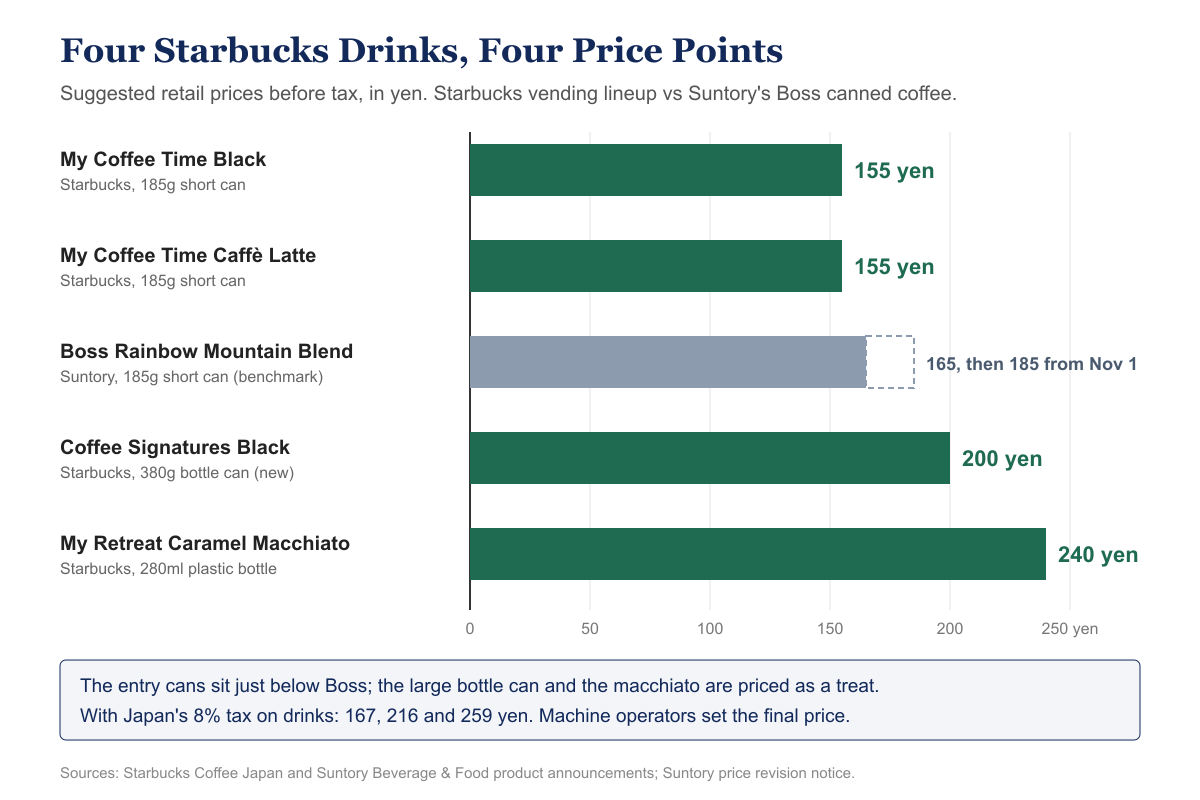
The lineup is short and deliberately tiered. Here is what the machines carry, with the manufacturer’s suggested retail prices. Japan applies a reduced 8% consumption tax to non-alcoholic drinks, so the tax-included figures are also shown.
| Product | Format | Suggested price (ex-tax) | With 8% tax | |—|—|—|—| | Starbucks Coffee Signatures Black (new, Sept 15) | 380g bottle can | ¥200 | ¥216 | | Starbucks My Retreat Caramel Macchiato (renewed) | 280ml plastic bottle | ¥240 | ¥259 | | Starbucks My Coffee Time Black | 185g short can | ¥155 | ¥167 | | Starbucks My Coffee Time Caffè Latte | 185g short can | ¥155 | ¥167 |
Machine operators set the final prices, so what customers see on the street can differ. But the structure is clear. The short cans are priced to compete with the ordinary canned coffee that has filled Japanese machines for half a century. For comparison, Suntory’s own Boss Rainbow Mountain Blend, one of the best-known canned coffees in the country, comes in the same 185-gram can and carries a suggested price of ¥165, rising to ¥185 for shipments from November 1. The large bottle can and the macchiato sit at the premium end, where a buyer is paying for the brand as much as the caffeine.
The design choices matter too. The new black coffee can carries “1971,” the year Starbucks opened its first store in Seattle, layered over the Siren. The packaging is designed to look like something from a café, not something from a factory. In a channel where most products are anonymous until you are close enough to read the label, a green machine with a Siren on the side is an advertisement that works from across the street.
A Country That Sells Drinks From 2 Million Machines
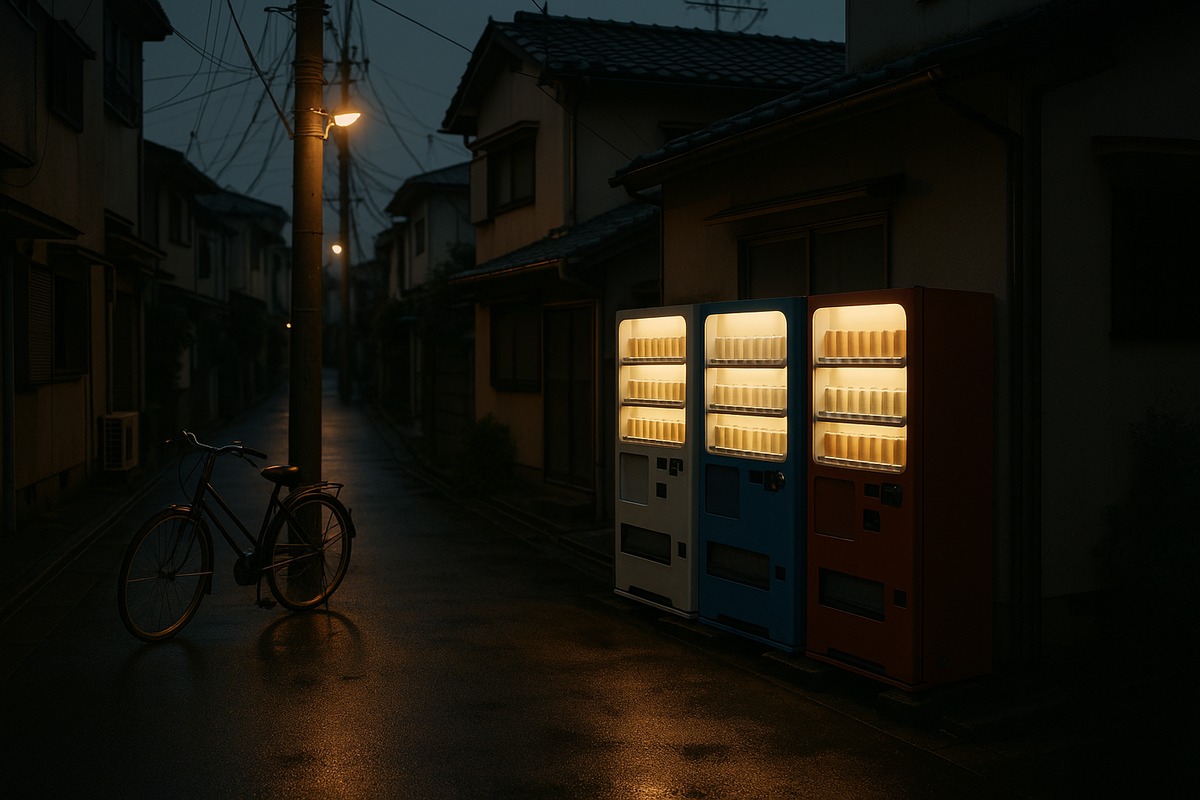
To see why this is a significant move, start with the scale of what vending means in Japan.
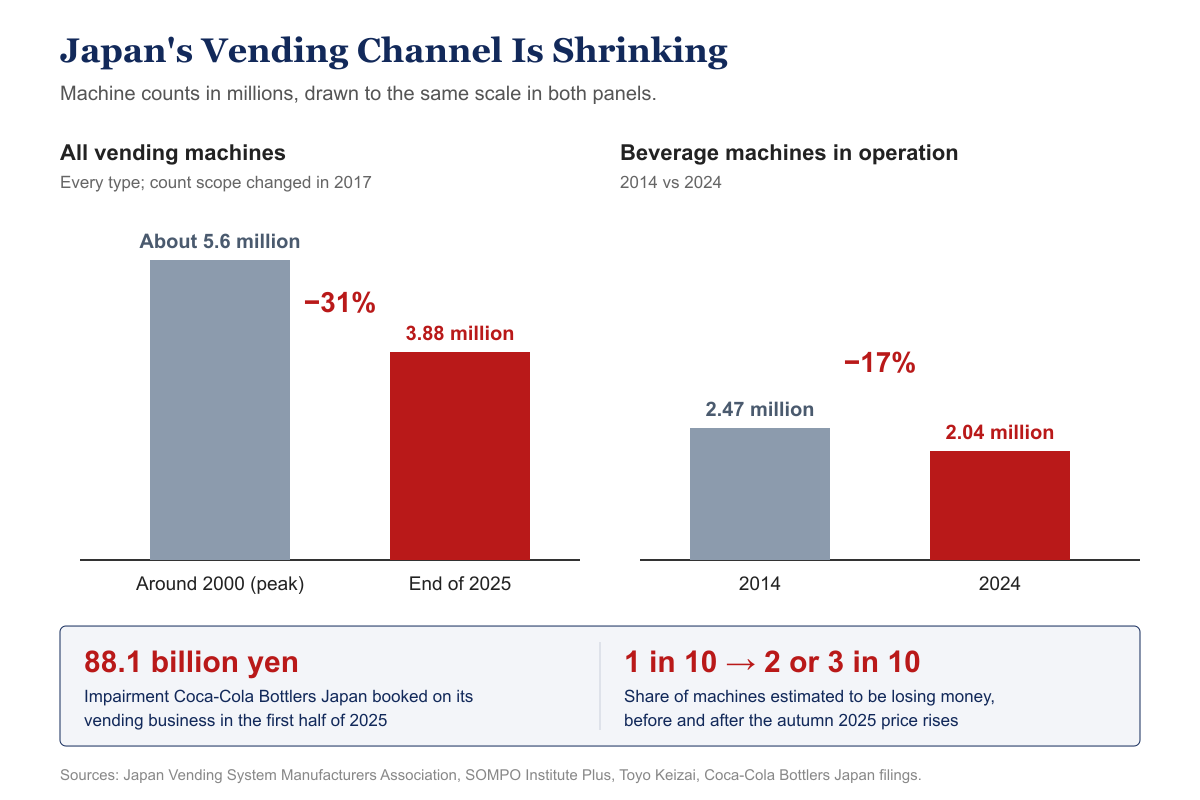
At the end of 2025, according to the Japan Vending System Manufacturers Association, the country had 3,881,700 vending machines of all kinds. Of those, 2,179,000 sold beverages. With a population of roughly 123 million, that works out to about one vending machine for every 32 people, and one drink machine for every 57. They stand outside homes in residential streets, on railway platforms, in office corridors, at mountain trailheads and in the car parks of shrines. Most of them sell both hot and cold drinks, and they switch many slots to hot in autumn.
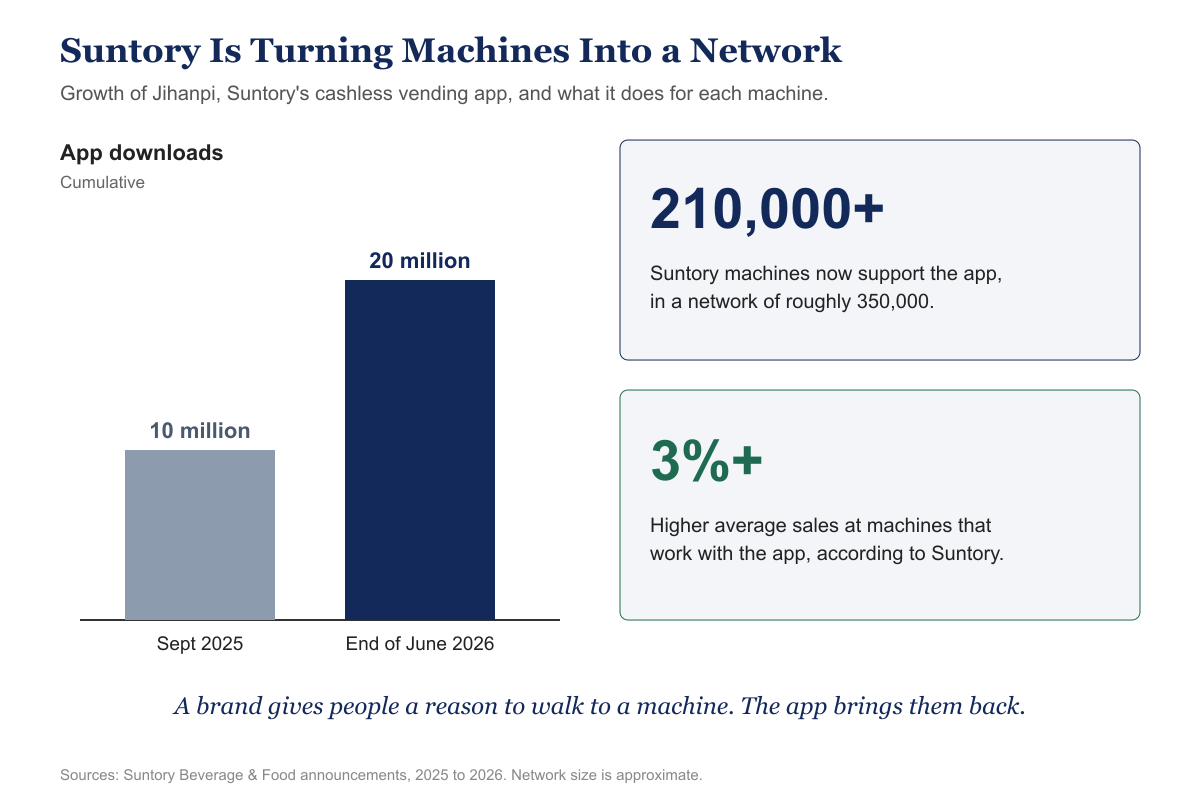
For the beverage companies, these machines have been more than a sales outlet. They were a pricing engine. A drink sold from a machine carries a higher price than the same drink in a supermarket, and the beverage company or its operating partner keeps far more of the margin than it does when a retailer sits in between. That is why Japan’s drink makers built enormous networks. Coca-Cola Bottlers Japan operates about 650,000 machines, the largest fleet in the country. Suntory’s beverage business runs around 350,000. DyDo, the third-largest operator, had about 247,000 machines in Japan in 2024 and depends on vending for close to 90% of its domestic beverage revenue.
The machines also do things no store can. They are open every hour of the year, they need no staff, and they reach places where no one would ever build a shop. Many are designed to dispense drinks for free in a disaster. For a foreign observer, the density is the surprise. For a Japanese beverage executive, the density used to be the business model.
The Channel Is Shrinking, and Losing Money
That business model is now under visible strain.
Japan’s vending machine count peaked at about 5.6 million around 2000, and the 2025 total of 3.88 million is far below that. The industry association changed the scope of its count in 2017, so long-run comparisons are approximate, but the direction is not in doubt. The trend in drink machines is the same. Figures cited by Toyo Keizai put the number of beverage machines in operation at 2.47 million in 2014 and 2.04 million in 2024.
The reasons are not mysterious. Convenience stores, supermarkets and drugstores keep multiplying, and drugstores in particular sell bottled drinks at close to half the price of a machine. Office attendance never fully returned after the pandemic, which hurt machines in workplaces. The population is ageing and shrinking, especially in the rural areas where a roadside machine once had no competition. And the cost of running the network has risen on every line: the wages of the staff who restock machines, the pay needed to find truck drivers, and the electricity to keep a refrigerated box running around the clock.
To defend margins, the industry has raised prices, hard. A 500-milliliter bottle of Coca-Cola from a machine reached ¥200 in autumn 2025. In October 2025 Suntory raised prices on 234 products, with cans going up between 10% and 24%. Its Craft Boss Black in a 500-milliliter bottle rose from a suggested ¥200 to ¥240. Another round, covering 131 products, starts with shipments on November 1, 2026.
Higher prices have not solved the problem. Toyo Keizai reported that roughly one machine in ten was already losing money, and that after the autumn 2025 price rises the share could reach two or three in ten. The balance sheets tell the same story. In the first half of 2025, Coca-Cola Bottlers Japan booked an impairment of ¥88.1 billion on its vending business and went on to report a net loss of about ¥50.7 billion for the year. The company still generates more than 20% of its sales volume through machines, but that volume has fallen by about a quarter over the past decade. Sapporo has exited the vending business altogether, and DyDo and Ito En have both booked impairment losses of their own.
In other words, Starbucks is not entering a growth channel. It is entering a channel whose owners are deciding which machines deserve to survive.
Why Suntory Wants a Siren on the Machine
That is precisely why the Starbucks machine makes sense for Suntory.
When a network shrinks, the economics shift from the number of machines to the sales of each one. An operator that removes its weakest locations and raises revenue at the rest can end up with a smaller, more profitable business. The industry has a phrase for this, selection and concentration, and every major operator is practicing it. What Suntory needs is reasons for people to walk to a specific machine instead of buying a six-pack at a drugstore.
A strong brand is one of those reasons. Suntory has made Starbucks drinks for the Japanese market for two decades, and it knows the brand pulls customers who might otherwise ignore a vending machine entirely. A dedicated Starbucks machine turns the machine itself into a destination, and it gives Suntory a premium product that can carry a higher price without feeling like a penalty. At ¥200 before tax, the 380-gram bottle can is not an impulse buy in the way a small can of coffee is. It is a choice.
The second reason is data. Suntory’s cashless vending app, Jihanpi, passed 10 million downloads by September 2025, was rolled out nationwide in March 2026 and reached 20 million downloads by the end of June 2026. More than 210,000 Suntory machines now support it. According to Suntory, machines that work with the app sell on average more than 3% more than those that do not. That is what the modern Japanese vending machine is becoming: less an anonymous metal box and more a connected retail point that knows who buys what, when and where.
Put the two together and the logic is straightforward. A shrinking channel needs fewer, better machines. Better machines need brands that draw customers and apps that bring them back. Starbucks supplies the first, and Suntory already has the second.
Twenty-One Years of Starbucks in a Can
What makes this more than a one-off licensing deal is the history behind it.
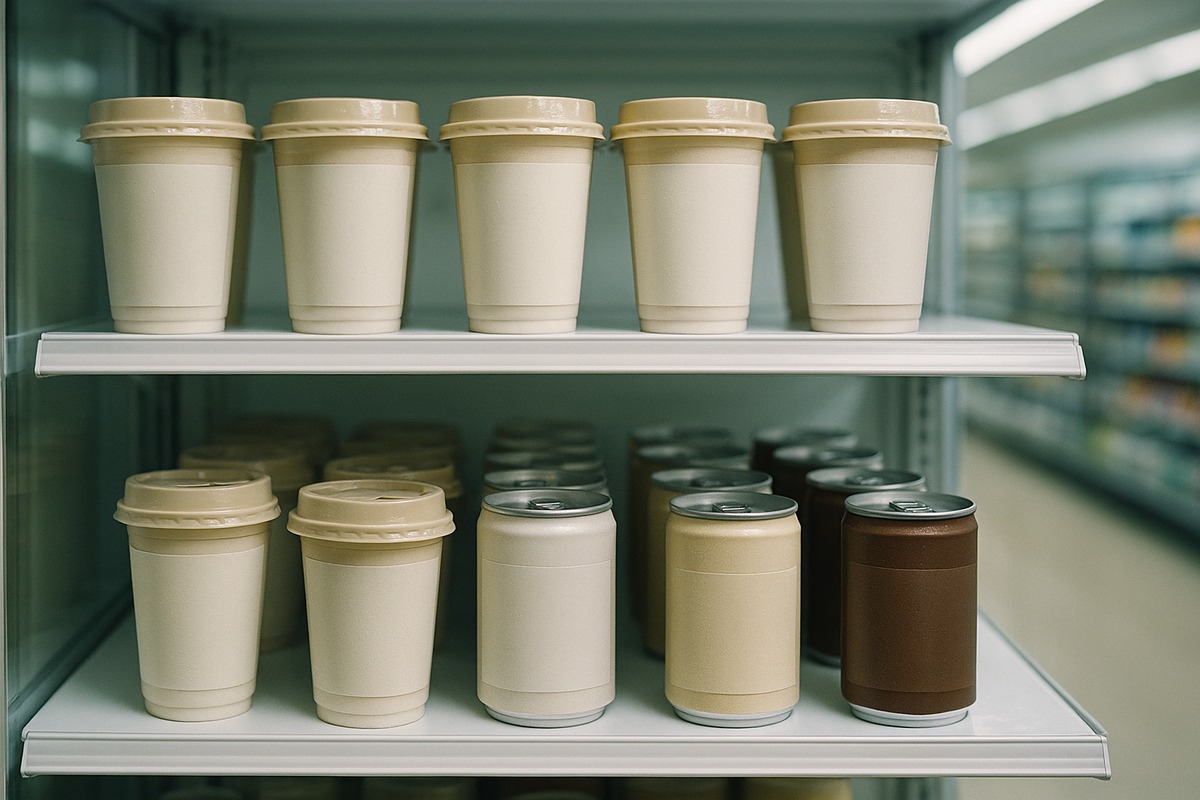
In 2005, Starbucks and Suntory signed an agreement to develop ready-to-drink coffee for Japan. That September they launched Starbucks Discoveries, a chilled coffee in a plastic cup with a peel-off lid, first in convenience stores in the Tokyo area. It was the first Starbucks-branded chilled cup coffee anywhere in the world. The companies say it created a premium tier in a category that had been dominated by cheaper products. Two decades later the chilled cups are still on convenience store shelves, and the partnership has expanded into cans and bottles. The short My Coffee Time cans now in the vending machines were launched in November 2025.
Japan has long been a testing ground for Starbucks. The Ginza store that opened in August 1996 was the company’s first outside North America. Starbucks Corporation later took full ownership of its Japanese business, and the store count kept climbing through the 2020s, from 1,637 in March 2021 to 2,077 by the end of September 2025.
The American arrangement is different. In the United States, Starbucks’ bottled and canned drinks come out of the North American Coffee Partnership, a joint venture with PepsiCo formed in 1994, which introduced the bottled Frappuccino two years later. In 2018 Nestlé paid Starbucks $7.15 billion upfront for the right to sell Starbucks packaged coffee and foodservice products around the world. Starbucks reports this activity as Channel Development, and in fiscal 2025 its revenue grew by $102 million, or 6%.
The pattern is consistent. When it comes to ready-to-drink coffee sold outside its cafés, Starbucks has repeatedly lent its brand to partners that already have the bottling, distribution and retail reach, choosing a different partner for each job and each market. In Japan, for ready-to-drink coffee, that partner has been Suntory for twenty-one years. The vending machine is simply the next piece of infrastructure Suntory can offer.
Two Starbucks Strategies in the Same Week
The timing produced a striking contrast.
Two days after the vending machine announcement, on September 10, Starbucks CEO Brian Niccol told investors that the turnaround he began in September 2024 under the name Back to Starbucks was working, and that the next stage would focus on renovating cafés and improving the customer experience. The numbers support him. Global comparable store sales rose 7.9% in the company’s fiscal third quarter, its fourth straight quarter of growth. More than 1,000 locations were renovated in nine months, with a goal of 1,500 or more by the end of fiscal 2026, and the company plans to open 150 to 175 new stores in the United States this year.
So in the same week, Starbucks’ American message was “come back to the café,” and its Japanese partner’s message was “Starbucks, anytime and anywhere, from a machine.” It would be easy to call that a contradiction. It is closer to a division of labour.
The café is where the brand is built. The seating, the service and the store design are what make a green logo worth paying extra for, and Niccol’s plan is an admission that Starbucks let that experience slip in the US. The machine is where the brand is monetised at scale, in places a café will never reach. That only works if the café side stays strong. A Siren on a machine at a rural railway station is valuable because of what happens in the Ginza store, not the other way round.
The risk is dilution. A premium brand that appears everywhere can stop feeling premium. Starbucks has managed that risk in Japan for two decades through convenience store chilled cups, and the tiered vending lineup suggests it intends to keep doing so, with a mass-priced short can for the everyday buyer and a large bottle can and macchiato priced for someone treating themselves.
What Operators Should Take From This
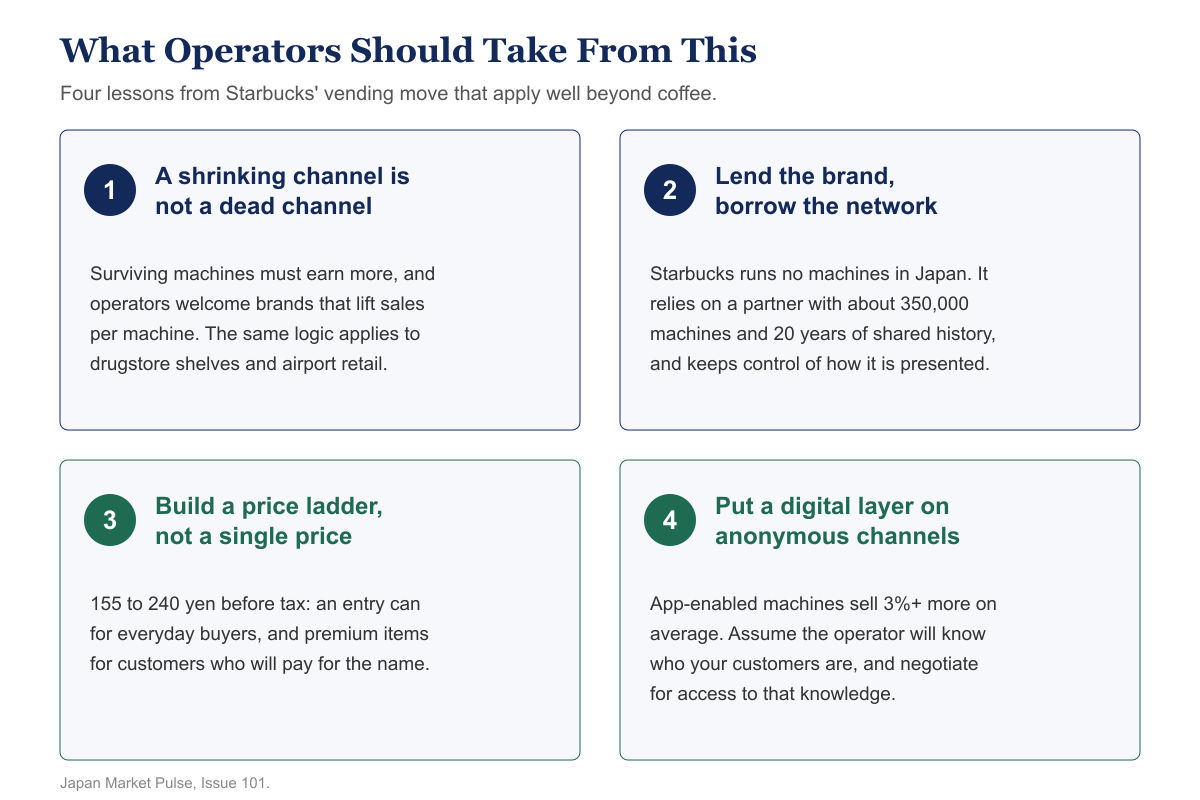
Four lessons travel well beyond coffee.
First, a shrinking channel is not a dead channel. Japan’s vending network is getting smaller, but the machines that remain will need to earn more, and they will be filled with the products that justify the space. Brands that can raise sales per machine will be welcomed by operators who are cutting everything else. The same logic applies to department stores, drugstore shelves and airport retail.
Second, lend the brand and borrow the network. Starbucks does not operate a single vending machine in Japan. It relies on a partner that runs around 350,000 of them and has twenty years of experience making its drinks. For a foreign brand entering Japan, building distribution from scratch is slow and expensive. Partnering with a company that already owns the channel is often the faster route, as long as the brand keeps control of how it is presented.
Third, build a price ladder, not a single price. The four Starbucks products span ¥155 to ¥240 before tax. The entry can competes with everyday canned coffee, and the premium items capture customers willing to pay for the name. In a market where consumers have become sharply price-conscious after years of increases, a ladder lets a brand hold its premium image while still selling to the budget buyer.
Fourth, put a digital layer on anonymous channels. Suntory’s app has turned hundreds of thousands of silent machines into points that collect data and bring customers back, and it says the effect shows up in sales. Any brand selling through vending, kiosks or unattended retail in Japan should assume the operator will increasingly know who its customers are, and should negotiate for access to that knowledge.
Frequently Asked Questions
Q. Where can I find the Starbucks vending machines in Japan?
A. The machines began rolling out in mid-September 2026 and are being installed across Japan in stages through Suntory Beverage & Food’s vending network. Neither Starbucks nor Suntory has disclosed how many machines there will be or a full list of locations, so availability will vary by area during the rollout.
Q. How much do the drinks cost?
A. The suggested retail prices before tax are ¥200 for the 380-gram Coffee Signatures Black bottle can, ¥240 for the 280ml My Retreat Caramel Macchiato and ¥155 for each of the two 185-gram My Coffee Time short cans. With Japan’s 8% consumption tax on beverages, that is ¥216, ¥259 and ¥167. Actual prices are set by the machine operator and can differ by location.
Q. How many vending machines does Japan have?
A. At the end of 2025 Japan had 3,881,700 vending machines, of which 2,179,000 sold beverages, according to the Japan Vending System Manufacturers Association. That is roughly one machine for every 32 people. The total has been falling for years and is well below the peak of about 5.6 million reached around 2000.
Q. Can I buy Starbucks ready-to-drink coffee outside Japan?
A. Yes, but the products differ by country. In the United States, bottled and canned Starbucks drinks are produced through the North American Coffee Partnership with PepsiCo and are widely sold in grocery and convenience stores, as well as online through Amazon. The Japanese lineup, including the vending machine drinks, is developed with Suntory specifically for Japan.
Conclusion
The Starbucks vending machine is a small object with a large message. Japan’s drink machines are no longer the unquestioned cash machines they were for fifty years. Their number is falling, their prices have been pushed to levels that send customers to drugstores, and the largest operator has written down their value by ¥88.1 billion. The companies that own them are choosing which machines to keep, and they are filling the survivors with brands and apps that give people a reason to stop.
Starbucks, for its part, is doing what it has done in Japan since 2005: lending a carefully built brand to a partner with the infrastructure to take it where cafés cannot go. In the same week that its CEO promised American customers better cafés, its Japanese partner began putting the Siren on the side of a machine.
For international operators, the lesson is not about coffee or vending. It is that in a mature market, the most valuable asset is often not the channel or the brand on its own, but the combination of the two. A shrinking channel still has room for a strong brand, and a strong brand still needs someone else’s channel to reach everyone.
This article contains affiliate links. If you purchase through these links, we may earn a small commission at no extra cost to you.
If you’re interested in this topic, the Japanese market more broadly, or what KETCHUPs is working on, we’d love to hear from you — please reach out via our contact form.
Japan Market Pulse is a weekly read on what the Japanese consumer-tech, food, and mobility markets are choosing to do, written for international operators who want to know what is happening before it shows up in the global trade press.
Subscribe at ketchups.co/japan-market-pulse.