

Disclosure: This article includes references to Japanese retail products. Some external links may be affiliate links.
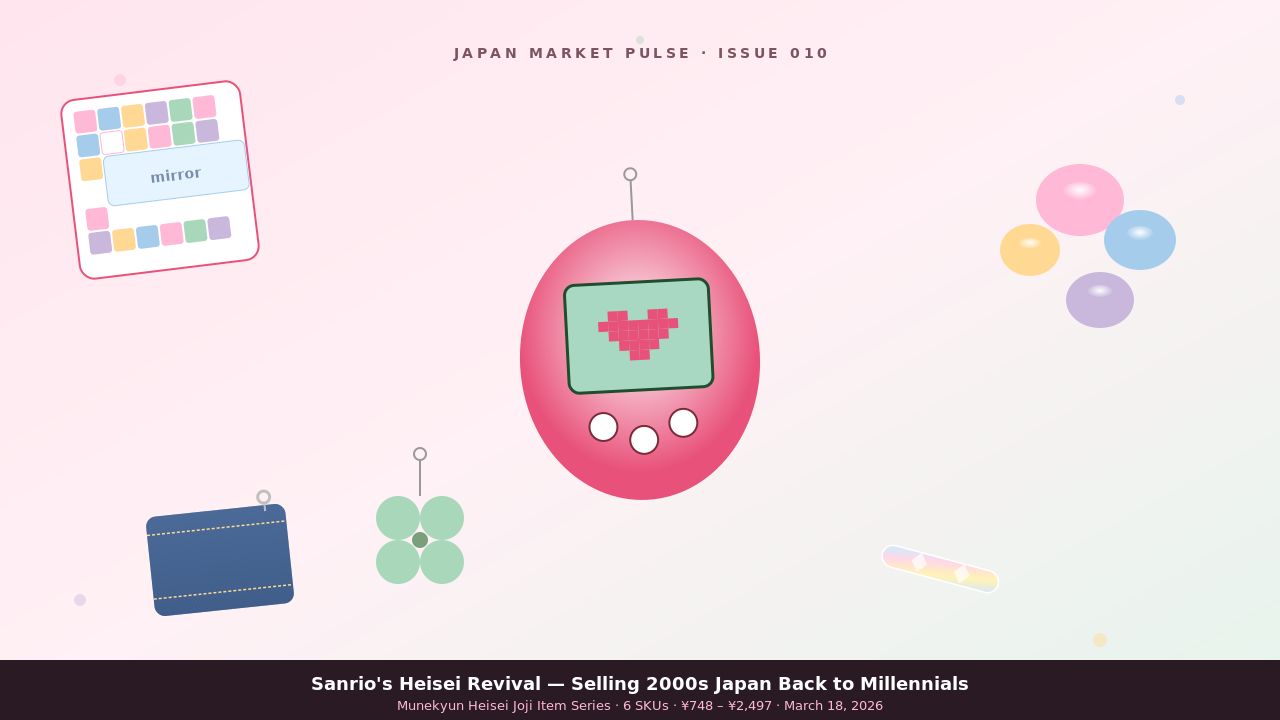
In March 2026, Sanrio launched a six-product capsule called “Munekyun Heisei Joji Item Series” — fake-glass-gem stickers, tile-sticker-style compact mirrors, and pixel-art charms shaped like a 1999 mini-game console. The packaging looks like nostalgia. The strategy is something more interesting: a deliberate, financially-tuned attempt to convert a 35-year-old’s childhood memory into a ¥990 impulse buy that her own daughter will also want.
Japan Market Pulse — Issue 010 | Consumer Trends
A small market-watcher confession is in order. The author has spent years skeptical of “nostalgia drops” as a category — the LEGO Rebrick line, the Nike Cortez relaunch, the endless 90s-anime t-shirt cycle, the Spice Girls comeback tour. Most of the time these are press-release flares: a small SKU run, a focused PR cycle, an Instagram bump, and three months later the brand quietly returns to its main product line. The drop sells out, the brand gets a halo, and the strategic story is a single quarter long.
Sanrio’s Munekyun Heisei Joji Item Series (“munekyun” is the Japanese onomatopoeia for a heart-fluttering moment; “Heisei joji” translates as “Heisei-era girl child”) looks, on first glance, like exactly that kind of drop. Six SKUs. Released March 18, 2026. Sanrio-channel-only — directly-operated stores and department-store Sanrio corners. Price points clustered between ¥748 and ¥2,497. Confined to a single named character group: Hello Kitty, My Melody, Kuromi, Cinnamoroll, Pompompurin, Pochacco, and the remainder of the standard Sanrio Characters cast.
But step back, look at Sanrio’s last three fiscal years, and the drop stops looking like a marketing flare. It looks like a two-generation conversion funnel designed by a company that has just had the best fiscal year in its 65-year history and is trying to lock in the millennial-mother demographic for the next decade.
This is a piece about that funnel — what Sanrio actually shipped, why “Heisei Retro” is not the same trend as the Y2K revival happening in the West, and what it tells anyone who sources from Japan about the millennial-mother / Gen-Alpha-daughter purchase pattern that Japanese retail has spent two years quietly perfecting.
What Sanrio Actually Shipped on March 18
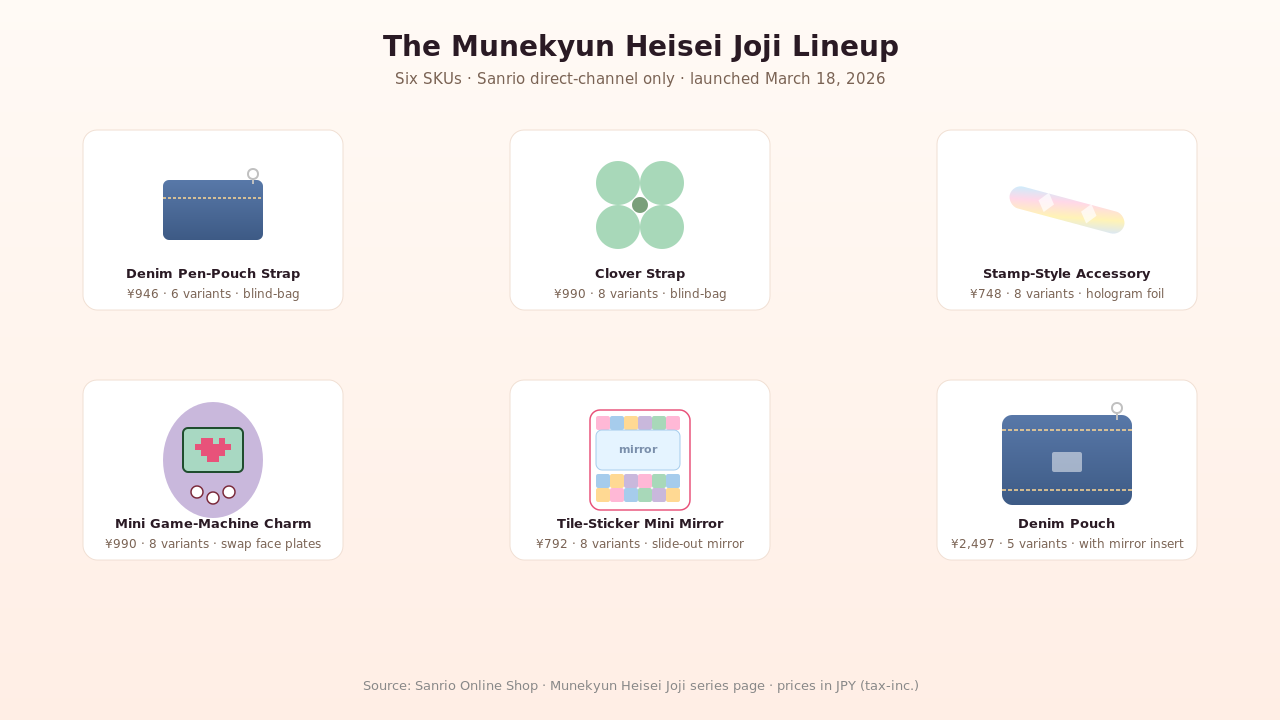
The Munekyun Heisei Joji series is six products, deliberately small, deliberately priced. Here is the full lineup, with the official Sanrio Online Shop pricing:
- Secret Denim Pen-Pouch-Style Strap — ¥946 — six variants, blind-bag format
- Secret Clover Strap — ¥990 — eight variants, blind-bag format
- Secret Stamp-Style Accessory — ¥748 — eight variants, hologram-foil hairclip and strap formats
- Secret Mini Game-Machine-Style Charm — ¥990 — eight variants, removable sticker face plates with internal storage compartments
- Secret Tile-Sticker-Style Mini Mirror — ¥792 — eight variants, slide-mirror with bead charms
- Denim Pouch — ¥2,497 — five variants, with mirror inserts and metal strap-attachment hardware
The series rolled out March 18 to most of Japan and on a March 19–22 staggered window to Kyushu, Tottori, Hiroshima, Yamaguchi, and Okinawa — Sanrio’s standard tiered-region launch pattern. Distribution: Sanrio-direct stores, the department-store Sanrio corners, and the Sanrio Online Shop. No convenience-store or general-mass-channel distribution at launch.
The deliberate detail here is that every single item is a 1999–2003 schoolgirl artifact reissued at adult-quality. The “fake glass” sticker accessory is the puffy-resin chiyo-shi sticker that elementary-school girls used to hoard in shiitake-shaped pencil cases in 2001. The tile-sticker compact is the tairu shiiru — small grid-shaped adhesive tiles applied to flip-phone backs, school notebooks, and pencil cases through the entire 2002–2007 flip-phone era. The mini-game-machine charm is, unmistakably, a Tamagotchi in silhouette, complete with a pixel-art screen window and the swap-out face plates that the original Bandai Tamagotchi shipped with from 1996 onward. The clover strap is the prized yotsuba no kuroobaa good-luck charm of 1999 stationery culture, fossilized in resin. The denim pen-pouch-shaped strap is a deliberate scaled-down miniature of the jinbei pochi canvas pencil cases that every female elementary student in the late Heisei era seemed to own. None of these objects, in any form, was being sold in the same shape in 2025.
The drop is not “Hello Kitty merchandise that happens to look retro.” It is a literal-grade reproduction of the visual vocabulary of late-Heisei girlhood, restamped with adult-2026 production quality.
Sanrio is, in other words, doing what Pokémon and Bandai Candy have done for several years with their respective fan bases — but with an unusual twist. Pokémon’s nostalgia drops sell to the people who played Pokémon as kids. The Bandai Candy reissue line sells to the people who collected the original snacks. The Sanrio drop is selling to the people who owned the visual culture around the toys — a much wider, more emotionally diffuse target. You did not need to own a specific Tamagotchi to feel the pull of a Tamagotchi-shaped charm at ¥990. You needed to be a Japanese woman who was between 7 and 14 years old between 1998 and 2005.
That is approximately 6.7 million Japanese women by official MIC age-cohort data — a population now aged 28 to 45, holding a median household income that exceeds the national average, and with disproportionate purchasing influence over an additional 4.1 million daughters aged 5 to 14.
Why “Heisei Retro” Is Not the Y2K Revival the West Is Having
Western trade press has been covering “Y2K nostalgia” as a global aesthetic since roughly 2022 — the low-rise jeans cycle, the Juicy Couture tracksuit relaunch, the Paris Hilton brand-revival arc, the Bratz-doll Instagram resurgence. It is, by now, a well-documented Western fashion cycle, and a reasonable shorthand reading would be that Sanrio’s March 2026 drop is the Japanese version of the same cycle.
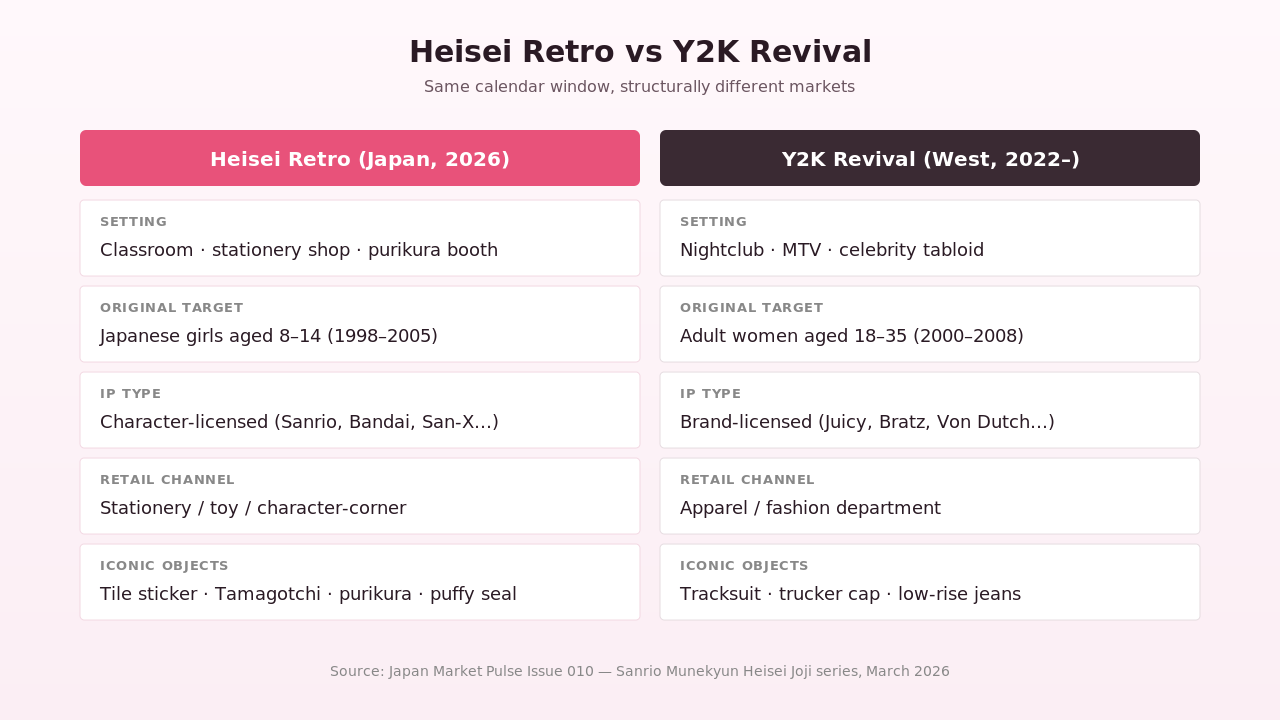
That reading is too tidy. “Heisei Retro” — the term Japanese trend press has settled on — is structurally a different product than “Y2K.” The two share the same calendar window (roughly 1995–2005). They share several visual codes (chunky tech, clear plastic, bubble shapes, glitter). But the emotional vocabulary the two are pulling from is different in three specific ways that matter for any operator buying Japanese product for a Western retail floor.
First, Heisei Retro is anchored to a school-life context, not a club-life context. Y2K, in the West, lives at the intersection of MTV, the nightclub, the music video, and the celebrity tabloid. Heisei Retro, in Japan, lives at the intersection of the kyōshitsu (classroom), the bunbougu-ya (stationery shop), the purikura booth, and the konbini magazine rack. The two aesthetics overlap in their love of pink-and-silver and their preference for chunky tech, but the social setting they are nostalgic for is different. A Heisei Retro reissue is a school-supplies reissue first and a fashion piece second.
Second, Heisei Retro is a girls’-content reissue, not an adult-fashion reissue. Most of the iconic Y2K Western pieces were originally adult-market products: Juicy Couture’s tracksuits were sold to women in their 20s; Paris Hilton’s brand was a celebrity-adult product; the rhinestone-trim Von Dutch trucker hat was adult streetwear. Heisei Retro’s iconic objects are objects originally sold to Japanese girls aged 8–14: tile stickers, Tamagotchi, the kira-kira glitter pencil, the Pucca-and-Garu eraser. The market the original products were sold into was the shōgakusei (elementary-school) market. The reissues are now selling to those same women at age 35.
Third, Heisei Retro is intrinsically character-licensed in a way Y2K is not. Y2K’s Western icons — Juicy, Bratz, Paris Hilton — are mostly brand-icons, not character-licensed properties. Heisei Retro in Japan is unimaginable without character licensing: Hello Kitty, Doraemon, Pokémon, Cardcaptor Sakura, Sailor Moon, Pucca, Tarepanda, Gachapin, Mofunyan. The aesthetic itself was structurally character-saturated from the start. So a Heisei Retro reissue almost has to be character-licensed — and the character holders, almost all of which are Japanese, control the supply.
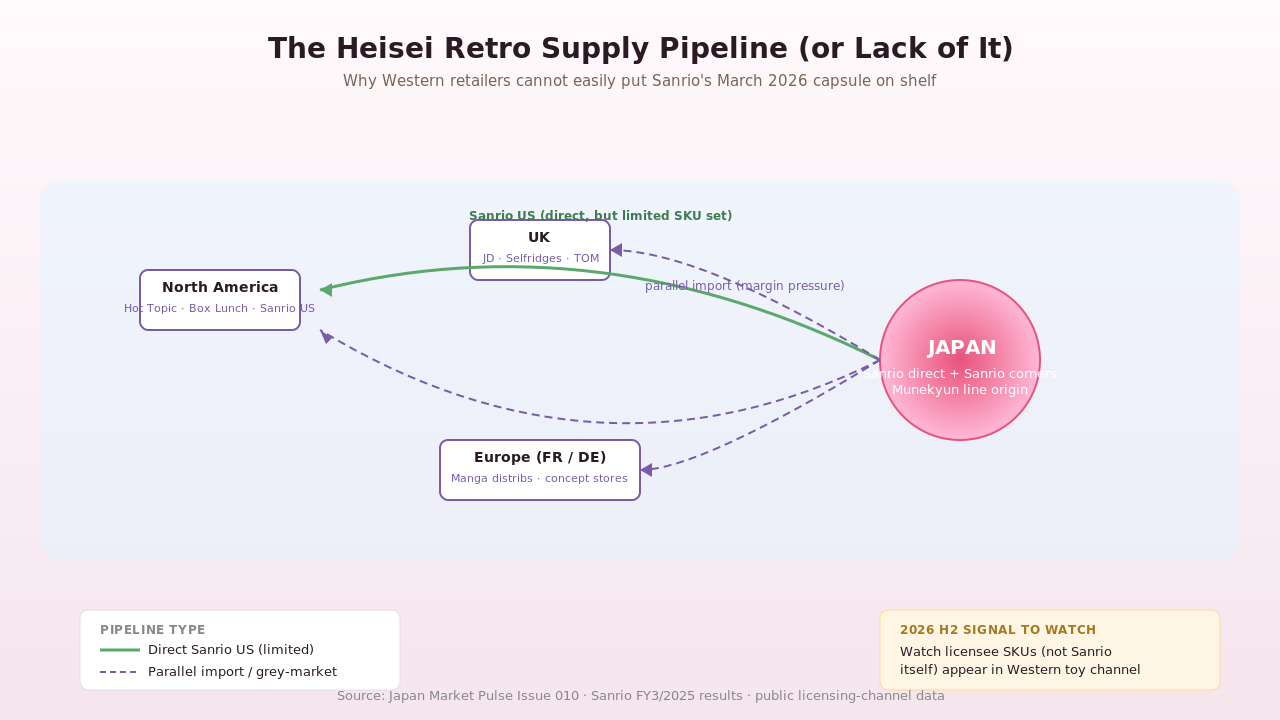
The strategic implication for a Western operator is that the Heisei Retro shelf has very different economics than the Y2K shelf. A Y2K shelf is sourced primarily through Western brand revivals and vintage resellers, with margins roughly comparable to standard fashion. A Heisei Retro shelf has to be sourced through Japanese character licensees — which means narrower distribution, longer lead times, character-licensing friction, and substantially lower SKU substitutability. The Sanrio Munekyun drop is, in this light, a textbook example of the supply-side problem: six SKUs, Sanrio-channel-only, no Western distribution at launch, no Amazon US listing. A Western retailer reading this article today, in May 2026, who tries to source the line at scale will find that the only available channel is parallel import — and the unit economics through that channel do not work at full retail margin.
A small additional note: a non-trivial portion of what Western trade press has filed under “Y2K” in the last 18 months is, on closer inspection, Japanese Heisei Retro misread as Y2K. The fact that Korean and Japanese pop-cultural exports have been driving the Western Y2K-revival pipeline at the visual level (K-pop styling, J-pop and city-pop revival music, Japanese cosmetics-channel-aesthetic on TikTok) means that the surface-level visual signal Western audiences are absorbing is not, in fact, an authentic 2002-Western signal. It is the Japanese 2002 signal, refracted through K-pop styling and TikTok algorithm. Operators who fail to make the distinction will continue to source through the wrong supply channel, and continue to get the wrong product on shelf.
The Multi-Character Engine That Made the Drop Possible
Sanrio reported its best fiscal year in company history for FY3/2025, which closed March 31, 2025. Sales rose 44.9% year-on-year to ¥144.9 billion. Operating profit rose 92.2% to ¥51.8 billion. Net income jumped 137% to ¥41.7 billion. The company raised its FY3/2027 operating-profit guidance from “over ¥40 billion” to “over ¥65 billion” — a 62.5% upward revision halfway through a three-year mid-term plan.
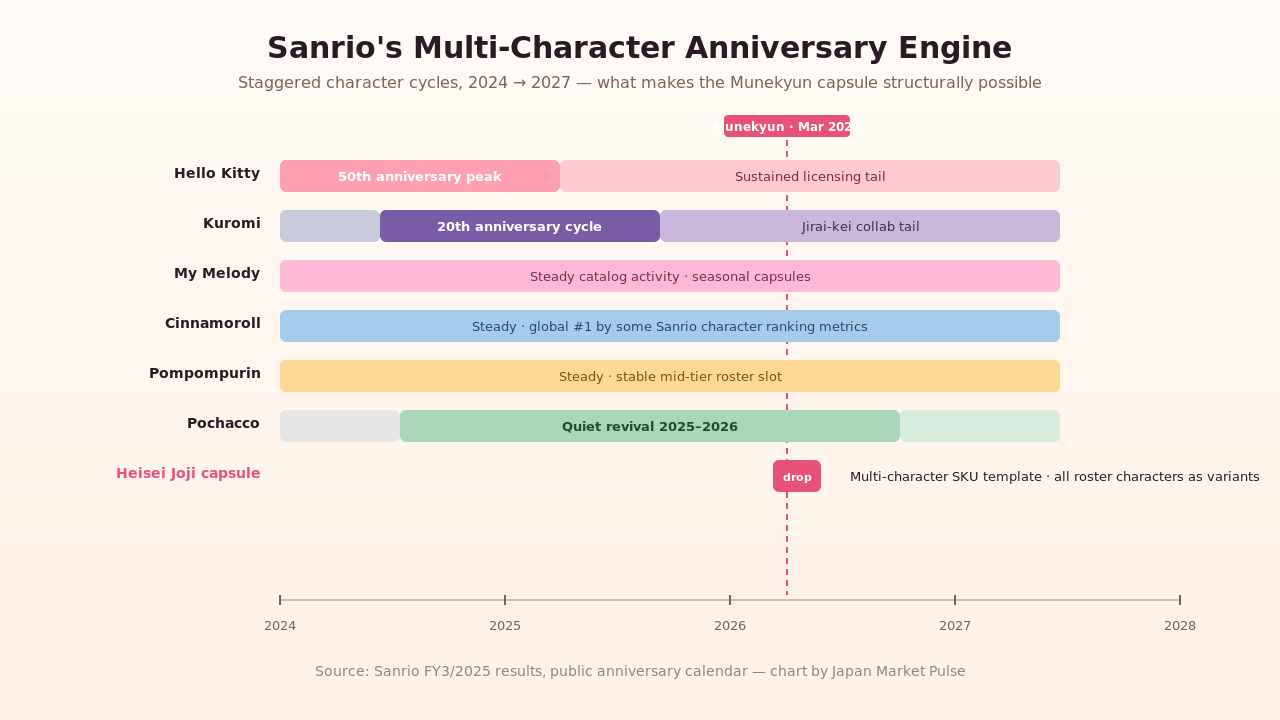
The cause of that surge was not Hello Kitty alone. It was the multi-character strategy Sanrio has been rebuilding for the last seven years. Hello Kitty turned 50 in 2024, with a calendar-anchored anniversary campaign that drove tourism into Sanrio Puroland and licensed product into convenience stores. Kuromi turned 20 in 2025, with a separate parallel anniversary cycle. My Melody, Cinnamoroll, and Pompompurin all run their own brand calendars in the staggered windows between the flagship anniversary years. Pochacco, the dog character that lived in the late-Heisei second tier and that Western readers may not recognize at all, has its own quiet but loyal Japanese fanbase.
The Munekyun Heisei Joji drop is the visible product of an internal capability the multi-character strategy has built up: Sanrio can now ship coordinated capsule drops that engage every major character in its roster simultaneously without any of them stepping on the others’ main brand calendars. The Munekyun line is not “the Hello Kitty Heisei drop” or “the Kuromi Heisei drop.” It is a Sanrio-Characters-cast drop, with all the major characters as design variants inside the same SKU template. That is structurally hard to do, requires a unified design vocabulary across multiple character IPs, and is something Sanrio could not have shipped this cleanly in 2018.
The financial logic is that a multi-character capsule drop has a higher collect-them-all coefficient than any single-character drop — the eight variants of the Mini Game-Machine Charm include Hello Kitty, My Melody, Kuromi, Cinnamoroll, Pompompurin, Pochacco, and two seasonal variants, and the blind-bag format means a buyer who wants the Kuromi variant has to buy more than one to reliably get it. The same buyer, three days later, may also buy the Tile-Sticker Mini Mirror because the Cinnamoroll variant from that line completes the set across two product types. The blind-bag-times-multi-character math drives a substantially higher units-per-buyer figure than a conventional single-SKU launch would.
Sanrio’s multi-character engine has, in effect, weaponized blind-bag economics against the millennial collector instinct. It is a Pokemon-style mechanic, refitted for adult women.
The Two-Generation Purchase Funnel
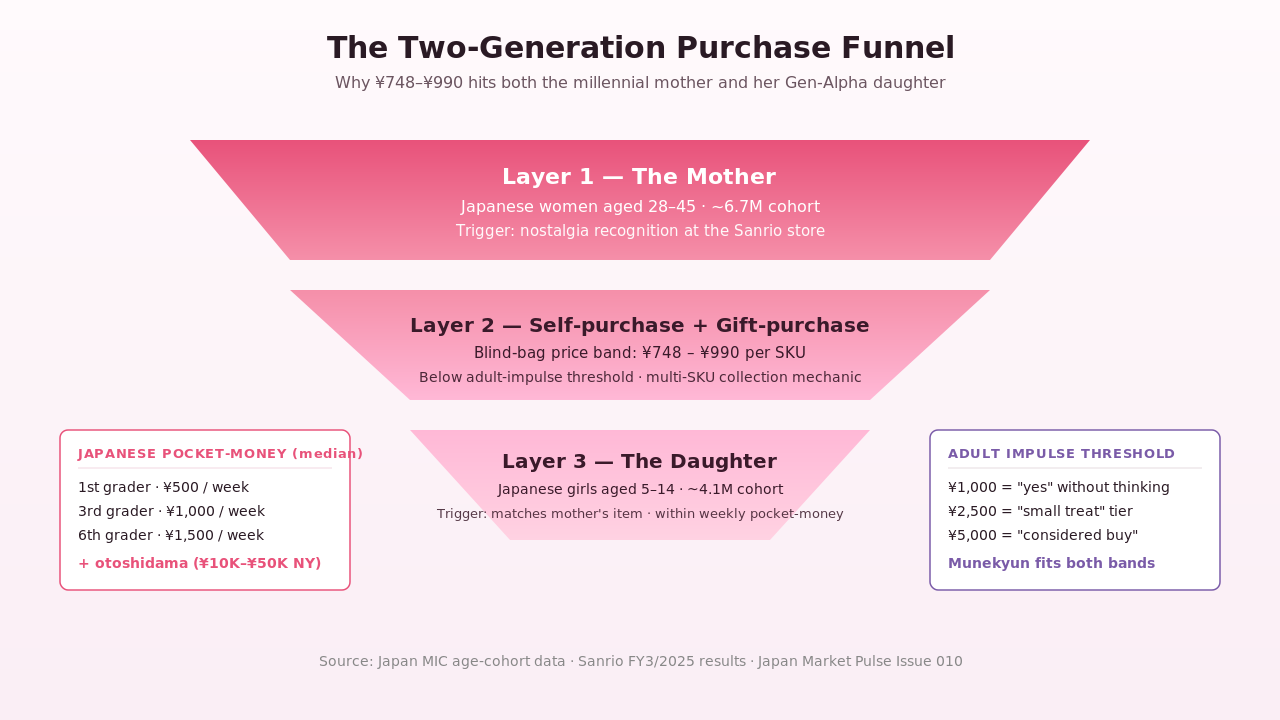
Here is where the strategy gets interesting for any operator outside Japan looking at the trend. The Munekyun drop is targeted at Japanese women aged 28–45, but the secondary target is their daughters. The blind-bag price point of ¥748–¥990 is deliberately calibrated to sit at the intersection of two purchase impulses: the mother’s nostalgia impulse and the daughter’s pocket-money allowance.
Japanese pocket-money culture is substantively different from the U.S. equivalent. Japanese elementary-school children typically receive a structured weekly or monthly otoshikai allowance, with median values around ¥500 for first graders and ¥1,500 for sixth graders, plus quarterly bonus injections at New Year (the otoshidama envelope tradition). A ¥990 charm is, in pocket-money terms, exactly one week of the median sixth-grader’s allowance — a substantial but reachable single-purchase price point for a child to spend on her own. A ¥748 hairclip is in the same range. The pricing is not retail-arbitrary. It is calibrated to the daughter’s spending rhythm.
But the parent’s purchase impulse — and this is where Heisei Retro becomes financially compelling — is calibrated against an adult‘s discretionary-impulse threshold. ¥990 for a Tamagotchi-shaped charm that the mother carried in her bag in 2001 is not a child’s birthday-party tier purchase decision. It is a self-directed “I want this for myself” purchase, an order of magnitude below the threshold at which an adult Japanese woman pauses to think.
The result is a unique two-generation funnel: the mother buys one for herself in the moment of recognition at the store, then she buys another for her daughter as a small gift, then she comes back the next week because the Tile-Sticker Mini Mirror also exists and she has to have the Kuromi variant, and along the way she buys her daughter the matching Hello Kitty version. The Sanrio Direct-Store traffic data Sanrio has cited in past investor calls — average basket sizes that are unusually large and unusually multi-SKU — is consistent with this funnel running at scale.
The anchoring concept Sanrio is selling, and selling well, is a shared mother-daughter object world. The mother’s childhood memorabilia and the daughter’s current play vocabulary are deliberately overlapping. Mother and daughter can both own the same Mini Game-Machine charm and have it mean two different things — to the mother, the loaded reference to the actual Tamagotchi she carried; to the daughter, just a cute pixel-art toy. The drop monetizes both readings.
What This Means for Western Operators
If you import Japanese product into a Western retail floor, the Sanrio Munekyun drop is signal in several specific ways.
The first is that the Heisei Retro / Y2K visual overlap is now a multi-billion-yen commercial category in Japan, not a fashion-press topic. Sanrio’s full-year revenue trajectory and the FY3/2027 guidance revision indicate that the company is staffing up against this category for years, not quarters. The Munekyun drop is the first product in what is structurally certain to be a multi-year line. Other character holders — Bandai for the Tamagotchi IP, Sega Toys for Pucca, San-X for Tarepanda and Rilakkuma, Pokémon for first-generation 1999–2003 merchandise — are visibly running parallel reissue cycles, with retailers like 3COINS and Thank You Mart moving aggressively into the same category at a lower price tier.
The second is that the supply problem for Western retailers is acute and is going to stay acute. Sanrio’s direct-store-and-Sanrio-corner-only launch policy is consistent with how Sanrio has historically handled premium drops, and there is no signal in the FY3/2025 messaging that the company plans to widen distribution into Western mass-market. The Sanrio US e-commerce channel exists and is reasonably stocked, but it is not stocked with the Japan-domestic Munekyun line. The Plaza Japan / White Rabbit Japan / Tokyo Otaku Mode parallel-import grey-market exists, but margins compress quickly as soon as a Western importer tries to sell at scale.
The third is that Western retail buyers should, in the second half of 2026, expect to see Heisei Retro / Sanrio collaboration product appear through the licensed-toys channel rather than the apparel channel. Watch for major Japanese-IP collaborations to start appearing on the Hot Topic and Box Lunch shelves in the United States, on the JD Sports / Selfridges shelves in the UK, on the major French and German anime-merchandise distributors. The signal to watch is a Sanrio licensee — not Sanrio itself — appearing on a Western retail SKU sheet with a 2002-coded design vocabulary.
The fourth, and most operationally interesting, is that the two-generation purchase funnel Sanrio is exploiting in Japan is not yet being exploited by Western character licensees, but the demographics that would make it work in the West are arriving. The U.S. millennial-mother cohort — women aged 28–45 — has just become, in 2025–2026, the cohort with the largest aggregate consumer-discretionary spending power, and it is the cohort with the most direct experience of Sanrio characters as children (Hello Kitty entered the U.S. mass market in the 1990s and has been continuously present since). The same two-generation logic that drove the Munekyun drop in Japan has Western parallels that no Western retailer has yet fully built around, and that is, for the right operator, an opening.
TL;DR — What’s New, What’s Strategic, and What to Watch
What’s new: Sanrio’s Munekyun Heisei Joji Item Series, six SKUs, ¥748–¥2,497, March 18, 2026, Sanrio-channel-only. Faux-glass-gem stickers, tile-compact mirrors, Tamagotchi-shaped charms, denim pouches.
What’s strategic: This is not a one-off nostalgia capsule. It is the first product of a multi-year, multi-character, two-generation conversion funnel that Sanrio has spent the last seven years building the operational capability to ship. The drop is calibrated to the millennial-mother demographic and the Gen-Alpha-daughter pocket-money rhythm at the same price point.
What to watch: Whether other Japanese character holders — Bandai (Tamagotchi), Sega Toys (Pucca), San-X (Rilakkuma), Pokémon Co. — follow with their own Heisei Retro reissue cycles in 2026 H2. Whether Western character licensees start running the same two-generation funnel against the U.S. millennial-mother cohort. Whether Western retailers start carrying Heisei Retro / Y2K Japanese-IP product through the toy channel rather than the fashion channel.
Heisei Retro is not a season. It is a multi-year demographic harvest. Sanrio just rang the bell.
Get in Touch
If you’re interested in this topic, the Japanese market more broadly, or what KETCHUPs is working on, we’d love to hear from you — please reach out via our contact form.
Japan Market Pulse is a weekly read on what the Japanese consumer-tech, retail, and lifestyle markets are choosing to do, written for international operators who want to know what is happening before it shows up in the global trade press.
Subscribe at ketchups.co/japan-market-pulse.
Sources
- Sanrio Official — Munekyun Heisei Joji Item Series
- Sanrio Online Shop — Munekyun Heisei Joji series page
- Tamago Daruma — Japan’s Heisei Retro Boom (English)
- Bokksu — Heisei Retro: Why Japan’s ’90s and 2000s Aesthetic Is Back
- Sanrio Corporate IR — Latest Financial Highlights
- JAKOTA News — Sanrio Profit Surges 137% on Hello Kitty’s 50th Anniversary
- Tokyo Scope — The Hello Kitty Comeback: Sanrio’s Three Secrets for U.S. Success
If you’re interested in this topic, the Japanese market more broadly, or what KETCHUPs is working on, we’d love to hear from you — please reach out via our contact form.
Japan Market Pulse is a weekly read on what the Japanese consumer-tech, food, and mobility markets are choosing to do, written for international operators who want to know what is happening before it shows up in the global trade press.
Subscribe at ketchups.co/japan-market-pulse.