

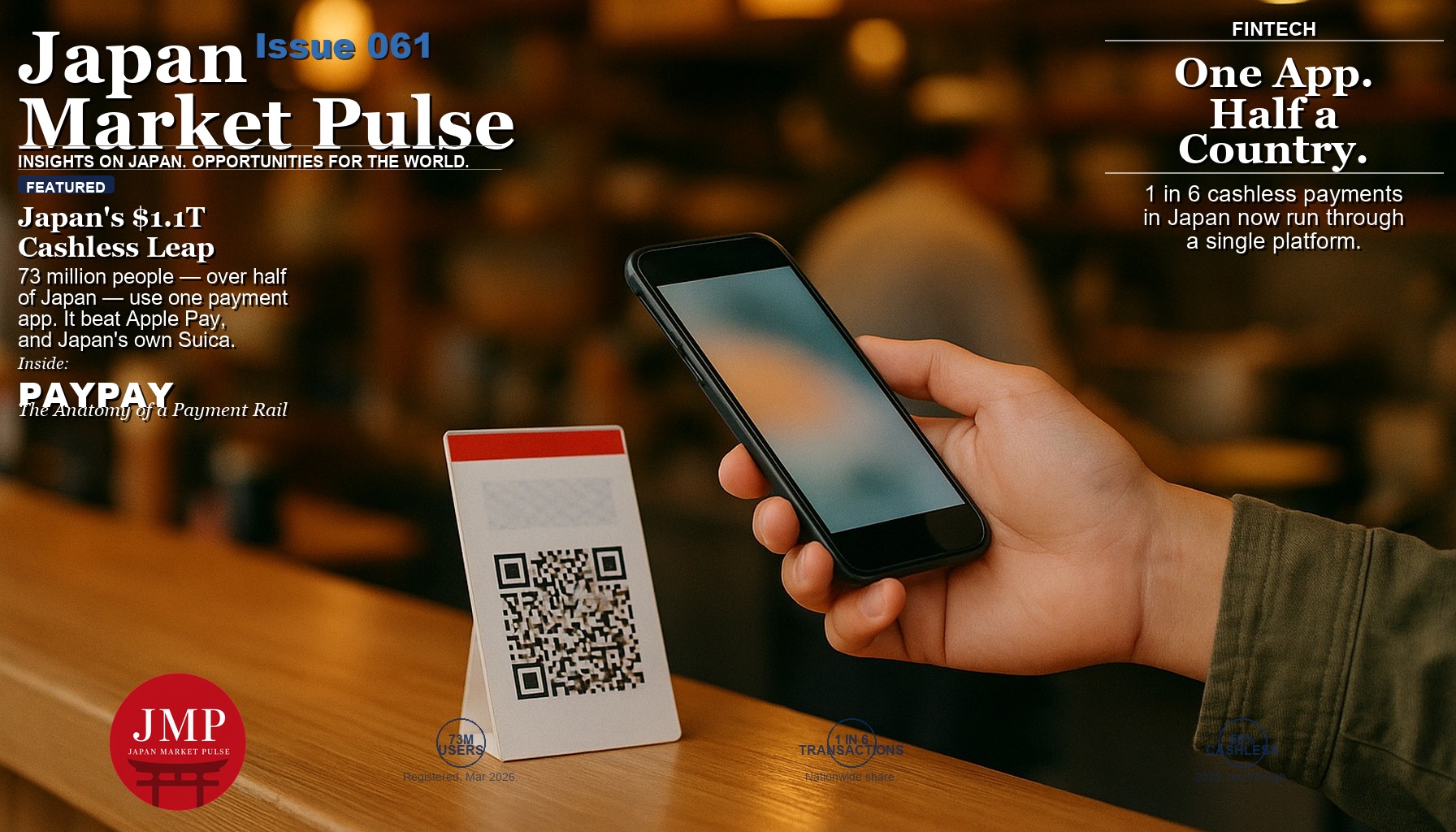
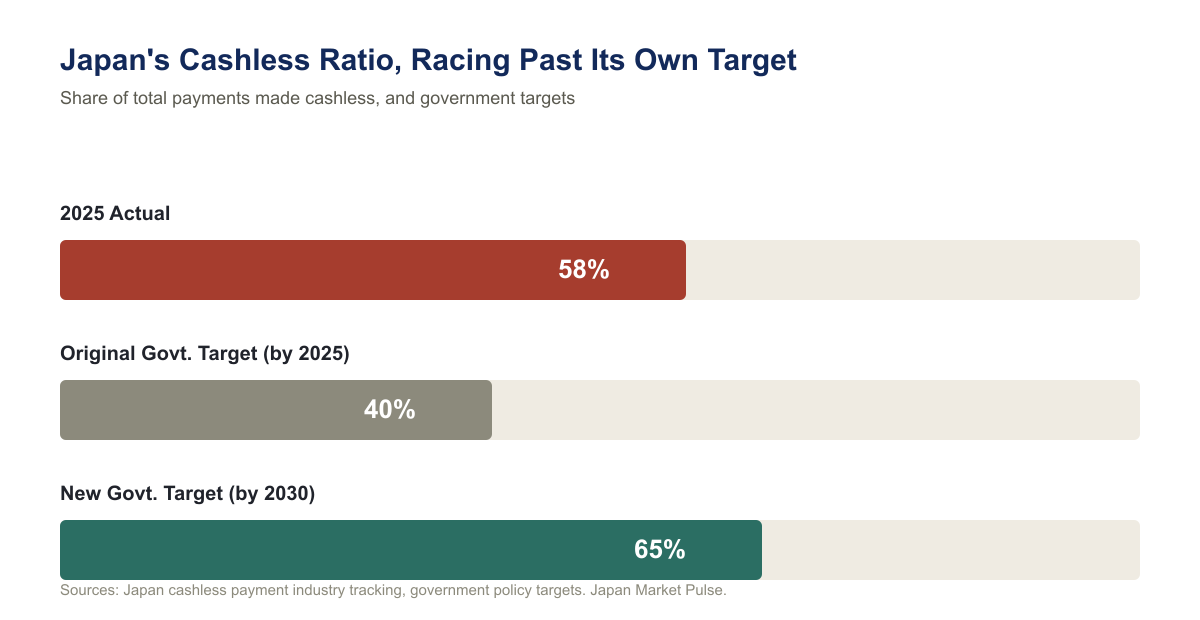
Seventy-three million people in Japan — more than half the country’s entire population of roughly 124 million — are registered users of a single mobile payment app called PayPay. Forty million of those users have completed full identity verification, linking the app to roughly 1,000 different financial institutions. One in every six cashless transactions in Japan now runs through PayPay specifically. Nationally, Japan’s overall cashless payment ratio hit a record 58% in 2025, worth approximately ¥162.7 trillion (around $1.1 trillion) in transaction value, blowing past the government’s own target of 40% cashless adoption by 2025 and setting a new goal of 65% by 2030.
For anyone building or studying payments outside Japan, the part worth sitting with isn’t the raw adoption number. It’s that Japan got there through a single dominant app built on a payment rail — QR codes — that the U.S. and most of Europe treated as a stopgap, not a destination. America’s cashless landscape is a patchwork: Apple Pay and Google Pay for card-linked tap payments, Venmo and Cash App for peer-to-peer transfers that mostly don’t work at a cash register, Zelle for bank-to-bank transfers with its own separate rules, and a merchant card-terminal infrastructure that charges small businesses real money just to accept a card at all. None of these fully interoperate. Japan effectively skipped that entire fragmented layer and went straight to something closer to what China built with Alipay and WeChat Pay: one app, one QR code, near-universal acceptance, and merchant onboarding cheap enough for a single-owner noodle shop to adopt on day one.
Why QR Codes Won When Cards Didn’t
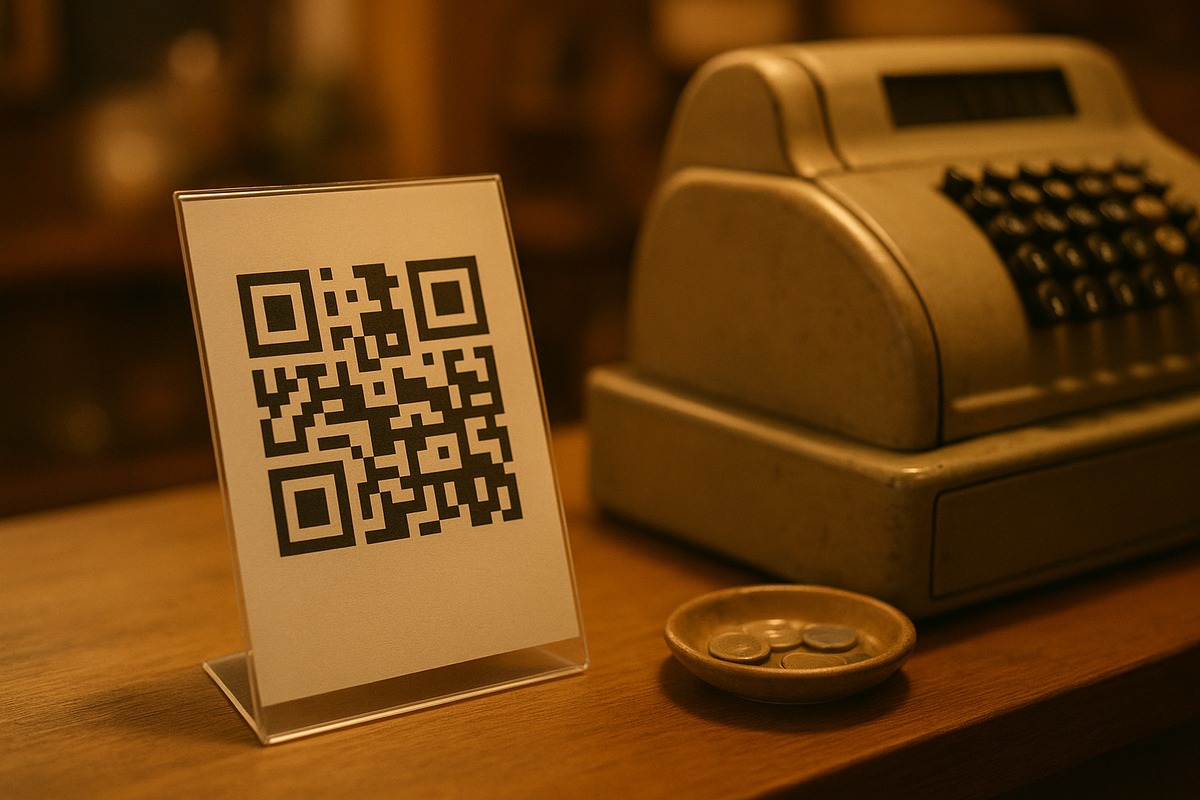
The mechanical reason PayPay could scale this fast comes down to what a merchant actually has to buy to accept it. A card payment terminal is a physical device, typically leased or purchased, that comes with per-transaction processing fees a small shop owner has to factor into already-thin margins. A PayPay QR code is, at the simplest level, a printed piece of paper taped to a counter. The customer opens the app, scans the code, and confirms the amount — no hardware purchase, no terminal lease, and historically, aggressively low or waived merchant fees during PayPay’s growth-phase land grab, subsidized by its parent companies to buy market share fast.
That cost structure is the entire story of why cashless adoption in Japan looks so different from cashless adoption in the West. American cashless growth has been card-rail growth — a system already built around merchant fees, chargebacks, and hardware that assumes a business can absorb transaction costs. Japan’s cashless growth has been QR-rail growth, a system that assumes the opposite: that widespread acceptance requires making it nearly free for the smallest possible merchant to say yes. When the onboarding cost approaches zero, adoption stops looking like a technology rollout and starts looking like a light switch.
Leapfrogging Japan’s Own Earlier Cashless Attempt
The strangest part of this story, for anyone who’s followed Japanese payments for more than a decade, is that Japan already had a mature contactless payment system in place before PayPay existed — and PayPay grew past it anyway. Suica and PASMO, the tap-to-pay transit cards that Tokyo commuters have used at train station gates since the early 2000s, functioned essentially the same way Apple Pay does today: tap a card or phone against a reader, no QR code, no app required. It was fast, reliable, and had a decade-plus head start.
But Suica-style e-money never fully broke out of transit and convenience-store use into the broader merchant economy, for a reason that echoes the card-terminal problem: accepting Suica requires a reader device, a piece of hardware a small independent restaurant or market stall owner has to buy and maintain. PayPay’s QR code needed nothing but a phone the merchant probably already owned and a piece of paper. When two payment technologies compete and one requires a hardware purchase while the other requires printing a sticker, the sticker usually wins the small-merchant market, even if the hardware-based system is technically slicker for the end user. Japan’s cashless story isn’t a simple case of a technologically backward market suddenly catching up. It’s a case of a technologically sophisticated market already having one solution in place, and a second, cheaper-to-deploy solution overtaking it anyway because it solved a different, more important constraint: merchant-side cost.
The Numbers Behind “More Than Half the Country”
PayPay’s 73 million registered users as of March 2026 aren’t just a large user base in isolation — they represent a majority of Japan’s entire population choosing to register for one specific app, in a country not exactly known for rapid, uniform consumer technology adoption across every age group. Forty million of those users have gone through full identity verification, a meaningfully higher bar than simple app download, and the app now connects to roughly 1,000 separate banks and financial institutions for direct funding and transfers.
The transaction-share number is arguably the more telling metric: more than one in six cashless payments made anywhere in Japan — across every card network, every e-money system, every competing QR app — now runs through PayPay specifically. That’s not market leadership in a niche category. That’s a single private company sitting on top of a meaningful share of an entire national payment system, a position no single consumer payment app in the U.S. or most of Europe currently holds.
Zoomed out to the national level, Japan’s cashless ratio hit 58% in 2025, translating to roughly ¥162.7 trillion in transaction value — a record high. That clears the government’s own 40%-by-2025 target with room to spare, and the government has since reset its ambition to 65% cashless by 2030, treating the original target as achieved ahead of schedule rather than something to declare victory on and move past.
Government Policy Set the Table, PayPay Cleared It

None of this happened in a policy vacuum. Japan’s government has run an explicit, numbered cashless-adoption target since before PayPay’s most aggressive growth phase — the original 40%-by-2025 goal wasn’t a vague aspiration, it was a specific figure tied to national competitiveness and, more practically, to the operational cost of cash itself. Handling physical currency is expensive at a national scale: armored transport, ATM maintenance, teller labor, theft and counterfeiting risk, and the simple friction of a shrinking working-age population having to physically service cash infrastructure for millions of aging, rural, and small-business cash users. A government actively subsidizing point-of-sale terminal costs and running public cashless-adoption campaigns creates exactly the kind of policy tailwind a QR platform needs to convert already-favorable unit economics into rapid market capture.
That combination — a state actively pushing merchants toward cashless acceptance, and a private platform offering the cheapest possible way to comply — is a big part of why Japan’s transition compressed into roughly a decade what took some Western markets considerably longer to approach more incrementally, one card network and one point-of-sale vendor contract at a time.
What Happens When One App Becomes Infrastructure
Once a payment app crosses the threshold from “popular” to “the way this country pays,” it stops behaving like a consumer product and starts behaving like infrastructure — and infrastructure invites a different set of expectations and risks than an app competing for downloads. A PayPay outage is no longer a bad app-store review cycle; it’s a real disruption to how a meaningful share of daily commerce in Japan actually functions, from vending machines to izakaya bar tabs to utility bill payments. Concentration risk that would be a minor talking point for a niche fintech becomes a systemic question when the platform is processing one in six cashless transactions nationwide.
There’s also a competitive dynamic worth watching: once a QR payment app achieves this kind of density, it becomes extraordinarily difficult for a rival to unseat, not because of superior technology but because of the two-sided network effect payment platforms run on. A consumer wants the app every merchant already accepts; a merchant wants the app every consumer already has installed. Once one player wins that loop decisively — as PayPay effectively has — a challenger needs either a structural advantage (deeper bank integration, government backing, a genuinely cheaper rail) or an enormous subsidy war to dislodge it. Japan’s card networks, e-money operators (Suica, PASMO), and rival QR apps are all now competing against an incumbent that has already crossed the adoption threshold where switching costs work in its favor rather than against it.
What International Operators Should Take From This
The lesson for payment companies, banks, and platform operators outside Japan isn’t “build a QR app.” It’s narrower: fragmented cashless ecosystems — the American pattern of five different apps covering five different use cases, none of which talk to each other — aren’t an inevitable stage of payment modernization. They’re a specific outcome of building cashless adoption on top of expensive card-rail infrastructure that assumes merchants can absorb hardware and processing costs. Markets that instead build cashless adoption around the cheapest possible merchant onboarding path — QR codes, in Japan’s and China’s case — tend to consolidate around one or two dominant platforms far faster, because the two-sided network effect compounds instead of fragmenting across incompatible systems.
For any market outside Japan still in the early stages of cashless transition — parts of Southeast Asia, Latin America, and Africa are the most obvious current examples — the operative question isn’t which payment technology is objectively superior. It’s which one gets a small merchant to say yes with zero friction and near-zero cost, because that decision, repeated at scale, is what determines whether a market ends up with fragmented cashless adoption or a single dominant rail carrying most of the country’s daily commerce.
Frequently Asked Questions
Q. How many people in Japan actually use PayPay?
A. As of March 2026, PayPay has roughly 73 million registered users, more than half of Japan’s population, with 40 million having completed full identity verification.
Q. What share of Japan’s cashless payments go through PayPay specifically?
A. More than one in six cashless transactions nationwide, across all payment methods, now run through PayPay.
Q. Why did QR code payments succeed in Japan when card payments didn’t dominate first?
A. QR-based payment acceptance requires almost no merchant investment — no hardware terminal, minimal or waived fees during the platform’s growth phase — making it far easier for small, independent merchants to adopt than traditional card infrastructure.
Q. Is Japan’s cashless adoption unusual globally?
A. Japan’s overall cashless ratio reached 58% in 2025, and while that trails some card-dominant markets, the concentration of transaction share in a single QR app is unusual outside of China’s Alipay/WeChat Pay duopoly.
If you’re interested in this topic, the Japanese market more broadly, or what KETCHUPs is working on, we’d love to hear from you — please reach out via our contact form.
Japan Market Pulse is a weekly read on what the Japanese consumer-tech, food, and mobility markets are choosing to do, written for international operators who want to know what is happening before it shows up in the global trade press.
Subscribe at ketchups.co/japan-market-pulse.