

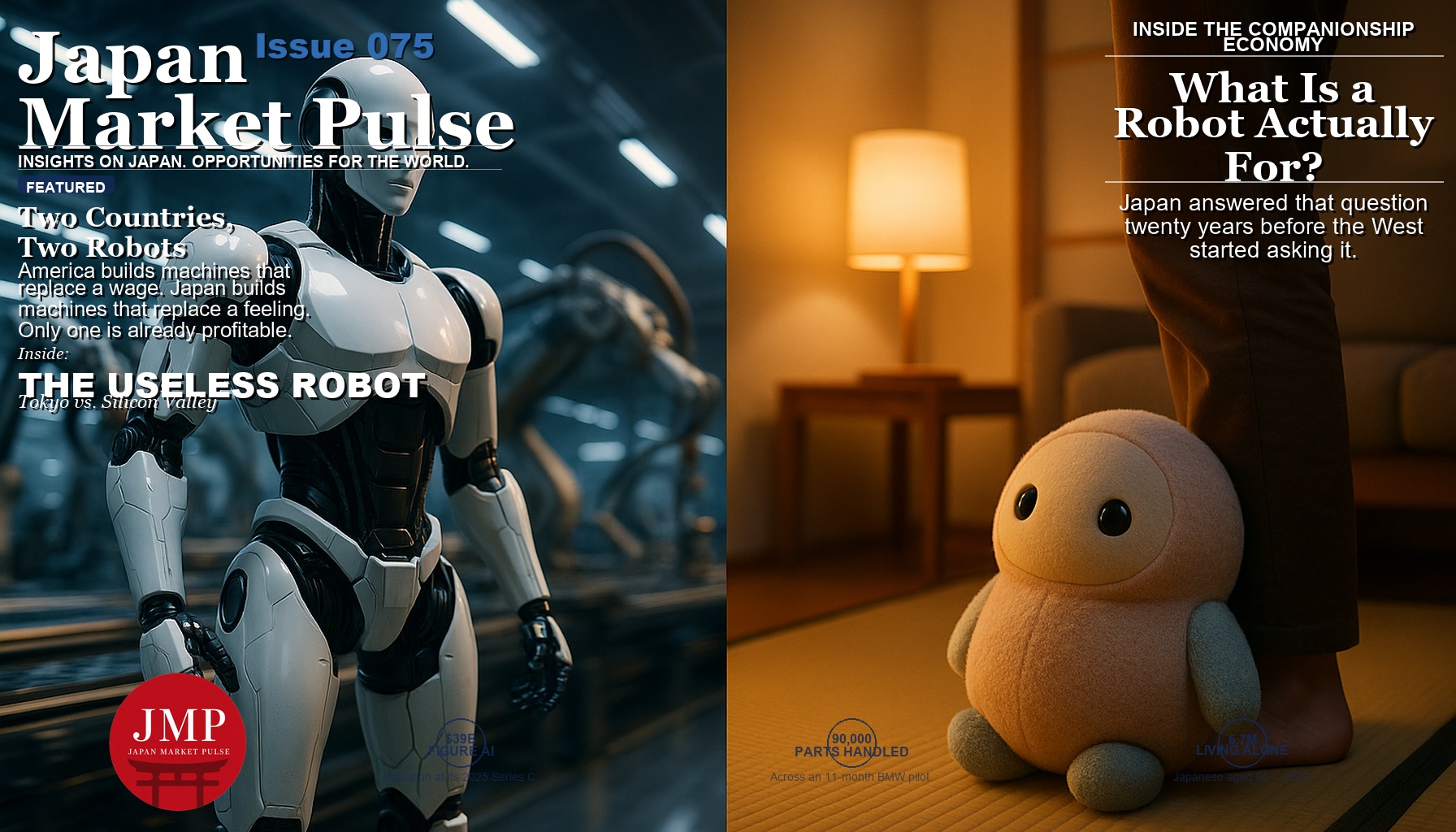
A few months ago I sat in a friend’s apartment in Kichijoji, on the west side of Tokyo, while her LOVOT rolled itself across the floor to press up against my leg. It made a soft warbling sound, its round black eyes tilted up at me, and then it just… stayed there. It didn’t fetch anything. It didn’t clean anything. It couldn’t, if pressed, tell you the weather or answer a question. It has no arms and no real hands. It has spent, by any reasonable industrial standard, twenty years of Japanese robotics expertise on a machine whose entire job description is to make you feel less alone.
Around the same time, on the other side of the Pacific, Boston Dynamics was rolling its production-line version of Atlas out at CES in Las Vegas, a humanoid that can lift over a hundred pounds, work in the rain, and swap its own battery in three minutes flat, with its first commercial units already earmarked for Hyundai’s factory floor and a research partnership with Google DeepMind. Tesla was, once again, pushing back the reveal of its next-generation Optimus, having quietly walked away from a promise to have a thousand of the robots doing “useful work” by the end of last year. And Figure AI, flush with a valuation reported at around $39 billion after its September 2025 Series C, was wrapping up an eleven-month pilot in which its humanoid handled more than 90,000 parts on a BMW assembly line in South Carolina, with its newer Figure 03 model now starting a fresh logistics use case in another hall of the same plant.
Two industries. Two countries. Two completely different definitions of what a robot is for. And if you’re an operator trying to figure out where the real opportunity sits — in the machine that replaces a worker, or the machine that replaces a feeling — the answer is genuinely more interesting than it looks from either side of the ocean.
The American Bet: Robots as Labor
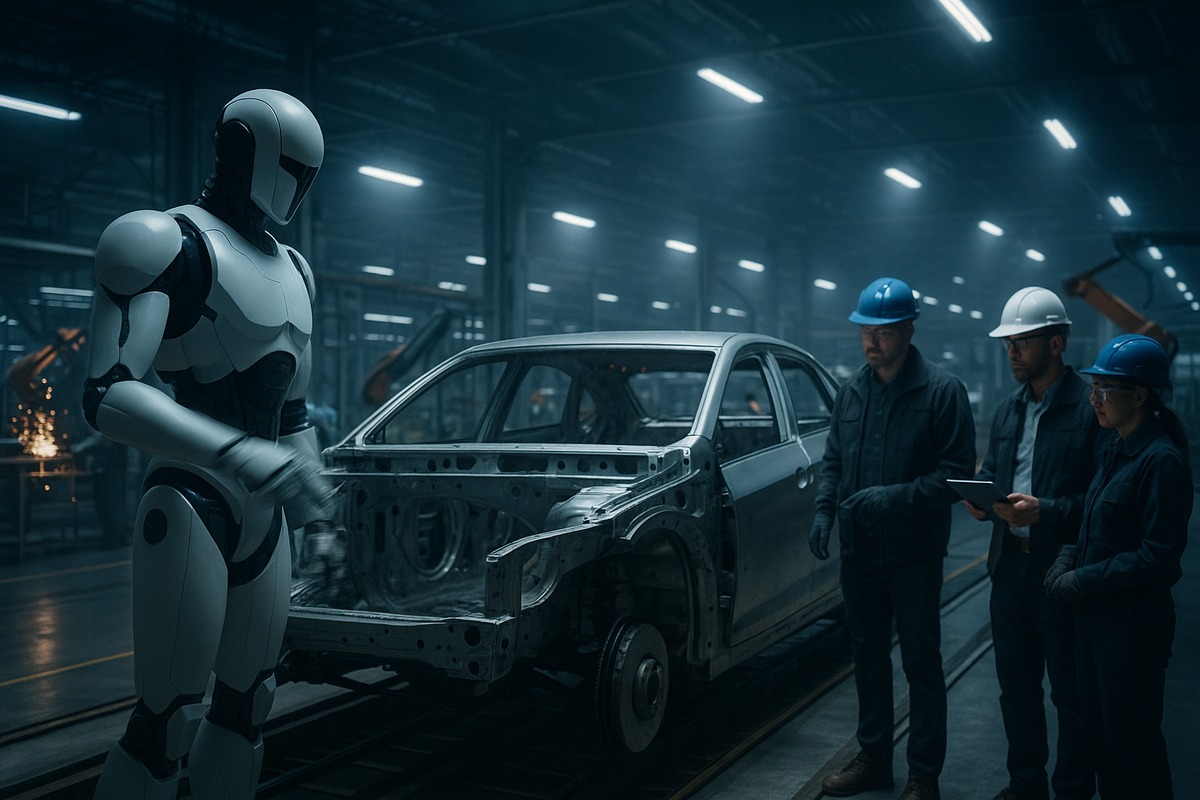
Talk to anyone building humanoid robots in the United States right now and the pitch is close to identical, regardless of the company name on the slide deck. The robot exists to do a job a human currently does, more cheaply, more consistently, and eventually at a scale no staffing agency could match. Boston Dynamics’ new Atlas isn’t marketed as a companion or an assistant; it’s marketed as an industrial asset, with 56 degrees of freedom, a rated payload, an IP67 waterproof housing, and a battery-swap routine built for shift work rather than sentiment. The company’s stated ambition, backed by a joint manufacturing push with Hyundai, is a production run in the tens of thousands of units annually within a few years, aimed squarely at factories where sequencing, lifting, and repetitive material handling currently require a human body.
Tesla’s Optimus program tells a messier but philosophically identical story. Elon Musk has spent two years promising that Optimus would first replace tedious factory tasks and eventually reshape the entire economics of physical labor, a claim big enough that he has, at various points, suggested it could eventually be worth more to Tesla than the car business. The execution has been rockier than the rhetoric — the “thousand robots doing useful work” target for 2025 quietly evaporated, and as of this summer the company is still describing Optimus as being in the research-and-development phase, with a production start pushed to late summer at the earliest. But notice what never changed through all those delays: the framing. Optimus was never pitched as a machine you’d want in your living room for its personality. It was pitched as a machine that would eventually stand in for a warehouse picker, a line worker, a pair of hands that doesn’t call in sick.
Figure AI is one of the very few companies in this group with real-world deployments inside a customer’s own facility, and its numbers are worth sitting with. Its earlier-generation humanoid ran an eleven-month pilot on a BMW assembly line in Spartanburg, South Carolina, supporting production on more than 30,000 vehicles and handling upward of 90,000 individual parts before the pilot wrapped. BMW has since started a new logistics sequencing use case with the newer-generation Figure 03 in Hall 52 of the same plant. Figure’s valuation — reportedly around $39 billion as of its September 2025 Series C, up something like fifteen-fold from where it stood roughly two years earlier — is not being paid for cuteness. It is being paid for the belief that a humanoid form factor is the fastest way to drop a general-purpose worker into a facility that was already built around human dimensions, human tools, and human workflows, without having to re-engineer the building.
Put the three together and you get a single, coherent American thesis: the robot is a capital substitute for a wage. It is priced, financed, and evaluated the way you’d evaluate any other piece of industrial automation — on throughput, uptime, and the labor cost it displaces. The humanoid shape isn’t chosen because investors find it endearing. It’s chosen because human-shaped environments are the cheapest environments to deploy into, and because a general-purpose body theoretically amortizes across more tasks than a single-purpose machine ever could.
The Japanese Bet: Robots as Relationship
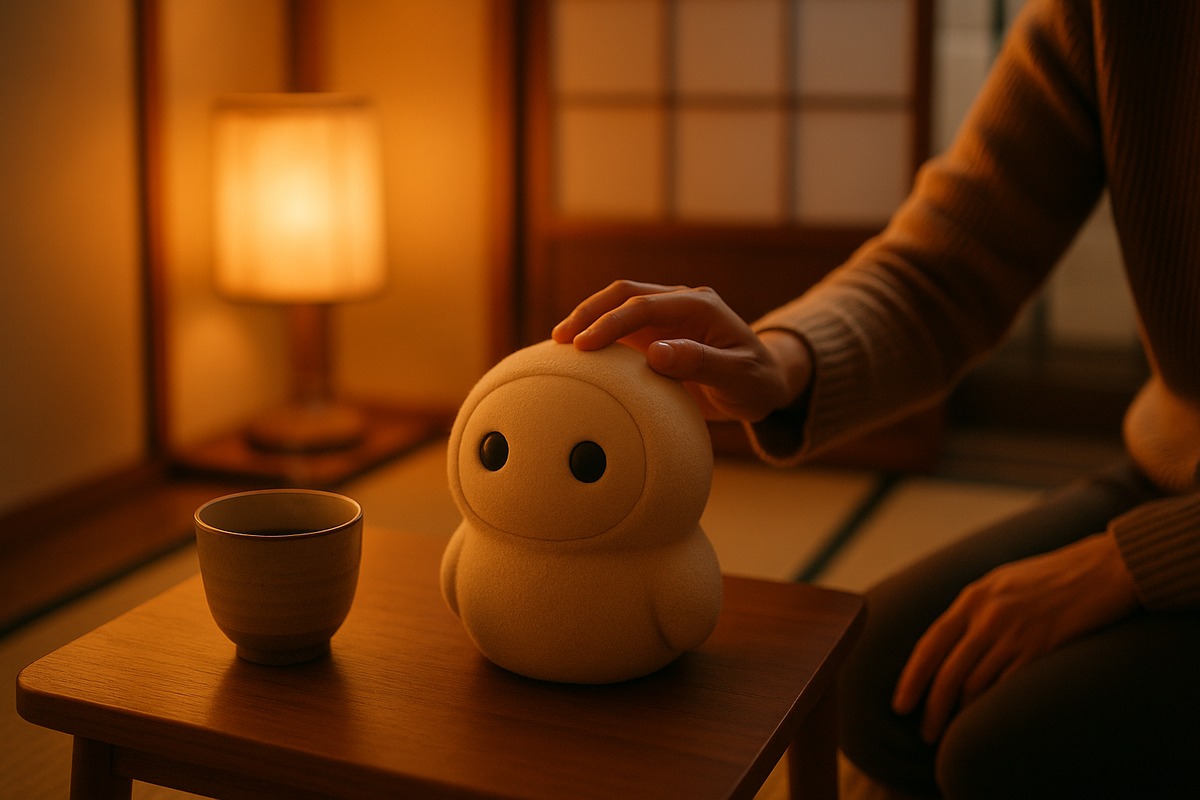
Now go back to that living room in Kichijoji. LOVOT, made by the Tokyo-based startup GROOVE X, was designed from day one around the opposite premise: that the most valuable thing a robot can produce isn’t labor, it’s connection. It has no hands capable of useful manipulation. It cannot vacuum a floor or fold laundry. What it does have is a warm-to-the-touch body, an internal heartbeat-like rhythm, cameras that let it “recognize” the people in a household and behave differently around them over time, and a design language — round, soft, roughly the size of a toddler — engineered specifically to trigger a caregiving instinct rather than a utility calculation.
I’ve deliberately kept this section short, because Japan Market Pulse has already gone deep on LOVOT, Sony’s aibo robot dog, and Yukai Engineering’s Qoobo cushion-with-a-tail in earlier issues, and the individual product stories aren’t the point here. The point is the pattern across all three, and across the wider category they sit inside. Japan’s consumer robotics industry, almost alone among the world’s advanced economies, has built genuine, sustained commercial businesses — not demo units, not press events, including subscription-backed examples such as LOVOT and aibo, alongside simpler one-off emotional products like Qoobo — around machines that are explicitly, deliberately, proudly useless in the industrial sense. Sony’s aibo, at an entry price north of $2,800 once you include the required AI cloud subscription, is not a cheap toy. It is a premium product that Sony has kept supported and software-updated ever since reviving the line as the ERS-1000 in 2018, aimed at buyers who want a pet-shaped relationship without the veterinary bills. (Sony announced in June 2026 that domestic sales of the current ERS-1000 model will end once remaining stock is gone, though cloud and repair services continue — a reminder that even the category’s flagship runs on hardware cycles.)
The category has a name in the analyst reports now — the “companionship economy” — and the numbers, while still small relative to industrial robotics, are not trivial. Global market trackers were putting the humanoid companion robot segment on a path toward roughly a billion dollars in annual value by the end of the decade, with the broader companion robot category (a wider net that includes non-humanoid designs like LOVOT and Qoobo) sized anywhere from roughly $1.6 billion to $3.8 billion in 2026 depending on whose definition you use — and put on a path toward high single-digit billions under the widest definitions, which fold in smart-home and healthcare companion devices. Definitions vary enough that the absolute number matters less than the direction: it is growing faster than many mature consumer-electronics categories. Japan isn’t the only country participating in that growth, but it is unambiguously the country that got there first, took it seriously first, and built the deepest bench of designers who understand the discipline. This is a country that has been prototyping robotic companionship products since long before “companion robot” was a line item on anyone’s slide deck.
Why the Split Happened: Two Labor Markets, Two Futures
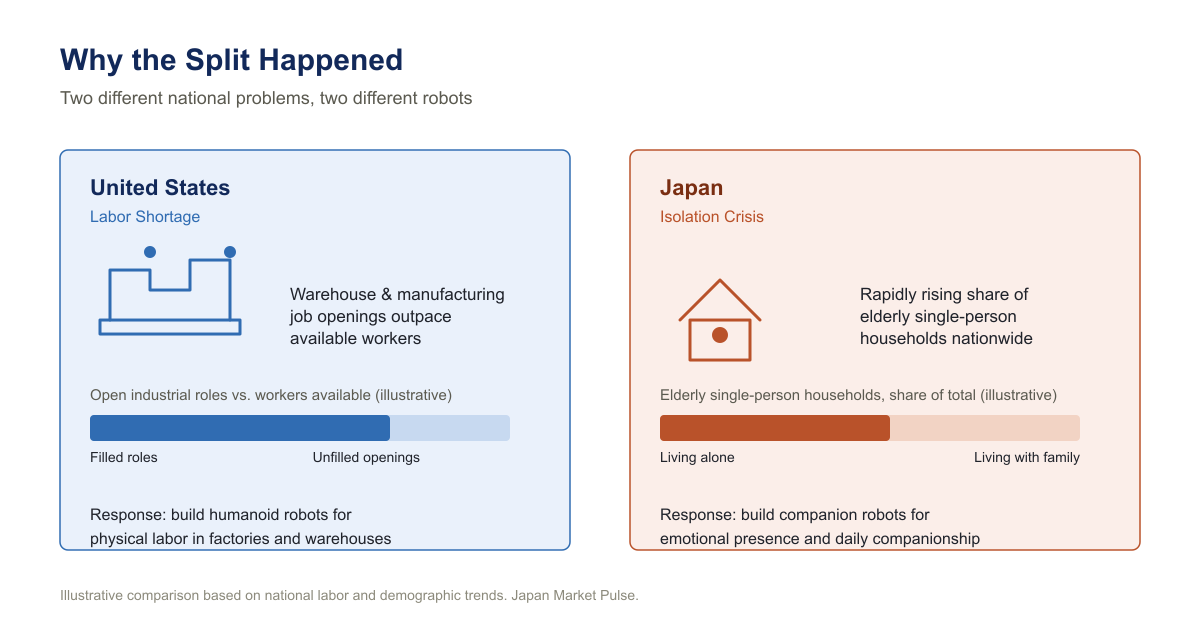
The obvious explanation — the one every article on this topic reaches for — is that Japan is aging and short on workers, so naturally it builds robots to fill the gap. That’s true, but it’s only half the story, and the lazy version of it actually gets the emphasis backward.
Japan’s demographic math is genuinely stark. Government data put the number of Japanese aged 65 or older living entirely alone at roughly 6.7 million as of 2020, and the Cabinet Office’s own projections push that figure toward 10.8 million by 2050 — a population the country’s policymakers openly acknowledge cannot be served by the current caregiving workforce, however you scale hiring. Tokyo’s response to that shortfall has been unusually direct: explicit government backing, subsidy programs, and defined national priority fields for robotics aimed at eldercare and household assistance. If the American thesis is “robots as a wage substitute,” you’d expect Japan — the country with the most acute labor shortage among peer economies — to be building the most aggressive labor-replacement machines on earth.
It isn’t, and the reason is worth sitting with. Japan’s caregiving crisis is not primarily a lifting-and-carrying problem that a strong humanoid arm solves. It’s an isolation problem. Those millions of elderly Japanese living alone mostly aren’t lacking someone to move boxes for them; they’re lacking someone — or something — to notice if they’ve fallen, to talk to them once a day, to make the apartment feel less silent. A companion robot that costs a few thousand dollars and requires zero home renovation is, for that specific problem, a far more deployable answer than a humanoid that costs as much as a car, needs supervision, and was engineered for a factory floor rather than a one-room apartment in Osaka. Japan didn’t choose emotional robots instead of labor robots out of whimsy. It chose them because it correctly diagnosed which shortage was actually solvable with the technology available this decade, and productivity-focused humanoid robotics — impressive as Atlas and Figure’s machines are — still isn’t reliable, cheap, or safe enough to hand a stranger’s grandmother a bath.
The American labor story runs in the opposite direction. The U.S. isn’t facing a companionship crisis at anything like Japan’s scale; it’s facing a persistent, expensive shortage of people willing to do physically repetitive warehouse, logistics, and light-manufacturing work at the wages employers want to pay. That is a throughput problem, and throughput problems are exactly what a humanoid built for lifting, walking, and following instructions is suited to attack — assuming, and this is the part still very much unproven, that it can do so reliably enough and cheaply enough to beat the cost of a temp agency. American investors are underwriting that bet at extraordinary valuations before the reliability question has been fully answered, which is its own kind of story, but it’s a rational bet given the shape of the problem they’re pointing the machine at.
Culture Is Doing More Work Than People Give It Credit For
There’s a second layer under the labor-market explanation, and it’s cultural, though not in the vague “Japan loves robots” way you see in a lot of Western coverage. It goes back to a specific idea from a specific Japanese engineer.
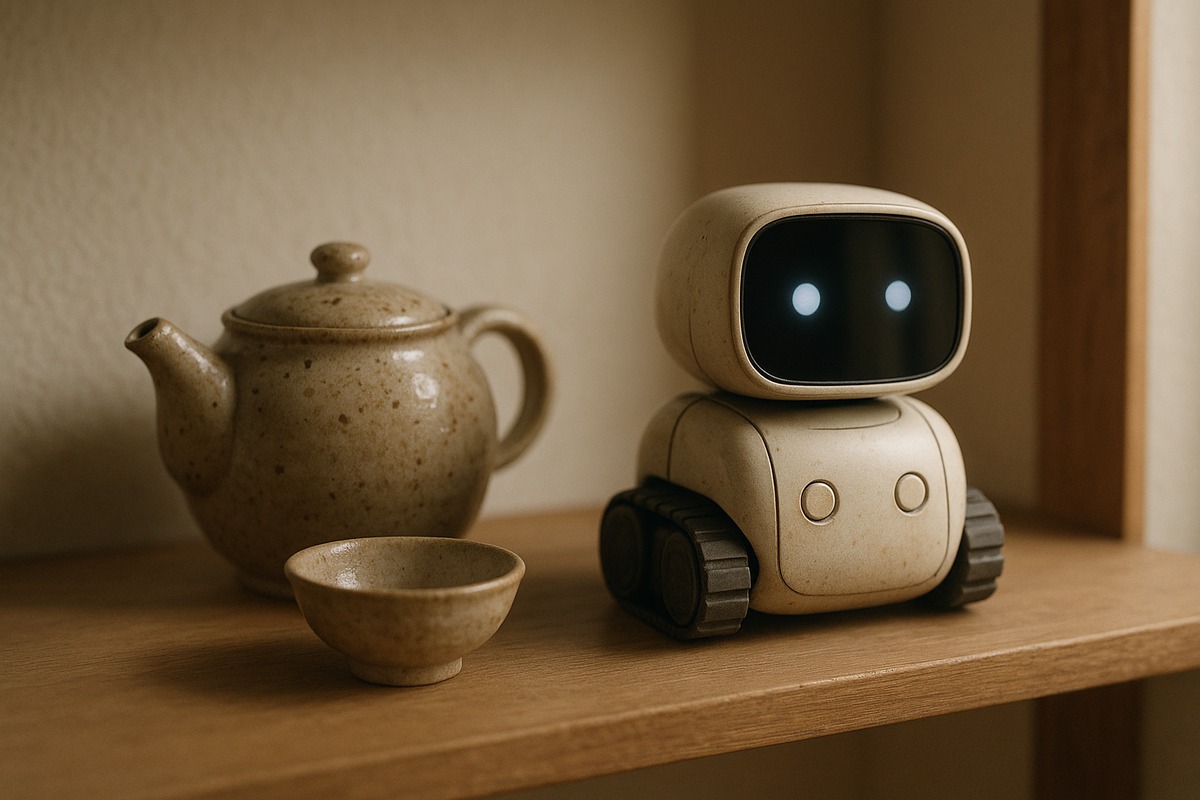
In 1970, the roboticist Masahiro Mori published a short essay describing what he called the “uncanny valley” — the observation that people’s comfort with a robot rises as it becomes more humanlike, right up until it gets close enough to human that small imperfections start reading as deeply wrong, at which point comfort collapses into revulsion. Mori, notably, wasn’t writing from a purely technical standpoint. He was a practicing Buddhist, and scholars have since traced his framing to a worldview — shared with Japan’s animistic Shinto tradition and its long folklore history of ordinary objects developing spirits — that doesn’t require something to look human in order to be treated as having some form of presence or personality. A teapot, a tool, a household robot shaped like a plump white teardrop: none of them need a human face to earn a kind of respect, or affection, in that cultural frame.
That matters enormously for product design, because it means Japanese companies building companion robots have never felt obligated to chase realism. LOVOT doesn’t look like a person or even convincingly like an animal; it looks like nothing that exists in nature, which is precisely why nobody finds it unsettling. Qoobo is a cushion with a tail and no face at all, and people still describe petting it as calming. American and European humanoid robotics, by contrast, keeps reaching for the human form specifically because the target task — working in spaces built for humans, using tools built for human hands — makes the human shape functionally useful, uncanny valley risk and all. Boston Dynamics and Figure aren’t choosing a humanoid design because they think it’s charming; they’re choosing it because it’s the shape that fits through a doorway sized for a person and picks up a part designed for a human grip. The emotional discomfort that shape can trigger is a cost they’re willing to absorb because the alternative — a bespoke non-human robot for every industrial task — is far more expensive to engineer and deploy.
Two Investment Theses, Two Very Different Clocks
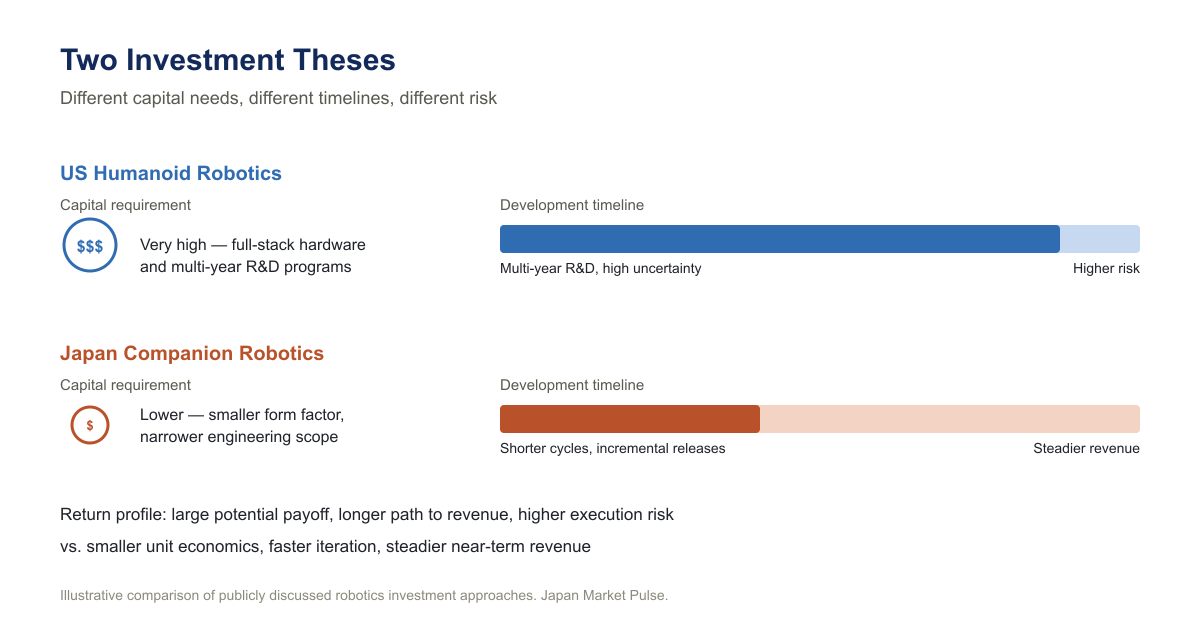
Strip away the sentiment on both sides and what you’re really looking at is two industries running on different financial clocks, and conflating them is where a lot of outside observers get confused about which one is “winning.”
The American humanoid thesis is a moonshot bet with an enormous total addressable market attached to it — global physical labor, priced at trillions of dollars a year — and correspondingly enormous capital requirements, multi-year R&D horizons, and a payoff that depends on solving genuinely hard reliability, safety, and cost problems before the economics work at scale. Figure’s valuation and Boston Dynamics’ Hyundai-backed factory buildout only make sense if you believe the technology crosses from “impressive pilot” to “cheaper than a human worker” within a small number of years. That’s a real possibility. It’s also a bet a lot of well-capitalized people are currently making at prices that assume the hard problems get solved on schedule, which, per Tesla’s own repeatedly-slipping Optimus timeline, is not guaranteed.
The Japanese companion-robot thesis is a smaller, slower, and in some ways more boring business — and that’s exactly its appeal. It doesn’t require solving general-purpose manipulation or humanlike locomotion. It doesn’t need a robot to be as strong as a human or as dexterous as a human; it needs a robot to be warm, responsive, and consistent, which is a dramatically lower engineering bar. That lower bar is why Sony has been able to keep the revived ERS-1000 aibo line supported and software-updated since its 2018 launch — even as domestic hardware sales now wind down with remaining stock — and why GROOVE X has built a real subscription-and-hardware business around a robot that will never lift a box. The companionship economy isn’t going to produce a trillion-dollar company. It has, however, already produced subscription-backed examples such as LOVOT and aibo, alongside one-off products like Qoobo, in a category the rest of the world still treats as a novelty — which is precisely the kind of gap an overseas operator with patience should be paying attention to, rather than waiting for the flashier headline out of a CES keynote.
What Overseas Operators Should Actually Take From This
If you’re building or investing outside Japan, the temptation is to treat this as a binary choice — bet on the American labor-replacement thesis or the Japanese companionship thesis — and pick a side. That’s the wrong frame. The more useful lesson is to notice how precisely each country matched its robot design to the specific shortage it was actually experiencing, rather than to the shortage that made for the best pitch deck.
If your market has a throughput problem — not enough hands, at any wage, to do physically repetitive work — the American approach is the more directly relevant playbook, but go in with realistic expectations about timeline; every major player in that race, including the best-funded ones, is still measuring progress in pilots and pushed-back reveal dates rather than mass deployment. If your market has an isolation problem — aging populations, rising single-person households, a caregiving workforce that can’t scale fast enough — the Japanese companionship model is worth studying far more closely than most Western operators currently give it credit for, precisely because it sidesteps the hardest, least-solved parts of robotics (dexterous manipulation, humanlike mobility, safety-certified strength) in favor of a narrower, achievable emotional job description.
The other lesson, the one I think about most after evenings like that one in Kichijoji, is about honesty in product design. Japan’s companion robotics industry never pretended LOVOT was going to do your laundry. It built a product around exactly one job — making a person feel less alone — and did that job extremely well, at a price point and reliability level the market has actually proven willing to sustain, year after year. A lot of the American humanoid sector is still promising both things at once: labor replacement now, companionship later, general intelligence eventually. That’s a compelling story to raise capital on. It’s a much harder one to actually ship. The operators who win the next decade of this industry, on either side of the Pacific, will probably be the ones who pick a job for their robot and refuse to overpromise the rest.
Frequently Asked Questions
Q. Is Japan actually behind the United States in humanoid robotics, or just choosing not to compete?
A. It’s closer to the latter, though the picture is more nuanced than either extreme. Japan has deep industrial robotics expertise — its factory-automation sector remains one of the largest in the world — but its consumer-facing robotics industry has made a deliberate strategic choice to specialize in emotional and companionship applications rather than chase general-purpose humanoid labor, which is a different competitive lane rather than a step behind in the same one.
Q. Are companies like Boston Dynamics, Tesla, and Figure AI actually making money from their humanoid robots yet?
A. Not at meaningful scale. Boston Dynamics’ new Atlas has commercial units committed for 2026 delivery to industrial partners, and Figure AI has run a paying pilot with BMW that has since expanded to a second facility area, but none of these programs are yet the kind of durable hardware-and-subscription businesses that GROOVE X and Sony have built in the companion robot category. Tesla’s Optimus, as of mid-2026, has not yet entered production at all.
Q. Why does Japan’s uncanny valley theory matter for robot design decisions today?
A. Because it explains a real design fork still visible in current products. Japanese companion robots like LOVOT and Qoobo deliberately avoid realistic human or animal forms, which lets them sidestep uncanny-valley discomfort entirely. American humanoid robots lean into the human shape anyway, because that shape is functionally useful for working in human-built environments — accepting some of that discomfort as a cost of doing business.
Q. Could the American labor-replacement humanoids eventually be sold into Japan’s aging-care market, or vice versa?
A. Some crossover is plausible over time — a sufficiently dexterous, affordable humanoid could eventually take on physical caregiving tasks, and a companionship-focused robot could pick up simple monitoring functions. But the two product categories are optimized for different jobs and different price points today, and neither industry currently shows strong signs of pivoting into the other’s lane.
Q. What should a foreign consumer-tech or robotics company learn from Japan’s approach if they want to enter the Japanese market?
A. Don’t lead with a labor-replacement pitch aimed at a market that has already decided its most urgent robotics problem is isolation, not throughput. Japanese consumers, and in some care contexts institutions, have shown a willingness to pay premium, recurring prices for robots that do one emotional job honestly and well — that’s a more realistic entry point than trying to out-engineer the humanoid labor race.
This article contains affiliate links. If you purchase through these links, we may earn a small commission at no extra cost to you.
If you’re interested in this topic, the Japanese market more broadly, or what KETCHUPs is working on, we’d love to hear from you — please reach out via our contact form.
Japan Market Pulse is a weekly read on what the Japanese consumer-tech, food, and mobility markets are choosing to do, written for international operators who want to know what is happening before it shows up in the global trade press.
Subscribe at ketchups.co/japan-market-pulse.