

Disclosure: This article covers Japanese consumer-mobility products. All products mentioned are Japan-only at this time — no Amazon Associates US affiliate links apply. Concept-driven regulatory analysis.
In July 2023, Japan created an entirely new vehicle category that exists nowhere else on Earth. The tokutei-kogata — a moped class that requires no license, no mandatory helmet (only “encouraged”), a maximum of 20 km/h on roadways and 6 km/h on sidewalks, and an age restriction of 16+. No other country has this. It is not a product innovation. It is a regulatory innovation, and it is shaping an entirely new competitive landscape in Japan’s micromobility space.
Japan Market Pulse — Issue 018 | Consumer Trends
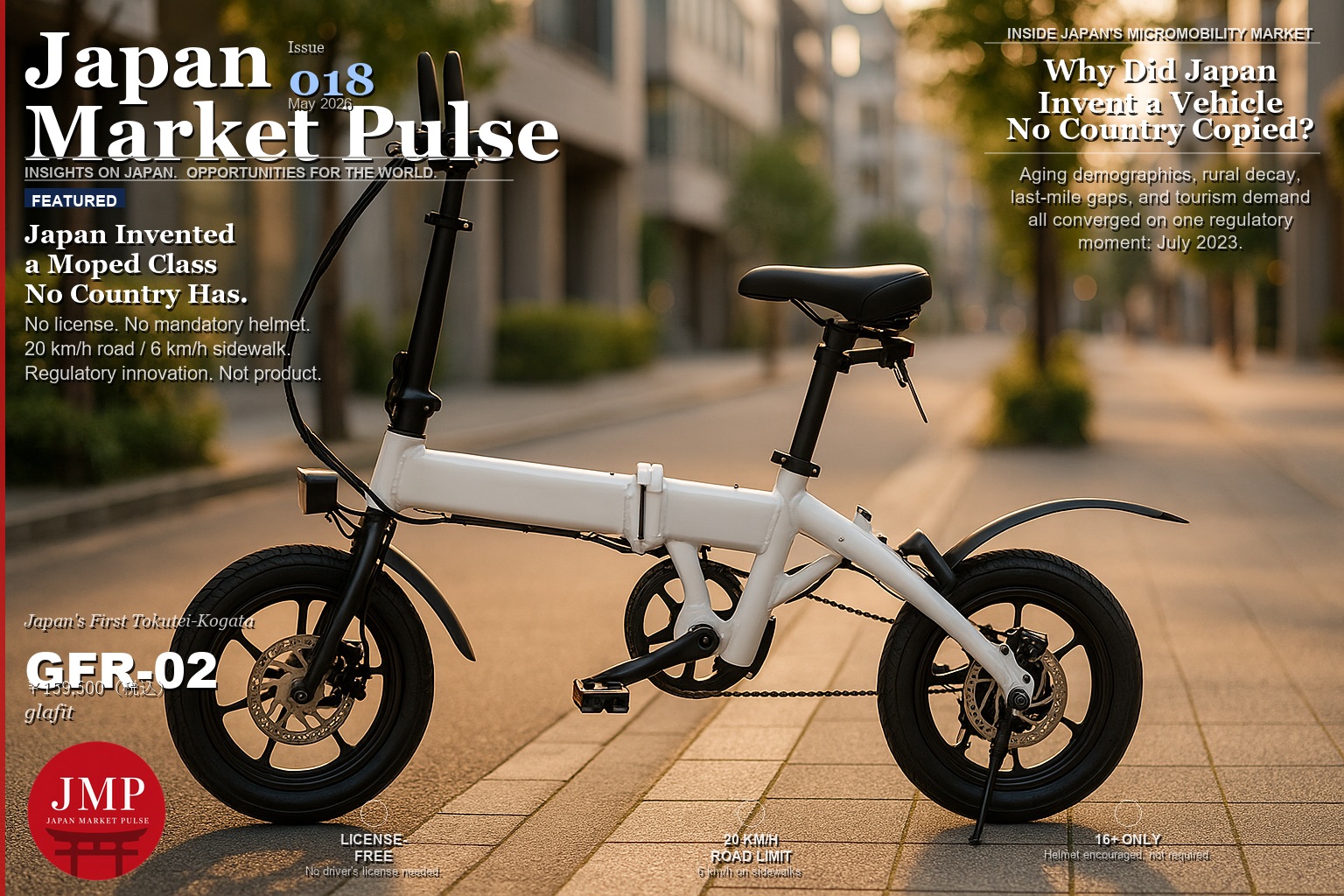
The global narrative around electric micromobility in 2024–2026 has been dominated by failure. Bird, Lime, Vois — the electric scooter and bike-share giants that conquered Western cities in 2018–2020 — have all retreated, cut staff, or restructured. The reasons are well-documented: regulatory uncertainty, oversupply, low usage per unit, and cities unable or unwilling to enforce rules against reckless riding. The lesson the international press took away was straightforward: micromobility does not work in mature cities.
Japan’s answer to this story is a different answer entirely. In July 2023, rather than wait for the market to fail, the country’s Ministry of Economy, Trade and Industry (METI) and Ministry of Land, Infrastructure, Transport and Tourism (MLIT) sat down with manufacturers — Honda, Sony Honda Mobility, Glafit, KINTONE, and others — and invented a legal category from first principles. The result is the tokutei-kogata. And because of that category, Japan’s micromobility market in 2026 is not contracting. It is consolidating, professionalizing, and preparing for export.
Japan did not let micromobility fail. It rewrote the law to make micromobility possible.
What Is Tokutei-Kogata? The Legal Definition
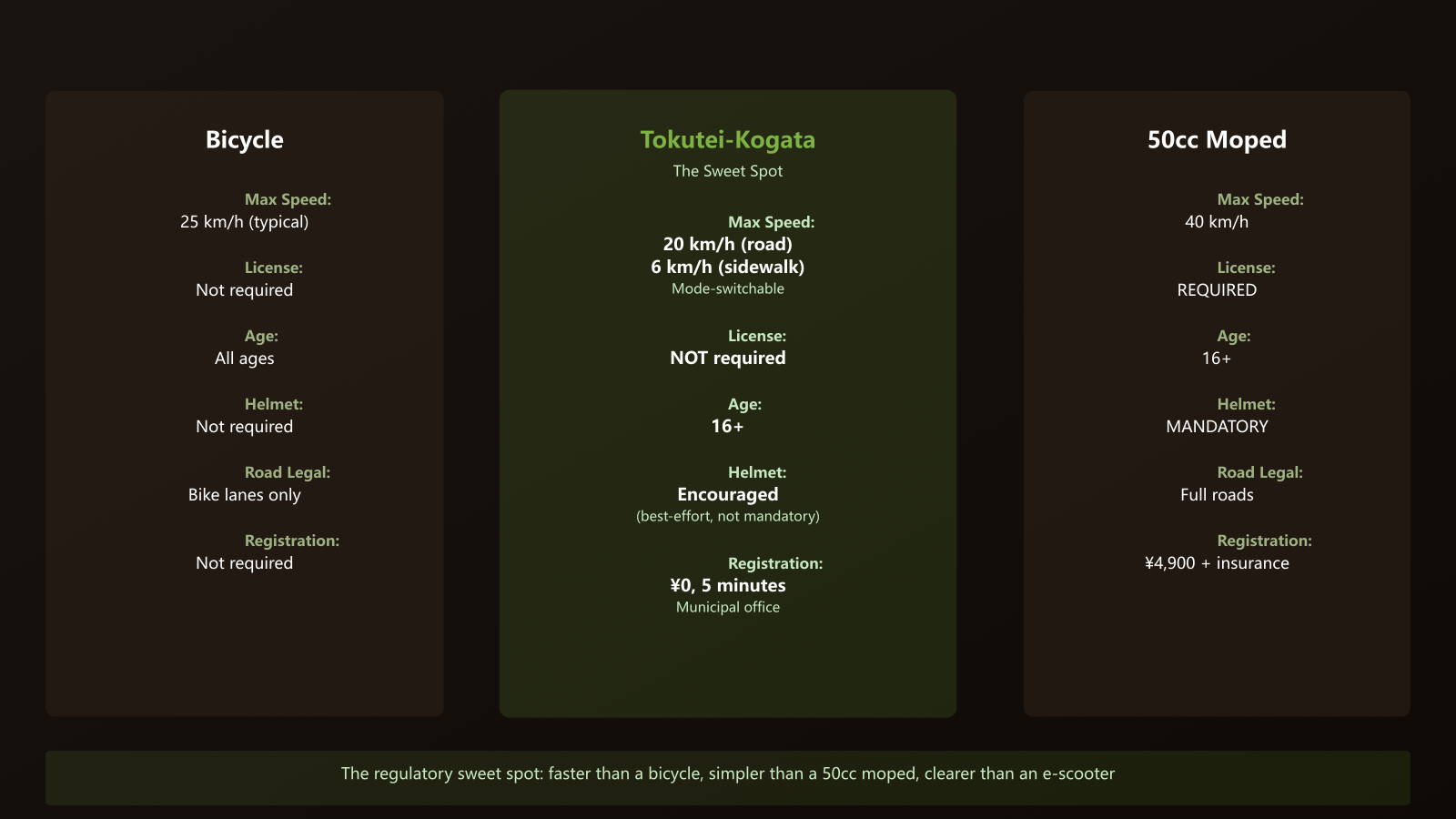 The regulatory sweet spot: faster than a bicycle, simpler than a 50cc moped, clearer than an e-scooter.
A tokutei-kogata vehicle must meet all of the following specifications:
- Maximum speed: 20 km/h on public roads, 6 km/h on sidewalks. The vehicle must have a switchable mode that enforces this electronically or mechanically.
- Age requirement: 16 years old or older.
- Licensing: No driver’s license required. A simple municipal registration (¥0, takes 5 minutes) via the kei-car notification system is the only administrative requirement.
- Helmet: “Encouraged” — not mandatory, but operators and safety advocates recommend it.
- Motor capacity: Limited by the speed and torque characteristics that result in the above speed profile. Typically, this translates to 500–600W motors.
- Platform: Can be wheeled (scooter-form), pedal-assisted (e-bike-form), or hybrid. The form factor is unconstrained; only the performance envelope matters.
This legal class sits between the bicycle (no engine, no license, all-ages) and the moped, engine-required, 50cc max, needs license. It fills a gap that did not previously exist in Japanese law.
The regulatory decision to make helmets “encouraged” rather than mandatory is a deliberate policy choice. By making helmets optional but “encouraged,” Japan’s policy chose inclusivity over optimal safety compliance. This is a defensible choice if one believes that a larger market with somewhat lower individual safety compliance is better than a smaller market with higher compliance.
Why Japan Created This Category: Four Structural Pressures
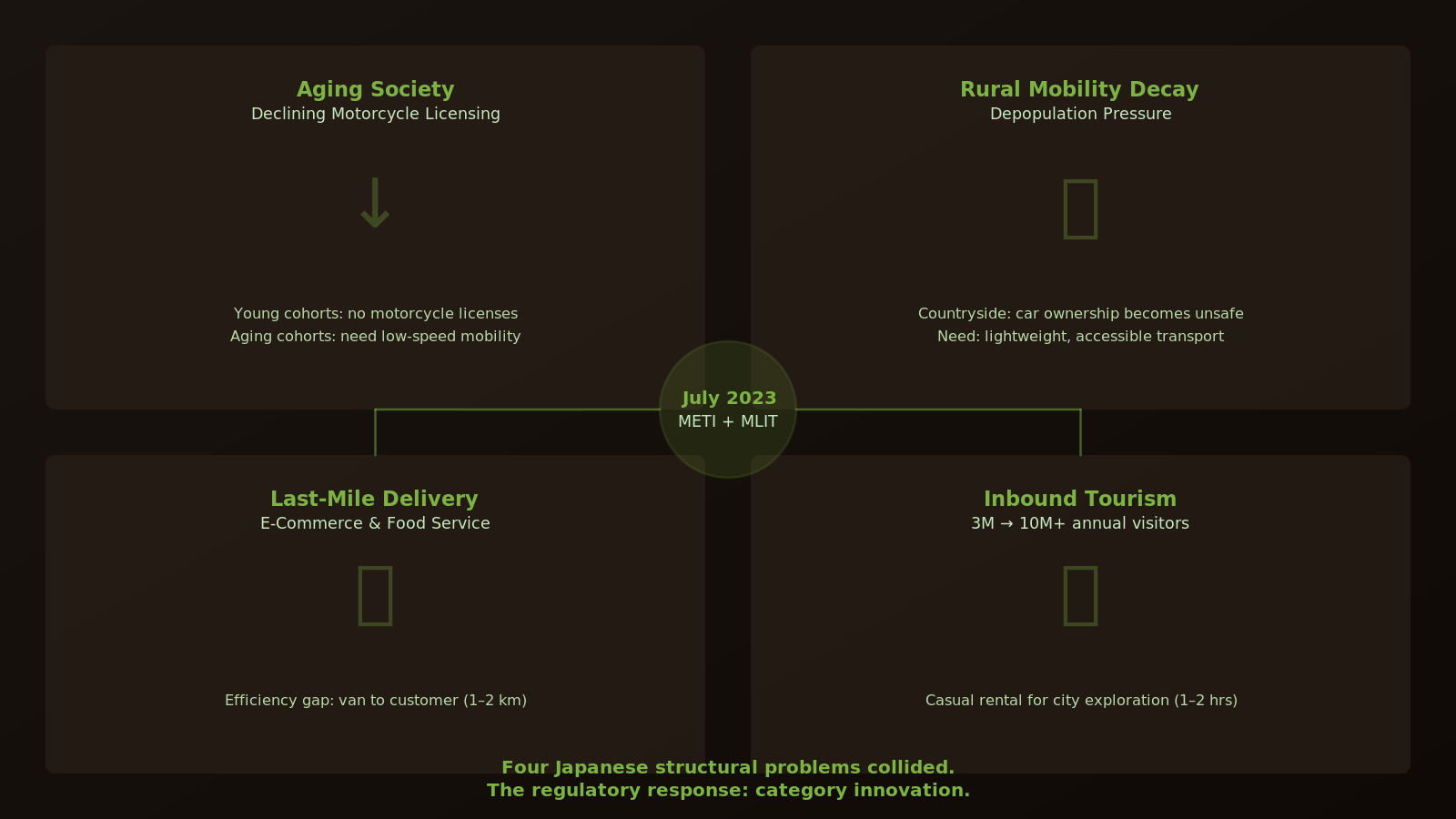 Four Japanese structural problems collided. The regulatory response was category innovation.
The tokutei-kogata category was not invented in a vacuum. It was a response to four structural pressures that Japan faces acutely and most other mature markets face only partially.
Pressure One: Aging society, declining motorcycle licensing. Japan’s population is aging rapidly. Younger cohorts have dramatically lower motorcycle-license ownership than their parents’ generations — not from inability, but from choice. The car-and-smartphone combo makes small-displacement motorcycles redundant for younger users. But this trend creates a mobility gap in aging neighborhoods where car ownership becomes unsafe or economically unviable for elderly residents.
Pressure Two: Rural mobility decay. Japan’s kei-car market remains robust, but its competitor in rural areas is increasingly the electric trike and cargo bike. As the countryside depopulates, the question becomes: what is the minimum viable personal transport? A motorcycle is overkill. A bicycle is insufficient. A tokutei-kogata fits between.
Pressure Three: Last-mile delivery. E-commerce and food-delivery services have exploded in Japan’s cities. The efficiency bottleneck is the last 1–2 km. A lightweight, license-free, 20 km/h vehicle is ideal for this use case. It is faster than a bicycle, cheaper to operate than a 50cc moped, and requires no insurance or licensing complexity.
Pressure Four: Inbound tourism and micromobility on demand. Japan welcomed roughly 3 million international visitors per year (pre-2020), and that number is recovering toward 10+ million annually by 2025–2026. Tourists want to rent a small vehicle, ride around central Tokyo or Kyoto for an afternoon, and return it. An electric scooter is ideal. But unregulated scooter-share had created chaos in several cities. The tokutei-kogata category gave city authorities a way to license the category while still permitting casual use.
Taken together, these four pressures justified a new regulatory category in ways that developed markets like the United States or Western Europe do not yet experience as urgent.
The Four Manufacturers: A Form-Factor Matrix with No Consensus
 No consensus on form factor. Four entirely different bets on what tokutei-kogata can be. The category is still defining itself.
By 2026, four manufacturers have launched tokutei-kogata-compliant products. Notably, they have taken radically different approaches to the form factor, powertrain design, and market positioning. There is no consensus on what a tokutei-kogata “should” look like.
Glafit GFR-02 entered the market in July 2023, immediately after the category’s legal approval. It is a folding platform with a standing-only riding position, weighing approximately 25 kg, with a range of about 30 km per charge and a price point of ¥159,500. The design prioritizes compactness and portability. The intended use case is someone who carries the vehicle onto a train or stores it in a workplace locker. The Glafit team has been open about their global-expansion roadmap: Taiwan, Singapore, and Hong Kong are Phase Two markets. https://glafit.com/
KINTONE Bike Special takes an entirely different aesthetic direction. KINTONE is a Kyoto-based e-bike manufacturer that has pivoted into the tokutei-kogata category. Rather than designing a visibly “new” form factor, KINTONE’s strategy is to make their tokutei-kogata look like a conventional bicycle — pedal-assist power, drop bars, sleek frame geometry. The design language says: “This is not a scooter. This is a very advanced bicycle.” https://kintone.tokyo/
BLAZE SMART EV represents a third form-factor choice: a minimalist stand-on platform with digital controls, app connectivity, and a design language that echoes consumer electronics. BLAZE’s aesthetic is closer to a high-end scooter, with an emphasis on smart features (regenerative braking display, battery-state app integration, rider-profile management) that appeal to tech-forward early adopters. https://blaze-smartev.com/
Striemo — a Honda-backed startup — has taken the most internationally conscious approach. Of the four, Striemo is the only manufacturer with an English-language website (https://www.striemo.com/en/), CE-marking-compatible component sourcing, and a stated expansion roadmap that includes Singapore, Thailand, and Australia by late 2026. The competitive advantage lies in organizational readiness for export and regulatory compliance across markets.
Four manufacturers. Four entirely different interpretations of what a tokutei-kogata should look like. No consensus on form factor, materials, or positioning. This is what a new category looks like before consolidation.
Policy Precedes Product: The Regulatory Design
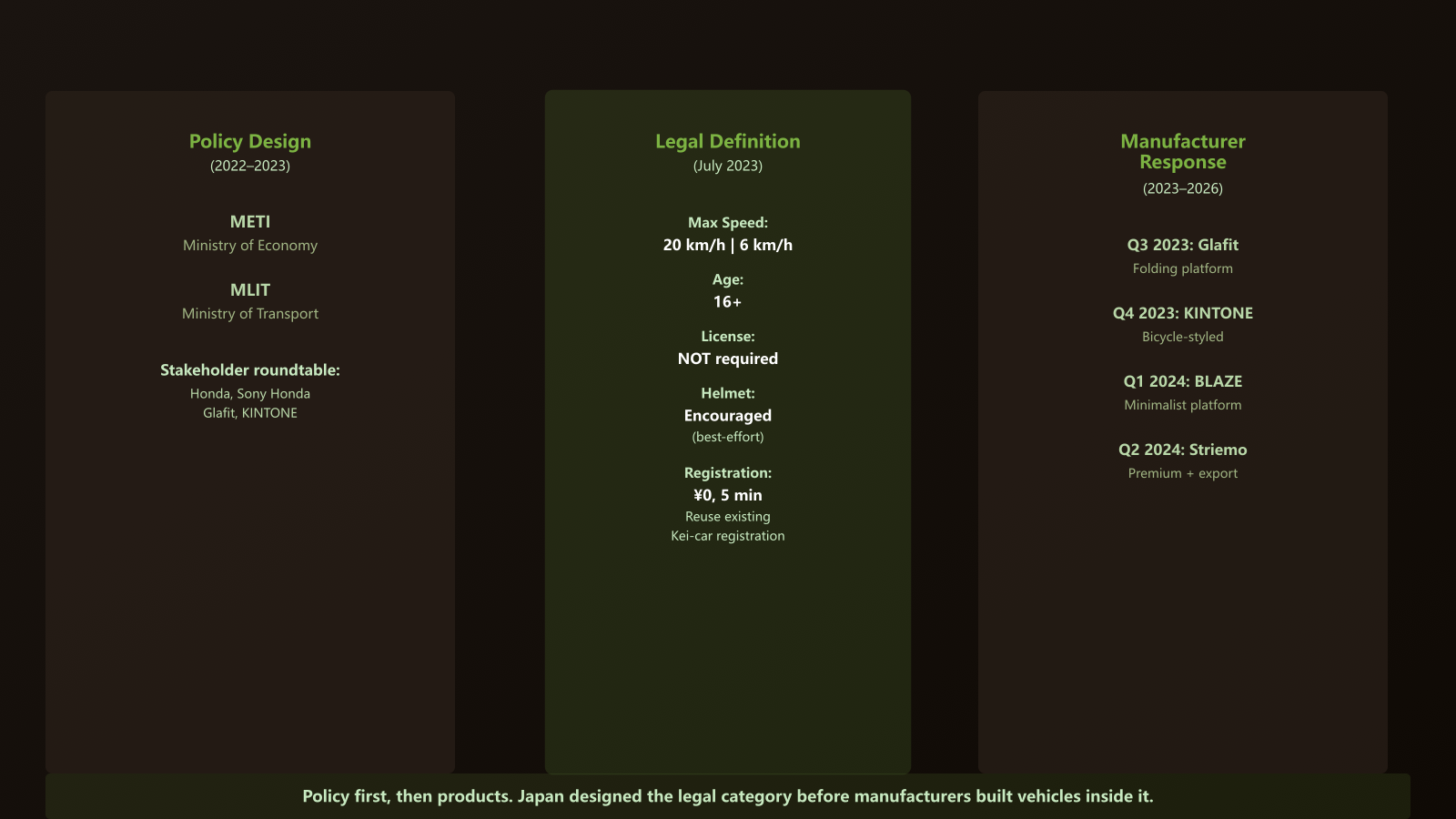 Policy first, then products. Japan designed the legal category before manufacturers built vehicles inside it.
The technical brilliance of the tokutei-kogata category lies not in the products, but in the legal architecture that made them possible.
The category was engineered to be a “Goldilocks” zone in existing Japanese law: looser than a 50cc moped (no license required, faster entry, lower barriers), more capable than a bicycle (legal parity with automotive traffic, higher speed, weather-independent), and clearer than an e-scooter (explicit statutory definition).
The decision to use the kei-car notification system for registration was particularly elegant. Japan already had a light-vehicle registration system designed to be fast and frictionless. Rather than creating a new bureaucratic layer, METI simply extended the existing system to cover tokutei-kogata. Registration takes 5 minutes, costs ¥0, and can be done at any municipal ward office.
The helmet question — “encouraged” rather than mandatory — was also deliberate. Mandatory helmet rules in other markets have created two problems: they shrink the casual-user market (tourists, occasional riders) and they trigger cultural resistance. By making helmets optional but “encouraged,” Japan’s policy chose inclusivity over optimal safety compliance.
The speed limits themselves — 20 km/h (roads) and 6 km/h (sidewalks) — are conservative but psychologically important. A vehicle that cannot exceed 20 km/h feels fundamentally different from one that can reach 40 km/h. The psychological ceiling is part of the regulatory design.
The Market in 2026: Real, But Still Maturing
 15,000–20,000 registered vehicles in 2.5 years. Growth is real, but the category remains early-adopter phase.
How large is the tokutei-kogata market today? As of May 2026, the cumulative registered tokutei-kogata vehicles in Japan (across all four manufacturers and others) is estimated at 15,000–20,000 units — a small number in absolute terms, but growing at roughly 40–50% year-over-year. The majority are concentrated in the greater Tokyo, Osaka, and Kyoto regions, where tourism and urban logistics are highest.
Glafit, the first mover, has shipped approximately 8,000–10,000 units cumulatively as of May 2026. KINTONE, BLAZE, and Striemo are in the 2,000–4,000 cumulative-unit range each. The price point — ¥150,000–¥250,000 (roughly USD $1,000–$1,700) — positions these vehicles above e-bikes but below full-scale electric motorcycles.
Distribution is primarily direct-to-consumer (online sales, maker websites) with secondary retail partnerships emerging in electronics chains and sporting-goods stores. The rental market (tourists, corporate fleets) is nascent but growing.
Will the EU Follow? Will Singapore? Will North America Ever Get Here?
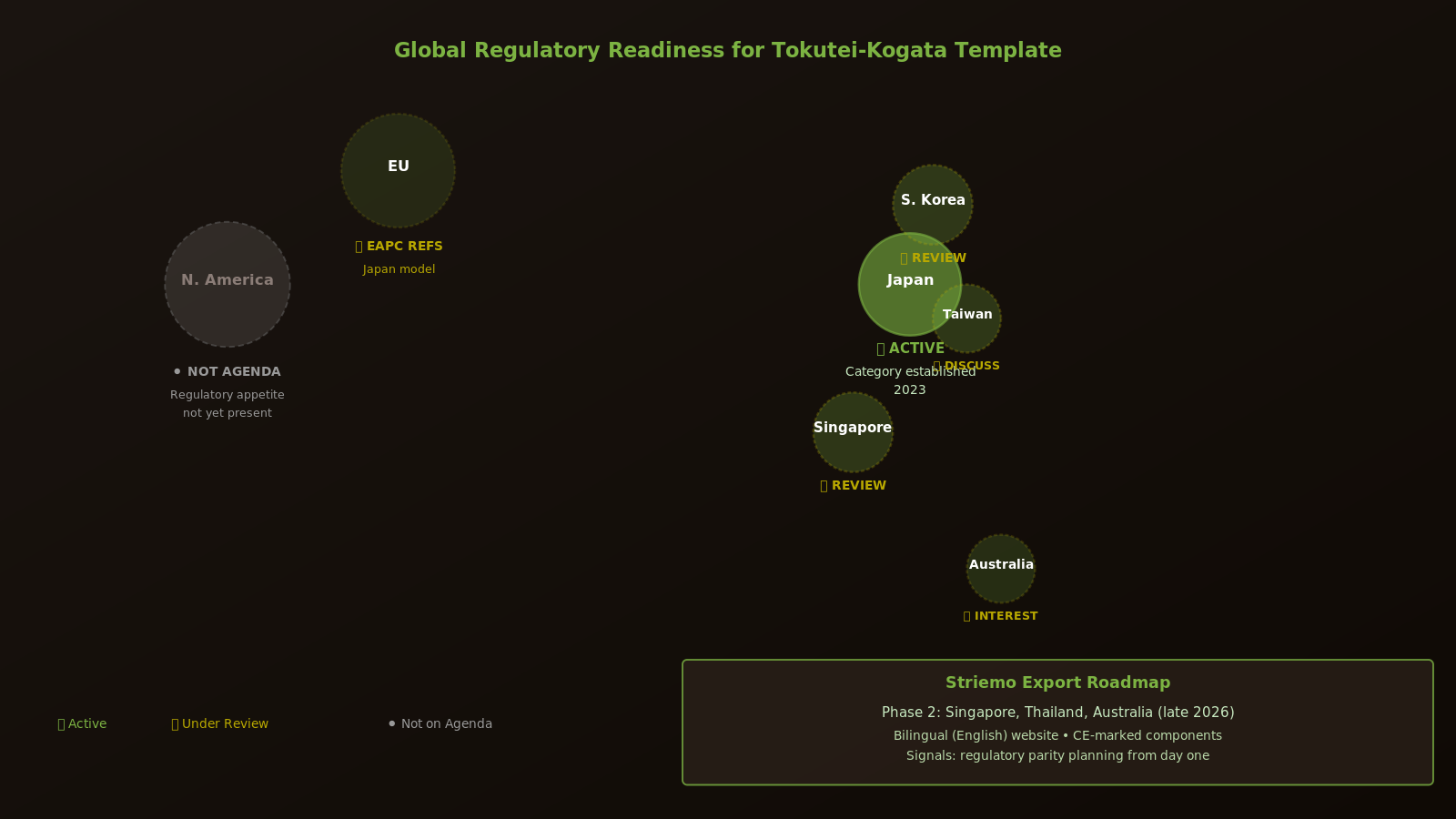 Japan’s template is spreading. The EU, Singapore, and South Korea are all watching. North America is still asleep.
The question every international operator should ask: Is tokutei-kogata a Japan-specific phenomenon, or is it the leading edge of a global regulatory shift?
The evidence leans toward “template with regional potential.” In the European Union, regulatory bodies are actively discussing a “small-class moped” category that mirrors aspects of tokutei-kogata. The EU’s EAPC (European Association of Bicycle, E-Bike, Scooter and Moped Manufacturers) has cited Japan’s framework as a reference point. In Singapore, where land is constrained and micromobility adoption is high, the Media Development Authority and Land Transport Authority have begun reviewing the tokutei-kogata model. In South Korea, there is significant quiet discussion among logistics companies and city authorities.
In North America, the regulatory appetite does not yet exist. The United States continues to treat e-scooters and e-bikes as gray-market products with fragmented local rules. The idea of a federal or state-level “tokutei-kogata equivalent” seems remote — not because it would not work, but because the political consensus for regulatory clarity does not yet exist.
Japan did not invent a product. It invented a legal category. If that category spreads, the products spread with it.
What This Teaches International Operators
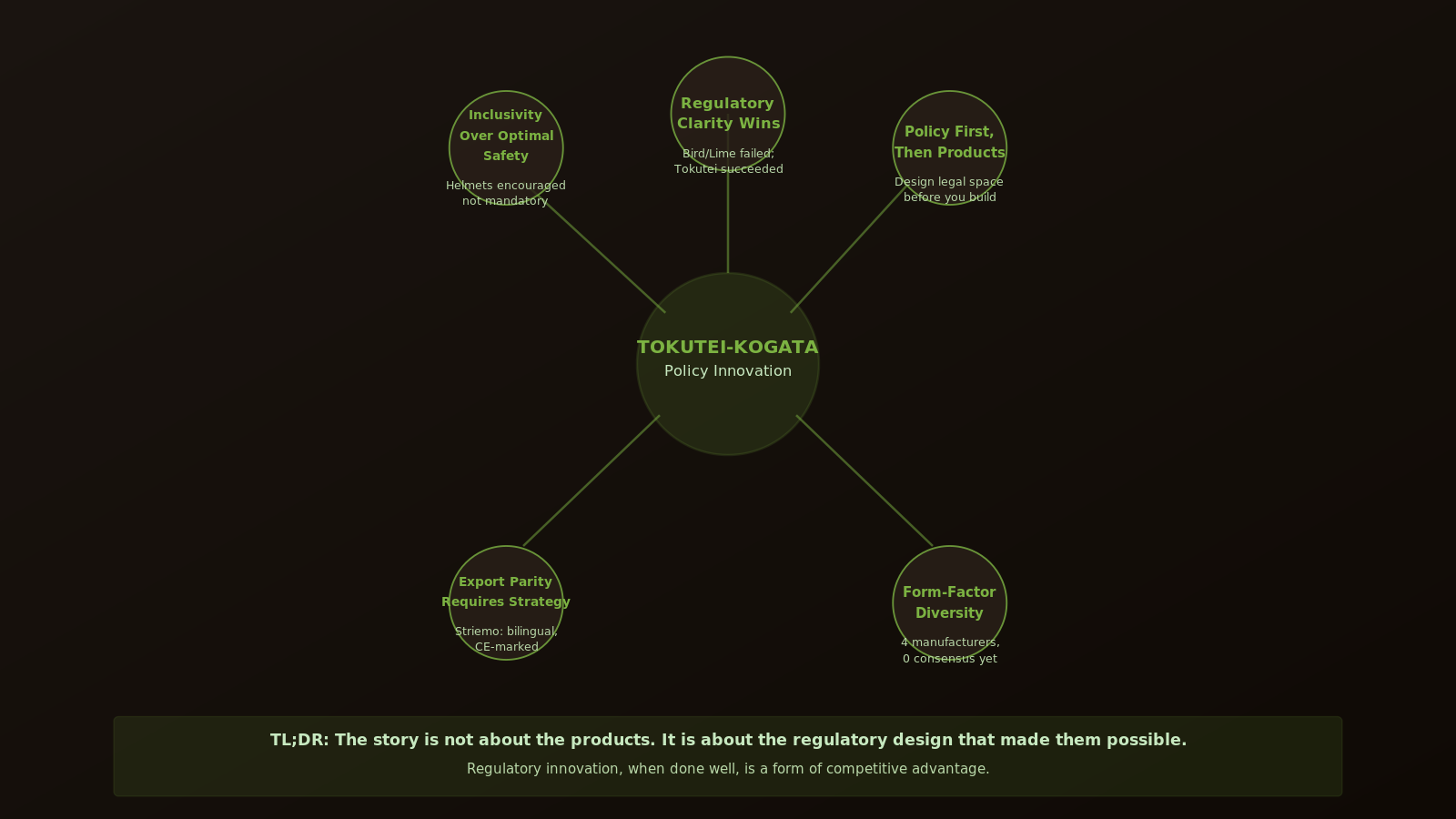 The story is not about the products. It is about the regulatory design that made them possible.
For companies evaluating expansion into micromobility or considering new market entry in Asia-Pacific:
One: Regulatory clarity is a competitive advantage, not a constraint. Japan’s explicit tokutei-kogata definition is a moat that protects all manufacturers equally — by raising the bar for entry and keeping out bad actors.
Two: Policy precedes product in mature markets. If you are entering a market where regulation is uncertain, expect to spend 18–24 months on policy alignment before you launch products. Japan did this. The manufacturers knew the legal parameters before they designed the first prototype.
Three: Form-factor consensus takes years to establish. Glafit, KINTONE, BLAZE, and Striemo are all tokutei-kogata-compliant, but they look nothing alike. The market is still discovering what form factors consumers prefer. Plan for diversity; do not assume early pioneers’ choices are optimal.
Four: Export ambitions require attention to regulatory parity across markets. Striemo’s bilingual website and CE-marking sourcing are not accidents. They signal that the company is designing for scalability across regulatory regimes from day one.
TL;DR — What to Watch
If you want to see how regulatory clarity shapes market formation: Study the tokutei-kogata story alongside Bird and Lime. One succeeded because it aligned with law. The others failed because they fought it.
If you want to see what regulatory innovation looks like: Watch METI and MLIT’s technical decisions around speed limits, age restrictions, and helmet rules. These are not accidents; they are calibrated choices about market size versus safety compliance.
If you want to see form-factor diversity in a nascent category: Compare Glafit (folding scooter), KINTONE (e-bike-styled), BLAZE (minimalist platform), and Striemo (polished hardware). None has “won” yet. The category is still defining itself.
If you are an international operator evaluating Asia-Pacific expansion or regulatory strategy: The tokutei-kogata story is a case study in how to build a market when existing categories do not serve your customer base. Japan’s government did not create tokutei-kogata to help Glafit, KINTONE, BLAZE, or Striemo. It created it to solve four structural problems: aging, rural decay, last-mile delivery, and tourism. The manufacturers happened to be ready. That alignment is where the story’s real strength lies.
The lesson is not “copy Japan’s tokutei-kogata.” The lesson is: regulatory innovation, when done well, is a form of competitive advantage.
Japan Market Pulse is a weekly read on what the Japanese consumer-tech, food, and mobility markets are choosing to do, written for international operators who want to know what is happening before it shows up in the global trade press.
Subscribe at ketchups.co/japan-market-pulse.
If you’re interested in this topic, the Japanese market more broadly, or what KETCHUPs is working on, we’d love to hear from you — please reach out via our contact form.
Japan Market Pulse is a weekly read on what the Japanese consumer-tech, food, and mobility markets are choosing to do, written for international operators who want to know what is happening before it shows up in the global trade press.
Subscribe at ketchups.co/japan-market-pulse.