

Disclosure: This article covers Japanese consumer-tech products. Some links lead to crowdfunding pages or maker-direct shops. Three of four products are Japan-domestic only; AIVELA Ring Pro is internationally available via maker-direct sales and Kickstarter delivery.
While the Western smart-ring market has consolidated around health tracking, Japan’s 2026 device landscape shows two parallel evolution paths: medical-grade biometric rings competing with the global Oura standard, and payment-plus-control rings that exist only because of Japan’s unified Felica/Suica infrastructure. Here is what international operators need to know about a market that is following the data, not the global consensus.
Japan Market Pulse — Issue 014 | Consumer Trends
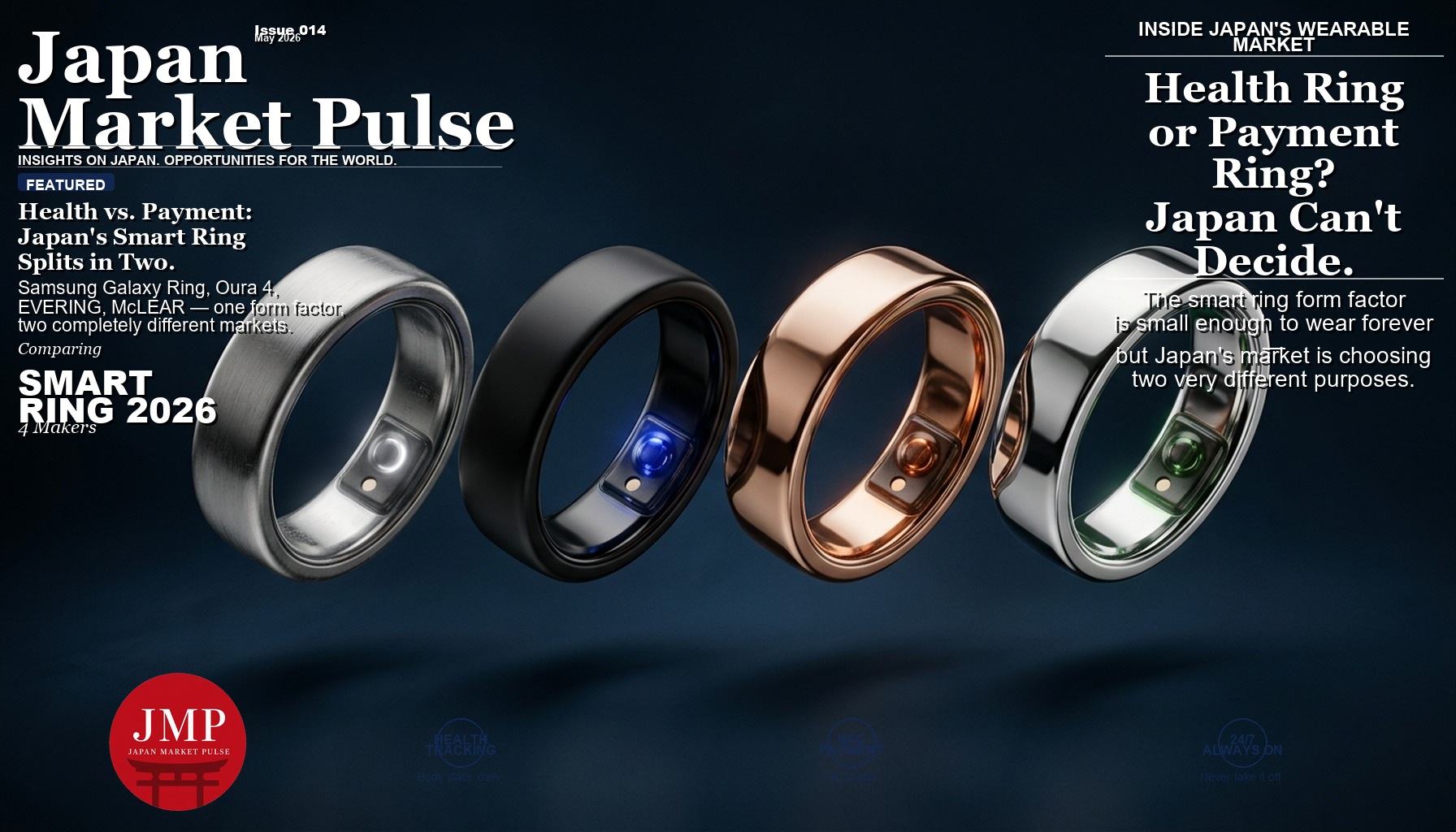
A brief, clarifying fact: the global smart-ring narrative in 2026 is almost entirely about health. Oura Ring tracks sleep and heart-rate variability. RingConn measures temperature, stress, and oxygen saturation. The conversation is wellness, the format is wearable, and the baseline competitive question is always: whose sensors are most accurate?
Japan’s smart-ring market is answering a different question. Three of the four devices that GetNavi featured in its May 2026 issue (pages 20–21) solve for payment and control, not health. One offers NFC-based contactless payments. Another operates a smartphone camera shutter. A third sits at the intersection — gesture-controlled wearable that also measures vital signs. The underlying reason is structural: Felica-compatible NFC infrastructure is embedded in 99% of Japan’s convenience stores, vending machines, and transit terminals. Payment-ring businesses can exist only where those rails are complete. Health-tracking rings, by contrast, face the same competitive landscape globally.
The result is not a market anomaly. It is a two-path divergence — one path competing on the global stage (health tracking), another path serving a Japan-specific infrastructure that competitors in the West cannot replicate.
The Four Generations of Smart-Ring Evolution: 2013 → 2018 → 2023 → 2026
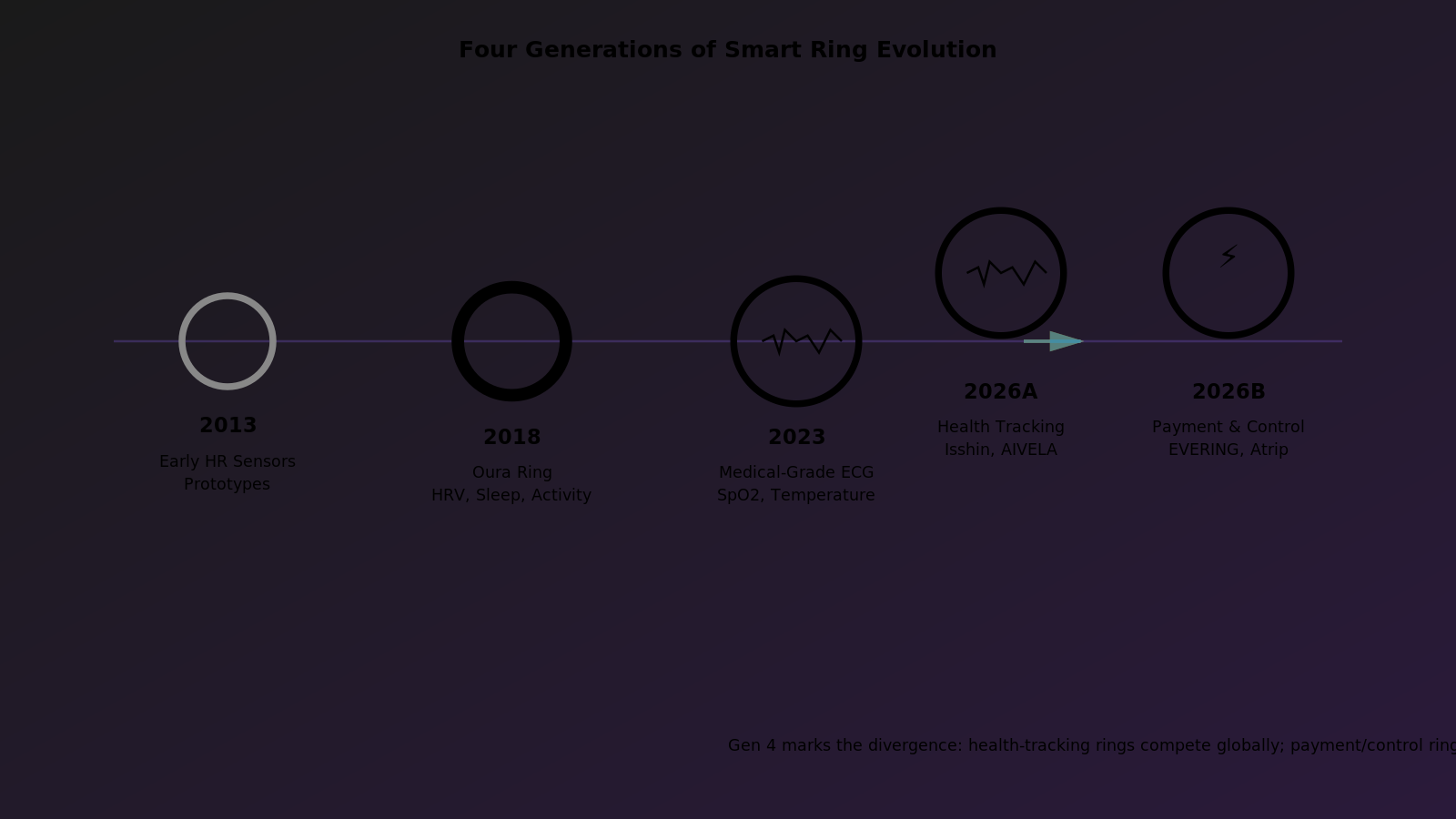 Four generations of smart-ring evolution. 2013: prototypes. 2018: Oura market formation. 2023: medical-grade ECG. 2026: Japan’s split into health-tracking and payment-control paths.
To understand where Japan’s market stands in 2026, it helps to know where all smart rings came from.
Generation One (2013): Early heart-rate sensors in ring form. Prototypes, mostly. The category did not yet exist as a consumer product.
Generation Two (2018): Oura Ring arrived, and a market formed. Heart rate variability, sleep stages, activity data — the wellness-tracking standard. Oura became the reference point, globally, for what a smart ring was supposed to do. For five years, the answer stayed the same.
Generation Three (2023): Medical-grade electrocardiogram (ECG) sensors joined the feature set. Oura adapted. The question shifted from “lifestyle tracking” to “clinical accuracy.” Blood-oxygen saturation became standard. The ring began to resemble a diagnostic device, not a lifestyle wearable.
Generation Four (2026): Japanese manufacturers entered the category at scale — and the category itself split. One path continued the health-tracking lineage (Isshin, AIVELA). One path opened entirely new territory: payment systems and device control. This divergence is the story.
Path One: Medical-Grade Health Tracking — Competing Globally
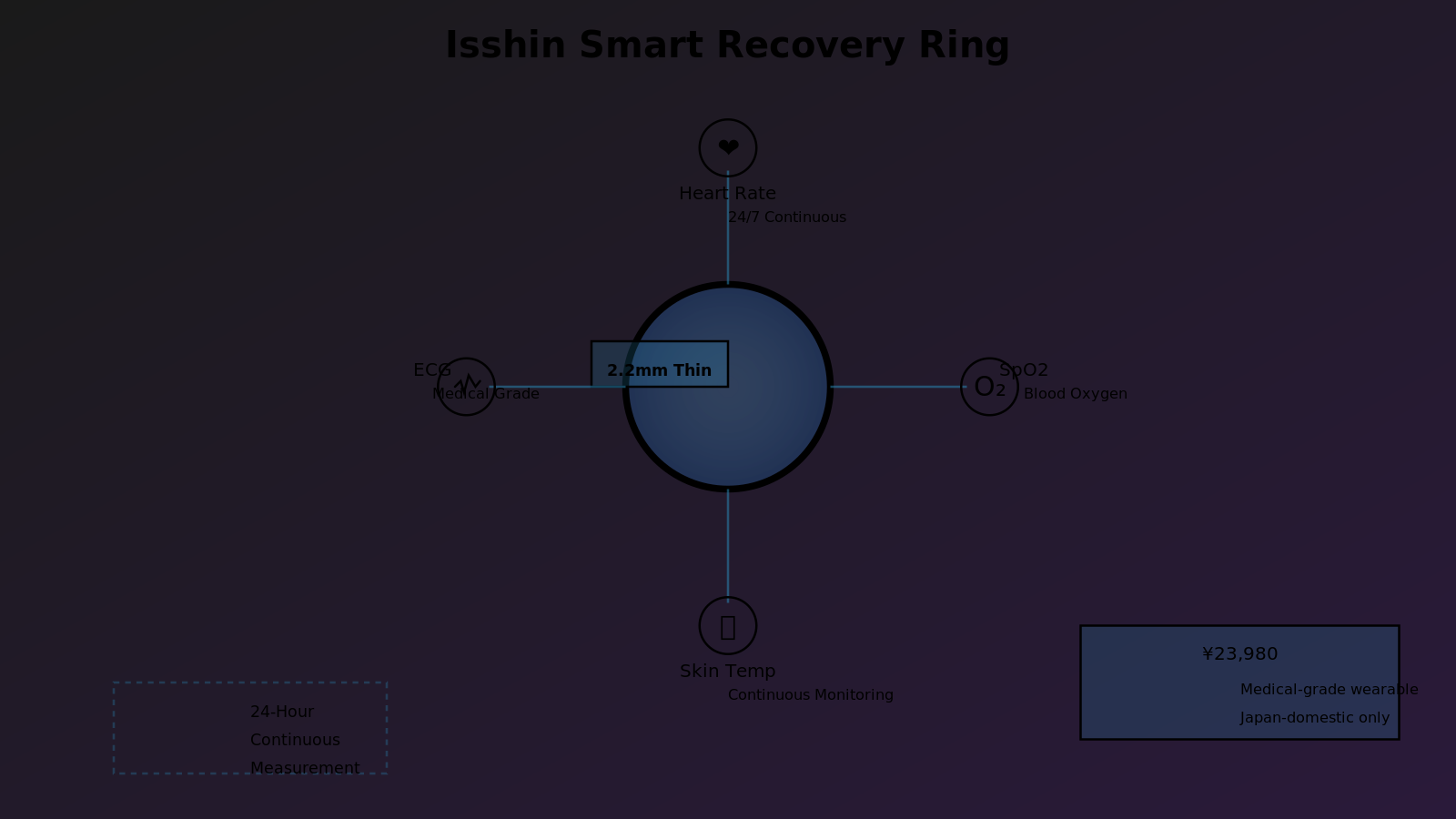 Isshin’s medical-grade sensor stack: heart rate, SpO2, skin temperature, ECG — all measured continuously. At 2.2mm, it prioritizes wearability without sacrificing clinical accuracy.
The first path is, structurally, the Oura path. Companies building ECG-capable health-tracking rings are entering a competitive market with a proven winner already occupying the space.
Isshin Smart Recovery Ring (¥23,980) represents this path. The ring measures heart rate, blood-oxygen saturation, skin temperature, and carries a full 24-hour ECG capability. At 2.2 millimeters thin, it prioritizes wearability over bulk — a point of engineering emphasis that Oura also made in its early designs. The price sits below Oura’s Japanese retail tier (which runs ¥50,000+), suggesting a strategy aimed at the ¥20,000–¥30,000 segment.
The catch: Isshin is Japan-only. No Amazon US availability. The company’s global expansion strategy is opaque, and the medical-grade positioning suggests a domestic clinical-adoption focus more likely than a consumer-market export play.
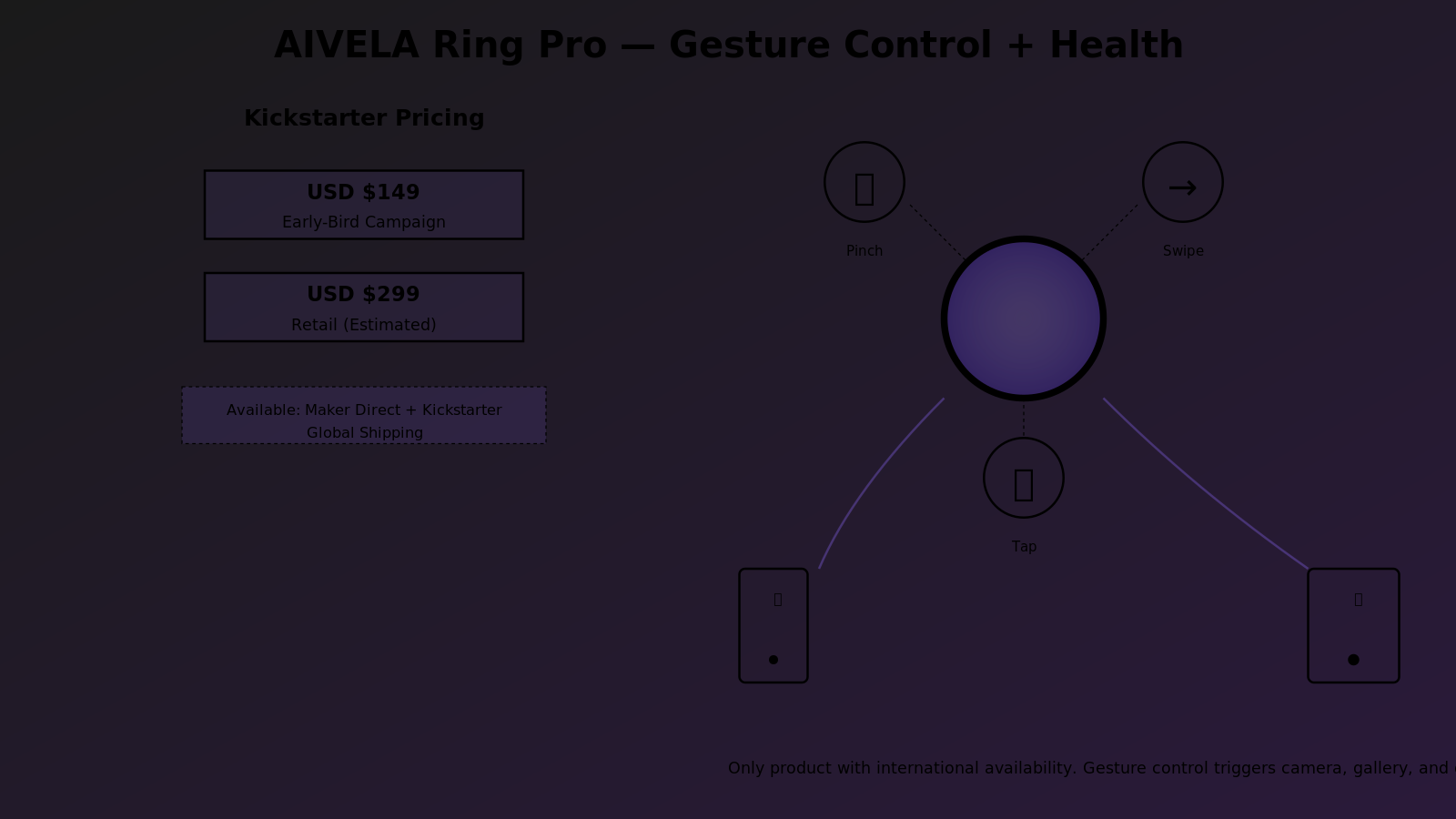 AIVELA Ring Pro bridges health tracking and device control. Gesture recognition triggers camera, gallery, or device functions. Kickstarter early-bird at USD $149; maker-direct sales bring it to international markets.
AIVELA Ring Pro (USD $149 early-bird, USD $299 retail) follows a different approach to the health-tracking path. The ring combines gesture recognition (hand-based control) with biometric measurement. The form factor is smart-ring, but the feature set bridges two categories: it is both a health tracker and a device-control interface.
What makes AIVELA strategically distinct is its distribution model: Kickstarter and maker-direct sales bring it to international markets. No Japan-domestic limitation. The USD $149 crowdfunding price provides an entry point for Western consumers, and the direct-sales model (https://www.aivela.com/) ensures shipping to OECD markets. This is the only one of the four devices with inherent international viability.
The gesture-recognition feature (triggering phone cameras, tablet functions) is the wedge. AIVELA is positioning itself not as a health-tracker competitor to Oura, but as the first consumer smart ring to seriously integrate device control into the health-tracking form factor. For international operators, this matters: it signals that the second generation of smart-ring use cases — beyond health tracking — is emerging in the market, and it is emerging first in Japan.
Path Two: Payment and Control — Japan-Specific Infrastructure
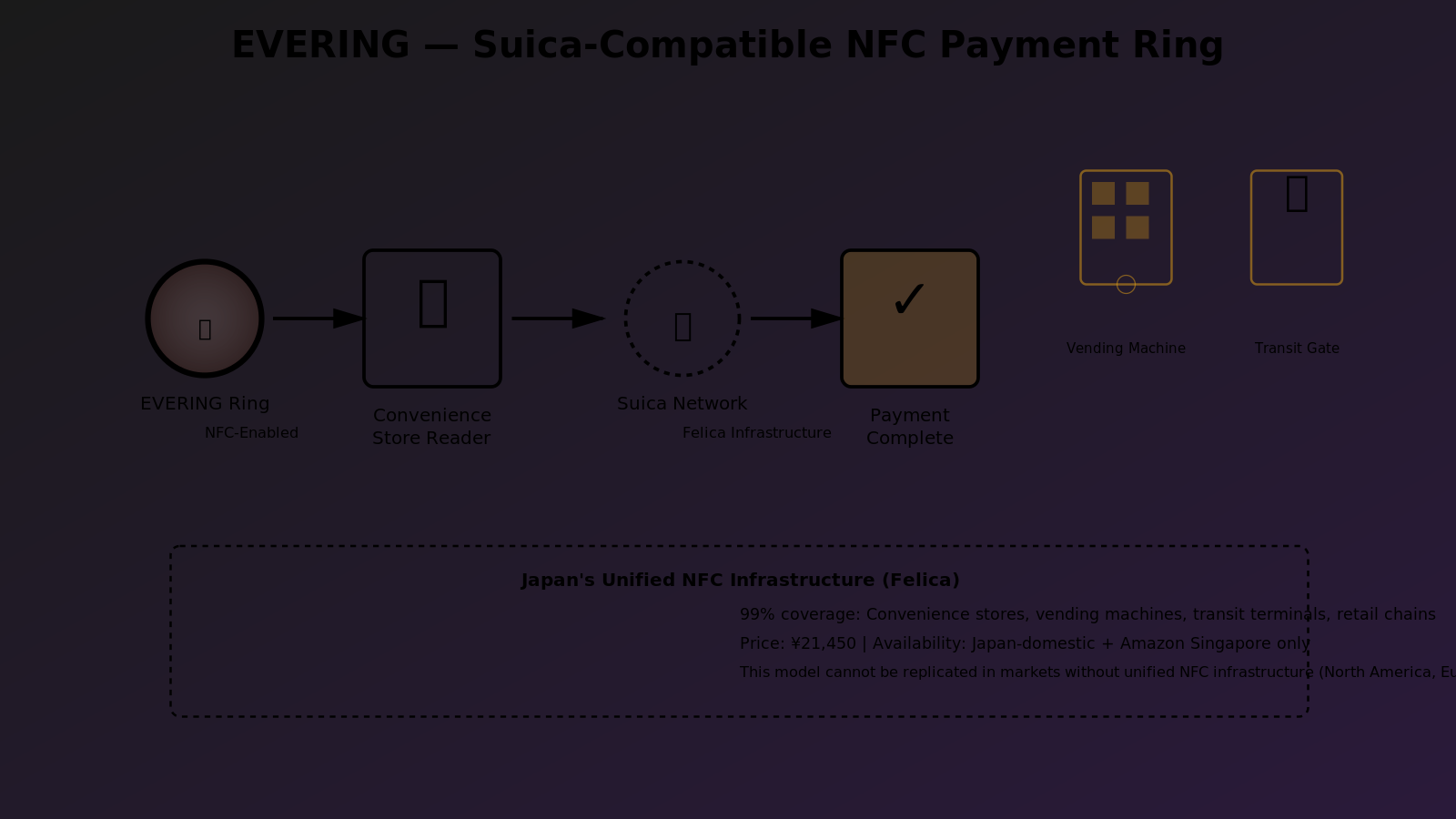 EVERING’s payment model depends entirely on Japan’s unified Felica/Suica infrastructure. It works at 99% of Japan’s point-of-sale terminals. Replicate this model elsewhere requires comparable infrastructure consolidation — a condition that does not exist in North America or Europe.
The second path exists because of a single fact: Japan unified its contactless-payment infrastructure decades ago.
EVERING (¥21,450) is the canonical example. It is a Suica-compatible NFC payment ring — ISO/IEC 18092 and ISO 14443A compliant. You tap a ring to a reader at a convenience store, train station, or vending machine, and it behaves like any other Suica card. The payment clears the same payment network that 200 million Japanese cards use daily.
This is possible in Japan because Felica (the Japanese NFC standard) achieved near-total infrastructure penetration by 2015. Convenience-store chains, automatic ticket gates, and vending-machine networks all converged on the same reader standard. A payment-ring business model becomes viable in this and only this context.
Try to replicate EVERING in the United States or Europe and the business collapses. NFC infrastructure exists in both markets, but it is fragmented: Apple Pay uses one NFC stack, Google Pay uses another, and regional bank networks use others still. No single unified infrastructure exists. A payment ring is a convenience only if the consumer base can tap it at 99% of transaction points. EVERING has that. No American or European payment-ring startup does.
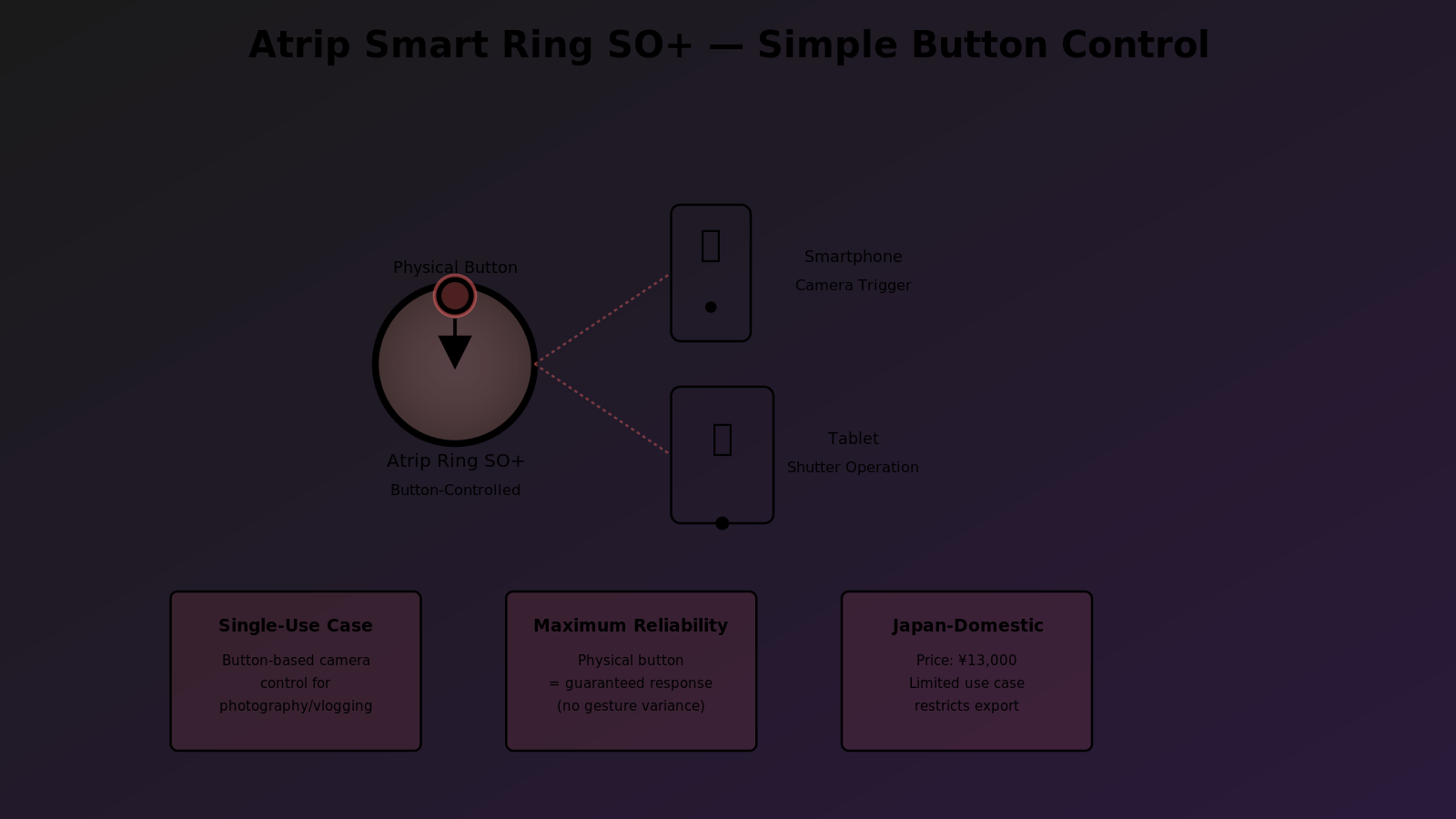 Atrip’s button-controlled shutter design is the simplest smart-ring form factor: press the ring button, trigger the camera. Single-use case, maximum reliability, Japan-domestic positioning.
Atrip Smart Ring SO+ (¥13,000) operates in the same Japan-specific space, but focused on smartphone and tablet control. The ring has physical buttons; press them and it triggers camera shutter operations or other smartphone functions. It is simpler than EVERING — no payment infrastructure needed — but equally Japan-domestic. The intended market is consumers who want a discreet camera control when doing studio photography, vlogging, or sports videography.
The fact that both EVERING and Atrip are Japan-only is not incidental; it reflects the reality that neither product solves a pain point that international markets have converged on. Payment via wearable is a convenience, not a necessity, and it is a convenience only where the infrastructure supports it. Device control via ring is similarly niche; phone cameras have physical buttons already, and Bluetooth control is standard. These products exist because the infrastructure enabled them, and because early adopters in Japan’s affluent urban markets are willing to try novel form factors.
Why Japan Split: Infrastructure, Design Culture, and Market Timing
The divergence between Path One (health, global-competitive) and Path Two (payment/control, Japan-specific) reveals something important about how markets emerge. It is not that Japanese consumers are fundamentally different. It is that the underlying infrastructure enabled a second path to exist.
Oura created a global template: health tracking in ring form, sold to consumers who value precision and wellness data. That template is universal. But the convenience-store payment infrastructure is not universal. The moment that Suica achieved near-total penetration, Japanese manufacturers could see a product opportunity (EVERING) that did not exist anywhere else.
The second factor is design culture. Japanese manufacturers — especially in electronics, precision instruments, and industrial components — have a long tradition of producing form-factor innovations tied to existing infrastructure. EVERING is essentially a Suica card reimagined as a wearable ring. That kind of infrastructure-aware product design is a core competency for Japanese industrial design.
The third factor is market timing. By 2023–2024, smart-ring sensor technology (ECG, temperature, motion) had matured enough that new entrants could source components at reasonable cost. Oura no longer held exclusive claims to the technology. Japanese manufacturers could, for the first time, assemble competitive products. The result: Isshin entered the health-tracking market, and EVERING and Atrip opened the payment-and-control markets.
What This Means for International Operators
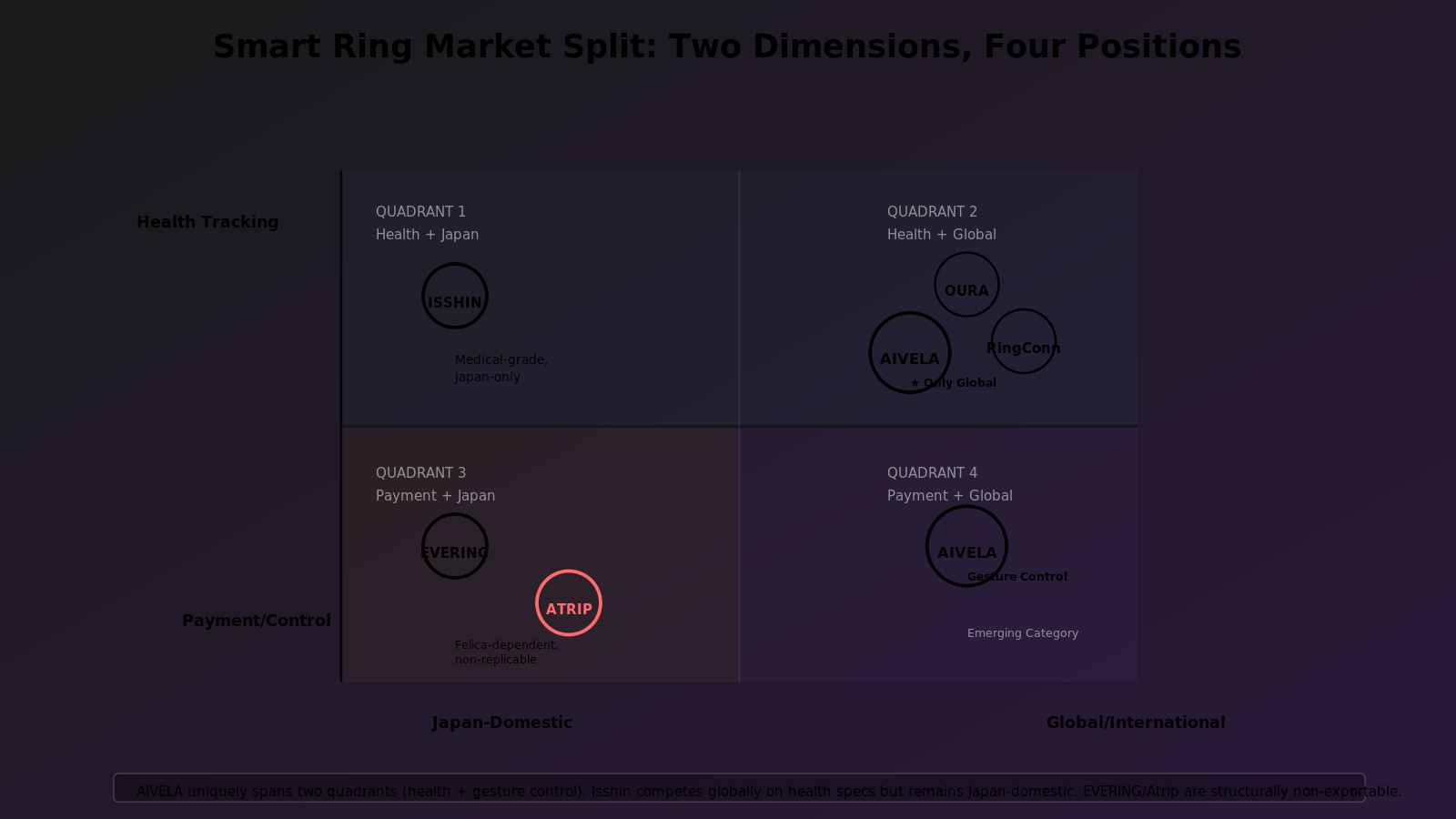 Japan’s smart-ring market splits into two axes: health tracking (competing globally with Oura, RingConn) and payment/control (Japan-domestic, with AIVELA as the only global entry point). The divergence reflects infrastructure differences.
Oura’s first-mover advantage was substantial, but it is no longer a moat. Isshin, RingConn, and others are producing medical-grade rings with ECG capability. Price competition is emerging. The category is moving from market creation (Oura’s era) to market competition (now).
For international operators evaluating entry or expansion, the implication is straightforward: compete on clinical validation, user experience, and ecosystem integration, not on raw sensor technology. Isshin’s ECG capability is credible, but Oura’s clinical research library (published studies on sleep, stress recovery, etc.) is deeper. RingConn’s form-factor innovation (thinner, lighter designs) is competitive with Oura’s but not fundamentally distinct. The next wave of differentiation will come from seamless integration with health apps, healthcare provider partnerships, and insurance/corporate wellness programs.
EVERING and Atrip are real products solving real problems — but only in Japan. International operators should not attempt to replicate these models in markets without comparable infrastructure consolidation.
However, the underlying insight is transferable: device-wearable integration (whether payment, control, or authentication) is a growth area. International operators should examine whether they have comparable infrastructure advantages.
Of the four products covered here, AIVELA Ring Pro is the most internationally relevant — not because it is better than the others, but because it is internationally accessible and it opens a new use case.
Gesture recognition in a wearable ring is not new (Oura has hand-gesture integration in beta). But AIVELA’s positioning — device control as the primary use case, health tracking as a secondary feature — is a role reversal from the Oura template. For consumers in creative fields (photography, videography, AR development), this is compelling.
The payment-ring model exists not because consumers asked for payment rings, but because the infrastructure to support payment rings already existed. That is how categories form in mature tech markets.
The Kickstarter campaign (September 2025) and the maker-direct sales model give Western operators a sightline into a product that is explicitly designed for global markets. Unlike Isshin (Japan-only) or EVERING (Japan-primary), AIVELA has marketing collateral, shipping logistics, and support infrastructure aimed at international customers.
For international operators, the lesson is simple: device-control smart rings are a neglected category. Oura and RingConn have dominated the health-tracking narrative. AIVELA is showing that gesture-control smart rings can reach market and find customers. The second wave of competition in wearable rings may well come from companies that focus on control and productivity features, not health tracking alone.
TL;DR — What to Watch
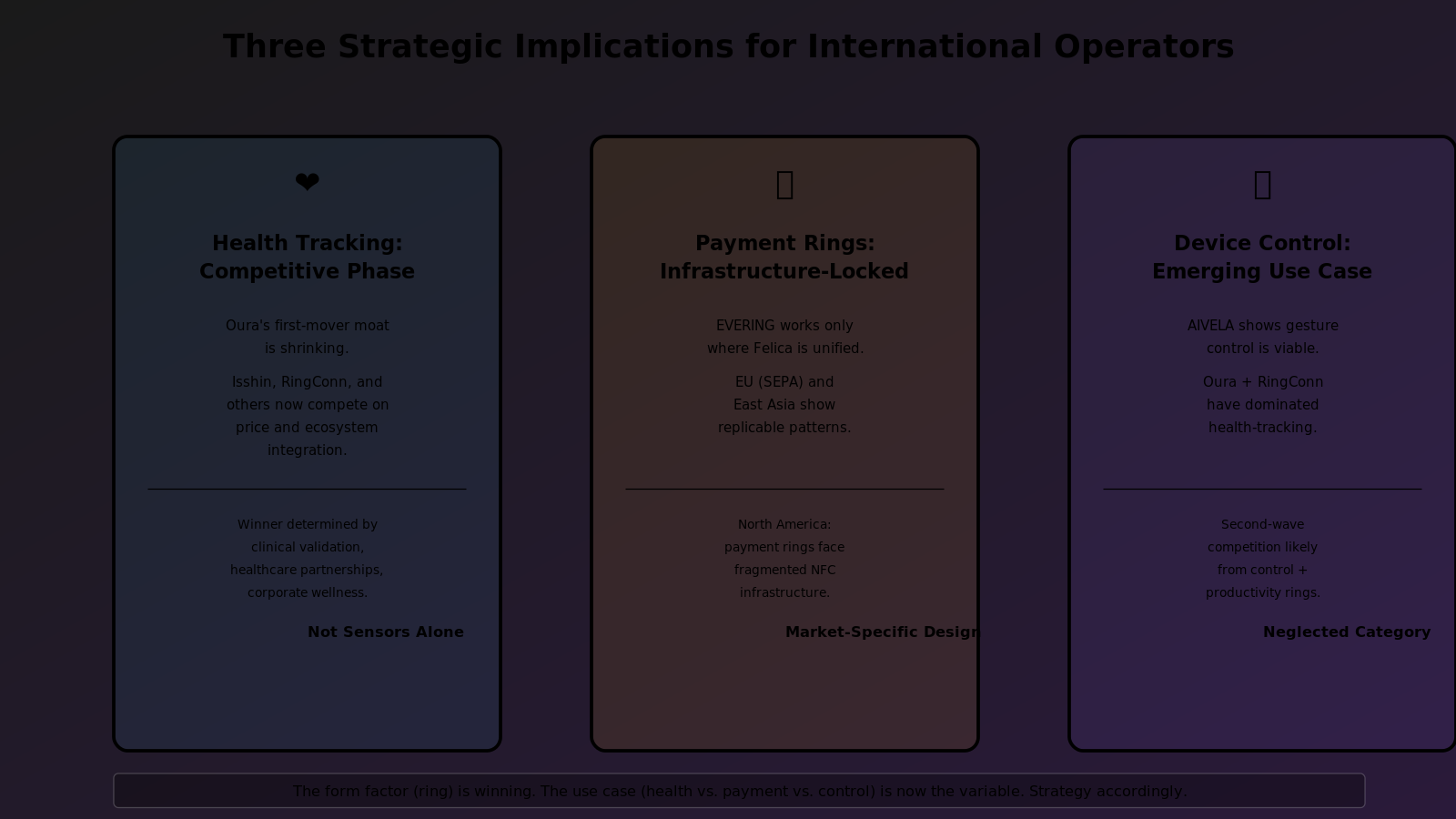 Three strategic implications for international operators. Health-tracking rings are becoming competitive. Payment rings are infrastructure-dependent. Device-control rings represent the next frontier.
If you want to see where Oura-style health tracking is heading in a competitive market: Watch Isshin’s clinical adoption in Japan. Can a lower-priced, Japan-domestic ring achieve healthcare-provider adoption? If yes, the pattern applies globally. If no, it suggests that brand, ecosystem, and clinical credibility are tougher moats than tech journalists typically acknowledge.
If you want to see infrastructure-enabled product innovation: Study EVERING. It is not a globally-scalable model, but it shows how legacy infrastructure (Felica/Suica) can enable new form factors that would be unthinkable elsewhere.
If you want to see what smart-ring second use cases look like: Watch AIVELA’s Kickstarter campaign and post-campaign adoption. The gesture-control integration is the wedge; if it gains traction, device-control wearables become a category worth serious product investment.
If you are an international operator evaluating wearables: The market is no longer “Oura versus the next Oura.” It is “health-tracking rings” versus “device-control rings” versus “infrastructure-specific rings” (payment, authentication, etc.). The form factor is winning. The use case is now the variable.
Japan Market Pulse is a weekly read on what the Japanese consumer-tech, food, and mobility markets are choosing to do, written for international operators who want to know what is happening before it shows up in the global trade press.
Subscribe at ketchups.co/japan-market-pulse.
Sources
- Isshin Smart Recovery Ring — Official site (JP)
- AIVELA Ring Pro — Maker direct site
- AIVELA Ring Pro — Kickstarter campaign
- EVERING — Official site (JP/EN)
- Atrip Smart Ring SO+ — Official site (JP)
- Oura Ring — Global health-tracking reference
- RingConn — Global competitor
- GetNavi 20265pp. 20-21 — Source publication
If you’re interested in this topic, the Japanese market more broadly, or what KETCHUPs is working on, we’d love to hear from you — please reach out via our contact form.
If you’re interested in this topic, the Japanese market more broadly, or what KETCHUPs is working on, we’d love to hear from you — please reach out via our contact form.
Japan Market Pulse is a weekly read on what the Japanese consumer-tech, food, and mobility markets are choosing to do, written for international operators who want to know what is happening before it shows up in the global trade press.
Subscribe at ketchups.co/japan-market-pulse.