

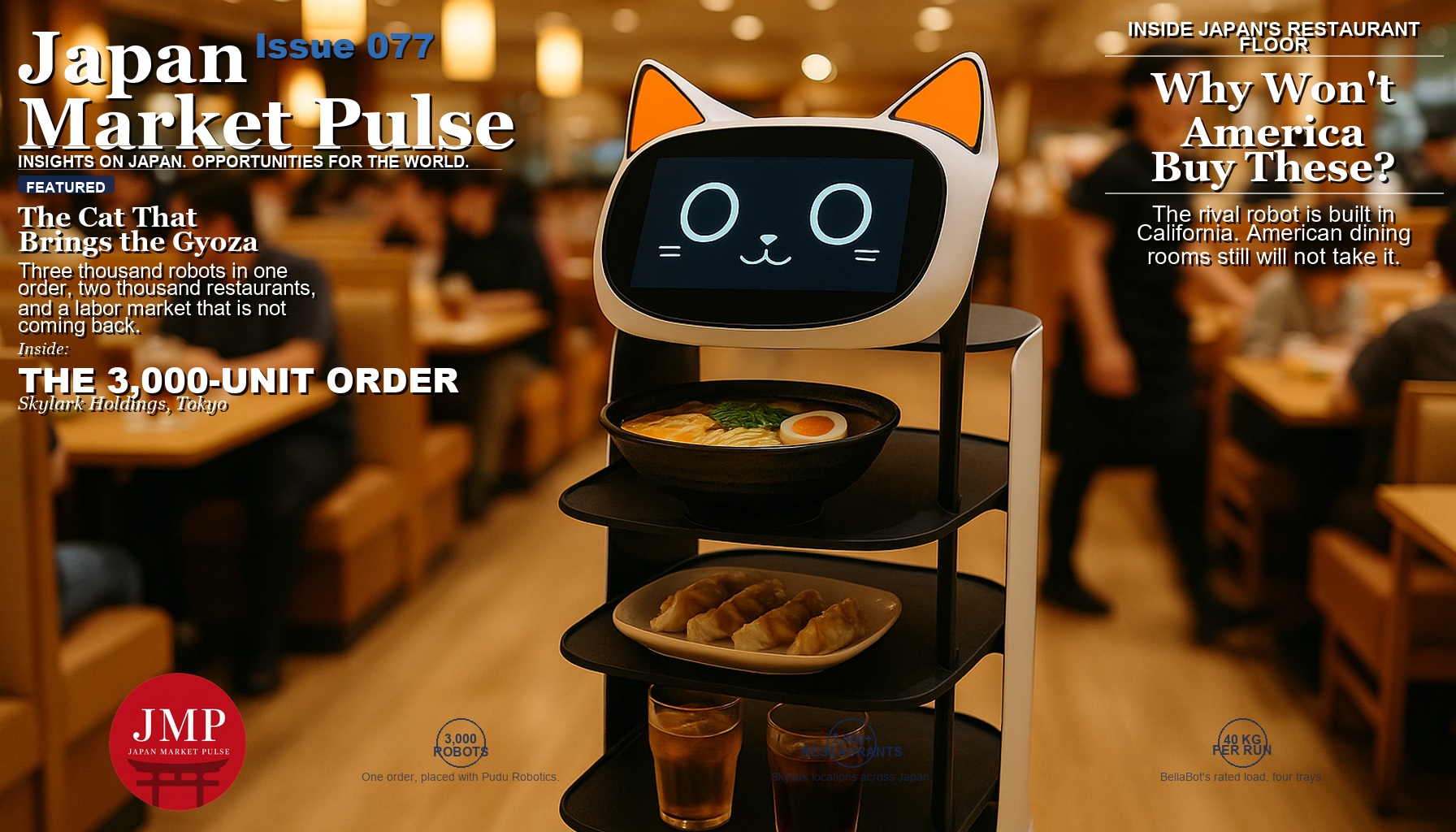
The first time my kids saw one, they nearly climbed out of the booth. We were at a Gusto — the ubiquitous family restaurant chain that anchors just about every roadside shopping strip in Japan — and a cat-faced robot the height of a large dog rolled up next to our table, blinked its cartoon eyes, and announced in a chirpy synthesized voice that our gyoza and corn potage had arrived. My youngest asked if she could pet it. The answer, delivered by the robot itself in a follow-up line of dialogue, was a polite “please enjoy your meal,” which felt like the most Japanese possible way for a machine to dodge a question.
That was three years ago. It no longer registers as a novelty to me. I have eaten at shabu-shabu restaurants, ramen chains, and conveyor-belt sushi spots where a robot delivered part or all of my order, and at this point I notice the absence of one more than the presence. That shift — from spectacle to infrastructure — is the real story, and it is one that has almost entirely bypassed the United States, despite America’s restaurant industry facing many of the same pressures that pushed Japan toward robots in the first place.
The Chain That Ordered Three Thousand Robots at Once
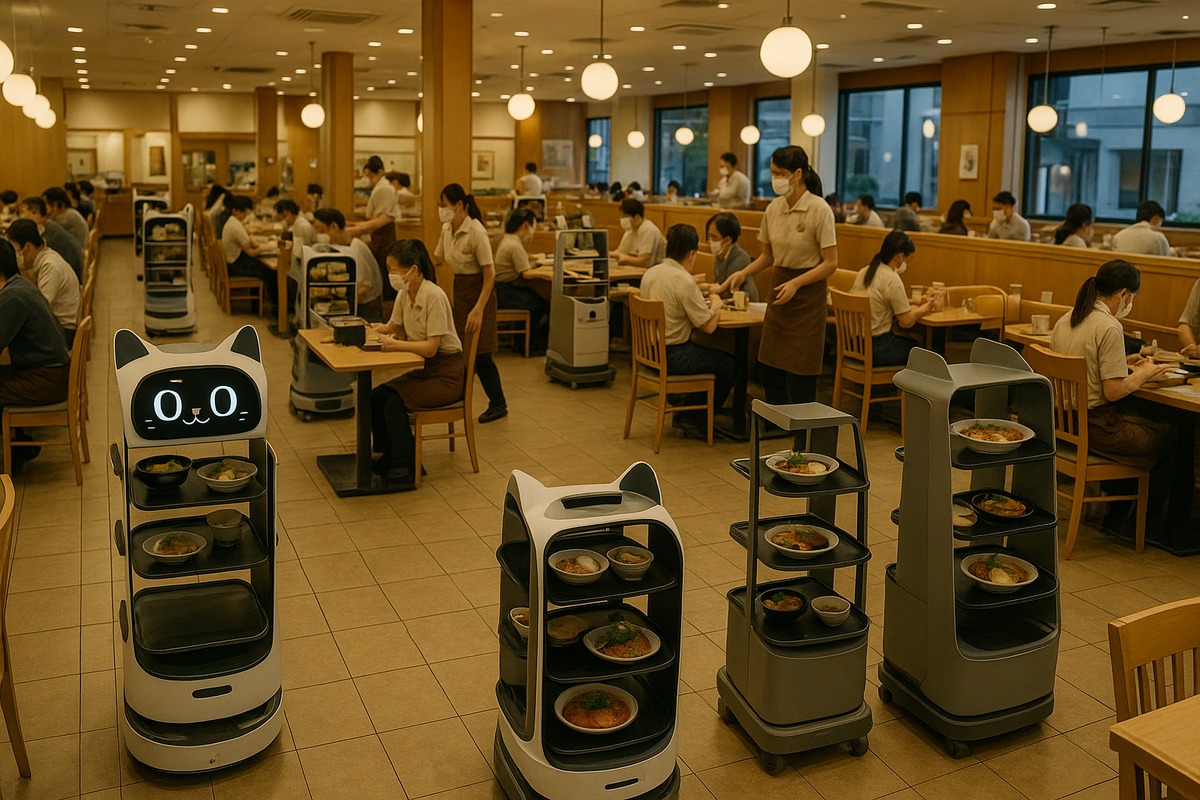
Skylark Holdings runs Gusto, Bamiyan, the all-you-can-eat shabu-shabu chain Shabu-yo, and a long list of other familiar chains that make up the backbone of Japan’s casual dining scene — the kind of restaurants you end up at on a Tuesday night because they are fast, cheap, and everywhere. A few years ago, Skylark placed an order with the Chinese robotics company Pudu Robotics for roughly 3,000 serving robots, deploying them across more than 2,000 of its restaurants nationwide. At the time, it was described as the largest single order of service robots the food industry had ever seen, and it turned what might have been a gimmick into something closer to standard kitchen equipment.
The robot in question is Pudu’s BellaBot — the cat-eared model my kids fell in love with. It is a wheeled cart with sensors, a touchscreen face, and enough onboard mapping intelligence to navigate a dining room full of moving chairs, distracted toddlers, and servers carrying trays, without a fixed track or floor marking. BellaBot carries up to four trays and roughly 40 kilograms of food and dishware, gliding from kitchen pass to table and back on routes it calculates itself. Sushi chains had experimented with conveyor systems and delivery carts years earlier, but the scale of the Skylark rollout is what turned this into an industry-wide story rather than a single chain’s publicity stunt.
Skylark was not alone. Kappa Sushi’s parent company built an explicit operating philosophy around the technology: tasks that robots can do, robots do; tasks that require a human touch stay with the staff. Kura Sushi, which also operates in the United States, brought BellaBot and Pudu’s KettyBot into some of its stores as well, though notably in a more limited role — carrying drinks and condiments rather than replacing the conveyor belt that still does the heavy lifting of sushi delivery. Once you start looking, the cat robots are not confined to one chain or one region. They have become part of the visual furniture of Japanese dining, in the same way that self-checkout kiosks became part of the visual furniture of American grocery stores a decade ago.
What a Restaurant Robot Actually Does All Day
It is worth being precise about what these machines are for, because the marketing photography — robot delivering ramen with a cartoon smile — undersells how mundane their actual job is. A serving robot does not cook, does not take verbal orders in most configurations, and does not handle payment. What it does is walk. Specifically, it walks the repetitive, physically taxing route between the kitchen pass and the dining floor, over and over, for an entire shift, at a steady pace that does not slow down when the restaurant gets slammed at 7 p.m. on a Friday.
That sounds almost too simple to matter, but ask anyone who has worked a dinner rush what actually burns out a server, and the answer is rarely the complexity of the job. It is the sheer distance covered — the miles logged crossing a dining room dozens of times an hour, carrying loaded trays, dodging other staff, backtracking for a forgotten side dish. Pudu Robotics’ own published capacity figure for BellaBot is more than 400 deliveries in a working day, and a mid-sized family restaurant running two or three units simultaneously through lunch and dinner is working at that order of magnitude across its fleet. That is a vendor number rather than an audited one, and neither Pudu nor Skylark publishes a definitive per-store average across the network, but the order of magnitude is not in dispute: these machines are doing the bulk of the walking that floor staff used to do, continuously, for hours at a stretch.
That reallocation of labor is the entire point. A human server freed from ferrying dishes back and forth can instead focus on the tasks a machine still cannot do — reading whether a table wants to be left alone, catching the raised hand of a customer who needs something, upselling a dessert, handling a complaint with actual empathy. Restaurant operators in Japan describe this less as replacing staff and more as re-triaging what staff spend their time on — and the operators themselves do not agree on where that lands. Skylark has told Japanese media that its robot rollout did not cut staff numbers, framing the machines as a way to give the same headcount more time on the floor. A separate operator, CiX Holdings, has been reported as saying one of its outlets was able to run with roughly half the staffing after robots came in. Both statements can be true at once, and the gap between them is the whole argument: the same machine is a labor-quality investment for one chain and a headcount lever for another, depending on how thin the floor was to begin with.
Why the Novelty Never Really Wore Off
I expected, when I first saw one of these robots, that the appeal would fade within a few visits. Japanese consumers are not typically dazzled by gadgetry for its own sake, and Japanese restaurant chains do not have a reputation for gimmicks that fail to pull their weight. What actually happened is more interesting: the emotional appeal and the functional value turned out to reinforce each other instead of one cannibalizing the other.
Children love the robots, full stop, and family restaurant chains like Gusto built entire business precisely around families with young kids — the exact demographic that turns a five-minute wait for food into a small crisis. A robot that turns “when will my food arrive” into an event rather than a source of impatience is doing real work for the restaurant, not just decorating it. Early customer surveys conducted around some of these rollouts found roughly two-thirds of diners reporting a positive impression of the robots’ presence, which is a remarkably high number for something that, functionally, is just a delivery cart. Adults, for their part, seem to appreciate something subtler: the robot removes a layer of low-grade social friction. There is no awkwardness in a robot bringing your food quickly and moving on, no sense that you are inconveniencing an overworked human being by asking for a refill. In a culture that already prizes minimizing imposition on others — the deep-seated instinct the Japanese call meiwaku, or the avoidance of burdening those around you — a machine that handles a mundane task without needing to be thanked, apologized to, or managed socially fits unusually well.
None of this means the human staff disappeared from the floor. If anything, the restaurants that have leaned hardest into robot service tend to be more deliberate about training the remaining staff on the parts of hospitality that actually require a person — greeting, troubleshooting, reading a room. The robots absorbed the grunt work; the humans kept the job that was always the harder one to automate anyway.
The Math That Nobody in Japan Is Arguing About
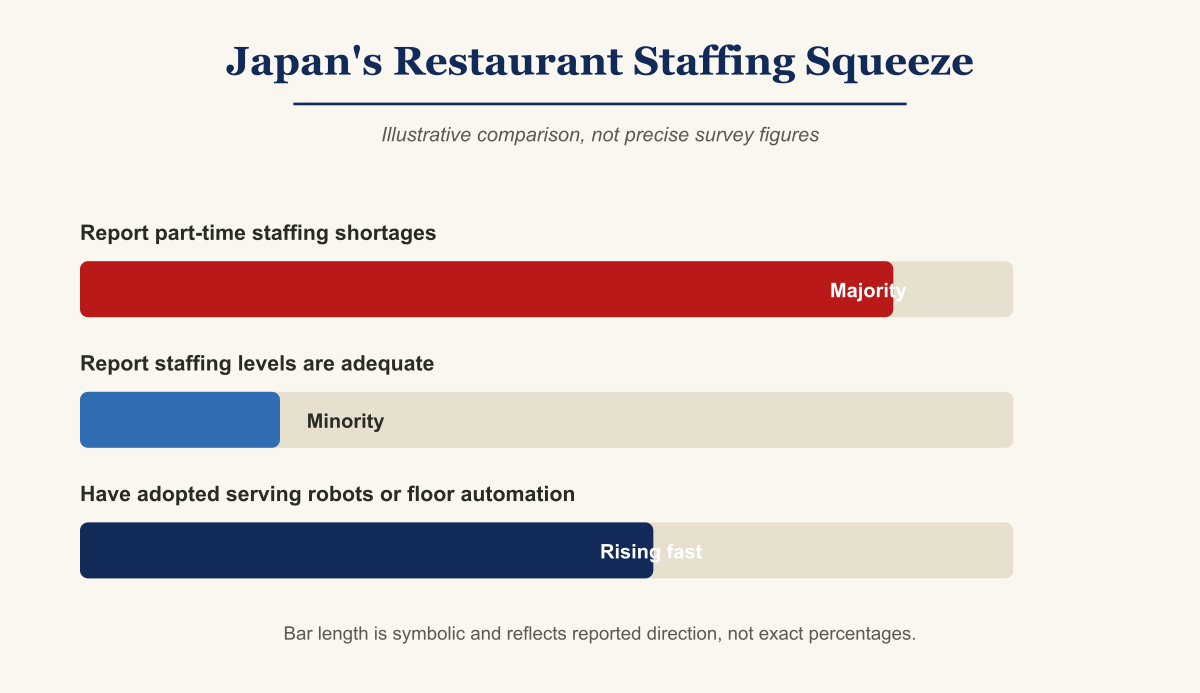
Behind the cute face is a spreadsheet, and the spreadsheet is not subtle. Japan’s food service industry has been in a structural labor crunch for years, driven by a shrinking working-age population and a service sector that has long depended on part-time and student labor to staff evening and weekend shifts. Survey data from Teikoku Databank, one of Japan’s major credit research firms, has repeatedly found that roughly seven in ten restaurant operators report difficulty filling part-time positions — a level of chronic understaffing that makes “we can’t find enough servers” less a periodic complaint and more a permanent operating condition.
Against that backdrop, a robot that works every shift, never calls in sick, never quits with two weeks’ notice, and does not need to be scheduled around exam season is not a luxury purchase — it is closer to a hedge against a labor market that is not going to loosen up. The financing models reflect that logic. SoftBank Robotics, which brought Bear Robotics’ Servi model into the Japanese market, structured its offering as a three-year rental running under 100,000 yen a month, deliberately priced to undercut what a restaurant would otherwise spend on a single part-time staffer’s monthly wages, benefits, and turnover costs. Pudu’s units, deployed at Skylark’s scale, follow a similar operating logic even where restaurants purchase rather than lease: the unit cost gets compared not against “doing nothing” but against the fully loaded cost of a human position that increasingly cannot be filled at any price, in any case. When the alternative to automating is simply not having enough staff to open a restaurant’s full seating capacity during a dinner rush, the return-on-investment conversation stops being about efficiency and starts being about whether the location can function at all.
Across the Pacific, the Same Pressures Produce a Different Answer
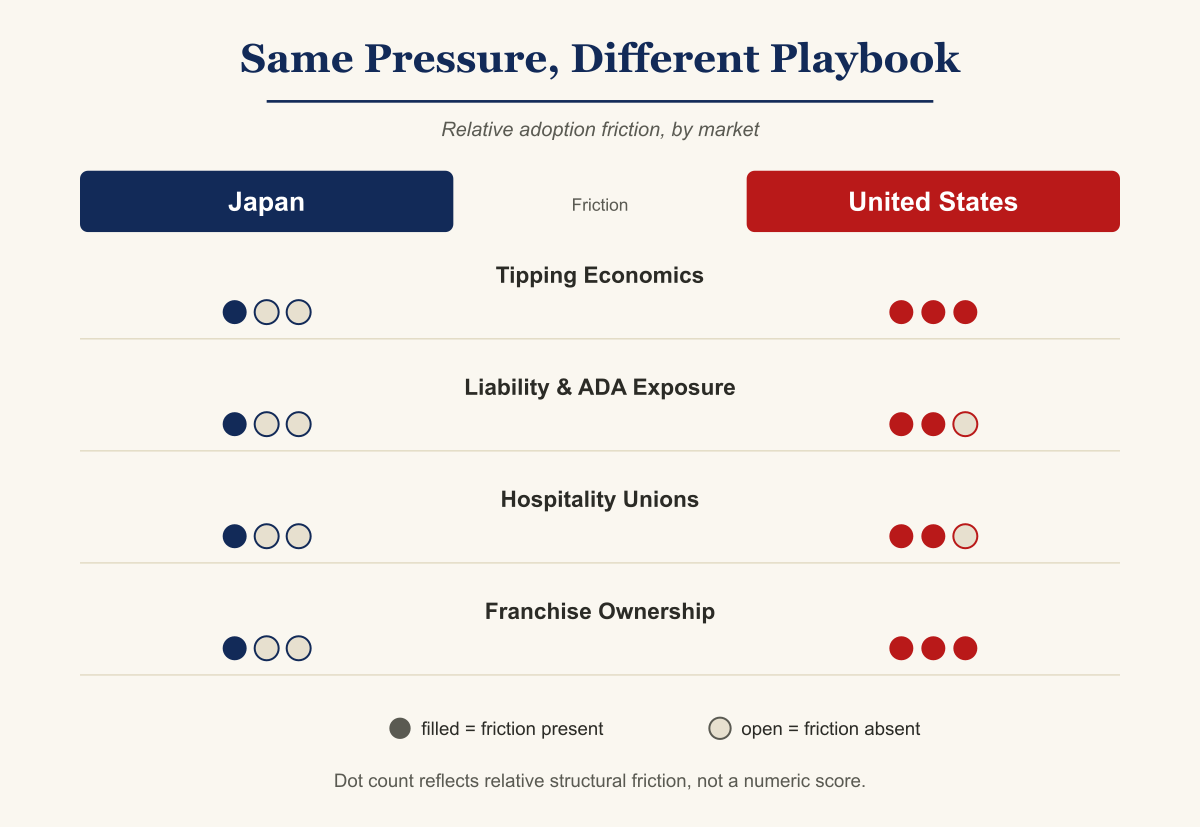
Here is what makes this genuinely interesting rather than just a “Japan does robots, how quirky” story: the United States restaurant industry is under comparable strain, and American executives are not blind to what Skylark and its peers have done. In Popmenu’s 2025 operator survey, 45 percent of American restaurant operators said they planned to further automate front-of-house functions and 59 percent said the same about their online-facing ones, and hourly wages in accommodation and food service have climbed well past twenty dollars an hour in many markets, alongside chronic difficulty filling open positions. On paper, the American case for serving robots looks at least as strong as the Japanese one. In practice, walk into a full-service American chain restaurant today and you will almost never see one gliding between the tables. The gap is not about technology — Bear Robotics, the company behind Servi, is itself American, headquartered in Redwood City, California, and its robots roam plenty of restaurants in Asia. The gap is structural, and it comes down to at least four forces that simply do not exist, or exist far more mildly, in Japan.
The first and most fundamental is tipping. In Japan, service staff earn a flat wage with no tipping expectation, so the cost of a server is transparent, fixed, and easy to compare directly against the cost of a robot. In the United States, tipped servers in full-service restaurants often earn total compensation, driven by gratuities, that far exceeds the state or federal tipped minimum wage — meaning the “cost” a restaurant is weighing against a robot purchase is frequently subsidized by the customer, not fully borne by the operator. That distorts the return-on-investment math in a way that has nothing to do with efficiency and everything to do with who is actually paying for the labor. A robot that could theoretically do a server’s walking does not touch the part of the job — and the part of the compensation — that tipping is built around, which is the interpersonal service exchange itself.
The second is legal exposure, and this one surprises people outside the industry. The United States has an unusually active landscape of litigation tied to accessibility, premises liability, and workplace injury, and a wheeled robot navigating a dining room full of the public introduces a new category of risk that corporate legal departments have to underwrite before a single unit gets deployed: a robot colliding with a customer using a mobility device, a robot blocking an accessible path in violation of the Americans with Disabilities Act, a scalding tray tipping onto a patron, a server injured while working around an unfamiliar autonomous machine. None of these risks are hypothetical, and in a country where restaurant chains already spend heavily on liability insurance and legal defense, the marginal legal risk of introducing robots into a dining room is a real line item, not a footnote. Japan’s much lower rate of premises litigation means this cost barely factors into the equation there at all.
The third is organized labor. Union density in American food service is low overall — the Bureau of Labor Statistics puts membership in food services and drinking places at under two percent — but it is highly concentrated, and where it exists it bites. Hospitality unions such as UNITE HERE hold real bargaining power in unionized hotel, casino, airport, and urban food-service settings, and automation that touches staffing levels is exactly the kind of change that triggers formal grievance processes, contract renegotiation, and public labor disputes — the sort of friction that made headlines when hotels and casinos tried to introduce robotic room service or cleaning during recent contract fights. Full-service chain restaurants operating in unionized markets have to treat a serving-robot rollout as a labor relations decision, not just a capital expenditure decision. Japan’s hospitality workforce, dominated by part-time and non-regular staff with comparatively little collective bargaining infrastructure in the restaurant sector, has nothing resembling that friction.
The fourth is ownership structure. Roughly three-quarters of American chain restaurant locations are franchised or licensed rather than company-operated — the share is far higher in limited-service chains and more mixed in full-service dining, where industry estimates put it closer to a third, though many of the largest casual-dining brands still lean heavily on franchisees. Where that structure applies, it means the parent company that might want to project a modern, automated brand image does not actually control the capital budget of the individual restaurant that would need to buy or lease a robot. A franchisee running on thin margins, already paying royalties and marketing fees back to headquarters, has to be individually convinced that a robot pays for itself — store by store, owner by owner — rather than receiving a single top-down mandate the way Skylark, which owns and operates the overwhelming majority of its own locations directly, was able to issue. That single difference in corporate structure explains a meaningful share of why an American equivalent of “3,000 robots, one order” has essentially never happened.
The Kitchen Is Moving Faster Than the Dining Room
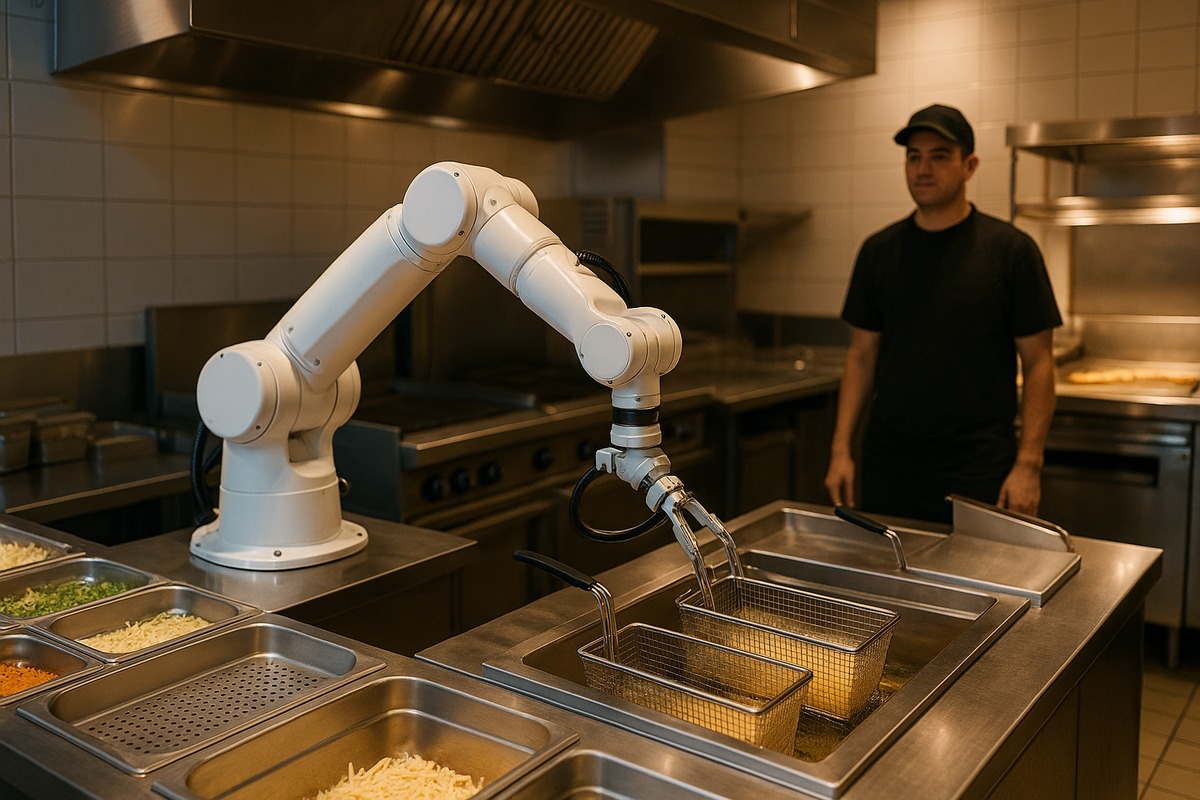
None of this means American restaurants are ignoring automation — they are simply automating a different part of the building first. Fast-casual and quick-service chains including Chipotle and White Castle have been piloting kitchen-side robotics: automated fry stations, robotic tortilla assembly, back-of-house systems that never face a customer, never navigate a dining room, and crucially never raise the tipping, liability, or labor-relations questions that a front-of-house robot immediately triggers. That is a rational sequencing decision, not timidity. Kitchen automation delivers labor savings without touching the parts of the American dining experience — personal service, tipped interaction, the presence of a human being at the table — that carry the most cultural and legal weight. Serving robots have shown up in the U.S. mostly in narrow, lower-risk contexts: fast-casual counters, food courts, a handful of pilot programs at chains like Chili’s parent Brinker International that were later scaled back, and quick-service formats where the “server” role barely exists in the traditional sense anyway.
Kura Sushi’s American locations are the clearest bridge between the two markets, and they are telling in what they chose not to import. The chain brought its Japanese robot-serving concept across the Pacific, but rather than replicate the full Skylark model, it kept the conveyor belt as the primary delivery mechanism for sushi itself and limited the robots to secondary tasks like drinks and condiments. That is not a technology limitation — it is a calculated read of what an American dining room will tolerate and what an American legal and labor environment will underwrite.
What Would Actually Have to Change
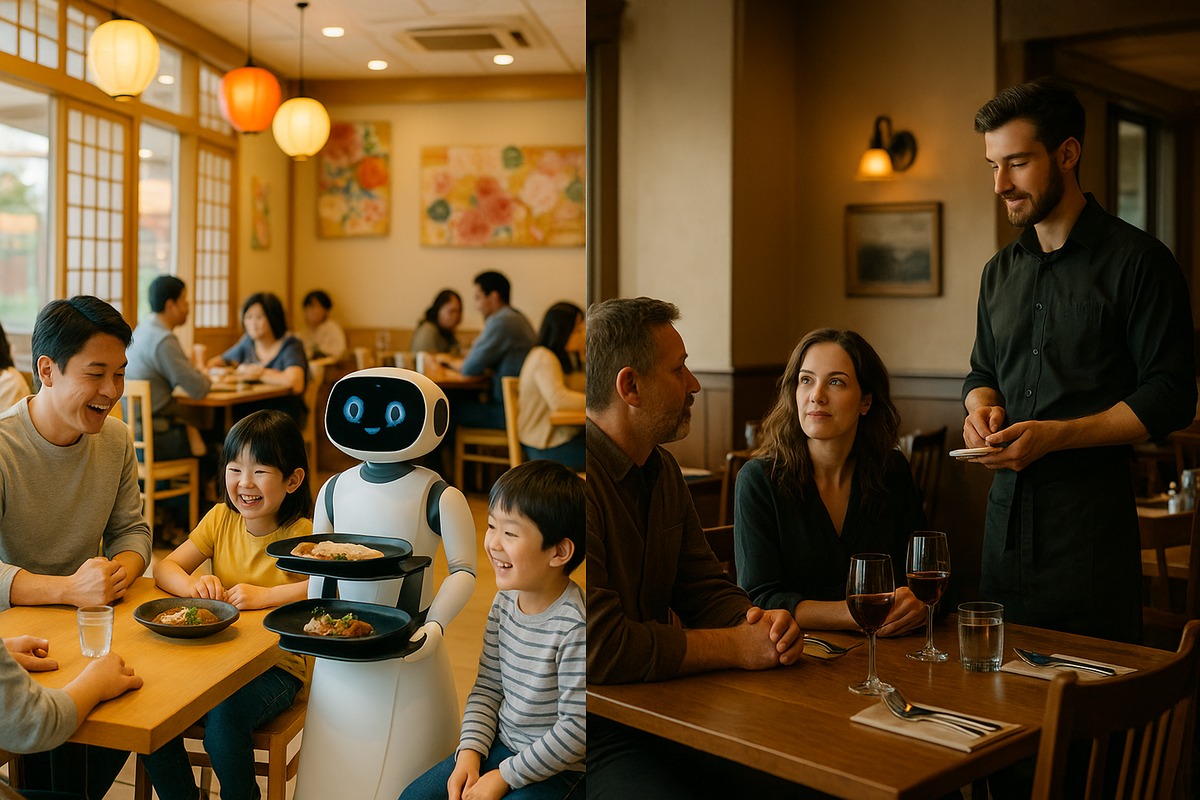
The honest prediction is not that American restaurants will suddenly adopt the Skylark playbook wholesale, but that the pressure pushing them toward some version of it is not going away. Labor costs in food service are on a long upward trajectory, workers are not returning to full-service restaurant jobs in the numbers the industry wants, and the technology itself keeps getting cheaper and more capable, which quietly erodes one of the barriers over time. What is less likely to erode quickly are the tipping norms, the litigation environment, and the franchise structure that make Japan’s approach hard to transplant directly. If serving robots do spread further in the United States, the more plausible path runs through formats that sidestep those specific frictions: company-owned fast-casual chains rather than franchised full-service ones, ghost kitchens and delivery-only operations with no dining room liability to speak of, and markets where labor shortages have become severe enough that the legal and cultural resistance simply gets outweighed. Japan did not solve a technology problem. It solved a structural one, by having fewer structural obstacles in the way. The United States has the same technology sitting on the shelf. What it does not yet have is Japan’s absence of friction.
Frequently Asked Questions
Q. Where can I actually see one of these robots in action?
A. Skylark-owned chains such as Gusto, Bamiyan, and Shabu-yo have them across the large majority of their Japanese locations, and Kappa Sushi and Kura Sushi have deployed them in various forms as well. Outside Japan, Kura Sushi’s American restaurants use a limited version of the same technology for drinks and condiments, though sushi still travels by conveyor belt.
Q. Are serving robots actually used in American restaurants at all?
A. Yes, but far more narrowly than in Japan. They tend to show up in fast-casual chains, food courts, and a handful of pilot programs rather than in full-service dining rooms, where tipping norms, liability exposure, union presence, and franchise ownership structures all make wholesale adoption harder to justify.
Q. How much does a restaurant robot cost to operate?
A. Pricing models vary by vendor and market, but Japanese deployments have leaned heavily on rental and leasing structures — SoftBank Robotics, for example, offered its Servi robot on a three-year rental plan priced under 100,000 yen a month specifically to undercut the cost of a part-time staff position. In the United States, robot vendors typically price units in a range that restaurant groups compare against loaded labor costs, with return-on-investment periods commonly cited in the one-to-three-year range depending on volume and configuration.
Q. Do these robots replace kitchen staff, not just servers?
A. No. The robots discussed here are exclusively front-of-house delivery and bussing units — they do not cook. Kitchen-side automation, such as automated fryers or robotic food assembly, is a separate category of technology that some American chains are actually adopting faster than serving robots, precisely because it avoids the dining-room complications described above.
Q. Can I get my hands on one of these robots, even just as a collectible?
A. Not the working restaurant unit, but Pudu Robotics’ BellaBot has become popular enough that Japanese model kit maker Kotobukiya produces a scaled plastic model kit of it, available through Amazon, for anyone who wants a desk-sized version of the cat-faced server without opening a restaurant.
Conclusion
What struck me most, watching my kids wave goodbye to a robot that could not actually wave back, was how little the technology itself mattered to the outcome. Pudu and Bear Robotics did not invent anything America’s own robotics companies could not build. What Japan had, and still has, is a restaurant industry backed into a corner tight enough that the fastest available fix — a wheeled cart that never gets tired, never quits, and never needs a tip — stopped being a novelty and started being infrastructure. America’s restaurant industry is heading toward a similar corner. It just has more walls to knock down first: a tipping system that hides the true cost of service labor, a legal environment that turns every new object in a dining room into a liability question, a union movement with real leverage in hospitality, and a franchise structure that spreads decision-making across thousands of individual owners instead of one boardroom. None of those walls are permanent. But until they move, the cat robots are staying on their side of the Pacific.
This article contains affiliate links. If you purchase through these links, we may earn a small commission at no extra cost to you.
If you’re interested in this topic, the Japanese market more broadly, or what KETCHUPs is working on, we’d love to hear from you — please reach out via our contact form.
Japan Market Pulse is a weekly read on what the Japanese consumer-tech, food, and mobility markets are choosing to do, written for international operators who want to know what is happening before it shows up in the global trade press.
Subscribe at ketchups.co/japan-market-pulse.