

This article is published by KETCHUPs, a Tokyo-based trading and brand-development firm. All content is editorial.
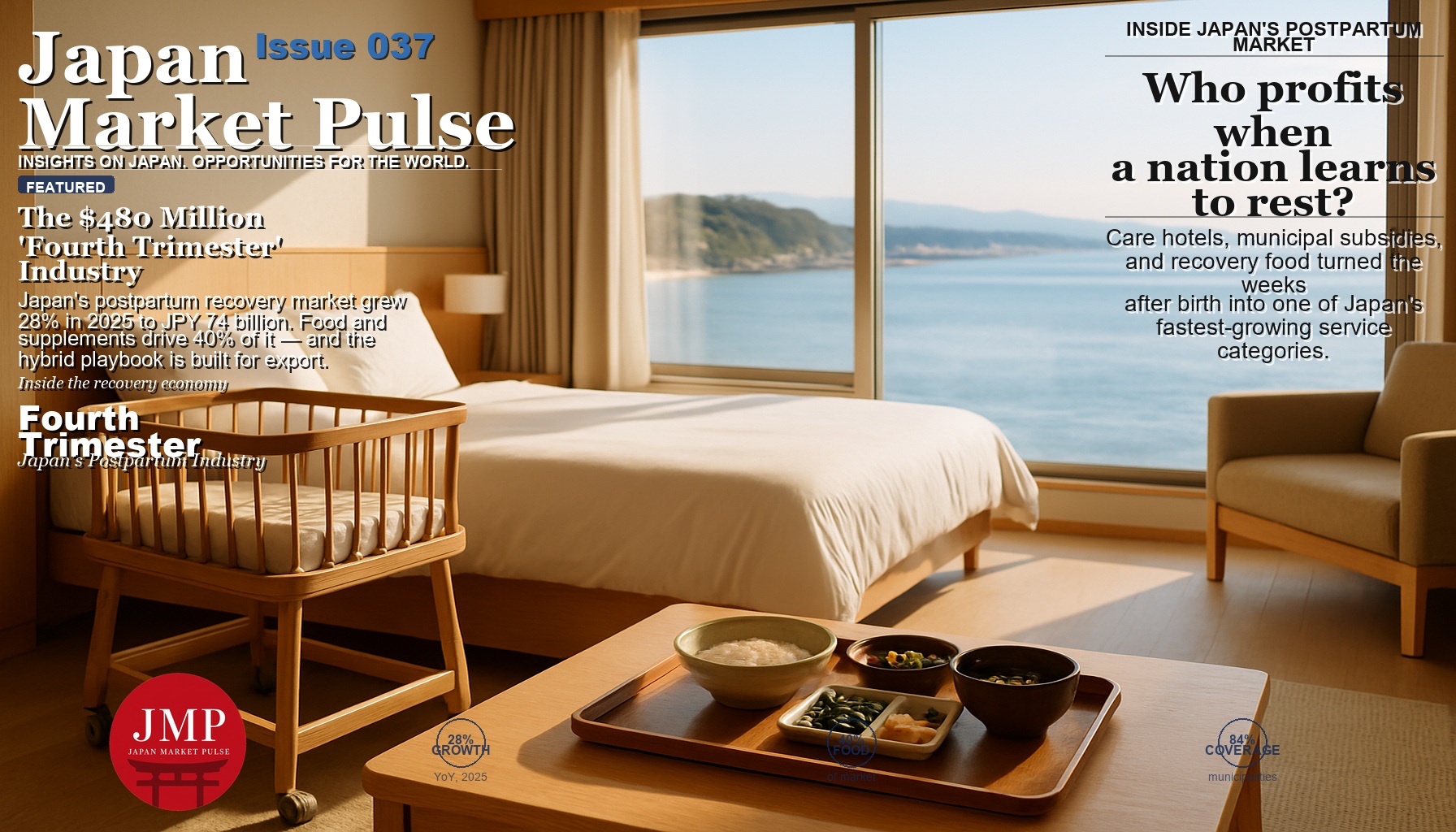
There is a hotel on the Hayama coastline, about an hour south of Tokyo, where the guests check in carrying newborns and check out weeks later looking — by their own accounts — like functioning human beings again. The first time a friend told me she had booked a month there after her second child, I assumed it was a luxury splurge, the kind of thing you see once and never again. I was wrong. What she had booked was a room in one of the fastest-professionalizing service categories in Japanese consumer health, and the numbers behind it tell a story that American operators and femtech investors should be paying close attention to.
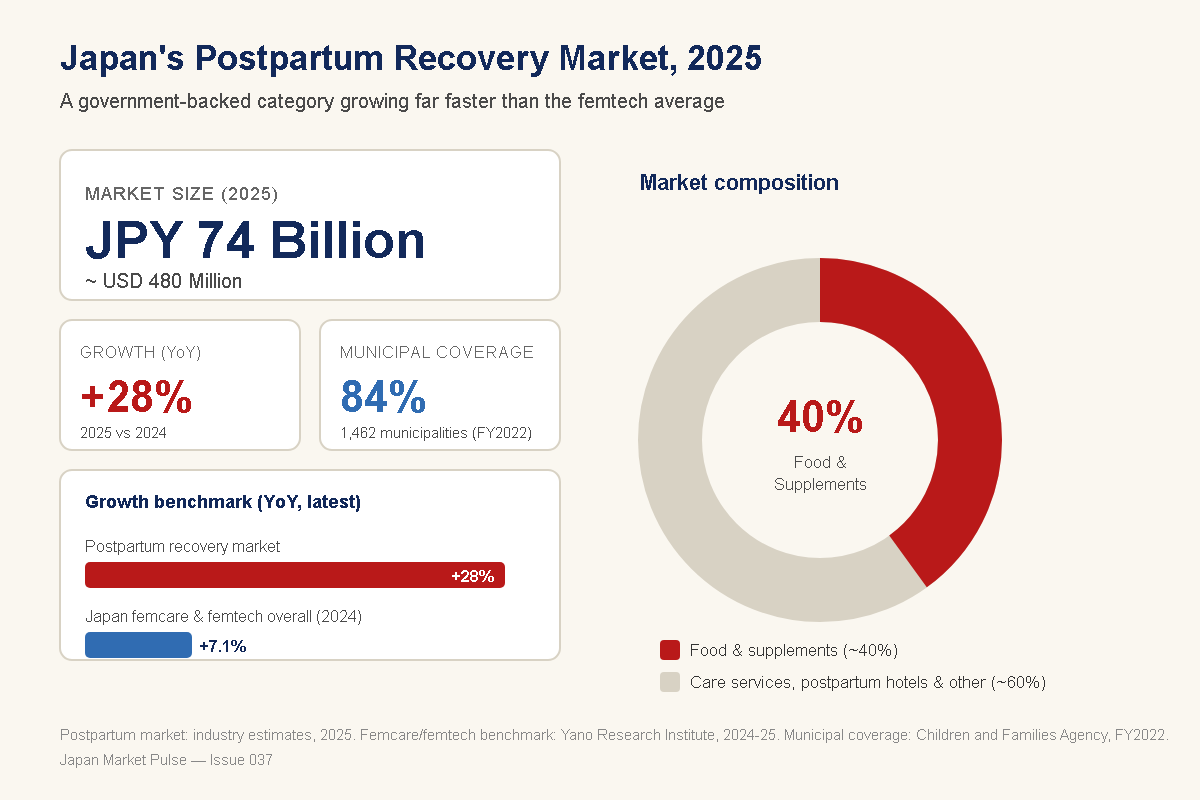
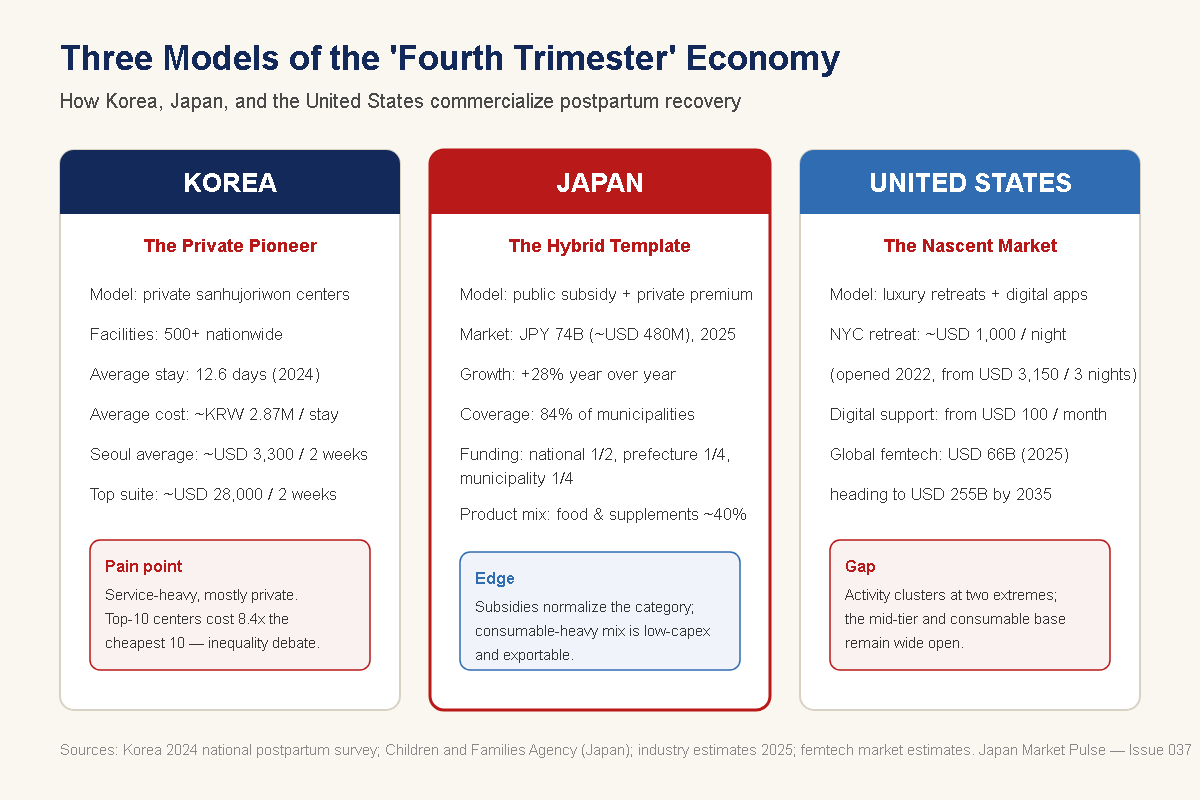
Japan’s postpartum recovery market grew roughly 28 percent in 2025, reaching approximately 74 billion yen — about 480 million US dollars. Food and supplements account for roughly 40 percent of that figure, which is itself a tell: this is no longer a niche of boutique hotels for wealthy Tokyo mothers. It is a layered industry with a mass-market consumable base, a government-subsidized service middle, and a premium hospitality top — and it is maturing in a country where the number of births falls every single year.
That paradox is the whole story. Japan is building a growth industry on top of a shrinking customer base, and doing it successfully. After twenty years of living here and watching consumer categories rise and fall, I can tell you that when Japan manages that trick, the underlying playbook usually travels well.
The Quietest Boom in Japanese Consumer Health
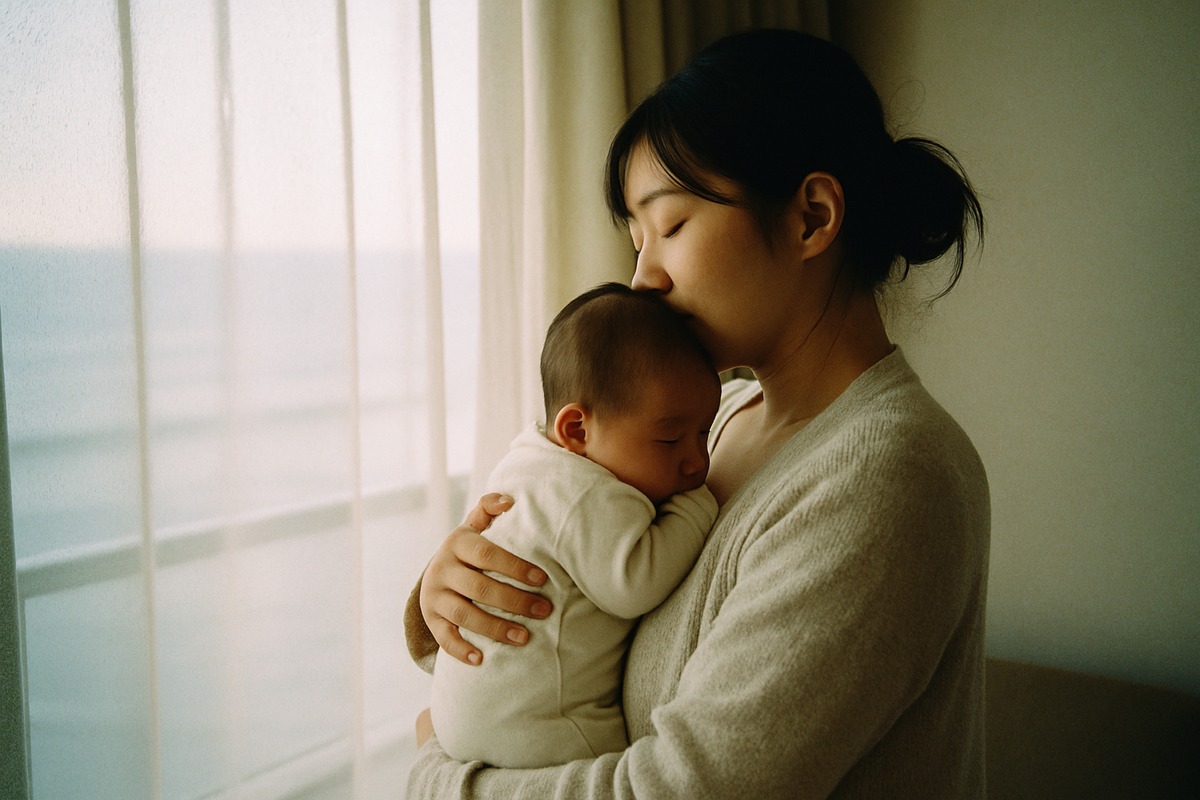
Let me put that 74 billion yen figure in context, because Japanese market statistics can be slippery if you do not know what sits inside them.
The postpartum recovery market, as the industry counts it, spans four broad layers. At the base are specialized foods and supplements — meal kits formulated for recovering and breastfeeding mothers, iron and protein products, traditional warming foods updated into convenient formats. That is the roughly 40 percent slice. Above it sit services: overnight postpartum care facilities, day-care programs where a mother can hand over the baby and sleep, and outreach visits from midwives and helpers. Then come the dedicated postpartum hotels, the most visible and most photographed layer. Finally there is a thin but fast-growing layer of digital products and consumer goods built specifically for the recovery window.
For broader context, Yano Research Institute, one of Japan’s most established market research firms, estimated the country’s overall femcare and femtech market for consumer goods and services at 80.4 billion yen in 2024, up 7.1 percent year over year, with a forecast of 88.9 billion yen for 2025. Against that backdrop, a postpartum segment growing at 28 percent is not riding a general femtech wave — it is dramatically outpacing it.
What changed is not the biology of recovery. What changed is that Japan stopped treating the weeks after birth as a private family matter and started treating them as a service category — with a legal framework, a subsidy structure, and a product shelf. The industry even borrowed the American clinical phrase for it: the “fourth trimester,” the twelve weeks after birth when a mother’s body and mind are still very much in transition. Japan did not invent the concept. It is, however, building the most complete commercial answer to it that I have seen anywhere.
Why Japan Suddenly Needed an Industry for Something Grandmothers Used to Do
For most of the postwar period, Japan handled postpartum recovery through a custom called satogaeri shussan — returning to your hometown to give birth and then spending the first month or two being fed and supported by your own mother. It was an elegant informal system, and it is collapsing in slow motion.
The reasons will sound familiar to anyone watching family structures anywhere in the developed world, but they are sharper here. Japanese women now have their first child later, which means their own mothers are older — often in their late sixties or seventies, sometimes still working, sometimes themselves needing care. Households have migrated to greater Tokyo and other metros, far from hometown support networks. And the share of households where both partners work full time keeps climbing, which means a husband taking extended leave to cover the gap is still more the exception than the rule, despite genuinely improving paternity leave policies.
Strip out the informal family safety net and what remains is a stark service vacuum at the most physically vulnerable moment in many women’s lives. Researchers in maternal health have documented that the overwhelming majority of women — studies commonly cite a range of 87 to 94 percent — experience at least one health complication in the immediate postpartum period, and over a third report longer-term issues. In Japan, the problem had an extra edge: postpartum depression became a quiet public health crisis, and maternal mental health in the first year after birth turned into a policy priority at the national level.
Here is the part I find most characteristically Japanese. Faced with a vanishing informal institution, the country did not simply exhort families to do better. It professionalized the institution — turned the grandmother’s role into a licensed, subsidized, bookable service with meal plans and night nurseries. That instinct, to convert informal care into formal infrastructure, is exactly what produced Japan’s elder-care industry two decades ago. Postpartum care is following the same arc, just faster.
The Law That Built a Market
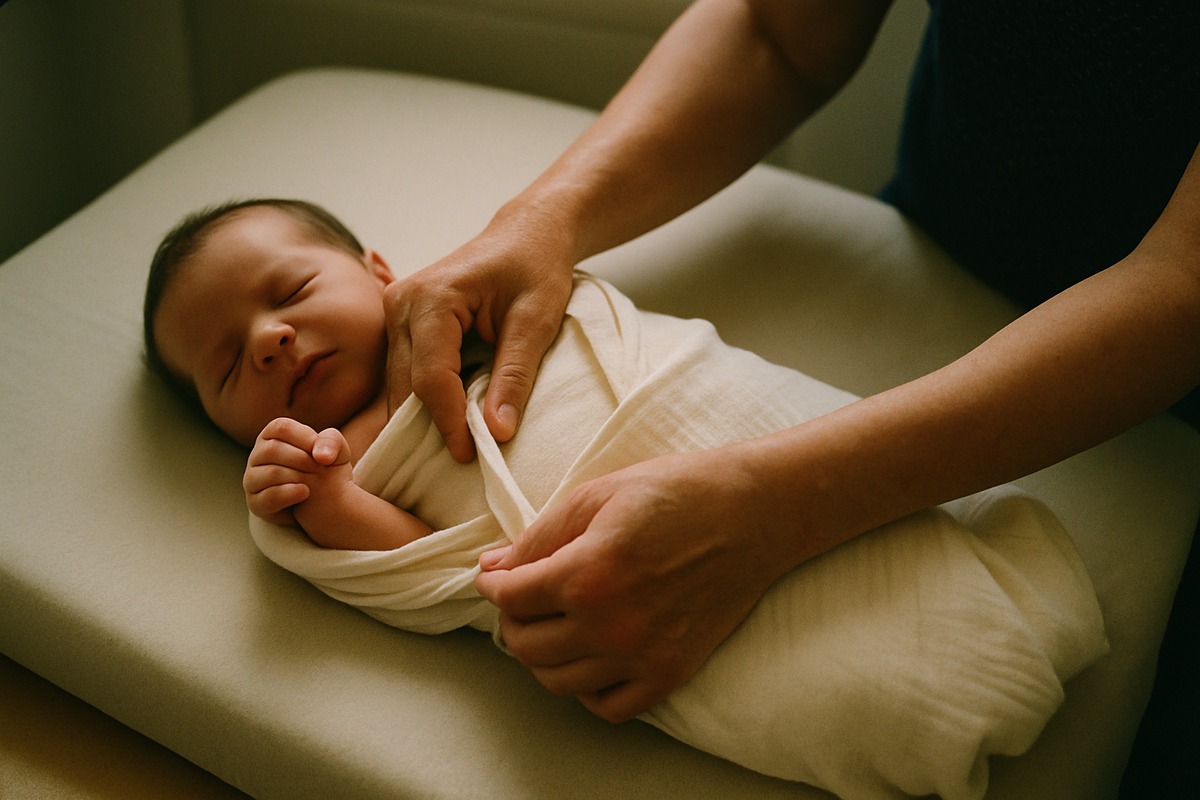
If you want to understand why this market inflected when it did, look at a legal amendment, not a consumer trend.
In 2019, Japan amended its Maternal and Child Health Act to make postpartum care an official responsibility of municipal governments, with the provision taking effect in fiscal 2021. The law defines three service types: overnight stays in care facilities, day-service programs, and outreach visits to the home, generally for use within the first year after birth. Municipalities were instructed to make these available, and the national government set a goal of nationwide coverage by the end of fiscal 2024.
The rollout has been remarkably fast by the standards of Japanese local government. As of fiscal 2022, roughly 84 percent of Japan’s municipalities — 1,462 cities, towns, and villages — were already running postpartum care programs. The national budget line has grown year after year, reaching about 6 billion yen in fiscal 2024, and the cost-sharing formula is straightforward: the national government covers half, prefectures a quarter, and municipalities the final quarter. In 2024, the government went further and removed the cap on subsidies to municipalities, a clear signal that it wants supply to expand rather than ration.
For the user, the practical effect is dramatic. A subsidized overnight stay that might cost tens of thousands of yen at market rate comes down to a few thousand yen per night in many municipalities, with standard fee reductions of 2,500 yen per use for ordinary households and 5,000 yen for low-income households layered on top. In Tokyo’s wealthier wards, some mothers pay almost nothing for their first several nights.
This is the structural insight American readers should sit with: Japan’s postpartum market is not purely a private consumer market. It is a hybrid, where public money builds the habit and private operators build the experience. The subsidy does not crowd out premium services — it normalizes the category, teaching an entire cohort of new parents that handing your newborn to a professional at 2 a.m. is not a failure of motherhood but a standard, government-endorsed part of recovery. Once that psychological barrier falls, the premium tier gets its customers.
Inside the Postpartum Hotel: The Premium Tier Takes Shape
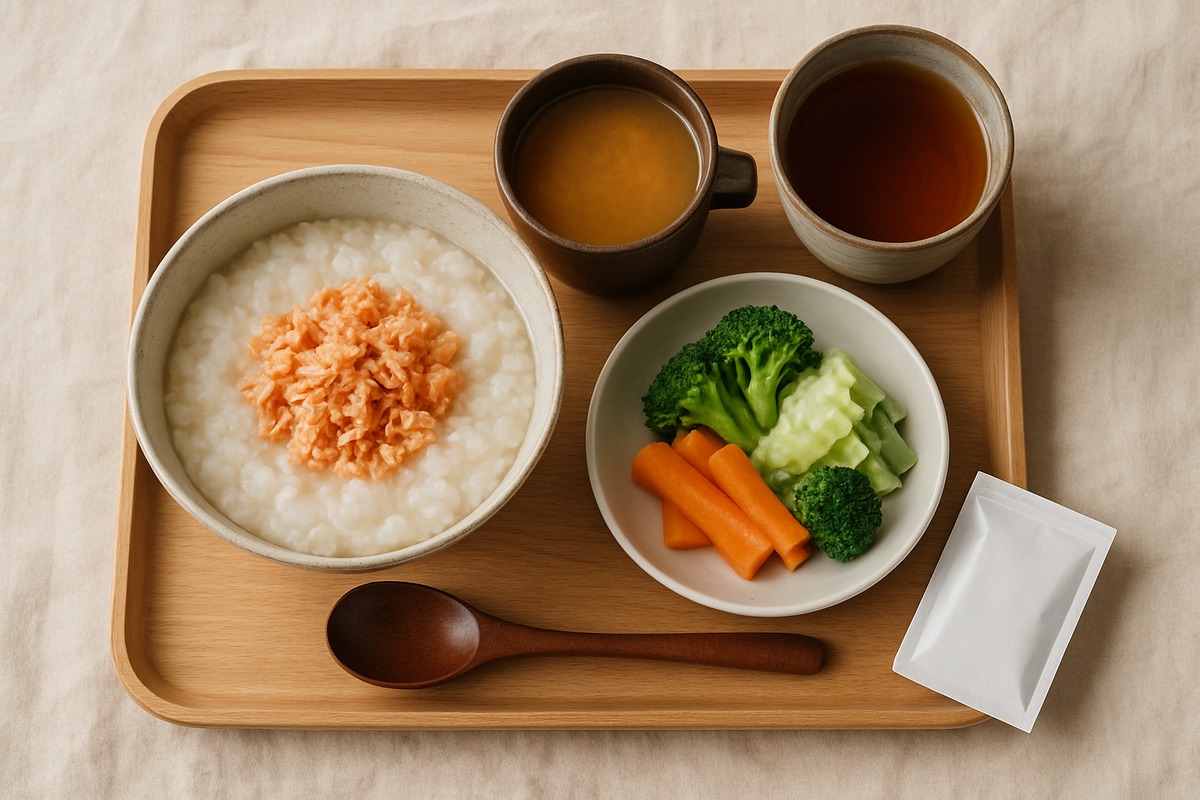
The flagship of that premium tier is Mom Garden Resort Hayama, which opened in December 2021 on the Shonan coast and bills itself as Japan’s largest resort-style postpartum care hotel. The model is simple to describe and hard to execute: a full hotel converted to serve only postpartum families, with midwives and childcare staff on duty around the clock, a 24-hour nursery so mothers can actually sleep, lactation support, recovery-oriented meals, and programs that teach newborn care before the family goes home.
Demand answered quickly. The facility now serves roughly 2,000 families a year — more than 150 a month — and its operator reported that users multiplied 1.8 times within a single year as awareness spread. Established baby brands took notice; Mikihouse, one of Japan’s best-known children’s apparel makers, developed original newborn underwear specifically for babies staying at the facility. Media coverage settled into a familiar rhythm: a celebrity or magazine writer checks in, documents the sleep, the food, and the tearful staff farewell, and bookings climb again.
What strikes me most, having toured this category as a market watcher rather than a guest, is the deliberate hotel-ness of it. These are not clinics with nicer curtains. The product being sold is hospitality — ocean views, course meals, scheduled massage — wrapped around a clinical core of midwife monitoring and mental health screening. The luxury is the Trojan horse; the care is the payload.
The model is now propagating. Across Japan, hotel operators facing soft occupancy have begun converting floors or entire properties into postpartum care use, and new purpose-built facilities are opening in regional cities, often with their local government as an anchor customer through the subsidy program. A pattern worth noting for anyone who has watched Japanese service industries before: the first mover establishes the format, the subsidy establishes the demand floor, and then the conversion wave does the scaling.
The 40 Percent Nobody Photographs: Food and Supplements as the Market’s Engine
The hotels get the magazine spreads, but the largest single slice of Japan’s postpartum economy is something far less glamorous: food. Roughly 40 percent of the market is specialized foods and supplements, and I would argue this is the layer that makes the Japanese template genuinely exportable.
The logic is cultural before it is commercial. East Asian postpartum tradition has always been food-centric — specific warming dishes, soups for lactation, ingredients believed to restore the body. Japan’s food industry has done what it always does with a tradition: industrialized it into convenient, safety-obsessed, beautifully packaged formats. The current shelf includes frozen meal services designed for one-handed eating while holding a newborn, nutrient-fortified soups and rice porridges aimed at recovery and breastfeeding, iron and folate supplement lines repositioned from pregnancy to the postpartum year, and gift sets that let grandparents and coworkers participate in recovery the way they already participate in baby gifts.
That last point deserves emphasis. Japan runs on gift-giving occasions, and the industry has successfully positioned postpartum food as a giftable category — recovery as something your friends can buy for you. It converts a low-frequency personal purchase into a recurring social one, which is precisely the kind of structural demand multiplier that consumer investors hunt for.
The global context says this layer has room to run. The worldwide postpartum health supplement market is estimated at about 1.4 billion dollars in 2025 and projected to more than double by 2034, growing at roughly 9 percent annually. Japan’s contribution to that category is distinctive not in size but in product philosophy: meal-format rather than pill-format, taste-first, designed for daily consumption over a defined twelve-week window rather than indefinite wellness maintenance. A defined consumption window is a marketer’s dream — it creates urgency, gift logic, and a natural subscription length all at once.
The Korean Template — and Where Japan Deliberately Diverged
No honest discussion of this market can skip Korea, because Korea built the original commercial answer to the fourth trimester. The sanhujoriwon — dedicated postpartum care centers where mothers stay for around two weeks — is a default part of Korean birth culture, with more than 500 facilities nationwide. Korea’s 2024 national postpartum survey put the average stay at 12.6 days at an average cost of about 2.87 million won, with Seoul averages near 4.8 million won for two weeks — roughly 3,300 dollars. At the top end, the most expensive center in Seoul’s Gangnam district charges over 40 million won, around 28,000 dollars, for a two-week deluxe-suite stay.
Korea proved the consumer demand beyond any doubt. It also surfaced the model’s pathologies. The Korean market is overwhelmingly private, and the price spread has become a social flashpoint: the average cost among the ten most expensive centers runs more than eight times the average of the ten cheapest, and “which joriwon did you stay at” has become a status marker attached to a newborn. Korean media now regularly frames postpartum care as a symbol of inequality as much as a triumph of maternal support.
Japan, arriving at the category a decade later, has effectively run the same play with a different financing structure. By routing the base of the market through municipal subsidies, Japan made the entry tier nearly universal while leaving the premium tier free to flourish above it. The result is a two-speed market that, so far, has avoided Korea’s inequality narrative — the mother using three subsidized day-care sessions at a local clinic and the mother spending a month at an oceanfront hotel are both, visibly, inside the same system.
There is also a product-mix divergence. Korea’s market is service-heavy; Japan’s, with food and supplements at 40 percent, is consumable-heavy. That makes the Japanese market less capital-intensive at the margin, more accessible to new entrants, and — for foreign operators studying it — much easier to learn from, because a meal-kit playbook crosses borders far more easily than a 50-room care hotel does.
What American Operators Should Steal From This
The United States is, by the data, the developed world’s most underserved postpartum market. The fourth-trimester problem is well documented by American clinicians, and the gap between a standard six-week checkup and what new mothers actually experience has become a recognized failure point in US maternal health. The commercial response is just beginning. Boram, New York’s pioneering postnatal retreat, opened in spring 2022 inside the Thompson Central Park Hotel at around 1,000 dollars a night, has raised seed funding to expand, and added a digital arm offering virtual postpartum support from about 100 dollars a month. Femtech money is circling the space: the global femtech market is estimated at roughly 66 billion dollars in 2025 with projections toward 255 billion by 2035, and maternal health platforms like Maven Clinic have pulled in major venture rounds.
But most American activity clusters at two extremes — luxury retreats for the top of the market and apps for everyone else. Japan’s experience suggests the durable value sits in the layers Americans have barely touched. Three lessons stand out to me.
First, the consumable base is the volume business. Food and supplements built for a defined twelve-week recovery window — giftable, subscription-friendly, culturally legible — represent 40 percent of Japan’s market and require no real estate. For DTC founders, this is the lowest-friction entry point, and the Japanese product architecture is sitting in plain sight, waiting to be studied.
Second, normalization is the real product. Japan’s subsidy did not just lower prices; it reframed professional postpartum care as ordinary. In the US, the equivalent lever is not government — it is employers and insurers. Boram is already pitching itself as an employee benefit, and Japan’s trajectory says that whoever institutionalizes the category first will own the demand it unlocks.
Third, shrinking birth numbers do not mean a shrinking market. Japan’s births decline every year, yet spending per birth is rising fast enough to grow the category 28 percent annually. Fewer children mean each birth is treated as more precious, more invested-in, more serviced. American operators worried about falling US birth rates should study that arithmetic carefully.
I have watched Japan industrialize convenience, hospitality, and elder care over two decades, and the pattern is always the same: take an informal human practice, professionalize it with obsessive operational detail, and let a hybrid of public framework and private polish scale it. The fourth trimester is simply the latest practice to enter that machine. The market template is maturing here in plain view — 74 billion yen and growing — and for once, the rest of the world has the chance to study the playbook while the play is still being run.
If you’re interested in this topic, the Japanese market more broadly, or what KETCHUPs is working on, we’d love to hear from you — please reach out via our contact form.
Japan Market Pulse is a weekly read on what the Japanese consumer-tech, food, and mobility markets are choosing to do, written for international operators who want to know what is happening before it shows up in the global trade press.
Subscribe at ketchups.co/japan-market-pulse.