

This article is published by KETCHUPs, a Tokyo-based trading and brand-development firm. All content is editorial.
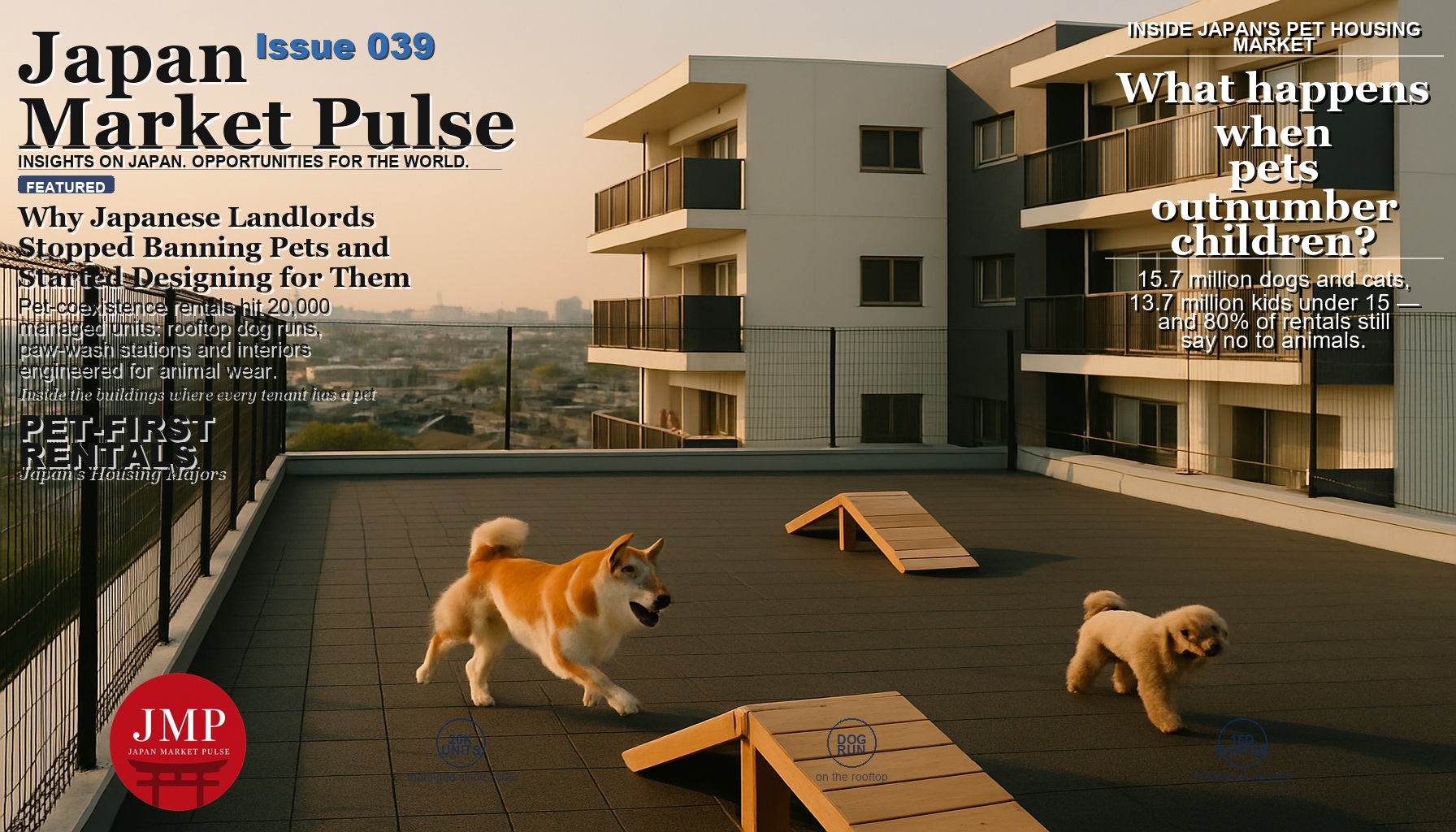
The first time I visited a friend’s apartment building in suburban Tokyo and rode the elevator up to a rooftop dog run — an actual fenced, rubber-matted, off-leash play area on top of a rental apartment building — I remember thinking that somebody in a Japanese housing company had quietly figured out something the rest of the developed world was still arguing about.
This was not a luxury condo tower. It was a mid-rise rental building, the kind of unremarkable three-story apartment block you see repeated tens of thousands of times across Japan’s commuter belts. But every tenant in the building owned a dog or a cat. That was not an accident, and it was not merely tolerated. It was the entire premise of the building.
After twenty years of living in Japan, I have learned that the most interesting market signals here rarely arrive as press conferences. They arrive as infrastructure — as things that get built. And what is getting built right now, at scale, is rental housing designed from the foundation up around the assumption that the tenant’s most important family member walks on four legs. Asahi Kasei Homes, one of Japan’s major housing companies, announced in April 2026 that its pet-coexistence rental housing line had reached 20,000 managed units, twenty years after launching the product in 2006. At the same time, the company rebranded the entire program under a new unified trademark: PAWTNER.
Twenty thousand units is not a pilot program. It is a category. And for American multifamily operators currently bolting dog-washing stations onto buildings that were never designed for animals, the Japanese version of this story is worth a careful read, because it suggests the pet amenity arms race in the United States is being fought on the wrong terrain.
The Country Where Pets Outnumber Children
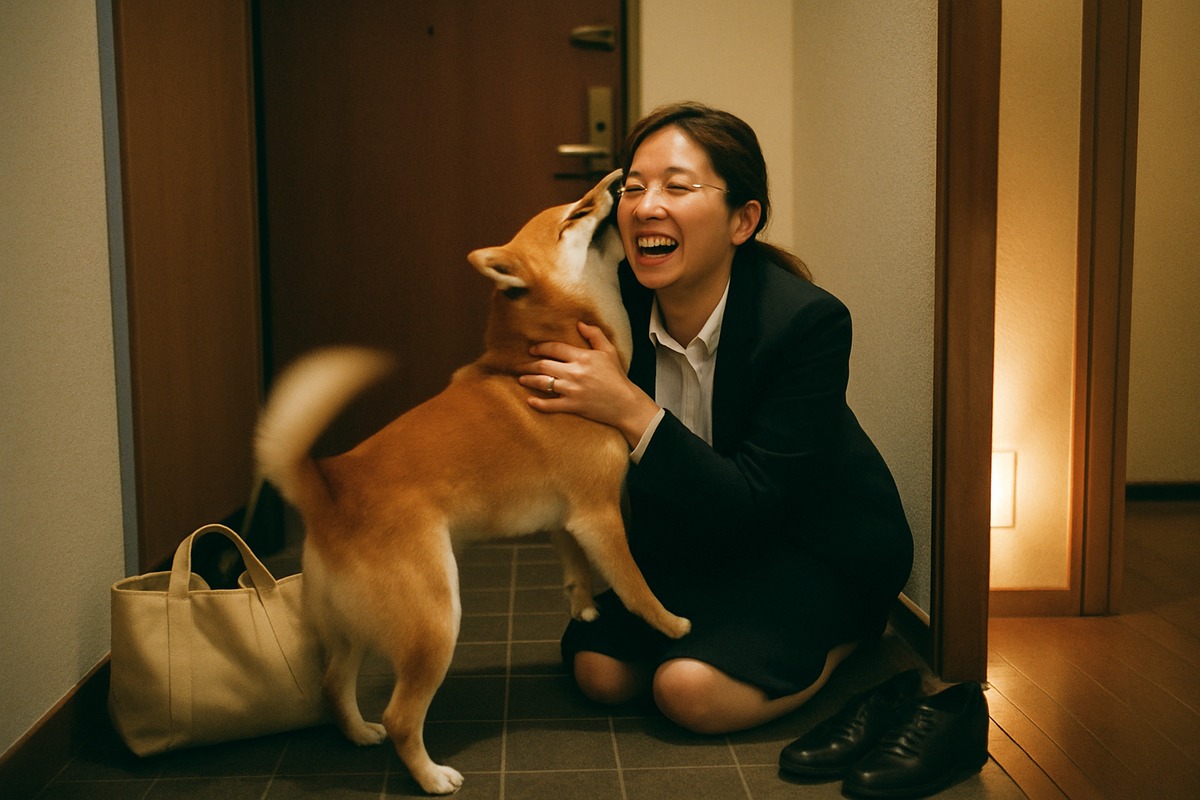
Start with the demographic fact that makes everything else in this story rational rather than eccentric: in Japan, pet dogs and cats outnumber children.
According to 2025 industry survey data cited in Asahi Kasei’s own materials, Japan is home to roughly 6.82 million pet dogs and 8.85 million pet cats — about 15.7 million animals combined. The number of children under fifteen, meanwhile, has fallen to roughly 13.7 million and continues to decline every year. The crossover happened years ago, and the gap keeps widening. Japan is frequently described as the only major economy where this inversion has occurred, and having watched the change happen in real time — fewer strollers in my neighborhood park each spring, more dog buggies — I can tell you it is not a statistical curiosity. It is visible on the sidewalk.
The economic weight behind those animals is substantial. The Yano Research Institute, one of Japan’s most-cited market research firms, put the total pet-related market at 1.91 trillion yen in fiscal 2024, up 2.6 percent year over year, and forecasts roughly 1.93 trillion yen for fiscal 2025 — call it around 13 billion US dollars at recent exchange rates. The growth drivers Yano identifies are telling: premiumization and what Japanese marketers call the “family-ization” of pets, meaning owners increasingly spend on their animals the way previous generations spent on children.
Here is the friction point. Despite all of that, the Japanese rental housing stock has historically been openly hostile to animals. Asahi Kasei’s April 2026 release notes that approximately 80 percent of rental housing in Japan still prohibits pets outright. Japanese leases are famously strict, security deposits are sacred, and landlords have spent decades treating a dog as a guaranteed restoration bill. So you have one of the world’s largest and fastest-premiumizing pet populations, a tenant base that increasingly treats animals as family, and a housing supply where four out of five doors are closed to them.
Any American real estate analyst will recognize what that combination is: not a problem, but a mispriced market.
“Pet-Allowed” Versus “Pet-Coexistence”: The Distinction That Changes the Economics
To understand what Asahi Kasei built, you first need a piece of vocabulary that does not really exist in American leasing: the difference between pet-allowed housing and pet-coexistence housing.
A pet-allowed building is what Americans know well. It is an ordinary building where the landlord has decided, usually reluctantly, to permit animals — often with weight limits, breed restrictions, extra deposits, and a property manager who quietly resents the whole arrangement. The building itself concedes nothing. The drywall is the same drywall. The neighbor who hates barking lives right next door to the beagle.
Pet-coexistence housing inverts every one of those assumptions. In Asahi Kasei’s Hebel Maison pet-coexistence buildings, owning a pet is effectively the premise of tenancy. Everyone in the building is an animal owner. That single design decision dissolves the most expensive problem in pet-friendly leasing, which is not scratched flooring — it is conflict between pet owners and non-pet-owners. When the entire tenant community has self-selected around animals, the noise complaint, the elevator confrontation, and the passive-aggressive lobby notice largely disappear.
The company then wraps process around the premise. Prospective tenants go through interviews with specialized staff who assess how the animal is cared for — vaccination practice, training, temperament — before approval. After move-in, the program layers on services: free veterinary consultations, visits from dog trainers, arrangements for veterinary house calls, and pet transportation support. The April 2026 rebrand to PAWTNER consolidated all of this — the hardware, the screening, the services — under one trademark, which tells you Asahi Kasei now thinks of it as a platform rather than a floor plan option.
I find the screening interview detail the most culturally revealing piece of the whole model. Japanese landlords did not become pet-friendly by lowering standards. They became pet-friendly by building a vetting apparatus rigorous enough that they could trust the animals they let in. It is a very Japanese solution: the answer to risk is not exclusion, it is qualification.
Twenty Years to 20,000 Units: A Quiet Land Grab
The scale milestone deserves a moment, because the timeline tells you how durable this is.
Asahi Kasei Homes launched its pet-coexistence rental product in 2006 — two years before the iPhone reached Japan, for context. The line crossed 20,000 managed units in 2026, and the company marked the twentieth anniversary with the PAWTNER rebrand. This is not a developer chasing a post-pandemic pet bubble. It is a housing company that identified a structural demographic shift two decades ago and compounded on it patiently, building by building, through Japan’s particular model in which a manufacturer constructs rental housing for individual landowners and then manages the units.
That model matters for the economics. Asahi Kasei is not just selling apartments to tenants; it is selling a business case to landowners deciding what to build on inherited plots of land. And the pitch to those landowners is straightforward: in a country with a shrinking population and a chronic rental oversupply in many suburbs, an ordinary apartment building competes on price against every other ordinary apartment building. A pet-coexistence building competes against almost nothing, because 80 percent of the market has locked the demand out.
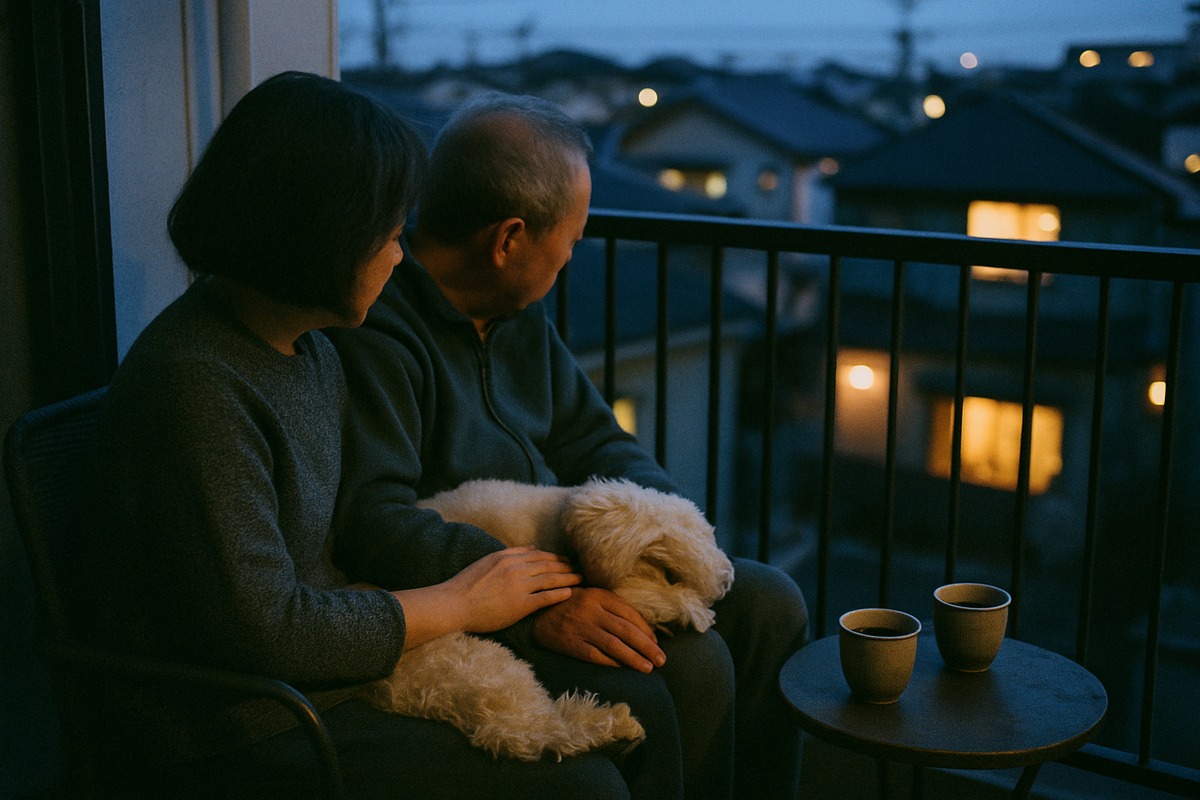
Vacancy is the silent killer of Japanese rental investment, and specialized pet housing is, at its core, a vacancy hedge. The tenant who finally finds a building with a paw-washing station, a community of fellow dog owners, and a landlord who will not flinch at her golden retriever does not browse listings casually two years later. Where does she go? Back into the 80 percent of the market that does not want her? Pet-coexistence housing converts a discriminated-against tenant population into the most loyal tenant population in the country.
The Economics: Higher Rents, Faster Leasing, Longer Stays
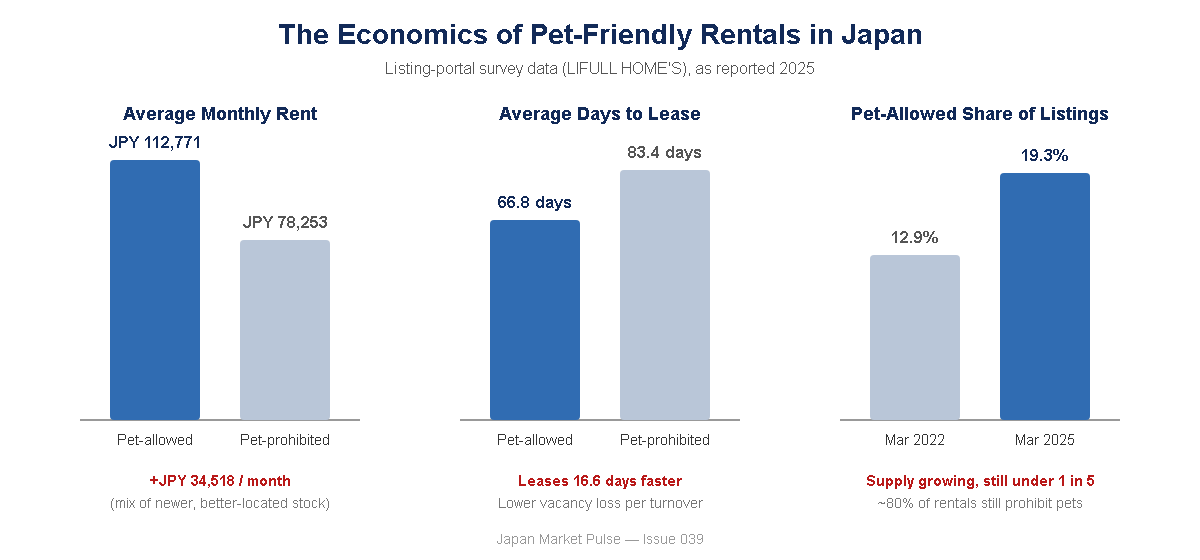
So what does the premium actually look like? Japanese listing-site data gives us unusually clean numbers.
Survey data published by LIFULL HOME’S, one of Japan’s largest property portals, shows pet-allowed rental listings carrying an average rent of 112,771 yen per month against 78,253 yen for pet-prohibited listings — a gap of more than 34,000 yen, or roughly 230 US dollars a month. Part of that spread reflects composition, to be fair: pet-allowed stock skews newer and better located, so the figure should not be read as a pure like-for-like premium. Japanese property managers more commonly describe the achievable premium for comparable units in the range of 5 to 20 percent, with purpose-built pet-coexistence buildings commanding the top of that band and beyond, because the tenant is paying for the dog run and the community, not just for permission.
The leasing velocity data is harder to argue with. The same LIFULL HOME’S dataset shows pet-allowed units leasing in an average of 66.8 days versus 83.4 days for pet-prohibited units — sixteen to seventeen days faster. In a market where every vacant month is pure loss for a small landowner, that statistic alone justifies the renovation budget.
There is a third leg to the economics that the listing data cannot capture directly, but that every property manager I have spoken with here emphasizes: tenure. A pet changes the psychology of moving. Relocating with a dog or cat in a market where four out of five landlords will reject you is not a weekend project; it is a months-long ordeal that most owners will go to considerable lengths to avoid. Longer tenancies mean fewer turnovers, and in Japanese rental economics — where each turnover triggers cleaning, advertising, agent commissions, and the dreaded restoration negotiation — turnover frequency quietly matters as much as headline rent.
And the supply response is visible but still slow: pet-allowed listings rose from 12.9 percent of the LIFULL HOME’S market in March 2022 to 19.3 percent in March 2025. Demand-side surveys fill in the rest of the picture — 67.2 percent of Japanese real estate agencies report rising demand for pet housing, and 91.6 percent of pet owners say they have struggled to find housing, with insufficient pet-allowed inventory the most commonly cited frustration. A market where nine out of ten customers report difficulty buying the product is a market that has not cleared. The premium is not going away soon.
Rooftop Dog Runs and Replaceable Wainscoting: What “Designed for Pets” Actually Means
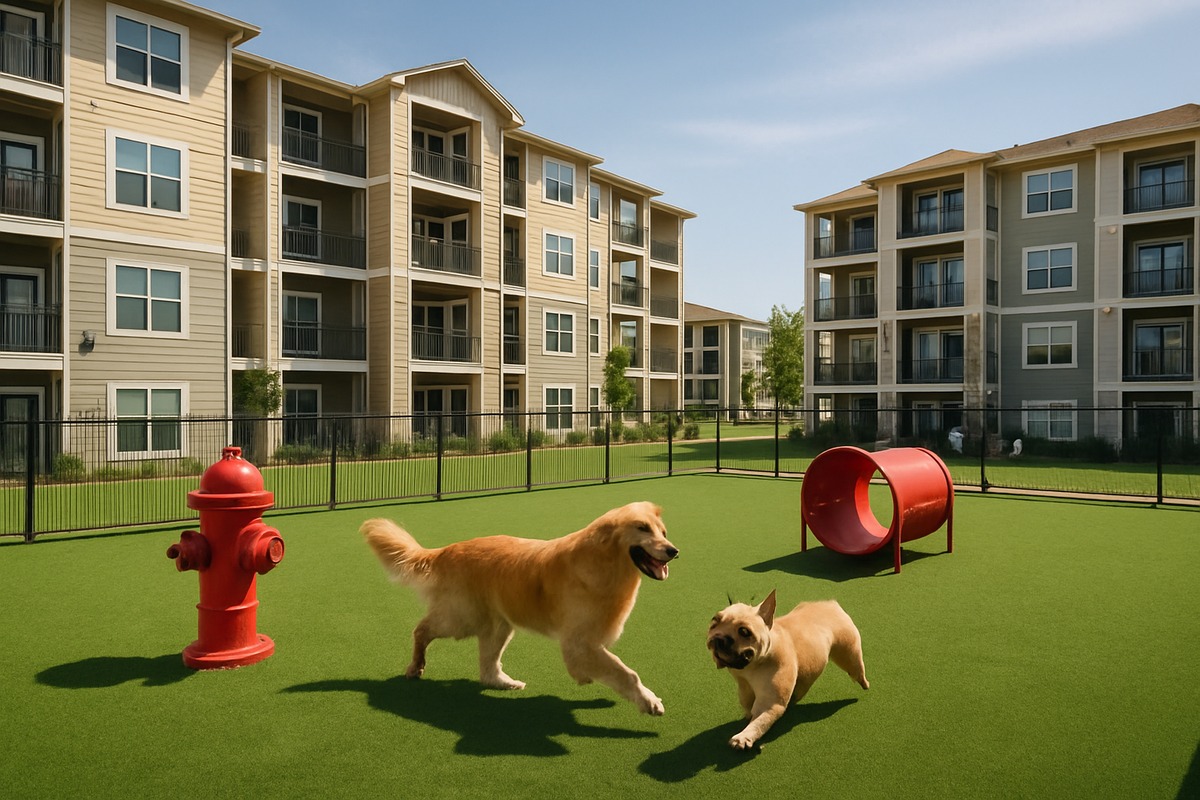
The phrase “pet-friendly design” gets thrown around loosely, so it is worth being concrete about what these buildings physically contain, because the details are where the Japanese approach separates itself.
The headline amenity is the dog run — in some Hebel Maison properties, located on the roof, an ingenious use of space in a country where land is the scarcest input. An off-leash area inside the property line means the morning exercise routine never requires a car trip, which for a working tenant in a Japanese commuter suburb is the difference between owning a dog and not owning one.
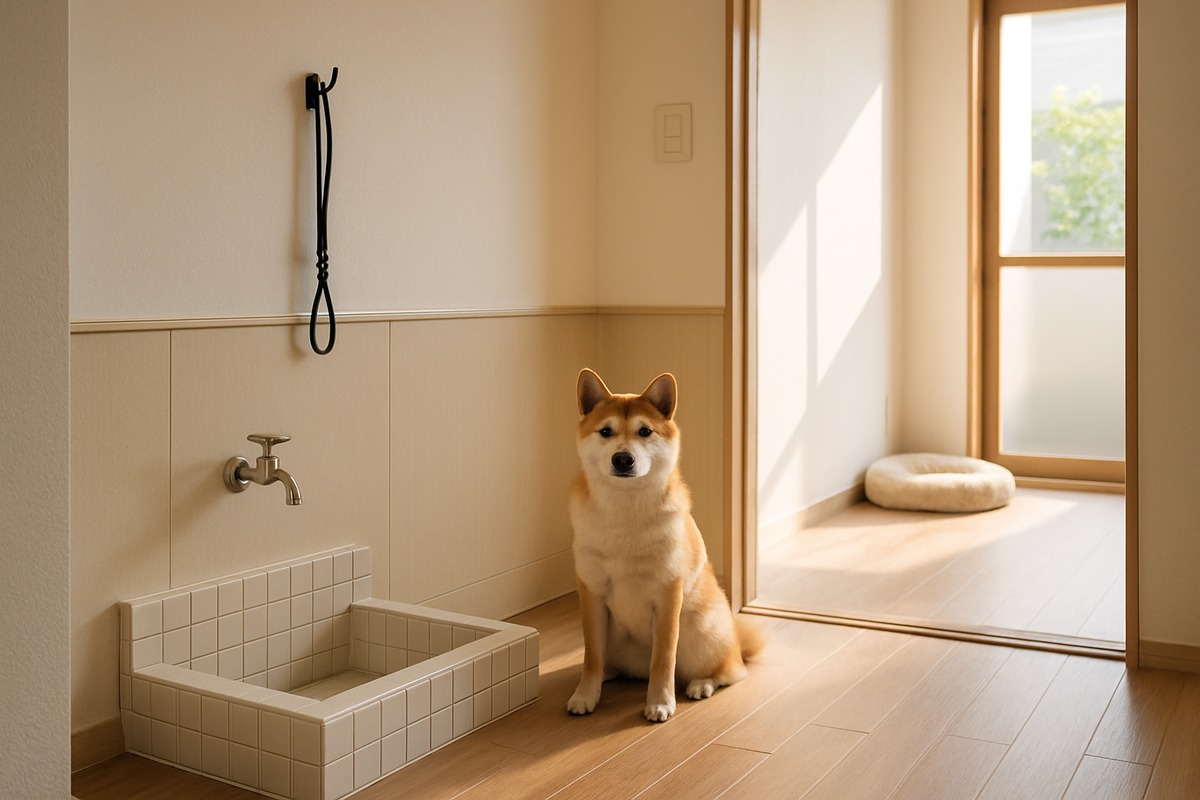
But the cleverest features are the small ones. Paw-washing stations sit at the building entrance, positioned so that the mud from the riverbank walk never reaches the lobby — the architecture enforces the etiquette. Lead hooks are mounted at entrances and in common areas, so an owner can secure the dog while collecting packages or chatting with a neighbor; the hook is a social technology as much as a hardware item, because it makes lingering possible, and lingering is how a building full of strangers becomes a community. Entrances and shared corridors are dimensioned generously so that two leashed dogs can pass without a standoff.
Inside the units, the thinking continues at the level of materials. Wall coverings are installed with a horizontal trim line partway up the wall, so that the lower section — the zone that takes the scratches — can be replaced independently and cheaply at turnover, instead of recovering the entire wall. Flooring is specified for claw resistance. Some units include dedicated pet spaces and air-treatment equipment for odor control. None of this is exotic technology. It is simply what happens when a design team starts from the question “a dog lives here” instead of retrofitting around the question “what if a dog damages this?”
The turnover math is the quiet genius. The standard landlord objection to pets is restoration cost at move-out. The replaceable lower wall covering does not eliminate the damage; it contains the damage to a component engineered to be sacrificial. That is a manufacturing mindset applied to leasing — accept the wear, route it into a cheap consumable, and price the consumable into the premium rent.
America’s Pet Amenity Arms Race Is Fighting on the Wrong Terrain
Now hold the Japanese model up against what is happening in US multifamily, because the comparison is instructive in both directions.
American renters are, if anything, even more pet-saturated than Japanese ones. Roughly 94 million US households owned a pet in 2025, up from about 82 million in 2023, and surveys put pet ownership among renters at well over half — one widely cited dataset showed 59 percent of renters owning at least one pet by 2023, up from 46 percent in 2019. On major listing platforms, the pet-friendly filter is reportedly toggled about twice as often as any other amenity filter, and 57 percent of multifamily renters describe pet acceptance as essential to their leasing decision. The industry has noticed: pet parks now appear in over half of apartment listing descriptions in some analyses, with pet spas and washing stations spreading fast, and the standard monetization stack — pet rent averaging around 35 dollars a month, deposits around 300 dollars, one-time fees of 150 to 300 dollars — is now nearly universal.
On paper, then, the American industry looks further along than the Japanese one: a majority-pet renter base, near-universal monetization, and amenity penetration the Japanese market cannot match. The 2025 surveys of US rental operators show 81 percent reporting growth in resident pet ownership and 68 percent describing their own portfolios as pet-friendly — numbers a Japanese landlord, sitting on a market that is still 80 percent pet-prohibited, would find astonishing.
So American operators are competing on pets. But look at the shape of the competition. It is overwhelmingly an amenity checklist war: add a dog wash in the parking garage, fence a patch of lawn, mention “pet spa” in the listing copy, collect the pet rent. The building itself — the unit interiors, the tenant mix, the screening process, the service layer — remains a general-purpose product with animal fees attached. Pet rent in the US is structured as compensation for tolerating the animal, not as the price of a product built for the animal.
The Japanese model makes three moves the American one has not. First, it curates the tenant community rather than just the amenity list, eliminating the owner-versus-non-owner conflict that drives most pet-related management pain. Second, it engineers the unit interior for animal wear, attacking the restoration cost problem at the materials level instead of the deposit level. Third, it wraps services around the lease — vet consultations, trainer visits — turning the landlord from a pet-tolerator into a pet-care platform, which is exactly the kind of relationship that produces tenure measured in many years.
I will not pretend the model transplants cleanly. The US lacks Japan’s manufacturer-builds-and-manages rental ecosystem, fair housing law shapes what screening can look like, and American breed and size diversity poses design questions that a country of toy poodles and Shiba Inus does not face. But the strategic insight transplants perfectly: in a renter population that is majority pet-owning, the scarce product is not permission, and it is not even amenities. It is a building where the animal is the organizing principle. Nobody of scale is selling that in the American market yet.
What Operators and Investors Should Take From the Japanese Playbook
Strip the story to its transferable lessons and I count four.
First, specialized demand beats general supply in oversupplied markets. Japan has too many ordinary apartments and not nearly enough homes for 15.7 million dogs and cats. Asahi Kasei did not out-build its competitors; it out-defined them, and twenty years later it owns a 20,000-unit category with structurally lower vacancy. Any operator in a softening US metro should recognize the shape of that trade.
Second, the premium is paid for certainty, not square footage. Japanese pet owners pay more and lease faster not because the units are larger but because the search is so painful everywhere else — recall that 91.6 percent of them report difficulty finding housing. Pricing power lives wherever the customer’s alternative is misery.
Third, design beats deposits. The replaceable wall covering and the entrance paw-wash are cheaper, over a tenancy, than the adversarial deposit-and-restoration fight that defines pet leasing in both countries. Engineering the wear out of the cost structure is a better business than litigating the wear at move-out.
Fourth, services compound the moat. The vet consultations and trainer visits in the PAWTNER program look like perks, but they are really retention machinery and data: a landlord who knows the tenant’s dog by name has a tenant who does not move.
Twenty years ago, a Japanese housing company looked at a country where the kids were disappearing and the dogs were multiplying, and instead of lamenting the demographics, it built for them. The rooftop dog run I stood on was not a gimmick. It was the most honest piece of demographic analysis I have ever seen poured in concrete — and the 20,000 units behind it suggest the analysis was right.
If you’re interested in this topic, the Japanese market more broadly, or what KETCHUPs is working on, we’d love to hear from you — please reach out via our contact form.
Japan Market Pulse is a weekly read on what the Japanese consumer-tech, food, and mobility markets are choosing to do, written for international operators who want to know what is happening before it shows up in the global trade press.
Subscribe at ketchups.co/japan-market-pulse.