

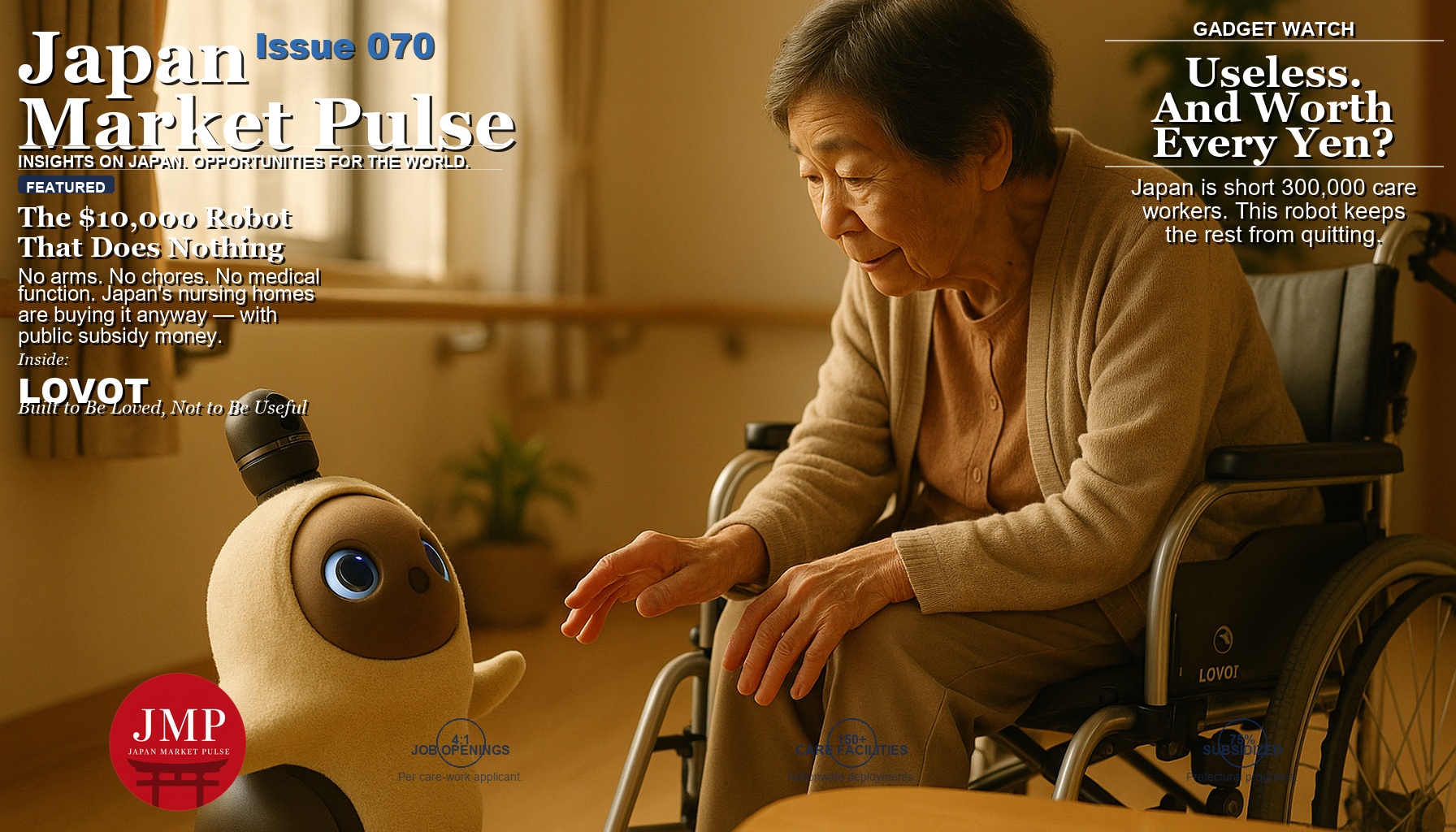
At a long-term care health facility in Oita, on the southern island of Kyushu, a small robot rolls through the common area on two wheels, makes eye contact with a resident in a wheelchair, and wobbles its arms until she reaches out and picks it up. It has no hands. It cannot fetch medication, take a pulse, or lift anyone out of bed. It cannot, by any conventional accounting, do a single job that the facility is legally required to perform. And yet the operator, a social medical corporation called Keiwakai, wrote a purchase order for it, budgeted for a recurring monthly service fee on top of the hardware cost, and has continued the deployment, by its own public account.
I have spent twenty years in Japan watching this country buy things that look irrational from the outside and turn out to be the opposite — vending machines that sell hot canned coffee at 3 a.m. in towns with populations in the low four figures, convenience stores stocked with fresh onigiri delivered three times a day to serve a customer base that could easily survive on a weekly shop. Japan has a specific talent for building infrastructure around needs that a spreadsheet would never surface on its own. GROOVE X’s LOVOT — a warm-skinned, egg-shaped companion robot that costs roughly $10,000 across a hardware purchase and several years of mandatory subscription, and whose founder has said outright that it exists “to be loved, not to be useful” — is now doing the same thing inside one of the most cost-constrained sectors in the Japanese economy: elder care.
This is not a story about a cute gadget going viral in nursing homes. Japan Market Pulse has already covered LOVOT and its rivals as a consumer product, in a two-part series on the companion robot market. This is a different story, and a more useful one for anyone who sells, funds, or studies eldercare technology: it is about how a facility administrator, working inside one of the tightest budget environments in Japanese healthcare, gets a device with zero clinical function past a funding committee — and why, once you see the actual numbers behind Japan’s care-worker shortage, that decision stops looking irrational at all.
The Purchase Order That Shouldn’t Exist
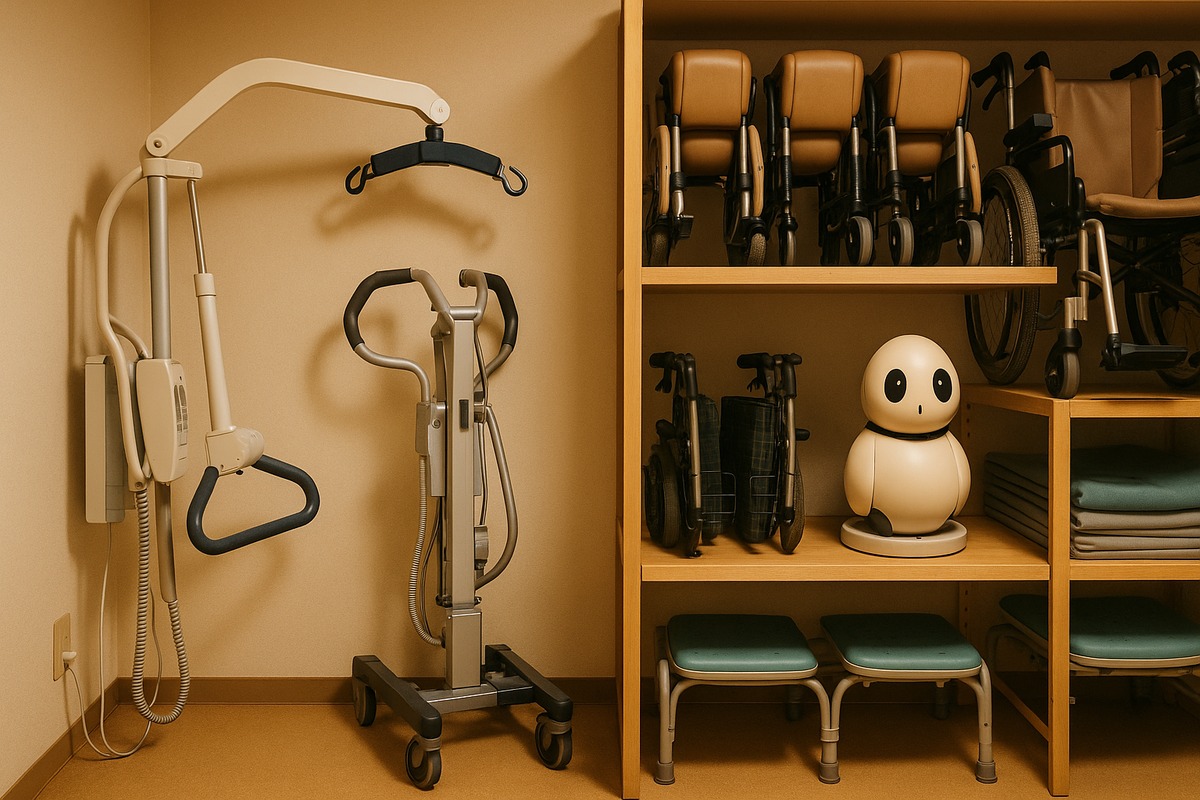
Start with what Japanese nursing homes are actually allowed to spend public money on, because the contrast is the whole story.
The Ministry of Health, Labour and Welfare runs a national eldercare technology subsidy program, administered prefecture by prefecture, that helps facilities buy equipment proven to reduce physical strain on staff and improve safety for residents. The approved categories read like a hospital equipment catalog: powered transfer lifts to move residents between beds and wheelchairs without injuring a caregiver’s back, monitoring sensors that alert night-shift staff when a resident tries to get up unsupervised, wearable exoskeletons that reduce lumbar strain during repetitive lifting. In the most recent supplementary budget, the national pool behind this program was set at roughly ¥22 billion, with individual facilities able to recover a large share of a device’s cost — subsidy rates vary by year and prefecture, with recent schemes covering roughly three-quarters to four-fifths — up to roughly ¥300,000 per unit for most categories, and as much as ¥1 million for transfer and bathing-assist equipment. For years, that list centered on devices that earn their subsidy by doing a job a human would otherwise have to do — though the approved categories have since widened to include dementia-care and communication support devices as well.
LOVOT is on several of those same prefectural equipment lists. Kanagawa Prefecture, among others, has included it in its approved eldercare technology catalog, meaning a facility can apply the same subsidy mechanism built for transfer lifts and fall sensors to a robot whose entire design brief is the opposite of utility — no medical sensors, no lifting capacity, and no certified clinical-monitoring role (its app offers a basic camera/watch-over feature, but it is not a medical monitoring device). It has warm synthetic skin held near body temperature, layered digital eyes that make sustained contact, and a repertoire of movements engineered by former character animators to read as needy rather than useful. A fully equipped third-generation unit runs about ¥577,500 (roughly $3,800) up front, plus a mandatory monthly service plan starting around ¥9,900 — a combination that, financed over a typical multi-year deployment, lands comfortably in five-figure dollar territory once a facility runs two or three units, which is the more common deployment pattern.
Put those two facts next to each other and you get a genuinely interesting picture: a public subsidy system long centered on physical-assistance hardware that has formally widened to treat dementia care and quality-of-life support as fundable categories — wide enough to include a robot with no physical function at all. Understanding why requires looking past the robot and at the budget it is competing against.
The Math Behind an Irrational Purchase
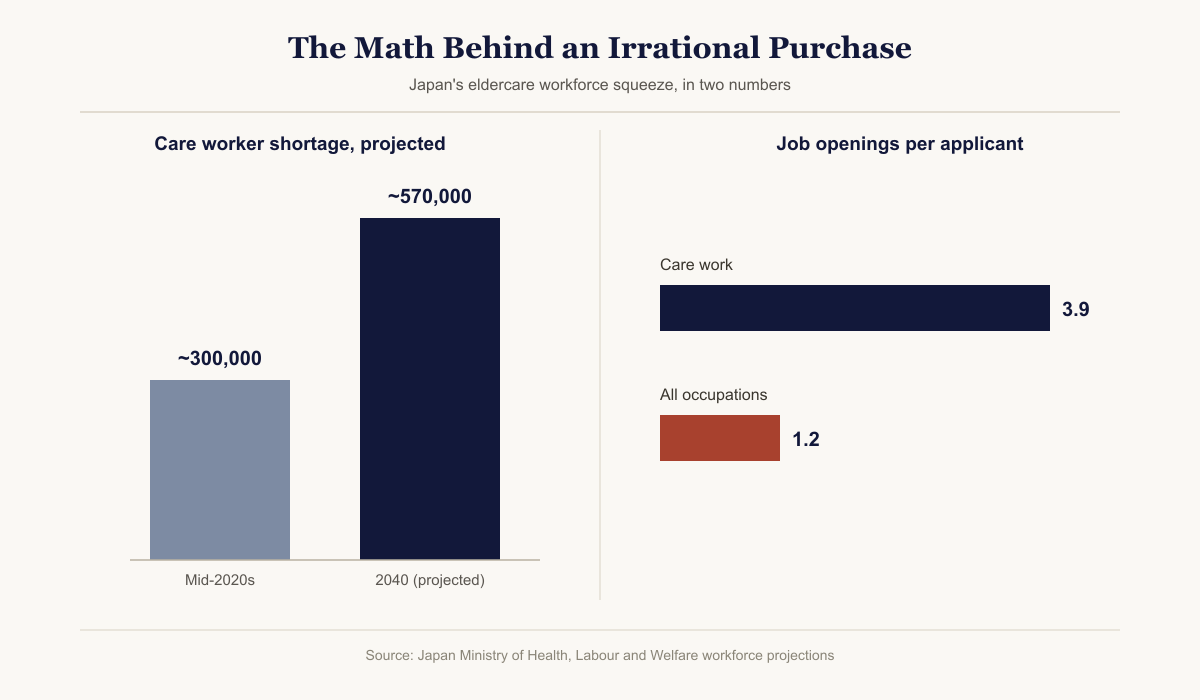
Japan’s long-term care sector has a labor problem that dwarfs almost every other developed economy’s version of the same crisis. The Ministry of Health, Labour and Welfare’s own workforce projections, built off the ninth long-term care insurance business plan, call for roughly 250,000 additional care workers by fiscal 2026, widening to an estimated 570,000 more by 2040 if current staffing patterns hold. The effective job-openings-to-applicants ratio for care work has recently run near 3.9 — meaning for every care worker looking for a position, facilities are advertising close to four openings — against a nationwide average across all occupations of roughly 1.2. Care work in Japan is among the hardest job categories in the country to fill.
That number reframes what a facility director is actually shopping for. A transfer lift protects a caregiver’s back for one task, a handful of times per shift. It does nothing for the deeper reason staff quit: emotional exhaustion, the accumulated weight of managing residents’ loneliness and cognitive decline on top of physical labor, and a work culture where a bad shift means going home having absorbed complaints, confusion, and grief from a dozen people who needed more attention than the staffing ratio allowed. Recruiting a replacement for a care worker who burns out costs a facility real money — advertising, onboarding, training hours, the productivity gap while a new hire ramps up — on top of a job market where, per that 3.9 ratio, there may not be a replacement to hire at all.
Facility administrators I’ve spoken with in the course of covering this sector describe LOVOT less as a resident amenity and more as a staff-retention tool wearing a companion-robot costume. It absorbs some of the emotional labor that used to fall entirely on caregivers — residents who might otherwise buzz for a staff member simply to have someone nearby now have something in the room with them between visits. Staff describe fewer of the low-grade, cumulative complaints that wear on morale over a shift. None of that shows up as a line item a subsidy auditor can inspect the way they can inspect a transfer lift’s weight capacity. But in a sector this short-staffed, buying something that keeps existing staff from quitting is, in a very literal sense, more useful than a device that makes one task marginally safer.
How a Feelings Machine Gets Past the Budget Committee
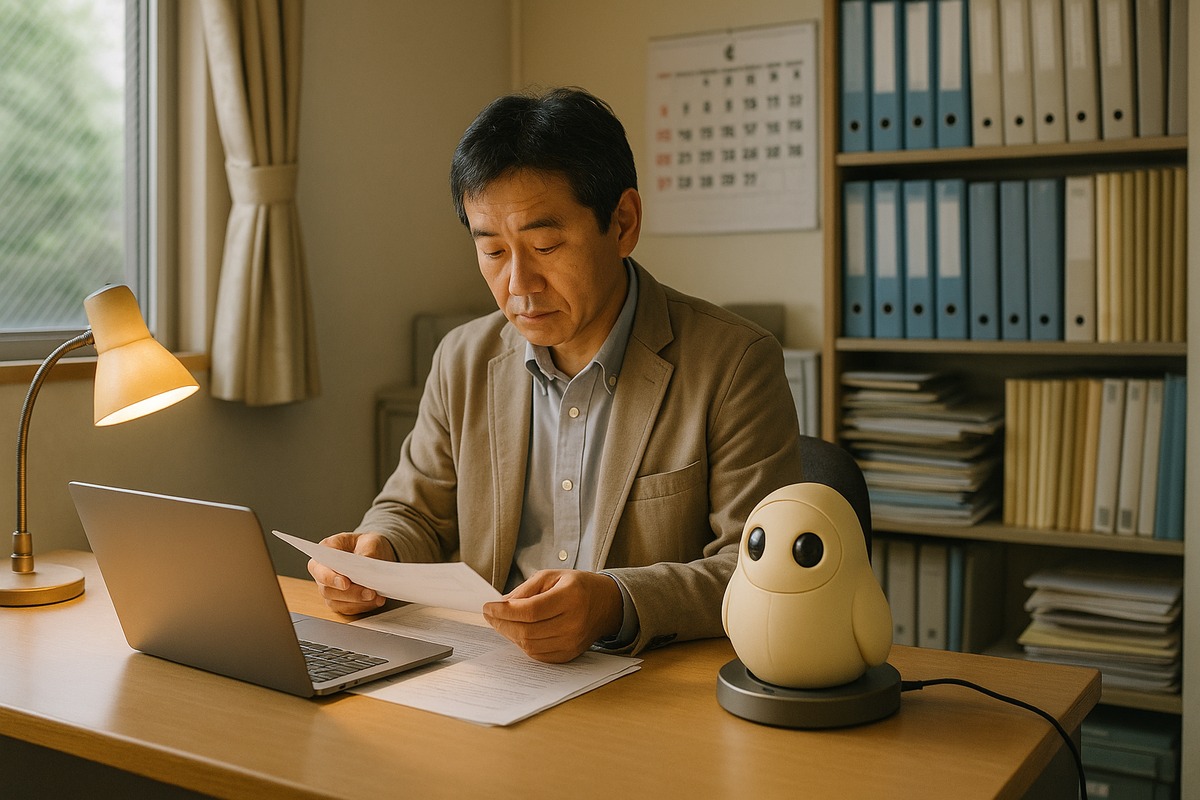
None of this explains the mechanics of approval, and the mechanics matter, because “it might reduce staff burnout” is a hard sentence to defend in a funding request. GROOVE X has built its institutional sales motion around removing exactly that friction.
The company offers eldercare facilities a two-week trial period before any purchase decision — the robot arrives, staff and residents interact with it under normal operating conditions, and the facility can walk away with no commitment. That trial period does two things a cold sales pitch cannot: it generates the facility’s own internal case study before anyone has to defend a number to a funding committee, and it lets an administrator observe the specific, hard-to-forecast moments that make the eventual purchase justification easier — a resident who rarely speaks reaching for the robot, a night-shift employee who mentions, unprompted, that the unit in the staff room changed the mood during a difficult stretch.
Once a facility decides to move forward, its placement on prefectural subsidy equipment lists converts what would otherwise be a discretionary purchase into a recognized capital expenditure with the same paperwork and reimbursement path as a transfer lift. That reclassification matters enormously inside a Japanese nonprofit’s approval process, where budget committees are far more comfortable approving spending that maps onto an established government category than spending that has to be justified from first principles. GROOVE X has also spent several years building a separate corporate channel — its Office LOVOT program, aimed at ordinary companies rather than care facilities, recently passed 1,000 corporate installations for reducing workplace stress and sparking conversation among employees. That parallel business line matters to eldercare buyers indirectly: it establishes LOVOT as an institutional product with a track record outside the home, which makes a care facility’s own purchase read less like an emotional indulgence and more like adopting a workplace-wellness tool that happens to specialize in elder care.
The last piece of the pitch is the one facility administrators mention most candidly: families notice. A resident’s adult children, visiting on a weekend and seeing a robot respond to their parent by name-equivalent behavior — approaching, making eye contact, settling into a lap — read that as evidence the facility is investing in quality of life beyond baseline custodial care. In a market where families increasingly comparison-shop nursing homes the way they’d shop a private school, that visible signal has recruiting value for new residents that a transfer lift, however necessary, will never generate.
What the Data Actually Shows
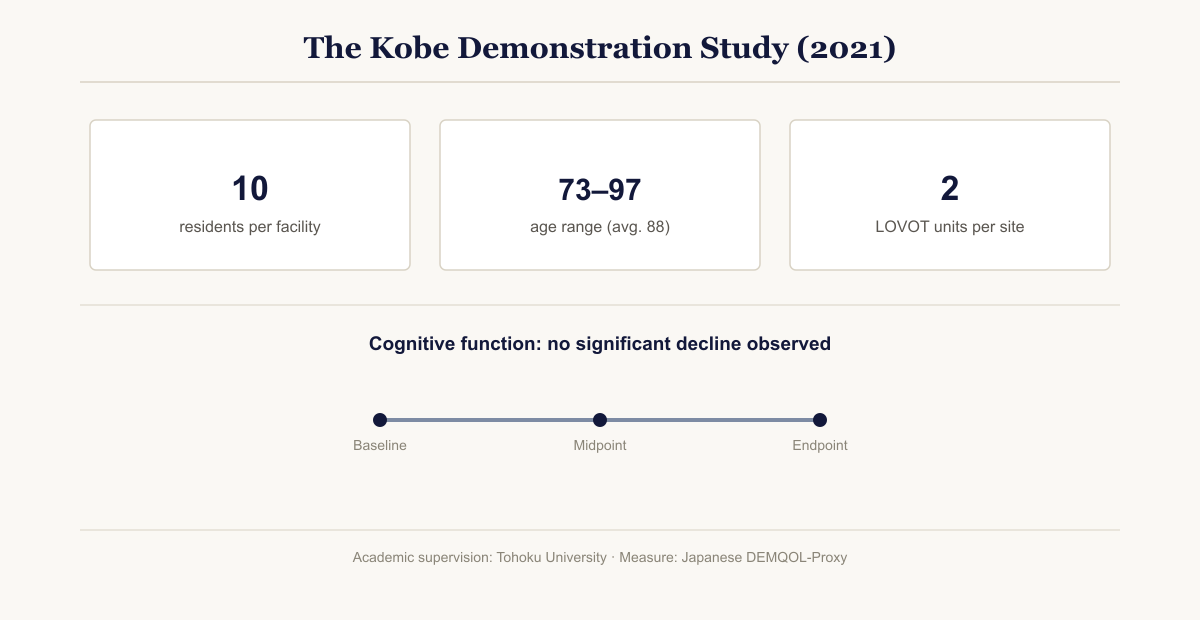
None of the above matters much if the underlying claim — that living alongside LOVOT measurably helps residents — doesn’t hold up, so it’s worth walking through the actual study rather than the marketing summary of it.
In late 2021, GROOVE X ran a formal demonstration project in Kobe under the city’s CO+CREATION KOBE public-private partnership program, with academic supervision from Tohoku University’s Professor Yasuyuki Taki. The study placed two LOVOT units in each participating facility — one in a shared common area, one in the staff office — and tracked ten residents per facility, ranging in age from 73 to 97, with an average age just under 88. Researchers used the Japanese-language version of DEMQOL-Proxy, a validated quality-of-life assessment for people with dementia, administered through structured staff interviews before and after the study period rather than self-reporting, which residents at that stage of cognitive decline often cannot reliably provide.
The headline result is intentionally modest, and worth stating precisely rather than inflating: residents who lived alongside LOVOT showed no statistically significant decline in cognitive function over the study window, which researchers interpreted as evidence the robot may help suppress the rate of decline rather than reverse it. On staff-side stress measures, the study found no statistically significant difference either — but the qualitative interview data told a more specific story. Caregivers reported more conversation among colleagues during shifts, a reduction in the kind of low-grade griping that builds up over a hard stretch of care work, and — the detail that came up most often — residents displaying facial expressions and moments of engagement with the robot that staff said they didn’t otherwise see directed at human caregivers.
That single study wouldn’t be enough to build a category on its own, and GROOVE X hasn’t tried to. The company has since expanded its eldercare research partnership with Future Care Lab in Japan, an innovation unit backed by Sompo Holdings — one of Japan’s largest insurance groups, with a direct financial interest in what actually reduces long-term care costs. Their joint case work has moved beyond the original Kobe cohort into facilities specifically targeting residents with mild dementia, tracking the same before-and-after framework at larger scale. As of the most recent public figures, LOVOT has been placed in more than 200 care facilities nationwide — a small footprint next to Japan’s thousands of nursing-care facilities, but a meaningful one for a product that, four years ago, barely existed as an institutional category at all.
The Honest Version — What Staff Actually Complain About
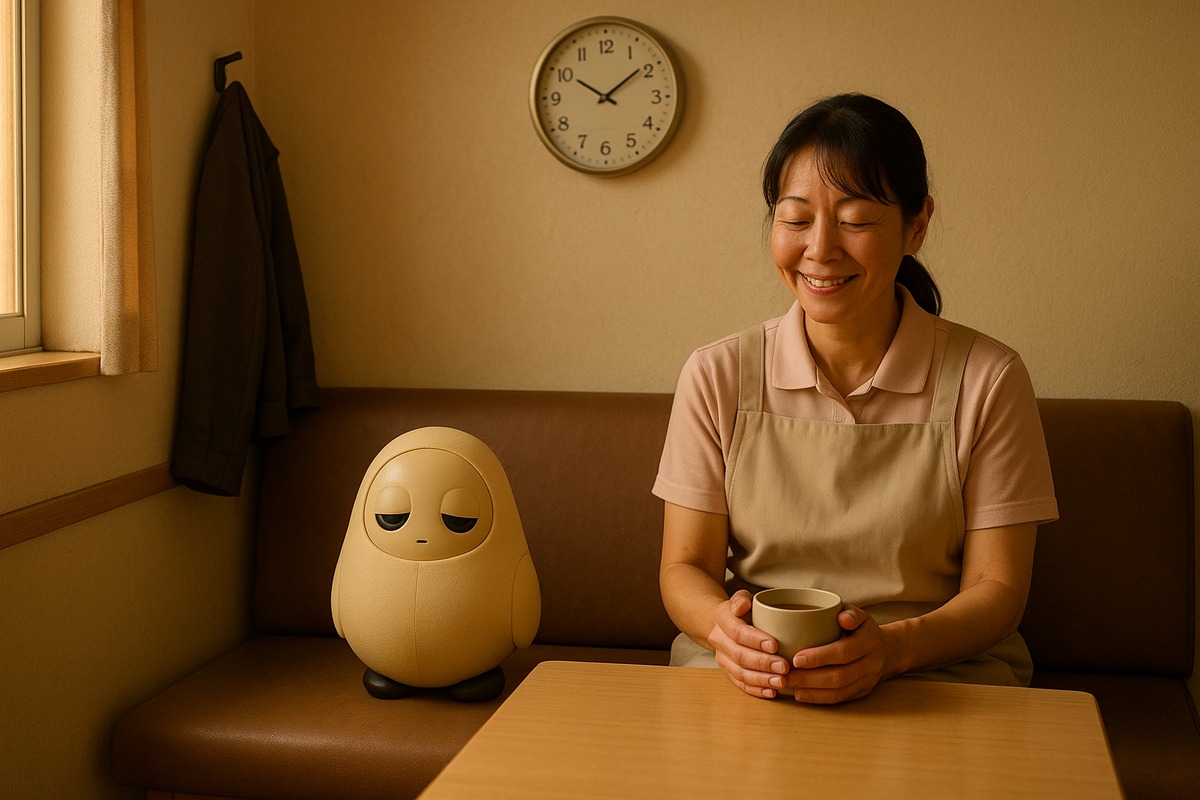
It would be easy to end the story here, on an upward trajectory of clinical validation and enthusiastic adoption, and that would be a disservice to how Japanese facility staff actually talk about the robot when a reporter isn’t standing in the room. Keiwakai, the Oita operator running LOVOT at its Oita Hoju-en facility, has been unusually candid about this in its own public communications, publishing an internal account of the rollout that reads less like a press release and more like an honest operations memo.
The positives track what you’d expect: more smiles during the day, more spontaneous conversation between residents who don’t otherwise interact, staff describing the robot as something that softened the emotional texture of a hard shift. But the same account flags real friction. The ongoing subscription cost is a genuine budget line that has to be re-justified every year, not a one-time capital purchase that disappears into a depreciation schedule. Staff have specifically requested voice functionality and reduced financial burden — in other words, they want the robot to do more while costing less, the same demand any technology purchase eventually faces once the novelty period ends. And unlike a transfer lift, whose value proposition doesn’t erode with familiarity, a companion robot’s emotional impact depends partly on staff continuing to actively integrate it into daily routines rather than letting it become furniture.
The honest framing, and the one facility administrators themselves use, is that LOVOT is not a replacement for caregiving staff and was never sold as one. It is a supplement that changes the emotional conditions caregivers work inside — closer to investing in break-room quality or shift scheduling than to buying a piece of medical equipment. Facilities that treat it that way, with realistic expectations about ongoing cost and the need for staff to keep engaging with it, report the results above. Facilities expecting it to function as either a clinical intervention or a babysitting substitute are setting themselves up for disappointment.
What This Means If You Build or Fund Eldercare Technology
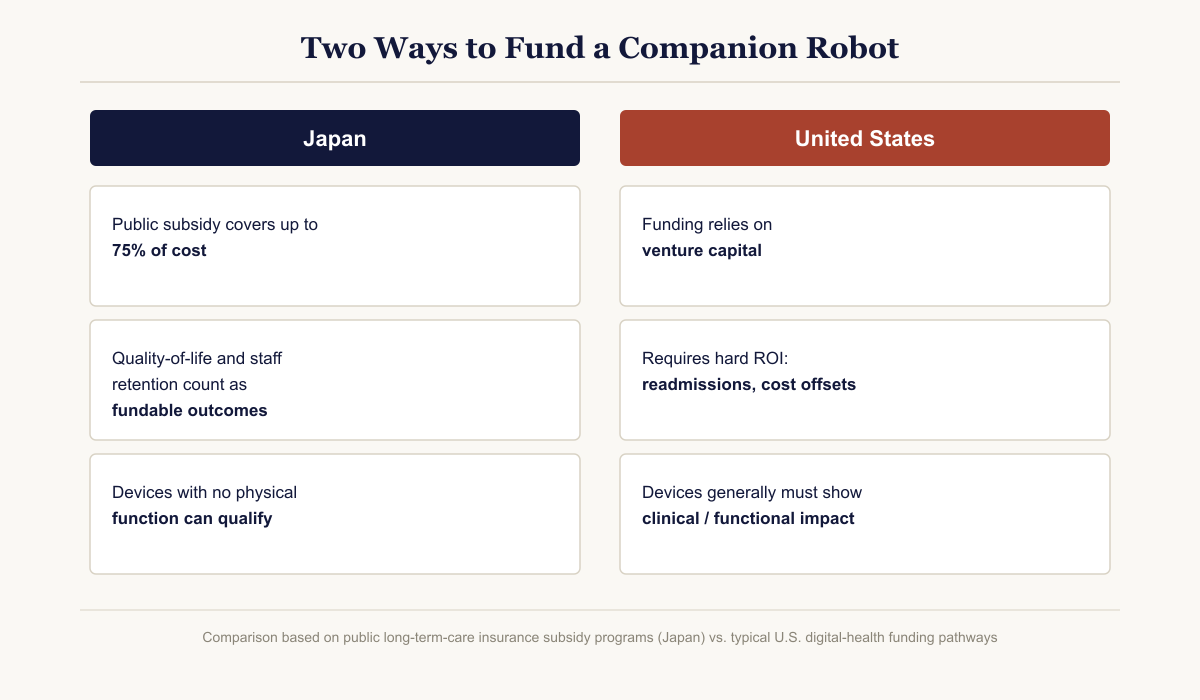
For international operators watching this from outside Japan, the more interesting story isn’t the robot — it’s the funding mechanism underneath it.
Compare this to the American eldercare technology market, where companies like Intuition Robotics’ ElliQ have built a genuinely strong product and clinical case for AI companionship, and still have to raise venture capital rounds — a $36 million Series B in 2020 and a $25 million round in 2024 among them — largely on the strength of hard ROI arguments: reduced hospital readmissions, measurable loneliness-scale improvements, cost offsets a payer can model. That is a defensible strategy, and it reflects what US buyers most consistently reward: quantified loneliness, engagement, and health-system outcomes. Japan’s eldercare technology subsidy system, by contrast, has proven willing — inside a defined but real set of prefectural programs — to treat resident quality of life and staff retention as legitimate, publicly fundable outcomes in their own right, without requiring a device to also perform a physical task.
That is a genuinely unusual feature of a market, and it matters practically for two kinds of readers. If you build wellbeing-oriented hardware — companion robots, ambient-presence devices, anything whose value proposition is emotional rather than functional — Japan’s prefectural eldercare technology lists are worth studying as a template for how “soft” outcomes get converted into fundable capital expenditure elsewhere. If you allocate capital into eldercare technology, GROOVE X’s trajectory is itself informative: a company that raised roughly $110–120 million building a robot explicitly engineered to avoid utility has found, four years into serious institutional sales, that the sturdiest growth channel isn’t consumer households at all — it’s B2B procurement inside two of the most conservative purchasing environments that exist, corporate offices and licensed care facilities. A market that has been steadily widening subsidy pathways to treat “presence” as a fundable outcome is a market signaling something about where global eldercare spending eventually goes, whether or not the rest of the world is ready to write that line item yet.
Frequently Asked Questions
Q. What does it actually cost a Japanese nursing home to introduce LOVOT?
A. A single third-generation unit runs roughly ¥577,500 (about $3,800) as a one-time hardware cost, plus a mandatory monthly service plan starting near ¥9,900 that covers software, cloud memory, and support. Facilities typically deploy two or more units — one in a shared common area and one near staff — which is how the total cost climbs into five-figure dollar territory once several years of subscription fees are factored in. Several prefectures, including Kanagawa, allow facilities to apply eldercare technology subsidies covering a substantial share of that cost (rates vary by year and prefecture) against approved equipment lists that include LOVOT.
Q. Is LOVOT available for purchase outside Japan, including on Amazon?
A. Not through standard Western retail. Japan remains LOVOT’s main market, and GROOVE X has also launched sales in China (announced in 2023) — but it has not listed the robot on Amazon.com or built a dedicated US/UK retail program, unlike some Japanese companion-robot rivals. International buyers interested in the product currently need to go through GROOVE X’s corporate inquiry channel directly, and institutional buyers outside Japan should expect to negotiate import, support, and service-plan logistics individually rather than through a standard consumer checkout.
Q. Is there real clinical evidence LOVOT helps dementia care, or is this mostly marketing?
A. There is early, credible but limited academic evidence. A 2021 demonstration study in Kobe, supervised by a Tohoku University professor and using a validated dementia quality-of-life assessment, found no statistically significant cognitive decline among residents who lived alongside LOVOT over the study period — interpreted as a possible suppression effect rather than proof of improvement. GROOVE X has since expanded testing with Sompo Holdings’ Future Care Lab in Japan into facilities focused on mild dementia. It is meaningful preliminary evidence, not yet the large-scale, peer-reviewed clinical literature that underpins an older therapeutic robot like PARO, which has two decades of published research behind it.
Q. Could a similar subsidized “presence robot” procurement model work outside Japan?
A. It would require a policy environment willing to fund resident quality of life and caregiver retention as outcomes in their own right, which most Western reimbursement systems currently are not built to do — American and European eldercare subsidy programs remain heavily anchored to devices with a demonstrable physical or clinical function. That gap is itself the opportunity: operators who can build the kind of quantified quality-of-life and staff-retention case Japan is now assembling have a template for eventually making the same argument to payers and regulators elsewhere.
Q. Why would a cash-strapped nonprofit facility spend money on a robot instead of hiring more staff?
A. Because, per Japan’s own labor statistics, there often isn’t staff to hire — the care-worker job-openings-to-applicants ratio has recently run near four open positions per available worker, against a roughly 1.2 ratio across the broader economy. Facility administrators describe the purchase less as a trade-off against hiring and more as a tool for keeping the staff they already have from burning out and leaving, in a labor market where a departure may not be replaceable at all.
Conclusion
The uncomfortable truth behind a “$10,000 robot that does nothing useful” is that it isn’t really being purchased for what it does. It’s being purchased for the same reason a hospital invests in break rooms or a school invests in art class — because the people running the institution have concluded, backed now by early data and a government willing to subsidize the bet, that emotional infrastructure is infrastructure. Japan’s care-worker shortage made that argument urgent enough to fund. The rest of the world’s eldercare systems are watching a smaller, poorer, faster-aging country solve a version of the problem they’re about to face themselves.
If you’re interested in this topic, the Japanese market more broadly, or what KETCHUPs is working on, we’d love to hear from you — please reach out via our contact form.
Japan Market Pulse is a weekly read on what the Japanese consumer-tech, food, and mobility markets are choosing to do, written for international operators who want to know what is happening before it shows up in the global trade press.
Subscribe at ketchups.co/japan-market-pulse.