

This article is published by KETCHUPs, a Tokyo-based trading and brand-development firm. All content is editorial.
I have lived in Japan for twenty years, and I thought I had a complete mental map of the convenience store. Onigiri and sandwiches on the chilled shelf, instant noodles in the middle, and a candy aisle that runs on chocolate, potato chips, and gummies. Nori — the paper-thin sheets of roasted seaweed that wrap rice balls and sushi — belonged to a different universe entirely: the dry goods shelf, next to the rice seasonings, in sober green-and-gold packaging designed to appeal to someone’s grandmother.
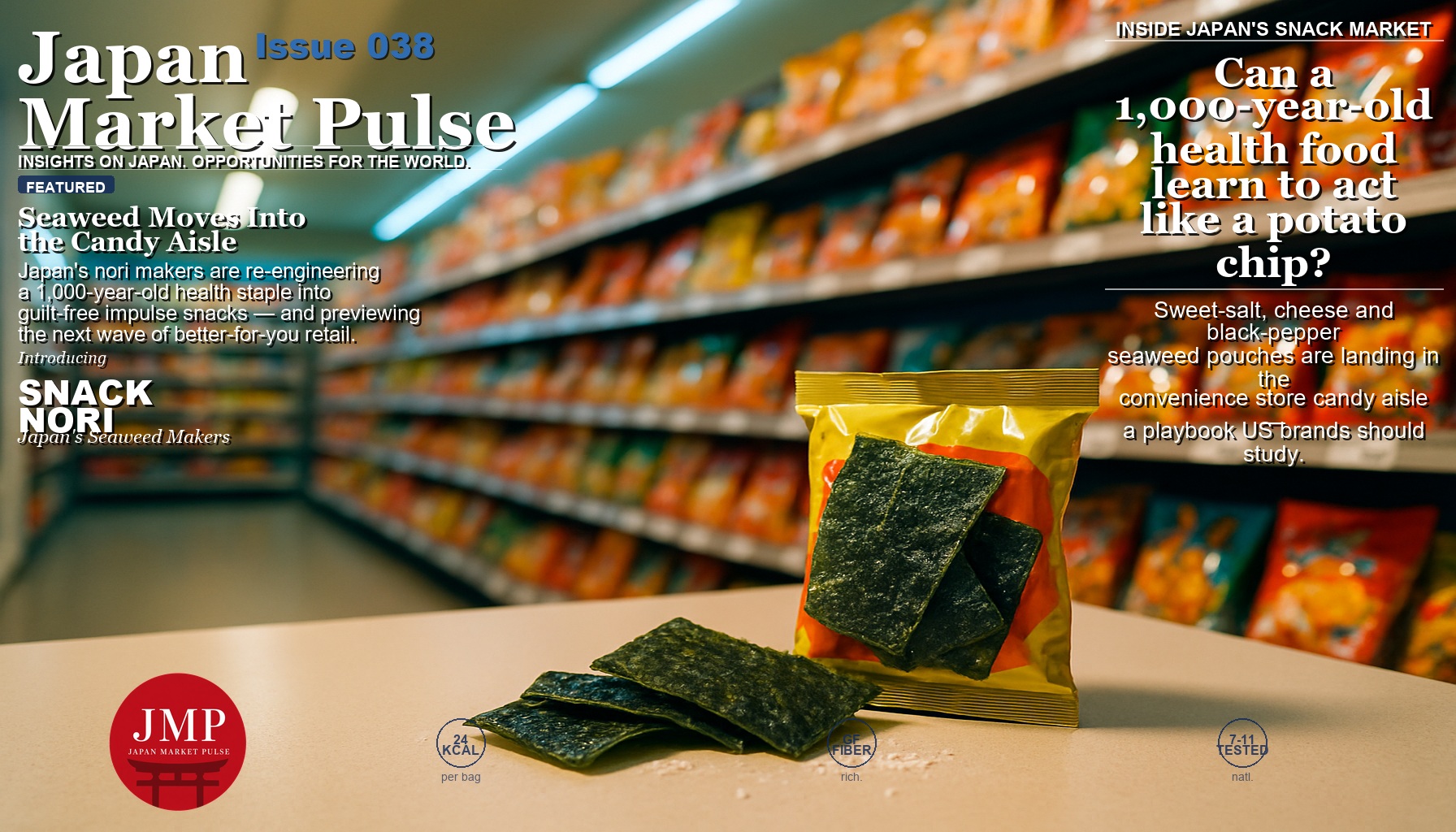
Then, on a Tuesday evening at my local Seven-Eleven in Tokyo, I found seaweed sitting in the snack section. Not sushi nori. Not the seasoned sheets you eat with breakfast rice. This was a small, brightly colored pouch from Nikoniko Nori — one of Japan’s major seaweed processors — labeled “Oyatsu Nori,” which translates roughly as “snack-time seaweed.” The flavor was sweet-salt. The bag advertised 24 calories and a generous dose of dietary fiber. It was shelved between the chips and the chocolate, priced for an impulse buy, and clearly designed to be eaten straight from the bag while watching television.
That little pouch is a bigger story than it looks. It is the story of how a 1,000-year-old health food gets re-engineered into a guilt-free impulse snack — and it carries direct, practical lessons for anyone operating in the overheated American better-for-you snack market. Japan is running this play under pressure, with shrinking supply and falling traditional demand, and that pressure is exactly what makes the playbook so instructive.
A 1,000-Year-Old Staple in Quiet Freefall
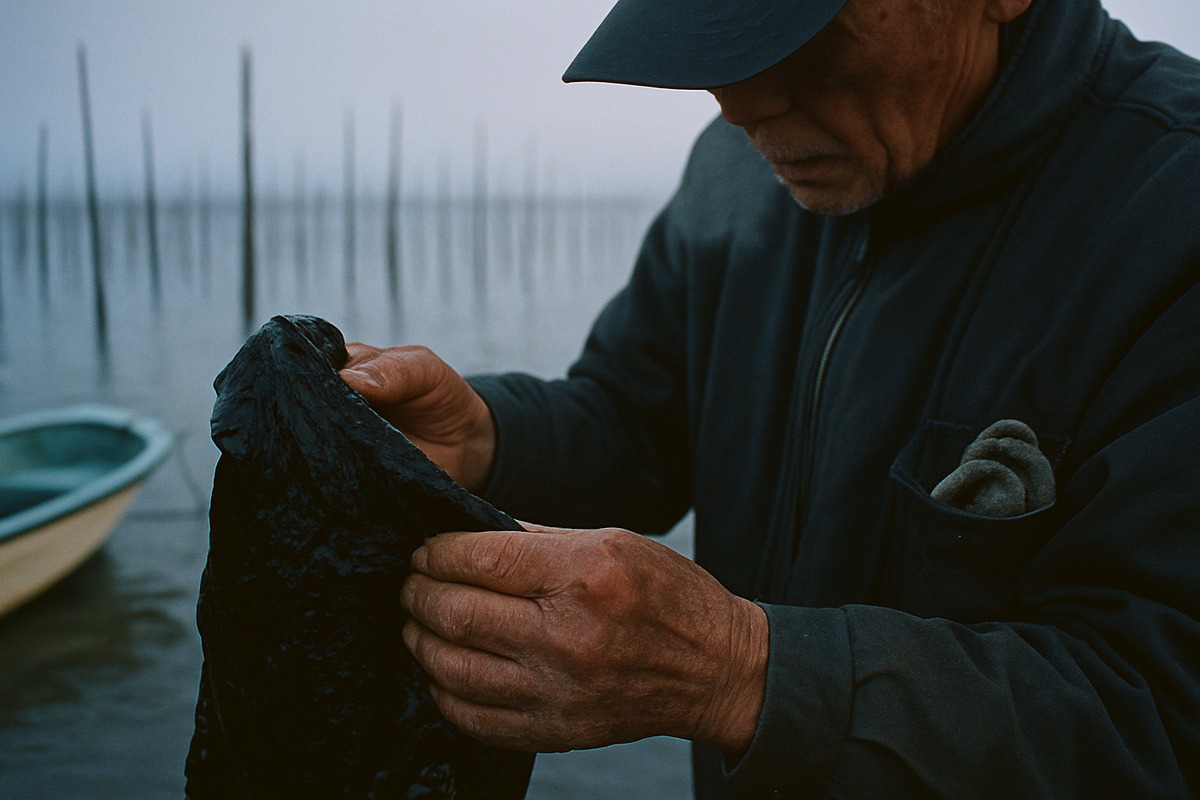
To understand why a venerable nori company is chasing the candy aisle, you need to understand the squeeze the Japanese seaweed industry is in. It is being crushed from both sides: supply is collapsing and traditional demand is eroding at the same time.
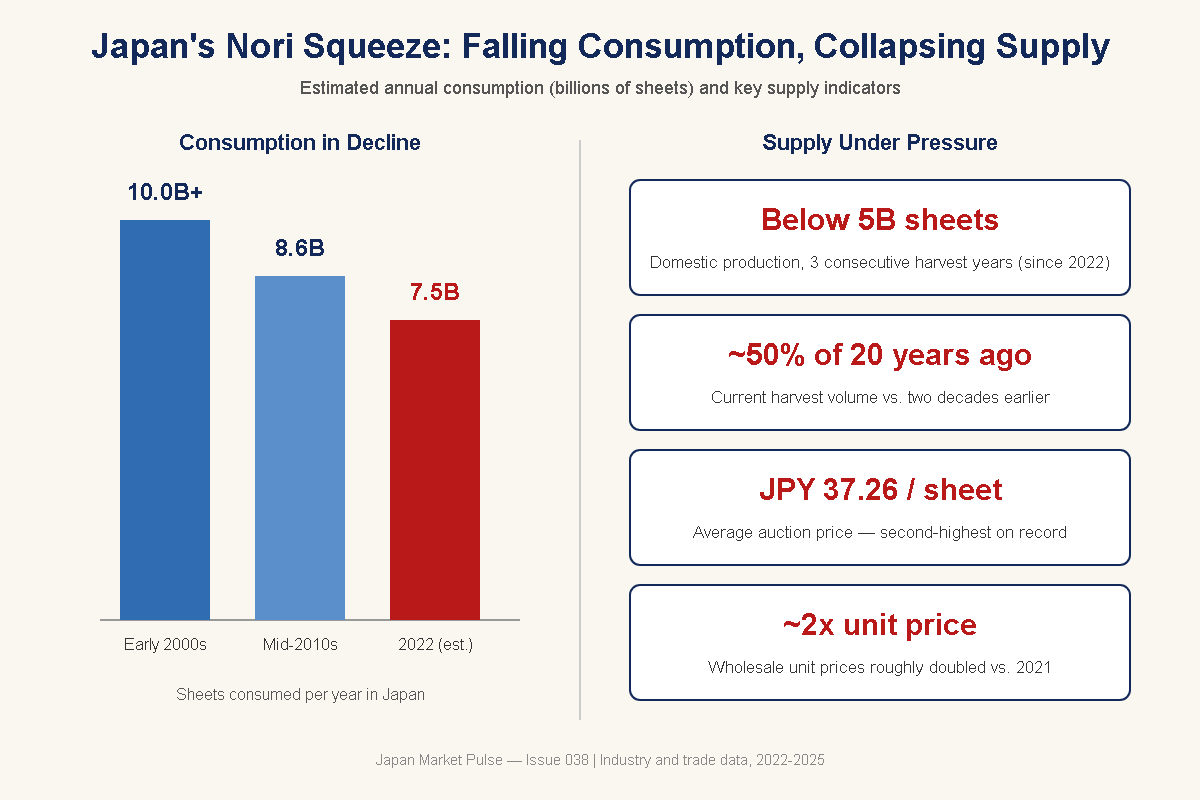
Start with supply. Japanese nori is farmed in coastal waters, and the crop depends on cold winter seas. Climate change has been brutal to it. Rising sea temperatures delay the seeding and growth of the laver crop, and improved coastal water treatment has — ironically — reduced the nutrient runoff the seaweed feeds on. The result: domestic production has fallen below five billion sheets for three consecutive harvest years starting in 2022, and the harvest is now roughly half of what it was twenty years ago. Prices have responded the way you would expect. The average auction price has reached 37.26 yen per sheet — the second-highest level on record — and unit prices have roughly doubled compared with 2021. Japanese trade press has started using the phrase “nori crisis,” and veteran wholesalers describe current prices as bubble territory.
Now look at demand. Japanese nori consumption exceeded ten billion sheets a year as recently as the early 2000s. By the mid-2010s it had drifted down to about 8.6 billion. The most recent estimates put consumption around 7.5 billion sheets — a decline of more than ten percent in under a decade. Roughly sixty percent of Japanese nori goes to commercial channels — convenience store onigiri, sushi chains, ramen shops, bento makers — and convenience store rice balls alone account for about thirty percent of all consumption. That concentration is a vulnerability: when nori prices spike, those commercial buyers respond by shrinking the sheet, switching to cheaper grades, or redesigning products so they need less seaweed. Some onigiri formats now skip the wrap entirely.
So the industry faces a textbook commodity death spiral: less product, higher prices, customers engineering you out of their cost structure, and a younger generation that views your product as something their parents ate. When I ask Japanese friends in their twenties about nori, the word that comes up is “jimi” — plain, sober, unexciting. That is the exact moment a category either reinvents itself or fades into the specialty aisle.
The Snackification Play: How Nikoniko Nori Re-Engineered Seaweed
Nikoniko Nori’s answer was not to defend the old category. It was to build a new one — and the details of how the company did it are where the lessons live.
In April 2025, the company launched the second generation of its “Oyatsu Nori” line exclusively at Seven-Eleven stores nationwide: a sweet-salt flavor and a butter-soy-sauce flavor. Read those flavor names again, because they are doing strategic work. Sweet-salt — amajoppai, the addictive sweet-and-salty profile — is the flavor language of caramel popcorn and honey butter chips, not of breakfast condiments. Butter and soy sauce is the taste of Japanese street-festival corn and movie-night popcorn. These are not seasonings chosen to complement rice. They are seasonings chosen to compete with confectionery.
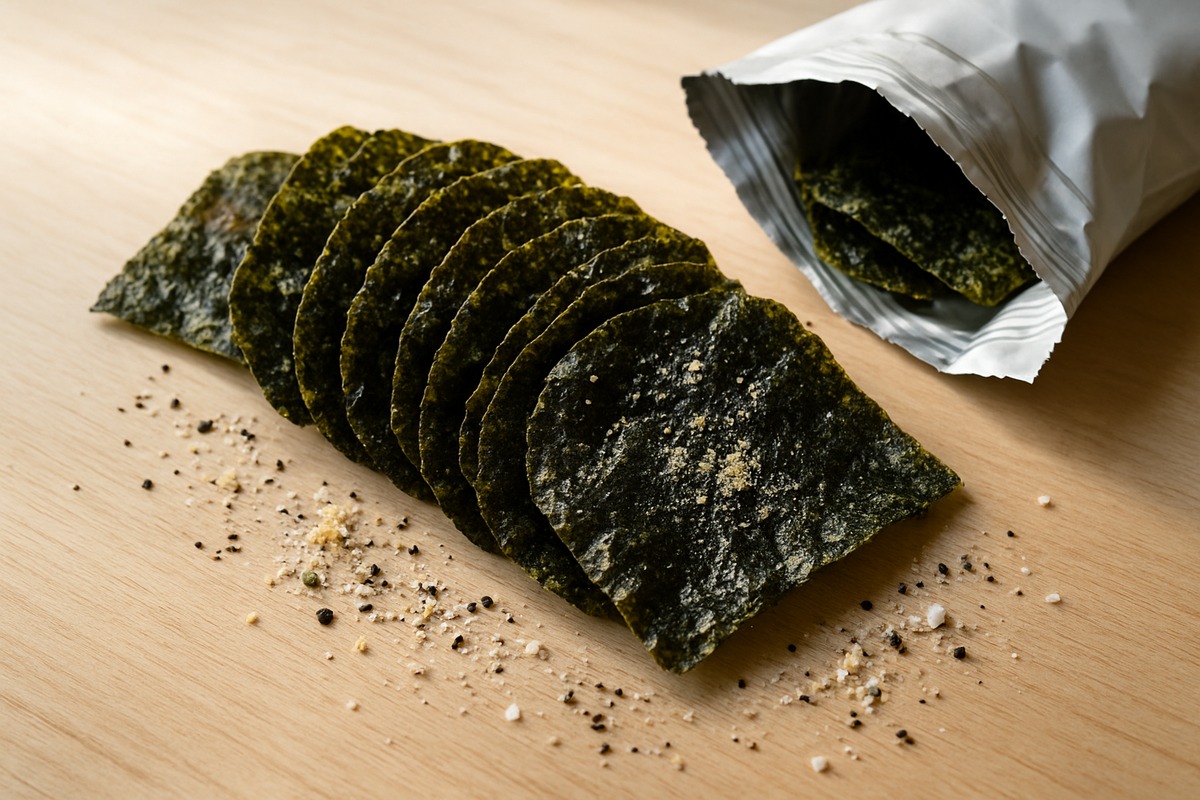
By December 2025, the line had expanded into a three-flavor rotation at Seven-Eleven — sweet-salt nationwide, cheese in western Japan, and black pepper in eastern Japan — a regional split-test run through one of the most data-rich retail networks on earth. And by spring 2026, the snackification push had widened further: a cheese-flavored snack nori in a small five-gram format, and even a cheese-flavored “gim-bugak” — a Korean-style crispy seaweed-and-rice snack — bringing the Korean snacking idiom directly into a Japanese nori company’s lineup.
Every element of the package is calibrated for the candy aisle rather than the dry-goods shelf. The portion is small and single-serving. The calorie count — 24 calories per bag — is printed prominently, because the number is the marketing. The fiber content is called out the way a protein bar calls out grams of protein. The format is crisp, dry, and eats like a chip. Nothing about it asks you to prepare rice. Nothing about it asks you to know anything about Japanese food culture. It asks only the question every successful snack asks: do you want something crunchy and salty right now that you will not feel bad about?
What strikes me most, having watched Japanese food companies operate for two decades, is the placement decision. Moving from the seasonings shelf to the snack aisle sounds trivial; it is anything but. The seasonings shelf is a planned-purchase zone with maybe two or three shopper visits a month. The snack aisle is an impulse zone visited on nearly every trip, where products are judged in two seconds on color, flavor promise, and price. By accepting the rules of the candy aisle — bright packaging, indulgent flavor names, impulse pricing — Nikoniko Nori multiplied the number of moments in which a consumer might buy seaweed by an order of magnitude.
Inside the Seven-Eleven Test Kitchen
It is worth pausing on the choice of launch partner, because it tells you how seriously Nikoniko Nori is treating this as a category experiment rather than a line extension. Both generations of Oyatsu Nori launched as Seven-Eleven exclusives, and in the Japanese food industry that is not a distribution decision — it is a research decision.
Japan’s convenience stores are the fastest product laboratories in global food retail. A typical store carries around three thousand items and replaces a meaningful share of them every single week. New products get national distribution overnight, sell-through data flows back daily, and items that miss their numbers are delisted within weeks, not quarters. For a manufacturer, a Seven-Eleven exclusive launch is the closest thing the physical world offers to an A/B test at national scale: you get an immediate, statistically meaningful read on whether a concept works, which flavors clear the bar, and what price the impulse shopper will tolerate — all before you commit to supermarket distribution, larger pack sizes, or export formats.
The December 2025 flavor rotation shows the machine running at full speed. Sweet-salt — the proven performer from the spring launch — went nationwide. The two unproven flavors were split geographically: cheese in western Japan, black pepper in eastern Japan. Two hypotheses, two regions, one winter sales season to read the results. This is the kind of disciplined, low-cost experimentation that American CPG brands typically need a retail media partnership and a six-figure research budget to approximate, and Japanese manufacturers get it as a standard feature of the channel.
I have come to think of the Japanese convenience store as the most underrated source of competitive intelligence available to Western food operators. Almost every snack trend that later surfaces in the United States as a premium import or a startup pitch — rice-flour chips, high-protein chilled desserts, single-serve freeze-dried miso soup — ran its first market test in a konbini, in public, with the results visible on the shelf to anyone paying attention. When a heritage seaweed processor starts cycling confectionery flavors through Seven-Eleven at this pace, it means the category has graduated from idea to active build-out. The shelf is telling you what the press release will say two years from now.
Why “Guilt-Free” Is the Magic Word

The genius of snack nori is that it gets to play the indulgence game while keeping the health halo it spent a thousand years earning. Most better-for-you products run the opposite direction: they start with an indulgence — a chip, a cookie, a candy — and strip things out of it. Less fat, less sugar, fewer artificial ingredients. The result usually carries an implicit apology: this is almost as good as the real thing. Seaweed snacks start from the other end. The base material is already a nutritionist’s checklist — low-calorie, fiber-rich, a natural source of iodine and minerals — so every move toward indulgence is pure addition. Make it taste like cheese, make it crunch like a chip, and you have built an indulgent snack with no nutritional debt to apologize for.
This matters because guilt-free snacking is precisely where the American market’s energy is concentrated right now. The U.S. snack industry has grown to roughly $156 billion in annual sales, expanding 4.8 percent in the past year even as overall food volumes flattened. Within that, the better-for-you segment is the growth engine: data analytics firm Spate forecasts healthy-snacking interest and sales growing 18.4 percent year over year into 2026, and retail data shows sales of snacks carrying “low-sodium” and “organic” claims rising 12 percent. American consumers have not stopped snacking; they have started auditing their snacks. A product that survives the audit while still delivering the dopamine of a salty crunch is the category’s holy grail.
Japan arrived at this insight through demographic necessity — an aging population, the world’s most label-literate shoppers, and a convenience store sector that prototypes and kills products with ruthless speed. But the insight travels. The most valuable better-for-you products are not degraded indulgences. They are health foods that have been taught to behave like snacks.
There is also a quieter pricing lesson buried here. Remember that nori supply is shrinking and raw material prices have doubled. Selling commodity sheets at commodity margins is a losing game when your input costs double. A flavored, branded, single-serve snack pouch carries a dramatically higher price per gram of seaweed than a fifty-sheet pack of sushi nori ever could. Snackification is not just a demand play; it is a margin play that converts a raw-material crisis into a premiumization opportunity. For American food operators staring at volatile commodity costs — cocoa, coffee, olive oil — that conversion logic deserves close study.
The Korean Wave Got There First — and That Is Exactly the Point
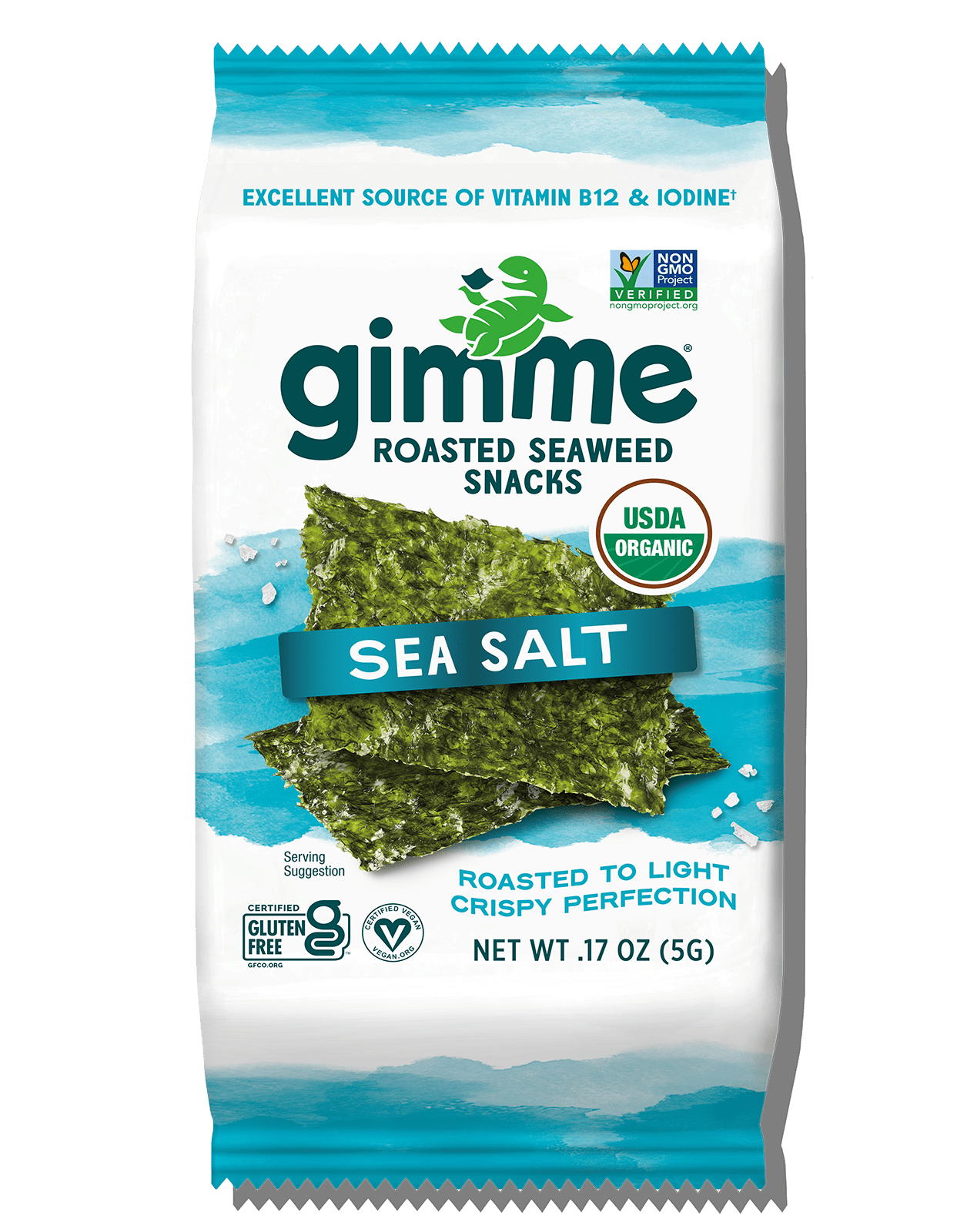
gimMe Organic Roasted Seaweed — Sea Salt
The U.S. category leader’s signature snack pack: USDA Organic roasted seaweed, the base layer of the wave Japan is now flavor-engineering.
View on Amazon →Image: © gimMe (gimmeseaweed.com) · As an Amazon Associate, we earn from qualifying purchases.
If you are reading this in the United States, you may be thinking: seaweed snacks are not new here. You are right, and the reason is Korea.
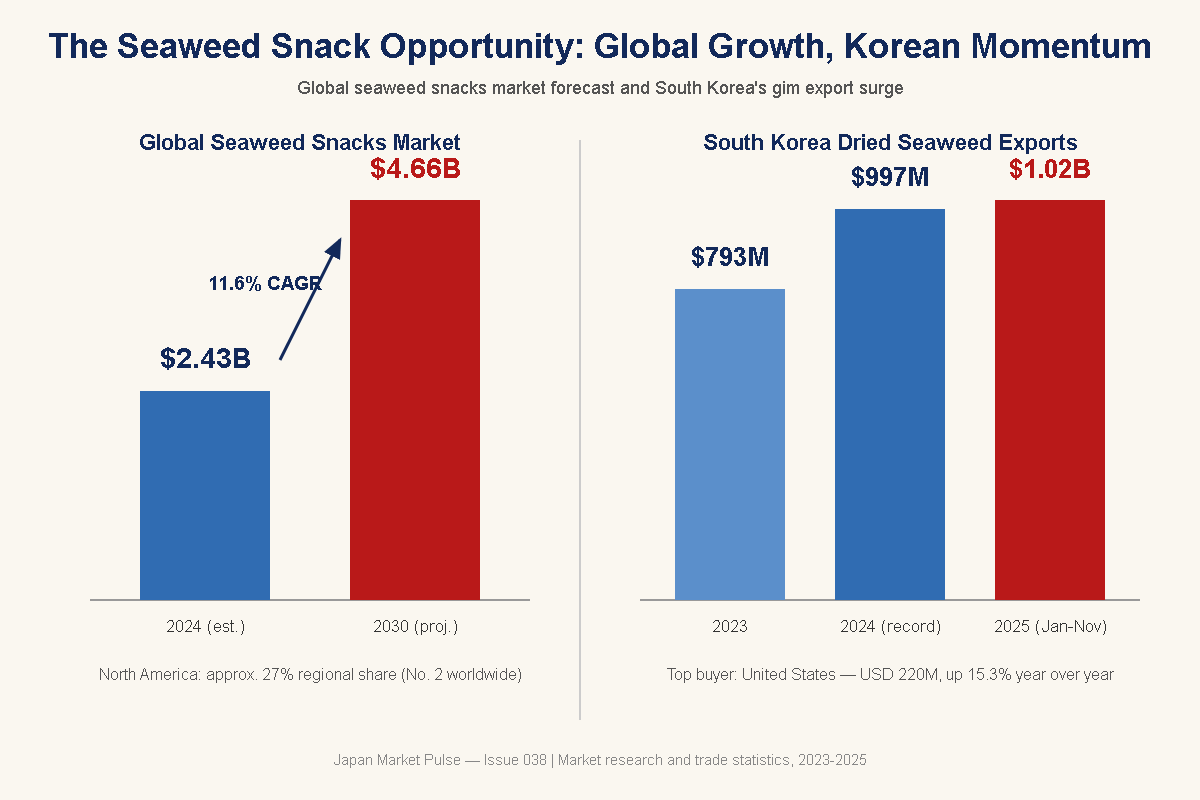
Korean gim — the Korean word for dried laver seaweed — has become one of the great food export stories of the decade. South Korea’s dried seaweed exports surged from $793 million in 2023 to a record $997 million in 2024, and crossed the $1 billion mark in the first eleven months of 2025, up 13.2 percent year over year. The single largest buyer is the United States, importing roughly $220 million worth — up 15.3 percent in a year. Korean officials have taken to calling gim the “black semiconductor,” and Korea now supplies more than seventy percent of the global dried seaweed trade. The K-food wave — gimbap going viral, Korean snack culture saturating American social media — turned roasted seaweed from an ethnic-aisle curiosity into a mainstream lunchbox item.
American brands rode that wave early. gimMe Organic Roasted Seaweed, with its sea-salt snack packs, has built one of the leading positions in the U.S. category — one industry analysis credits Gimme Health Foods with roughly 17 percent of the market — and the brand has leaned hard into organic certification and sustainability partnerships. SeaSnax, an early pioneer of the grab-and-go roasted seaweed format, helped establish the product in natural-foods retail before it spread to mainstream grocery. The category they built is no longer niche: the global seaweed snacks market was estimated at $2.43 billion in 2024 and is projected to nearly double to $4.66 billion by 2030, an 11.6 percent compound annual growth rate, with North America already the second-largest regional market at roughly 27 percent share.
Here is why Japan’s move matters against that backdrop. The first American seaweed-snack wave was essentially plain roasted sheets — seaweed, oil, salt. It established permission: Americans will eat seaweed as a snack. What it did not do is explore the flavor frontier. The Japanese snackification wave is a preview of the category’s second act: confectionery-grade flavor engineering — sweet-salt, butter-soy, cheese, black pepper — applied to a base Americans have already accepted, plus new textural formats like the crispy rice-batter gim-bugak that eat less like a health food and more like a premium chip. Japan’s convenience stores are, in effect, running the R&D program for what the American seaweed snack aisle will look like in three years. For category managers and brand builders, that is free intelligence — if you are watching.
What American Operators Should Steal From This Playbook
Strip away the specifics of seaweed, and the Oyatsu Nori story is a general-purpose method for taking any commodity staple with genuine health credentials and lifting it into the impulse-snack economy. Five moves stand out.
First, change the aisle before you change the product. The single highest-leverage decision Nikoniko Nori made was placement: out of planned-purchase dry goods, into the impulse zone. Most heritage food brands try to win more share of their existing shelf. The bigger prize is usually a different shelf entirely, where purchase frequency is ten times higher and the competitive set judges you on different criteria.
Second, borrow the flavor language of indulgence, not of health. Sweet-salt and butter-soy are popcorn flavors. Cheese and black pepper are chip flavors. The product whispers “healthy” through its numbers while shouting “delicious” through its flavor names. American better-for-you brands routinely get this backwards, leading with virtue and hoping taste follows.
Third, make the nutrition number the headline, not the footnote. Printing 24 calories on the front of the bag turns a regulatory disclosure into a purchase trigger. In a market where consumers audit every snack, the audit result is your best advertising.
Fourth, use small formats to manufacture permission. A five-gram pouch is not a meal decision; it is barely a decision at all. Low-stakes formats are how new categories get sampled, and how guilt-free positioning becomes literal — the portion itself removes the guilt.
Fifth, treat input-cost crises as premiumization deadlines. Nori prices doubling forced Japanese processors to find formats where the seaweed gram carries brand value instead of commodity value. Any American operator holding a commodity exposed to climate volatility should be running the same exercise before the crisis makes it mandatory.
I keep a bag of the sweet-salt Oyatsu Nori on my desk now — partly for research, mostly because it is genuinely hard to stop eating. That, in the end, is the whole story. A thousand-year-old health food, squeezed by climate change and changing diets, did not survive by asking consumers to respect its history. It survived by learning to behave like a potato chip while quietly remaining everything a potato chip is not. The American snack market, hungrier than ever for exactly that combination, should expect this wave to cross the Pacific — and the smartest operators will not wait for it to arrive.
This article contains affiliate links. If you purchase through these links, we may earn a small commission at no extra cost to you.
If you’re interested in this topic, the Japanese market more broadly, or what KETCHUPs is working on, we’d love to hear from you — please reach out via our contact form.
Japan Market Pulse is a weekly read on what the Japanese consumer-tech, food, and mobility markets are choosing to do, written for international operators who want to know what is happening before it shows up in the global trade press.
Subscribe at ketchups.co/japan-market-pulse.