

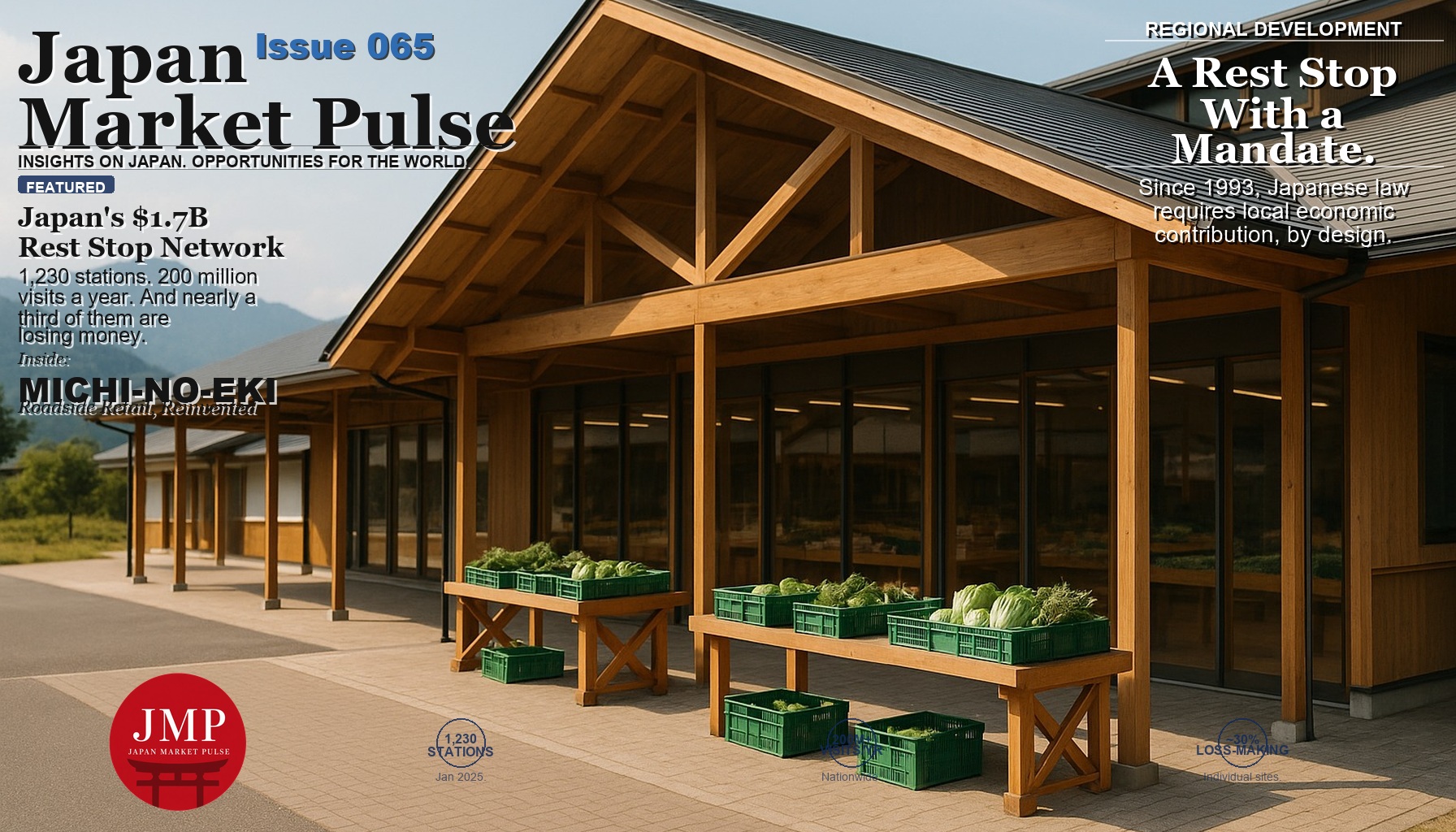
Japan has 1,230 government-certified roadside stations — michi-no-eki — generating an estimated ¥250 billion (roughly $1.7 billion) in combined annual sales as of 2023, and drawing more than 200 million cumulative visits a year. Some individual locations have expanded well beyond a simple rest stop into full day-trip destinations, complete with hot springs, amusement facilities, and farm-to-table restaurants built around what local producers bring in that morning. And yet, by most industry estimates, roughly 30% of michi-no-eki are currently operating at a financial loss, with a handful of long-running locations having closed over the past several years.
For anyone in the West used to thinking of a highway rest stop as a gas station, a vending machine bank, and maybe a fast-food counter, the scale of what Japan built out of the same basic real estate — a place drivers already have to stop — is worth studying directly. So is the uncomfortable fact that a genuinely popular, government-backed retail and tourism network can still leave a meaningful share of its individual operators in the red.
From a Rest Stop to a Destination

Michi-no-eki are a formally certified category, established by Japan’s Ministry of Land, Infrastructure, Transport and Tourism starting in 1993, specifically to combine three functions in one facility: a place for drivers to rest, a source of local information for travelers, and a hub for regional economic activity. That third function is the part that changed everything about what the format became. Rather than treating the roadside stop purely as a transit convenience, the certification framework explicitly built in a mandate for local economic contribution — meaning a michi-no-eki isn’t just permitted to sell local agricultural products, tourism goods, and regional specialties, it’s structurally expected to.
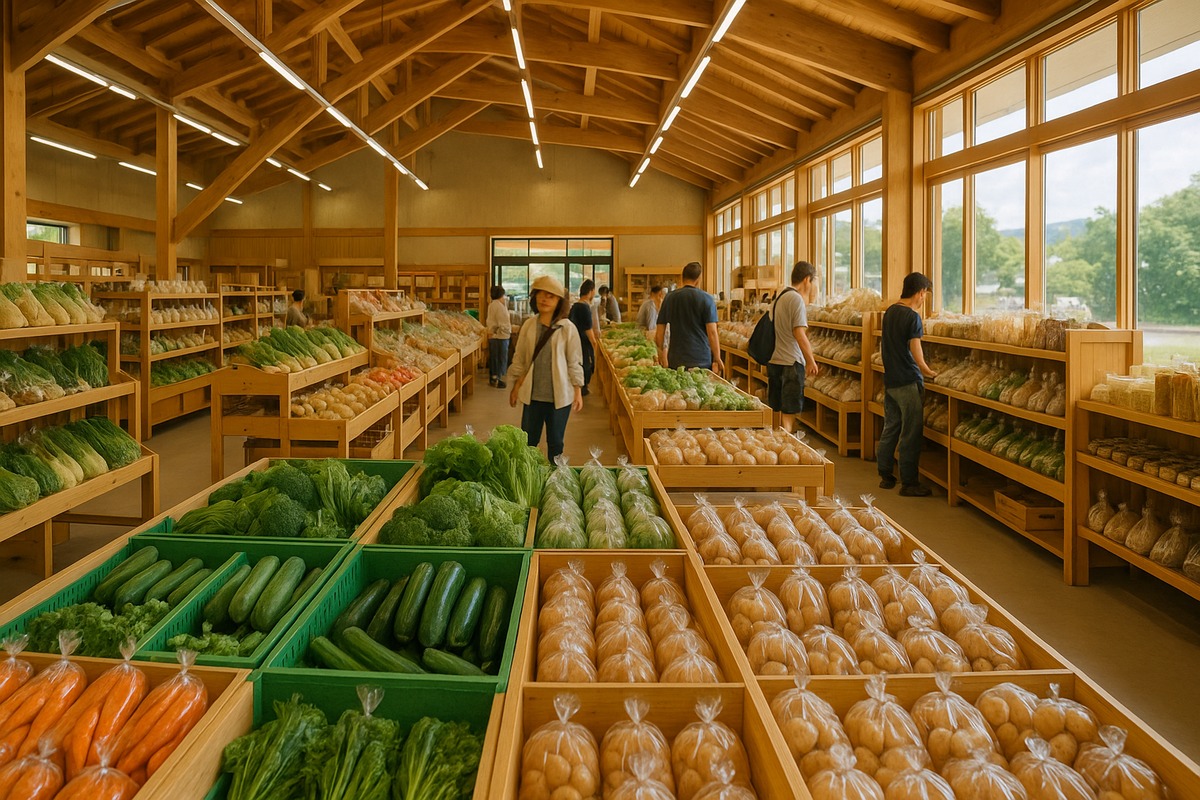
That single design choice is why a Japanese roadside station can look completely different from its American equivalent. A michi-no-eki commonly functions as a direct-to-consumer sales channel for nearby farms, letting small producers sell fresh produce, without the margin compression of going through a traditional wholesale distribution chain to reach a supermarket shelf. It’s routinely paired with a restaurant serving food built specifically around what came in from local farms and fisheries that day, rather than a standardized fast-food menu identical at every location nationwide. And at the more ambitious end, individual stations have expanded into genuine multi-hour destinations — some incorporating hot springs, amusement facilities, and event spaces that turn a highway stop into the actual purpose of a family day trip, not an interruption to one.
The Numbers Behind the Network
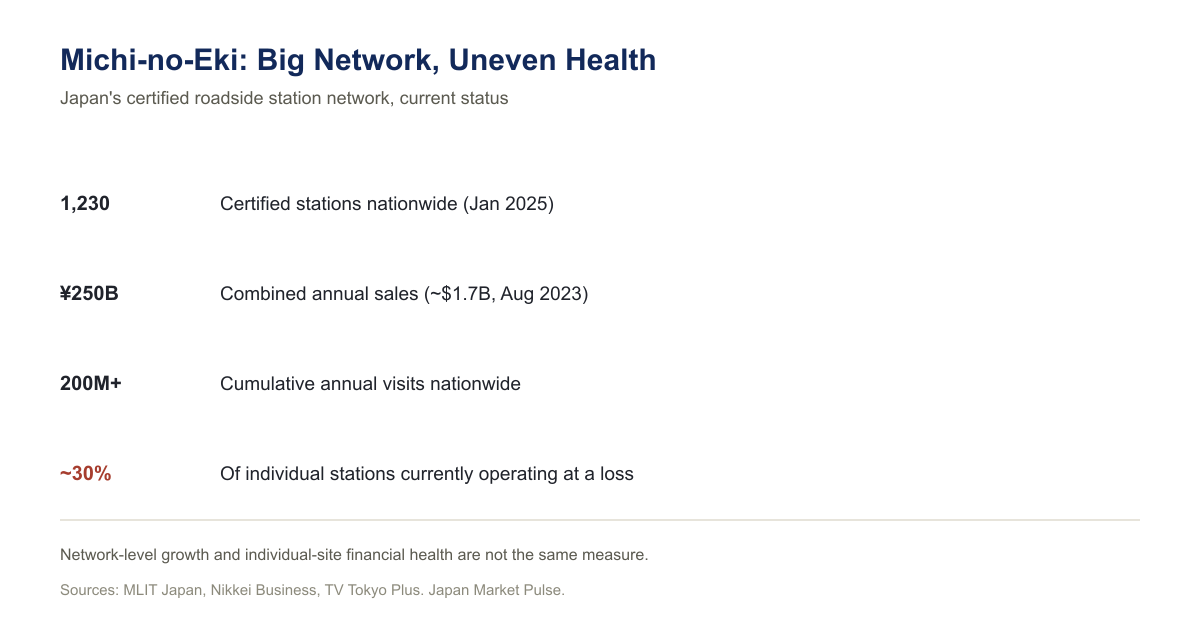
The scale here is what makes michi-no-eki worth treating as a retail category rather than a transportation footnote. As of January 2025, 1,230 stations carry the official certification nationwide. Combined annual sales across the network reached approximately ¥250 billion as of an August 2023 measurement, and cumulative annual visits across all locations exceed 200 million — a figure that implies most Japanese residents, and a meaningful share of inbound tourists, pass through a michi-no-eki multiple times a year without necessarily thinking of it as a distinct retail category at all.
That combination of ubiquity and genuine commercial scale is precisely what makes the network valuable as distribution infrastructure. A regional producer doesn’t need a national retail deal or an e-commerce operation to reach real customer volume — placement in a well-trafficked michi-no-eki along a popular driving route can function as a meaningful sales channel on its own, particularly for products too perishable, too regional, or too small-batch to interest a national supermarket chain’s supply chain.
The Part That Doesn’t Fit the Success Story
The uncomfortable number sitting underneath all of this is that roughly 30% of michi-no-eki are currently estimated to be operating at a loss, and a handful of longer-running stations have closed over the past several years despite the network’s overall growth in visitor numbers and total sales. The reasons are structural rather than a simple case of individual mismanagement: many stations were built and are still operated with municipal government involvement or subsidy, meaning the original business case wasn’t always purely commercial to begin with — some were built explicitly as regional-development infrastructure, with revenue self-sufficiency treated as a secondary goal rather than a hard requirement. As competition between neighboring stations has intensified — more of them chasing overlapping catchment areas of drivers along the same regional highway corridors — some analysts now describe the sector as entering an oversupply phase, where the network-level growth in total visits and sales masks a genuinely uneven picture underneath, with a smaller number of destination-tier stations pulling far more than their share of visitors while a larger number of smaller, more ordinary stations struggle against rising operating costs and stagnant local traffic.
That split matters for how outside observers should read the michi-no-eki success story. The headline numbers — 1,230 stations, ¥250 billion, 200 million visits — describe a network that is genuinely large and genuinely popular in aggregate. They don’t describe a network where every individual node is thriving, and the gap between the two is a normal feature of a maturing, three-decade-old retail category rather than a sign the underlying model has failed.
What International Operators Should Take From This
For transportation authorities, regional economic development agencies, and retail operators anywhere managing highway or transit infrastructure, michi-no-eki demonstrate a specific idea worth testing directly: a captive-audience transit stop can be turned into meaningful regional economic infrastructure if the operating mandate is built in from the start, rather than treated as an optional add-on to a fueling-and-vending-machine business model. The michi-no-eki certification framework didn’t just permit local economic activity — it required it as one of three core functions, which is precisely why the format scaled into a genuine sales channel for small producers rather than staying a transit-only convenience stop.
The oversupply lesson is just as transferable, and arguably more urgent for any region considering building out a similar network today. A format that works spectacularly well at moderate density can tip into genuine competitive cannibalization once too many similar facilities chase the same regional traffic corridor — the fact that roughly 30% of a thirty-year-old, broadly successful Japanese network are currently losing money is a real-time demonstration of that ceiling, not a hypothetical risk. Any region building out a similar rest-stop-as-retail-destination model should treat network density, not just individual site design, as the variable that ultimately determines whether the format is a durable regional economic asset or a subsidized amenity with a shrinking number of genuinely profitable locations.
Frequently Asked Questions
Q. How many michi-no-eki are there in Japan?
A. As of January 2025, there are 1,230 officially certified roadside stations nationwide.
Q. How much revenue does the michi-no-eki network generate?
A. Combined annual sales across the network reached approximately ¥250 billion (roughly $1.7 billion) as of an August 2023 measurement, with cumulative annual visits exceeding 200 million.
Q. Are michi-no-eki profitable?
A. Not uniformly. While the network overall is large and growing, roughly 30% of individual stations are estimated to be operating at a financial loss, and several have closed in recent years amid intensifying competition between neighboring facilities.
Q. What makes a michi-no-eki different from a typical highway rest stop?
A. Japan’s certification framework, established in 1993, formally requires each station to combine three functions — driver rest, traveler information, and regional economic contribution — which is why michi-no-eki commonly function as direct sales channels for local farms and producers rather than standardized fuel-and-snack stops.
If you’re interested in this topic, the Japanese market more broadly, or what KETCHUPs is working on, we’d love to hear from you — please reach out via our contact form.
Japan Market Pulse is a weekly read on what the Japanese consumer-tech, food, and mobility markets are choosing to do, written for international operators who want to know what is happening before it shows up in the global trade press.
Subscribe at ketchups.co/japan-market-pulse.