

Disclosure: This article is published by KETCHUPs, a Tokyo-based trading and brand-development firm. All content is editorial.
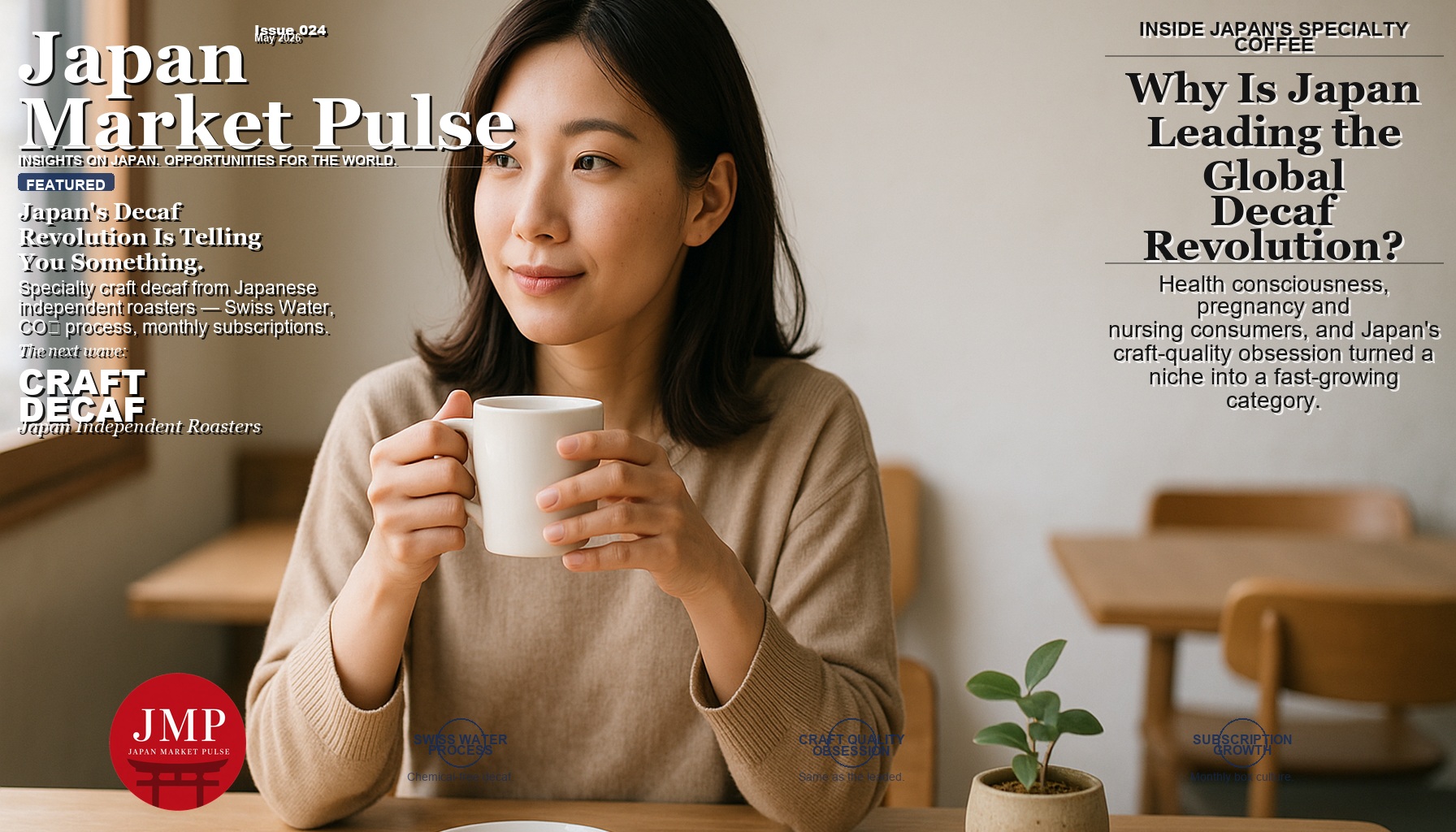
Walk into Onibus Coffee in Nakameguro on a Saturday morning and you will see something that didn’t exist five years ago: a handwritten A-frame sign advertising a single-origin decaf pour-over from a Colombian finca, priced at ¥950 a cup. The barista talks about it the same way they talk about the regular seasonal offering — processing method, elevation, tasting notes. Nobody apologizes for it being decaf.
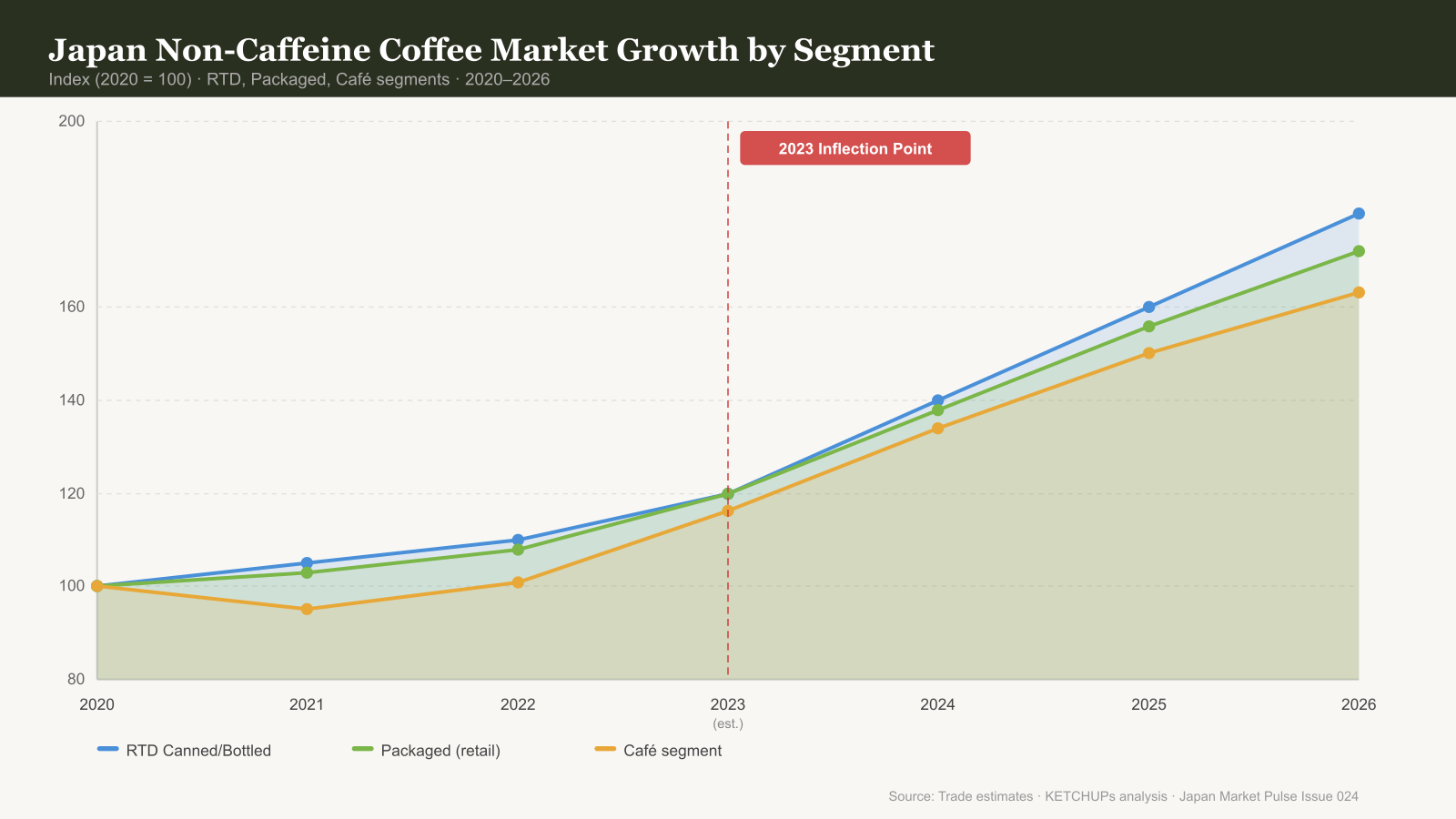
That shift in posture — decaf treated not as a compromise but as a legitimate craft product — is the story of what has happened to the Japanese coffee market over the past two years. The numbers confirm what the A-frame sign suggests: the non-caffeine coffee segment is now the fastest-growing segment in Japanese packaged coffee, with approximately 35% aggregate growth across RTD, packaged, and café segments between 2022 and 2025. That is not a rounding error. That is a category rewriting its own identity.
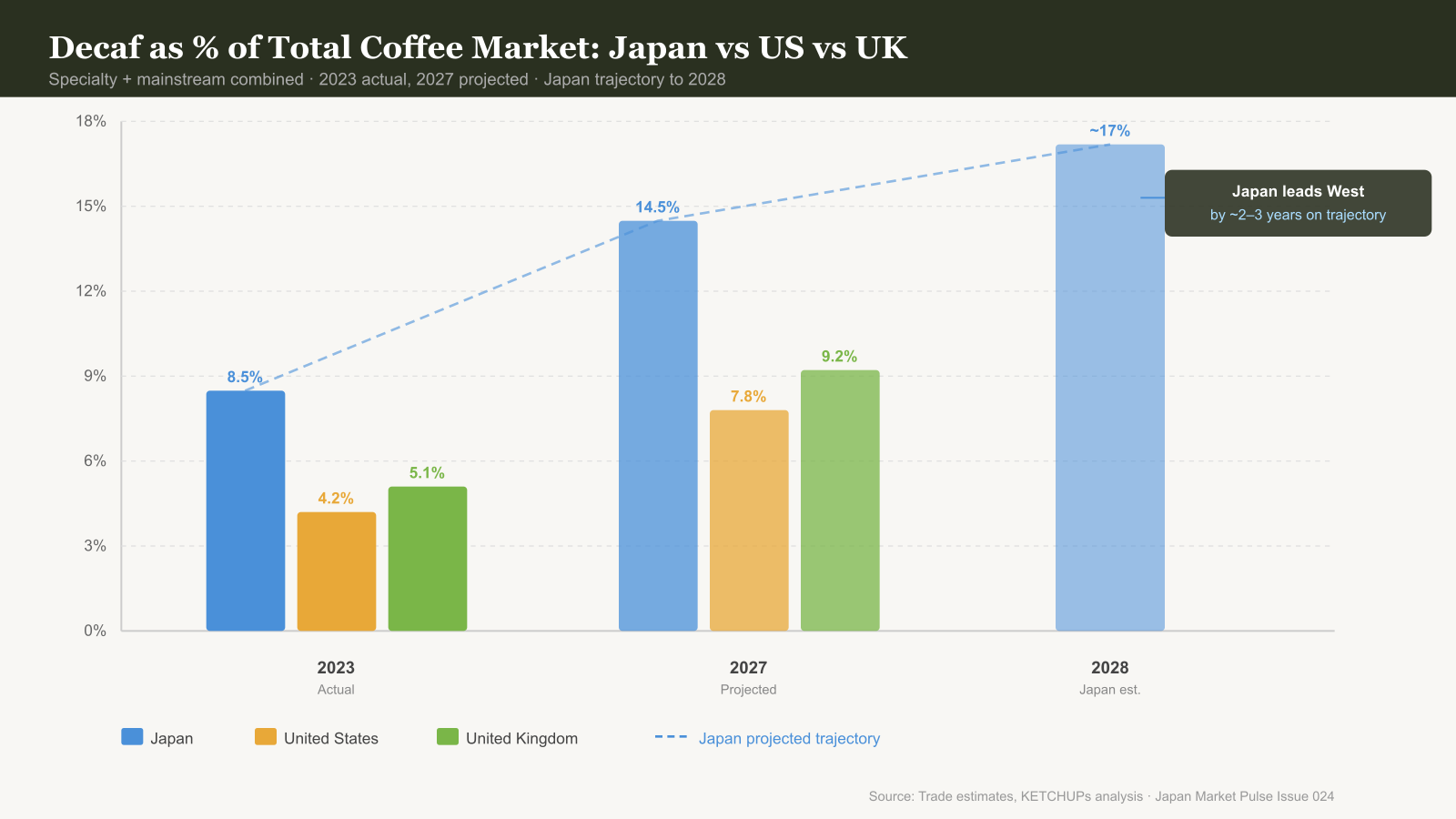
For anyone operating in the Western specialty coffee space, Japan’s decaf trajectory deserves serious attention. Japan has a history of being an early-signal market for premium beverage trends — third-wave coffee itself was flourishing in Tokyo neighborhoods like Shimokitazawa and Daikanyama years before it became a mainstream concept in American mid-size cities. If the pattern holds, what is happening to decaf in Japan today is a 2-to-3-year preview of where the US and UK markets are heading.
From Pharmacy Shelf to Specialty Bar: A Category Repositioning
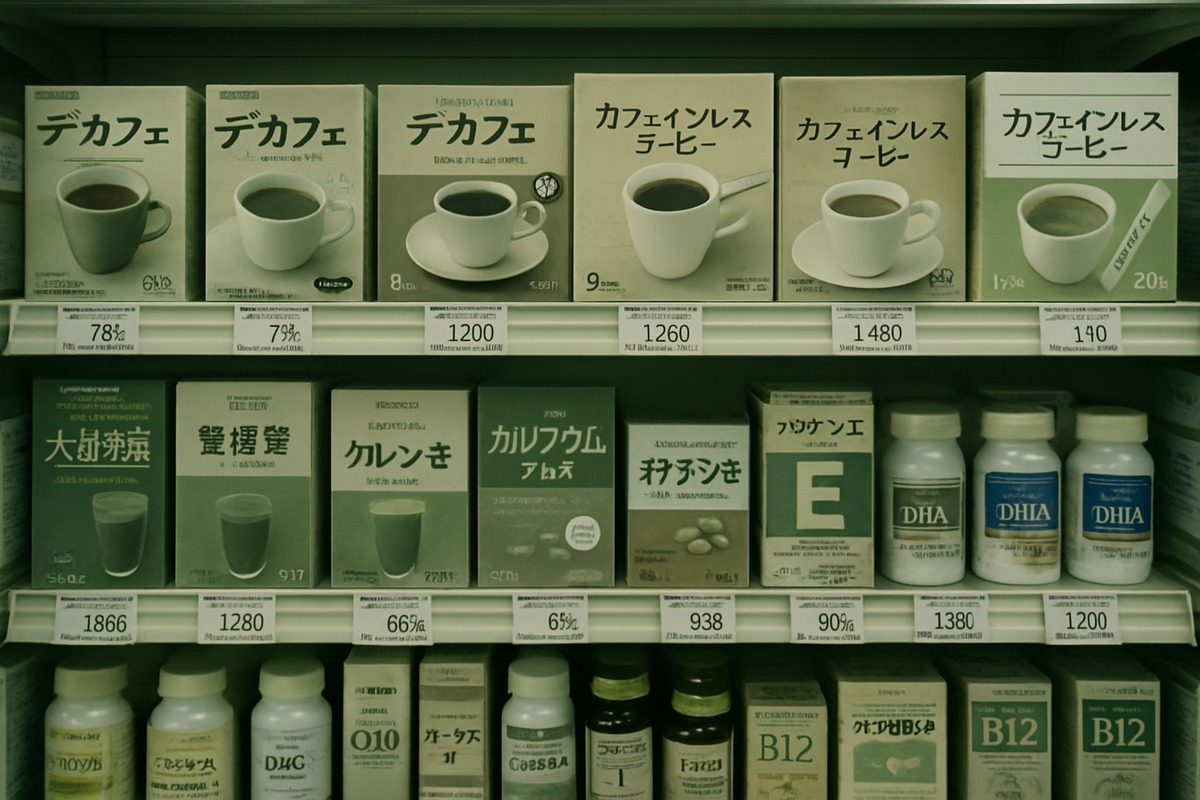
For most of the 2000s and early 2010s, decaf coffee in Japan lived in a specific and narrow social context: it was something you bought at the pharmacy or the health food section of a supermarket if you were pregnant, had heart issues, or were following a doctor’s recommendation to reduce caffeine intake. The product itself was generally unremarkable — mass-produced, chemically processed, bearing little resemblance to the origin coffee experience that was simultaneously becoming a serious enthusiast pursuit in Japanese cities.
The stigma was real. Ordering decaf at a specialty café in Tokyo circa 2015 was likely to earn you a polite but unmistakable signal that you had wandered into the wrong venue. The craft coffee world, with its meticulous attention to extraction variables and varietal characteristics, had no room for a product that began with compromised source material.
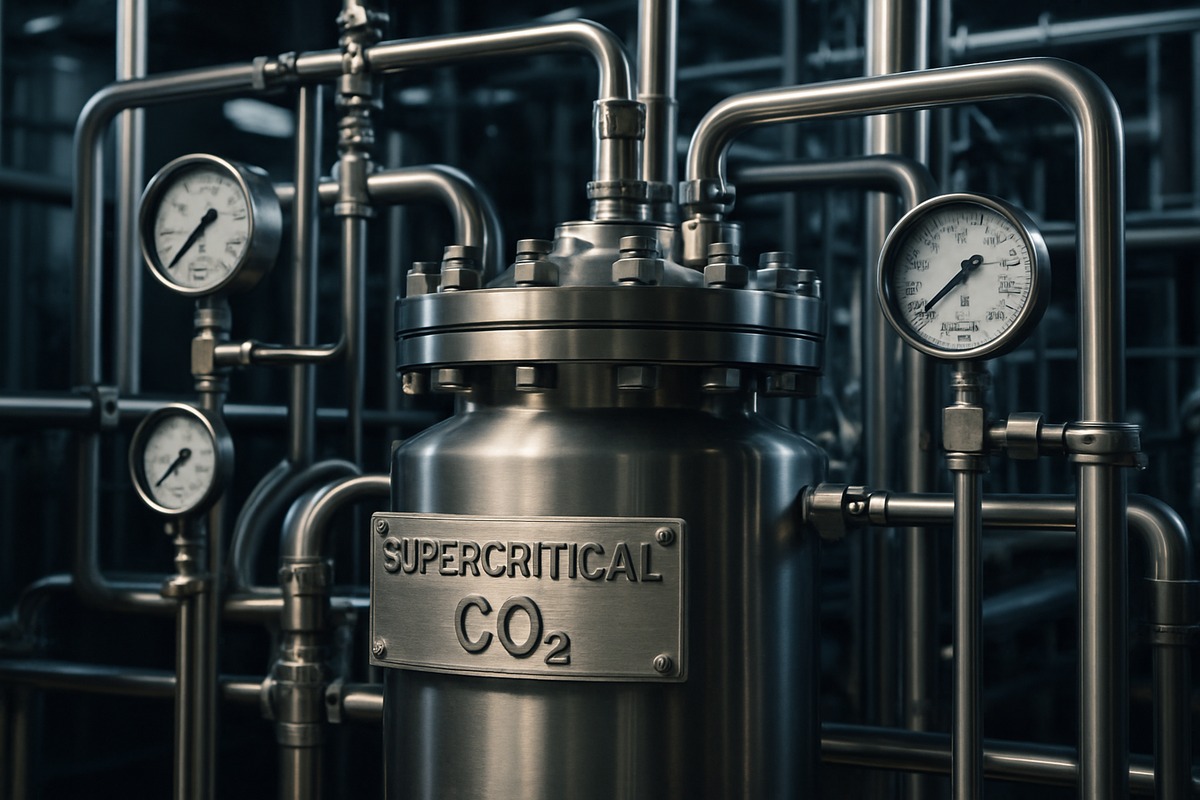
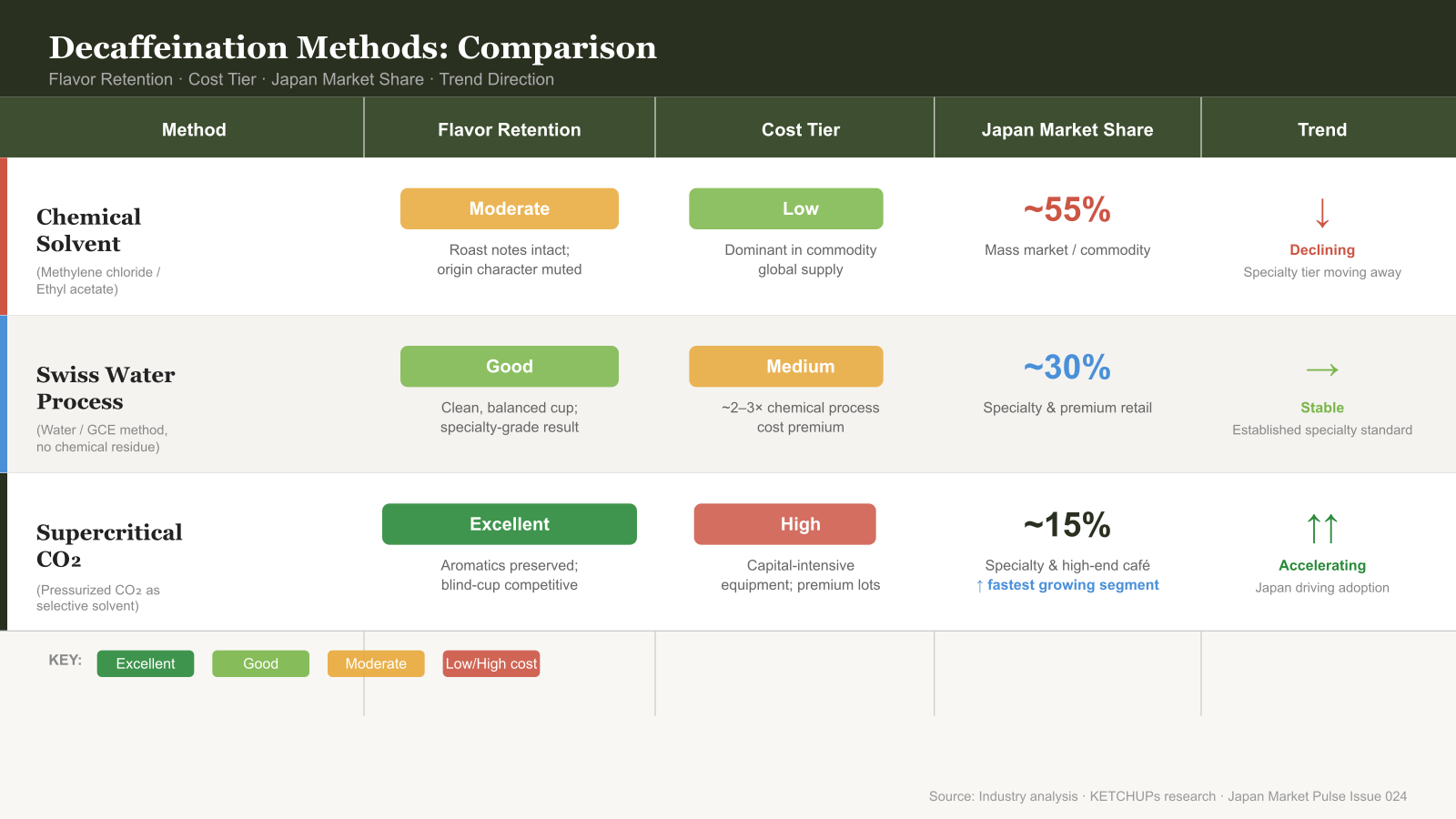
What changed was not demand — it was supply quality. The proliferation of advanced decaffeination methods, particularly the supercritical CO2 process and the Swiss Water Process, fundamentally altered the flavor profile of what decaf coffee could taste like. Supercritical CO2 decaffeination operates without chemical solvents: pressurized carbon dioxide acts as a selective solvent for caffeine molecules while leaving the aromatic compounds and flavor precursors largely intact. The result is a decaffeinated green coffee that roasters can actually work with — something that responds to light roasting, develops nuanced tasting notes, and behaves on the cupping table like a real coffee.
Japanese specialty importers and roasters, who already had established relationships with origin producers in Ethiopia, Colombia, and Guatemala, began sourcing decaffeinated lots processed with these premium methods. The category became something you could talk about with the same vocabulary as regular origin coffee, and that changed everything.
The Commercial Signals: Mass Market Validation
The specialty tier moves first, but commercial validation follows. The markers of mainstream arrival in Japan are now visible across multiple retail channels simultaneously.
UCC Ueshima Coffee — one of Japan’s oldest and most recognized coffee brands, founded in Kobe in 1933 — rolled out a dedicated decaf line that positions quality and taste rather than health avoidance as its primary selling proposition. Nescafé Japan followed with decaf SKUs across its soluble and capsule formats. These are not token additions. They represent category management decisions made by brands whose core business depends on reading Japanese consumer demand accurately.
The Starbucks Japan signal is worth parsing separately. Starbucks Japan has generally been more aggressive than its US parent in introducing premium and artisanal formats — the pour-over option, available at selected Reserve stores, was expanded to include decaf. For a chain at Starbucks’ scale, menu real estate is allocated with considerable analysis behind it. Adding a decaf pour-over option is a statement that the brand believes enough paying customers will order it at a premium price point to justify the operational complexity.
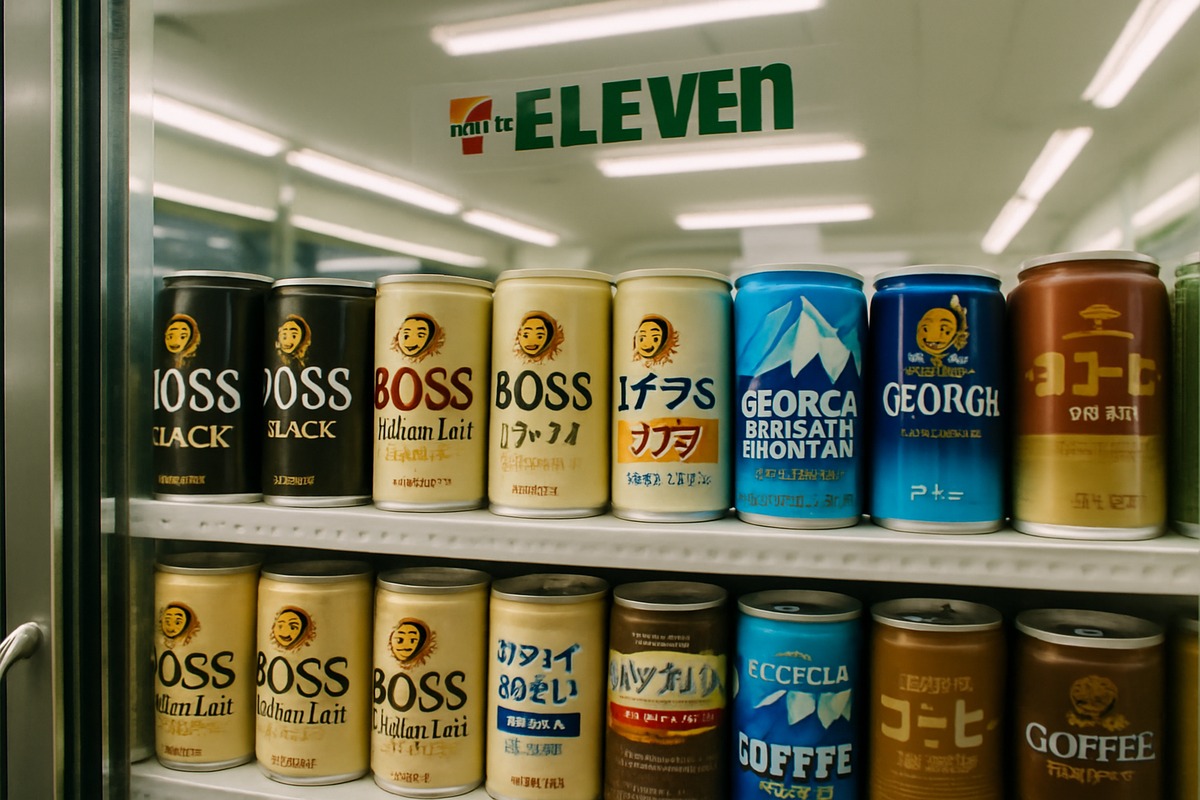
The confirmation of mass-market arrival, though, came in 2024 when 7-Eleven Japan began stocking decaf canned coffee in its refrigerated section. 7-Eleven Japan’s convenience store category decisions are among the most data-driven in Japanese retail. They run constant product churn, eliminating SKUs that underperform within weeks. If decaf canned coffee is on the shelf at a 7-Eleven in suburban Tokyo next to regular Boss Coffee and Georgia, it means the register data supports it. Convenience store presence is the Japanese equivalent of a product reaching the endcap at Walmart — not an indicator of trendiness, but of genuine, broad-based consumer demand.
The Technology Layer: Why the Product Is Actually Good Now
The craft coffee world’s acceptance of decaf is not purely a cultural shift — it is grounded in a real improvement in what the product tastes like. Understanding the decaffeination method landscape is essential context for anyone evaluating this market.
Chemical solvent-based processes (methylene chloride or ethyl acetate) remain the cheapest option and still dominate commodity decaf globally. Flavor retention is acceptable but not exceptional. These methods are increasingly disfavored by the specialty tier and by Japan’s health-conscious consumers who read ingredient sourcing information carefully.
Swiss Water Process — a Canadian-developed method using only water, temperature, and time to remove caffeine via a green coffee extract — has no chemical residue and produces clean, balanced cups. It has been the specialty decaf standard for about a decade and is widely used by third-wave roasters in the US and Japan.
Supercritical CO2 decaffeination is the premium tier. CO2 under high pressure and specific temperature becomes a supercritical fluid that selectively dissolves caffeine molecules without stripping the aromatic compounds that give specialty coffee its character. The capital cost of the equipment is high, which means it is used primarily for premium, high-value green coffees where the economics justify it. Japanese specialty importers have been early adopters of CO2-processed decaf lots precisely because the flavor difference is discernible even to casual drinkers.
The practical result: a skilled Japanese roaster applying a light or medium-light roast to a CO2-processed decaffeinated Ethiopian natural can produce a cup with recognizable stone fruit and floral characteristics. Blind cupping data from Japanese coffee competitions has shown that trained palates cannot consistently distinguish CO2-decaf from origin coffee in the same roast profile. That is a remarkable engineering outcome, and it removes the primary objection that specialty coffee culture had to decaf.
Market Data and Demographics: Who Is Buying and Why
The 35% growth figure for Japan’s non-caffeine coffee segment between 2022 and 2025 requires some unpacking. The number spans multiple product formats — RTD canned and bottled coffee, retail packaged ground and whole bean, and café-served orders — and the growth is not uniform across them.
The RTD segment shows the sharpest growth in unit volume but the lowest average price point. The packaged ground and whole bean segment shows more moderate volume growth but significantly higher revenue growth, driven by the price premium that specialty decaf commands. Current pricing for specialty-grade decaf in Japan runs approximately ¥800 to ¥1,200 per 100 grams, versus ¥600 to ¥900 for comparable regular specialty coffee — a roughly 20 to 30 percent premium that consumers are evidently willing to pay.
The primary adopter demographic is women aged 25 to 45 in urban markets: Tokyo, Osaka, Nagoya, Fukuoka. This cohort has driven Japanese specialty coffee adoption generally — they are the core customer base for the third-wave café scene, they index heavily on home brewing with manual methods, and they are health-attentive without being restrictive. For this group, premium decaf solves a real problem: they want the sensory experience and social ritual of specialty coffee without the physiological effects of caffeine on sleep quality, anxiety, or hormonal sensitivity.
The secondary and growing demographic is men over 40 who have been told by doctors or who have self-diagnosed a need to reduce caffeine. This cohort is less interested in the craft narrative and more interested in product quality parity — they want something that actually tastes like good coffee. The improvement in decaf quality is what is converting this group from reluctant accommodation to active preference.
Home brewing is a significant amplifier. Japan’s home coffee culture is extraordinarily well-developed — Hario, Kalita, and Kinto have distribution across the world now, but the center of gravity for their domestic market is the Japanese consumer who brews carefully at home. The adoption of pour-over decaf for home use, using the same V60 dripper and the same scale and timer that a Japanese home brewer uses for their regular coffee, is a powerful signal that decaf has been fully inducted into the serious coffee practice. Equipment choice communicates category belonging.
The Specialty Tier: Tokyo Roasters as Category Architects
The commercial expansion would not have happened without the specialty tier establishing the proof of concept. Several Tokyo roasters deserve specific attention as early movers.
Onibus Coffee, which operates multiple locations in Tokyo and has built a following among the city’s serious coffee drinkers, introduced decaf single-origin offerings as part of its regular rotation rather than as a separate menu category. The decision not to segregate decaf into a distinct section — not to put a special label or apology around it — was itself a positioning statement.
Bear Pond Espresso in Shimokitazawa, known for its exacting standards and idiosyncratic owner, has offered decaf espresso options that adhere to the same sourcing and roasting standards as its regular offerings. For a café that has never compromised on quality positioning, that inclusion is a credibility signal for the category.
These specialty players do not move units at scale. But they establish what is credible, and that credibility migrates downstream. UCC’s category managers track what Onibus is doing. Buyers for Tokyu Department Store’s food hall watch what Bear Pond is serving. The specialty tier in Japan functions as a research and development operation for the mass market, and right now it is telling the mass market that premium decaf is real.
What Western Operators Should Do With This Information
The US specialty decaf market is, by most estimates, under 5% of total specialty coffee sales by volume. That number is growing — Blue Bottle has expanded its decaf SKU count and sourcing transparency. Intelligentsia has introduced decaf single-origin offerings. Counter Culture, Stumptown, and other major US specialty roasters have moved from single decaf SKUs to multiple offerings.
But they are doing this cautiously, treating decaf as a secondary offering that requires explanation and justification in their marketing. The Japan case suggests that approach may be miscalibrated. Japan’s specialty roasters did not apologize their way into a 35% growth category — they treated decaf with the same seriousness they applied to origin coffee, and the market responded.
Several specific implications follow from the Japan signal: decaffeination method is a marketing asset — put the processing method on the bag; the 20-30% price premium over regular specialty that Japan’s market is accepting suggests that consumers who have been converted to quality decaf will pay for it; and if Japan’s pattern holds, the US specialty decaf market in 2028 will look considerably different from today.
Japan’s decaf revolution did not happen because Japanese consumers are uniquely health-conscious or uniquely sophisticated about coffee. It happened because the product got good enough, the right operators took it seriously, and the rest of the market followed the signal. That sequence is not Japan-specific. It is a market pattern, and it is currently running approximately two years ahead of where the West is standing.
If you’re interested in this topic, the Japanese market more broadly, or what KETCHUPs is working on, we’d love to hear from you — please reach out via our contact form.
Japan Market Pulse is a weekly read on Japanese consumer trends, retail shifts, and market signals for B2B operators watching the market.
Subscribe at ketchups.co/japan-market-pulse.