

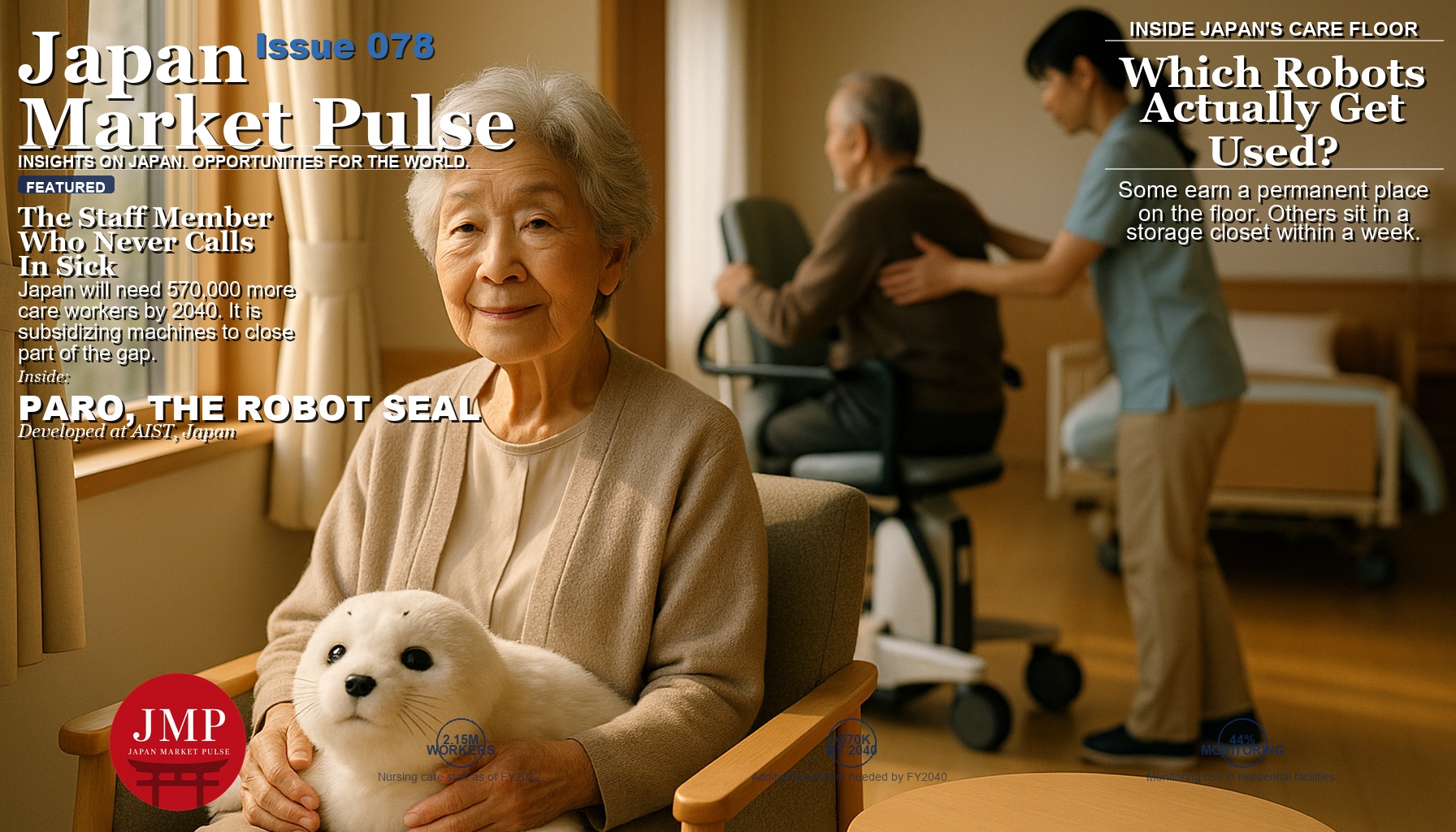
There is a nursing home in Tokyo’s Setagaya ward where the most reliable staff member never calls in sick. It is about the size of a large housecat, covered in white fur, and it spends its days being wheeled — or, more often, carried in someone’s arms — from room to room. Its name is PARO. It is a robot shaped like a baby harp seal, developed at Japan’s national AIST research institute and commercialized through a private manufacturer, Intelligent System, and its entire job is to be held.
I have lived in Japan for twenty years now, long enough to stop being surprised by robots that do jobs I once assumed only humans could do. But the first time I watched a robotic seal calm an agitated resident faster than the two exhausted human caregivers standing next to her, something clicked. This wasn’t a novelty. This was infrastructure.
Picture a woman in her late eighties, a resident of a facility not unlike the one in Setagaya. She moved in after a fall made living alone too risky for her family’s peace of mind, though not, by her own account, too risky for her own. Her days follow a rhythm familiar to anyone who has spent time around Japanese elder care: meals on schedule, a bath twice a week, physical therapy in the mornings, and a robotic seal that visits her room in the afternoon and lets her hold it while she watches television. She did not choose this arrangement because she loves technology. She chose it, or had it chosen for her, because there were not enough human hands to go around. That is the quiet, unglamorous truth sitting underneath every headline about Japan’s “robot future.” The robots did not arrive because Japan is obsessed with gadgets. They arrived because Japan ran out of caregivers first.
The Scale of the Problem
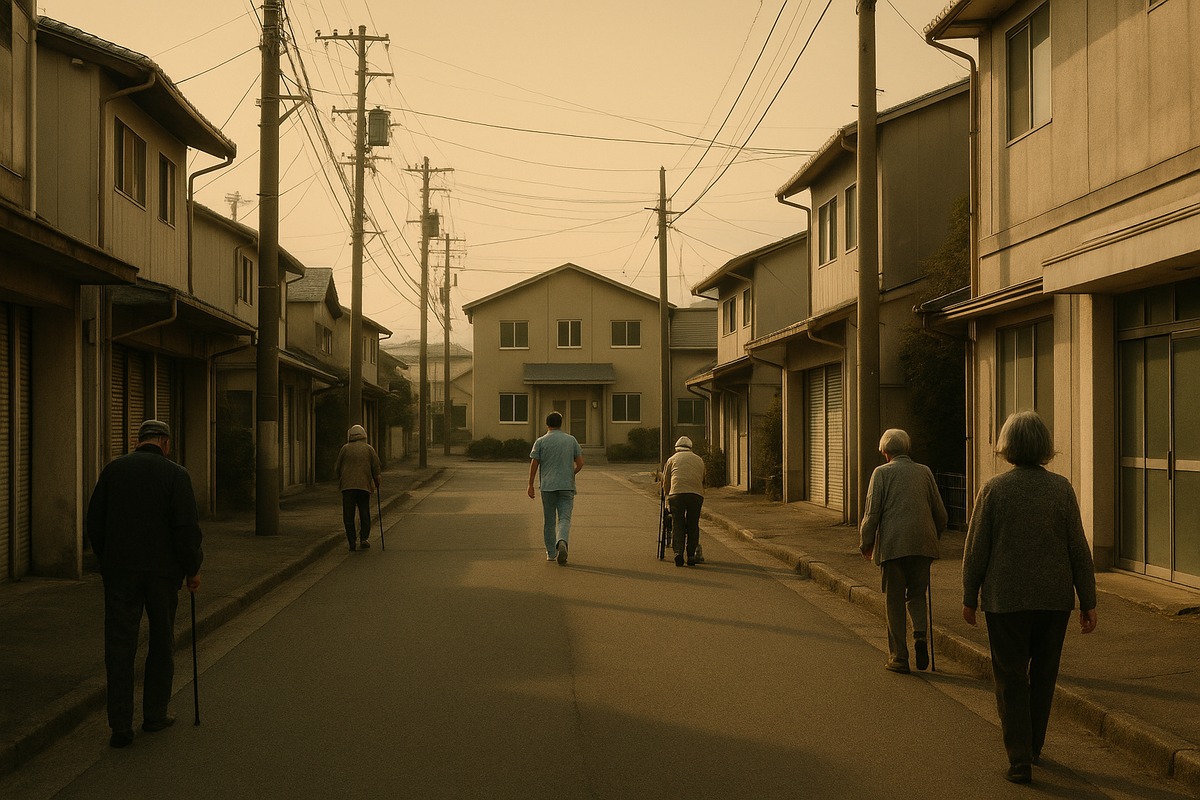
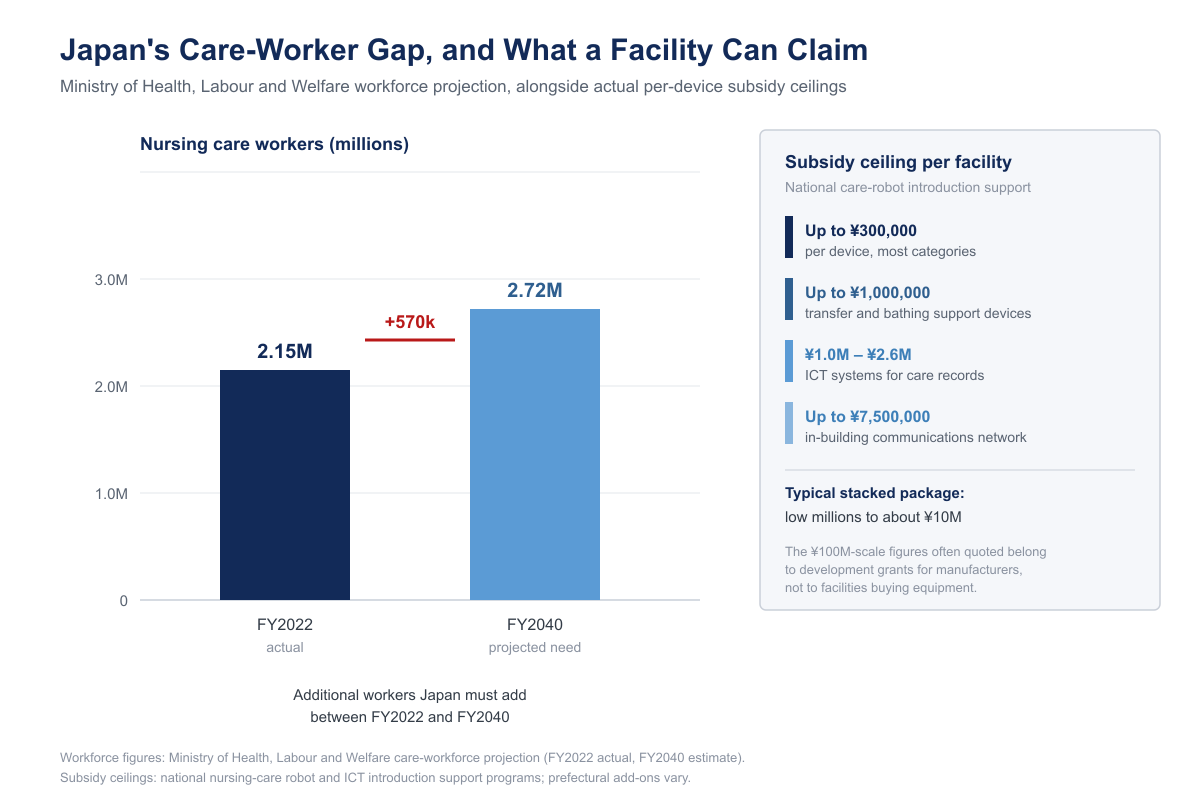
Japan is one of the world’s oldest major economies, and it aged earlier than most of its peers — Korea is now aging faster, but Japan got here first, which means it is the first to run the experiment. Its caregiving workforce has not kept pace. As of fiscal 2022, the most recent year the health ministry has fully tallied, the country employed roughly 2.15 million nursing care workers — a number that sounds substantial until you look at what is coming. The same ministry projects that Japan will need about 2.72 million care workers by fiscal 2040, roughly 570,000 more than it had in 2022, as the baby boomer generation moves deeper into its eighties and nineties, precisely the age band that requires the most intensive daily support.
The labor market signals are already flashing. Job-to-applicant ratios in caregiving occupations sit stubbornly above three-to-one in many regions, meaning there are more than three open caregiving positions for every person applying. Rural areas and smaller cities feel this most acutely, where younger workers have moved to Tokyo or Osaka and the people left behind are, disproportionately, the ones who need care rather than the ones able to provide it. Add to this a hard demographic ceiling: nearly a third of Japan’s population is now 65 or older, a share that keeps climbing while the working-age population that funds pensions and staffs care facilities keeps shrinking.
For a country that prizes group harmony and quiet competence, this is an unusually loud crisis, one that shows up not in protests but in facility closures, in waitlists for nursing homes, and in families quietly deciding that Grandmother will have to make do with less attention than she needs. It is the kind of problem that does not lend itself to slogans. It lends itself to spreadsheets, subsidy programs, and, as it turns out, robots.
Tokyo’s Answer: Subsidize the Robots
Japan’s Ministry of Economy, Trade and Industry did not wait for the crisis to fully arrive before acting. Back in 2013, METI launched what has become one of the most sustained industrial policy experiments of its kind anywhere in the world: a program to develop and subsidize the introduction of robotic devices specifically for nursing care. The logic was straightforward even if the execution has been anything but simple. If Japan could not import enough caregivers and could not train new ones fast enough, it would have to build machines that let existing caregivers do more with the same two hands.
The program identifies priority categories where robots are believed to offer the clearest return: transfer and mobility assistance, help with using the toilet, monitoring and communication support, bathing assistance, and general care-work support. Within these categories, the government has put money into both research and adoption, though the research side is smaller than the headlines suggest: by the late 2010s, national spending on care-robot R&D had reached roughly $100 million, with the dedicated development program running on annual budgets in the hundreds of millions of yen. The money that actually moves the market is on the adoption side, not the lab side.
The subsidy structure that facilities and manufacturers actually deal with today is, frankly, a maze — the kind of layered bureaucracy that would make an American operator’s eyes glaze over. Depending on the prefecture, a nursing facility can stack a national nursing-care robot introduction subsidy with prefectural ICT grants and newer AI-care-planning incentives, in some cases reducing the facility’s out-of-pocket cost to roughly a quarter or a half of the sticker price. The ceilings themselves are modest per device: on the order of a few hundred thousand yen for most categories, up to roughly one million yen for transfer and bathing equipment, one to two-and-a-half million yen for ICT systems, and several million yen for the in-building communications network the sensors run on. Stack the full menu and a mid-sized care home is usually working with a package in the low millions to around ten million yen — enough to genuinely change the math on whether it installs one transfer robot or five, but nowhere near the hundred-million-yen figures that circulate in coverage of this program. Those larger ceilings belong to development grants aimed at manufacturers, not to facilities buying equipment.
This is where the American reflex to see subsidies as market distortion runs into a genuinely different policy philosophy. Japan is not trying to pick winners in a speculative tech race. It is trying to keep an essential service sector functioning at all, and it has decided that de-risking the purchase decision for individual facility operators is the fastest lever available. Whether or not you think that is good economics, it has undeniably created a market that would not otherwise exist at this scale, this early.
The Robots on the Floor
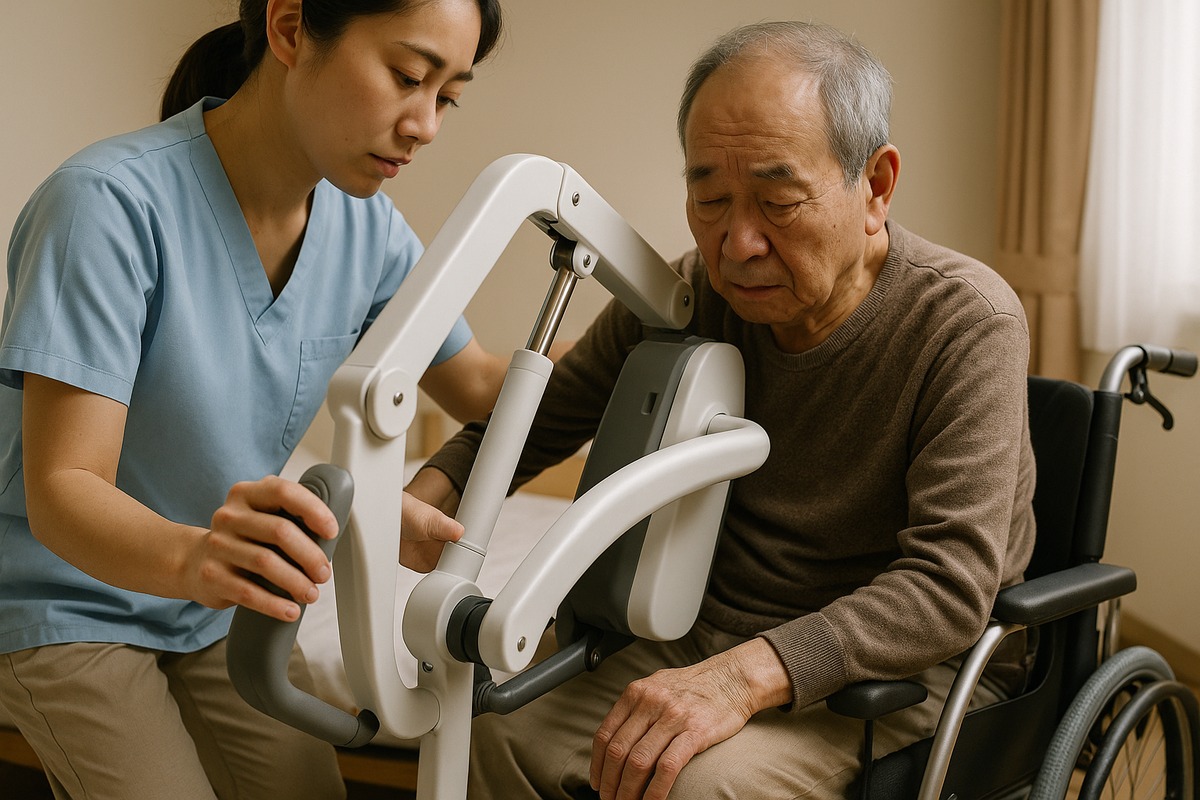
Walk through a well-funded Japanese care facility today and you will likely meet a small cast of recurring characters. There is Hug, a lifting robot from Fuji Corporation that slides a soft robotic arm under each of a resident’s armpits to help them stand or transfer from bed to wheelchair, sparing a caregiver’s lower back the repetitive strain that has ended more than a few nursing careers early. There is Resyone Plus, made by Panasonic’s elder-care subsidiary, which solves the same transfer problem differently: the bed itself splits apart, with one half detaching to become a motorized wheelchair at the push of a button, so the resident never has to be manually lifted at all. There is PARO, the seal, whose entire value proposition is emotional rather than mechanical — reducing agitation, easing loneliness, giving caregivers a few calmer minutes with residents who have dementia. And, in a smaller and shrinking number of facilities, there is Pepper, the humanoid robot once positioned as a group-exercise leader and conversational companion, whose novelty has faded faster than the more utilitarian devices around it.
What is refreshing, and worth being honest about, is that this technology has not been a uniform success story. Some of the most useful documentation of Japan’s care-robot experiment comes not from manufacturers but from researchers who spent months embedded inside actual facilities. Their accounts describe exactly the kind of friction you would expect from any workplace technology rollout: caregivers who found Hug cumbersome to wheel from room to room and quietly stopped using it within days, staff who preferred the speed and familiarity of manual transfers even when a robot was sitting a few meters away fully charged. Adoption, in other words, has not been automatic just because a subsidy made the purchase price attractive.
The devices that have stuck tend to share a common trait: they fit into the existing rhythm of caregiving rather than demanding caregivers change their habits around the machine. Resyone Plus succeeds partly because it removes a physically dangerous task rather than adding a new procedural step. PARO succeeds because holding a soft, responsive object is something a caregiver would want to encourage anyway, robot or not. The devices that have struggled tend to be the ones that ask staff, already stretched thin, to learn an entirely new workflow during a shift that has no slack in it for learning.
This nuance matters enormously for anyone outside Japan sizing up this market. The headline narrative — robots solving Japan’s care crisis — oversells what is actually a slower, messier, facility-by-facility sorting process, where some machines earn a permanent place on the floor and others end up parked in a storage closet within a year. That sorting process is, in its own way, valuable data that other aging economies have not yet had to generate themselves.
Beyond the Facility: Robots at Home
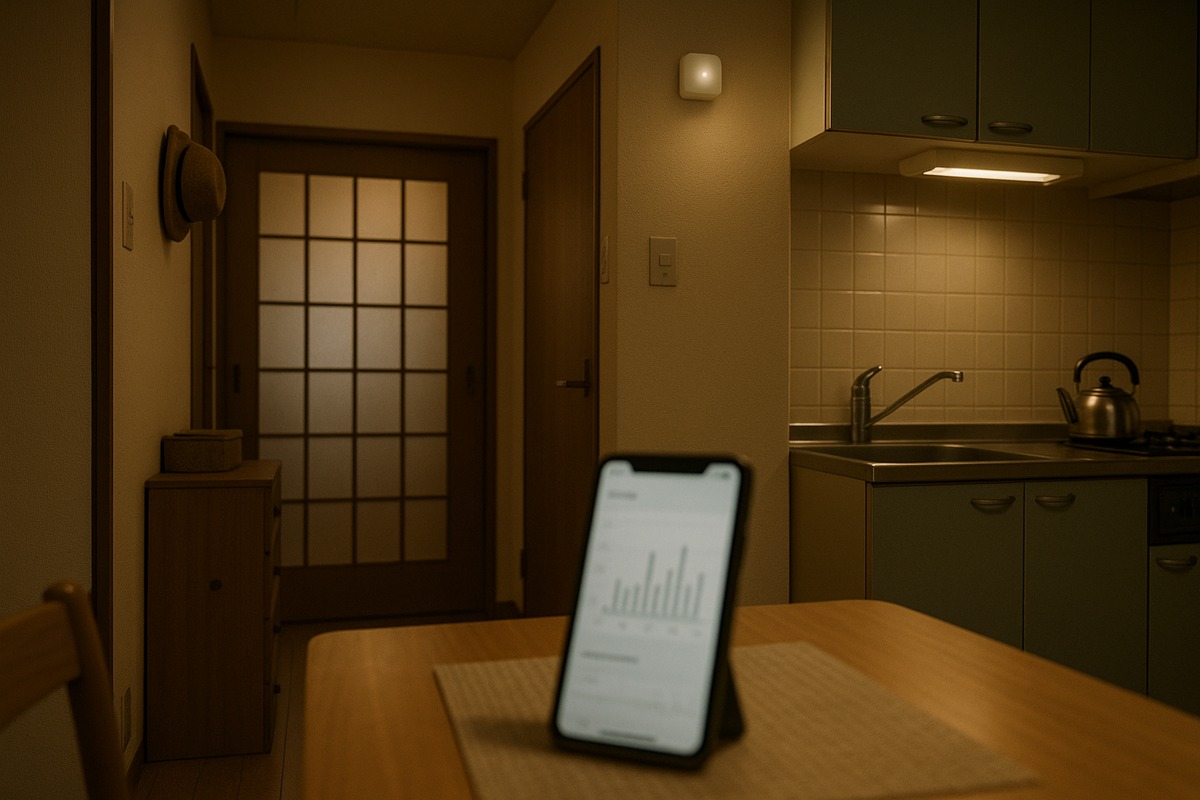
Not every part of this story happens inside an institution. A significant and growing share of Japan’s elderly population lives alone, a trend that has accelerated for decades as adult children moved to cities for work and multigenerational households became less common. For families with an aging parent living independently, often hours away by train, the anxiety is less about physical care tasks and more about a simple, unbearable uncertainty: is she okay right now?
Monitoring technology has quietly become the answer for a large share of these households. Sensor-based systems are the fastest-spreading category in this entire industry, though it is worth being precise about how far that has actually gone: a Care Work Foundation survey found that roughly 80 percent of providers across Japan’s long-term care insurance system had introduced no care robot of any kind, and while some municipal and facility-type surveys show monitoring-device adoption in the mid-40 percent range inside residential facilities such as special nursing homes, there is no clean national figure at that level. Nationally, in other words, this is a fast-growing minority rather than a settled norm. Where the systems are installed, they track motion, temperature, and light levels across a residence and translate the pattern into something a family member can check from a smartphone hundreds of miles away. A gap in expected movement — no motion detected in the kitchen by mid-morning, when there always has been before — triggers an alert rather than a frantic, unanswered phone call. These systems are not glamorous. Many barely qualify as “robots” in the pop-culture sense, more sensor network than android companion. But they are arguably the most quietly impactful branch of this entire industry, because they let elderly people continue living independently, in their own homes, for months or years longer than they otherwise could — which is both what families want and, not incidentally, what keeps expensive institutional care beds free for the people who need them most.
The Money: How Big Is This, Really
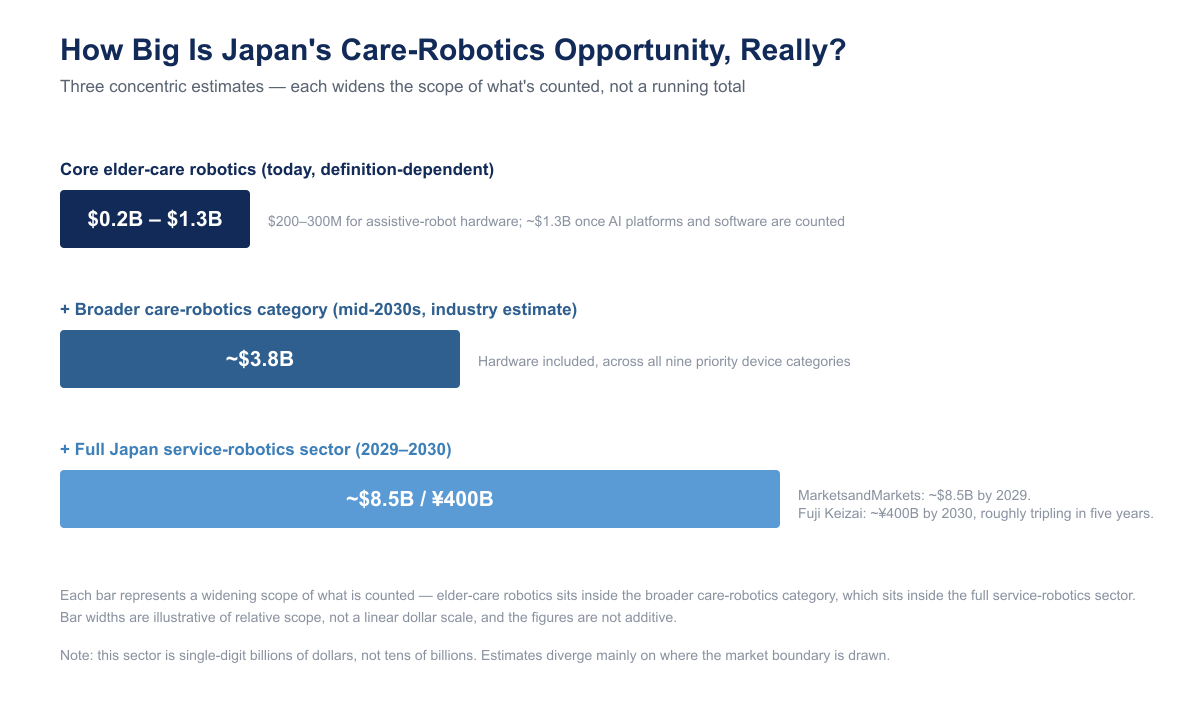
Here is where I want to be careful, because market-size claims in this space vary wildly depending on who is doing the counting and what, exactly, they are counting.
If you define the market narrowly — AI-enabled elder-care robotics platforms specifically, the software-and-sensor layer sitting on top of the hardware — one widely cited private estimate — Ken Research’s “AI in elderly care robotics platforms” market, a deliberately broad definition — puts Japan at around $1.3 billion, a figure that has grown quickly as facilities move from single-purpose machines toward more integrated, AI-assisted systems that combine monitoring, transfer support, and care-planning software into one purchase decision. That is the largest number you will see quoted for this sector, and it is worth holding loosely: draw the boundary differently — elder-care assistive robots as hardware, for instance — and other research houses put Japan somewhere between $200 million and $300 million for 2025. The gap is not a contradiction so much as a definitional argument about whether the software-and-sensor layer counts, and it is a good reminder that in this sector the market definition does more work than the decimal places.
Widen the lens and the numbers move accordingly. Secondary coverage of METI-linked projections has pointed toward the broader care-robotics category — hardware included — expanding toward roughly $3.8 billion by the mid-2030s, though I have not been able to trace that figure back to a primary ministry document, so treat it as an industry rule of thumb rather than an official target. Widen further still, to Japan’s entire service-robot sector, which includes everything from restaurant delivery robots to warehouse automation alongside eldercare devices, and the credible projections still land in the single-digit billions of dollars rather than the tens of billions: Fuji Keizai has forecast roughly ¥400 billion by 2030, tripling the category in about five years, while MarketsandMarkets puts Japan’s service-robotics market near $8.5 billion by 2029.
None of these numbers contradict each other so much as they describe concentric circles. The honest takeaway for an international operator is this: the core elder-care robotics segment is already a real domestic market with government tailwinds behind it — a couple of hundred million dollars on the narrowest hardware definition, over a billion once AI platforms and software are folded in — and it sits inside a larger service-robotics wave that Japan is betting will define a meaningful slice of its economy over the next decade. Anyone pitching a precise, single number as gospel is rounding off more nuance than the data supports — which is, admittedly, a very Japanese thing for an industry to do quietly and without much fanfare.
Can Japan Export This
The question every foreign operator eventually asks is whether any of this travels. Japan is aging first, but it is not aging alone. China’s 65-and-older population is expanding faster in absolute terms than Japan’s ever did. South Korea’s birthrate has fallen even lower than Japan’s, setting up a caregiving crunch that may arrive on a similarly steep curve. Germany and Italy are grappling with their own aging populations and caregiver shortages, and the United States, for all its demographic advantages over East Asia, is not exempt from the arithmetic of a shrinking pool of working-age caregivers relative to a growing population of people who need care.
Japanese manufacturers are already testing the water abroad. Companion robots such as PARO and selected mobility-support devices developed and refined inside Japanese facilities are being marketed or trialed in other markets — Singapore and Hong Kong among them, along with parts of continental Europe — markets that share Japan’s demographic trajectory if not its exact regulatory environment. That regulatory gap is the real barrier to a faster global rollout. A device that qualifies for a Japanese nursing-care subsidy under METI’s category system does not automatically qualify as reimbursable medical equipment under Medicare, the EU’s medical device framework, or any other country’s insurance architecture, and the certification path for each new market can take years and real capital most robotics startups do not have sitting around.
What does travel more easily than the hardware itself is the operating knowledge: which categories of robot actually get adopted by exhausted staff, which ones end up ignored in a storage room, and how to structure a subsidy so it nudges adoption without distorting the market. That is arguably Japan’s most exportable asset from this entire experiment, and it is invisible on any market-size chart. Every other aging society is going to have to answer the same design questions Japan has spent over a decade quietly working through, one difficult, imperfect facility rollout at a time.
Frequently Asked Questions
Q. What exactly counts as a “care robot” in Japan?
A. The government’s own subsidy framework defines it broadly across nine priority fields, including transfer and mobility support, toileting assistance, bathing support, monitoring and communication devices, and general care-work support tools. In practice this spans everything from a robotic seal designed purely for emotional comfort to a motorized bed-and-wheelchair hybrid designed to prevent caregiver back injuries.
Q. How much does a care robot cost, and who pays for it?
A. Prices vary enormously by device category, from a few hundred dollars for a basic home monitoring sensor system to tens of thousands of dollars for a full transfer-assist robot. Japanese nursing facilities can offset a substantial share of that cost — often somewhere between a quarter and half of the purchase price — by combining national and prefectural subsidy programs, which is a major reason adoption has concentrated in facilities with the administrative capacity to apply for multiple grants at once.
Q. Are any of these robots available for individual consumers to buy, rather than institutions?
A. Yes, particularly on the monitoring and companionship side. Home sensor-based monitoring kits are sold directly to families, and companion robots designed for emotional engagement — including PARO, the therapeutic seal robot — are available through specialist distributors in some markets rather than mainstream electronics stores, with availability and pricing varying considerably by country. Transfer and lifting robots remain mostly institutional purchases given their size, cost, and the training required to operate them safely.
Q. Is this technology actually reducing the caregiver shortage, or is it mostly hype?
A. Both things are true simultaneously. Independent research inside Japanese facilities has documented genuine, measurable improvements from certain devices, particularly transfer robots that reduce caregiver injury and monitoring systems that reduce night-shift check-in workload. At the same time, adoption has been uneven, and some well-funded devices have gone unused after staff found them cumbersome. The honest picture is a slow, facility-by-facility sorting process rather than a wholesale replacement of human caregivers, which nobody serious in this industry is actually promising.
Q. Could this model work outside Japan?
A. The underlying demographic pressure — more elderly people needing care, fewer working-age people available to provide it — applies to much of East Asia and Western Europe, and increasingly to the United States. What transfers most easily is not any single piece of hardware but the policy playbook: government-subsidized pilot adoption, priority categories that focus funding on the highest-impact use cases, and a willingness to accept that some devices simply will not earn their place on the care floor.
Conclusion
Japan’s care-robot industry is not a science-fiction preview of a fully automated future. It is something more useful and considerably less cinematic: a decade-plus, government-funded, facility-by-facility experiment in figuring out exactly where machines can responsibly absorb work that human hands can no longer cover fast enough. Some of that experiment has failed quietly, in the form of an expensive lifting robot parked in a closet after a week of disuse. Some of it has succeeded just as quietly, in the form of a robotic seal that lets an eighty-seven-year-old woman spend an afternoon a little less alone, or a sensor system that lets her neighbor down the hall keep living in her own apartment instead of moving into a facility a year earlier than she wanted to. For international operators watching their own countries age, Japan is not offering a finished product to license. It is offering a decade’s head start on the much harder question of what actually works, and what only sounds like it should.
This article contains affiliate links. If you purchase through these links, we may earn a small commission at no extra cost to you.
If you’re interested in this topic, the Japanese market more broadly, or what KETCHUPs is working on, we’d love to hear from you — please reach out via our contact form.
Japan Market Pulse is a weekly read on what the Japanese consumer-tech, food, and mobility markets are choosing to do, written for international operators who want to know what is happening before it shows up in the global trade press.
Subscribe at ketchups.co/japan-market-pulse.