

This article is published by KETCHUPs, a Tokyo-based trading and brand-development firm. All content is editorial.
For most of its modern history, Japan has had not one beer market but three — each with its own tax rate, its own consumer psychology, and its own vocabulary of failure and reinvention. Regular beer sat at the top: full malt, high tax, aspirational. Happoshu, the low-malt “beer-like beverage” invented in the 1990s, occupied the middle rung. At the bottom sat dai san no bīru — the third category, a beverage brewed from soybeans, peas, or other non-malt materials, taxed at a fraction of the rate of real beer and consumed in enormous quantities by office workers who wanted to drink cheaply at home without admitting they were drinking anything that wasn’t beer.
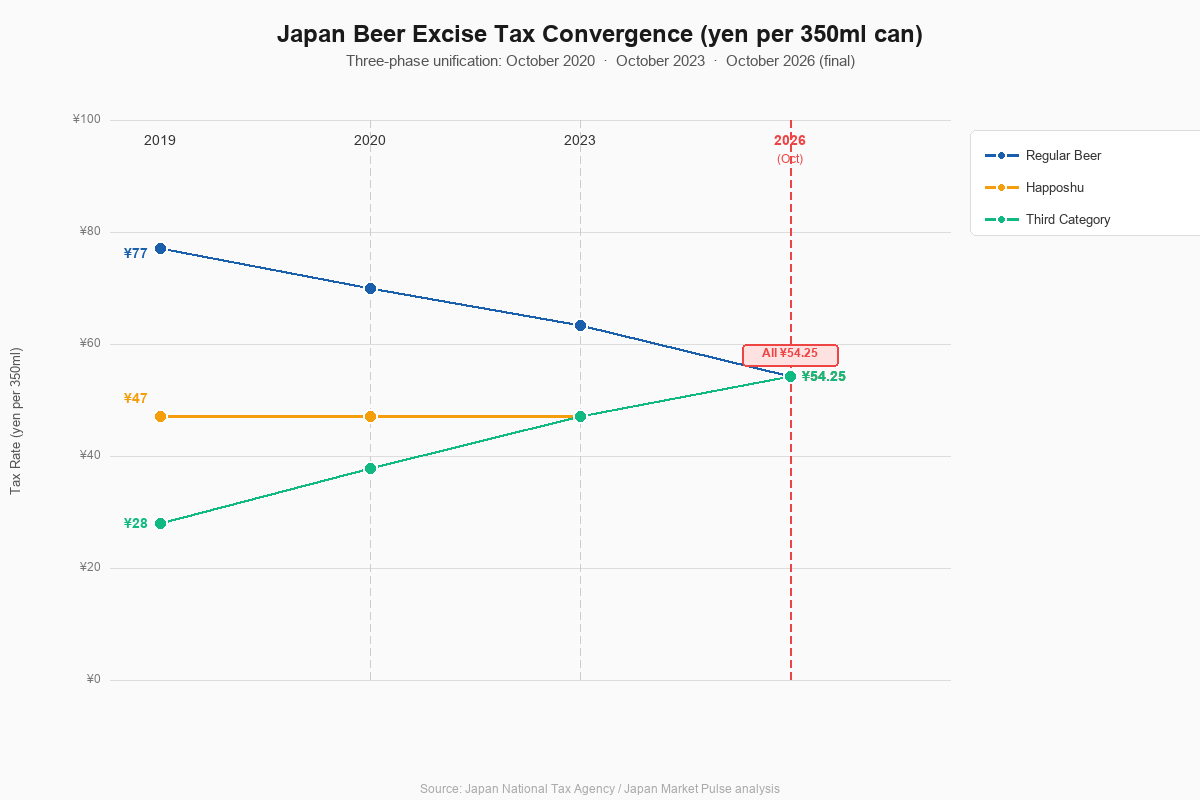
The tax system that created this architecture is now being dismantled. In October 2026, Japan completes the final phase of a multi-stage liquor tax reform that began in 2020, unifying the excise rates on all three categories at ¥54.25 per 350-milliliter can. The same can that once bought you third-category beer at a significant tax discount over regular beer will now cost almost as much to produce as a Kirin Ichiban. Decades of category engineering, overnight, become irrelevant.
That is a big story in itself. It is also only half the story. Because while Japan’s domestic brewers scramble to reformulate their products, raise their malt ratios, and convince consumers that their long-cheap brands are now worth a premium price, a different kind of beer is quietly capturing the space the third category is vacating — and it is not Japanese.
The Thirty-Year Taxonomy That Shaped a Nation of Drinkers
To understand why the October 2026 reform matters, you have to understand what it is dismantling. Japan’s beer taxonomy is not a natural consumer-preference artifact. It was engineered, category by category, by brewers looking for tax arbitrage.
The original sin was happoshu. When major Japanese brewers introduced low-malt beer alternatives in the early 1990s, the Ministry of Finance’s beer excise definition specified malt content thresholds: beverages below 67% malt were taxed at a lower rate. Happoshu, with its reduced malt ratio, slipped under the threshold. Consumers got a slightly inferior beer at a materially lower shelf price. The category boomed.
The ministry responded by raising the happoshu tax rate. Brewers responded by inventing the third category: beers with no malt at all, or with malt below levels that would trigger any beer tax classification. The third category was taxed even lower than happoshu. It boomed in turn.
By the mid-2000s, Japan had constructed an entire consumer culture around tax-engineered beer alternatives. Brands like Kirin’s Hon Kirin and Suntory’s Kinmugi became household names — not despite being ersatz beer, but partly because of their price positioning. A six-pack of Hon Kirin cost roughly ¥500 less than a six-pack of Asahi Super Dry. Over a year of daily drinking, that gap compounded into real money.
The 2020 reform began closing it. The first-phase adjustment in October 2020 cut the regular beer tax by 7 yen per 350ml while raising the third-category tax by 9.8 yen. The second adjustment in October 2023 continued the compression, bringing third-category beer tax to the same level as happoshu. By October 2026, all three rates converge at ¥54.25. When that happens, the price incentive that sustained thirty years of third-category drinking simply ceases to exist.
The scale of what this unwinds is significant. Third-category beer and happoshu combined have historically accounted for roughly half of Japan’s total beer-type beverage consumption by volume. That is not a niche. It is the structural backbone of how Japan’s beer industry has been organized for a generation.
The Big Four Are Already Moving
None of Japan’s major brewers are waiting passively for October. The reform has triggered what may be the most significant portfolio reshuffling in Japanese beer history, with Kirin and Suntory making moves that would have been commercially inconceivable five years ago.
Suntory announced it would reformulate Kinmugi — one of Japan’s best-selling third-category brands — to qualify as a genuine “beer” under Japanese law by increasing its malt content. The target products are Kinmugi, Kinmugi The Lager, and Kinmugi 75% Less Sugar, with a combined sales target of 35 million cases annually. The brand will keep its price positioning in the lower beer segment, but its legal classification — and its quality pitch — will change entirely.
Kirin followed with an equivalent announcement for Hon Kirin, its dominant third-category entry. The product will be reformulated, relaunched as a beer, and repositioned to compete directly with Suntory’s newly minted Kinmugi in what the trade press has taken to calling the “affordable beer” tier — a price range that, until October 2026, did not technically exist in Japanese beer law.
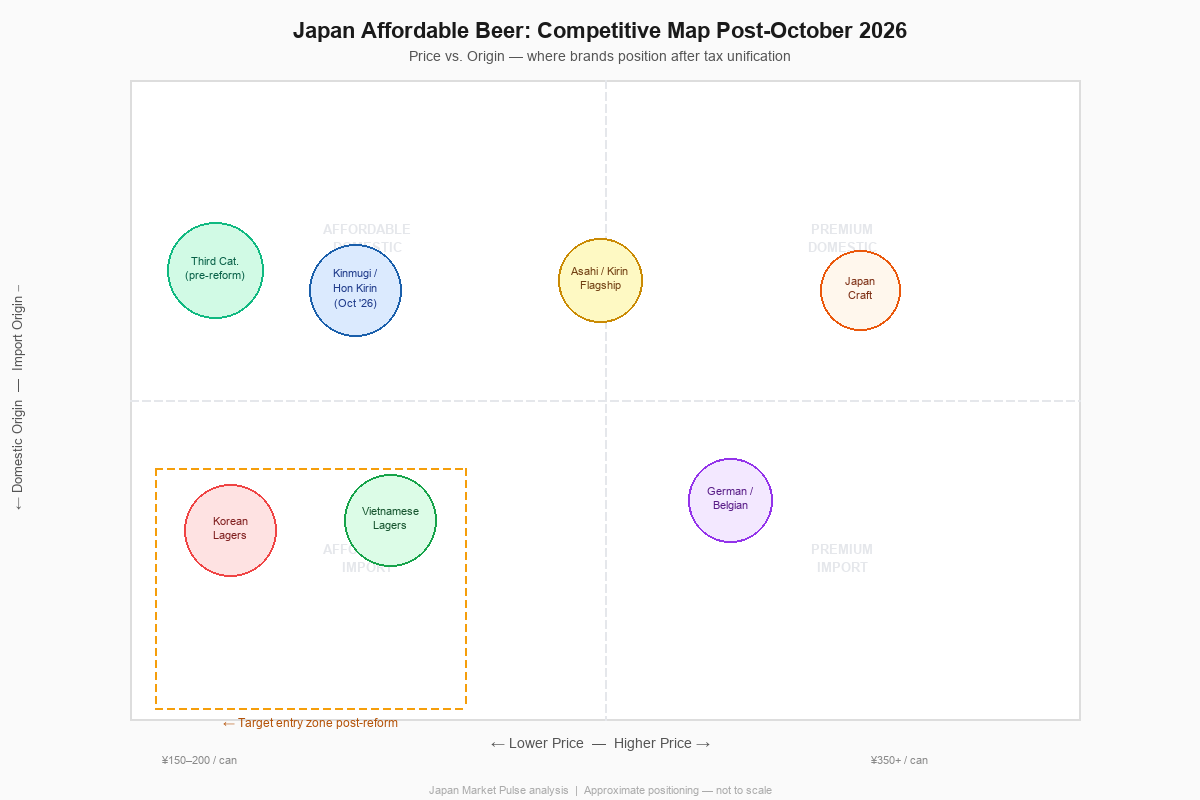
What the major brewers are effectively doing is colonizing the space just above where third-category beer used to sit, before any import brand can claim it. The strategy is logical: both Kirin and Suntory hold enormous brand equity in the low-cost segment from their third-category incumbency. If they can upgrade their products to full-beer status while keeping prices close to their old levels, they create a new accessible beer tier that domestically favored brands can dominate.
The question is whether they can execute fast enough — and whether Japanese consumers, after decades of product loyalty to cheap alternatives, will follow them up the quality ladder. That question, still open, is exactly the opening that import brands are watching.
44 Million Liters and Growing
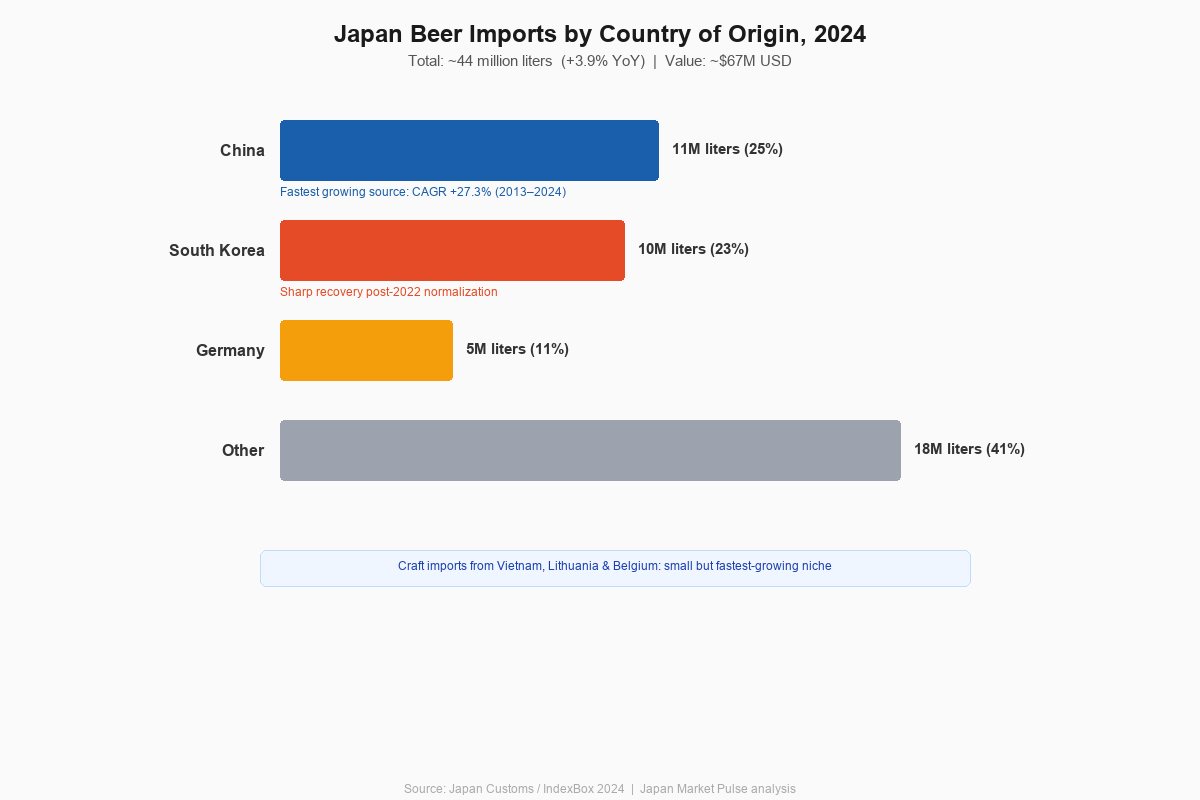
Japan’s beer import numbers are not, on their face, dramatic. In 2024, the country imported approximately 44 million liters of beer — a 3.9% year-on-year increase, solid but not spectacular. The top three suppliers were China (around 11 million liters), South Korea (around 10 million liters), and Germany (around 5 million liters). By value, the total import market was approximately $67 million in 2024. Against a domestic Japanese beer market valued at over $40 billion, that is a rounding error.
But the rounding-error framing misreads what is actually happening. The relevant growth is not in volume totals — it is in the texture of the import market itself, and in the structural conditions that are about to change.
Three things have shifted since 2020 that are, together, compressing the window between “import beer as niche” and “import beer as mainstream channel.”
The first is price convergence. As the third-category tax has risen toward beer-level rates across three reform tranches, the retail price gap between a domestic third-category can and an imported lager can has closed. A Vietnamese Tiger Beer or Korean Hite that once sat two price tiers above a Hon Kirin is now, at many convenience store chains, within ¥20 or ¥30 of the domestic alternative. At that spread, the consumer decision is no longer purely price — it becomes a question of experience, brand, and curiosity. That is territory where imports compete very well.
The second shift is retail channel access. Japan’s convenience store chains — Seven-Eleven, FamilyMart, and Lawson — have meaningfully expanded their imported beer sections over the past three years. This is partly a reflection of the price convergence dynamic, and partly a response to documented consumer interest in variety. The chilled beer aisle at a major Tokyo convenience store in 2026 looks materially different from the same aisle in 2020: more SKUs, more countries of origin, more visible design differentiation. The shelf is no longer exclusively a domestic beer display with a small import corner. It is a beer display where import presence is treated as a feature.
The third shift is consumer profile evolution. Japan’s craft beer market — dominated by domestic producers like Yo-Ho Brewing, Ise Kadoya, and regional microbreweries — grew to approximately $930 million in 2025, with projections suggesting a CAGR of 8.7% through 2033. What that market has done, across the decade it took to establish itself, is train a cohort of Japanese consumers to pay attention to where their beer comes from, what it tastes like at a product level, and what the label says about the brand’s origins. Those same consumers are now perfectly positioned to notice, and to purchase, an interesting import lager from Southeast Asia or an unfamiliar craft pale ale from the Baltic.
Who Is Actually Winning: The Third-Country Entrants
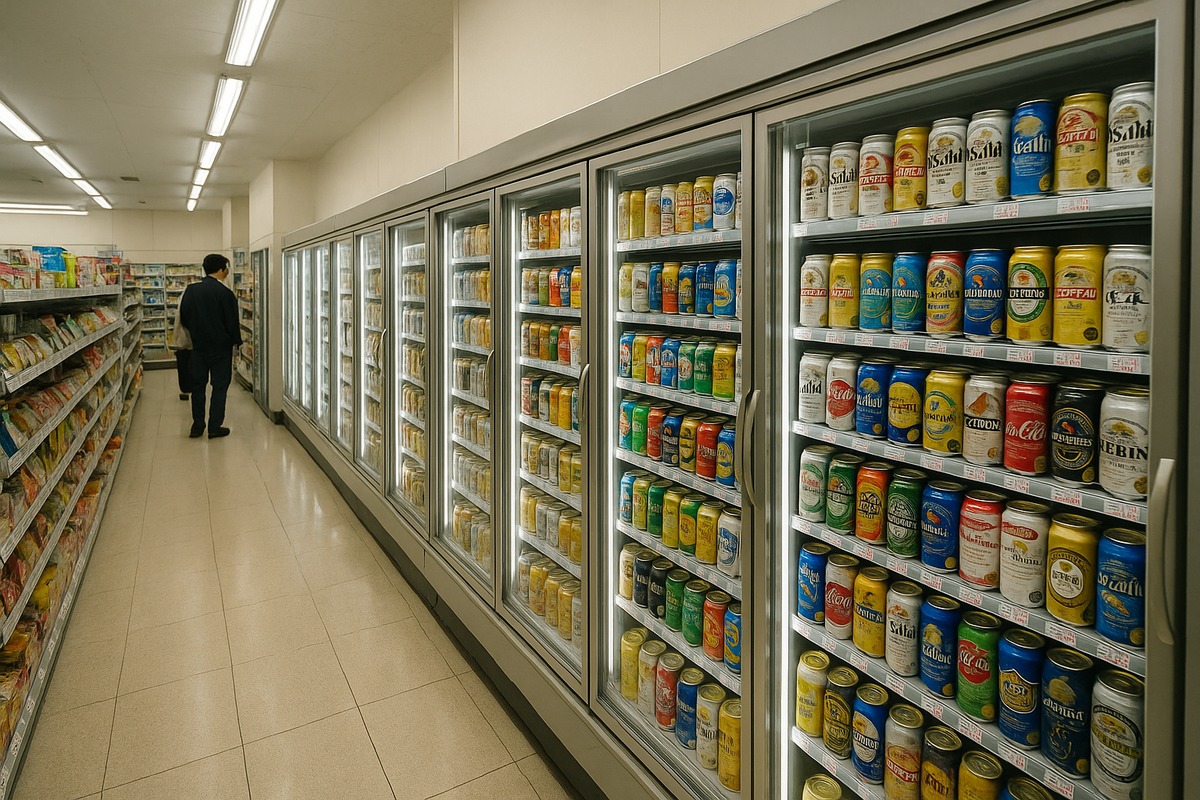
The import brands gaining visible momentum in Japan’s retail channels in 2025-2026 fall into three loose categories, each capturing a distinct consumer motivation.
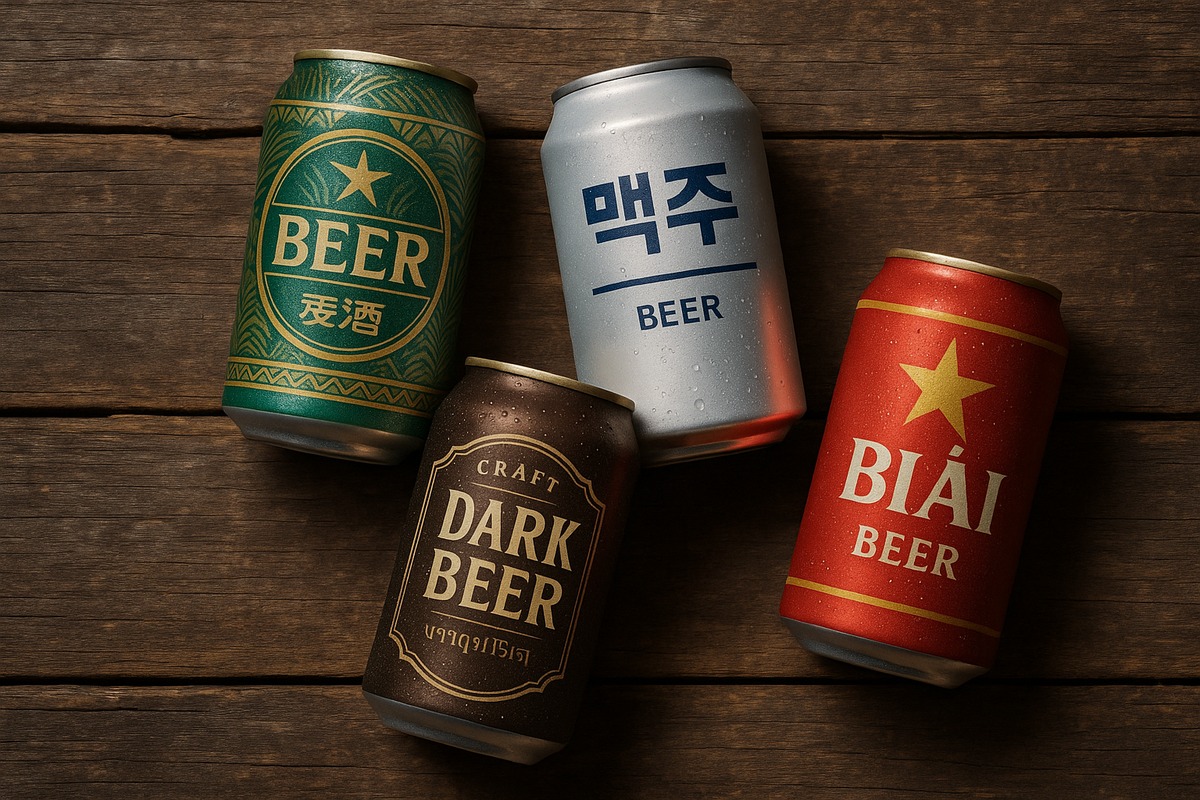
The first is Southeast Asian lager, led by Vietnam. Tiger Beer (Heineken-owned, Singaporean-origin, brewed throughout Southeast Asia) and Bia 333 (Sabeco, Ho Chi Minh City), among others, have built durable retail positions in Japan’s convenience and discount store channels. Their appeal is partly exotic — “the beer you drink in Vietnam” carries genuine place-association value for the large number of Japanese travelers who have been to Southeast Asia — and partly practical: they deliver a clean, refreshing lager profile at competitive price points, with packaging aesthetics that read as distinctive on a Japanese shelf without being loud.
Vietnam is specifically interesting because Japan-Vietnam travel flows have recovered strongly post-pandemic, and food tourism has created a documented consumer appetite for Vietnamese-origin products. The same consumer who discovered bun bo Hue at a Vietnamese restaurant in Shimokitazawa is not surprised to encounter Bia Hanoi at the neighborhood Seven-Eleven.
The second category is Korean beer, and it is the largest story in the import segment by volume. South Korea supplied approximately 10 million liters of beer to Japan in 2024, and brands like Hite and Cass have achieved genuine mass-market visibility in Japanese retail. The Korea-Japan beer relationship has been complex — Korean beer imports to Japan collapsed during the bilateral political tensions of 2019-2020, then rebounded sharply as diplomatic relations improved and Japanese interest in Korean food culture (driven by the K-drama and K-beauty waves) pulled Korean food and beverage products into mainstream Japanese retail channels. Korean beer, in this context, is riding cultural adjacency: the consumer who is already buying Korean skincare and streaming Korean dramas is a natural target for Korean beer.
The third category is European craft and specialty imports. German beer has a long-standing presence in Japan’s premium retail and restaurant channels. But the more interesting recent development is in craft-forward imports from smaller European producers — Belgian farmhouse ales, Baltic craft lagers, independent UK breweries. These products do not compete on price; they compete on experience and story. They are sold primarily in specialty retailers, bottle shops, and the growing number of craft-focused taprooms in Tokyo, Osaka, and other major cities. But their presence in the market validates and expands the culture of treating beer origin and provenance as a meaningful consumer signal — the same cultural infrastructure that eventually lifts the accessible tier of imports.
The Emoshohi Factor: Why “Where It’s From” Matters More Than It Did
Any analysis of Japan’s import beer market that focuses only on price and distribution misses the motivational engine that is actually running it: what Japanese consumer researchers call emoshohi, or emotional consumption.
Emoshohi describes a consumer pattern that has become increasingly visible in Japan’s post-pandemic retail environment — a preference for purchases that carry emotional meaning, personal resonance, or experience-association beyond the functional performance of the product itself. It is closely related to what international trend researchers call “experience purchasing” and “cultural tourism consumption,” but with a specifically Japanese inflection: the emphasis is less on acquiring status and more on acquiring a connection to something that feels authentic, personally significant, or place-linked.
Beer is an almost ideal emoshohi product. A beer from Lithuania carries the specific gravity of “I once went to Riga” or “I want to go to Riga” or simply “this is a thing from somewhere that is not here.” A Vietnamese beer carries the sensory memory of drinking it by the Mekong, or the ambient knowledge that it should be drunk with fresh spring rolls. These associations are not invented by advertising — they are genuine, and they give import beer a category advantage that domestic third-category beer, for all its engineering and brand equity, can never replicate.
The emoshohi dynamic has been amplified by Japan’s extraordinary international travel recovery. Japanese outbound tourism in 2024 and 2025 returned to near pre-pandemic levels, and the cultural openness associated with travel — the willingness to try new things, the formation of place-linked food and drink memories — has flowed back into domestic retail consumption. The shopper who spent two weeks in Vietnam and developed a fondness for late-afternoon Tiger is a different beer shopper than the one who never left Kanagawa and simply wanted the cheapest acceptable drink with dinner.
This is also why the retail channel dynamics are moving quickly. Japan’s convenience stores are not expanding their import beer sections out of altruism or general cosmopolitanism. They are responding to revealed consumer preference data: people are picking up the foreign cans. When the data shows the foreign can sells, the chain adds more foreign cans, creates better placement for them, and signals to international distributors that Japan’s best-in-class convenience retail system is available as a launch channel. That signal has not been available in the same way before.
What International Operators Should Know
The beer market opening created by Japan’s October 2026 tax unification is real, but it requires realistic framing. It is not a sudden opening — it has been building since the first reform tranche in 2020, and brands that began distribution work in Japan five years ago are already better positioned than those beginning now. But it is also not closed. The final tax adjustment in October 2026 will produce the most visible pricing shift, and the consumer recalibration that follows will continue for at least two to three years.
A few structural observations for international operators assessing the opportunity.
Price band matters more than category. The sweet spot for imported beer in Japan’s accessible retail channel is currently the ¥200–¥300 per 350ml can range — the tier that is now in direct competitive contact with reformulated domestic products like Hon Kirin and Kinmugi. Import brands that can deliver credibly in this range, with distinctive packaging and an accessible origin story, are positioned well. Import brands that require pricing above ¥350 per can for the accessible tier to work are competing in a different market — specialty retail, bottle shops, restaurant lists — that has its own dynamics and a much higher barrier to distribution.
Korea’s playbook is the most instructive precedent. Korean beer’s recovery in Japan after the 2019-2020 political disruption demonstrates both the fragility and resilience of origin-linked consumer preference. The recovery was driven by cultural adjacency — specifically, the K-content boom that made Korean food and beverage consumption feel like participation in a mainstream cultural moment, not just a niche ethnic food experience. International operators who can attach their brand to a Japanese cultural moment or travel context — not just to a generic “premium import” positioning — will outperform those that rely on quality signals alone.
Convenience store distribution is the prize. Seven-Eleven Japan (around 21,000 stores), FamilyMart (around 16,000 stores), and Lawson (around 14,000 stores) together represent the most efficient ambient retail distribution system in the world for a product with a defined shelf life. Getting into the chilled beer section of one of these chains — even in a limited test market or regional rollout — is the functional equivalent of major-retailer distribution in the United States, but with higher purchase frequency and more daily consumer contact. The qualification process is rigorous. But for import beer brands with genuine retail-scale ambitions in Japan, convenience store distribution is the objective, and every other channel is preparation.
The window is specific. The most interesting consumer recalibration will happen in the twelve to eighteen months after October 2026, when the price gap between third-category beer and regular beer disappears on Japanese retail shelves for the first time in thirty years. Consumers who have never had a structural reason to consider premium-tier or import beer at that price point will, for the first time, face a choice that is more about preference and less about arithmetic. That is when origin stories, packaging, and experience associations become primary decision drivers. Operators who have distribution and brand presence in Japan by mid-2026 are well-placed to be visible when that recalibration begins.
The third category is not dying quietly. It is being reformulated, rebranded, and relaunched by companies with enormous resources and deep retail relationships. But the era when Japanese consumers would reach for the cheapest possible beer alternative because it was the rational economic choice is ending. What replaces it will be determined, at least partly, by which foreign brands have arrived early enough to offer a credible alternative — and which have waited for certainty that they missed the wave.
There is also a longer-term signal worth watching. Japan has a demonstrated pattern of market behavior in which a regulatory shift opens a window, early movers establish brand presence during the adjustment period, and then the category sets into a new stable configuration that lasts for a decade or more. This is precisely how Korean food and beverage categories — including the K-beauty category that now dominates Japan’s cosmetics import market — established durable positions in Japanese retail. The regulatory mechanism was different, but the behavioral pattern is consistent: Japanese consumers, once they have genuinely decided that a foreign product belongs in their ordinary shopping basket, are remarkably loyal to it. The beer market’s structural recalibration in late 2026 is a category-entry event. Brands that understand it that way — as a timed window for establishing baseline consumer familiarity, not just a short-term pricing opportunity — will be building something that compounds over years, not quarters.
If you’re interested in this topic, the Japanese market more broadly, or what KETCHUPs is working on, we’d love to hear from you — please reach out via our contact form.
Japan Market Pulse is a weekly read on what the Japanese consumer-tech, food, and mobility markets are choosing to do, written for international operators who want to know what is happening before it shows up in the global trade press.
Subscribe at ketchups.co/japan-market-pulse.