

This article is published by KETCHUPs, a Tokyo-based trading and brand-development firm. All content is editorial.
For most of the twenty years I have lived in Japan, the anime export business worked on a simple, slightly arrogant assumption: make the show for Japanese teenagers, subtitle it in English, and let the rest of the world adapt to you. If you loved it, great. If you didn’t get it, that was your problem. The product was finished the moment it left Tokyo.
That era is over, and the speed of its ending is one of the most underreported business stories coming out of Japan right now. Sometime in the last three years, Japan’s animation distributors quietly stopped treating “overseas” as one market. They started treating it as a portfolio of markets with measurably different appetites — and they began engineering different versions of the same export for each one. India gets the hero. Saudi Arabia gets the plot. Indonesia gets the open door. Same industry, three completely different products.
If you run media, licensing, or brand strategy in the United States, this should interest you for a selfish reason. You are probably wrestling with the same question Japan’s anime executives faced five years ago: do we roll out one global campaign, or do we localize and accept the cost and complexity? Japan’s answer — segment by what each market actually buys, not by language alone — is one of the cleanest live case studies available, and the receipts are now public.
The Quiet Flip Nobody Announced
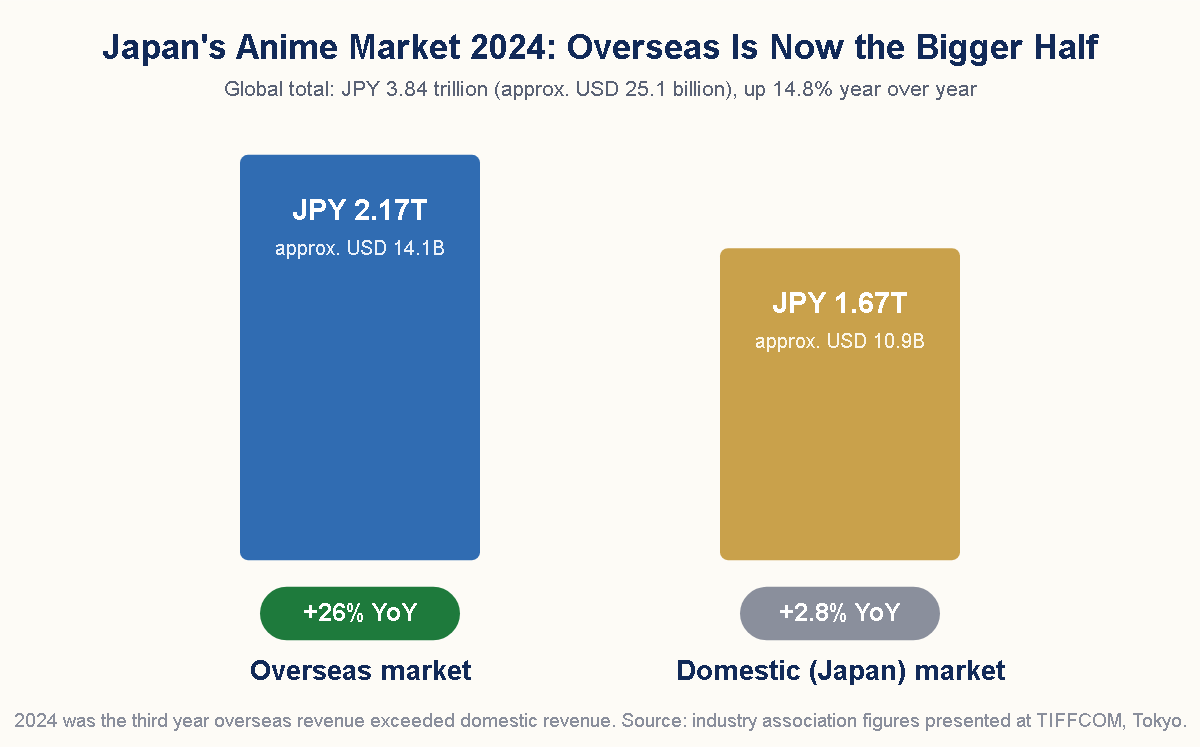
Start with the number that changed everyone’s incentives. According to figures presented by the Association of Japanese Animations at the TIFFCOM trade event in Tokyo, the global anime market reached a record 3.84 trillion yen in 2024 — roughly 25 billion US dollars — growing 14.8 percent in a single year. That headline number hides the real story. The overseas portion hit 2.17 trillion yen, about 14.1 billion dollars, growing 26 percent. The domestic Japanese market, at 1.67 trillion yen, grew just 2.8 percent.
Read those two growth rates side by side and the strategic conclusion writes itself. Japan’s home market for anime is mature, aging, and nearly saturated. The international market is compounding at almost ten times the domestic rate. 2024 was the third year in which overseas revenue exceeded domestic revenue, and the gap is widening. For the studios, the publishers, and the toy conglomerates that sit on top of this industry, foreign viewers are no longer a bonus. They are the growth model.
Here is what makes this moment instructive rather than merely impressive: when overseas became the majority of the business, the old export logic collapsed under its own success. You can treat foreign fans as an afterthought when they are 20 percent of revenue. You cannot when they are 56 percent. So the industry did something Japanese companies are often accused of being unable to do. It disaggregated. It looked at India, the Gulf, and Southeast Asia and admitted that these audiences were not buying the same thing — and then it built three different machines to serve them.
There is also a structural reason the change happened so fast once it started. Anime’s international revenue does not flow through one pipe. It is a braid of streaming licenses, theatrical distribution, merchandise royalties, game tie-ins, and live events, each contracted separately, often country by country. That contractual fragmentation used to be described as the industry’s great weakness — too many middlemen, too little coordination. But it meant that the moment a regional experiment worked, the next contract could encode it. No global platform committee had to approve anything. The system learned market by market, deal by deal, which is exactly how it discovered that three of its fastest-growing territories wanted three different things.
I want to walk through those three machines one at a time, because each maps onto a dilemma American executives know intimately.
India Buys the Hero

In India, anime consumption is overwhelmingly character-led. The franchise heroes — the orange-clad ninja, the demon-slaying swordsman, the rubber-limbed pirate — function less like TV protagonists and more like sports stars. Indian fans follow them across series, films, merchandise, and social media the way fans follow a cricketer across formats. The distributors noticed, and they built the Indian go-to-market around the character rather than the catalog.
Crunchyroll, the Sony-owned anime streaming service, opened a Mumbai office in October 2022 and now offers a library of more than 800 titles in the country. But the strategic weapon was never library breadth. It was dubbing — putting the heroes’ voices into Hindi, Tamil, and Telugu. Dubbed titles now account for over 65 percent of Crunchyroll’s total viewership in India, and for breakout franchises like Jujutsu Kaisen and Chainsaw Man, Hindi-dub viewership has overtaken the English versions. Think about what that means: the bottleneck in India was never interest in Japanese stories. It was the friction of experiencing your hero in someone else’s language.
The theatrical data makes the same point at a larger scale. When Demon Slayer: Infinity Castle opened in India in September 2025 with day-and-date dubs in Hindi, Tamil, and Telugu, the regional-language versions allowed the film to screen in 680 cities — against roughly 120 screens in major metros for earlier anime releases. It finished as the highest-grossing anime film in Indian box-office history, earning almost eight times the previous record holder. India’s anime market, currently valued around 1.6 billion dollars, is projected by Polaris Market Research to surpass 5 billion dollars by 2032, and Crunchyroll’s president Rahul Purini has said flatly that “the future of anime lies in South Asia.” Sony’s most recent fiscal-year results showed Crunchyroll passing 21 million paid subscribers globally, up roughly 25 percent year over year, with emerging markets like India doing much of the pulling.
Local platforms reinforced the character-first logic. JioCinema, the Indian streamer attached to the country’s dominant telecom, launched a dedicated “Anime Hub” bundled with its cricket coverage — a packaging decision that tells you exactly how Indian distributors see anime heroes: as another roster of stars to follow, sitting right next to the batting lineup.
I felt the scale of this shift secondhand before I saw the numbers. A colleague in Tokyo who handles licensing told me that inquiries from Indian merchandisers used to arrive a few times a year, usually for the same two or three legacy properties. Now they arrive weekly, and they come with audience data attached — which hero, which dub language, which tier of city. The Indian side is no longer asking what Japan will deign to license. It is telling Japan what its viewers already watch, and asking the rights holders to keep up.
The lesson I take from India is uncomfortable for anyone who believes in the sanctity of the original work. Indian audiences did not want a more faithful version of the Japanese product. They wanted the hero extracted from the product and delivered in their own voice, at their own price point, in their own city. Japan’s distributors swallowed their pride and did it.
Saudi Arabia Buys the Story
Now move 4,000 kilometers west, and the playbook inverts. In the Gulf — and Saudi Arabia specifically — the unit of consumption is not the character. It is the narrative, and increasingly the shared authorship of the narrative.
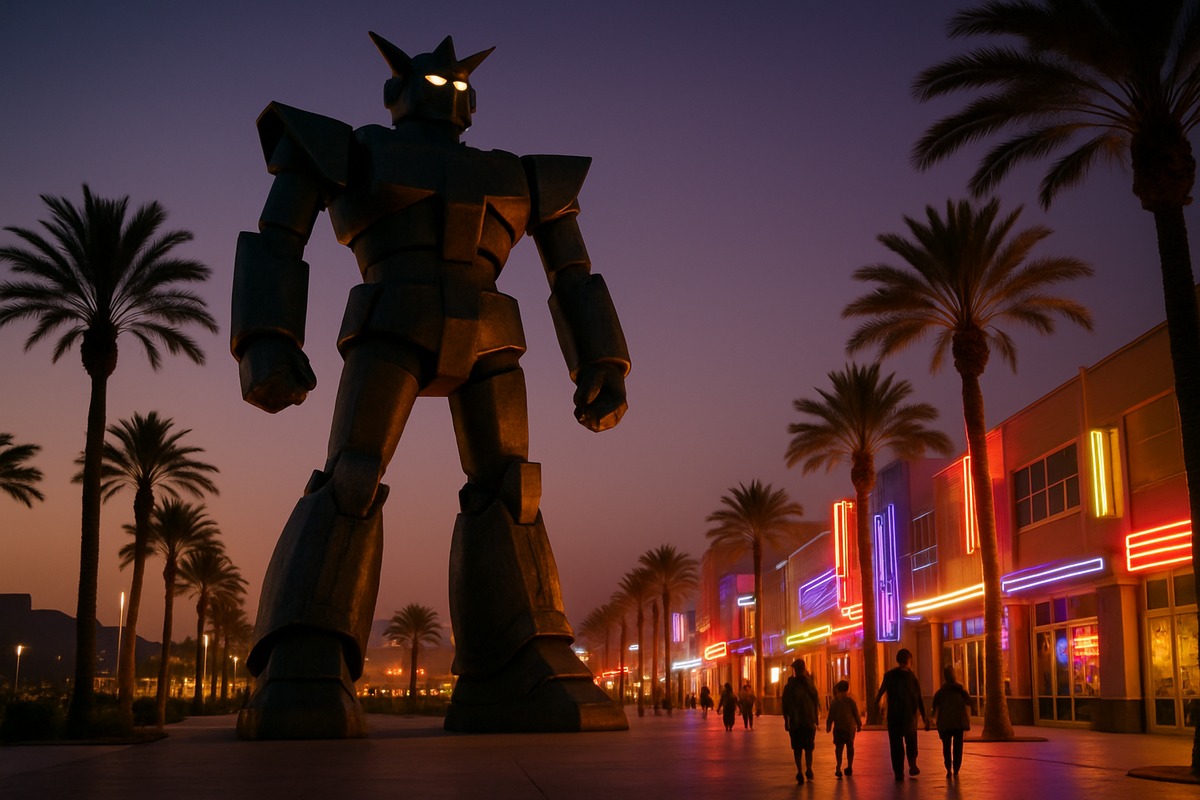
The history here is older than most Americans realize. UFO Robo Grendizer, a 1975 super-robot series, was dubbed into Arabic and first aired on Lebanese television in 1979, then spread across the region until it became a generational touchstone — by most accounts more beloved in the Arab world than it ever was in Japan. In 2022, the Saudi entertainment company Sela built a 33.7-meter Grendizer statue at Riyadh’s Boulevard World, certified by Guinness World Records as the largest metal sculpture of a fictional character ever made. A nation does not build a 110-foot monument to a foreign cartoon because it likes the merchandise. It builds one because the story became part of its own childhood memory.
Japan’s distributors read that signal correctly, and the response was not more dubbing. It was co-creation. Manga Productions, the Saudi studio affiliated with the MiSK Foundation, partnered with Toei Animation to co-produce The Journey, a 2020 feature film about the defense of Mecca some 1,500 years ago — Saudi Arabia’s most ambitious animated feature, drawn with Japanese craft around an Arabian story. The same partnership produced Asateer (Future Folktales), a series built on folklore from the Arabian Peninsula that aired on platforms including TV Tokyo in Japan and MBC1 across the Arab world. Manga Productions then licensed Grendizer rights for the Middle East from Go Nagai’s Dynamic Planning — covering television and theme-park usage — and when the franchise reboot Grendizer U arrived in 2024, Saudi landscapes appeared inside the show itself. Meanwhile MBC Group, the region’s broadcasting giant, has been expanding licensing relationships with Toei, Aniplex, and TV Tokyo, picking up marquee narrative properties like Bleach: Thousand-Year Blood War.
Notice what is being sold in each of these deals. Not a face for a lunchbox. A plot — and, more valuable still, a seat at the table where the plot is written. For a kingdom spending heavily to build a domestic creative economy, the prestige purchase is narrative capability, and Japan is effectively exporting its storytelling apparatus as a service. The anime itself is almost the packaging.
I find this the most sophisticated of the three machines, because it monetizes something most exporters give away: the right to see yourself inside the story. Japanese studios spent decades politely declining to bend their narratives for foreign sensibilities. In the Gulf, they discovered that bending the narrative — co-writing it, setting it locally, rooting it in regional folklore — was the product.
Indonesia Buys the Door

The third machine is the least glamorous and, per viewer, probably the most disciplined. In Indonesia and across Southeast Asia, the binding constraint is neither language pride nor narrative ownership. It is price and access. The audience is enormous, mobile-first, young, and unwilling or unable to pay North American subscription rates. The wrong response is to discount the premium product. The right response — the one Japan’s licensees actually chose — is to redesign distribution itself.
The emblematic player is Muse Communication, a Taiwanese licensor whose Muse Asia channel streams licensed anime free on YouTube with English and Chinese subtitles for Southeast and South Asian audiences. By April 2024 the channel had passed 8.6 million subscribers and 2.9 billion views, and the company had spun up localized channels for Indonesia, Malaysia, the Philippines, Thailand, Vietnam, and India. The model is openly tiered: offer the YouTube channel first, and where a rights holder declines, sub-license to platforms like Netflix, Disney+, Bilibili, and Viu. Free, ad-supported, fully legal anime on the world’s most accessible video platform — a distribution decision that would have been unthinkable heresy in the DVD-protective Japan of fifteen years ago.
The dubbing economics in the region tell the same story as India, with a twist. Netflix has reported that more than half of its global users now watch anime, and that 80 to 90 percent of those viewers choose dubbed versions, which is why the service now dubs anime into as many as 33 languages — Indonesian among them, with recent seasonal titles arriving with Bahasa Indonesia audio as a matter of routine rather than exception. When nine out of ten viewers on the planet’s biggest streamer prefer the localized voice, “subtitles are the authentic experience” stops being a strategy and becomes a niche.
There is a longer game embedded in the free tier, and Japanese rights holders understand it well because they invented it. Anime fandom is a ladder: free broadcast builds the audience, the audience buys merchandise, the superfans buy figures and attend events and pay for theatrical releases. Indonesia’s free YouTube viewers are not lost revenue. They are the widest rung of a ladder whose upper rungs — cinema tickets, collectibles, eventual subscriptions as incomes rise — are where the region’s payoff sits. The 680-city Indian theatrical run shows what happens when a market climbs that ladder; Southeast Asia is being deliberately loaded onto the bottom of it now.
What Indonesia teaches is that localization is not only a content decision. It is a business-model decision. The same episode of the same show is a premium subscription product in Ohio, a telecom-bundled add-on in Mumbai, and a free YouTube stream in Jakarta — and all three configurations feed the same franchise flywheel of merchandise, games, and films where the real margin lives.
The Conglomerates Made It Official Policy
For a while you could dismiss all of this as opportunism by individual licensors. You no longer can, because the strategy is now written into the capital plans of Japan’s largest IP holders.
Bandai Namco, the toy-and-games conglomerate that controls Gundam and holds master toy positions across the anime canon, has committed roughly 600 billion yen — close to 4 billion dollars — over three years to expand its IP-axis strategy, with a stated goal of lifting overseas revenue from about 30 percent of sales to more than half by 2028. The interesting part is not the number but the language around it. The company’s investor materials describe “comprehensive marketing activities that give consideration to local cultures and preferences” region by region, and state explicitly that in markets with diverse tastes “it is crucial to localize content based on an understanding of each culture rather than releasing content uniformly.” A new Dallas office, opened in September 2024, exists to run Gundam activations rooted in local communities; the One Piece Card Game ships in five languages with region-specific event programs.
When a 70-year-old Japanese conglomerate puts “do not release content uniformly” into its integrated report, the debate inside the industry is over. Per-market engineering won. The single global rollout — the model Hollywood essentially invented and Japan once envied — lost, at least for this category, in this decade.
It is worth pausing on why anime could make this pivot when so many Western media franchises struggle to. Anime’s economics were always modular: the broadcast or stream is a loss leader, and the money is recovered through layered licensing — merchandise, games, pachinko, theatrical, events — each negotiated territory by territory. That structure made regional experimentation cheap. Licensing Grendizer theme-park rights to Riyadh does not interfere with selling Hindi dubs in Mumbai or YouTube ads in Jakarta. The franchise was already a federation, so federating the strategy was natural. Most American IP, sold through globally integrated platforms with day-and-date everything, has quietly engineered that flexibility out of its own system.
The Three Questions Worth Stealing
Strip away the giant robots and the box-office trivia, and Japan’s anime exporters are running a segmentation discipline that any US brand or media company could copy tomorrow. It reduces to three questions, asked market by market, in order.
Before the three questions, one caveat that keeps this honest. Segmentation of this kind is expensive in ways that do not show up in a strategy memo. Day-and-date dubs in four Indian languages mean four parallel voice productions on an unforgiving anime schedule. Co-productions in the Gulf mean shared creative control, which Japanese studios historically treated as unthinkable. Free YouTube distribution means accepting ad-tier economics on content that cost premium money to make. The anime industry paid all three costs anyway, because the alternative — one product, uniformly delivered, slowly losing relevance in the fastest-growing markets on earth — was more expensive. That is the trade every global brand is actually weighing, whether it admits it or not.
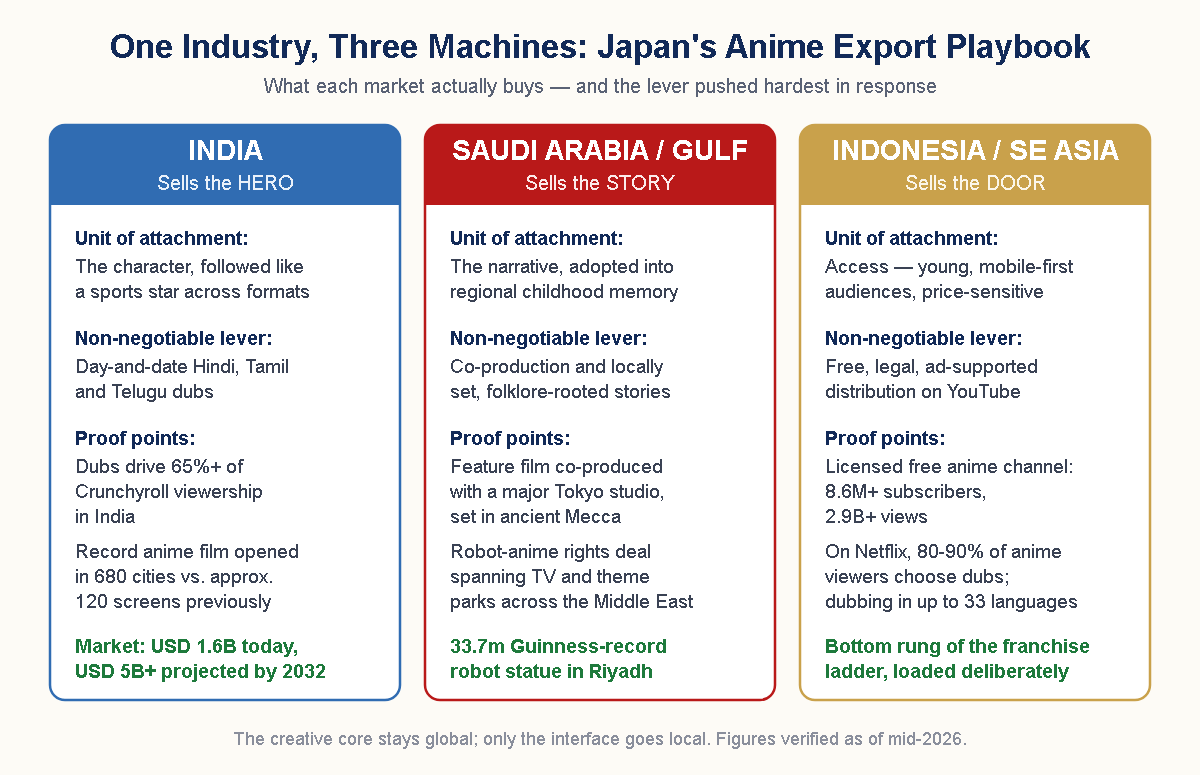
First: what is the actual unit of attachment here — the character, the story, or the access? India’s data said character: follow the hero, in your own language, everywhere. The Gulf’s data said story: we already adopted your narrative forty years ago; now let us co-own it. Southeast Asia’s data said access: remove the paywall and we will give you a generation of fans. These are empirically different answers, and the distributors found them by watching behavior — dub-versus-sub ratios, theatrical footprints, YouTube completion — not by commissioning brand-essence decks.
Second: which lever does that answer make non-negotiable? In India it was voice talent and day-and-date regional dubs. In Saudi Arabia it was co-production credits and locally set stories. In Indonesia it was free, legal, mobile-first distribution. Note that each market got one primary lever pushed hard, not a thin smear of localization across everything. That concentration is what kept the economics sane.
Third: what stays ruthlessly global? The animation itself. The production pipeline, the visual grammar, the Japanese creative core — none of it forked. Anime did not become Indian animation in India or Arab animation in Riyadh; The Journey is striking precisely because it is unmistakably Japanese craft applied to a Saudi story. The product’s soul stayed centralized while its interface went local. Most companies localize in exactly the wrong direction: they fork the core and standardize the interface.
I will admit my own bias here. Twenty years ago I would have told you anime’s global appeal proved that great content needs no translation — that the world would meet Japan where it stood, the way my generation of American fans did, hunched over fansubs. The 26 percent overseas growth rate says I was wrong. The world did not meet Japan halfway. Japan walked the last mile, three different ways at once, and got paid three different ways for it. For any executive still defending the one-campaign global launch because it is cleaner, the question Japan’s anime industry would ask you is simple: cleaner for whom?
If you’re interested in this topic, the Japanese market more broadly, or what KETCHUPs is working on, we’d love to hear from you — please reach out via our contact form.
Japan Market Pulse is a weekly read on what the Japanese consumer-tech, food, and mobility markets are choosing to do, written for international operators who want to know what is happening before it shows up in the global trade press.
Subscribe at ketchups.co/japan-market-pulse.