

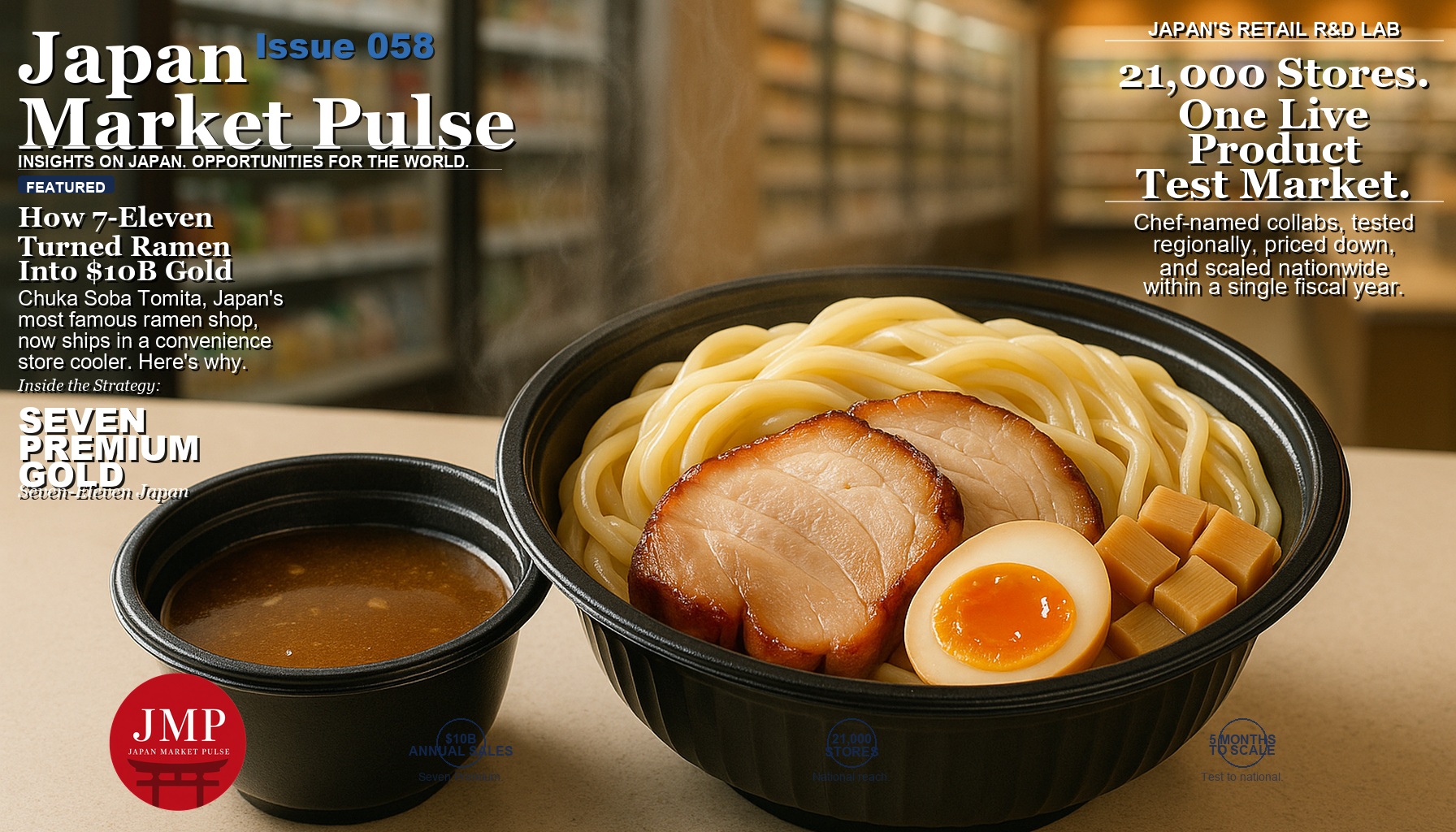
It was late January, the kind of Tokyo evening where the cold gets into your coat collar, and I ducked into a 7-Eleven near Ichigaya station to grab something hot before catching the last train. I wasn’t looking for anything special — just dinner, standing up, eaten out of a plastic tray. What stopped me was the name printed across a chilled ramen box in gold lettering: Tomita.
If you don’t follow Japan’s ramen scene, that name means nothing. If you do, it stops you in your tracks the way seeing a three-Michelin-star chef’s name on a TV dinner would. Chuka Soba Tomita, in the suburb of Matsudo just outside Tokyo, is not a restaurant you casually decide to visit. It is a restaurant you plan a morning around — arriving before sunrise, standing in a line that snakes down the block, and hoping the shop hasn’t sold out of noodles before you reach the door. It was the subject of an entire episode of the documentary "Ramen Heads," and ramen obsessives from Los Angeles to London talk about it the way wine collectors talk about a First Growth Bordeaux. And there it was, repackaged, chilled, and sitting on a convenience store shelf for less than the price of a coffee.
I bought it, obviously. I also spent the next several weeks unable to stop thinking about what that gold label actually represented — not as a ramen fan, but as someone who has spent two decades watching Japanese retail quietly rewrite the rules of what a "private label" product is supposed to be. What I’d stumbled into wasn’t a one-off marketing stunt. It was a glimpse into a much bigger strategy that Japan’s convenience store chains have been building for over a decade, and one that American retailers — still mostly stuck thinking of private label as the cheap generic option next to the name brand — would do well to study closely.
The Deal That Turned a Ramen Line Into a Retail Story
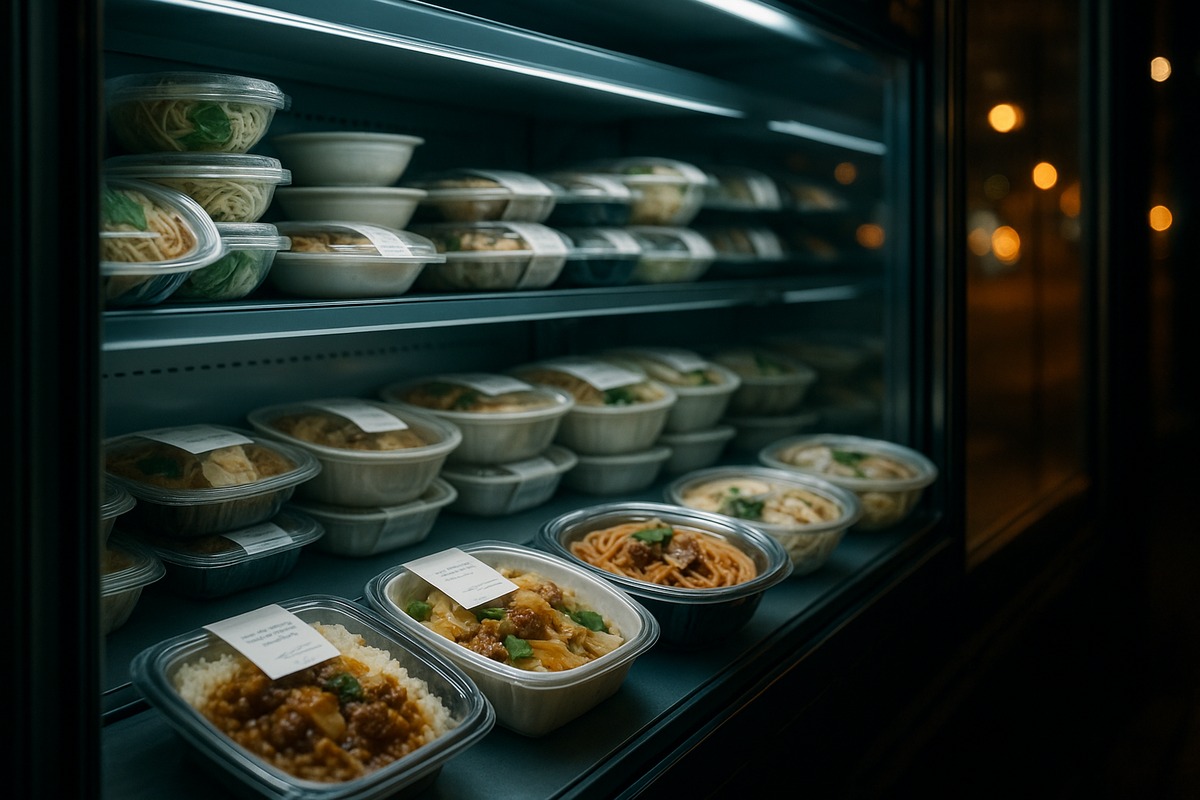
The product that caught my eye that night in Ichigaya was part of a limited regional rollout: Seven Premium Gold’s "Kin no Tsukemen" (Golden Dipping Noodles), developed under the supervision of Chuka Soba Tomita and launched in select prefectures — Fukushima, Ibaraki, Tokyo, and Kanagawa — in May. It shipped as a two-part system, the way serious tsukemen always is: a pack of thick, springy noodles for about 181 yen, and a small tub of intensely reduced pork-and-seafood dipping broth for around 289 yen, with the shop’s signature garnishes — thick-cut chashu pork, a soft-yolked marinated egg, and diced bamboo shoots — sold as optional add-ons so customers could build the bowl exactly as they wanted it. By July, 7-Eleven had folded the concept into a single, more accessible national release: "Seven Premium Gold Kin no Nokou Tsukemen," priced at 429.84 yen with tax, rolled out to every 7-Eleven in the country, and priced roughly 90 yen cheaper than the version it replaced.
That detail — cheaper, not more expensive, on the national rollout — is worth sitting with for a moment, because it tells you something about how deliberate this whole operation is. This wasn’t a chef slapping his name on a product for a fee and walking away. It was iterated. Seven-Eleven tested a premium, higher-friction version in four prefectures, watched how people bought it, and then re-engineered the economics before scaling it to roughly 21,000 stores nationwide. That is not how a novelty item gets made. That is how a product line gets built.
And Tomita is far from the only marquee name lending its reputation to a convenience store cooler. Nakiryu, the Tokyo tantanmen specialist that earned a Michelin star in 2017 — a year after Tsuta became the world’s first Michelin-starred ramen shop, and among the handful of ramen restaurants anywhere to hold the distinction — has supervised its own instant cup noodle under the Seven Premium banner — a version so faithful to the original that it has developed something of a cult following among ramen tourists who can’t always make it to the shop’s tiny counter in Otsuka. You can find Myojo’s Seven Premium instant cup ramen carrying the Tomita name and the Nakiryu-supervised tantanmen version sold through import retailers on Amazon.com today, which tells you something else important: these products aren’t just a domestic curiosity. They travel. A convenience store chain in Japan has effectively become an export vehicle for some of the country’s most guarded culinary reputations, shipped in a cardboard cup with a five-minute cook time.
Why "Gold" Means Something Inside a Convenience Store
To understand why this works, you have to understand what "Seven Premium Gold" actually is, because it is not the same thing as the regular Seven Premium label that fills most of the shelf. Seven & i Holdings launched the standard Seven Premium private-label line back in 2007 as a fairly conventional cost-plus-quality play — better ingredients than a no-name generic, priced a notch below the national brand it was quietly mimicking. It worked. By 2024, Seven & i was announcing that cumulative Seven Premium sales had crossed 15 trillion yen, and the company had set an annual sales target of 1.55 trillion yen for the line for its 2025 fiscal year — a business, inside a business, doing roughly ten billion dollars a year in sales through a chain of stores that most people think of as a place to buy a rice ball and pay a utility bill.
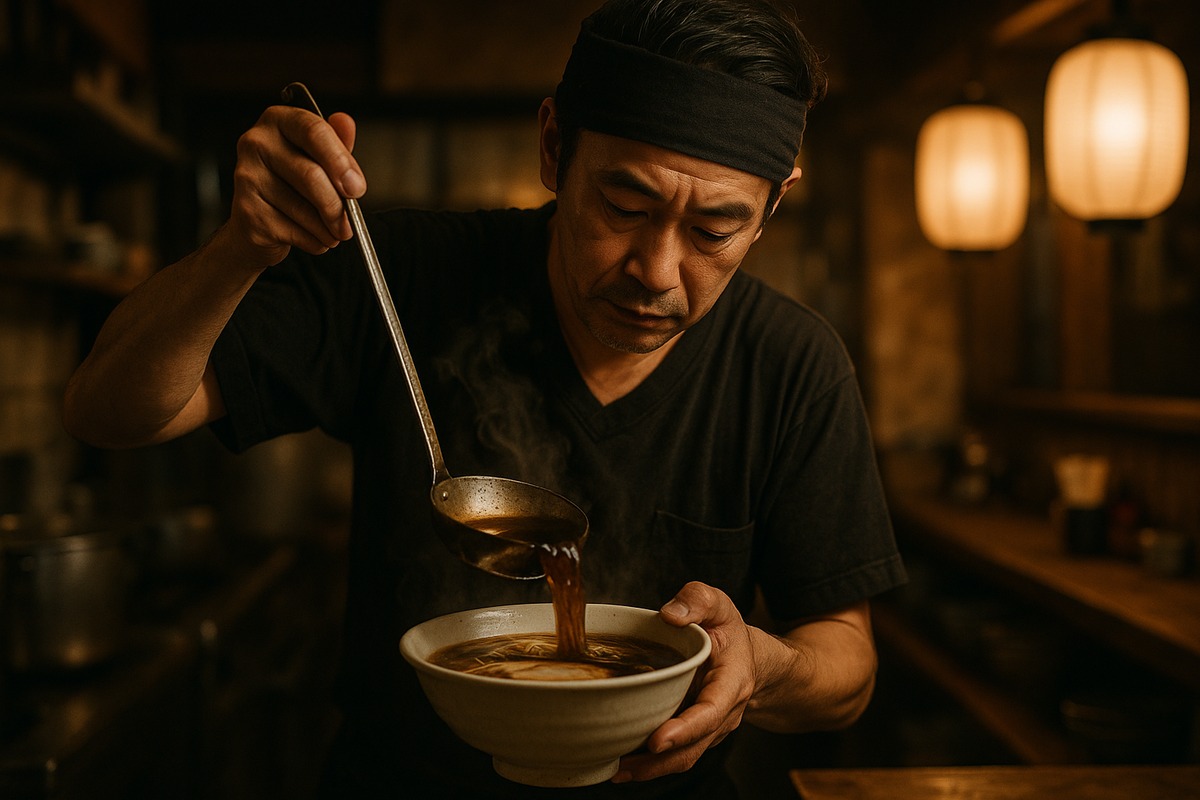
Seven Premium Gold, introduced in 2010, was something different from the start. The stated concept, in the company’s own language, was to bring "a special taste to the table" by working directly with "top chefs and specialists" — not just formulating a better recipe in a test kitchen, but explicitly borrowing outside culinary authority and putting a name on the package that a serious food person would recognize. Over the years that has meant partnerships with pastry chefs like Koji Tsuchiya, a gold medalist at the Salon du Chocolat in Paris, and executive chef Yannick Chevallereau on premium chocolate boxes, alongside the ramen-world collaborations that get less press internationally but arguably matter more to Japanese shoppers’ daily habits. It has also meant workhorse comfort food, reimagined: the Gold line’s beef curry, for instance, is built around red wine and an eighteen-spice blend, explicitly positioned to taste closer to a restaurant dish than a supermarket retort pack, and consistently ranks near the top when Japanese food media run their inevitable convenience-store curry taste tests.
What’s notable is the range Gold covers — everything from a $4 hamburger steak to a $3 chocolate box to a $4 bowl of dipping noodles built around one of the hardest restaurant reservations in the country. The thread connecting all of it isn’t ingredient cost. It’s borrowed authority. Seven Premium Gold isn’t selling you a slightly nicer version of what you’d get anyway; it’s selling you a shortcut to an experience you’d otherwise have to earn — a three-hour line, a coveted reservation, a pastry chef’s competition medal — compressed into something you can buy on your way to the train.
The Convenience Store as Retail’s Fastest R&D Lab
Here’s the part that I think gets missed if you only look at this as a food story instead of a retail one. Japan has roughly 55,000 convenience stores, and 7-Eleven alone operates something in the neighborhood of 21,000 of them nationwide. That density is the actual innovation. No department store food hall, no specialty grocery chain, no direct-to-consumer ramen kit startup can put a new product in front of that many transactions, in that many neighborhoods, in that short a window.
Think about what that means operationally. A limited four-prefecture test of the Tomita tsukemen wasn’t a soft launch in the way an American retailer might understand the term — a few flagship stores in Manhattan and San Francisco, watched carefully for a quarter before a national decision gets made. It was a live pricing and packaging experiment across thousands of stores, with enough transaction volume to generate a statistically real signal in a matter of weeks, not months. By the time the national version launched in July at a lower price point, the company wasn’t guessing. It had data most retailers would need a full fiscal year and an expensive market research firm to assemble.
This is the "R&D lab" framing that I think is the real story here, and it’s one I don’t hear discussed enough outside Japan. Convenience stores are usually described — even by people who should know better — as the retail format defined by convenience and nothing else: fast, cheap, disposable. But scale changes the calculus of what a format is capable of. When you can distribute a new SKU to tens of thousands of checkout counters overnight, test regional pricing variants in real time, and pull a product entirely within a fiscal quarter if it underperforms, you’ve built something closer to a national test kitchen with an unusually good feedback loop than a place that just sells gum and instant coffee. The chef collaboration isn’t the innovation. The distribution network that lets the chef collaboration be tested, iterated, and scaled inside of five months is the innovation.
The Barbell Strategy: Cheap and Chef-Made, Side by Side
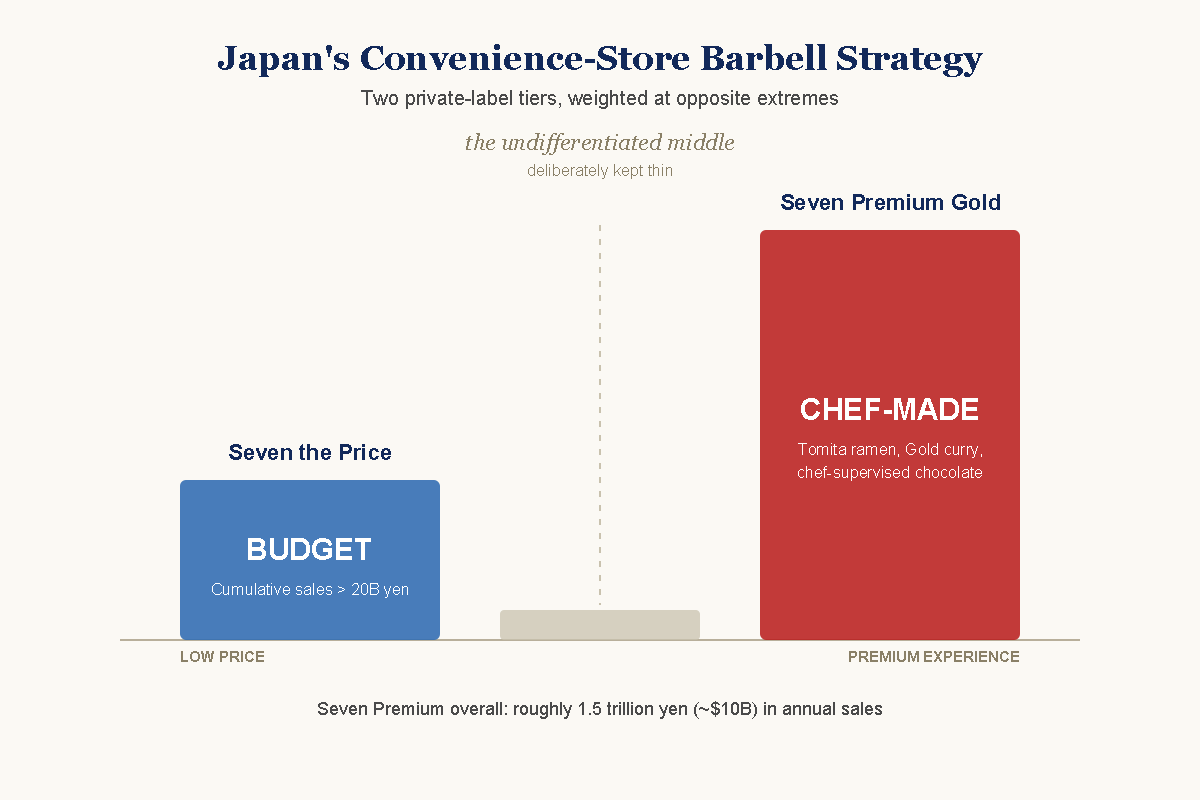
What makes this even more interesting from a strategy standpoint is that Seven & i isn’t just pushing upmarket. In 2022, in the middle of Japan’s worst inflation stretch in decades, the company launched Seven the Price — a deliberately bare-bones, budget-focused private-label line sitting at the opposite end of the shelf from Seven Premium Gold. It has done well enough that the company announced cumulative sales past 20 billion yen. The two lines are not in tension with each other; they’re two ends of the same bet.
Retail people sometimes call this a barbell strategy — weight concentrated at both extremes, very little in the flabby middle. Seven & i is explicitly telling its 1.4 trillion yen worth of private-label customers two different things at the same time: if you’re squeezed by grocery inflation, here is an unapologetically cheap option that still carries our name and our quality guarantee; if you want to treat yourself without leaving the neighborhood, here is a bowl of noodles designed by a chef people wait three hours to eat from. What gets sacrificed is the undifferentiated middle — the "fine, I guess" product that isn’t cheap enough to win on price and isn’t distinctive enough to win on story. That’s a bet Japanese retail has been making with increasing confidence, and it’s a bet that private-label teams in the U.S. — still largely organized around a single "store brand equals savings" value proposition — have been slower to embrace.
It’s Not Just 7-Eleven
If this were a single retailer’s marketing gimmick, it would be a good story and not much more. What makes it a trend worth tracking is that Lawson and FamilyMart, 7-Eleven’s two largest domestic rivals, have been running the same playbook with growing intensity through 2026. Lawson has released udon and curry-ramen products developed in partnership with well-regarded Hiroshima restaurants, leaning on regional food reputations the way 7-Eleven leans on Tokyo ramen royalty. Matcha specialist Morihan has supervised seasonal sweets sold across the convenience channel. Afternoon Tea, the café and lifestyle brand with a loyal following among Japanese women in their twenties and thirties, put its name on a summer dessert lineup that leaned directly into its own brand cachet rather than a generic "premium" label.
None of these companies are coordinating with each other — this is competitive convergence, not collusion — but the direction is unmistakable. Convenience-store trade press has started using a specific phrase to describe what’s happening: the shift from "convenience" to "convenience gourmet." It’s a small linguistic change that captures a real repositioning. For years, the implicit promise of a Japanese convenience store was that it would never embarrass you — reliable, fast, fine. The implicit promise now, on a growing slice of the shelf, is that it might actually impress you. Industry watchers overseas have started calling 2026 a breakout year for Japanese private label specifically because of this dynamic: the premium end is no longer a side experiment, it’s becoming a core growth lever, running in parallel with the value end rather than instead of it.
What American Retailers Can Steal From This Playbook
I want to be careful here not to overstate the transferability, because the underlying conditions in Japan are genuinely unusual. Convenience store density this high doesn’t exist in most of the U.S. outside a handful of dense metro corridors, and the cultural weight that a restaurant name like Tomita carries — the willingness of Japanese consumers to queue for hours and then talk about it for years — doesn’t map cleanly onto American dining culture, where "worth the wait" tends to mean fifteen minutes, not three hours.
That said, three specific mechanics translate cleanly, and I think U.S. grocery and convenience chains are already circling around versions of them.
The first is treating your distribution network itself as the R&D asset, not just the sales channel. A regional test-and-learn approach — launch in a handful of markets, watch real transaction data for a defined window, adjust price and packaging before a national rollout — is something chains with Kroger- or Walgreens-scale footprints could run far more aggressively than they currently do. Most U.S. private-label testing is still slower and more research-driven than it needs to be, when the stores themselves could be doing the research in real time.
The second is the barbell, applied deliberately rather than accidentally. A lot of American private label sits in an undifferentiated middle by default, not by design — "store brand" as a single monolithic tier rather than a portfolio with a clear budget option and a clear indulgence option. Trader Joe’s has intuitively understood a version of this for years with its rotating "special edition" items that create urgency and story around otherwise ordinary private-label categories. Formalizing that instinct into an explicit two-tier strategy, the way Seven & i has, is a more replicable move than it might first appear.
The third, and the one I think is most underused, is borrowing specific, credible outside authority rather than vague premium branding. "Chef-inspired" is a phrase American shoppers have learned to discount because it so rarely means an actual named chef with an actual reputation on the line. What makes the Tomita and Nakiryu collaborations work isn’t the word "premium" on the package — it’s that the names are real, specific, and independently verifiable by anyone who cares to check. A retailer willing to do the harder work of signing a genuine, named local or regional food authority — not a marketing concept, an actual person or actual restaurant with skin in the game — gets a credibility signal that no amount of "gourmet" copywriting can buy.
Frequently Asked Questions
Q. What is Seven Premium Gold, exactly?
A. It’s the top tier of Seven & i Holdings’ Seven Premium private-label line, launched in 2010 with the explicit goal of bringing "top chef and specialist"-level food into convenience stores. It sits above the standard Seven Premium range and the budget-focused Seven the Price line, and it’s the tier where most of the named chef and restaurant collaborations — including the Chuka Soba Tomita ramen line — actually live.
Q. Can I buy the Tomita-supervised ramen outside Japan?
A. Not the fresh chilled tsukemen sold in Japanese stores, since that’s a short-shelf-life product tied to the domestic cold chain. But the shelf-stable instant cup version, developed with Myojo under the Seven Premium banner, is exported and sold through import grocery retailers, including on Amazon.com. A similarly styled cup noodle supervised by Michelin-recognized tantanmen shop Nakiryu is also available on Amazon for readers who want to taste what this trend is about without a plane ticket.
Q. How much do these chef-collaboration products actually cost in Japan?
A. They’re positioned as an affordable indulgence rather than a luxury purchase. The national tsukemen release landed at 429.84 yen with tax — roughly three dollars — and most Seven Premium Gold items across categories sit in the 250-to-450-yen range, deliberately priced to stay well inside an everyday convenience-store purchase rather than a special-occasion one.
Q. Why would a famous, hard-to-get-into restaurant agree to a convenience store collaboration at all?
A. Licensing income is part of it, but reach matters just as much. A shop like Tomita can serve maybe a few hundred customers a day at its physical counter, no matter how efficient the line moves. A national convenience store rollout puts a version of that experience — and the restaurant’s name — in front of millions of people who will never get a seat, many of whom become curious enough to plan an eventual visit to the real thing.
Q. Is this trend limited to ramen, or to 7-Eleven specifically?
A. Neither. Seven Premium Gold’s chef and specialist collaborations span categories from curry and hamburger steak to premium chocolate, and rival chains Lawson and FamilyMart have been running comparable named-partner strategies through 2026 — regional restaurant tie-ins, matcha specialist collaborations, and café-brand dessert lines among them. It’s best understood as an industry-wide repositioning of convenience-store private label, not a single retailer’s marketing campaign.
Conclusion
What stuck with me, standing at that counter in Ichigaya with a bowl of reheated Tomita tsukemen, wasn’t really the flavor — though it was good, genuinely good, closer to the real thing than any convenience food has a right to be. It was the realization that I was watching a supply chain decision dressed up as a food story. Seven & i didn’t put Tomita’s name on a package because it makes for a nice piece of marketing copy, although it does. It did it because the company has built a distribution network large enough, fast enough, and data-rich enough to treat a ramen shop’s twenty-year reputation as raw material for a national retail experiment — testing it in four prefectures, pricing it down for scale, and rolling it out to 21,000 stores inside a single fiscal year.
That’s the part worth taking seriously if you’re running private label anywhere outside Japan: not the noodles, but the machine underneath them. The convenience store, treated properly, isn’t the humble little format everyone assumes it is. It might be the fastest, cheapest, most honest product lab retail has ever built — and Japan’s biggest chains are only just getting started using it that way.
This article contains affiliate links. If you purchase through these links, we may earn a small commission at no extra cost to you.
If you’re interested in this topic, the Japanese market more broadly, or what KETCHUPs is working on, we’d love to hear from you — please reach out via our contact form.
Japan Market Pulse is a weekly read on what the Japanese consumer-tech, food, and mobility markets are choosing to do, written for international operators who want to know what is happening before it shows up in the global trade press.
Subscribe at ketchups.co/japan-market-pulse.