


BOOKOFF, Japan’s dominant secondhand retail chain, now operates 727 stores domestically and has crossed 50 locations overseas, with a stated target of 200 international stores by 2033. Sixteen of those overseas locations are in the United States — the same market where Borders went bankrupt in 2011, where independent used bookstores have spent two decades treated as a nostalgia category in structural decline, and where “the used bookstore is dying” has been a comfortable, mostly unquestioned assumption in American retail commentary for years.
BOOKOFF now controls roughly 40% of Japan’s entire used-book resale market on its own, inside a national reuse economy valued at approximately ¥2.9 trillion in 2022 and projected to approach ¥4 trillion by 2030. In April 2025, the chain added eBay as a new cross-border sales channel, layering global e-commerce reach on top of its physical international footprint. For a category most American retail observers have quietly written off, a company is expanding into that exact market with real capital and a multi-decade growth target. That gap — between how the US used-book category is generally perceived and what a Japanese operator is actually betting on it — is worth examining directly.
What BOOKOFF Actually Built

The reason BOOKOFF is worth studying as a retail system, not just a bookstore, is that it solved the two problems that make secondhand retail structurally difficult almost everywhere else: inconsistent quality and slow, labor-intensive pricing. A used bookstore’s core operational challenge isn’t finding inventory — people are always trying to sell or donate books — it’s processing that inventory fast enough, and consistently enough, to run it as a real retail business rather than a curated hobby shop. BOOKOFF industrialized that process: standardized condition grading, fast in-store buyback pricing that doesn’t require an expert bookseller to individually evaluate rare editions, and a retail floor plan organized for high-volume browsing rather than curated discovery. That system is what let BOOKOFF scale to nearly 730 domestic locations and capture 40% of an entire national resale category, something no used bookstore chain in the U.S. has come close to replicating at comparable scale.
The circular-economy framing matters here too. BOOKOFF sits inside a broader Japanese reuse market — encompassing secondhand books, media, clothing, and general goods — worth close to ¥2.9 trillion as of 2022 and expanding toward ¥4 trillion by the end of the decade. Book resale is one well-developed vertical inside a much larger, systematized national reuse infrastructure, not an isolated nostalgia category surviving on its own.
Why America Looks Like an Opportunity, Not a Graveyard
The standard American narrative — physical bookstores in general decline, used bookstores doubly so, the format being slowly replaced by e-readers, Amazon, and secondhand marketplaces like ThriftBooks and eBay’s own book category — isn’t wrong about the pressure the format has faced. What it misses is that most of that pressure hit fragmented, individually-run independent stores that never had BOOKOFF’s operational infrastructure to begin with. A Japanese chain entering the U.S. with standardized buyback pricing, consistent condition grading, and a retail model already proven at scale across hundreds of stores isn’t competing against Amazon on Amazon’s terms. It’s importing a systematized version of a category that the U.S. market has only ever experienced in its unsystematized, mom-and-pop form.
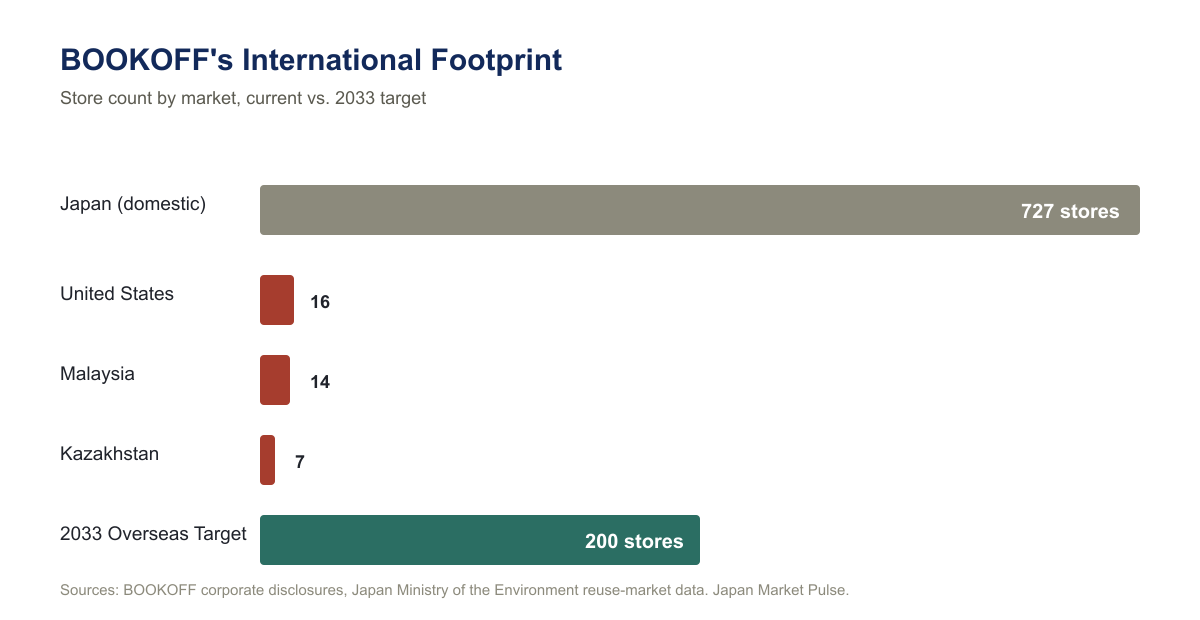
BOOKOFF’s current U.S. footprint (16 stores) sits alongside 14 in Malaysia and 7 in Kazakhstan — a geographic spread that itself signals something: this isn’t a company chasing one obvious growth market, it’s testing the operating model across wildly different retail environments simultaneously, from a mature Western consumer market to fast-growing Southeast Asian retail to a market with far less secondhand retail infrastructure of any kind. A retailer confident enough in its underlying system to run that experiment in parallel, rather than perfecting one market before entering the next, is signaling real conviction that the model itself — not any single market’s specific conditions — is what’s driving results.
The eBay Move Completes the Loop

Adding eBay as a cross-border sales channel in April 2025 is a smaller move on paper than opening new physical stores, but it closes an important gap in BOOKOFF’s international strategy. Physical stores capture local browsing demand and build brand recognition in a new market; a cross-border e-commerce channel captures the much larger population of buyers outside Japan who want access to Japanese books, manga, and media but don’t live near one of BOOKOFF’s still-limited overseas locations. Running both simultaneously means BOOKOFF isn’t choosing between physical retail expansion and e-commerce reach as competing strategies — it’s using each to cover the gap the other leaves, brick-and-mortar for local density where it exists, e-commerce for everywhere else.
What International Operators Should Take From This
For any retailer, investor, or operator who has written off a physical retail category as being in terminal, technology-driven decline, BOOKOFF’s expansion is a useful check on that assumption. The American used-book market’s struggles were real, but they were largely the struggles of a fragmented, operationally unsophisticated category — not evidence that secondhand retail itself can’t work as a scaled, systematized business. A operator that solves the actual structural problem (inconsistent quality grading, slow and inconsistent buyback pricing, retail formats built for browsing rather than volume) can find real growth in a market that local incumbents had already declared dead.
The geographic strategy is worth copying too: testing an operating model across genuinely different market types in parallel — a mature Western market, a fast-growing Southeast Asian one, a frontier market with little existing infrastructure — generates a much faster read on whether a retail system is actually portable versus whether it only worked because of one market’s specific quirks. Any retailer sitting on a proven domestic operating model and wondering whether “market X is already saturated” or “category Y is already dying” should ask, as BOOKOFF apparently did, whether the market is actually saturated with sophisticated operators, or just with a category that’s never been run properly at scale.
Frequently Asked Questions
Q. How many stores does BOOKOFF operate worldwide?
A. Roughly 727 stores in Japan across its BOOKOFF, BOOKOFF PLUS, and BOOKOFF BAZAAR formats, plus more than 50 international locations, with a target of 200 overseas stores by 2033.
Q. Where is BOOKOFF expanding outside Japan?
A. Current overseas locations include 16 stores in the United States, 14 in Malaysia, and 7 in Kazakhstan, among others — a deliberately varied set of market types.
Q. What share of Japan’s used-book market does BOOKOFF control?
A. Approximately 40% of the domestic used-book resale category specifically, within a broader Japanese reuse market valued at roughly ¥2.9 trillion as of 2022.
Q. Why would a Japanese company expand into the U.S. used-book market if it’s supposedly in decline?
A. Much of the U.S. market’s struggle was concentrated in fragmented, individually-run independent stores lacking standardized pricing and condition grading — the exact operational problems BOOKOFF’s system was built to solve at scale.
If you’re interested in this topic, the Japanese market more broadly, or what KETCHUPs is working on, we’d love to hear from you — please reach out via our contact form.
Japan Market Pulse is a weekly read on what the Japanese consumer-tech, food, and mobility markets are choosing to do, written for international operators who want to know what is happening before it shows up in the global trade press.
Subscribe at ketchups.co/japan-market-pulse.