

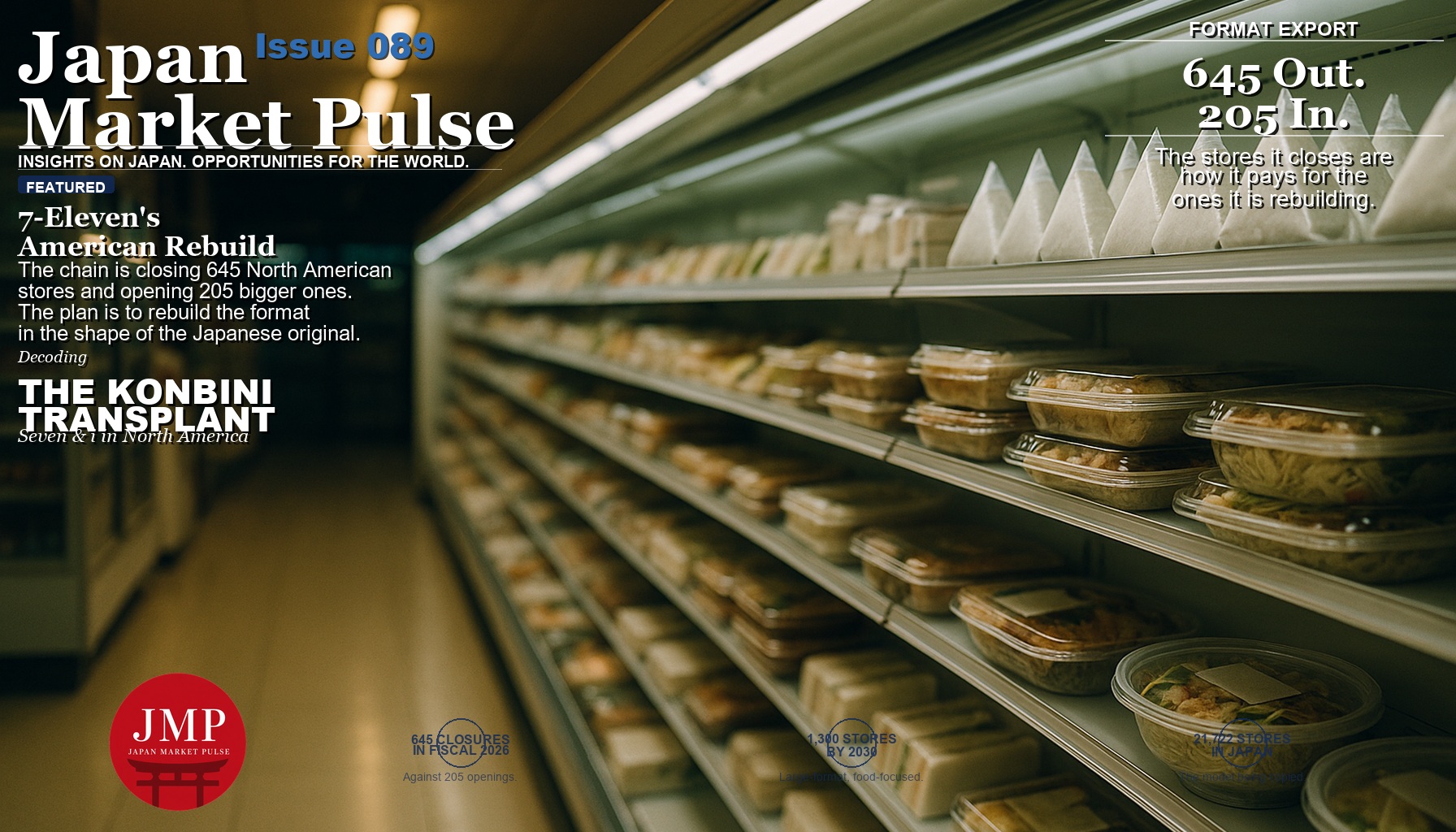
The world’s largest convenience chain just told investors it will shut or convert 645 North American stores in fiscal 2026 while opening 205. That is not a retreat. It is an attempt to rebuild an American business in the shape of the Japanese one — and it is the clearest live case study anyone has of what does and does not transfer between the two markets.
In April, buried in a set of fiscal-year filings that most American shoppers will never read, Seven & i Holdings put a number on something its customers had been noticing store by store for five years.
Six hundred and forty-five.
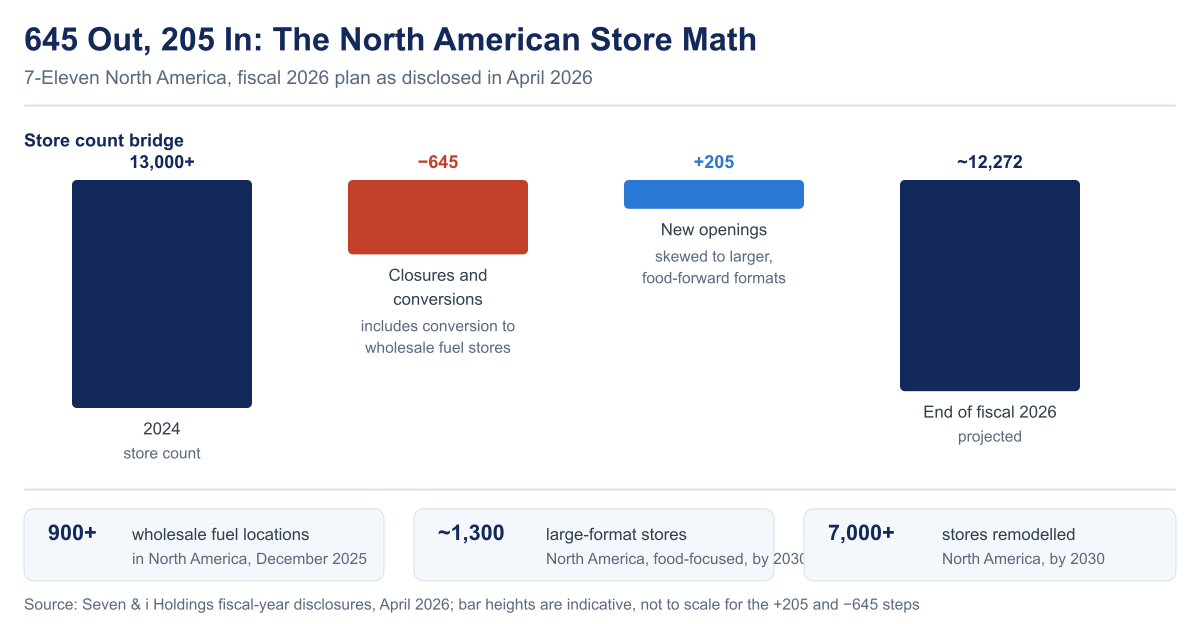
That is how many North American 7-Eleven locations the company plans to close or convert during its 2026 fiscal year. Some will simply go dark. Others will be turned into wholesale fuel sites — locations that keep selling gasoline under supply agreements but stop operating as company convenience stores. Against those 645, the company forecasts 205 new openings, and it is prioritising larger, food-forward formats among them.
Net, the North American store count is expected to land somewhere around 12,272 by the end of the fiscal year, down from more than 13,000 in 2024.
I have lived in Japan for two decades, and I want to be precise about why this story is interesting, because the headline version — “7-Eleven closing hundreds of stores” — gets it almost exactly backwards. This is not a chain in retreat. It is a chain trying to perform a transplant. Seven & i is attempting to take the operating model that makes 7-Eleven one of the strongest retail formats in Japan and install it in a market that was never built to run it.
Watching that attempt is more instructive than any market-entry white paper, because it is the same company, the same brand, the same logo and the same balance sheet — with the cultural and infrastructural variables isolated.
The Announcement Was 645 Closures. The Strategy Is 205 Openings.
Start with what the closures actually are, because the composition matters more than the count.
Seven & i’s own materials noted that the shuttered stores “include the conversion to wholesale fuel stores.” That is not a rounding detail. The company’s North American wholesale fuel business had already grown past 900 locations by December 2025. Converting a weak convenience store into a wholesale fuel site is not the same as abandoning the corner — it keeps the fuel volume and the supply relationship while removing the labour, the inventory and the couple of thousand square feet of merchandise that was not paying for itself.
The reason those stores stopped paying is spelled out in the same filings with unusual candour. Describing North American conditions in fiscal 2025, the company said that “although the economy remained robust, personal consumption also began to soften,” a trend it observed “particularly among low-income households, as inflation continued to weigh on spending.”
That sentence is the whole American convenience-store problem in one line. The traditional U.S. c-store model sells fuel, cigarettes, packaged snacks and fountain drinks to a customer who is disproportionately price-sensitive. When that customer’s real income compresses, the basket shrinks first, and the format has almost nothing else to sell them. Cigarette volumes have been in structural decline for years. Fuel is a low-margin traffic driver that increasingly runs on rewards programmes and, slowly but really, on a vehicle fleet that is electrifying.
So the 205 openings are the actual news. They are bigger boxes with proper kitchens, expanded prepared-food programmes, private-label depth and seating — stores designed so that the merchandise inside is the business rather than the thing you buy while the pump runs.
And the 2026 number is the small end of the plan. Seven & i’s roadmap for North America runs to 2030 and is unusually specific: roughly 1,300 new large-format, food-focused stores, at least 7,000 existing stores remodelled, 1,100 new in-store restaurants, $1 billion of incremental fresh food sales, and a private brand business doubled to around $2.6 billion. Underneath all of it sits a target of 3% to 5% compound annual growth in merchandise sales per store through fiscal 2030 — the metric that tells you whether the boxes are actually selling more, rather than whether there are more boxes.
That is not a facelift. It is an attempt to change what the average American 7-Eleven is for, at a chain with tens of billions of dollars in sales, and it is one of the largest deliberate category re-weightings anyone in global retail is currently attempting.
Two Companies Wearing the Same Logo
To understand why they want it so badly, you have to understand how differently the two halves of 7-Eleven behave.
In Japan, Seven-Eleven Japan proper operated 21,722 stores as of February 2026 — 21,927 counting the separately operated Okinawa business — and plans to add roughly 200 more in the current fiscal year. It is not just the largest convenience chain in the country; it is the largest by a margin that has been stable for years, and it out-earns its rivals on the metric that matters most in this format — average daily sales per store. Seven-Eleven Japan first pushed past ¥700,000 per store per day, roughly $4,500 at recent exchange rates, during the March–August 2023 period, and it has consistently run ahead of FamilyMart and Lawson on the same measure.
The reason is not location science, though Japanese konbini site selection is genuinely excellent. It is the mix. The fresh and prepared food categories — rice balls, sandwiches, boxed lunches, chilled noodles, prepared side dishes and the fried items sold at the counter, which the company reports across its fast food and daily food lines — together account for more than 30% of sales at Seven-Eleven Japan, and comparable industry data puts fresh and prepared food at roughly a third of Japanese convenience store sales overall.
In North America, prepared food is a far smaller slice of a business whose revenue line is dominated by fuel. And even the comparison flatters the American side, because the two “food” numbers are not the same substance. In North America, a large share of it is fountain drinks, Slurpees, roller-grill items, coffee and packaged bakery. In Japan, the equivalent share is a rotating assortment of chilled meals that are manufactured that morning, delivered that day and pulled from the shelf tomorrow.
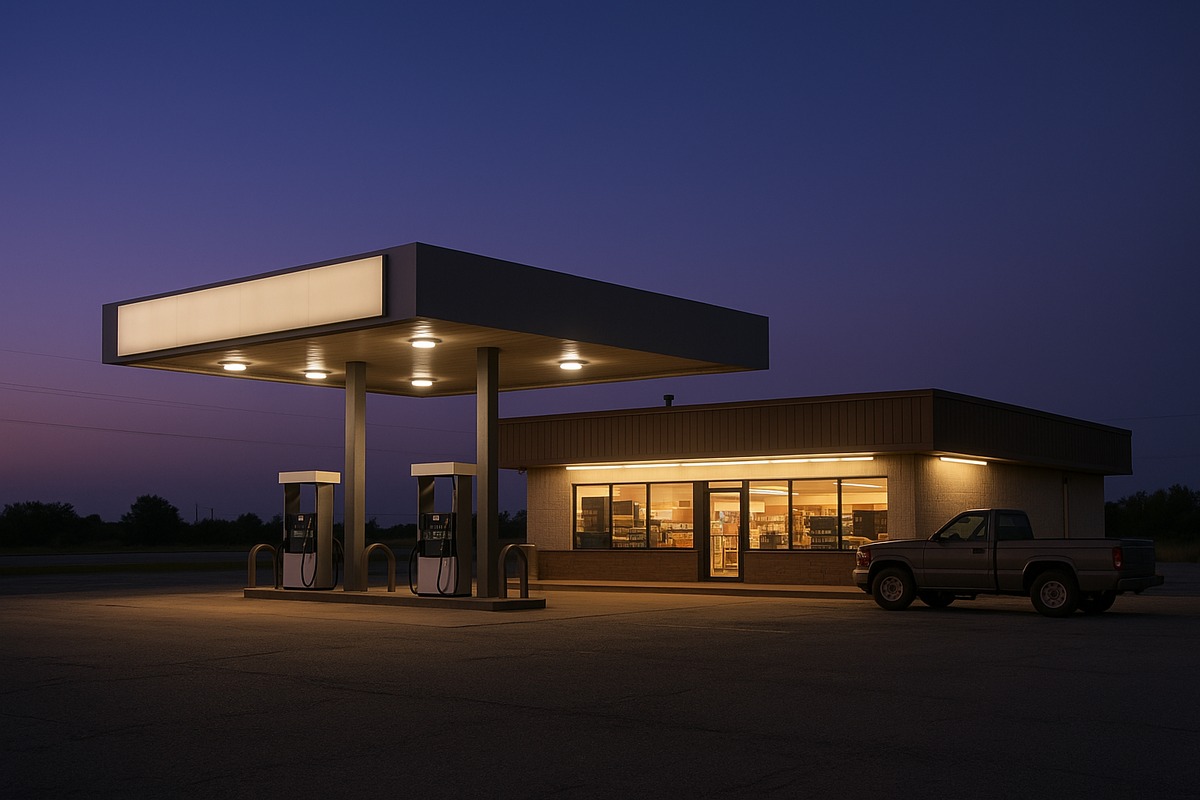
That difference produces the third divergence: visit frequency. A Japanese konbini customer is not making a fuel stop. They are buying breakfast, or lunch, or a late dinner after a long commute, and they are doing it several times a week from a store within walking distance. The American 7-Eleven customer is, overwhelmingly, arriving by car.
Two companies, one logo, entirely different jobs.
What a Japanese 7-Eleven Actually Sells You
Let me describe the shelf, because the abstraction hides the thing that matters.
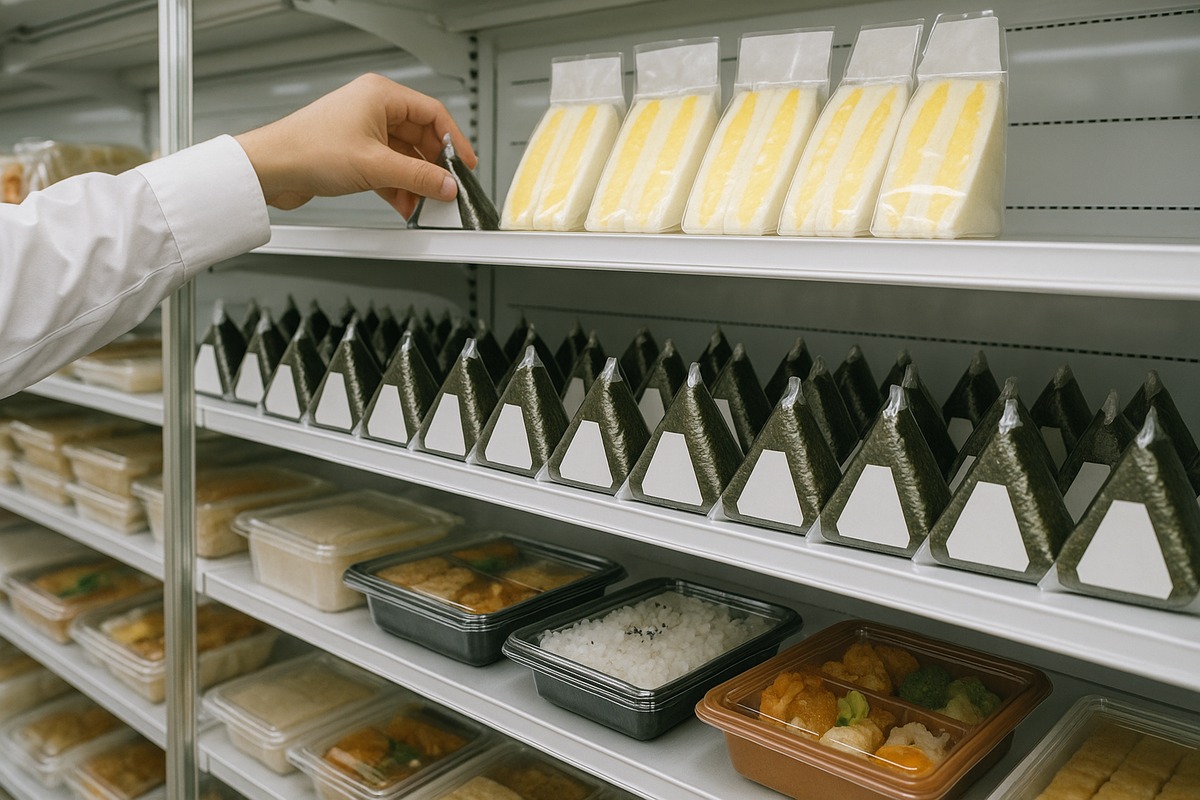
Walk into a 7-Eleven in Tokyo at 7:30 in the morning and the first fixture you meet is refrigerated. Rice balls, thirty or forty facings, each wrapped in a film mechanism that keeps the seaweed dry until you pull the tab. Egg sandwiches on crustless milk bread. Chilled noodle bowls in summer, oden simmering in a partitioned tray by the register in winter. Bento boxes with fried chicken, rice and three vegetable sides. Cold-brew coffee you pour over ice you bought as a sealed cup.
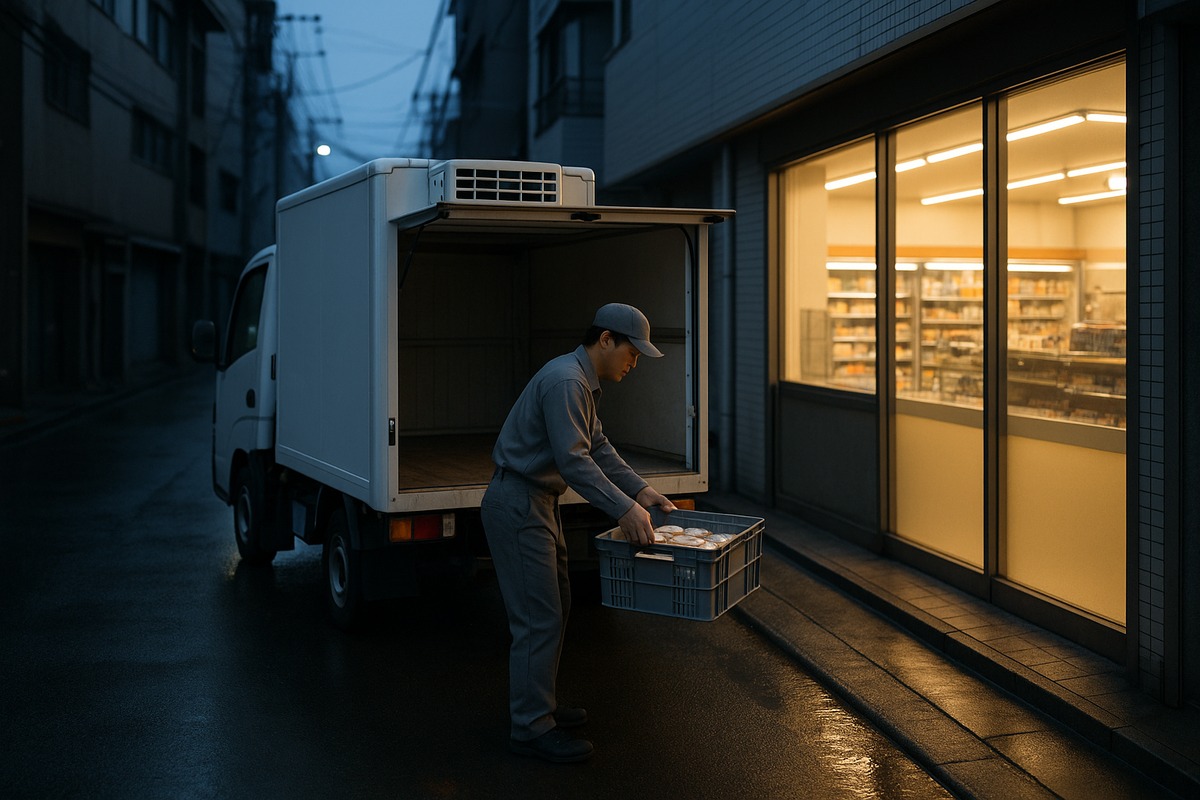
By 7:30 that evening, a substantial share of that assortment is different — either replenished, or replaced with products aimed at the commuter rather than the office worker. Konbini fresh-food logistics in Japan runs on repeated temperature-controlled deliveries into every store every day, out of dedicated production facilities that in many cases make product for one chain and nothing else.
That is the part the American retail conversation consistently underrates. The rice ball is not the innovation. The innovation is a manufacturing and distribution network — largely built with dedicated partner factories over four decades — that lets more than twenty thousand stores each carry a hundred-odd short-shelf-life items with enough forecasting accuracy that spoilage does not eat the margin.
On top of that sits Seven Premium, the private brand launched in May 2007 that the group grew into a portfolio spanning food, household goods and more, with sales the company has discussed in the ¥1 trillion range. In Japan, private label is not the value tier. It is frequently the best product on the shelf, and customers treat it that way.
The company is now extending the same asset in the other direction. 7-Eleven Japan has been rolling out its 7NOW delivery service nationwide, offering last-mile drops in as little as 20 minutes, with around 3,000 food and daily-goods items available. The stores are the dark stores. They were always going to be.
The $47 Billion Question That Forced the Issue
None of this urgency exists in a vacuum. Seven & i is rebuilding North America under conditions it did not choose.
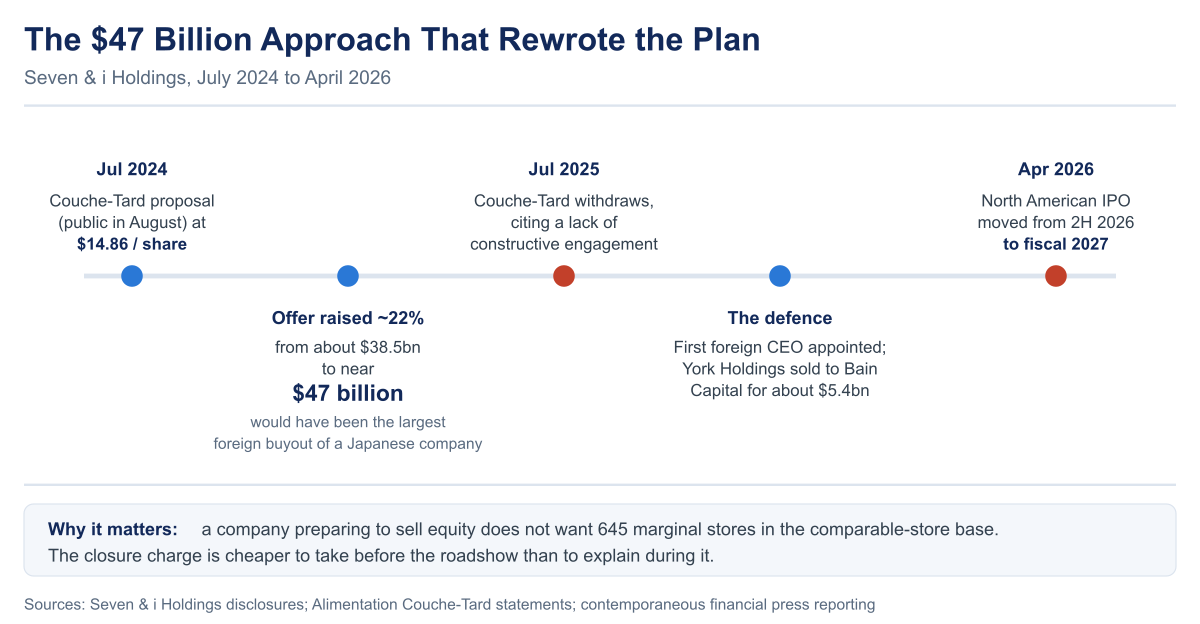
In July 2024, Canada’s Alimentation Couche-Tard — owner of Circle K — submitted an initial proposal to buy Seven & i outright, an approach that became public the following month, at $14.86 per share, valuing the company at roughly $38.5 billion. Seven & i rejected it. Couche-Tard raised its offer by about 22%, to a valuation near $47 billion. It would have been the largest foreign buyout of a Japanese company in history.
In July 2025, Couche-Tard walked away, publicly blaming what it called a lack of sincere or constructive engagement. Seven & i’s shares fell sharply on the news.
The defence, though, had already reshaped the company. Seven & i appointed Stephen Dacus, its first foreign chief executive, and committed to a narrower, convenience-store-centred group: it agreed to sell its superstore and specialty retail arm, York Holdings, to Bain Capital in a deal valued in the region of $5.4 billion, and it laid out a plan to list the North American business publicly.
That listing is the pressure point. The IPO was originally targeted for the second half of 2026. In April 2026 the company pushed it back to fiscal 2027 at the earliest — effectively March 2027 or later, given how its fiscal year falls — citing softer U.S. performance among other factors. Dacus framed it plainly: the company would prioritise “demonstrating tangible results” from the transformation first, and “the timing of any IPO will be driven strictly by value.”
Read the 645 closures against that sentence and they stop looking like distress. A company preparing to sell equity in a business does not want 645 marginal stores sitting in the comparable-store base. It wants a smaller, denser, food-heavy portfolio with a credible growth story attached — and it would rather take the closure charge before the roadshow than explain the drag during it.
The takeover fight also answered a strategic question Seven & i had left open for a decade. For years the group ran North America mostly as a scale-and-fuel business and Japan as a fresh-food business, and did not force the two together. A $47 billion offer from a fuel-and-convenience specialist is a fairly direct argument that if you are going to run an American c-store chain the American way, someone else can probably run it better. The only defensible answer was to stop running it the American way.
Fresh Food Is a Supply Chain Problem, Not a Menu Problem
Here is where I would put my scepticism, and where I think the useful operator lesson lives.
Everything 7-Eleven has announced on the food side is achievable. American stores have been adding Japanese-inspired items — rice balls, egg sandwiches, regionally tuned assortments, partnerships that borrow credibility from established Japanese food names. Reporting on the plan has consistently noted that one of the first steps is establishing new supply chains capable of daily fresh deliveries.
That single clause is the entire degree of difficulty.
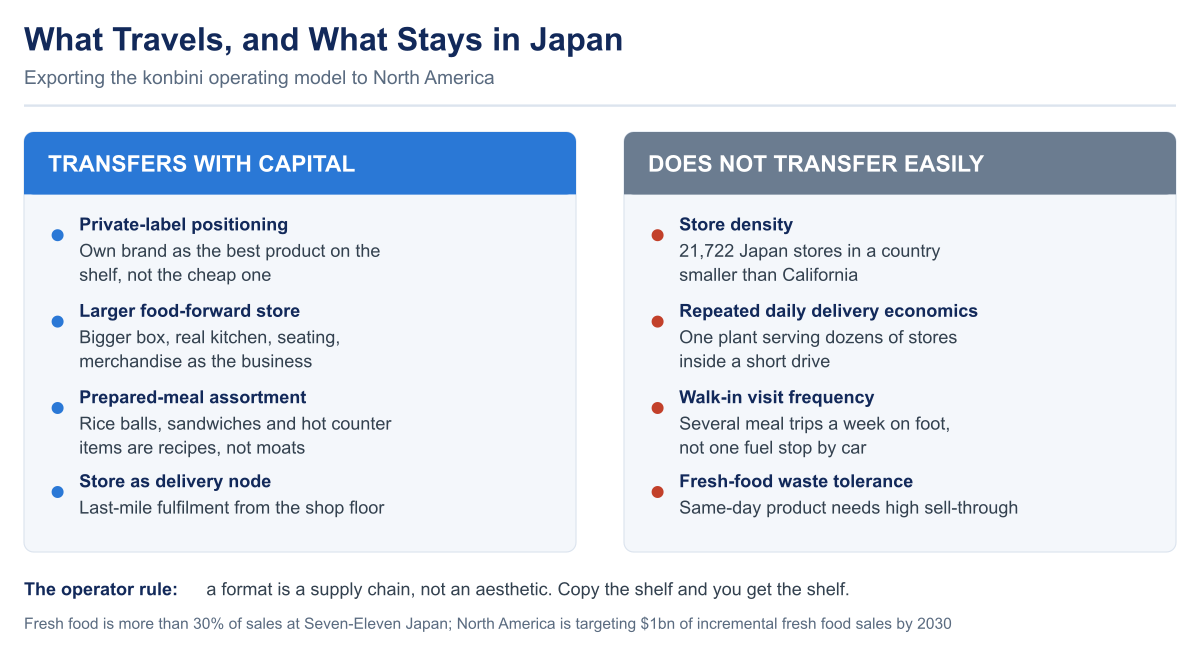
Consider what the Japanese system assumes. It assumes stores dense enough that one production facility can serve dozens of them inside a short drive. It assumes drivers, at wage levels and in a labour market that supports repeated daily runs. It assumes a customer who buys a chilled meal as a default behaviour rather than an experiment, which is what keeps the sell-through rate high enough for a same-day product to work. And it assumes a waste model where unsold fresh food is a manageable, forecastable cost rather than a catastrophic one.
Now map that onto North America. Store density outside dense metro cores is a fraction of Japan’s. Distances between locations are measured in miles rather than blocks. Trucking capacity and labour cost sit at completely different levels. And the customer has forty years of learned behaviour telling them that food at a fuel-forecourt convenience store is a compromise, not a meal — which means the initial sell-through rate on a genuinely fresh assortment will be lower than in Japan, at exactly the moment when the economics most need it to be high.
None of that makes the plan wrong. It makes it slow, and it makes sequencing matter enormously. The larger food-forward store is the correct unit to start with, because a bigger box in a denser, higher-traffic location is the only place where the supply chain maths has a chance of clearing early. The 645 closures, viewed this way, are not separate from the food strategy. They are how you pay for it and how you concentrate it.
I would watch two metrics rather than the headlines. The first is merchandise sales per store, which the company has publicly staked itself to growing 3% to 5% a year through fiscal 2030 — the cleanest single test of whether a remodelled, food-heavy store actually sells more than the one it replaced. The second is what happens to new-format openings in fiscal 2027 and 2028. Roughly 1,300 large-format stores by 2030 implies a pace well above this year’s 205. If the annual number climbs toward that run rate, the transplant is taking. If it stays near 205 while closures continue, the company has found the ceiling on how far the Japanese model travels.
What This Means If You Sell Anything in Either Market
For operators there are four transferable lessons here, and they are worth more than the specific c-store detail.
A format is a supply chain, not an aesthetic. The most common mistake I see from brands entering Japan — and from Japanese brands going the other way — is copying the visible layer. You can put a rice ball in an American cooler this quarter. You cannot put the four-decade dedicated-factory network behind it this quarter. When you evaluate a foreign retail model, ask what invisible infrastructure the visible thing rests on, and price that separately.
Private label is a positioning decision, not a price decision. Seven Premium works in Japan because customers believe it is the best version of the product, not the cheap version. Any brand entering Japan should assume the retailer’s own label is a genuine quality competitor. Any brand building private label elsewhere should notice that the Japanese answer to margin pressure was to make the own-brand better rather than cheaper.
Density is the hidden variable in unit economics. Almost every advantage the Japanese konbini enjoys — repeated daily deliveries, high visit frequency, viable 30-minute delivery from the store itself, tolerable fresh-food waste — traces back to how many stores sit inside how small an area. If you are modelling a Japanese format for a Western market, run the model at Western density before you run it at Japanese margins.
Capital pressure moves faster than consumer preference. The thing that finally forced this transformation was not the American shopper suddenly demanding better food. It was a $47 billion unsolicited takeover approach and a planned listing. If you are trying to predict when a large incumbent will actually change, watch its capital structure, not its customer surveys.
There is a fifth point, less tidy than the others. Seven & i is running a genuinely difficult experiment in public, with quarterly disclosure. Whatever happens, in three years there will be an unusually clean data set showing how much of a national retail model survives export — because for once, most of the other variables are held constant.
Frequently Asked Questions
Q. How many 7-Eleven stores are actually closing in North America?
A. Seven & i’s fiscal 2026 plan is 645 closures and conversions against 205 new openings, which would bring the North American store count to roughly 12,272 by the end of the fiscal year, down from more than 13,000 in 2024. Not all 645 go dark — a portion become wholesale fuel sites, a segment that had already passed 900 North American locations by December 2025.
Q. Is 7-Eleven in financial trouble?
A. The North American business is under real pressure — the company itself cited softening consumption among lower-income households — but the closures read better as portfolio pruning ahead of a planned listing than as distress. The Japanese business remains large and profitable, with 21,722 Seven-Eleven Japan stores as of February 2026 — 21,927 including Okinawa — and plans to keep opening.
Q. What happened to the Couche-Tard takeover bid?
A. Alimentation Couche-Tard submitted an initial proposal in July 2024, made public that August, at $14.86 per share, roughly $38.5 billion, then raised its offer by about 22% to a valuation near $47 billion. Seven & i did not accept, and Couche-Tard withdrew in July 2025, citing a lack of constructive engagement. It would have been the largest foreign acquisition of a Japanese company ever attempted.
Q. Why is Japanese convenience store food so much better?
A. Because it is a different industrial product. Japanese chains built dedicated production facilities and repeated daily temperature-controlled deliveries into every store, so a large share of the assortment is made and sold within about a day. Fresh food is more than 30% of sales at Seven-Eleven Japan, which justifies that infrastructure. American c-store food has historically been a much smaller share of revenue, so the equivalent network was never built.
Q. Can I buy Japanese 7-Eleven products outside Japan?
A. Shelf-stable Japanese konbini favourites and own-brand snacks circulate through import channels and third-party sellers (search Japanese convenience store snacks on Amazon), usually at a significant markup. The fresh assortment — rice balls, chilled bento, egg sandwiches — cannot be exported by definition, which is precisely why 7-Eleven has to rebuild the supply chain locally rather than ship anything.
Q. When will the 7-Eleven North America IPO happen?
A. It was originally targeted for the second half of 2026 and has been pushed to fiscal 2027 at the earliest, which given Seven & i’s fiscal calendar means March 2027 or later. Management has said the timing will be driven by value and by demonstrating results from the current transformation first, so further movement is possible.
Conclusion
The number worth remembering from all of this is not 645. It is 1,300 — the large-format, food-focused stores Seven & i says it will have opened in North America by 2030, alongside 7,000 remodels, 1,100 in-store restaurants and $1 billion of incremental fresh food sales.
Six hundred and forty-five closures is what that ambition costs at the front end. The 205 openings are what the first year of it looks like. And the whole exercise is a bet that the thing making 7-Eleven extraordinary in Japan is not Japanese culture, not Japanese taste and not forty years of accumulated brand affection, but a set of operating decisions about food, frequency and logistics that can, with enough capital and enough patience, be rebuilt somewhere else.
I am genuinely unsure whether that bet is right. Density is a hard constraint and you cannot buy it. But I have watched enough foreign formats fail in Japan — and enough Japanese formats fail abroad — to know that the ones that come closest are always the ones that identified the invisible infrastructure first and built that, rather than copying the shelf.
Seven & i has, at minimum, identified the right thing. Whether North America will let it build it is the question the next two fiscal years will answer, in public, in quarterly instalments.
This article contains affiliate links. If you purchase through these links, we may earn a small commission at no extra cost to you.
If you’re interested in this topic, the Japanese market more broadly, or what KETCHUPs is working on, we’d love to hear from you — please reach out via our contact form.
Japan Market Pulse is a weekly read on what the Japanese consumer-tech, food, and mobility markets are choosing to do, written for international operators who want to know what is happening before it shows up in the global trade press.
Subscribe at ketchups.co/japan-market-pulse.