

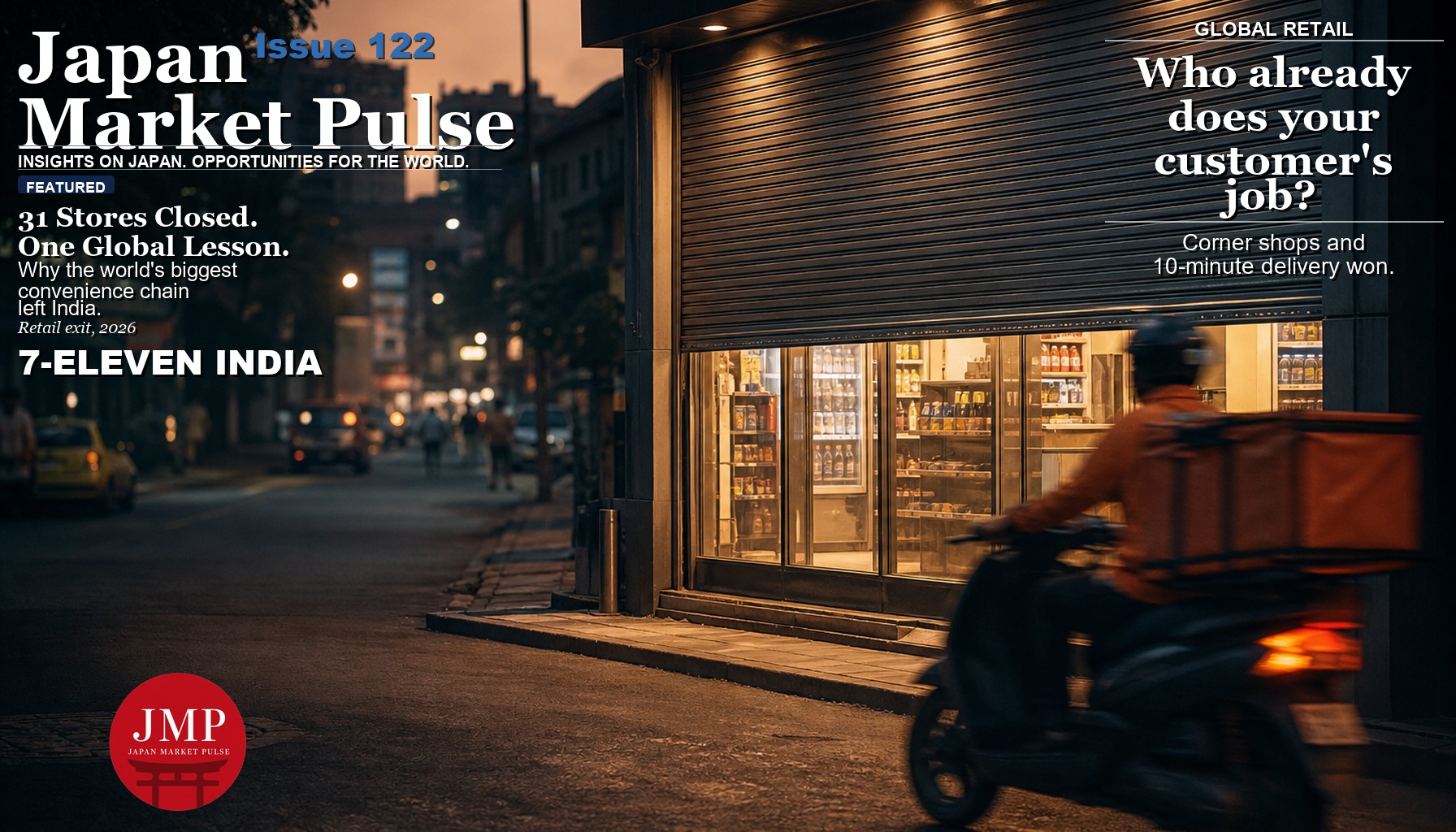
Five years after Reliance Retail opened India’s first 7-Eleven in Mumbai, every remaining store has closed. The local operator booked a loss of nearly ₹90 crore on about ₹92 crore of revenue in its final full year, and the network never got past roughly 60 stores. For Seven & i, the Japanese owner of the world’s largest convenience chain, India is a small market lost. For anyone exporting a retail format, it is a large lesson about what happens when the “convenience” you sell is already being delivered to the customer’s door in ten minutes.
On 30 September 2026, the last 7-Eleven stores in India closed their shutters. Seven & i Holdings, the Tokyo-based parent of the 7-Eleven brand, confirmed that its Indian master franchisee, Reliance Retail, had closed all 31 remaining outlets in Mumbai and Pune by that date. The five-year franchise partnership, launched with considerable fanfare in October 2021, came to an end with little more than a short statement.
On paper, this should have been one of the safest bets in global retail. 7-Eleven is the largest convenience-store chain on earth, with more than 85,000 stores across roughly 20 countries and regions. Reliance Retail is India’s largest retailer, backed by Mukesh Ambani’s Reliance Industries, with deep pockets, real-estate reach and a supply chain that already serves millions of shoppers. India is the world’s most populous country, urbanising fast, with a young population that has grown up on smartphones.
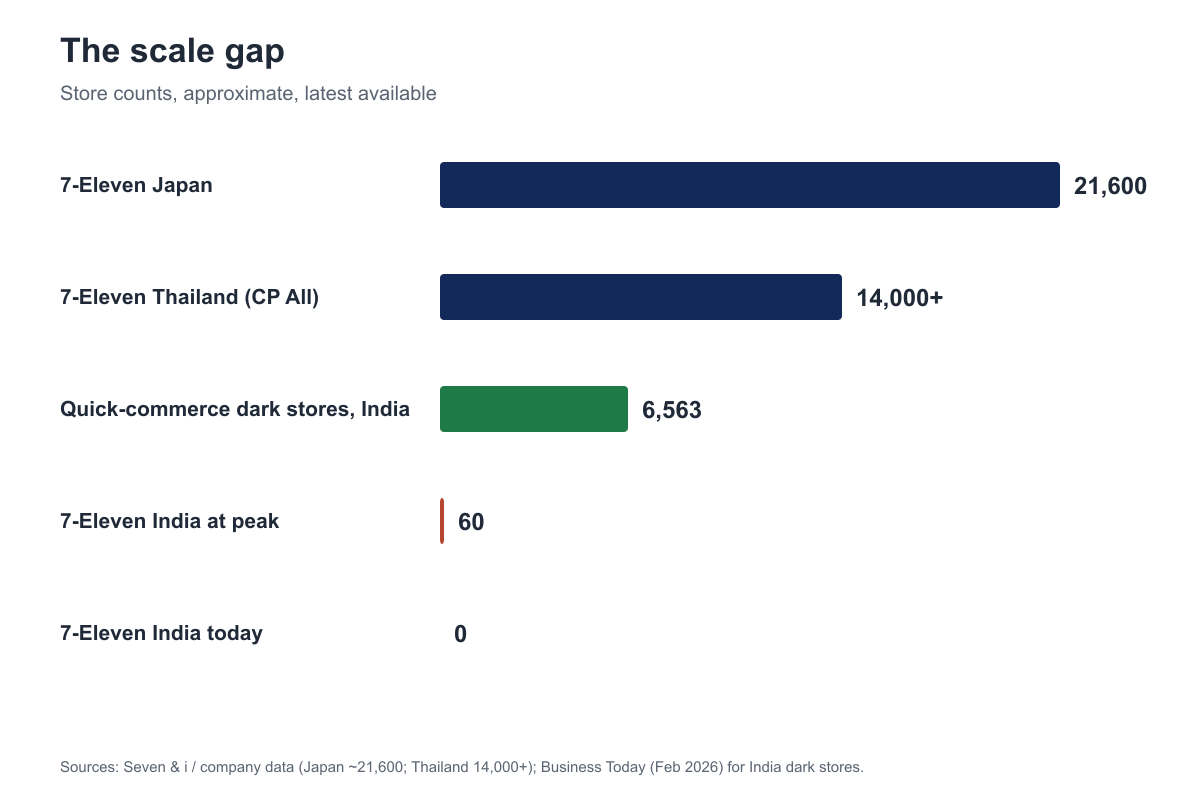
And yet the stores never scaled. The network reportedly peaked at around 60 outlets, a rounding error next to the roughly 21,600 7-Eleven stores in Japan alone. In the financial year to March 2026, the operating unit lost almost as much money as it took in.
This is worth studying closely, not because India is a large part of Seven & i’s business (it is not), but because the way 7-Eleven lost in India is increasingly the way physical convenience retail can lose anywhere. It was squeezed from below by millions of tiny neighbourhood shops, and from above by apps that deliver groceries in about ten minutes. Here is what happened, and what it means for Japanese retailers, and anyone else, trying to export a store format in 2026.
What Happened: 31 Stores, One Closing Date
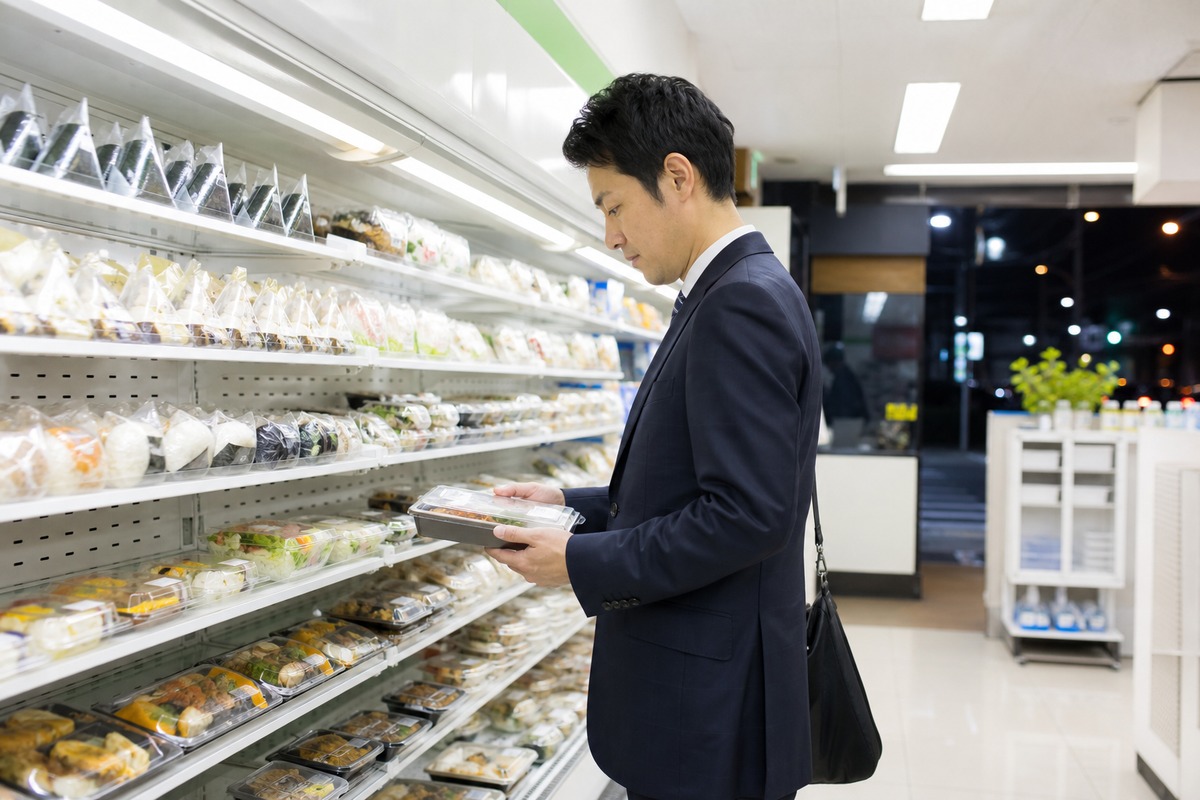
The facts of the closure are simple. According to Seven & i, Reliance Retail closed all 31 7-Eleven stores still operating in India as of 30 September 2026. The stores were concentrated in Mumbai and Pune, two of the country’s wealthiest and densest urban markets, which is exactly where a premium convenience format should have had its best chance.
Seven & i did not describe the closure as a failure. The company said 7-Eleven International continues to grow its global business, and a spokesperson told CNBC that the chain still wants to serve Indian customers and will explore options to expand its presence in the market over the long term. One adviser quoted in that coverage, Sohrab Bararia of Grant Thornton, described the move as “more like a rethink of the current franchise arrangement.”
Reliance Retail, for its part, did not issue a detailed public explanation at the time of the first reports. Indian business media reported that employees of the 7-Eleven business were being absorbed into Reliance Retail’s grocery and neighbourhood retail operations, and that, according to those reports, the group’s capital is shifting towards larger-format supermarkets and its own quick-commerce delivery through JioMart.
Some outlets may have stayed open briefly to clear stock. But as of October 2026, 7-Eleven, the brand that defines convenience retail across much of Asia, has no stores in the world’s most populous country.
The Numbers: ₹92 Crore In, Nearly ₹90 Crore Out
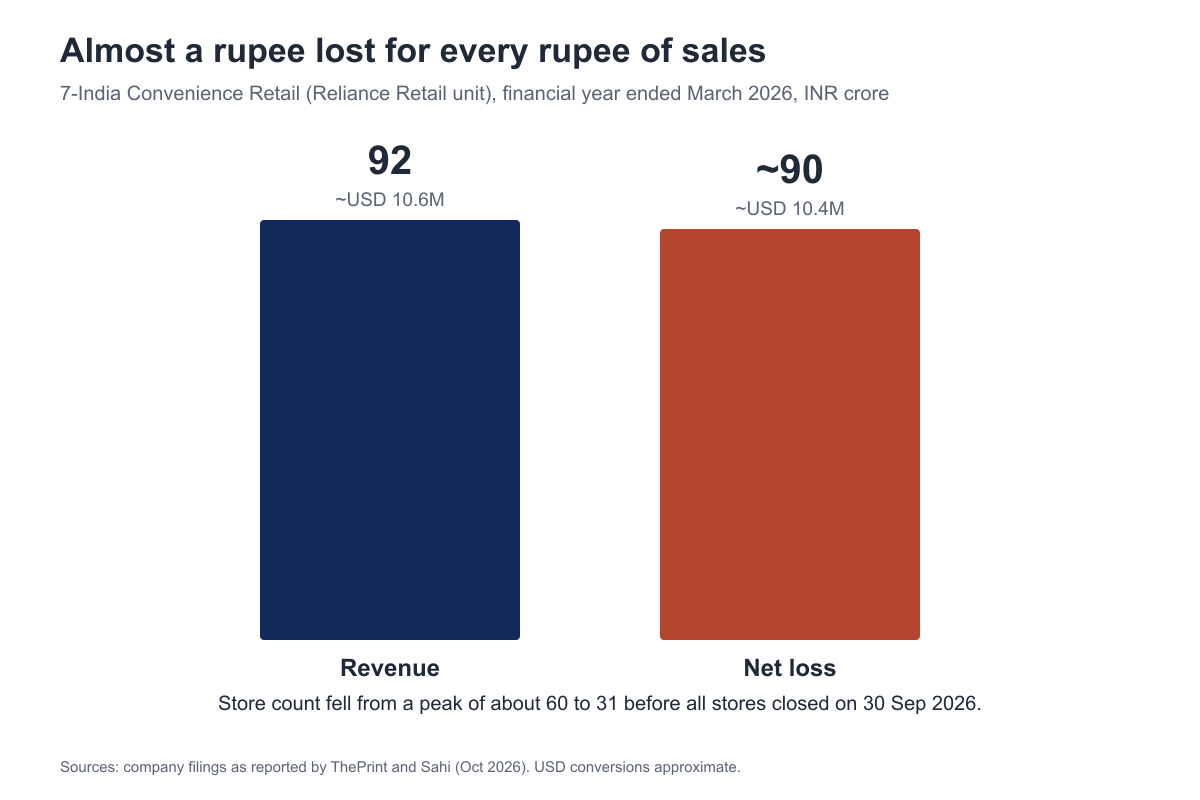
The most striking figures come from the operating company’s own accounts. 7-India Convenience Retail, the Reliance Retail subsidiary that ran the stores, reported revenue of about ₹92 crore (roughly US$10.6 million) for the financial year ended March 2026. Its net loss for the same year was nearly ₹90 crore, or about US$10.4 million.
Put simply, for almost every rupee of sales, the business lost close to another rupee. A convenience store business can survive thin margins, and a new network can survive a few years of losses while it builds density. What it cannot survive indefinitely is a loss of this size relative to revenue, five years in, with no clear path to the scale where the economics turn.
It is also worth looking at the revenue on a per-store basis. Divide about ₹92 crore by a network that was shrinking from its peak of around 60 stores towards 31, and each store was generating, on a rough average, somewhere in the range of ₹1.5 crore to ₹3 crore a year, or roughly US$175,000 to US$350,000. That is a simple calculation, not a disclosed figure, and the store count changed during the year. But it is a useful reality check: a mature 7-Eleven store in Japan typically takes in several times that amount, and it does so with a supply chain built around thousands of stores, not dozens.
Convenience retail is a density game. Fresh food factories, delivery trucks that visit several times a day, regional advertising and the data systems that decide what goes on each shelf all get cheaper per store as the network grows. At 30 to 60 stores, almost none of those advantages switch on. The fixed costs of a global brand, including franchise fees, imported systems and brand standards, land on a very small base.
Five Years, Two Partners, Around 60 Stores at the Peak
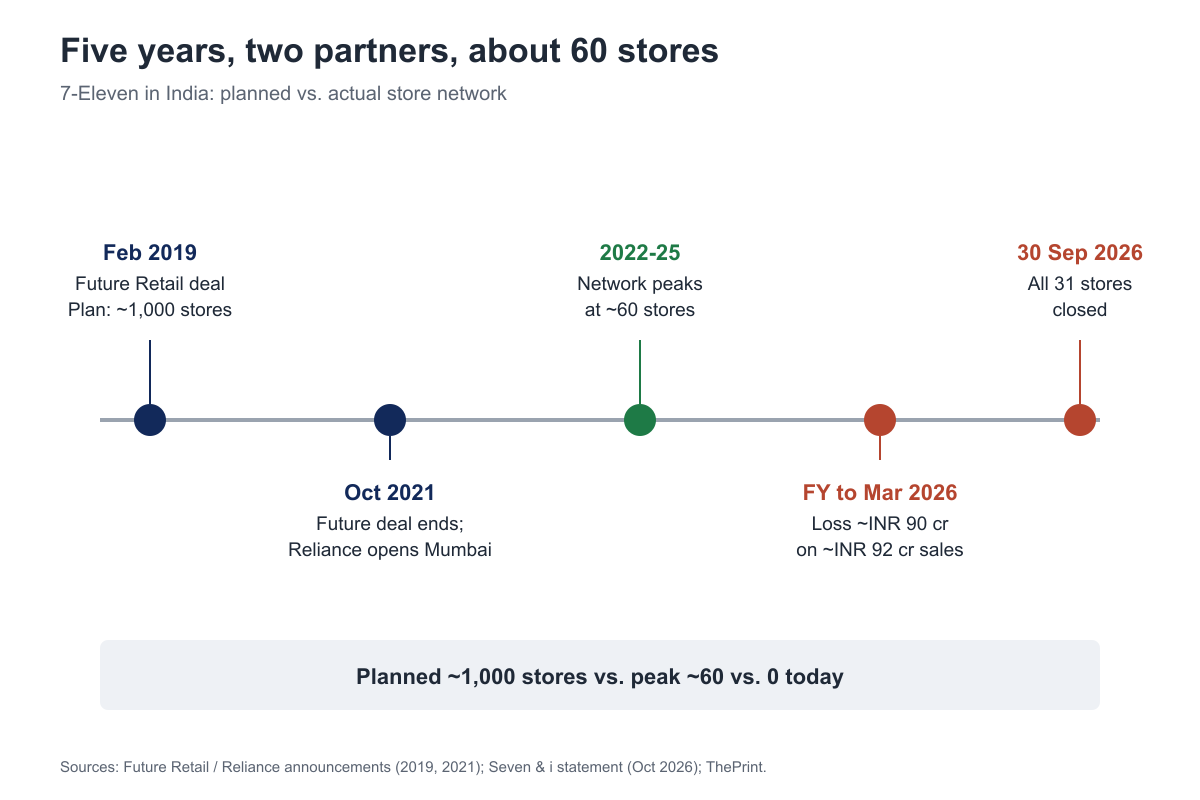
India was not 7-Eleven’s first attempt at the market under this generation of deals. In February 2019, 7-Eleven signed a master franchise agreement with Future Retail, then one of India’s biggest retailers, through a subsidiary set up to develop and operate convenience stores in the country. The ambition was large: the partners talked about building around 1,000 stores.
That plan never got going. Future Retail ran into severe financial trouble, and in early October 2021 the agreement was terminated by mutual consent. Future Retail said its subsidiary had been unable to meet store-opening targets or pay franchise fees.
Within days, Reliance Retail stepped in. It announced a master franchise agreement with 7-Eleven Inc. and opened India’s first 7-Eleven store in Andheri East, Mumbai, on 9 October 2021. The launch was widely covered as a sign that Ambani’s retail empire was adding a global convenience brand to a portfolio that already spanned grocery, fashion, electronics and e-commerce.
Then the expansion stalled. The network reportedly reached a peak of about 60 stores, mostly in Mumbai, before closures began. By the time the franchise term was ending, only 31 stores remained in Mumbai and Pune.
Compare that arc with the original Future Retail ambition of around 1,000 stores. The gap is not a matter of slow execution. It suggests that the format itself did not find a profitable place in Indian urban retail during these five years, even with one of the best-funded retail partners in Asia behind it.
The Kirana Problem: 12 Million Shops Already Next Door
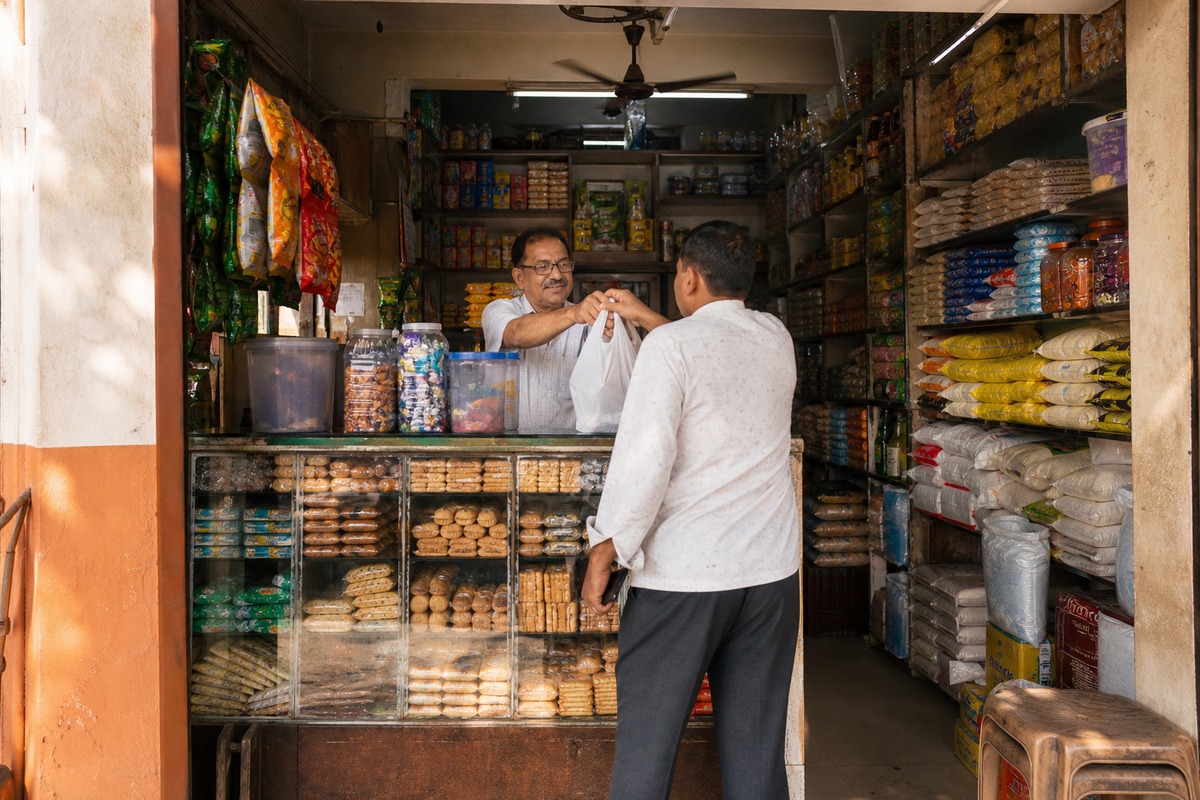
The first force that squeezed 7-Eleven is the oldest one in Indian retail: the kirana. These are small, usually family-run neighbourhood shops, often no bigger than a single room open to the street, selling rice, flour, oil, biscuits, soap and phone top-ups. Industry estimates commonly put their number at 12 million or more across the country.
To an outsider, kiranas can look like the informal retail that convenience chains are designed to replace. In practice, they already do much of what a convenience store promises. They are close, often within a few minutes’ walk of almost every home in a dense city. They open early and close late. Many offer informal credit to regular customers, deliver to nearby flats by phone order, and stock exactly what their neighbourhood buys. Their costs are low, because the owner’s family often works the counter and the shop may be on property they already occupy.
A 7-Eleven store competes against that with a different promise: clean, air-conditioned, standardised, with fixed prices, branded ready-to-eat food and a predictable experience. That promise has real value in some markets. But in India, the extra cost of delivering it, including rent for street-facing premises in Mumbai, staffing to brand standards, and fresh food handling, has to be recovered from shoppers who already have a cheaper, closer and more flexible alternative.
Reporting on the closure consistently names this competition as one of the core reasons the venture struggled to reach profitability. The kirana is not simply a weaker competitor that a modern chain can out-run. It is a deeply embedded, very low-cost network that already owns the “close and quick” position in most neighbourhoods.
The 10-Minute Problem: Quick Commerce Took the Convenience Store’s Job
The second force is newer, and it is the one that should worry convenience retailers in other markets. Over the same five years that 7-Eleven was trying to grow in Mumbai, India built one of the most aggressive quick-commerce markets in the world.
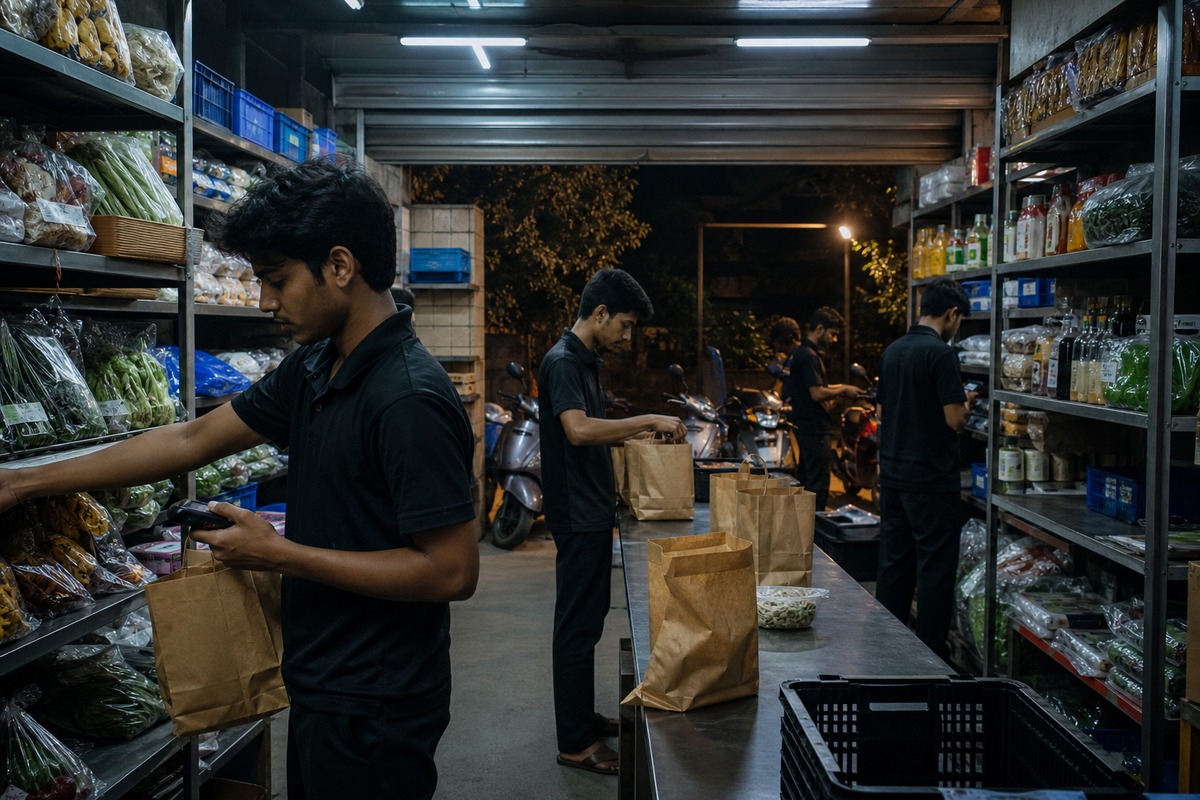
Quick-commerce apps such as Blinkit (owned by Eternal, formerly Zomato), Swiggy Instamart, Zepto and BigBasket promise to deliver groceries, snacks, drinks and household essentials in around ten minutes. They do it through “dark stores”, small warehouses closed to the public, placed inside dense neighbourhoods and staffed by pickers who pack orders for waiting delivery riders.
The scale of that build-out is enormous compared with 7-Eleven’s footprint. A Business Today report in February 2026 put the total number of quick-commerce dark stores in India at about 6,563. Blinkit alone has guided towards around 3,000 dark stores by March 2027. Third-party estimates of the market’s annual order value vary widely, from several billion dollars today to projections of US$35 billion to US$40 billion by 2027-28 from HSBC, and Morgan Stanley projections for 2030 that have been revised upward over time.
The precise numbers are less important than the direction. In India’s big cities, the core job of a convenience store, which is “I need a few everyday items right now, close to home”, is increasingly done by a phone. The customer does not walk to the store; the store comes to the customer. And the dark-store model does not need expensive street-front retail space, attractive fixtures or a branded in-store experience. It needs cheap back-street square footage, fast picking and a dense fleet of riders.
That leaves a physical convenience chain in an awkward middle position. It is more expensive than the kirana on the corner, and slower and less convenient than the app on the phone. In a market where both of those alternatives are improving every year, the middle is a hard place to build a business.
Why the Konbini Model Does Not Travel Everywhere
It is tempting to read the India exit as a story about one difficult market. But the 7-Eleven model that Seven & i has spent five decades refining in Japan is unusually dependent on conditions that are not present everywhere.
In Japan, 7-Eleven runs about 21,600 stores, roughly a quarter of its global network. The Japanese konbini is not mainly a place to buy snacks. It is a dense, data-driven logistics machine: dedicated factories produce rice balls, sandwiches and bento boxes, delivery trucks restock stores several times a day, and stores double as places to pay utility bills, collect parcels, withdraw cash and print documents. That model works because Japanese cities are dense, labour costs for factory food are manageable at scale, consumers are willing to pay a premium for consistent quality, and there is relatively little informal retail competition.
Where those conditions exist, the model has travelled well. In Thailand, 7-Eleven, operated by CP All under licence, has become a national institution with more than 14,000 stores. In Taiwan and South Korea, convenience stores are also part of daily life.
But even at home, the model is under pressure. The Japan Franchise Association has reported that same-store customer traffic at Japanese convenience stores has fallen year-on-year for 15 consecutive months, according to its September 2026 data. Inflation is pushing up the price of everyday food, delivery apps are competing for the same quick purchases, and chains are experimenting with new categories, including apparel, to bring younger shoppers back into stores.
In other words, the forces that beat 7-Eleven in India are not exotic. Low-cost neighbourhood alternatives and fast delivery exist, in different forms, almost everywhere. India simply combined both at extreme intensity, in a market where the konbini’s supporting infrastructure did not yet exist.
What It Means for Seven & i’s Global Plan

The India exit also lands at a sensitive moment for Seven & i itself. After fending off a takeover approach from Canada’s Alimentation Couche-Tard, which withdrew its offer in 2025, the company has been trying to persuade investors that it can grow as a focused convenience-store business on its own.
Part of that story is international expansion. In 2025, 7-Eleven International set a goal of expanding from around 20 countries and regions to 30 by fiscal 2030. Europe has been named as a potential “fourth major pillar of growth” alongside Japan, North America and Asia-Pacific, with reported target markets including Germany, France, Italy, Spain, Poland, Turkey and the United Kingdom.
At the same time, the company is pruning in its largest overseas market. Seven & i’s North American operator has said it expects to close around 645 stores in fiscal 2026, some of them through conversion to wholesale fuel sites, while opening only around 205. That is a reminder that, even for the world’s largest convenience chain, network quality now matters more than raw store count.
India itself is small in Seven & i’s financial picture, and the company has left the door open to return in a different form. But the episode sharpens a question every investor will ask about the new-country push: how will 7-Eleven make the format work in markets where it cannot quickly reach the density that makes its supply chain efficient, and where delivery apps are already training customers not to walk to a store at all?
What International Operators Should Take From This
For foreign retailers and brands looking at India, Japan or any other market, the 7-Eleven exit offers five practical lessons.
1. Map the real competition for the customer’s job, not the competitors in your category. 7-Eleven’s competition in Mumbai was not another chain of branded convenience stores. It was the corner kirana and the ten-minute delivery app, neither of which looks like a convenience store. Before entering a market, define the job your format does for the customer and list everyone who already does that job, online and offline.
2. A strong partner does not replace a working model. Reliance Retail is one of the most powerful retailers in Asia, with capital, property and supply chains that few partners anywhere can match. It still could not make the format profitable at this scale. A great franchise partner can accelerate a model that works locally; it cannot make a model work that the market does not want at that price.
3. Plan for density from day one. Convenience economics only turn positive when a network is dense enough to support shared factories, frequent deliveries and local marketing. A plan that reaches 60 stores in five years in a city of more than 20 million people is not a slow version of success; it is a sign the model has not found its unit economics. Set density milestones and decision points early.
4. Treat delivery apps as part of the format, not an add-on. In many cities, the physical store is now one channel among several for the same purchase. Retail formats exported in 2026 need a clear answer to how they work with, or against, quick commerce, whether that means acting as a delivery hub, partnering with platforms or building a role that delivery cannot copy.
5. Know which parts of the home-market model actually travel. The Japanese konbini’s strengths, including fresh food factories, multi-daily logistics and bill payments, depend on infrastructure and consumer habits built over decades. When exporting a Japanese format, separate the parts that can be adapted quickly, such as product quality and store standards, from the parts that need years of investment to replicate.
Frequently Asked Questions
Q. Has 7-Eleven completely left India?
A. As of 30 September 2026, all 31 remaining 7-Eleven stores in India, operated by Reliance Retail under a franchise agreement, had closed, according to Seven & i. Seven & i has said it still wants to serve Indian customers and will look at options for the market over the long term, so a return in a different form has not been ruled out.
Q. How many 7-Eleven stores did India have?
A. The network reportedly peaked at around 60 stores, mostly in Mumbai, after the first store opened in Andheri East in October 2021. By the end of the five-year franchise arrangement, 31 stores remained in Mumbai and Pune. An earlier deal with Future Retail, signed in 2019, had talked about around 1,000 stores but was terminated in 2021.
Q. Why did 7-Eleven fail in India?
A. Neither company has given a single official reason beyond the end of the franchise term. Reporting points to intense competition from millions of low-cost neighbourhood kirana shops and from fast-growing quick-commerce apps that deliver groceries in about ten minutes, combined with high costs for a small network that never reached efficient scale. The operating unit lost nearly ₹90 crore on about ₹92 crore of revenue in the year to March 2026.
Q. What is quick commerce in India?
A. Quick commerce refers to apps such as Blinkit, Swiggy Instamart, Zepto and BigBasket that deliver groceries and household items in around ten minutes from small neighbourhood warehouses known as dark stores. India had about 6,563 such dark stores in early 2026, according to Business Today, and the leading players continue to add more.
Q. Does this affect 7-Eleven stores in Japan?
A. Not directly. India was a very small part of Seven & i’s business, and Japan’s roughly 21,600 stores operate on a separate model. However, Japanese convenience stores face some of the same pressures, including inflation and delivery competition, and same-store customer traffic has fallen year-on-year for 15 consecutive months, according to the Japan Franchise Association’s September 2026 data.
Conclusion
The closure of 31 stores would barely register in most of 7-Eleven’s markets. In India, it marks the end of the brand’s presence in the world’s most populous country, five years after a launch that was meant to show how a global convenience leader and India’s biggest retailer could reshape urban shopping.
The lesson is not that India is impossible for modern retail, or that the konbini model is broken. It is that “convenience” is defined by the customer, not by the format. In Mumbai and Pune, convenience already meant a shop next door that knows your name and an app that brings your groceries before the kettle boils. A clean, well-lit store with branded food and fixed prices, however good, had to win against both.
For Seven & i, the India exit is a small but useful reality check as it pushes into new countries. For every company exporting a retail format, Japanese or otherwise, it is a reminder to ask a hard question before signing the franchise agreement: in this market, in 2026, who is already doing our customer’s job, and why would they switch?
If you’re interested in this topic, the Japanese market more broadly, or what KETCHUPs is working on, we’d love to hear from you — please reach out via our contact form.
Japan Market Pulse is a weekly read on what the Japanese consumer-tech, food, and mobility markets are choosing to do, written for international operators who want to know what is happening before it shows up in the global trade press.
Subscribe at ketchups.co/japan-market-pulse.