

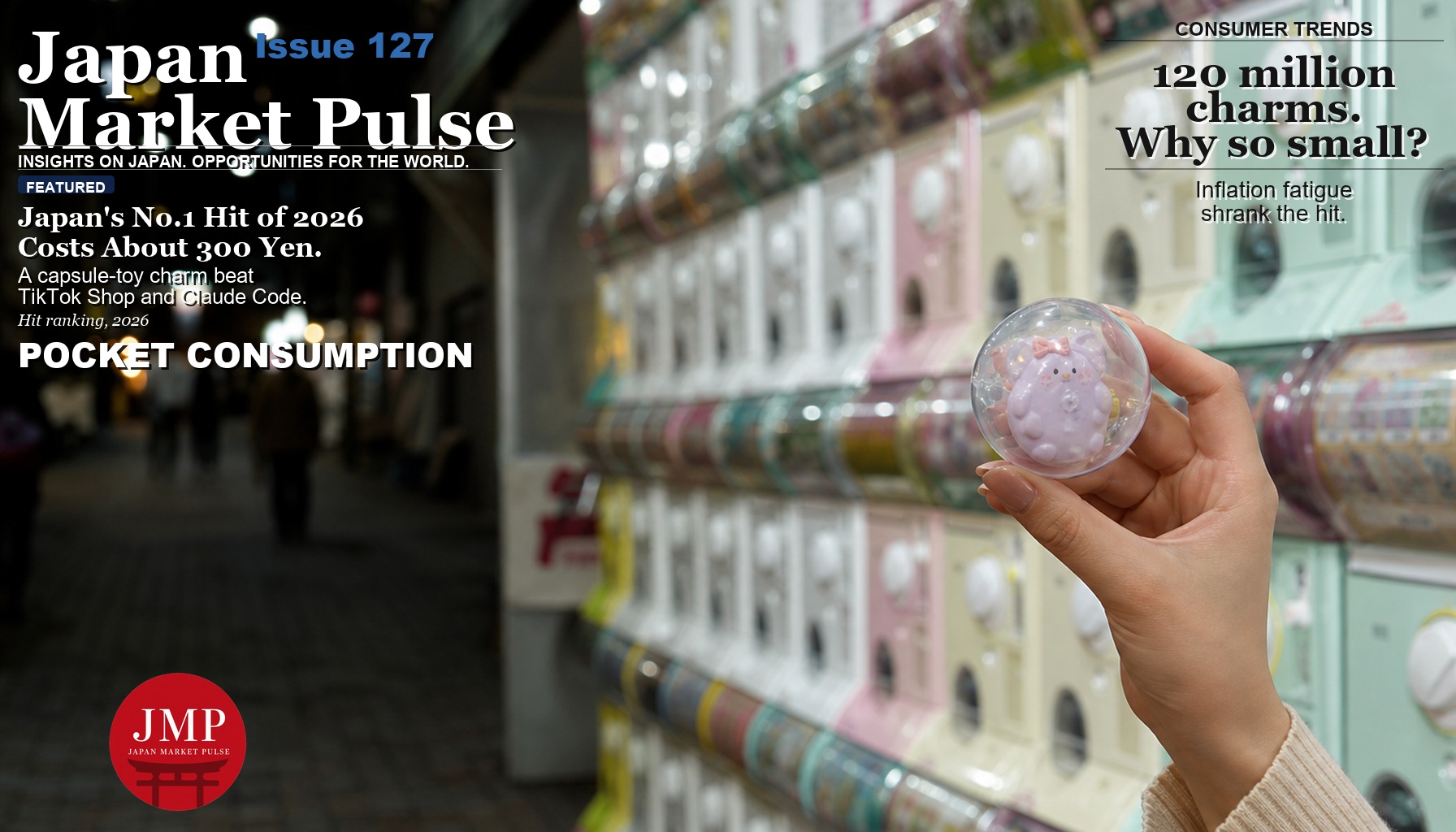
On 3 November 2026, Nikkei Trendy published its annual ranking of the 30 biggest hits in Japan. A year earlier, the top three were a world expo that drew 25 million visitors, a film seen by more than 10 million people and the Nintendo Switch 2. This year the winner is a tiny silicone-ringed mascot charm sold from capsule-toy machines for a few hundred yen, with Bandai alone shipping an estimated 120 million units. The magazine’s phrase for the year is “pocket consumption”: small, affordable pleasures bought by people who are tired of price rises. For international operators, the list is a map of what Japanese consumers are still willing to pay for, and how little it costs to win them.
I have lived in Japan long enough to have watched this ranking come out every November for two decades, and I still read it the way some people read election results. It is not a scientific survey. It is a judgement by the editors of a consumer magazine, based on three criteria, sales, novelty and influence, applied to products and services launched between October 2025 and September 2026. But because it tries to capture the mood of a year rather than just the receipts, it tends to say something true about where Japanese spending is heading.
This year the mood is unmistakable. Japan is in its second consecutive year of more than 20,000 food and beverage price increases. Wages are rising, but not fast enough for most households to feel it. And the product that beat everything else in 2026, from an AI coding tool to a blockbuster film, is a small charm that people clip to their umbrella so they can tell it apart from everyone else’s.
Here is what the list says, what the editors think it means, and what it should tell anyone selling into Japan in 2027.
The List: What Japan Actually Bought in 2026
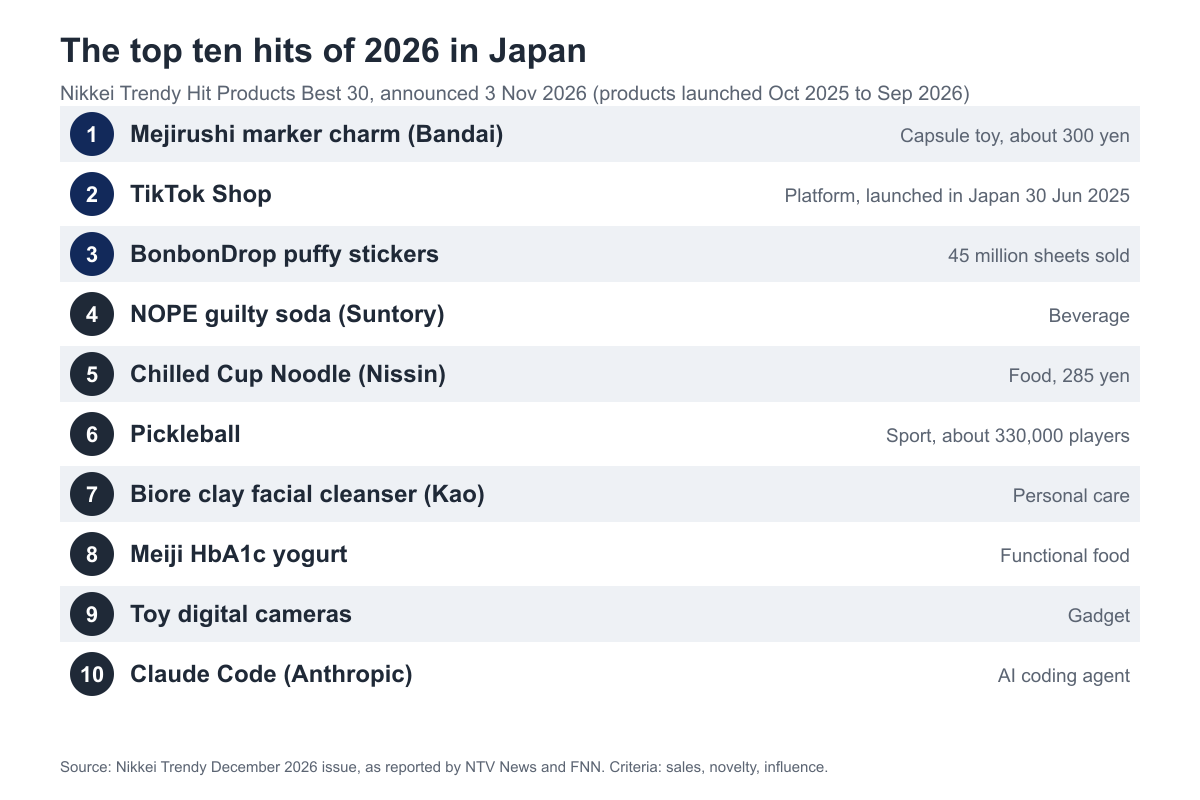
The top ten is a strange and revealing mix. At number one is the “mejirushi charm”, a mascot on a silicone ring that attaches to bags, umbrellas and handheld fans. At two is TikTok Shop, which launched in Japan at the end of June 2025 and has turned short-video recommendations into a mainstream way to buy. At three is the BonbonDrop sticker, a puffy, three-dimensional sticker sold through character collaborations that has reportedly passed 45 million sheets.
Four is Suntory’s NOPE, a “guilty” soda that tastes like a treat and markets itself as such. Five is Nissin’s Chilled Cup Noodle, a cup noodle designed to be made with cold water. Six is pickleball, the paddle sport that has gone from a curiosity to a sport with an estimated 330,000 players in Japan. Seven is a clay facial cleanser from Kao’s Biore line, eight is a Meiji yogurt aimed at people watching their blood sugar, nine is the toy digital camera, and ten is Claude Code, the agentic coding tool from Anthropic.
Further down the list come the year’s biggest film, the Chiikawa movie, at twelve; Nintendo’s Tomodachi Collection at eighteen; Kirin’s Good Ale beer at nineteen; a museum built inside a former prison in Nara at twenty; setlog, a social app for sending two-second videos, at twenty-one; air fryers with a window at twenty-two; Korean-style mega-size coffee shops at twenty-four; low-tech pet robots at twenty-five; everyday AI smart glasses at twenty-eight; and, at thirty, Grogu, the Star Wars character.
Three things stand out. First, the price point. Of the top ten, only pickleball, the toy camera and Claude Code cost more than a few hundred yen to try, and two of those are hobbies rather than purchases. Second, the share of character intellectual property. The charm, the sticker and the film are all driven by licensed characters, and the charm’s biggest moment came when it was used, twice, as an admission gift for the Chiikawa movie. Third, the number of entries that are not Japanese at all. TikTok Shop, pickleball, Claude Code, Korean coffee, Grogu: a third of the hits are imports, which is unusual for a list that has historically been dominated by domestic brands.
Number One Costs ¥300: The Charm That Shipped 120 Million Units
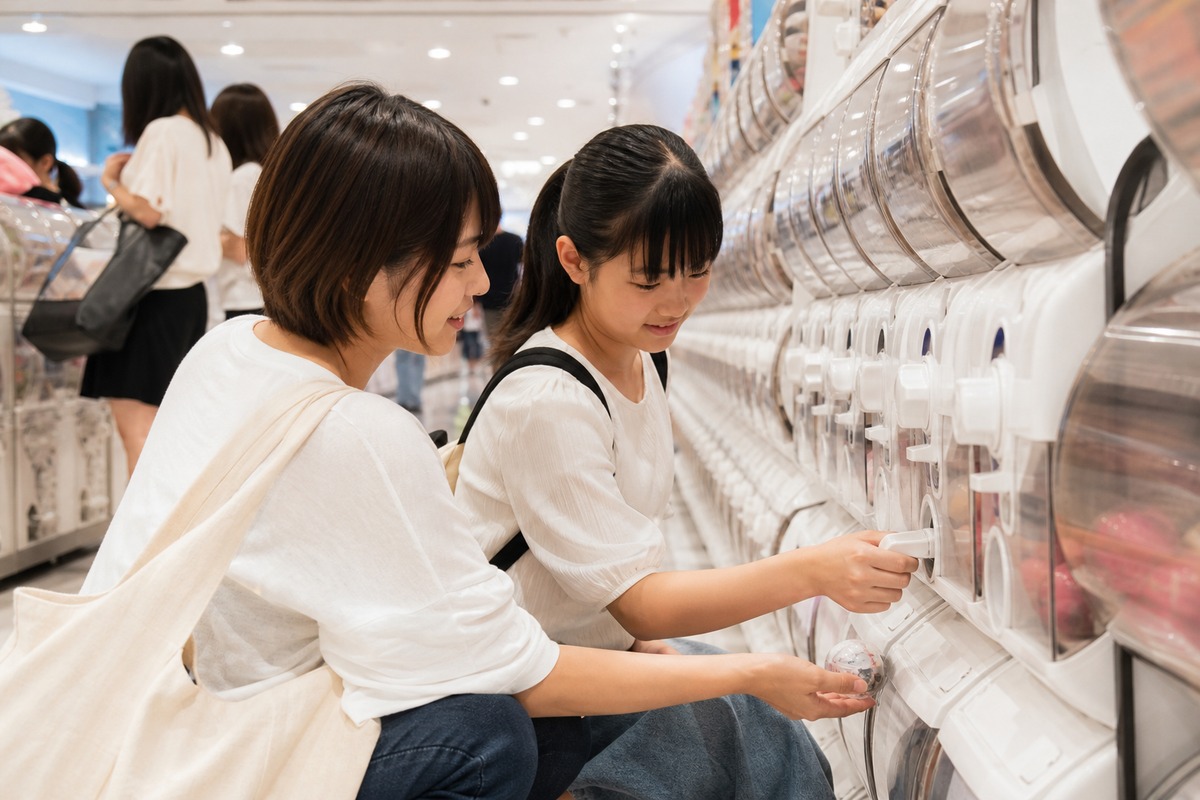
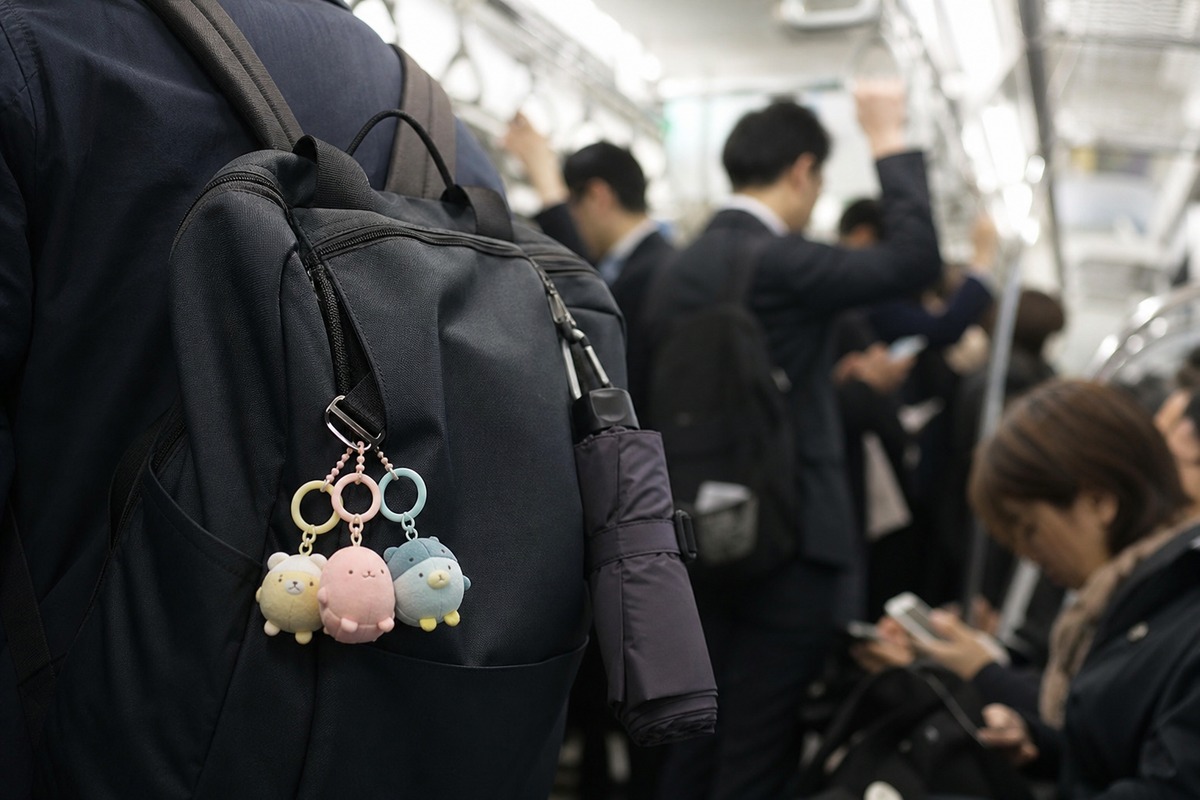
The winner deserves a closer look, because it is so easy to dismiss. A mejirushi charm, literally a “marker charm”, is a small mascot figure, usually of a licensed character, attached to a flexible silicone ring. You loop the ring around the handle of your umbrella, the strap of your bag or the grip of your handheld fan. The practical purpose is identification: in a country where everyone carries the same clear umbrella and the same fan, the charm tells you which one is yours. The emotional purpose is the point: the character on the ring is your favourite, and the charm is a tiny public display of that affection.
They are sold mainly from capsule-toy vending machines, the machines Japanese people call gacha, for 300 yen a turn in most cases, sometimes 200 yen, with 400 and 500 yen now the mainstream price for premium capsule items. The buyer does not choose which character comes out. That randomness, combined with the low price, makes people buy again and swap with friends, and the swapping is where the social life of the product lives.
The scale is what moved the editors. According to the ranking’s coverage, Bandai alone shipped about 120 million of them, enough for every person in Japan to own one. Regional versions appeared across the country, from a northern Japan illustrated-guide series to a Hanagasa festival charm in Yamagata, and local newspapers reported shops selling out and, in some cases, suspending sales to manage the queues. A survey by the arcade operator Taito ahead of “good oshi day” in October found that marker mascots and charms were the fan-goods trend of 2026 by a wide margin.
The editor’s note in the announcement called a goods item at number one “extremely rare”. The last two winners were an expo and a film, experiences that cost thousands of yen and a whole day. This year’s winner costs 300 yen and takes thirty seconds. That is the story of 2026 in one object.
Pocket Consumption: Why Japan’s Hits Got Smaller
Nikkei Trendy’s keyword for the year is “pocket consumption”, which it defines as spending that keeps outlays low while delivering a small, reliable happiness. The editors explicitly contrast it with the “expensive but good” products that often top the list in better years, and they connect it to what they call inflation fatigue.
The numbers behind that fatigue are not subtle. Teikoku Databank counts 20,327 food and beverage price increases in Japan in 2026, the second straight year above 20,000, with another 1,477 items going up in November alone, roughly ten times the figure for November 2025. In that environment, the editors argue, consumers do not stop spending. They shrink the unit. A charm instead of a plush. A sticker instead of a figure. A cup noodle instead of a restaurant. A 300-yen capsule instead of a 3,000-yen gift.
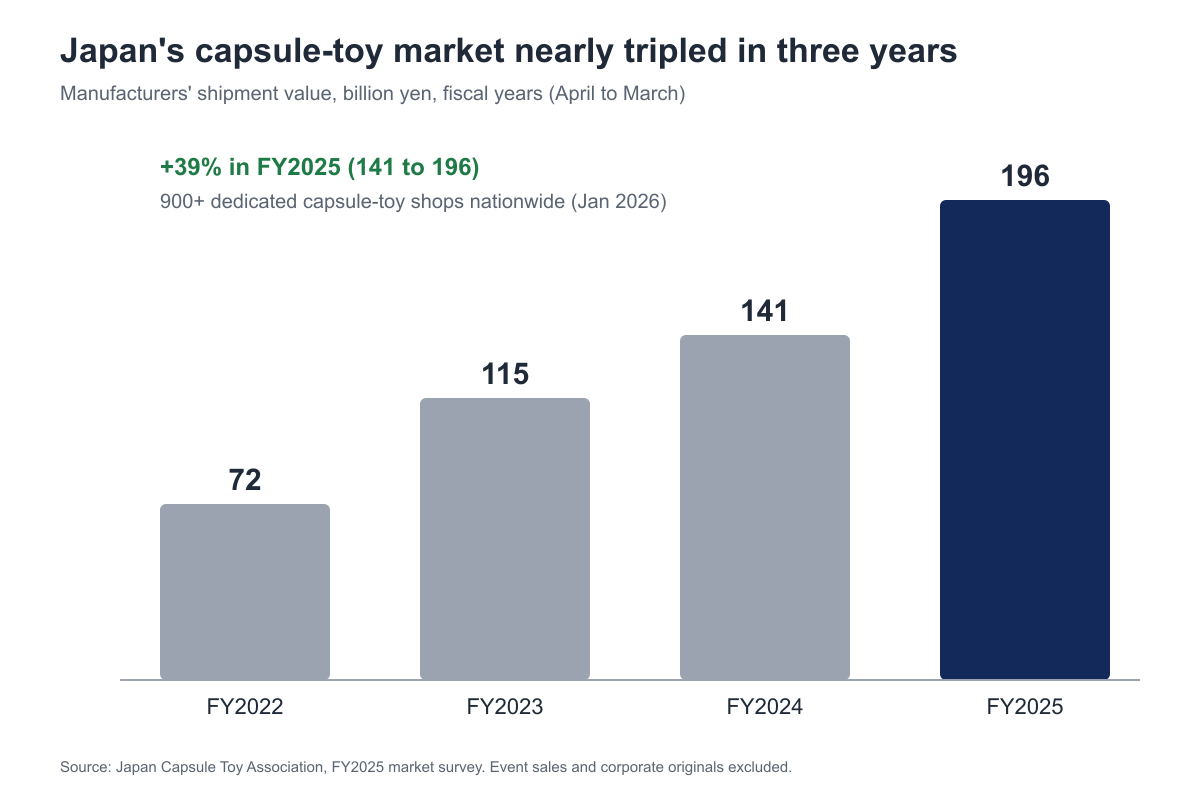
The capsule-toy industry is the clearest beneficiary. The Japan Capsule Toy Association puts the manufacturers’ shipment value of the market at about 196 billion yen in fiscal 2025, up 39 percent from 141 billion yen the year before, and up from 72 billion yen in fiscal 2022. That is a near tripling in three years. There are now more than 900 dedicated capsule-toy shops nationwide, and the association expects fiscal 2026 to grow again. Marker charms are the product that pushed the market from strong to extraordinary.
Two other keywords in the magazine’s analysis matter for operators. “Dopa-katsu”, a coinage from dopamine and the Japanese word for activity, describes a search for small, healthy, affordable stimulation: a spicy cold noodle, a fizzy soda that feels naughty, a new sport that gets you out of the house. And “petit reward” describes the willingness to pay slightly more than usual, but not a lot more, for something that feels premium. Kirin’s Good Ale, priced between standard and premium beer and sold as a “reward beer”, is the textbook example at number nineteen.
Put those three ideas together and you have a very precise brief for anyone launching in Japan next year. Keep the unit price inside what a person can spend without thinking. Make the product feel like a treat, not a compromise. And give it a social or collectible layer, because a small pleasure shared is worth more than a small pleasure alone.
TikTok Shop at Number Two: ¥65.5 Billion in Nine Months, and a Different Story From America
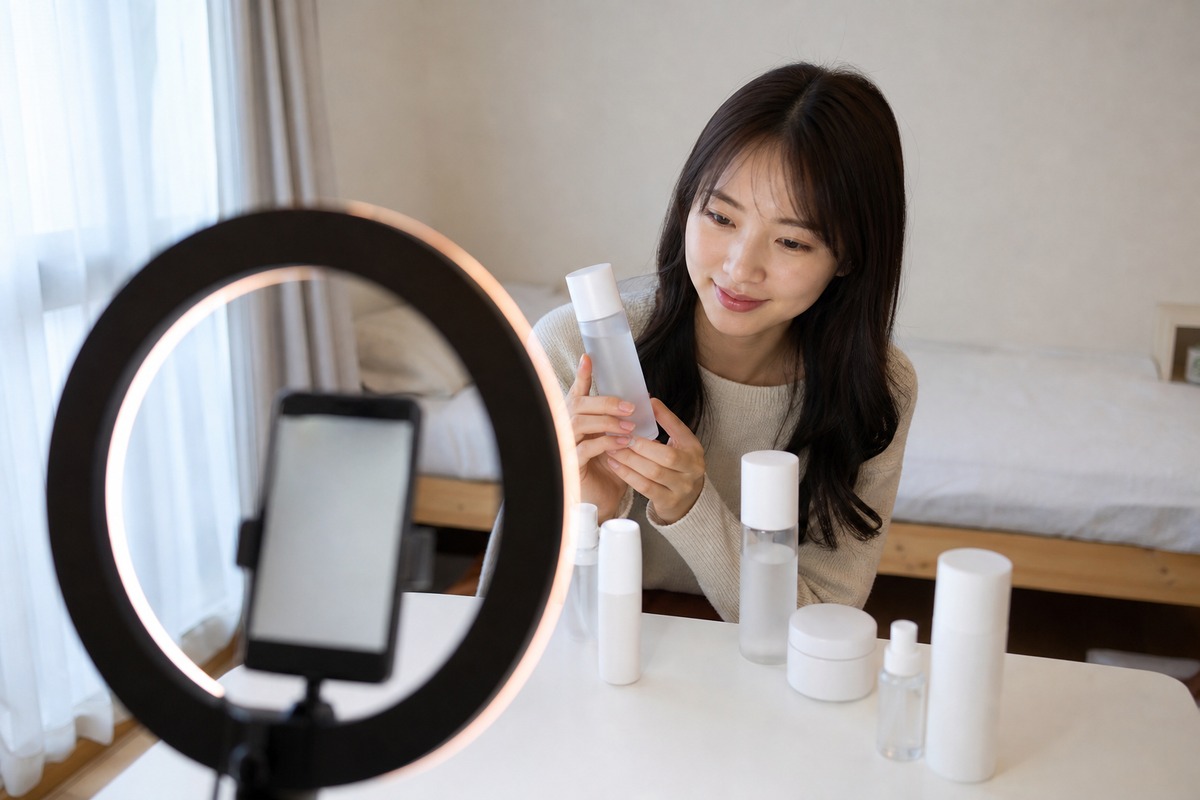
The one entry on the list that is unambiguously a platform rather than a product is TikTok Shop, and its position at number two is a measure of how fast it has reshaped Japanese e-commerce. The service opened in Japan on 30 June 2025, late by global standards. The ranking’s coverage says its distribution transaction value passed 65.5 billion yen in its first nine months and that sales roughly doubled during its anniversary sale. A six-month update from the company counted more than 50,000 active sellers and more than 200,000 creators, and it reported that about 70 percent of first-year transaction value came from content-led purchases rather than searches.
For context, that nine-month figure is roughly 430 million dollars at current exchange rates. In the United States, TikTok Shop’s gross merchandise value was estimated at about 15 billion dollars in 2025 and 11.8 billion dollars in the first half of 2026 alone, according to Momentum Works. Japan is a small market by comparison. But the growth curve is steep, and the platform has done something in Japan that American observers may not expect: it has become respectable. Established consumer brands, not only small direct-to-consumer sellers, have opened shops, and the editors highlight the demand from shoppers who want to buy the products that the recommendation feed surfaces, without leaving the app.
The contrast with the United States is instructive. In America, TikTok spent 2025 under the threat of a ban and, on 22 January 2026, its US operations passed to a joint venture led by Silver Lake, Oracle and the Abu Dhabi fund MGX, with ByteDance retaining a 19.9 percent stake. The shopping business kept growing through all of it, but the platform’s identity in the United States is tangled up with national security, data and politics. In Japan the same app is a shopping channel that a magazine for ordinary consumers has just ranked above a blockbuster film. There is no equivalent political debate. There is only the question of whether your product looks good in a 30-second video.
I would add one caution from watching Japanese e-commerce for years. Japan’s shoppers are loyal to Rakuten and Amazon, and they are slow to move. TikTok Shop’s early categories in Japan skewed heavily to beauty and personal care. The platform’s number-two ranking reflects novelty and influence as much as sales, which is exactly what the criteria say. The scale is still to come.
Dopamine on a Budget: Chilled Cup Noodles, Pickleball and Guilty Soda
The middle of the top ten shows what “dopa-katsu” looks like in practice, and each entry has a lesson.
Nissin’s Chilled Cup Noodle, at number five, is a product that should not have worked. Cup noodles are hot food. Nissin launched two flavours, spicy kimchi and chicken-salt lemon, on 20 July 2026, at a suggested price of 285 yen before tax, designed to be prepared with cold water and a five-minute wait. Within one week, according to Bloomberg, the company had sold what it had expected to last one to two months. Retail panel data showed the two flavours taking the first and second spots in the Cup Noodle range in launch week and lifting the brand’s share within its category from 7.6 percent to 12.3 percent. Resale listings appeared at more than double the retail price. Nissin has not published unit numbers, which is itself a sign that the constraint was supply.
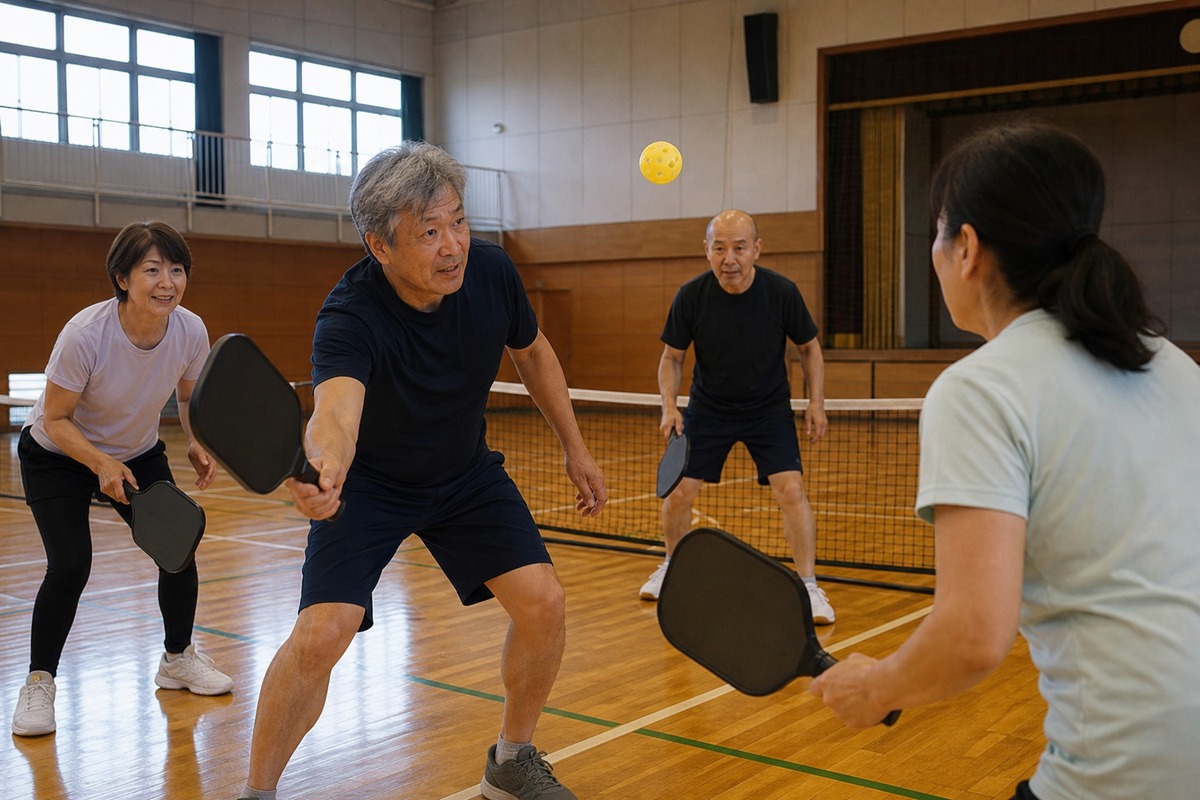
Pickleball, at six, is the rare entry that is neither Japanese nor a product. One industry estimate puts Japan’s player population at about 330,000 in 2026, up roughly seven times from the previous year’s estimate of 45,000, with dedicated venues opening in Toyosu and Ikebukuro and more than 650 facilities counted across 38 prefectures. In the United States, the sports industry body SFIA counts about 24.3 million players, so Japan is where America was around 2018. The ranking’s coverage emphasises how easy the sport is for beginners and how it functions as a place to make friends, which fits a year in which the magazine also lists “frenemy” and “choice fatigue” among its keywords. Pickleball is cheap, social and mildly competitive. It is dopa-katsu with a paddle.
Suntory’s NOPE, at four, is the beverage version of the same idea. A soda sold as “guilty” in a market where every other drink is sugar-free, calorie-off or functional, it gives permission for a small, inexpensive indulgence. Meiji’s blood-sugar yogurt at eight and Kao’s clay cleanser at seven are the healthier end of the spectrum, small daily upgrades that cost a little more than the standard product and promise a visible benefit.
What unites these is not a category. It is a size. Each one is a decision a Japanese consumer can make at a convenience store or a sports hall for the price of a lunch, and each one delivers a feeling, spicy, bubbly, sweaty, clean, that is slightly out of the ordinary. For international brands, the implication is uncomfortable but useful: the growth in Japan this year was not in premium, and it was not in value. It was in affordable novelty.
Claude Code at Number Ten, and the Anti-AI Backlash Predicted for 2027
The tenth-ranked hit is the one that confused Japanese internet forums the most. Claude Code, Anthropic’s command-line tool for delegating programming tasks to an AI agent, appears on a list otherwise populated by stickers and noodles. The editors’ explanation is simple: it lets people hand a task to an AI and have it completed “fully automatically”, and in 2026 that moved from a developer novelty to something ordinary office workers in Japan started to use. Japan has one of the most acute shortages of software engineers in the developed world, and a tool that lets a non-specialist get working code is a practical product here, not a technology story.
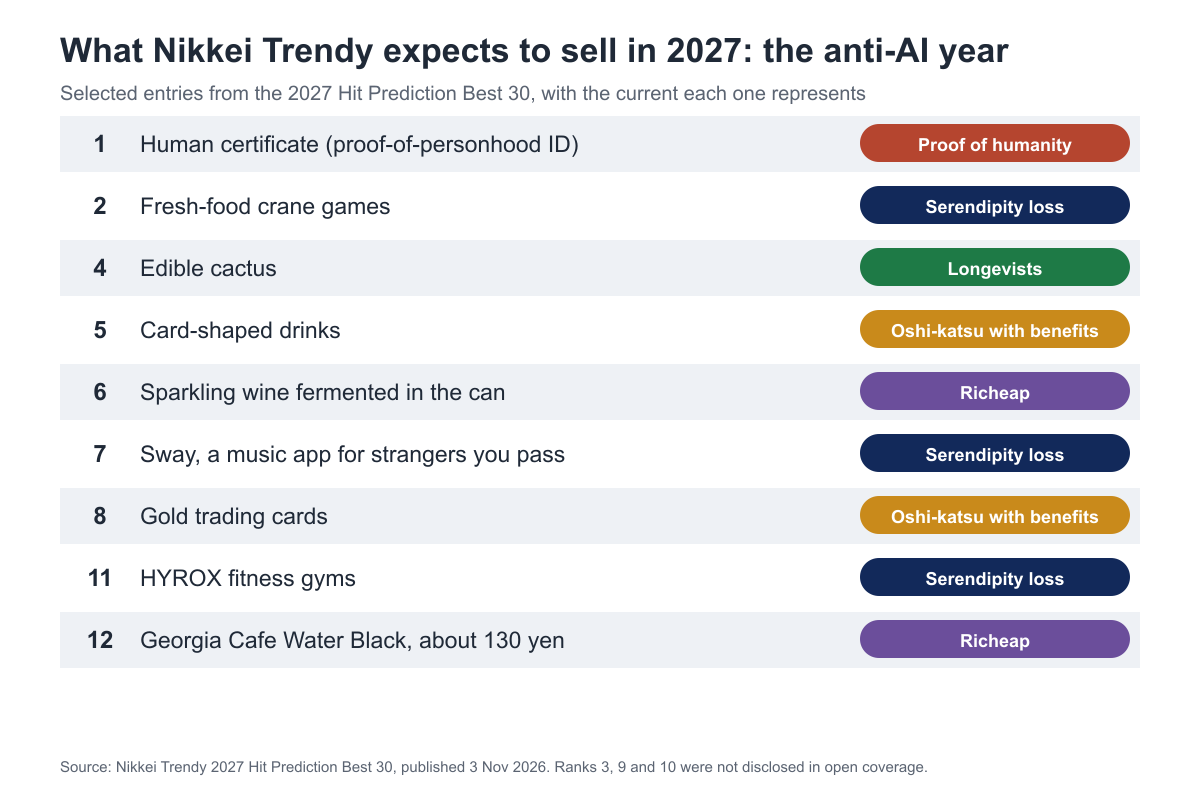
Its presence is also a setup for the magazine’s companion list, the 30 predicted hits for 2027, published on the same day. The theme of that list is, in the magazine’s own words, “anti-AI”. The predicted number-one hit for 2027 is the “human certificate”, technologies that prove the person on the other side of a screen is a person, with the iris-scanning World ID and an implanted NFC chip service called I’m HUMAN given as examples. The editors identify five currents: proof of humanity; “serendipity loss”, a hunger for chance encounters in a world where algorithms arrange everything; “longevists”, people who care less about living long than about staying healthy and attractive; “richeap”, a portmanteau of rich and cheap for products that are inexpensive but have a distinctive value; and “oshi-katsu with benefits”, fan spending that also returns something tangible.
The predicted list includes a crane game stocked with fresh food at number two, an edible cactus at four, card-shaped drinks at five, sparkling wine fermented in the can at six, a music app called Sway that shares songs with strangers you pass in the street at seven, gold-plated trading cards that combine a character licence with the asset value of bullion at eight, HYROX fitness gyms at eleven, and a coffee-flavoured water from Coca-Cola’s Georgia brand priced around 130 yen at twelve. The magazine notes that spending per fan on oshi-katsu is high but that the number of fans has plateaued, which is why “with benefits” matters.
I take two things from this. One is that the editors expect pocket consumption to continue, under a new name, in 2027. “Richeap” is pocket consumption with better branding. The other is that the same magazine that put an AI agent in its top ten is betting that the next wave of hits will be about escaping, or at least verifying, the machines. Those two ideas are not in conflict. They are the same consumer, using AI at work and paying for something unmistakably human on the weekend.
What International Operators Should Take From a ¥300 Winner
I have sat in enough meetings with foreign brands planning a Japan launch to know how this list will be received. The premium brand will say the list proves Japanese consumers are too price-sensitive. The mass brand will say it proves they are not. Both will miss what the ranking actually shows, which is a very specific set of conditions for a hit in 2026 and, probably, 2027.
The winning unit is small, not cheap. A 300-yen charm is not a discount product. It is a full-price product in a category where 300 yen is the price. The capsule-toy market grew 39 percent last year while raising its mainstream price point to 400 and 500 yen. Consumers are not refusing to spend; they are refusing to spend a lot at once. If your product cannot be bought on impulse at a convenience store, a station kiosk or a vending machine, think about whether a version of it could be.
Character licences do the heavy lifting. Three of the top three hits and the biggest film of the year all run on licensed characters. Japan’s character economy is the deepest in the world, and the marker charm shows how a licence can turn a commodity, a silicone ring, into the product of the year. Foreign brands that treat character collaborations as a marketing afterthought are leaving the main engine of Japanese retail unused.
Randomness and swapping create repeat purchase. The charm, the sticker and the capsule format all share a mechanic: you do not fully control what you get, and the gaps in your collection are filled by trading. The same mechanic is behind the “blind box” boom that Pop Mart rode to global fame with Labubu. It is worth noting that Pop Mart’s first-half 2026 results showed revenue from the Labubu family falling 7.5 percent and sales in the Americas down 16.5 percent even as the company nearly doubled its US store count. Japan’s version of the trend is cheaper, more local and, so far, still growing.
Platforms can become hits. TikTok Shop at number two is a reminder that in Japan the channel can be the story. A brand that arrives with a TikTok Shop plan and a creator roster will find a market that has already decided the format is legitimate. A brand that arrives expecting Rakuten and Amazon to do all the work will find the attention has moved.
Watch the keyword, not the product. Nobody will sell marker charms in 2027; that market is Bandai’s. But “pocket consumption”, “dopa-katsu” and “richeap” are briefs that any category can answer. The question to ask of your Japan line-up is whether it contains something a tired, price-conscious, character-loving consumer can buy without thinking and feel good about afterwards.
Frequently Asked Questions
Q. What is Nikkei Trendy, and how is the ranking decided?
A. Nikkei Trendy is a monthly consumer magazine published by Nikkei BP, part of the Nikkei group. Its “Hit Products Best 30” has been published every autumn for decades and is announced in the December issue, this year on 3 November 2026. The editors rank products and services launched between October 2025 and September 2026 on three criteria: sales performance, novelty and influence. It is an editorial judgement, not a sales chart, and it is published alongside a separate list of 30 predicted hits for the following year.
Q. Where can I buy a mejirushi charm, and how much does one cost?
A. They are sold mainly through capsule-toy vending machines in Japanese shopping malls, stations and the country’s more than 900 dedicated capsule-toy shops, usually for 200 to 300 yen a turn, with the character inside chosen at random. Official versions from Bandai and other makers also appear in character shops and at events. Outside Japan, a limited selection of capsule-toy charms is available on Amazon through importers, usually at several times the Japanese price.
Q. Is TikTok Shop in Japan the same service as in the United States?
A. Functionally yes: it lets users buy products directly from videos, live streams and a shop tab inside the TikTok app. The difference is scale and context. Japan’s service launched on 30 June 2025 and reached about 65.5 billion yen in transaction value in nine months, while the US business is estimated at about 15 billion dollars for 2025. In the United States the app’s ownership passed to a US-led joint venture in January 2026 after a long political dispute; in Japan there has been no comparable debate.
Q. Why did a tool like Claude Code make a consumer hit list?
A. The editors included it because 2026 was the year that handing a task to an AI agent and having it completed automatically became something ordinary workers in Japan started doing, not only software developers. Japan’s shortage of engineers makes a tool that produces working code from plain instructions unusually valuable. Its inclusion also frames the magazine’s prediction that 2027’s hits will revolve around proving and protecting what is human.
Q. What were the number-one hits in previous years?
A. In 2025 the top spot went to Expo 2025 in Osaka and its mascot Myaku-Myaku, which drew more than 25 million visitors, followed by the film Kokuho and the Nintendo Switch 2. The editors described 2025 as a year of “maximising experiences” and “logical consumption”. The shift from a 25-million-visitor expo to a 300-yen charm in one year is the clearest sign of how household budgets in Japan have tightened.
Conclusion
Nikkei Trendy’s 2026 list is a portrait of a country that has not stopped wanting things, but has changed the size of the things it wants. The biggest hit of the year is a 300-yen charm that shipped 120 million units. The second is a shopping platform that turns a video into a purchase in a tap. The third is a sticker. Further down sit a cold cup noodle that sold two months of stock in a week, a paddle sport that grew sevenfold and an AI coding agent. The editors call it pocket consumption, and they expect it to continue in 2027 under the banner of “richeap”, alongside a predicted backlash in favour of anything verifiably human.
For international operators, the lesson is not that Japan has become a discount market. It is that the unit of a Japanese hit has shrunk to something that fits in a pocket, and that the winners combine a low price with a character, a collectible mechanic and a small, reliable feeling of reward. The companies that will do well in Japan next year are the ones that can answer that brief without diluting what makes them worth buying in the first place.
If you’re interested in this topic, the Japanese market more broadly, or what KETCHUPs is working on, we’d love to hear from you — please reach out via our contact form.
Japan Market Pulse is a weekly read on what the Japanese consumer-tech, food, and mobility markets are choosing to do, written for international operators who want to know what is happening before it shows up in the global trade press.
Subscribe at ketchups.co/japan-market-pulse.