
Campaign Teardown · Makuake
LOOI: ¥79.2M Raised, Without Going Viral
LOOI generated almost no organic buzz on its way to becoming the largest single-platform crowdfunding result in its maker’s history. Here is what actually carried the campaign.
The campaign
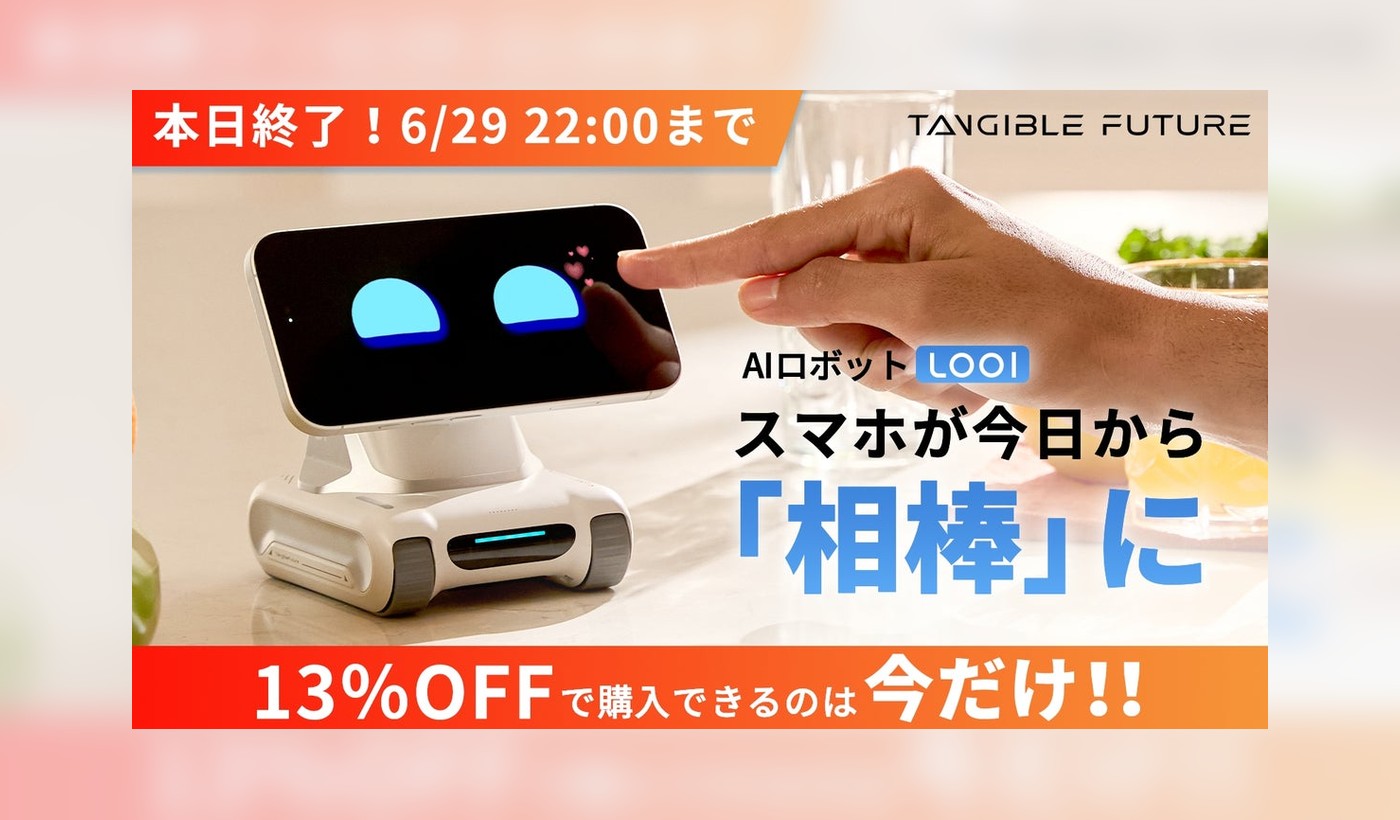
LOOI is a desktop AI robot that turns a spare smartphone into its head, pairing 12 onboard sensors with ChatGPT/Gemini connectivity, MagSafe charging, and multilingual voice support. It was developed by TangibleFuture (HK) Limited, based in Dongguan, China, and built on the XbotPark hardware-accelerator network. The company had already raised US$518,838 from 3,578 backers on Kickstarter in early 2024 and a further ~US$129,292 via an Indiegogo InDemand extension.
Its Japan debut ran on Makuake from April 28 to June 29, 2026 — 62 days, All-in funding, executed by MadSpace Japan, one of Makuake’s eight Global Official Partner agencies for overseas hardware brands. Against a nominal goal of ¥300,000, the campaign closed at ¥79,177,200 from 3,340 backers, a funding rate of 26,392% and an average pledge of ¥23,706. It stands as the largest single-platform crowdfunding result in TangibleFuture’s history.
The funding curve is front-loaded. Same-day reporting put the total at ¥7.38 million by the evening of April 28 (367 backers), and by 4:30pm on April 30 — three days in — the project had passed ¥30 million with roughly 1,500 backers, or about 38% of the eventual total. A second, calmer phase (May 1–June 17) added roughly ¥39 million across 48 days at a fairly steady daily pace, and a final 11-day sprint (June 18–29) added a further ¥10.18 million after a price-anchoring announcement described below.
Verified against the published total, 67.4% of all revenue came from just two uncapped tiers — a 24-hour, 33%-off flash price (¥19,800, 1,267 backers) and a standing 13%-off “Makuake exclusive” price (¥25,800, 1,095 backers). The capacity-limited early-bird tiers (300 and 500 units, sold out) contributed a combined 22.3%, and multi-unit bundles made up under 10%. The scarcity-limited tiers signaled urgency; the uncapped tiers carried the sales.
The acquisition funnel
Pre-launch activity started roughly six weeks out: Japanese-language Instagram, X, and Facebook accounts opened in mid-March, followed by two teaser posts (March 18 and 20) driving to a now-defunct Wix landing page, looirobot-jp.com. In the same window, TangibleFuture seeded review units to a shortlist of YouTubers and bloggers under embargo, and issued a ¥1,000-off coupon code (“LOOI_1000”) to TikTok creators ahead of launch day. No LINE official account or email opt-in list was built during this period — the pre-launch phase relied on direct social posts and seeded content rather than an owned list.
Launch day (April 28, 11:00) was engineered for simultaneity: the Makuake page went live with the 24-hour flash price, a PR TIMES release went out under TangibleFuture’s name, Makuake’s own official X account (@makuake_ca) reposted the launch, and five YouTube tie-up videos and several PR blog posts published within hours of each other. By 15:10 the same day, ASCII.jp had independently reported the project past ¥7 million raised — a story that was subsequently picked up by Yahoo! News, converting a same-day funding milestone into a second wave of press exposure.
YouTube carried the heaviest weight of the paid-media plan: 15 tie-up videos in total (one Shorts video was only discovered later, referenced in a June 18 activity report), with 12 of the 15 explicitly disclosing paid promotion. Combined views were roughly 385,000. Five videos launched simultaneously on day one, followed by a wave pattern at roughly one-to-two-week intervals through mid-June (May 2, 4, 11, 16, 26; June 2, 14) — a cadence that lines up with the steadier mid-campaign funding pace. View counts did not track subscriber counts: a channel with 2.07 million subscribers produced only 8,010 views, while a channel with 5,680 subscribers produced 31,363. The best-performing video, from a creator with 406,000 subscribers, drew 168,924 views on June 2 and credited “提供: MadSpace Japan” directly in its description — the clearest evidence the agency, not the brand or individual creators, was driving the casting.
A second, smaller influencer channel surfaced only in a June 24 activity report: three Instagram family/parenting creators whose posts framed LOOI as a family-friendly companion rather than a gadget-reviewer product. This Instagram track ran in parallel with, but separately from, the YouTube gadget-channel program, and appears timed to support a “family” narrative pushed in the same period’s activity reports.
What the numbers tell us
Across the full 62-day run, 25 external references to the campaign could be confirmed. Most of the visible demand was not broad organic virality; it was a deliberately assembled surface area of press syndication, seeded reviews, platform visibility, and paid creator distribution.
- Five YouTube tie-up videos launched on day one, with further creator waves continuing through mid-June.
- The strongest revenue concentration came from two uncapped reward tiers, which together accounted for 67.4% of the verified funding total.
- The final sprint was supported by a retail-price anchoring announcement that reframed the Makuake price as a steeper discount.
Structured like an executive launch dashboard: audience asset, offer window, and conversion proof are separated for diagnosis.
The takeaway for overseas brands
The most transferable lesson from LOOI is that a campaign can reach this scale in Japan with almost no owned audience and almost no organic virality, provided every visible surface is deliberately paid or borrowed. TangibleFuture entered Japan with under 700 combined followers on its dedicated accounts; MadSpace Japan compensated with a same-day, multi-channel unlock (press release, platform repost, five simultaneous videos, a time-limited price) and a steady drip of further paid tie-ups over the following two months. For a brand without an existing Japanese following, this points to media-buying and seeding discipline — not slow community-building — as the reproducible lever.
Reusing overseas pricing data also mattered: the ¥19,800–25,800 core price range roughly matched the brand’s 2024 Kickstarter early-bird pricing (US$119–129), and the late-campaign retail-price increase was pegged to the product’s actual US retail price rather than an arbitrary figure — a detail that likely matters if a similar move is scrutinized under Japan’s fair-pricing display norms.
The model has real limits worth flagging. No email or LINE list survived the campaign, so post-campaign retail conversion depends entirely on Makuake’s own messaging channel rather than an owned audience the brand can re-target. For brands weighing a Japan crowdfunding launch, the LOOI case argues for budgeting 12–15 paid video/blog tie-ups, planning a single coordinated launch-day unlock rather than a slow rollout, and reserving the heaviest reporting cadence for the final two weeks.
Source: KETCHUPs Inc. primary-source analysis of the Makuake project page, activity reports, PR TIMES releases, and YouTube/Instagram tie-up data (campaign period Apr 28 – Jun 29, 2026).
Planning a launch in Japan?
Tell us about your product and we will come back within 48 hours with an honest read on its fit for the Japanese market – including what comparable campaigns have done.