

On 1 October 2026, Torikizoku, the yakitori chain built on one promise, that every skewer, drink and side costs the same, moved its single price from 390 yen to 410 yen. Measured before tax, the menu that cost 280 yen until September 2017 now costs 373 yen, about a third more. The chain still grew sales by more than 10 percent in the fiscal year to July 2026, yet its operating profit fell by roughly a tenth. For anyone running a subscription, a flat-fee menu or a “one price” format, Torikizoku is the best live case study in Japan of what happens when the price is the brand.
If you have eaten in Tokyo, Osaka or Nagoya on a budget, you have probably seen the sign: a bright red and yellow storefront on the second or third floor of a nondescript building, with a menu where nothing has a price tag because everything has the same one. For nearly 30 years, that one price was 280 yen before tax, which at the time was a little over two US dollars for a plate of two skewers, a highball or a salad.
On 1 October 2026 at 9:00 a.m., the uniform price at every Torikizoku store in Japan became 410 yen including tax. The all-you-can-eat-and-drink banquet course, called Toriki Banquet, rose from 3,900 yen to 4,100 yen. The operator, Eternal Hospitality, announced the change on 10 September, citing higher costs for domestic chicken and vegetables, labour and energy.
A 20-yen change, roughly 13 US cents, is hardly newsworthy on its own. What makes it worth a close read is the structure around it. Torikizoku is not a restaurant that happens to have a flat price. It is a restaurant whose entire operating model, from purchasing to kitchen design to the way a table orders, was built around a single number. Every time that number moves, the chain has to ask whether it is still the same brand.
This article looks at the price ladder, the one time it went badly wrong, what the latest results say about the model, and what international operators can take from a Japanese chain that sells certainty as much as chicken.
What Happened: 390 Yen Becomes 410 Yen
The facts of the latest change are straightforward. According to the company’s notice, from Thursday 1 October 2026 the price of every food and drink item rises from 390 yen to 410 yen including tax. Before tax, that is 355 yen going to 373 yen. Takeout items follow the same headline price of 410 yen. The Toriki Banquet course goes from 3,900 yen to 4,100 yen including tax.
The company gave two kinds of reasons. First, the cost of running a store keeps climbing: domestic chicken, vegetables and other raw materials, labour and energy are all more expensive than they were. Second, it said the increase is needed to maintain quality and service. It also pointed to its cost-reduction work, including operational improvements, revised purchasing and reduced food loss, and noted that all of its ingredients have been sourced in Japan since 2016.
The previous change was in May 2025, when the price went from 370 yen to 390 yen. That means the chain moved its price twice in about 17 months. For a company that once held a single price for 28 years, the pace has changed dramatically.
The announcement landed in a wider wave of price increases across Japan’s food sector. Teikoku Databank, as reported by Kyodo, counted more than 20,000 food and beverage items with announced price increases for calendar 2026 as of the end of September, the second year in a row above that mark. Torikizoku’s move is part of that picture, but its meaning is different from a supermarket raising the price of a soy sauce bottle. When a store with a flat price changes the number, every item on the menu changes at once.
Six Increases in Nine Years: The Price Ladder
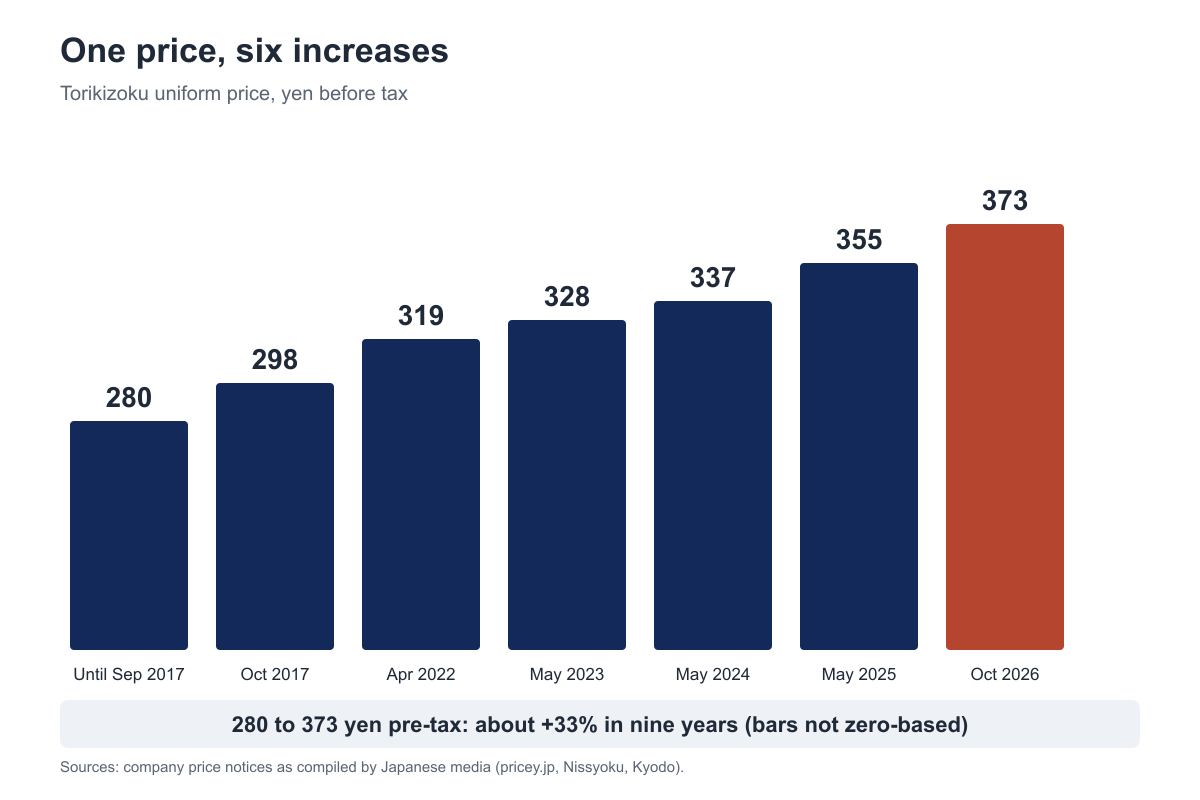
To see how far the chain has come, it helps to put the whole ladder in one place. The tax-included prices below are drawn from the company’s published price notices as compiled by Japanese media, and the 2017 figure converts the pre-tax price at today’s 10 percent consumption tax for comparison.
| Effective date | Tax-included price | Pre-tax price | Change | |—|—|—|—| | Until September 2017 | about 302 yen | 280 yen | — | | October 2017 | about 327 yen | 298 yen | +18 yen pre-tax | | April 2022 | 350 yen | 319 yen | +23 yen | | May 2023 | 360 yen | 328 yen | +10 yen | | May 2024 | 370 yen | 337 yen | +10 yen | | May 2025 | 390 yen | 355 yen | +20 yen | | October 2026 | 410 yen | 373 yen | +20 yen |
Two things stand out. The first is the long silence followed by a rapid sequence. From 1989 to September 2017, the chain kept the same pre-tax price despite the end of Japan’s long deflation era, rising wages in food service and consumption-tax changes. Since the first increase in 2017 it has changed the price five more times. Five of the six changes have come since April 2022.
The second is the size of the cumulative move. On a pre-tax basis, 280 yen to 373 yen is an increase of about 33 percent over nine years. On the tax-included basis most customers actually see, from roughly 302 yen to 410 yen, it is about 36 percent. Torikizoku has, in other words, been catching up with cost pressure that it absorbed for years.
Notice also how the increments have changed. The early steps were small, between 10 and 23 yen pre-tax. The last two are each 20 yen tax-included, which is now about 5 percent per step. Smaller, regular steps are a deliberate choice: each one is easy to explain, and none of them breaks a psychological threshold the way a jump from 298 to, say, 350 yen would have.
The 2017 Shock: When 280 Became 298
To understand why a 20-yen change is carefully managed, you need to go back to the one time the chain got it wrong.
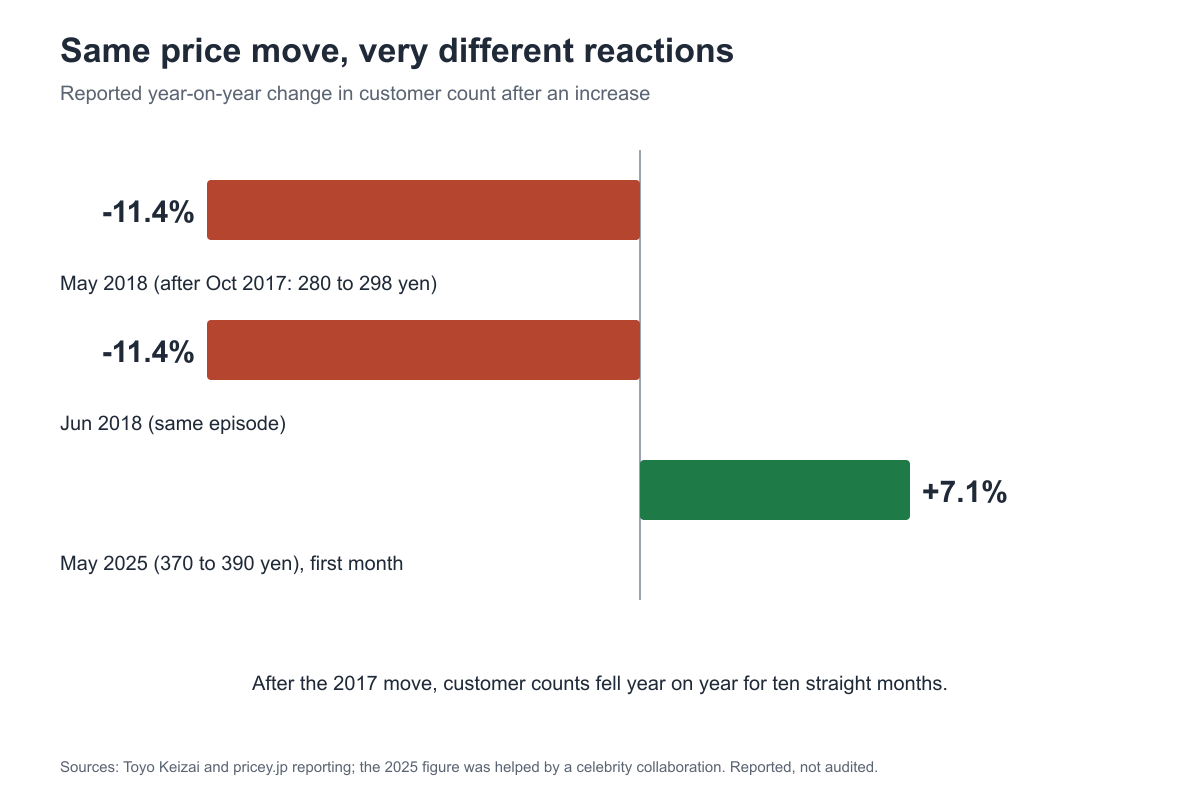
In October 2017, Torikizoku raised its price from 280 yen to 298 yen before tax, its first increase in about 28 years. The 18-yen move looked modest. Customers did not treat it that way. Japanese business media reported that same-store customer counts fell year on year for ten months in a row, a stretch that analysts nicknamed the “Torikizoku shock”. In 2018, the declines in May and June were each reported at around 11 percent.
The reason was not the size of the increase. It was what the old price meant. “Everything is 280 yen” was not a price, it was a slogan. It told families, students and office groups that they never had to look at the menu or do arithmetic. The moment the number changed, many customers who had thought of Torikizoku as the one place they could order without thinking started to compare it with cheaper competitors and with the supermarket aisle. Analysts at the time pointed to families and customers in their forties and older as the groups who drifted away.
There is a second lesson in the 2017 episode. The brand did not collapse. It recovered, and in the years since it has shown that the flat-price promise can survive higher numbers as long as customers still feel they are getting more than they pay for. But it took time, and the chain had to rebuild the case for value menu item by menu item, through portion size, quality and promotions.
Why Uniform Pricing Is a Brand, Not a Menu Choice
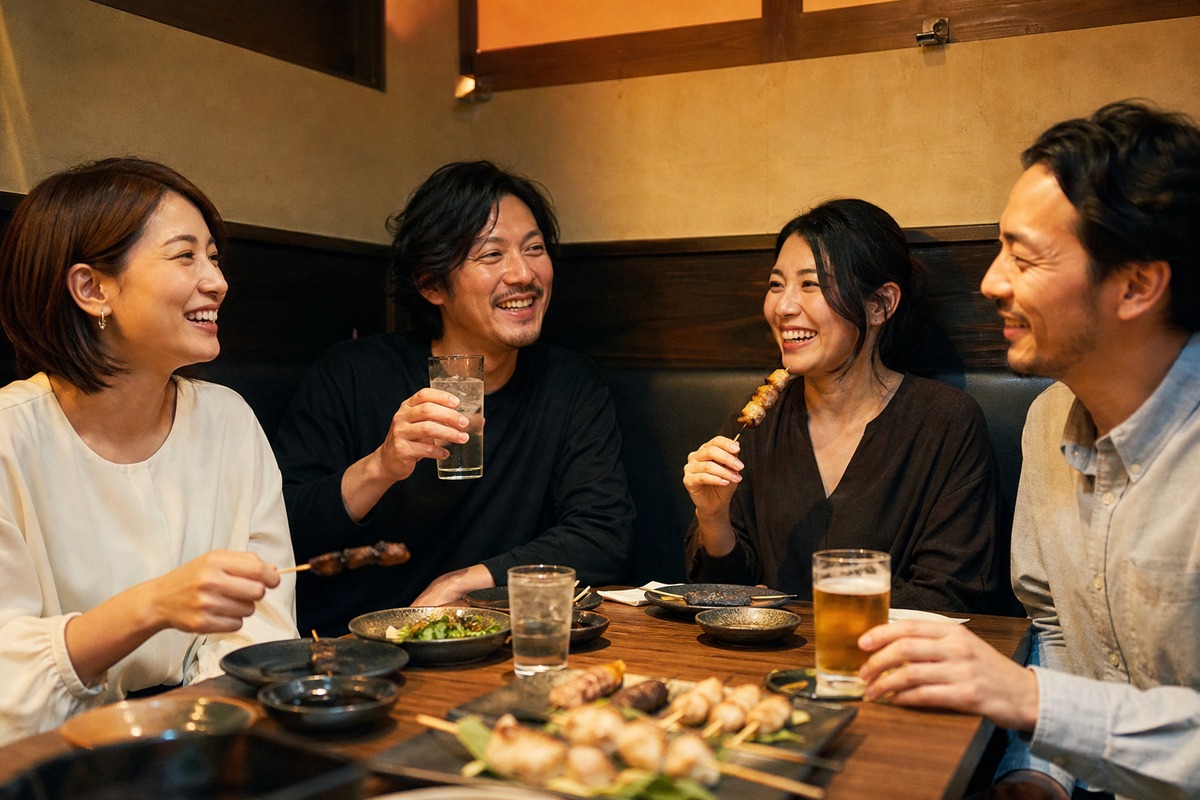
Most restaurants set the price of each dish according to what it costs to make and what the market will bear. Torikizoku sets one price and then designs everything else to fit inside it.
That has three practical consequences.
Purchasing drives the menu. With a single price, the chain cannot sell a premium dish at a high margin to cross-subsidise cheap ones in the usual way. Instead, the menu is built around ingredients whose costs sit within a narrow band, and the chain relies on volume buying, domestic sourcing and fresh chicken delivered daily and skewered in the store to hold quality at that price. The company has said it has sourced its ingredients in Japan since 2016, which matters because it removes the exchange-rate risk that has hit many importers, though it exposes the chain to Japanese chicken and vegetable prices.
The format is built for low rent and low labour. Torikizoku stores are typically on upper floors, where rent per tsubo is much lower than at street level. The kitchen produces a limited, standardised set of items, which keeps staffing lean. The company’s own investor materials describe a “dominant” strategy of clustering stores in a given area to improve delivery and management efficiency.
The customer’s decision is simplified. Because there is no price on the menu, the customer’s mental calculation is not “can I afford this dish” but “can I afford this evening”. That is a powerful form of friction removal. It is also why a price change feels more like a change of terms than a change of a single number.
International operators will recognise the pattern from other flat-price models: Netflix-style subscriptions, all-you-can-eat formats, “everything is 99 cents” retailers, and the Japanese 100-yen shop. In all of them, the price is the product. And in all of them, the owner faces the same problem: costs do not stay flat, so the price has to move, and every move risks reminding customers that they are paying.
The Cost Squeeze: Chicken, Vegetables and Wages
The three cost lines the company cited, ingredients, labour and energy, are the same three that have pushed prices up across Japan’s restaurant sector.
Ingredients are the most visible. Teikoku Databank’s tally of more than 20,000 food and beverage price increases in 2026 reflects higher costs for raw materials, logistics, packaging and energy, with a weaker yen and elevated oil prices cited in coverage as contributing factors. A chain that buys domestic chicken is protected from the currency effect directly, but not from feed costs, which are heavily import-dependent, or from labour and transport costs that sit behind every delivered box.
Labour is the second pressure. Japan’s minimum wage has been rising by record amounts, and restaurants compete for part-time staff with convenience stores, logistics firms and drugstores. A chain with hundreds of stores and a standardised menu is better placed than most, but it cannot avoid wage inflation, especially in major cities.
Energy, from gas for grills to electricity for refrigeration, is the third. Yakitori is a grill-heavy business, and the cost of heat is not something a kitchen can design away.
These are the same pressures facing every izakaya, ramen shop and family restaurant in the country. What makes Torikizoku different is that it can only answer them with one number. A conventional restaurant can raise the price of the three items customers care least about, shrink a portion or swap an ingredient. A uniform-price chain has to move everything together, or change what the price buys.
The Numbers: Higher Sales, Thinner Profit
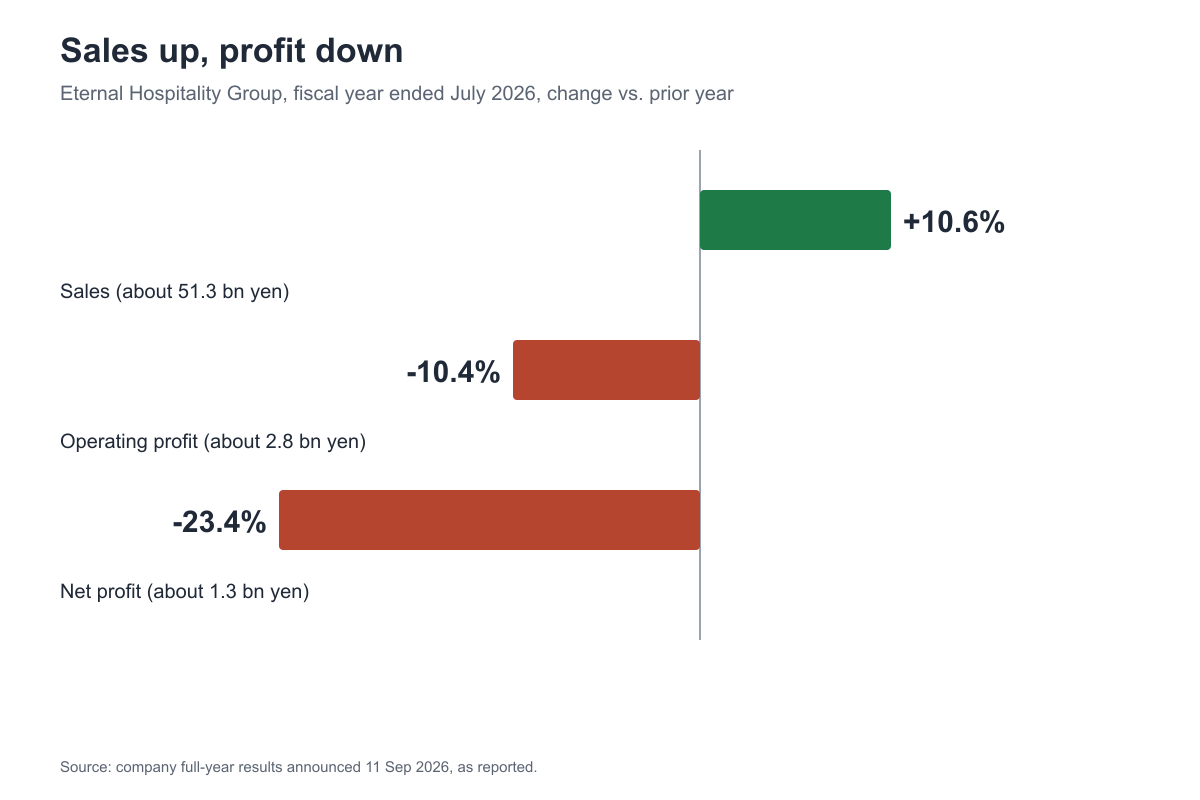
The company’s latest results show how tight the squeeze has become. In its fiscal year ended July 2026, Eternal Hospitality Group reported sales of about 51.25 billion yen, up 10.6 percent from the previous year, together with operating profit of about 2.80 billion yen, down 10.4 percent, and net profit of about 1.32 billion yen, down 23.4 percent. Sales and profit both fell short of the company’s own forecasts of about 52.8 billion yen and 3.43 billion yen respectively. The company attributed the gap to new openings, in Japan and overseas, that fell below plan, together with opening costs concentrated in the fourth quarter and higher selling and administrative expenses, including labour.
On the demand side, the picture is healthier than the profit line suggests. For the full year, same-store sales at directly operated Torikizoku restaurants in Japan were about 106.7 percent of the previous year, with customer counts at roughly 103.8 percent and spend per customer at about 102.8 percent. In other words, most of the growth came from more people through the door rather than from higher prices, which is exactly what a flat-price chain wants to see. Monthly data are more mixed: customer counts slipped to around 97.4 percent in June before recovering to about 102 percent in July.
At the end of July 2026, the Torikizoku brand had 695 stores in Japan, of which 424 were directly operated and 271 were operated by franchise partners. Reports vary slightly in how they count group-wide stores, so it is worth checking the company’s monthly figures before quoting a number.
The pattern is the classic cost-push squeeze. Revenue grows because the chain is opening stores and price increases lift the average ticket, but costs rise slightly faster, so profit shrinks. The 410-yen price, set at the beginning of the new fiscal year, is meant to restore the margin without losing the customer count. Whether it does will show up in the monthly same-store data for the autumn, which the company publishes each month.
One caveat on the evidence: the first full-month effects of the most recent increase are not yet available at the time of writing, and customer response to earlier steps has varied. After the May 2025 increase from 370 to 390 yen, one media analysis reported first-month same-store customer counts at about 107 percent of the previous year, helped by a high-profile celebrity collaboration. That shows an increase need not cost customers when it is paired with a strong promotion, but it is a single data point and not a rule.
Going Abroad: A Yakitori Chain at S$3.90
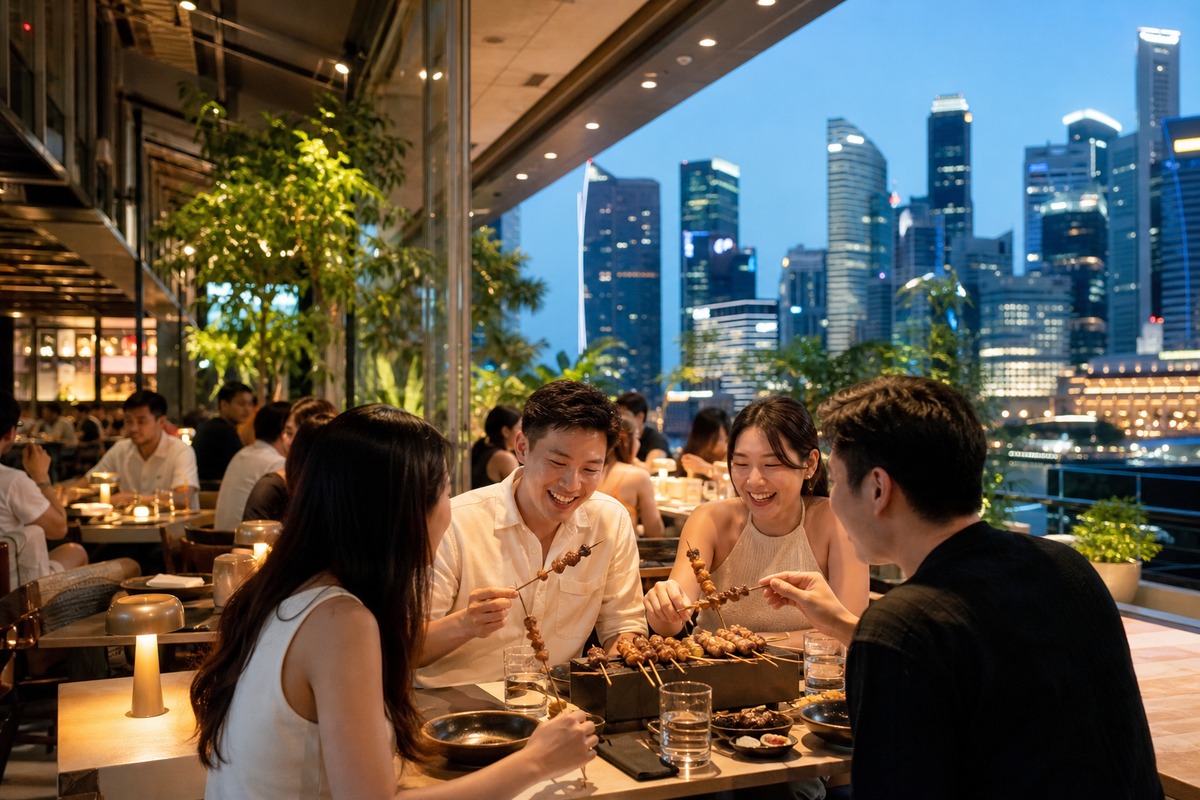
While the price rises at home, the chain is also looking overseas. In 2026, Torikizoku opened an outlet at VivoCity in Singapore, run by Gohan Concepts, a joint venture between the retail cooperative FairPrice Group and the food and beverage operator BHAG. Local coverage reported that most regular dishes were priced at S$3.90 each (alcohol and the kids’ menu reportedly sit outside the flat price), plus the usual service charge and tax, and the outlet opened with promotional pricing. That is close to 410 yen at recent exchange rates, although the figures are not directly comparable and the opening offer may not be permanent.
The point for international readers is not the exact Singapore price. It is the model. Torikizoku is exporting a flat-price concept to a market where the customer is used to paying separately for each dish, and where rent, labour and ingredient costs are all different from Japan’s. The chain has to decide whether the one-price promise travels, whether the price should be set at the local equivalent of the Japanese one, and how it will adjust when costs move.
The company’s own explanation of its Japanese increases suggests how that conversation will go. The price is the headline, but what customers actually buy is a feeling that the evening will not cost more than they expected. Overseas, where that feeling has to be built from zero, a single price can be a powerful way of introducing a new category. It is also a commitment that gets harder to keep every year.
What International Operators Should Take From This
Torikizoku’s record is useful for any business that sells on a simple, memorable price. Here are five practical lessons.
1. Raise the price in small, regular steps before the gap becomes a cliff. The 2017 increase came after 28 years of silence, and the shock was large. The later steps, every year or so, have been small and predictable. If your costs are rising, a series of 4 to 6 percent moves is usually easier on customers than one 20 percent move.
2. Explain the increase in the customer’s terms. The company’s notice names chicken, vegetables, labour and energy, which are all things customers read about in the news. It also names what it has done to hold costs down. A clear, specific explanation does not remove the pain, but it shifts the question from “are they greedy” to “is this fair”.
3. Protect the thing that makes the price feel like a deal. Torikizoku’s real promise is not “410 yen”. It is “you will not have to think about it, and the food will be good”. That is why the chain emphasises domestic ingredients, daily fresh chicken and in-store skewering. When the number changes, those quality signals are what keep the brand stable.
4. Watch customer counts, not just revenue. The headline figures in the latest results look healthy, with sales up more than 10 percent. The warning sign is in the details: profit down, and monthly customer counts that dip below the prior year. A price increase that lifts revenue while quietly shrinking the number of visits is a loan against the future.
5. Decide in advance what you will do if the flat price breaks. Torikizoku could, in theory, introduce a second tier, shrink portions or add a premium menu. So far it has chosen to keep the single price and raise it. Any business built around a flat fee should know which of those levers it will pull first, and which would break the brand.
Frequently Asked Questions
Q. How much does Torikizoku cost now?
A. Since 1 October 2026, every food and drink item at Torikizoku restaurants in Japan costs 410 yen including tax, or 373 yen before tax. Takeout items are also 410 yen, and the Toriki Banquet course is 4,100 yen including tax, up from 3,900 yen. The previous price of 390 yen had been in place since May 2025.
Q. Why did Torikizoku raise its price?
A. The operator said that the costs of running its stores, including domestic chicken and vegetables, other raw materials, labour and energy, have kept rising, and that the increase is needed to maintain quality and service. It also described its efforts to reduce costs through operational improvements, revised purchasing and less food waste.
Q. How has the price changed over time?
A. The chain held a pre-tax price of 280 yen for about 28 years until September 2017, then moved to 298 yen. Tax-included prices since 2022 have been 350 yen in April 2022, 360 yen in May 2023, 370 yen in May 2024, 390 yen in May 2025 and 410 yen in October 2026. That is six increases in nine years.
Q. Did the 2017 increase hurt the chain?
A. Yes. Japanese media reported that same-store customer counts fell year on year for ten consecutive months after the October 2017 increase from 280 to 298 yen, with declines of around 11 percent in May and June 2018. The brand recovered and has since raised prices several times, though the episode is still cited as a warning about changing a flat price.
Q. Is Torikizoku growing outside Japan?
A. The company has been expanding overseas, and in 2026 a Singapore outlet opened at VivoCity under a joint venture between FairPrice Group and BHAG. Reports put most regular dishes in Singapore at S$3.90. The company’s latest annual results said new openings in Japan and overseas had fallen below plan, so the pace of expansion is something to watch.
Conclusion
A 20-yen price change at a yakitori chain is a small event in Japan’s economy. It is a large event for a brand whose identity is a single price.
Torikizoku’s history since 2017 shows both the risk and the resilience of that model. The chain stumbled when it first broke a 28-year promise, then rebuilt the argument for value and moved the price six times without losing the core idea. Its latest results show a company still growing, with more customers and more stores, but under pressure to protect margins in a cost environment that will not wait.
For international operators, the lesson is not about chicken. It is that a simple price is a promise, and a promise can be updated, as long as the update is small, explained and backed by the same quality the customer already believes in. The next test will be the monthly customer-count data this autumn. If visits hold up at 410 yen, Torikizoku will have shown that Japanese consumers will accept a steadily rising flat price from a brand they trust. If they do not, the 2017 shock may have a sequel.
If you’re interested in this topic, the Japanese market more broadly, or what KETCHUPs is working on, we’d love to hear from you — please reach out via our contact form.
Japan Market Pulse is a weekly read on what the Japanese consumer-tech, food, and mobility markets are choosing to do, written for international operators who want to know what is happening before it shows up in the global trade press.
Subscribe at ketchups.co/japan-market-pulse.