

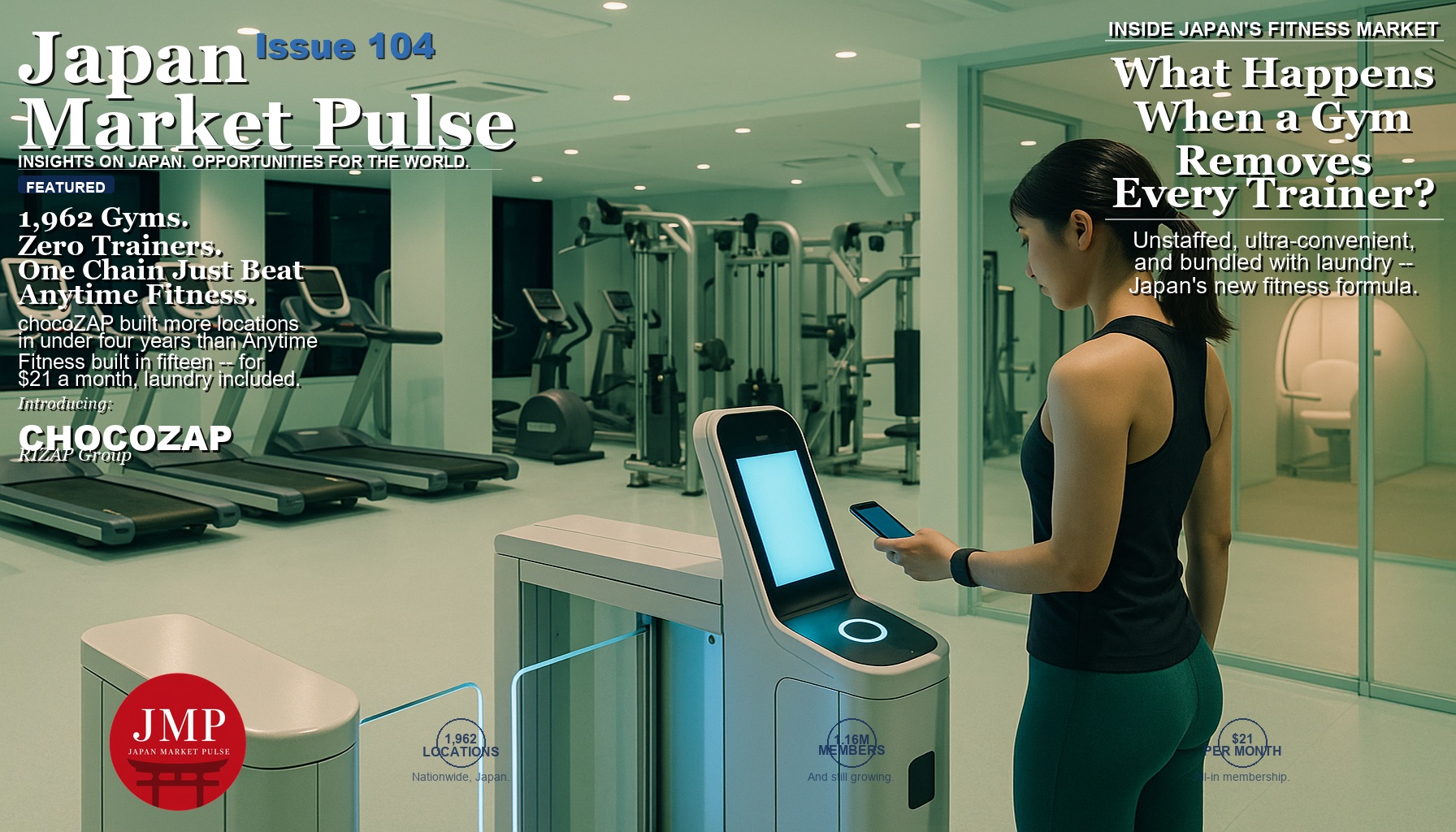
There are roughly 1,962 of them across chocoZAP’s markets as of this past spring, the vast majority of them in Japan. Add roughly five new stores a week, and you get a sense of how fast the number keeps climbing. None of them have a front desk. None of them have a personal trainer waiting to correct your squat form. A meaningful share of them will happily do your nails, dry your laundry, or hand you a microphone for twenty minutes of karaoke before you’ve touched a single weight. And in three years, this chain — chocoZAP, run by the same RIZAP Group that once built its entire brand on intense, expensive, before-and-after personal training — has grown into something Anytime Fitness, the American franchise giant that has been building gyms in Japan since 2010, has not managed to become: one of Japan’s largest fitness chains by membership, based on the roughly 1.16 million members chocoZAP reported as of May 2026 — a figure that, at the time, RIZAP’s own comparison materials described as the domestic lead, though Anytime Fitness Japan has since reported crossing 1.2 million members of its own in August 2026.
I have lived in Japan for two decades, long enough to have joined and quit three different gyms out of guilt rather than genuine intent, and long enough to recognize a distinctly Japanese business instinct when I see one. That instinct says: don’t ask people to change their behavior — change the cost of doing the thing you want them to do until it’s cheaper than not doing it. Convenience stores did this with food. chocoZAP is doing it with fitness. And the numbers suggest it’s working on a scale that should make every gym operator outside Japan sit up and take notice.
This is a story about a health club that barely markets itself as a health club, a household American franchise name that’s losing ground on its own turf, and a Japanese business model that has now quietly opened outposts in Hong Kong, Taiwan, Singapore, and — as of this past June — Malaysia. It’s also, if you squint, a story about what happens when a country with brutal labor shortages and a deep cultural aversion to being sold to builds a gym for people who don’t actually want to go to the gym.
The Numbers Behind One of Japan’s Biggest Gym Chains You’ve Never Heard Of
Let’s start with the scoreboard, because it’s the part that tends to surprise people who don’t follow Japanese retail.
chocoZAP — the name is a portmanteau of the Japanese word *chokotto* (“a little”) and RIZAP, evoking a small, easy step rather than an intense commitment — launched in the summer of 2022 as a spinoff of RIZAP, the personal-training brand famous in Japan (and briefly, via awkward late-night infomercials, in the United States) for dramatic weight-loss transformations backed by punishing, expensive coaching contracts. chocoZAP was built to be the opposite of that in almost every way: no trainers, no contracts that require a guarantor, no intake interview, no shame. Just an app-based QR check-in and a room full of equipment you can use whenever you want, 24 hours a day, 365 days a year at most locations.
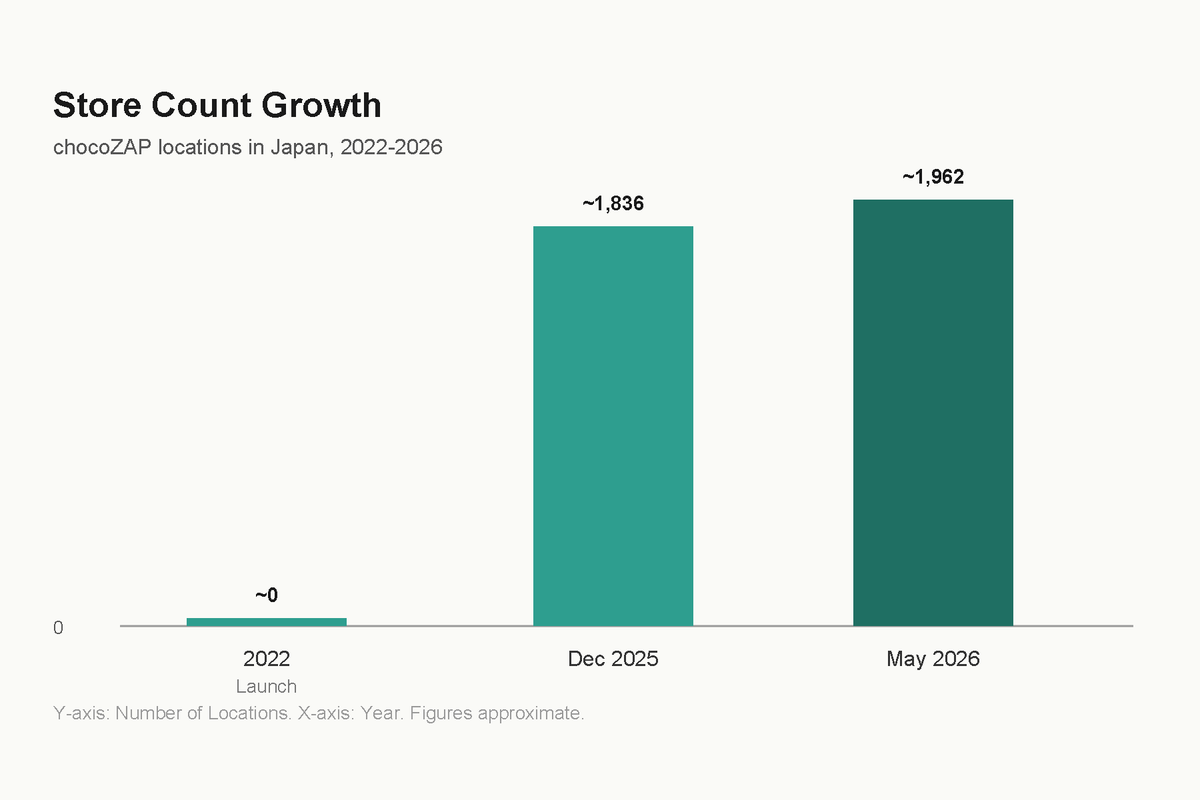
By December 2025, the chain had grown to roughly 1,836 stores. Five months later, in May 2026, that number had climbed to roughly 1,962 across all of chocoZAP’s markets, with Japan itself accounting for the large majority. Membership moved in the same direction: from about 1.105 million members in November 2025 to 1.161 million by May 2026, after a period earlier in its history where growth had actually stalled and RIZAP had to work to reaccelerate it. For a chain that didn’t exist before 2022, that is an extraordinary compression of what normally takes a fitness brand a decade or more to build.
The financial picture backs up the growth story. RIZAP Group’s results for the fiscal year ended March 2026 showed consolidated revenue of about ¥167.3 billion, actually down slightly — around 2% — from the year before. But operating profit told a very different story: it jumped to roughly ¥11.1 billion, up from about ¥1.9 billion the prior year, a nearly sixfold increase that marked a sharply improved profit year, though still short of the company’s all-time high operating profit of roughly ¥13.6 billion, set in the fiscal year ended March 2018 — a level RIZAP itself has said it is targeting to surpass in its plan for the fiscal year ending March 2027. According to the company’s own investor materials, chocoZAP’s profitability helped drive the improvement in RIZAP’s healthcare-and-beauty segment, the reporting segment that also includes its more traditional, higher-touch personal-training business.
In other words: the low-margin-looking, ¥3,000-a-month, no-frills convenience gym is now a major driver of the group’s profit recovery, the same group that made its name on premium, high-touch, high-price fitness coaching. That’s the kind of reversal that gets written up in Japanese business magazines as a cautionary tale for anyone still betting on the old model.
What’s Actually Inside a chocoZAP
Walk into a chocoZAP for the first time and the thing that stands out isn’t the equipment — it’s everything around the equipment.
New members receive a starter kit that includes a body-composition scale, free, bundled into the membership rather than sold as an upsell; the kit also used to include a fitness tracking watch, but chocoZAP has been phasing that out of new memberships since June 2026. That alone is a notable design choice: rather than charging extra for the data-driven, quantified-self layer that companies like Whoop or Oura have turned into premium subscription products in the U.S. and Europe, chocoZAP just hands it to you on day one, on the theory that people who can see their own numbers are more likely to keep showing up.
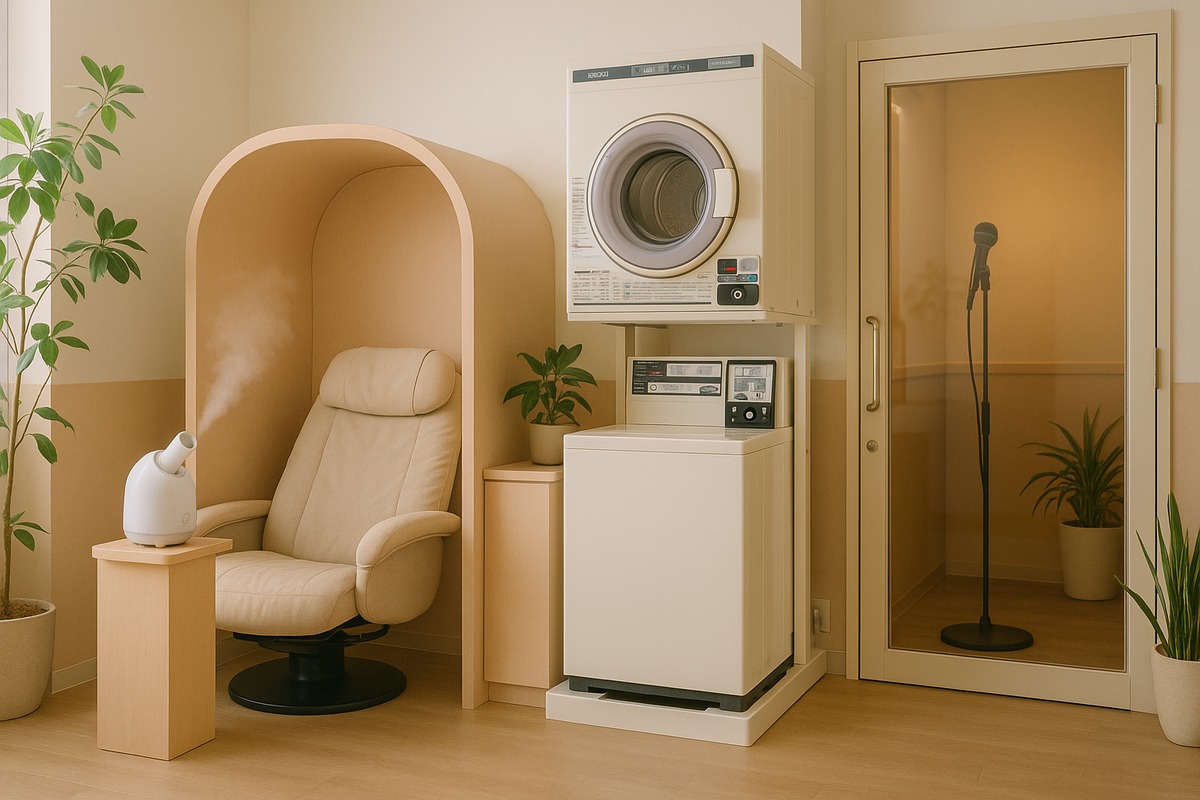
Then there’s everything that has nothing to do with exercise at all. Many locations offer private, lockable rooms for “self-esthetic” treatments — heated, automated full-body and facial machines that members use on their own, no esthetician required, typically for about ten minutes at a time. Others have self-service hair-removal booths, complete with protective eyewear and posted instructions, again fully unstaffed. Some locations have members-only, coin-free laundry machines included in the membership. Some have karaoke rooms. Some have golf simulators, massage chairs, or manicure stations. None of this is universal — equipment varies significantly store to store — but the pattern is consistent: chocoZAP is not trying to be a great gym. It’s trying to be a great errand stop that happens to have gym equipment in it, the same logic a convenience store applies to selling everything from fried chicken to concert tickets to bill payment services under one roof.
The staffing model makes this financially possible. A conventional gym needs front-desk staff, sales staff, class instructors, and maintenance personnel during open hours. A chocoZAP location needs almost none of that, relying instead on app-based check-in, remote camera monitoring, and a lean regional support structure. In a country facing one of the tightest labor markets in the developed world, where finding staff for a 24-hour retail operation is an operational headache regardless of industry, “the gym that doesn’t need staff” is not just a cute concept — it’s the only version of this business that scales at this pace.
The Anytime Fitness Problem
Here’s where the story gets genuinely interesting for anyone watching from outside Japan: Anytime Fitness got here first, and it hasn’t been able to keep up.
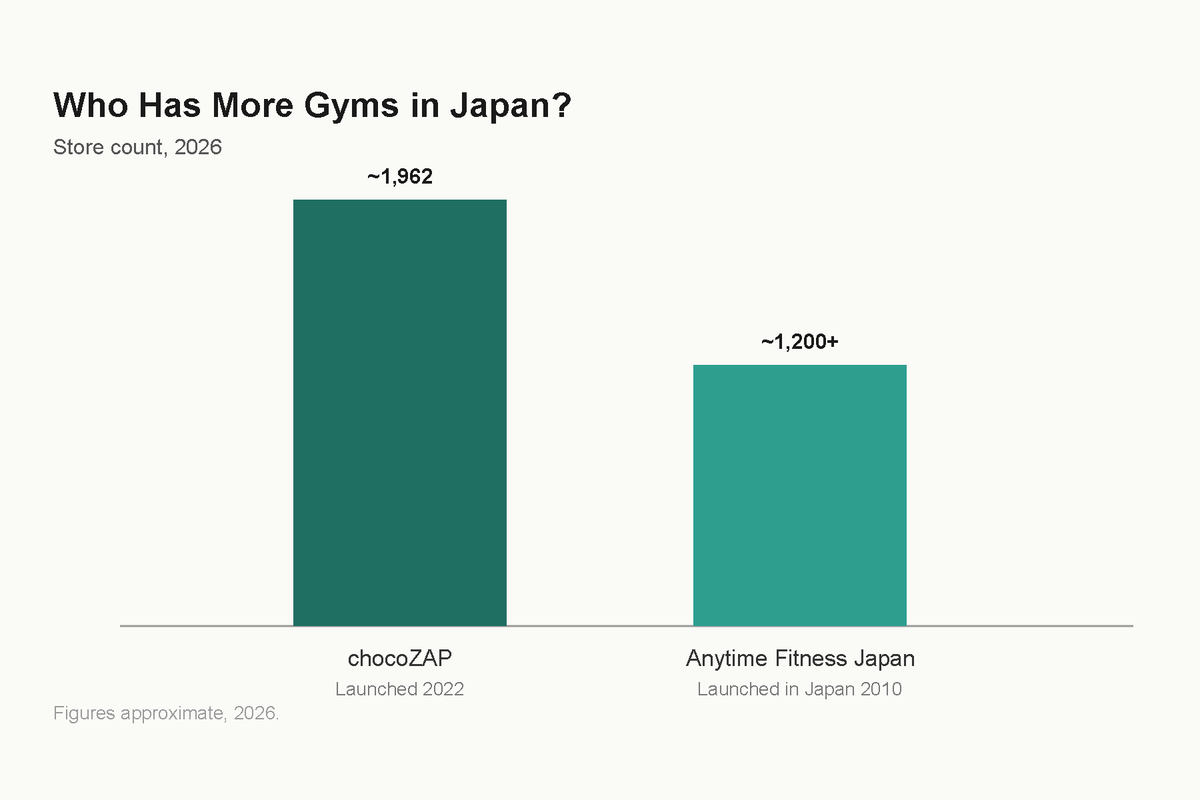
Anytime Fitness, the Minnesota-founded franchise that built a global empire on the exact same core insight — 24-hour access, minimal staffing, low monthly fees — has operated in Japan since 2010 and has expanded to more than 1,200 locations as of 2026. That’s a real, substantial footprint, built over a decade and a half by a company that helped popularize the global 24-hour, minimal-staff franchise-gym model.
chocoZAP did not exist four years ago. It now has more locations in Japan than Anytime Fitness, built the model faster, and did it while bundling in a laundry list of extras Anytime Fitness doesn’t offer. That’s not a knock on Anytime Fitness’s execution — the brand remains genuinely popular with Japanese members who specifically want a gym-first experience without the sideshow attractions. But it is a striking example of a homegrown challenger absorbing an imported business model, adding a distinctly Japanese layer of convenience-retail logic on top of it, and outgrowing the original in its own market within a matter of years.
Part of the difference comes down to what each brand is actually selling. Anytime Fitness sells gym access — a real, focused fitness product for people who already intend to work out. chocoZAP, by contrast, is selling permission not to feel guilty about not working out very hard, wrapped in enough ancillary services (the laundry, the nails, the self-whitening booths, the karaoke) that canceling the membership feels like giving up a small daily convenience, not just admitting a fitness failure. In a market where gym membership has historically carried a whiff of shame for people who join and then don’t go, removing that shame — by making the visit itself low-stakes and multi-purpose — turns out to be a bigger competitive advantage than adding another squat rack.
Doing the Math: chocoZAP vs Planet Fitness vs Anytime Fitness
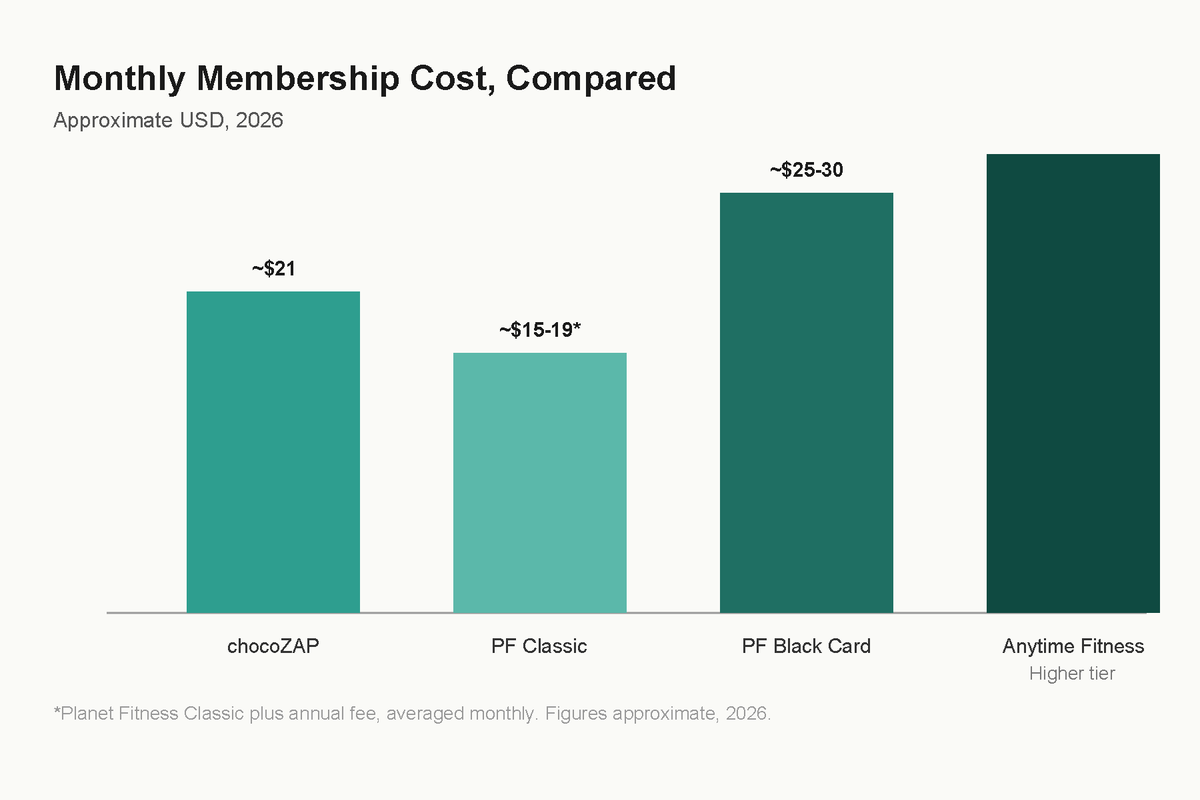
For an American reader, the closest cultural reference point isn’t Anytime Fitness — it’s Planet Fitness, the “Judgement Free Zone” chain that built a nationwide empire on the same anti-intimidation, low-commitment pitch aimed at first-time and infrequent gym-goers.
The pricing, once converted, lines up closely enough to make the comparison worthwhile. chocoZAP runs a touch over ¥3,000 a month — call it roughly $20 to $22 at the yen’s 2026 exchange rate of around ¥154 to the dollar. Planet Fitness’s Classic membership starts at $15 a month, with annual and enrollment fees that vary by club and run up to $59, netting out to something in a similar range once averaged monthly; its Black Card tier, which unlocks amenities like tanning and massage chairs, runs $24.99 a month. Anytime Fitness Japan’s pricing sits in a broadly comparable band as well, typically running somewhat higher than chocoZAP once initiation and administrative fees are factored in, in exchange for a more traditional, equipment-focused gym floor.
So the three chains are not wildly far apart on price. What differs is what that price buys. A Planet Fitness Black Card gets you tanning beds and massage chairs alongside the gym floor — genuinely the closest American analog to chocoZAP’s grab-bag model, and worth remembering the next time someone claims Japan’s convenience-gym concept has no U.S. equivalent at all. But chocoZAP goes further, folding in services — self-esthetic treatments, hair removal, laundry, karaoke — that sit entirely outside the fitness category, more department-store than health-club. It’s less “gym with extra amenities” and more “everyday errand hub that happens to have treadmills.”
That distinction matters for anyone in the wellness or franchise business trying to read Japan as a signal for where the category goes next. The lesson isn’t “charge less.” Planet Fitness already proved that works. The lesson is “bundle in enough non-fitness convenience that the membership survives even the weeks when the member never touches a weight.”
Convenience Store DNA: Why This Could Only Have Happened in Japan

I’d argue chocoZAP only makes sense once you’ve spent real time inside a Japanese convenience store, because the two businesses are run on the same underlying operating system.
A Japanese konbini — a 7-Eleven, a Lawson, a FamilyMart — has trained an entire population to expect that a single small, unstaffed-feeling, always-open retail box should be able to solve an absurdly wide range of daily problems: a hot meal, a printed document, a paid utility bill, an ATM withdrawal, a concert ticket, a fresh pair of socks. Nobody in Japan finds it strange that one store does all of that. The strangeness, if anything, runs the other way — a store that does only one thing, well, but only that one thing, can start to feel oddly limited by comparison.
chocoZAP is a convenience store with dumbbells instead of onigiri. It borrows the same underlying idea — solve as many everyday errands as possible in one nearby, always-open location — even though it gets there through a very different operating model: where konbini run on staff handling registers, restocking, hot food, and deliveries around the clock, chocoZAP strips staffing out almost entirely, using app-based check-in and self-service equipment to maximize the number of daily-life problems solved per square meter and make the unit economics work through sheer density and repeat visits rather than high margins per visit. I’ve walked into a chocoZAP near my neighborhood station on evenings when I had no intention of exercising at all, purely because the self-laundry machine was open later than the coin laundromat down the street — and I’d guess I’m far from the only member using it that way. That, more than any piece of gym equipment, might be the real product.
It’s worth noting this isn’t purely a low-cost, low-quality play, either. The starter kit — the free body-composition scale handed to every new member (a health-tracking watch was also included until chocoZAP began phasing it out of new memberships in June 2026) — signals real investment in the idea that data can nudge behavior more effectively than guilt or peer pressure ever did. It’s a very Japanese synthesis: high-tech, low-friction, and quietly ambitious about actually changing how a notoriously under-exercised population moves through its day.
Exporting the Model: Hong Kong to Malaysia
The part of this story that should really catch the attention of international operators is what’s happening outside Japan.
chocoZAP has already opened locations in Hong Kong, Taiwan, and Singapore. On June 23, 2026, it opened its first Malaysian location, in Petaling Jaya just outside Kuala Lumpur, marking its fourth overseas market. RIZAP has stated a target of up to 150 overseas chocoZAP locations by March 2027. YR Fitness, a regional fitness equipment operator, lists the chocoZAP project among its client work.
The stated logic for the Malaysia expansion is worth sitting with: RIZAP has pointed to a young population (an average age around 31), a “demographic dividend” period of economic growth, and a gap between rising incomes and the relatively high cost of conventional gym memberships in the market — essentially the same underserved-middle-market thesis that made Planet Fitness and Anytime Fitness successful in the U.S. two decades ago, now being pursued by a Japanese company using a Japanese playbook, in Southeast Asia.
That’s the twist worth sitting with. The unstaffed, budget, low-intimidation gym category was pioneered and globalized by American brands. Japan imported that category through Anytime Fitness, iterated on it aggressively by fusing it with convenience-retail logic, built something bigger and stickier than the original within its home market, and is now re-exporting its own version of the category to new markets in Asia — markets where, in some cases, it will be competing directly against the same American chains it just outgrew back home.
What International Operators Should Take Away
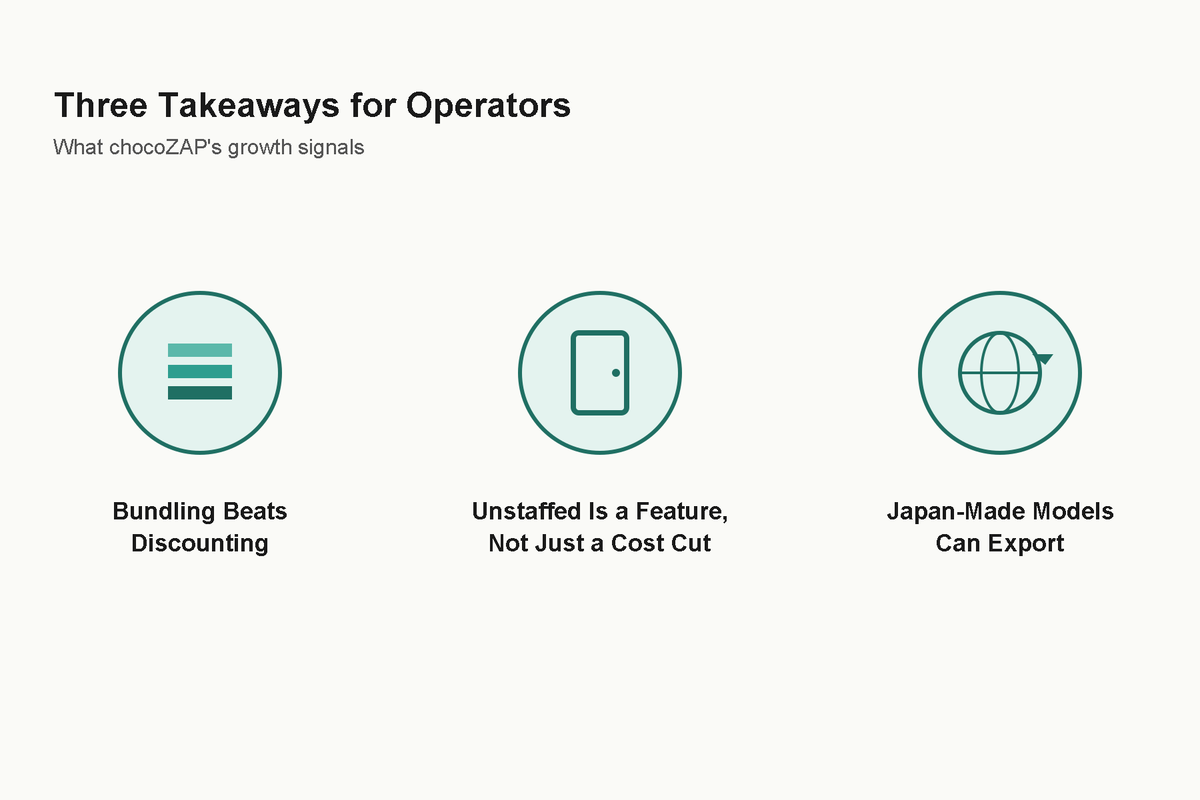
For readers running consumer brands, franchise operations, or wellness businesses outside Japan, a few things about the chocoZAP story travel well beyond the gym floor.
First, price parity doesn’t guarantee category leadership — bundling does. chocoZAP isn’t meaningfully cheaper than its Western-style competitors once everything is converted and compared; it wins by stacking non-core services on top of a commodity product until the membership becomes a habit rather than a fitness decision. Any subscription business — not just gyms — watching churn should be asking what its own equivalent of “included laundry” might be.
Second, removing staff isn’t just a cost play in a tight labor market — it’s increasingly a customer-experience feature for a certain segment of consumers who specifically want to avoid being sold to, corrected, or observed. That’s a generational and cultural signal that shows up well beyond Japan, and chocoZAP’s growth suggests operators underestimate it at their peril.
Third, and maybe most important for anyone benchmarking against Japan: don’t assume a market this famously “different” produces business models with no export potential. chocoZAP’s expansion into Hong Kong, Taiwan, Singapore, and now Malaysia is a live test of whether a Japanese consumer-retail hybrid can travel as well internationally as the American budget-gym format it was originally built on top of. If it works, it will be one more example — alongside things like Japanese drugstore skincare going viral on TikTok, or 100-yen shop retail formats spreading across Asia and beyond — of Japan taking in a foreign business model, refining it for a domestic audience with famously exacting service expectations, and sending an improved version back out into the world.
Frequently Asked Questions
Q. How much does a chocoZAP membership cost?
A. Pricing runs a touch over ¥3,000 a month at most locations, roughly $20 to $22 at 2026 exchange rates, positioning it close to mid-tier plans from Planet Fitness or Anytime Fitness once fees are factored in — but with a much wider bundle of non-fitness services included.
Q. Is chocoZAP available outside Japan?
A. Yes. As of 2026, chocoZAP operates in Hong Kong, Taiwan, Singapore, and Malaysia, with its first Malaysian location opening in June 2026 near Kuala Lumpur. RIZAP has stated a goal of up to 150 overseas locations by March 2027.
Q. How is chocoZAP different from Anytime Fitness or Planet Fitness?
A. Planet Fitness and chocoZAP both target value-conscious, first-time or infrequent gym-goers, while Anytime Fitness Japan also draws a broader base of more committed, training-focused members thanks to its staffed hours and fuller equipment floor. Their operating models differ: Anytime Fitness and chocoZAP both provide 24-hour member access, though Anytime Fitness operates staffed hours while chocoZAP is designed for largely self-service use, and Planet Fitness locations are staffed, with operating hours that vary by club, including some 24-hour locations. Anytime Fitness and Planet Fitness are primarily fitness-focused (Planet Fitness’s Black Card tier does add tanning and massage chairs), while chocoZAP extends much further into non-fitness convenience services like self-esthetic treatments, hair removal, laundry, and karaoke rooms at many of its Japanese locations.
Q. Do you need gym experience or a trainer to join?
A. No. chocoZAP is explicitly designed for people who find traditional gyms intimidating or inconvenient. There’s no mandatory intake session, no in-store trainer, and no fitness-level requirement — members receive a starter kit and access the facility using an app-based system.
Q. Where can I get something similar to the free body-composition scale chocoZAP gives new members?
A. Every chocoZAP membership includes a starter kit with a body-composition scale (a fitness tracker was also included until chocoZAP began phasing it out of new memberships in June 2026), which is a meaningful part of the chain’s appeal — it turns fitness into something trackable without an extra purchase. Outside Japan, the closest widely available equivalent is a connected smart scale like the Withings Body Smart, which measures body fat and weight and syncs automatically to a phone app, giving a similar at-home version of the data-driven nudge chocoZAP builds into its membership from day one.
Conclusion
It would be easy to read the chocoZAP story as a quirky footnote — a Japanese gym with a karaoke room, filed under the same drawer as vending machines that sell umbrellas or toilets that play music. But the numbers argue against filing it away that easily. A company built its entire founding reputation on intense, expensive personal training, then found its real growth engine in the opposite instinct: strip out the intimidation, strip out the staff, bundle in enough everyday convenience that quitting feels like a hassle, and let density do the rest. In under four years, that instinct produced more locations in Japan than an American franchise giant built over a decade and a half, became one of the main drivers behind a public company’s sharply improved profit, and is now being packaged up and shipped to Hong Kong, Taiwan, Singapore, and Malaysia.
The gym floor, it turns out, was never really the product. The convenience was.
*This article contains affiliate links. If you purchase through these links, we may earn a small commission at no extra cost to you.*
If you’re interested in this topic, the Japanese market more broadly, or what KETCHUPs is working on, we’d love to hear from you — please reach out via our contact form.
Japan Market Pulse is a weekly read on what the Japanese consumer-tech, food, and mobility markets are choosing to do, written for international operators who want to know what is happening before it shows up in the global trade press.
Subscribe at ketchups.co/japan-market-pulse.
This article contains affiliate links. If you purchase through these links, we may earn a small commission at no extra cost to you.
If you’re interested in this topic, the Japanese market more broadly, or what KETCHUPs is working on, we’d love to hear from you — please reach out via our contact form.
Japan Market Pulse is a weekly read on what the Japanese consumer-tech, food, and mobility markets are choosing to do, written for international operators who want to know what is happening before it shows up in the global trade press.
Subscribe at ketchups.co/japan-market-pulse.