
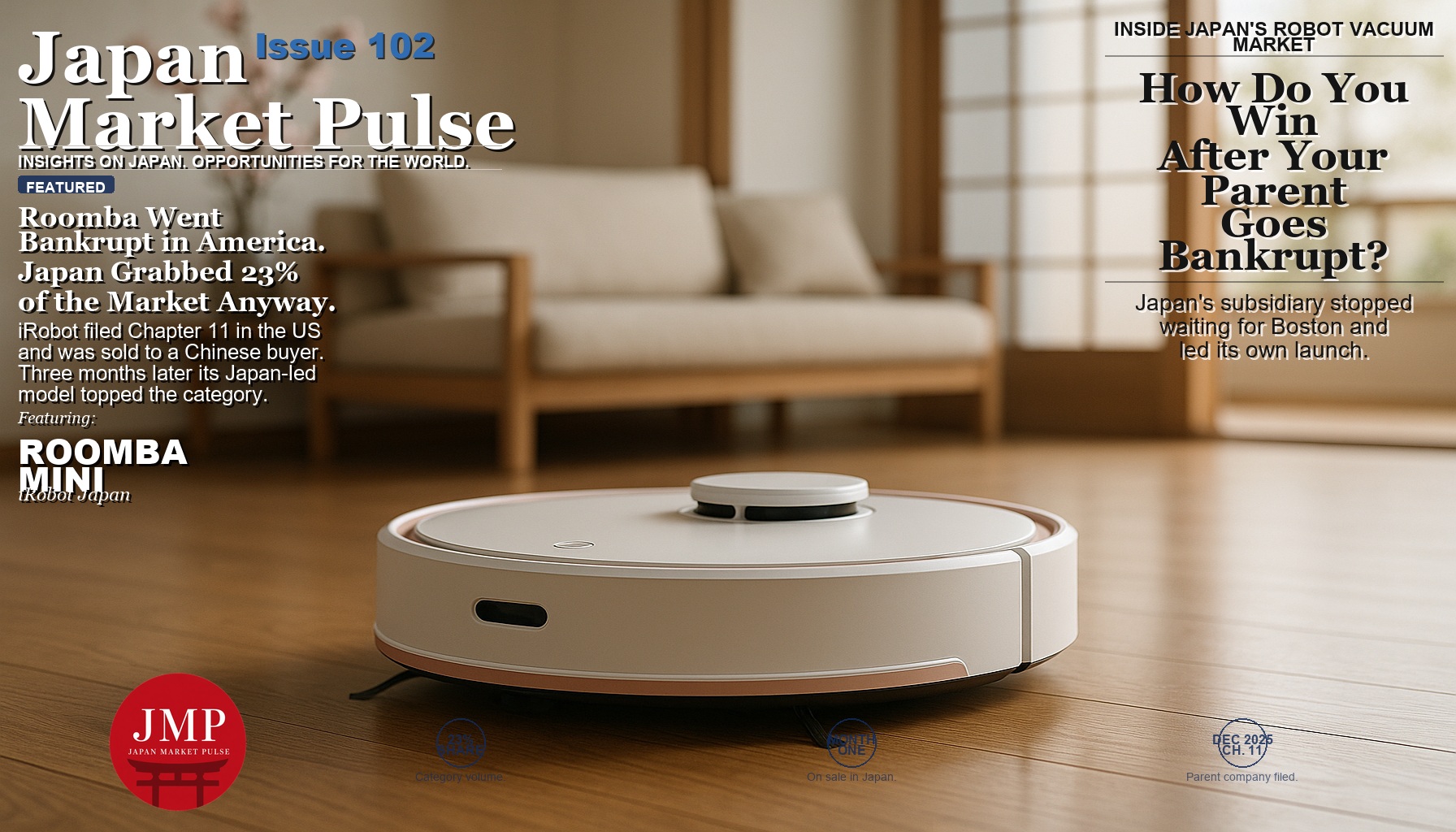
On December 14, 2025, lawyers for iRobot Corporation walked into the U.S. Bankruptcy Court for the District of Delaware and filed for Chapter 11. The stock, which had once made iRobot a household name on Wall Street as much as in American living rooms, cratered by as much as 70% in a single trading session. Thirty-five years after a trio of MIT roboticists founded the company, and twenty-three years after the original Roomba first bumped its way across a carpet, the maker of the world’s most recognizable robot vacuum was, in the plainest possible terms, broke.
I read the news the way most people in Tokyo probably did — as a passing headline about an American tech company nobody here thinks about very hard. And then, a few weeks later, I was standing in the appliance aisle of a Bic Camera near Ikebukuro, watching a woman debate between two nearly identical white discs, both stamped with the Roomba logo, one of them small enough to fit in a shoebox. The staff member helping her wasn’t hedging or apologizing for the brand. He was recommending it — enthusiastically — as the store’s best-selling robot vacuum of the month.
That contradiction is the whole story. A company that spent 2025 in American bankruptcy court spent the first months of 2026 posting some of the strongest retail numbers in its history — in Japan. Understanding why requires untangling three separate stories that happen to be about the same machine: a Delaware bankruptcy, a Chinese company’s quiet global takeover of an entire product category, and a small, oddly self-directed Japanese subsidiary that built a product nobody at headquarters asked for.
The Bankruptcy Nobody in Japan Noticed
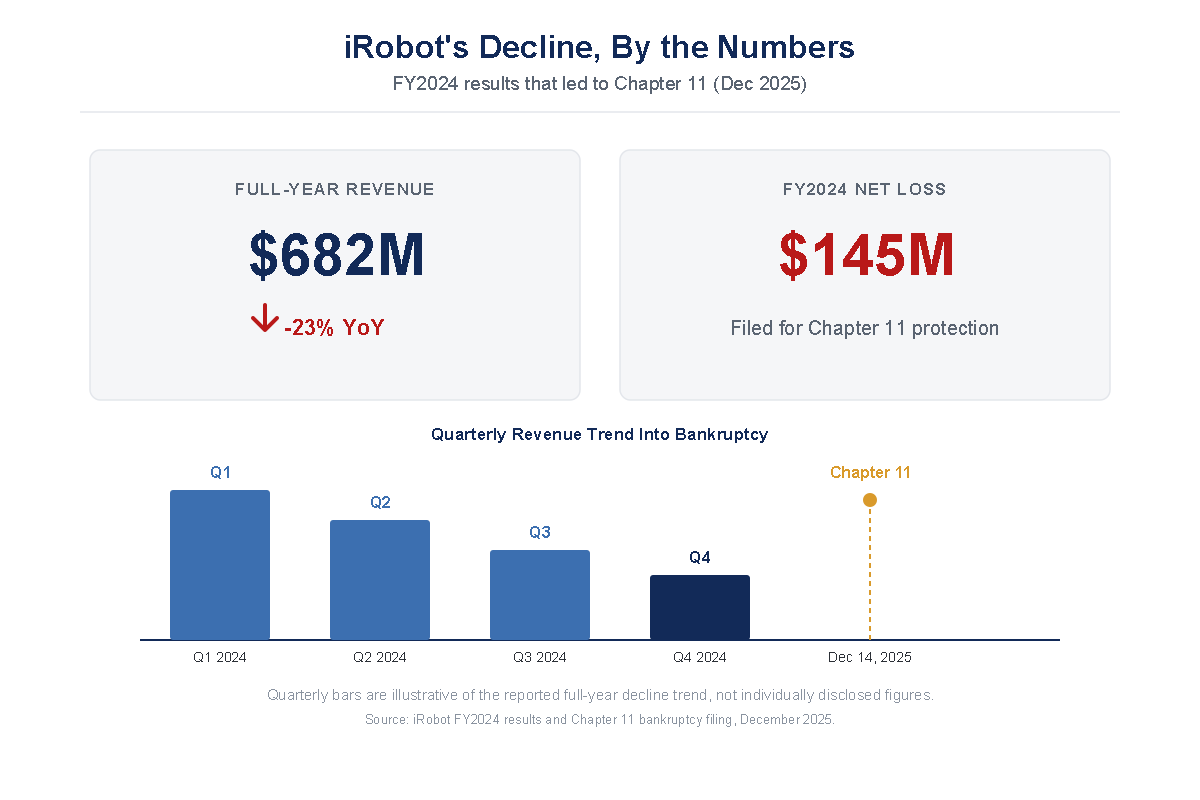
iRobot’s collapse had been building for years, and among the proximate pressures was something almost mundane: import costs. The company had spent 2024 posting revenue of $682 million, down 23% year over year, with a net loss of $145 million, according to filings and reporting from CNBC and Manufacturing Dive. Tariff exposure on Chinese-manufactured components, a debt load from a term loan raised in mid-2023, and relentless price competition from newer entrants had combined into a slow bleed that management’s March 2025 strategic review couldn’t stop in time.
The bankruptcy itself was, in financial terms, unusually tidy. iRobot filed what’s known as a “pre-packaged” Chapter 11 — meaning the company had already lined up its buyer before the paperwork hit the docket. That buyer was Shenzhen Picea Robotics, a Chinese firm that had spent years as iRobot’s primary contract manufacturer and, more recently, its secured lender. Picea wasn’t an outsider circling a wounded competitor; it was the company that had literally been building iRobot’s vacuums on factory floors in China for years, and now held enough of iRobot’s debt to become the natural buyer when the parent company ran out of runway. The court confirmed the plan on January 22, 2026, and the transaction closed the next day, with Picea acquiring 100% of iRobot’s equity.
It’s worth pausing on how quietly this all happened relative to its historical weight. This is, after all, the company that invented the mass-market robot vacuum category in 2002 and turned “Roomba” into a generic noun the way “Kleenex” or “Google” became one. And its ownership had just passed, with barely a ripple in the American press cycle beyond a few days of tech-trade headlines, from a Massachusetts-based public company to a private Chinese manufacturer.
There’s a second American story braided into this one, and most operators outside the U.S. tech press missed it entirely. In August 2022, Amazon announced it would acquire iRobot outright for $1.7 billion — a deal that would have folded the maker of the Roomba directly into Amazon’s smart-home ambitions alongside Alexa, Ring, and Echo. The European Commission spent more than a year investigating the deal and, in January 2024, signaled it would block the acquisition over concerns that Amazon could use its marketplace dominance to bury competing vacuum brands in search results. Amazon and iRobot mutually terminated the deal on January 29, 2024, with Amazon paying a $94 million breakup fee. That failed acquisition, in hindsight, marked the beginning of the two-year slide that ended in Delaware bankruptcy court. iRobot never found another lifeline as generous as Amazon’s, and by the time Picea stepped in, it was less a strategic acquisition than a rescue.
How China Already Won the Global Robot Vacuum War
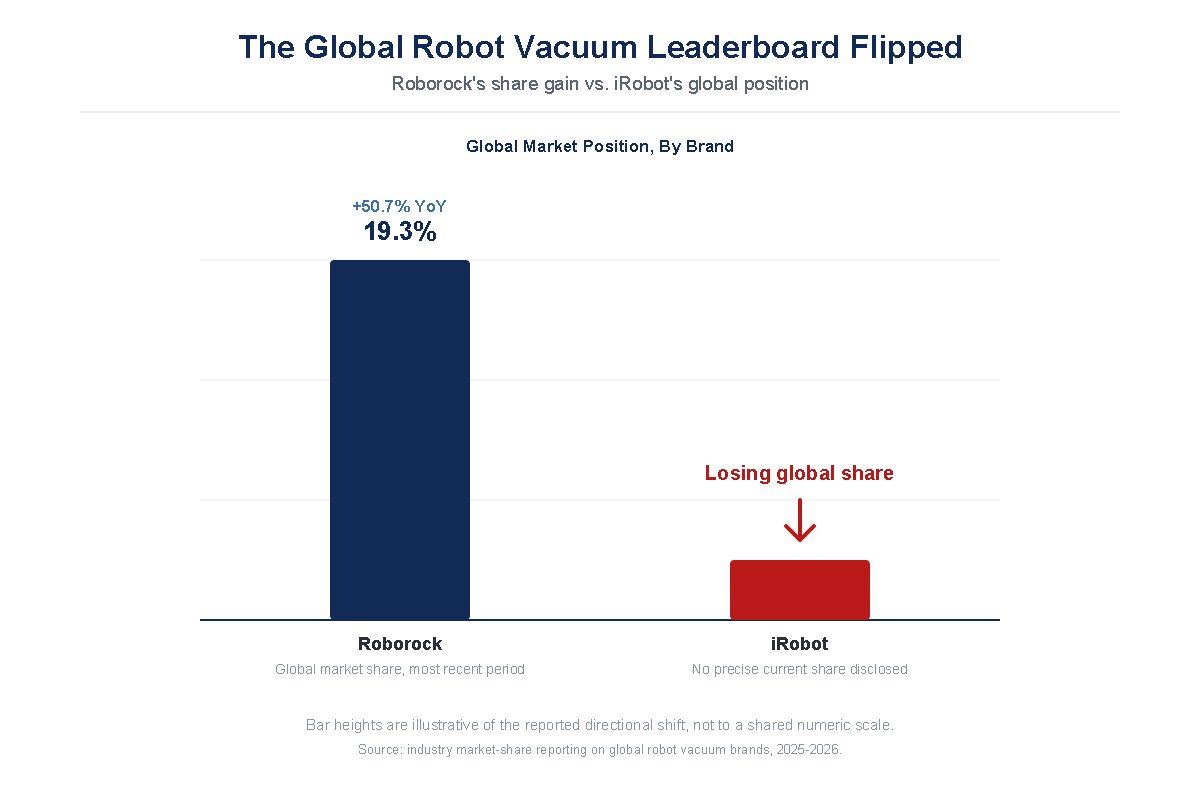
The iRobot bankruptcy wasn’t really a story about one company failing. It was the visible endpoint of a category-wide power shift that had been underway for years, and Roborock was its biggest beneficiary. Founded in Beijing in 2014 — a full twelve years after the original Roomba launched — Roborock spent a decade out-iterating iRobot on hardware while undercutting it on price. According to IDC market-tracking data, Roborock shipped 982,000 units in a recent measured quarter, good for a 19.3% global market share, up 50.7% year over year. Somewhere in that period, Roborock overtook iRobot as the global leader in the robot vacuum category by shipments — a title iRobot had held, essentially uncontested, for two decades.
Roborock wasn’t alone. Ecovacs, Dreame, and a wave of smaller Shenzhen-based manufacturers had spent the same period pushing self-emptying docks, LiDAR mapping, mop-and-vacuum combo units, and increasingly aggressive suction-power marketing (some newer Chinese models now advertise figures north of 20,000 pascals) into Western markets at price points iRobot’s cost structure simply couldn’t match. For American and European consumers browsing robot vacuums in 2026, “iRobot” was no longer the default answer to “which one should I buy” — it was one option among a crowded field increasingly dominated by Chinese brands competing almost entirely on hardware specs and price.
This is the part of the story that would predict, reasonably, that Japan should have gone the same way. Japanese consumers are not naive about Chinese electronics — brands like Anker have built enormous trust in Japan over the past decade, and Chinese EV makers have made real, if contested, inroads into the country’s notoriously closed auto market. There was no obvious reason Roborock’s global rise should have stopped at Japan’s borders.
Japan’s Strange Exception
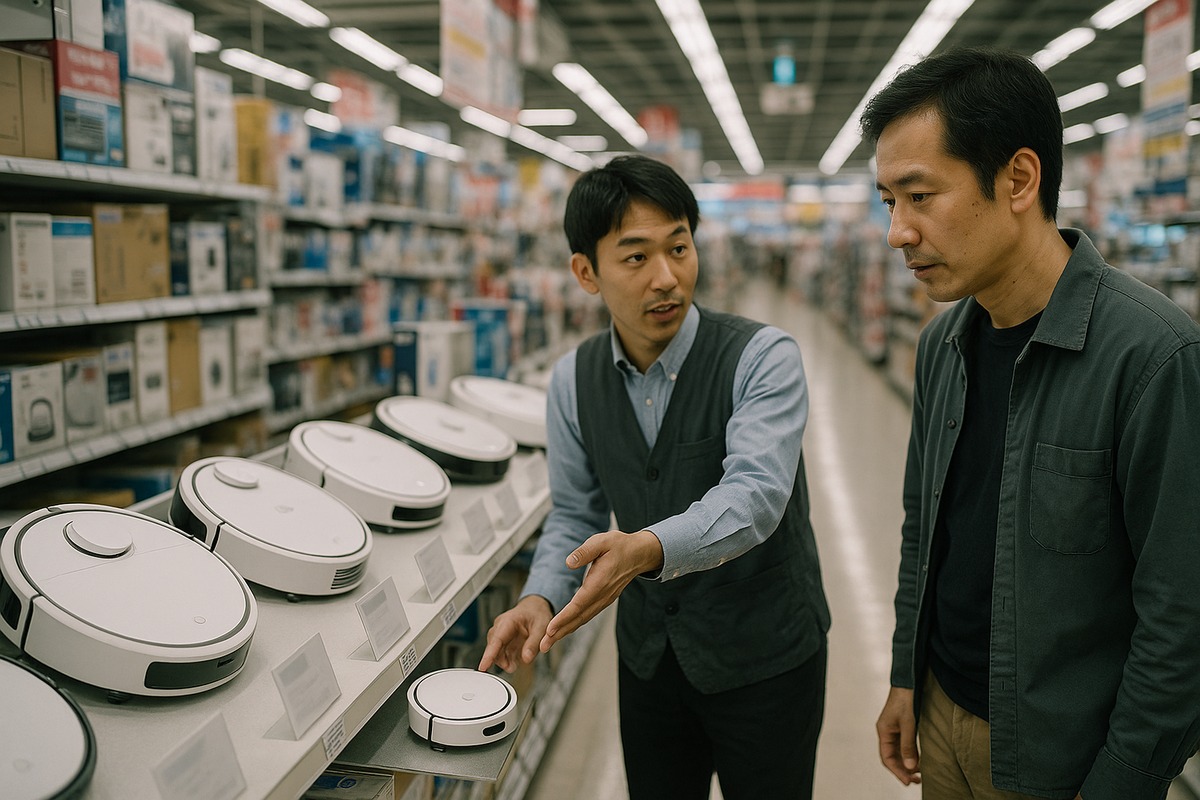
And yet it largely did. Japan’s robot vacuum market has long been unusually favorable to Roomba. Domestic retail tracking firm BCN reported iRobot commanding a dominant share of the category by volume in its 2019 first-half panel data — above 70% — at a time when Roomba was already facing meaningful competitive pressure everywhere else in the world, and iRobot has continued to be cited as a leading brand in Japan in more recent retail coverage. That dominance didn’t happen by accident, and it didn’t happen because Japanese consumers were unaware of cheaper alternatives sitting on the same store shelves.
Part of the answer is distribution. iRobot built a two-decade relationship with Japan’s electronics retail chains — Bic Camera, Yodobashi Camera, Yamada Denki — that gave Roomba prime shelf placement and staff familiarity that newer entrants have struggled to replicate. Part of it is brand trust earned the old-fashioned way: Roomba was the first robot vacuum most Japanese households ever owned, often a decade or more ago, and it worked. In a market where consumers are famously reluctant to switch away from a product that has already proven reliable, that first-mover trust compounds over time in a way it hasn’t in more price-sensitive, algorithm-driven markets like the U.S. Amazon marketplace.
But there’s a less obvious factor, too: iRobot Japan had, for years, operated with an unusual degree of local autonomy from its Massachusetts and — after January 2026 — Shenzhen ownership. Rather than simply importing whatever global lineup headquarters shipped, the Japanese subsidiary had developed a habit of localizing aggressively: smaller units for Japan’s more compact apartments and homes, and marketing built around Japan-specific pain points like tatami flooring and multi-generational households — a pattern that, with the Mini launch, extended to seasonal colors timed to a cultural moment like the spring cherry-blossom season. That local product culture is what set the stage for what came next — and what makes the timing genuinely remarkable.
The Product Japan Built While America Was in Bankruptcy Court
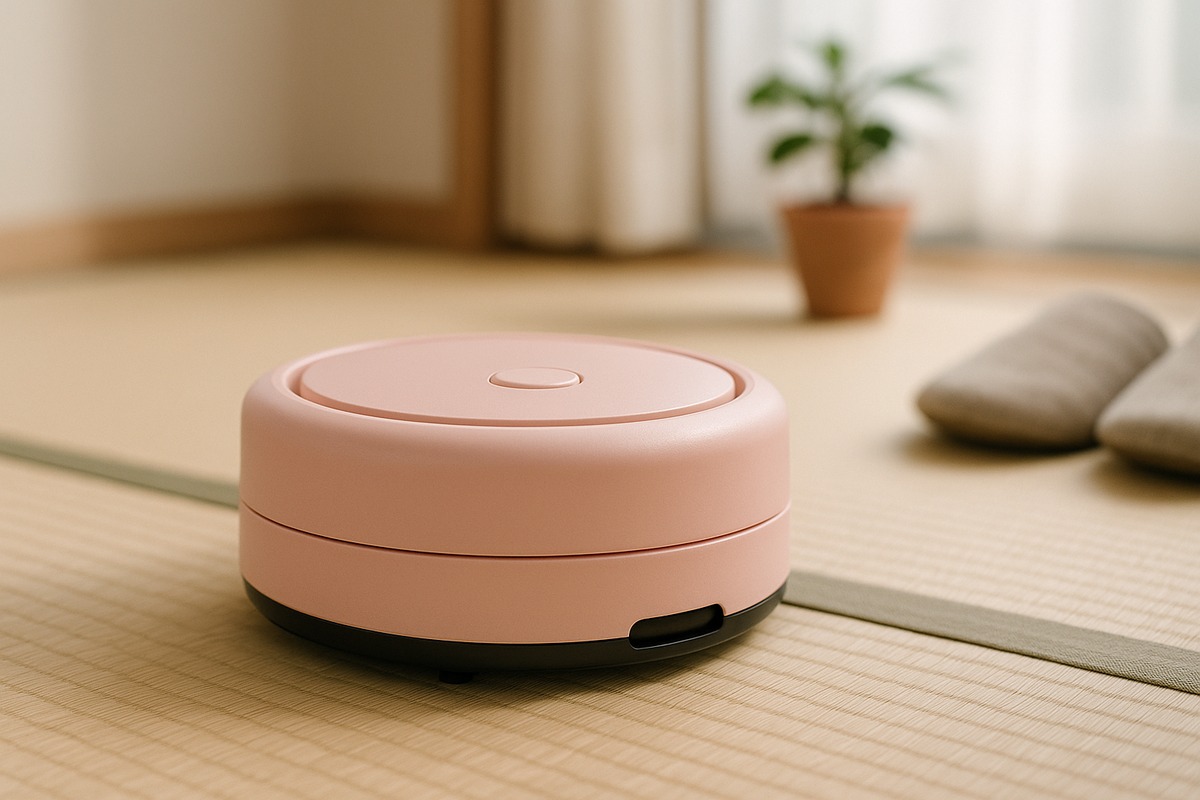
Here is the detail that turns this from an interesting footnote into a genuinely instructive business story: as far as the public record shows, this was among the first new Roomba models announced and launched anywhere after Picea’s takeover, and it wasn’t handed down from a Shenzhen product roadmap or dictated from Massachusetts. It was a global model developed under the leadership of iRobot Japan’s own local team, built with Japan’s living spaces and habits in mind — and it launched in Japan first, on February 27, with the UK and Europe following on March 10, 2026, well ahead of any confirmed date for the U.S. market.
On February 19, 2026, iRobot Japan announced the Roomba Mini, a pair of new models it described as “world’s smallest class” — about half the volume of the Roomba Combo 105, one of the company’s previous flagship units. The Roomba Mini and AutoEmpty Charging Station combination launched on February 27, priced from ¥49,800 (roughly $330 at prevailing exchange rates), with a separate, lower-priced Roomba Mini Slim, paired with the more compact, vertical SlimCharge dock, following on April 6 at ¥39,800 (roughly $260). Despite the dramatically smaller body, iRobot Japan claimed roughly 70 times the suction power of the company’s earlier popular compact line, paired with a specially designed single-action brush and a disposable dry-mopping sheet system for light floor cleaning. The launch colors — a soft pink called “Sakura” and a pale green called “Wakaba” — arrived during Japan’s spring new-school-year and new-apartment shopping season, a retail moment as culturally loaded in Japan as back-to-school is in the U.S.
What makes the Roomba Mini remarkable isn’t the specs — plenty of competitors ship comparable suction and mapping hardware. It’s the org chart. Trade coverage of the launch, including reporting from the Japanese tech outlet Ledge.ai, was explicit that the Roomba Mini was led and developed on the initiative of iRobot’s Japanese subsidiary, not simply handed down from a global product roadmap — and that it represents the first genuinely new model to reach any market since Picea completed its acquisition of the parent company. In other words: while the U.S. entity that owns the Roomba name was navigating a pre-packaged bankruptcy and changing hands to a Chinese manufacturer, a team in Japan was quietly finishing a product that would go on to rank first among robot vacuums in the country — by iRobot Japan’s own market-share reporting — within a month of launch.
For anyone who has managed a local subsidiary of a multinational going through financial distress, this should sound almost implausible. Corporate turmoil at headquarters typically means frozen budgets, delayed launches, and local teams told to simply hold the line until ownership questions resolve. iRobot Japan appears to have done close to the opposite — shipping its most innovative product in years at the precise moment its parent company’s future was least certain.
The Numbers That Even Surprised iRobot
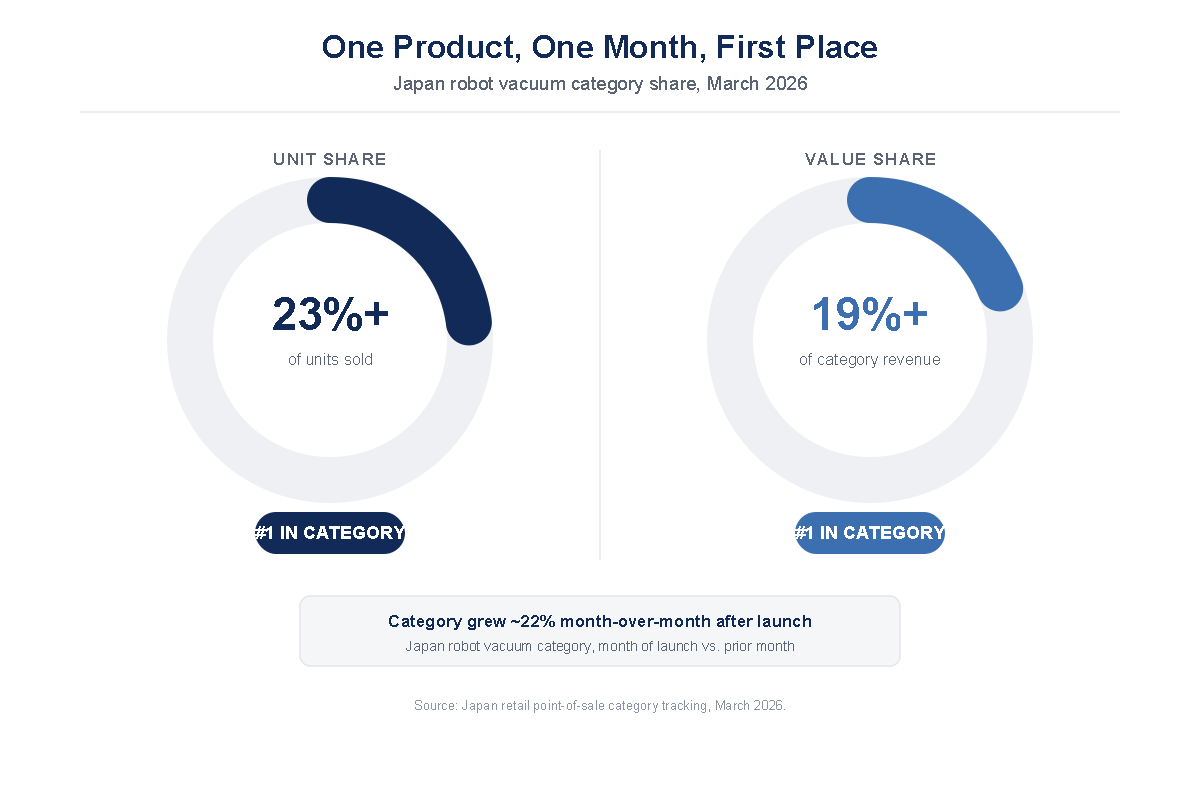
The market’s response validated the bet almost immediately. In its own press disclosures, iRobot Japan reported that in March 2026 — its first full calendar month on sale — the Roomba Mini captured more than 23% of the Japanese robot vacuum market by unit volume and more than 19% by sales value, ranking first in the category on both measures, by its own count. Japanese trade outlets ASCII.jp and Mynavi News, along with the robotics publication Robot Start, all reported the same iRobot Japan-disclosed figures, framing the Mini’s debut as a rare bright spot for a robot vacuum category that had been shrinking in Japan for several years running. iRobot Japan’s own reporting characterized the category’s overall month-over-month growth at roughly 22% — attributing a meaningful share of that lift directly to the Mini’s arrival.
There’s a subtlety worth drawing out here that a simple “market share” headline glosses over. A 23% unit share for the Roomba Mini line — one new model family launched into a category with dozens of active competing models from iRobot itself, Roborock, Ecovacs, Panasonic, and Sharp — is not a modest result by iRobot Japan’s own accounting; it looks close to a category-defining launch. But it’s worth being precise about what that number does and doesn’t measure: it’s iRobot Japan’s self-reported share of the Japanese market for a single month (March 2026), while Roborock’s often-cited 19.3% figure is an IDC-measured share of the *entire global market*, aggregated across Roborock’s full product portfolio, over a different measurement period. Different market, different timeframe, different measuring organization — the two numbers aren’t directly comparable, even though both point to genuinely strong performance in their respective categories.
None of this means iRobot’s global business is suddenly healthy. A $145 million annual net loss and a Chapter 11 filing don’t get erased by one country’s retail data. But it does mean that the assumption embedded in most Western coverage of the bankruptcy — that Roomba, as a brand, was losing to Chinese manufacturers everywhere — was true almost everywhere except the one market where the company chose to keep building rather than retreat.
What This Means for Global Operators
There are a few transferable lessons here for anyone running, or thinking about running, a business with both a global brand and a Japan-specific operation.
The first is that brand equity built through distribution relationships and long-term reliability can survive corporate turmoil at the parent-company level far better than most executives assume. iRobot Japan’s retail partnerships and consumer trust weren’t contingent on the health of iRobot’s American balance sheet — they were built locally, over roughly two decades, and they kept generating value even as headquarters filed for bankruptcy an ocean away. If you’re building a brand in Japan on behalf of a foreign parent company, that’s a real asset worth protecting deliberately, independent of how the parent is doing financially.
The second is about product localization as a genuine growth lever rather than a compliance checkbox. Plenty of foreign companies treat their Japan operation as a translation-and-distribution function — take the global product, adjust the manual, ship it. iRobot Japan instead treated Japan as a place worth designing for: smaller footprints for smaller homes, seasonal colors tied to cultural retail moments, and — critically — the organizational latitude to develop and launch a product independent of a parent company’s global roadmap. That latitude produced a category-leading launch at a moment when the parent company had every reason to expect its subsidiaries to freeze in place.
The third lesson is more cautionary, and it’s about complacency risk. Japan’s market structure — concentrated retail chains, high consumer loyalty, relatively slower Chinese-brand penetration than the U.S. or Europe — bought iRobot Japan time that its American parent didn’t have. But that structural protection is not permanent. Roborock, Ecovacs, and other Chinese brands are visibly investing in Japan-specific marketing and localization now, and the same dynamics that let Chinese manufacturers overtake iRobot everywhere else — faster iteration cycles, lower price points, more aggressive feature marketing — apply here too, just on a delay. The Roomba Mini’s strong March wasn’t proof the pattern can’t repeat in Japan; it was proof that a well-executed local product launch can still win, for now, if a company invests in doing it right.
If your business sells anything hardware-adjacent into Japan — consumer electronics, home appliances, connected devices — the Roomba Mini story is a useful reminder that Japan doesn’t reliably follow global category trends on the timeline the rest of the world expects. Sometimes that’s a market to be wary of underestimating. In this case, it turned into a lifeline for a brand that, everywhere else, looked like it was running out of road.
Frequently Asked Questions
Q. Can I buy the Roomba Mini in the United States?
A. Not yet in the United States. The Roomba Mini launched first in Japan on February 27, 2026, with the lower-priced Roomba Mini Slim following on April 6, both timed to Japan’s spring shopping season and led by iRobot’s Japanese subsidiary. The Mini has since also launched in the UK and Europe, from March 10, 2026, but iRobot has not announced a U.S. launch date. In the meantime, iRobot’s standard lineup — including the iRobot Roomba Combo robot vacuum and mop — remains available on Amazon in the U.S.
Q. How much does the Roomba Mini cost in Japan?
A. The Roomba Mini with its AutoEmpty charging station starts at ¥49,800 (roughly $330). The Roomba Mini Slim, bundled with the more compact, vertical SlimCharge dock, is a separate, lower-priced model starting at ¥39,800 (roughly $260). Both undercut many of iRobot’s own higher-end combo units, which is part of why they moved so quickly at retail.
Q. Why is Roomba still so dominant in Japan when Roborock and other Chinese brands have taken over the global market?
A. A combination of factors: two decades of retail relationships with chains like Bic Camera and Yodobashi Camera, strong first-mover brand trust among Japanese households, and a local subsidiary that has consistently localized products (smaller sizes, seasonal colors) rather than simply importing the global lineup unchanged.
Q. Is Roborock available in Japan too?
A. Yes — Roborock and other Chinese robot vacuum brands are sold in Japan and are gaining share, though not yet at the pace they’ve achieved in the U.S. and Europe. Shoppers comparing options can find models like the Roborock Qrevo S robot vacuum and mop widely available through Amazon in the U.S. market as well.
Q. What happens to iRobot now that it’s owned by a Chinese company?
A. Following the court-supervised sale, iRobot says it remains a U.S.-based company, with engineering, product development, and headquarters functions still anchored in Bedford, Massachusetts. Shenzhen Picea Robotics — previously iRobot’s primary contract manufacturer and a secured lender — now owns 100% of the company’s equity, but day-to-day operations, including iRobot Japan’s product decisions, have reportedly continued without disruption.
Conclusion
It’s tempting to read the iRobot bankruptcy as a clean morality tale about American manufacturing losing to Chinese hardware efficiency, and in the broadest sense, that’s not wrong — the broader rise of Chinese competitors, Roborock chief among them, really did help push iRobot into Delaware bankruptcy court, alongside its own debt load and tariff exposure. But the Japan chapter of this story doesn’t fit that tidy narrative, and that’s exactly why it’s worth paying attention to. A company that lost the global robot vacuum war anyway managed to keep winning in one market, not through inertia or nostalgia, but because a local team kept building the right product for the market in front of them, right through the worst months in its parent company’s history. For anyone running a global brand with a Japan operation, that’s not a footnote. It might be the whole lesson.
*This article contains affiliate links. If you purchase through these links, we may earn a small commission at no extra cost to you.*
If you’re interested in this topic, the Japanese market more broadly, or what KETCHUPs is working on, we’d love to hear from you — please reach out via our contact form.
Japan Market Pulse is a weekly read on what the Japanese consumer-tech, food, and mobility markets are choosing to do, written for international operators who want to know what is happening before it shows up in the global trade press.
Subscribe at ketchups.co/japan-market-pulse.
This article contains affiliate links. If you purchase through these links, we may earn a small commission at no extra cost to you.
If you’re interested in this topic, the Japanese market more broadly, or what KETCHUPs is working on, we’d love to hear from you — please reach out via our contact form.
Japan Market Pulse is a weekly read on what the Japanese consumer-tech, food, and mobility markets are choosing to do, written for international operators who want to know what is happening before it shows up in the global trade press.
Subscribe at ketchups.co/japan-market-pulse.