

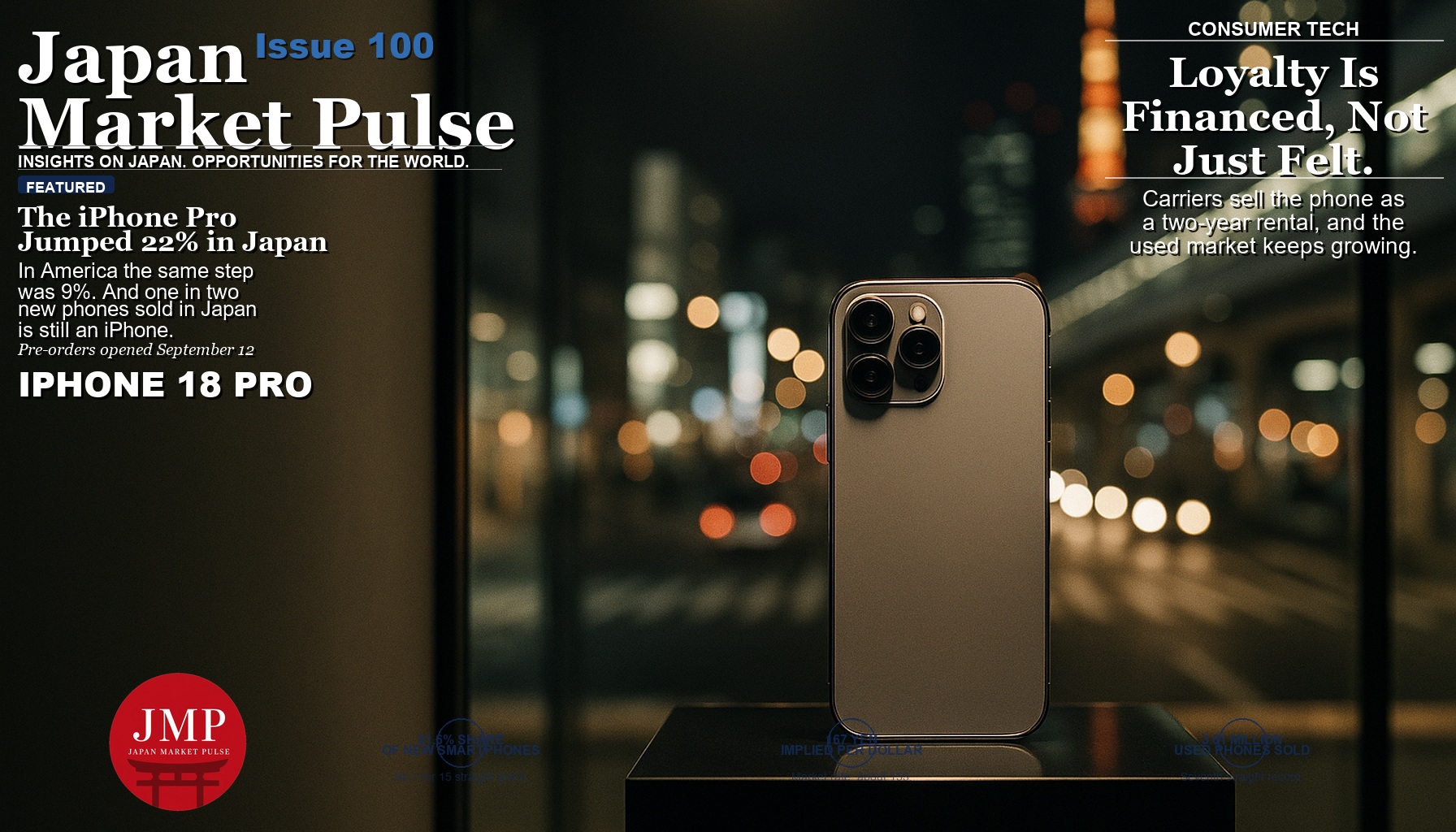
At 9 p.m. on Saturday, September 12, pre-orders opened in Japan for the iPhone 18 Pro. The entry model, with 256GB of storage, costs ¥219,800 at Apple’s own Japanese store, tax included. A year ago the equivalent iPhone 17 Pro launched at ¥179,800. That is a rise of ¥40,000, or 22%, in a single generation.
In the United States, the same step took the entry Pro from $1,099 to $1,199. That is 9%.
The gap does not stop at the entry model. The fully loaded iPhone 18 Pro Max with 2TB of storage costs ¥449,800 in Japan, ¥120,000 more than the top iPhone 17 Pro Max cost at launch. Apple’s first foldable, the iPhone Duo, starts at ¥364,800 and tops out at ¥574,800, the highest price Apple has ever put on an iPhone here. And alongside the launch, Apple raised the prices of the older phones it keeps on sale in Japan, for the second time since July. The standard iPhone 17 that cost ¥129,800 last September now costs ¥159,800, without a single change to the hardware.
I bought my first iPhone, an iPhone 3G, from a SoftBank shop in Tokyo in 2008, and I have watched this country fall for Apple harder than almost anywhere else. Japan is the rare large market where the iPhone is not a premium niche but the default phone. That is exactly what makes this year’s pricing worth studying. When a company raises prices faster in its most loyal major market than anywhere else, it is running a live experiment on how much loyalty is worth. Japanese consumers are already showing how they respond, and their answers are useful to anyone who sells a premium product across borders.
The Price Tag, Line by Line
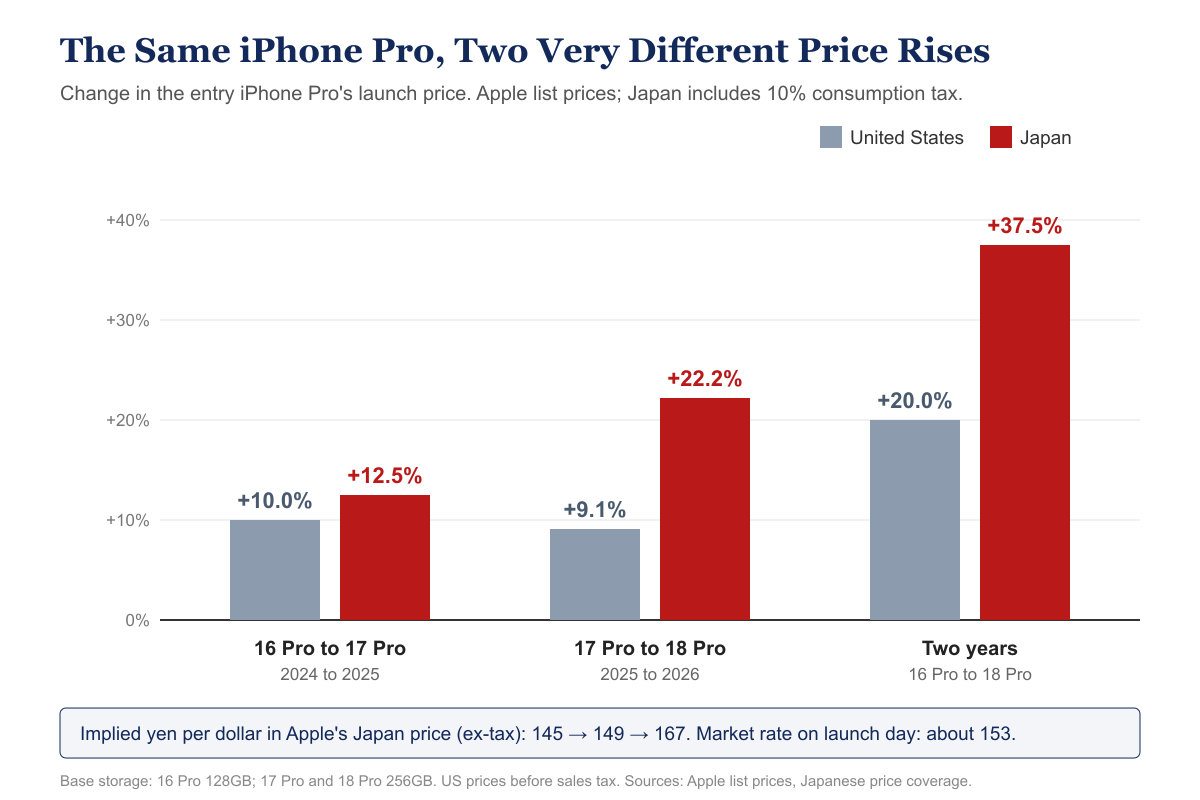
Start with the comparison Japanese tech media ran within hours of the announcement on September 9.
| Model (entry storage) | US price | Japan price (tax incl.) | Japan price (ex-tax) | Implied yen per dollar | |—|—|—|—|—| | iPhone 16 Pro (2024, 128GB) | $999 | ¥159,800 | ¥145,273 | about ¥145 | | iPhone 17 Pro (2025, 256GB) | $1,099 | ¥179,800 | ¥163,455 | about ¥149 | | iPhone 18 Pro (2026, 256GB) | $1,199 | ¥219,800 | ¥199,818 | about ¥167 |
American prices are quoted before sales tax, so the fair comparison strips Japan’s 10% consumption tax out of the yen figure. Do that, and the iPhone 18 Pro works out to roughly ¥167 per dollar. The Pro Max, at ¥239,800 against $1,299, lands at about ¥168. Business Insider Japan put the rate Apple appears to have used at around ¥166. The market rate in Tokyo on the day of the announcement was around ¥153.
In other words, Apple has priced its new phones in Japan as if the yen were roughly 8% to 9% weaker than it actually is.
Over two generations the divergence compounds. Since the iPhone 16 Pro, the entry Pro has risen 20% in dollars and 37.5% in yen. The base storage doubled from 128GB to 256GB with the iPhone 17 Pro, but that change applied equally in both countries, so it does not explain the gap between them. At the very top of the range the numbers become almost comic. The 2TB iPhone 18 Pro Max costs $2,499 in the US and ¥449,800 in Japan, roughly the price of a used compact car.
There are real cost pressures behind the headline. Japanese coverage points to the sharp rise in memory and storage chip prices, driven by demand from AI data centres, and those costs land on every market. But the currency cushion lands only on Japan. Apple sets a Japanese price roughly once a year and lives with it for twelve months while the yen moves daily. Building in a margin for a weaker yen is a rational hedge. It is also, from the point of view of a customer in Osaka, simply a higher price.
Two Price Rises Before the New Phone Even Arrived
The iPhone 18 launch was not the first time Japanese customers heard about higher prices this year. It was the third.
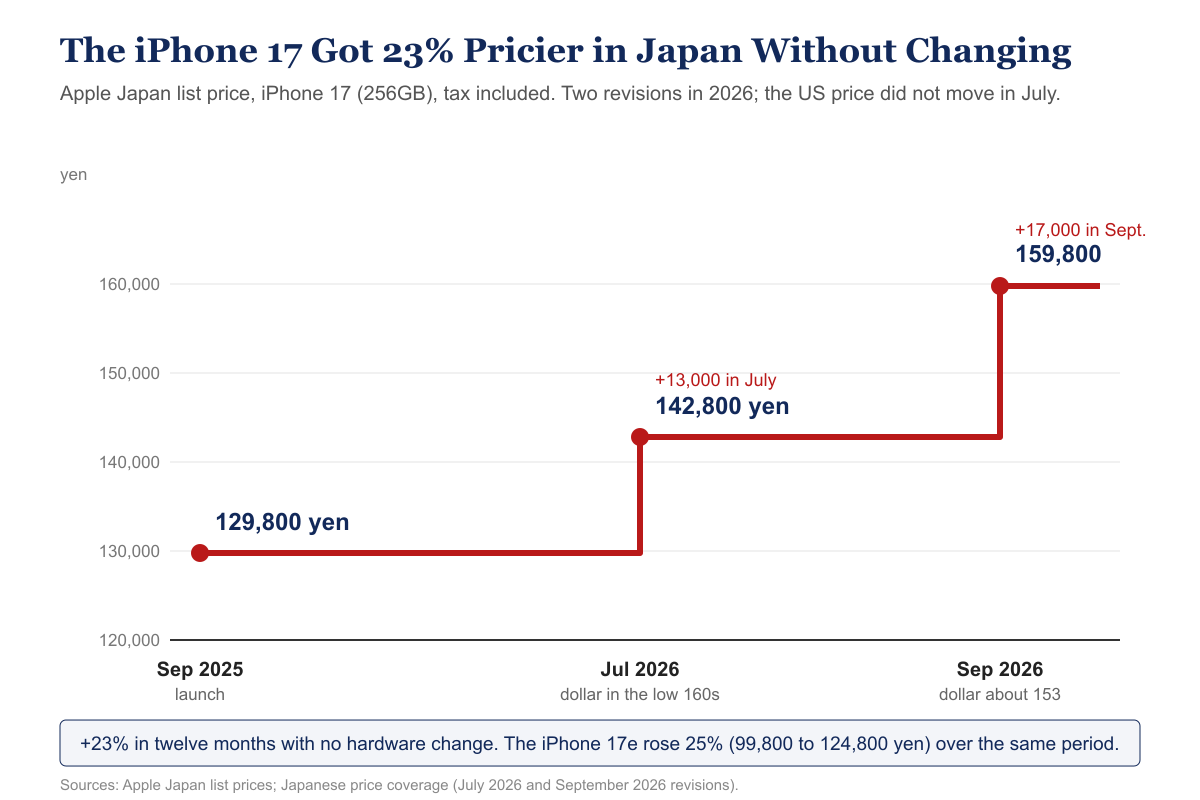
In mid-July, Apple raised prices across its Japanese range. The iPhone 17 went from ¥129,800 to ¥142,800. The iPhone 17 Pro went from ¥179,800 to ¥194,800, and the Pro Max from ¥194,800 to ¥214,800. The iPhone Air rose ¥18,000, the entry iPhone 17e rose from ¥99,800 to ¥107,800, and the older iPhone 16 rose ¥10,000. Apple Watch and AirPods went up too. American prices did not move. Japanese price-tracking sites attributed the change to the yen, which at the time was trading in the low ¥160s against the dollar.
Then, with the iPhone 18 announcement, Apple went back to the models it still sells and raised them again. The iPhone 17 now starts at ¥159,800 and the iPhone 17e at ¥124,800. According to ITmedia, the iPhone Air’s largest configuration rose by ¥47,000, about 19%, in one step. Put the two rounds together and the standard iPhone 17 is 23% more expensive than it was at launch a year ago. The 17e, the phone Apple positions as its affordable entry point, is 25% more expensive.
The twist is the currency itself. Between July and September the yen actually strengthened, from the low ¥160s to around ¥153. The stated logic of the July increase was a weaker yen. In September the yen was stronger and prices went up anyway.
Japanese consumers are not new to this. When the yen fell sharply in 2022, from around ¥115 to the dollar in March to the high ¥130s by July, Apple made its first large Japan-only price revision of the modern era. Since then, “Apple price revision” has become something close to a seasonal news event in Japan, like cherry blossom forecasts. It is covered in detail, complained about loudly, and then mostly absorbed.
The Most iPhone-Loyal Big Market in the World
To understand why Apple can do this, look at how dominant the iPhone already is.
In the fiscal year to March 2026, Apple shipped 16.15 million phones in Japan, up 4.9%, according to MM Research Institute. That was 50.1% of every mobile phone shipped in the country and 51.6% of smartphones. Apple has been the top phone maker in Japan for fifteen consecutive years and has held a majority of the smartphone market for four years running. Google is a distant second and Samsung third. For context, Counterpoint Research estimates Apple’s share of the global smartphone market at about 20% in 2025. In Japan it is two and a half times that.
The reasons are historical as much as commercial. SoftBank launched the iPhone 3G in Japan in July 2008 and bet its mobile business on it. When the two larger carriers followed, all three spent the next decade subsidising the phone so heavily that the most expensive handset on the market was often the cheapest one to walk out of a shop with. In 2016 Apple added FeliCa, the contactless chip behind Japan’s transit cards, to the iPhone 7 sold here, which made the iPhone a train pass and a wallet as well as a phone. Among younger Japanese, owning an iPhone became less a choice than a social default.
That loyalty has already survived one price shock. When the iPhone 17 series launched last year at higher prices, Counterpoint found that its cumulative sales in Japan over the first six weeks were still 6% ahead of the iPhone 16 series, led by the most expensive model, the Pro Max. In a market where demand has proved this inelastic, a company with pricing power will use it.
How Japan Actually Pays for a ¥219,800 Phone
Here is the part most foreign observers miss. Very few Japanese buyers pay the sticker price, and the way they do pay changes what a price rise means.
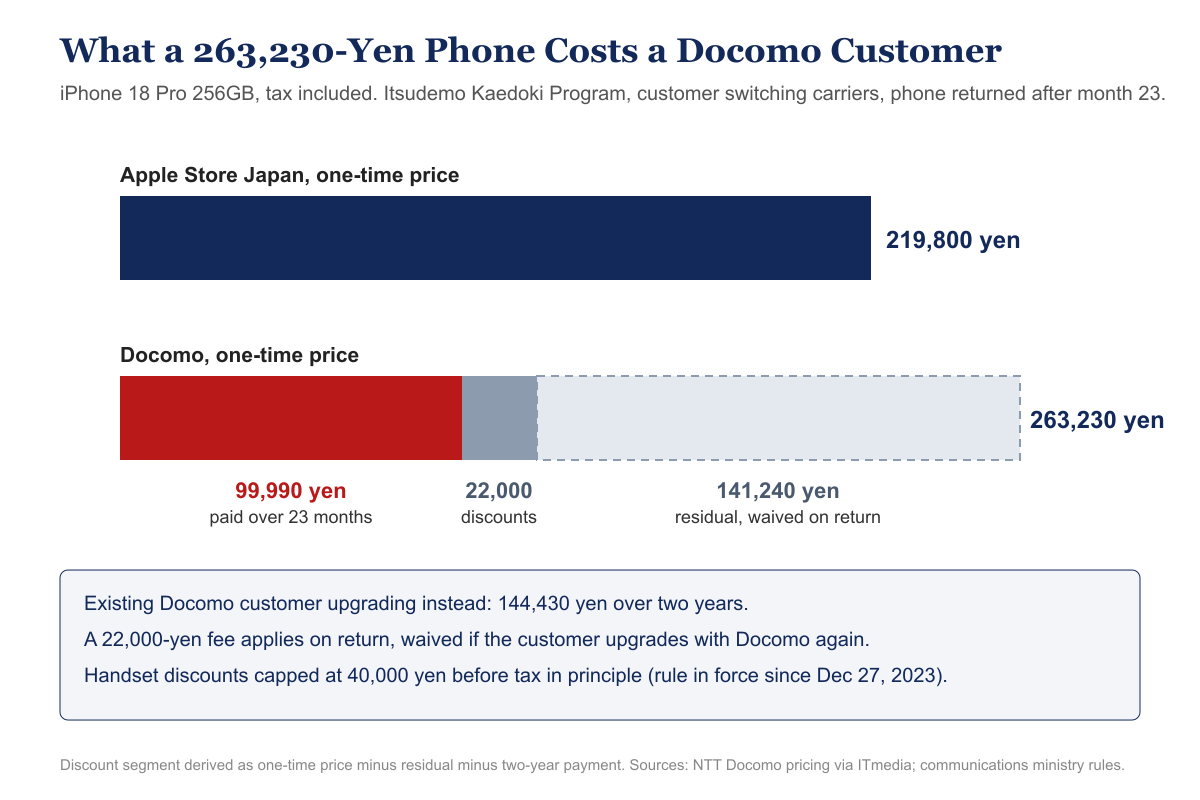
Look at NTT Docomo, Japan’s largest carrier. Its one-time price for the 256GB iPhone 18 Pro is ¥263,230 — about ¥43,000 more than Apple charges for the same phone in its own store. Almost nobody pays it. Instead Docomo sells the phone through its Itsudemo Kaedoki Program: 24 monthly instalments, with the right to hand the phone back after the 23rd month and have the remaining balance waived. A customer switching to Docomo from another carrier pays ¥99,990 over two years. An existing Docomo customer upgrading pays ¥144,430. The part of the price Docomo expects to recover by reselling the phone, the residual, is ¥141,240. There is a ¥22,000 fee when the phone goes back, waived if the customer upgrades with Docomo again. According to Japanese carrier comparisons, the effective two-year cost at the major carriers falls somewhere around ¥70,000 to ¥100,000 for customers who switch.
This structure is partly a product of regulation. From December 27, 2023, Japan’s communications ministry capped handset discounts at ¥40,000 before tax in principle, and extended the cap to phones sold without a contract. That ended the era of the ¥1 smartphone. The carriers responded by moving the value from the discount into the residual. In practice, the Japanese iPhone buyer is not buying a phone. They are renting one for two years, and the carriers are betting on what a used iPhone will be worth in 2028.
That bet is why the iPhone’s pricing power in Japan is sturdier than the sticker suggests. A phone that holds its resale value supports a high residual, and a high residual keeps the monthly payment tolerable even when the list price jumps. For a switching customer at Docomo, the new Pro works out to around ¥4,300 a month over 23 months.
America is moving in the same direction. In July 2026 Apple replaced its US iPhone Upgrade Program with Apple Upgrade, a lease backed by Klarna that starts at $17.99 a month. It is available only in the United States. Japanese carriers have been running the leasing model under another name for years.
The Used Phone Boom Is the Pressure Valve
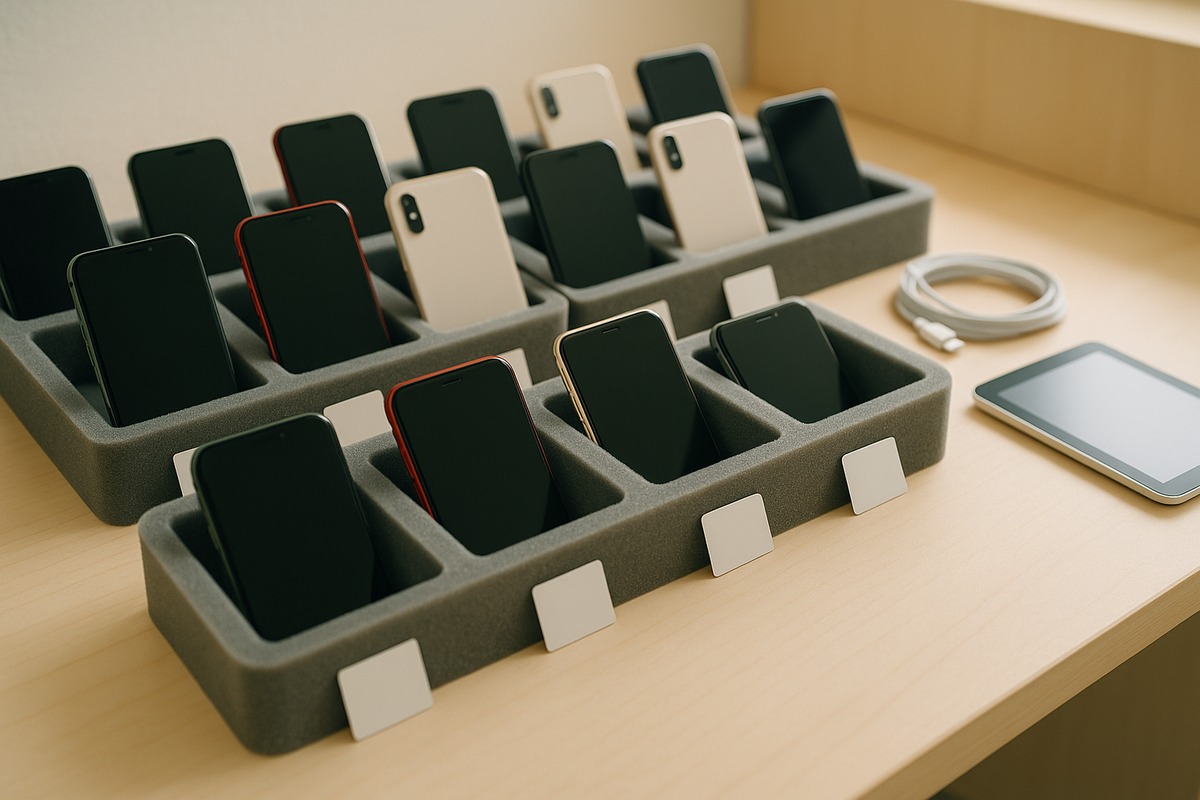
If the leasing model is how Japan absorbs a higher price, the used market is where it escapes it.
MM Research Institute counted 3.61 million used smartphones sold in Japan in the fiscal year to March 2026, up 12.4% and a record for the seventh year in a row. Used phones now account for 10.3% of all smartphones sold, new and used combined. The firm expects 3.96 million used units this fiscal year and more than 5 million by fiscal 2029, when used phones would pass 15% of the market. Its forecast for new smartphones points the other way: shipments are expected to fall about 7% this fiscal year, to 29.15 million, largely because rising memory prices are pushing up the cost of new devices.
The channels that feed the used market have multiplied. Consumer-to-consumer apps such as Mercari and Rakuten Rakuma sell huge volumes of phones. The carriers sell certified refurbished devices, many of them phones returned through exactly the residual-value programmes described above. Apple, Google and Samsung all have certified refurbished offers of their own. The loop is neat: the carriers’ two-year rentals become the next buyer’s certified used iPhone.
For Apple, this is not entirely bad news. A Japanese customer who moves from a new Pro to a certified iPhone 15 or 16 is still an iPhone customer, still paying for iCloud storage and still inside the ecosystem. What Apple loses is the hardware sale, and the higher it pushes new prices, the more of those sales it hands to its own older products.
The Foldable Test: ¥364,800
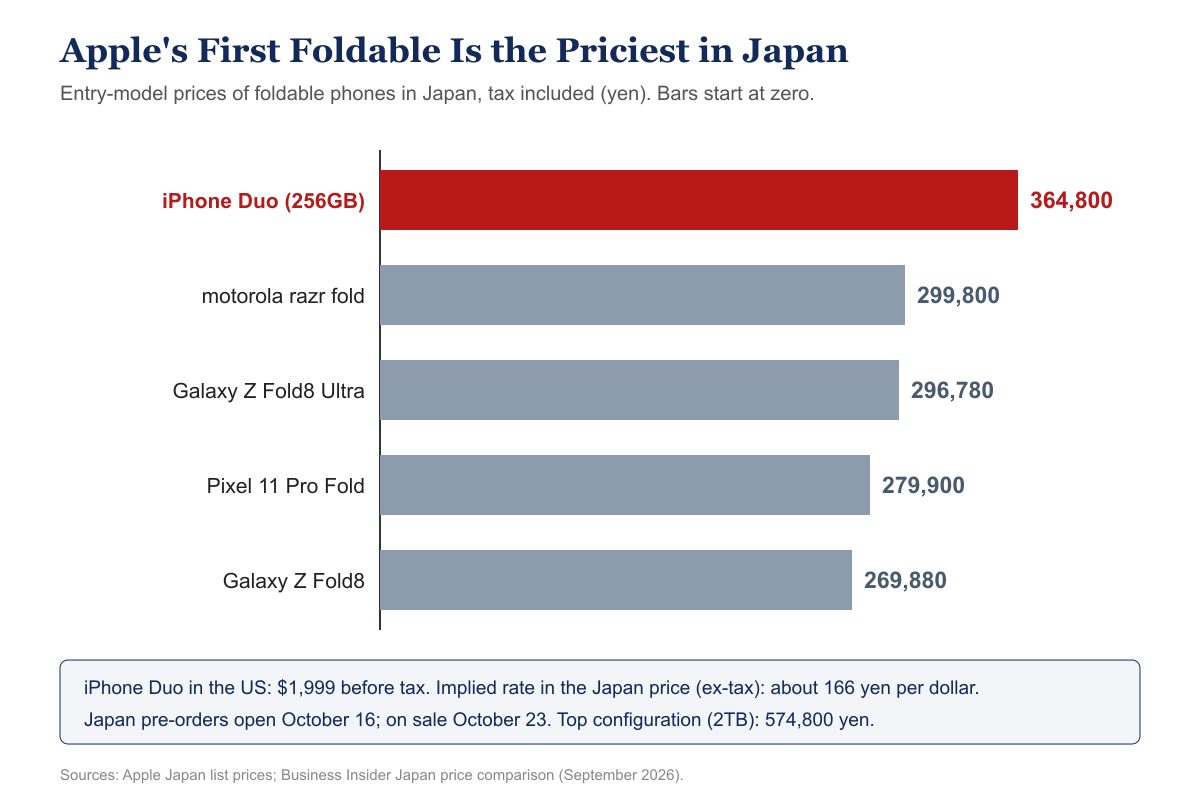
The iPhone Duo is where Apple’s Japanese pricing will be tested hardest, because this time it is not the default choice. It is the newcomer in a category that other companies have spent years building.
| Foldable phone (Japan, entry model) | Price (tax incl.) | |—|—| | iPhone Duo (256GB) | ¥364,800 | | motorola razr fold | ¥299,800 | | Galaxy Z Fold8 Ultra | ¥296,780 | | Pixel 11 Pro Fold | ¥279,900 | | Galaxy Z Fold8 | ¥269,880 |
The Duo starts about ¥95,000 above the Galaxy Z Fold8. As Business Insider Japan pointed out, no other phone with 256GB of storage is priced above ¥300,000 in Japan. Against its $1,999 US price, the Duo’s ex-tax Japanese price again implies about ¥166 to the dollar. Pre-orders open on October 16 and the phone goes on sale on October 23.
Foldables have so far stayed a niche in Japan, and at this price the Duo is unlikely to change that on its own. But the iPhone brand has a habit of turning niches into categories here. If the Duo sells well at ¥364,800, it will confirm that Japanese iPhone loyalty extends to form factors Apple did not invent. If it struggles, it will be the first clear evidence that Apple’s Japanese price curve has found its ceiling.
What Apple Is Really Protecting

It would be easy to read all this as a company squeezing a captive market. The more interesting reading is that Apple is protecting something.
The first thing is price parity. For much of 2023 and 2024, the weak yen made Japan one of the cheapest places in the world to buy a new iPhone, and visitors noticed. Tax-free iPhones became a staple of the tourist shopping list, and resellers exported them. Today that arbitrage is gone. Even a tourist who skips the consumption tax pays ¥199,818 for the entry iPhone 18 Pro, which at ¥153 or ¥154 is about $1,300 — roughly 8% more than the US sticker price before tax.
The second is margin insurance. A global company that sets prices once a year and sells in dozens of currencies has to choose between chasing every exchange-rate move and building in a buffer. In Japan, where the yen has been one of the most volatile major currencies of the past four years, Apple has chosen the buffer.
The third is a changing profit mix in Japan itself. Since December 18, 2025, Japan’s Mobile Software Competition Act has required Apple to allow alternative app marketplaces and third-party payments on iPhones in Japan, under a new fee structure that ranges from 5% to 26%. It would be a stretch to link the hardware prices directly to that law. But the timing is worth noting: in the market where Apple’s App Store economics have become least certain, the part of the business it still fully controls is the price of the phone.
What Operators Should Take From This
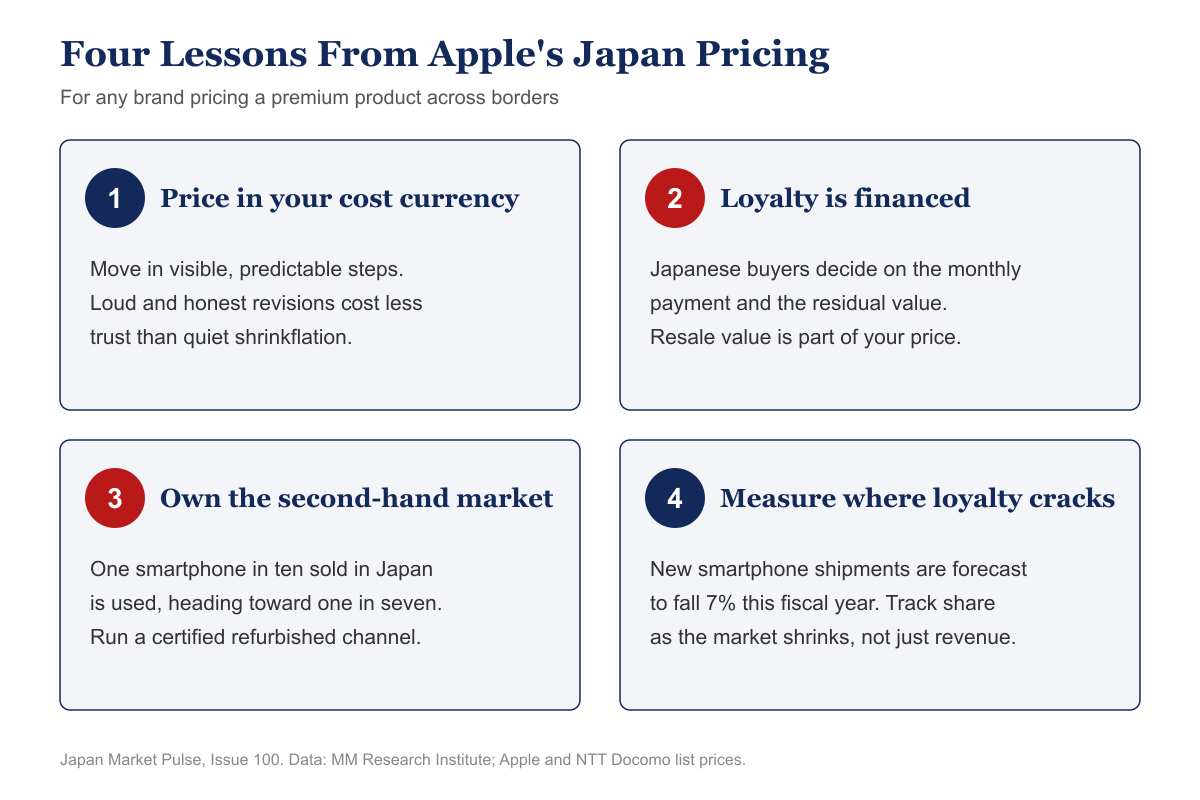
Four lessons travel well beyond smartphones.
First, price in the currency of your costs, and move in visible steps. Apple’s Japanese price revisions are loud, broad and timed to predictable moments. Customers complain, but they do not feel ambushed. Foreign brands selling in Japan often do the opposite, adjusting quietly or shrinking the product, and that tends to cost more trust than an honest price change.
Second, in Japan loyalty is financed, not just felt. The purchase decision is made on the monthly payment and the residual value, not the sticker. A product that holds its resale value can carry a higher list price. If you sell durable goods into Japan, resale value is part of your pricing strategy, and return or trade-in programmes are part of your distribution.
Third, the secondary market is part of your market. One smartphone in ten sold in Japan is already used, and that share is heading toward one in seven. Brands that own a certified refurbished channel keep those customers. Brands that do not hand them to Mercari.
Fourth, watch for the point where loyalty cracks, and measure it properly. New smartphone shipments in Japan are forecast to fall this year. If Apple’s share holds as the market shrinks, its pricing is working. If used phones and cheaper Android models take the difference, the experiment will have found its limit. The same test applies to any premium brand that prices a loyal market harder than the rest.
Frequently Asked Questions
Q. How much does the iPhone 18 Pro cost in Japan compared with the US?
A. At Apple’s Japanese store the iPhone 18 Pro starts at ¥219,800 for 256GB and the Pro Max at ¥239,800, including 10% consumption tax. In the US they start at $1,199 and $1,299 before sales tax. Removing Japan’s tax, the Japanese prices imply an exchange rate of about ¥167 to the dollar, against a market rate of around ¥153 on the day of the announcement.
Q. Is it still cheaper to buy an iPhone in Japan as a tourist?
A. Not any more for the new models. A tax-free iPhone 18 Pro costs ¥199,818 in Japan, which is about $1,300 at recent exchange rates, roughly 8% above the US price before sales tax. During 2023 and 2024, when the yen was weaker against Apple’s Japanese pricing, Japan was among the cheapest places to buy an iPhone. That gap has now closed.
Q. Why did Apple raise iPhone prices in Japan twice in 2026?
A. Apple does not explain its price changes. Japanese coverage attributed the July increase mainly to the weak yen, and the broader pressure to rising memory and storage chip costs. The second round, in September, came with the iPhone 18 launch even though the yen had strengthened since July, which suggests Apple is building a buffer against future currency swings into its Japanese prices.
Q. How do most Japanese buyers pay for an iPhone?
A. Most buy through a mobile carrier on a 24-month instalment plan with a residual-value option. At NTT Docomo, a customer who switches carriers can use the iPhone 18 Pro for two years for an effective ¥99,990 by returning it after the 23rd month, even though the carrier’s one-time price is ¥263,230. Discounts on the handset itself are capped by regulation at ¥40,000 before tax in principle.
Conclusion
The easy headline about the iPhone 18 in Japan is that it is expensive: ¥219,800 for the entry Pro, ¥449,800 for the top Pro Max and ¥574,800 for the largest foldable. The more useful story is how the pricing works. Apple has raised its Japanese prices far faster than its American ones this year, and it has done so in the one large market where half of all new phones are already iPhones.
Japanese consumers have not walked away. They have adapted, through carrier programmes that turn a phone into a two-year rental, through a used market that sets a new record every year, and by stepping down to older and cheaper models while staying inside Apple’s ecosystem. Whether that adaptation has a limit will show up over the next year, in the shipment data and in how many people pay ¥364,800 for a folding iPhone.
For anyone pricing a premium product across borders, Japan in 2026 is the clearest case study available of what loyalty will absorb, and how customers quietly re-engineer the way they pay when a brand pushes it.
If you’re interested in this topic, the Japanese market more broadly, or what KETCHUPs is working on, we’d love to hear from you — please reach out via our contact form.
Japan Market Pulse is a weekly read on what the Japanese consumer-tech, food, and mobility markets are choosing to do, written for international operators who want to know what is happening before it shows up in the global trade press.
Subscribe at ketchups.co/japan-market-pulse.