

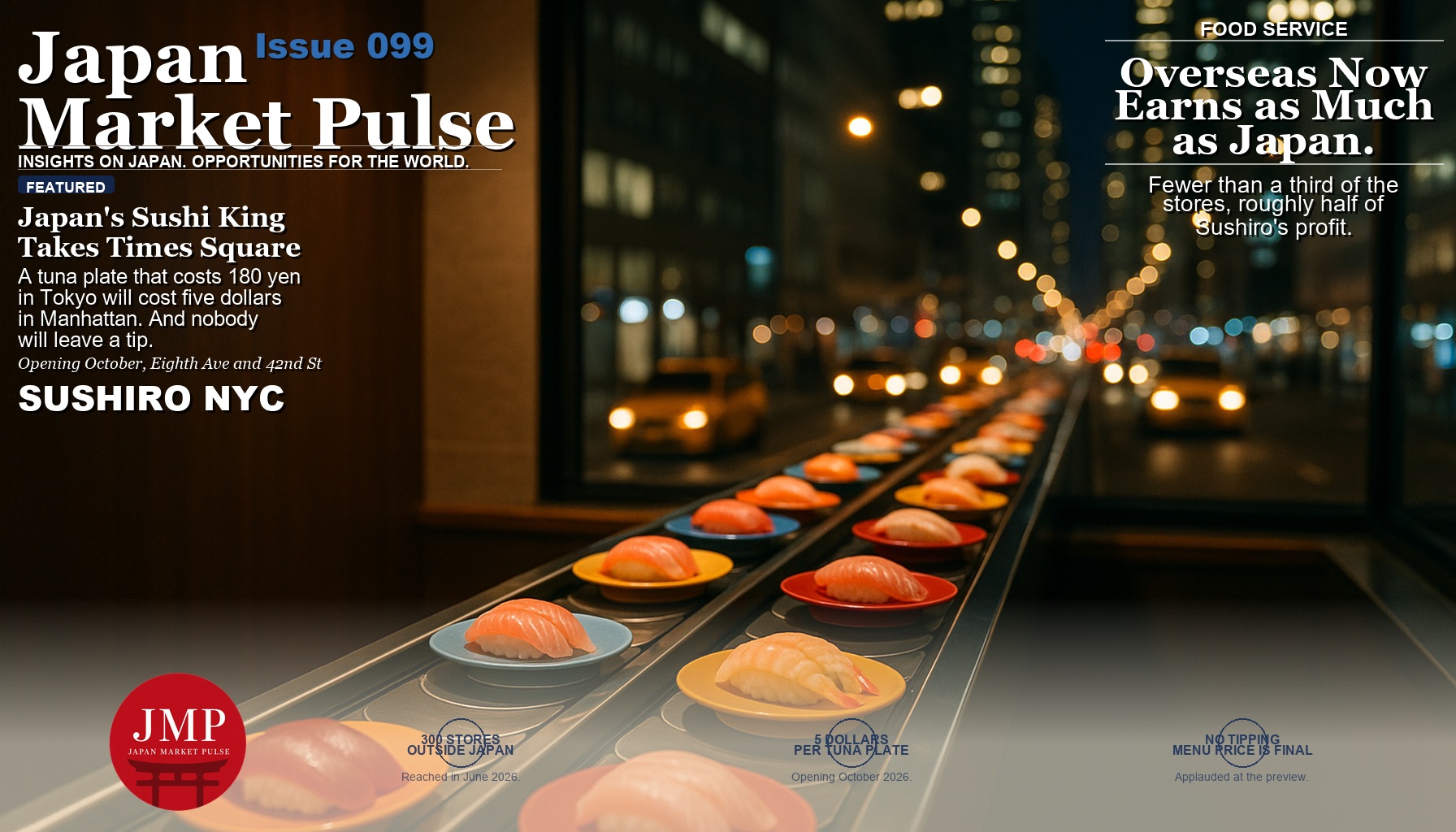
In October, on the corner of Eighth Avenue and 42nd Street, in a three-storey building that used to be a McDonald’s, Japan’s largest conveyor-belt sushi chain will open its first restaurant in the United States.
The chain is Sushiro. In Japan it is not a destination. It is where families go on a Tuesday night because the kids are hungry and nobody wants to cook. A plate of tuna at a Tokyo branch costs ¥180. In the suburbs it is cheaper still. Plates of salmon and shrimp still start at ¥120. You tap your order into a tablet, the plates arrive on a little express lane, and a family of four walks out having spent roughly what a pair of cinema tickets costs.
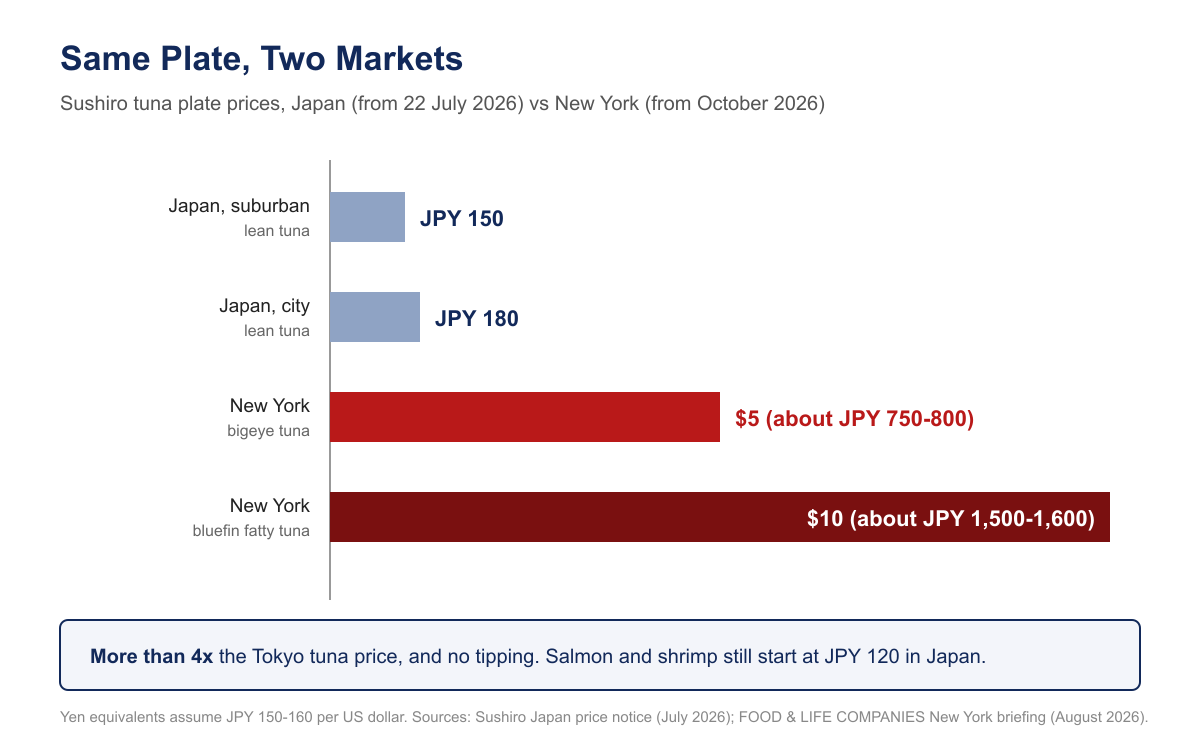
In Manhattan a comparable plate — bigeye tuna — will be $5. Fatty bluefin tuna will be $10. A shrimp double-cheese roll, invented for American tastes, will be $14. At ¥150 to ¥160 to the dollar, that tuna plate is roughly four times the Tokyo price. And there will be no tipping. When the company announced that detail at a preview event in New York at the end of August, the room applauded, according to SoraNews24’s account of the event.
I have lived in Japan for twenty years and eaten at more Sushiro branches than I would like to admit. What interests me about the New York opening is not the sushi. It is the arithmetic behind it. Sushiro’s parent company, FOOD & LIFE COMPANIES, has quietly become a business in which the overseas restaurants now earn about as much as the Japanese ones, from well under half as many stores. The home market that built the brand has stopped being big enough to carry it. Times Square is where a Japanese mass-market chain finds out whether its model works in the hardest restaurant market in the world.
For anyone thinking about taking a Japanese brand abroad, or bringing a foreign one into Japan, this is one of the more instructive experiments of the year.
The Numbers Behind the Move
Start with the financials, because they explain the timing.
FOOD & LIFE COMPANIES, usually shortened to F&LC, runs Sushiro alongside a handful of smaller restaurant brands. In the fiscal year to September 2025 it reported revenue of ¥429.6 billion, up 19%, and operating profit of ¥36.1 billion, up 54%. Those are strong numbers for a company whose core product is inexpensive sushi on a belt.
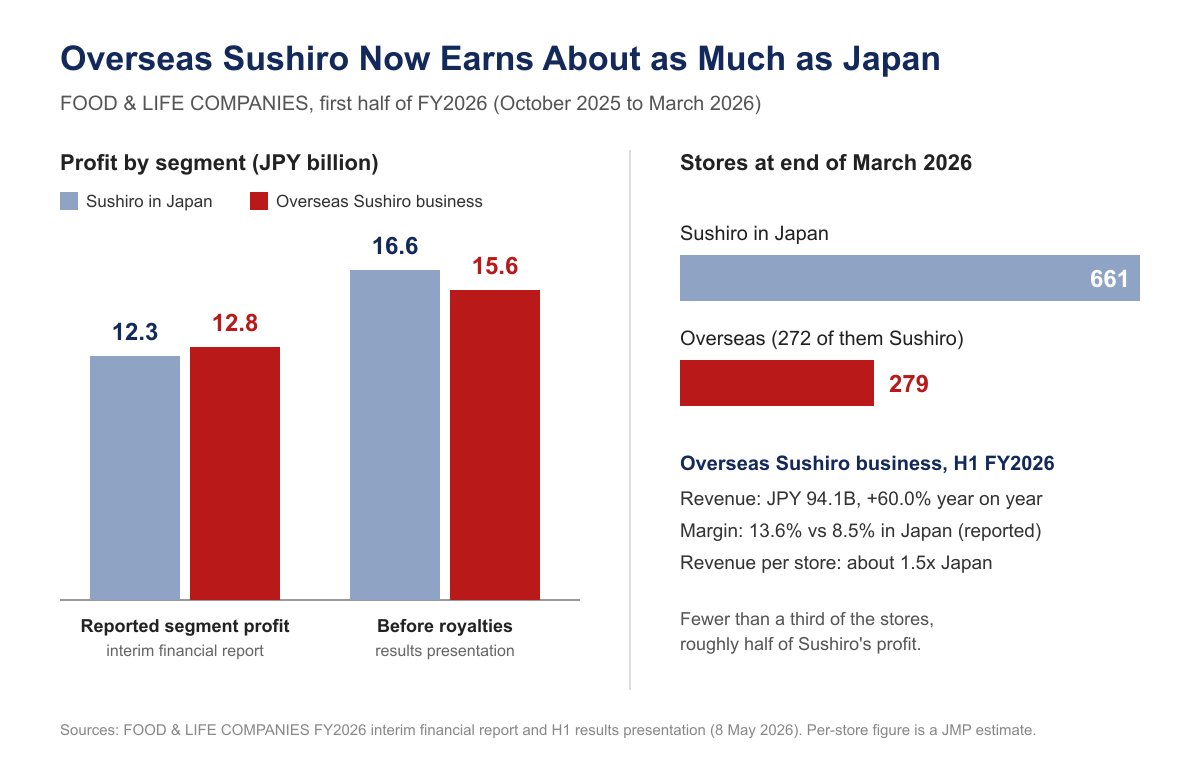
The more revealing figures came in the first half of the current fiscal year, October 2025 to March 2026. Consolidated revenue rose about 25% to ¥254.2 billion, and operating profit rose about 44% to ¥28.1 billion. Inside those totals the overseas Sushiro business grew revenue by 60% to ¥94.1 billion. In the interim financial report, its segment profit doubled, up 100.3% to ¥12.76 billion, while domestic Sushiro’s rose 10% to ¥12.30 billion on revenue of ¥144.5 billion.
Read that twice. On the reported segment basis, the Sushiro business outside Japan made slightly more money than the Sushiro business inside it, for the first time. The company’s own results presentation, which shows operating profit before royalty payments and counts a handful of non-Sushiro overseas stores in the same segment, puts it a fraction behind: ¥15.63 billion overseas against ¥16.63 billion in Japan. Either way, the two halves are now roughly level. And the overseas half got there with far fewer stores: 279 at the end of March, 272 of them Sushiro, against 661 Sushiro restaurants in Japan.
A back-of-envelope calculation from the reported half-year figures makes the gap vivid. Divide segment revenue by store count and an overseas store took in roughly ¥337 million in six months, against about ¥219 million for a Sushiro in Japan — about 1.5 times as much. It is also doing it at a higher margin on either basis: about 13.6% against 8.5% on the reported segment figures, or about 16.6% against 11.5% before royalties.
The company’s long-range target makes the direction explicit. Its FY35 vision calls for net sales of ¥1 trillion or more by fiscal 2035, with 55% of that coming from outside Japan. Its current mid-term plan aims for an overseas share of 35% in the year ending this month. It is already running slightly ahead of that.
That is not a company dabbling in export. It is a company whose centre of gravity is moving.
Why Japan Stopped Being Enough
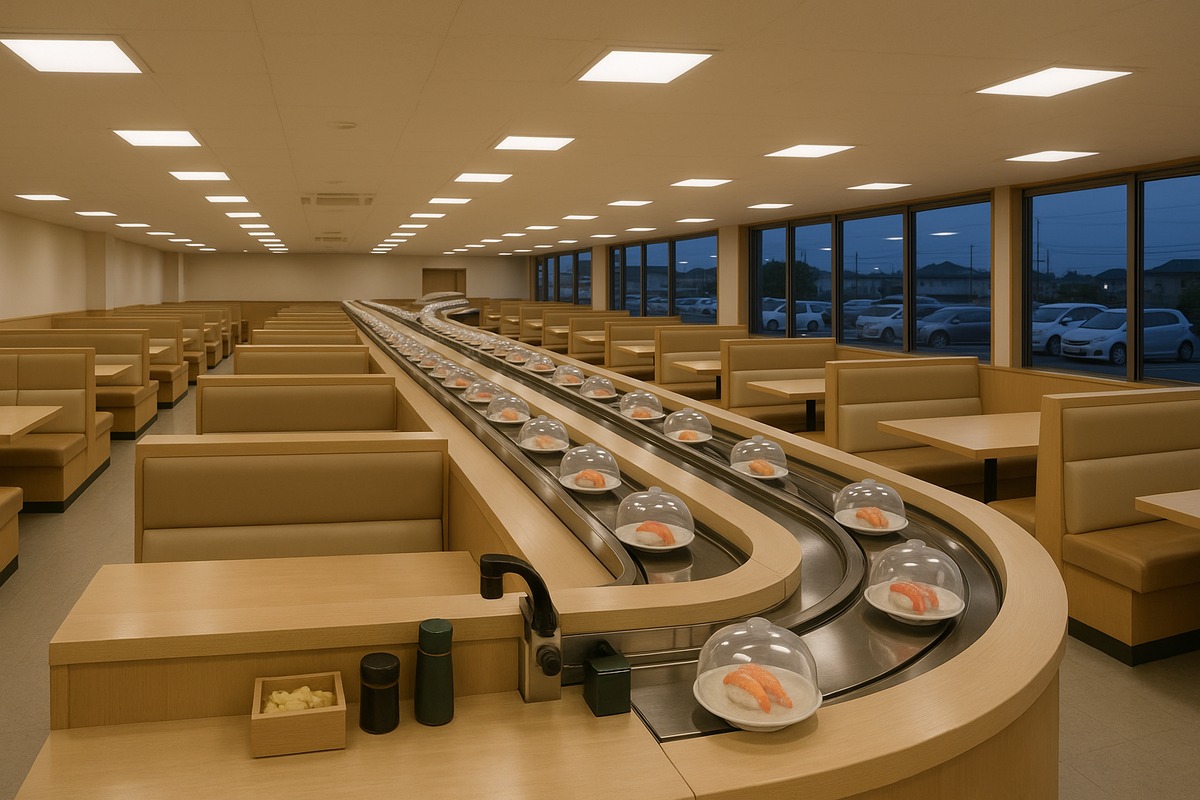
Nothing is wrong with Sushiro at home. It has been the top-selling conveyor-belt sushi chain in Japan by annual net sales for fourteen consecutive years. The problem is the market it leads.
Conveyor-belt sushi in Japan is a mature, crowded, price-anchored category. For decades the defining promise was the ¥100 plate, and when Sushiro finally abandoned it in October 2022 it made national news. Since then the chain has raised prices repeatedly. The most recent round came on 22 July 2026, when about a tenth of its standard menu went up by ¥20 to ¥30. The entry price for its selected lean tuna moved from ¥120 to ¥150 at suburban branches and from ¥150 to ¥180 at city branches. Salmon and shrimp held at ¥120. The company said it had concluded it could no longer absorb rising costs through its own efforts.
Every one of those increases is fought over in the Japanese press. Sushiro’s customers are highly price-sensitive, and it competes against rivals who are just as ruthless on cost: Kura Sushi, Hama-zushi, owned by the restaurant group Zensho, and a long tail of regional chains. Fish, rice, energy and labour costs have all risen. In a market where a ¥30 increase on a plate of tuna is a news story, pricing power is thin.
Then there is the demographic ceiling that every Japanese consumer business now plans around. Japan’s population is shrinking, it is ageing fast, and the suburban family that fills a conveyor-belt booth on a weekday night is a declining unit. Domestic Sushiro is still growing, at 10% in segment profit last half, but it is growing inside a box whose walls are visible.
The logic that follows is one I have watched play out across Japanese consumer companies for twenty years: take what the home market has made brutally efficient, and sell it somewhere that will pay more for it. Uniqlo did it with clothing. Daiso did it with household goods. Sushiro is attempting it with the most Japanese food category of all.
Asia Was the Rehearsal
The United States is not Sushiro’s first overseas market. It follows a long rehearsal across Asia.
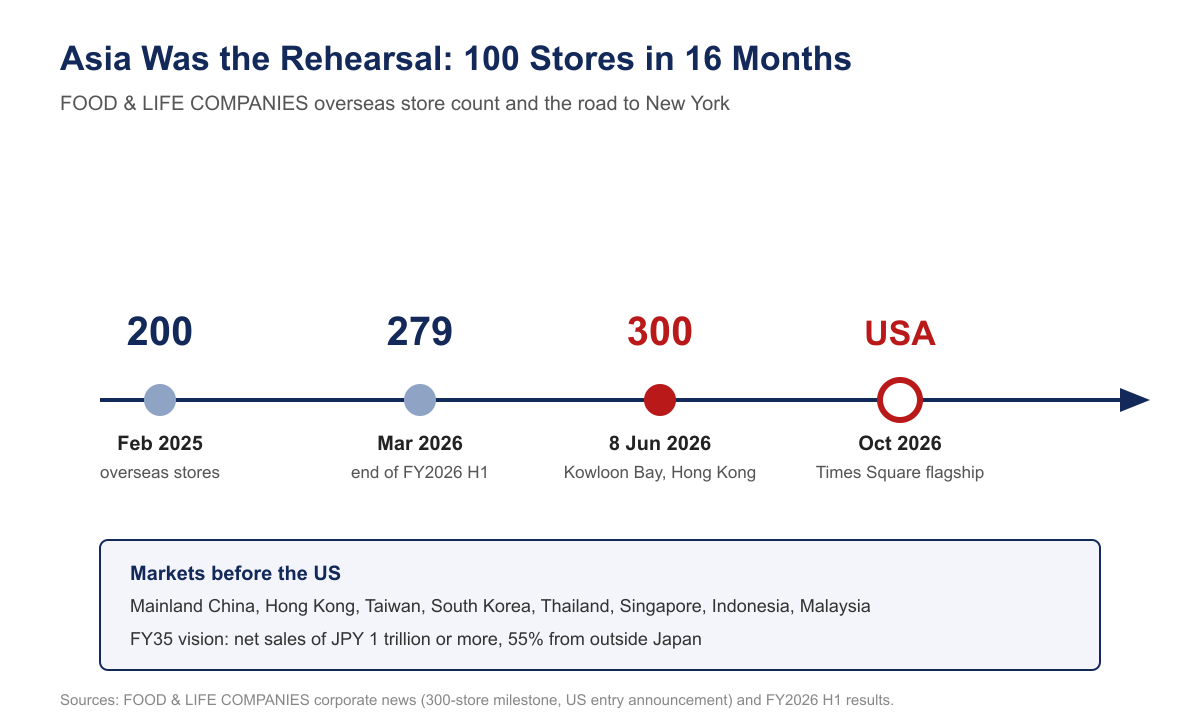
The international expansion began in Asia, and Asia is still where the scale is. The company reached 200 overseas stores in February 2025. It reached 300 on 8 June 2026, when a Sushiro opened at Amoy Plaza in Kowloon Bay, Hong Kong. That is roughly 100 stores in 16 months. Along the way it opened in places that say something about the brand’s ambitions. It opened inside Mandai Wildlife Reserve in Singapore in June 2025, in a Phuket shopping centre in November 2025, and at Shanghai’s Global Harbor mall in December 2025.
Its markets now include mainland China, Hong Kong, Taiwan, South Korea, Thailand, Singapore, Indonesia and Malaysia. Greater China is where profit growth has been strongest. In Hong Kong and several mainland cities, Sushiro queues have become a phenomenon in their own right. Waits of an hour or more are common at popular branches.
Two features of the Asian model matter for New York.
The first is ownership. F&LC talks about expanding through directly operated stores, keeping control of operations rather than handing the brand to franchisees, even where it holds 50% or less of the equity in a market. That is expensive and slow, but it protects the product, and in a category where freshness and consistency are the product, that is the point.
The second is positioning. In Japan, Sushiro is everyday dining. In much of Asia it is priced and perceived as an affordable treat, a notch above casual. The brand carries a premium simply for being authentically Japanese. That positioning gap is where the margin comes from, and it is what F&LC is betting it can reproduce in America.
Why America Is the Hard Part
Sushiro is arriving in a market where a Japanese rival has already written the manual. It is not a flattering read.
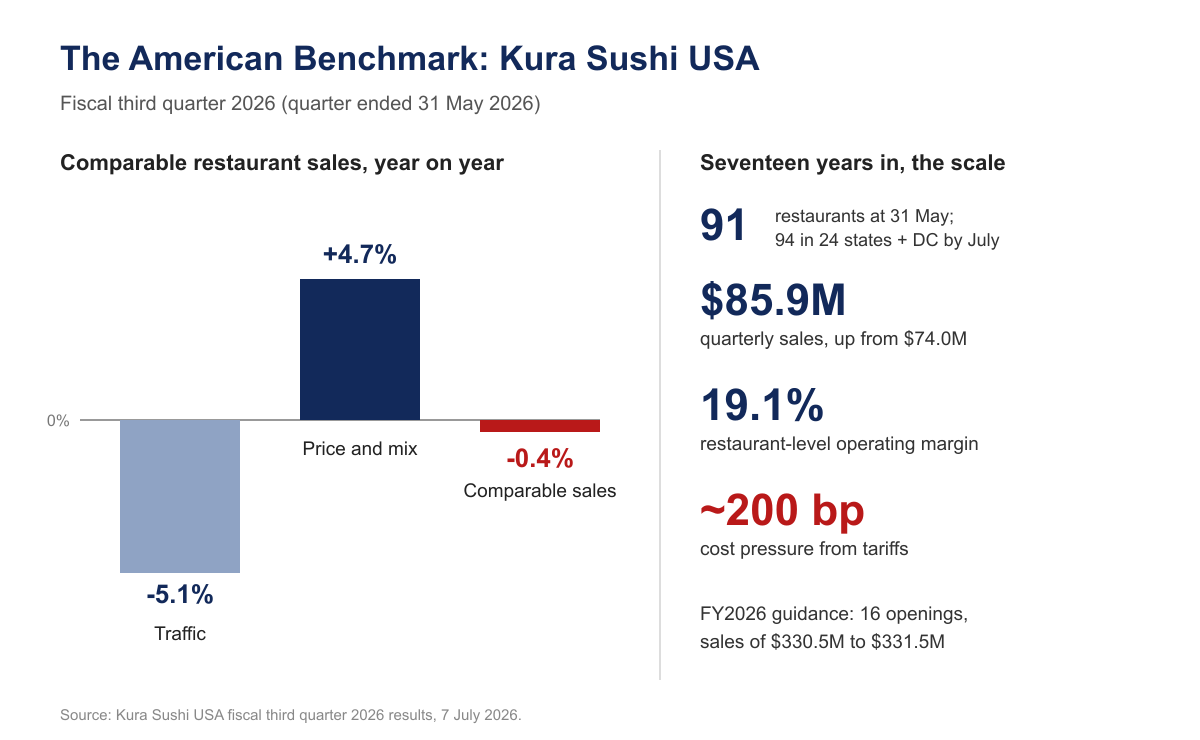
Kura Sushi entered the United States in 2008, opened its first American restaurant in Irvine, California, in 2009, and listed its US subsidiary, Kura Sushi USA, on Nasdaq in 2019. At the end of May 2026 it had 91 restaurants. Three more opened shortly afterwards, in Tulsa, suburban Austin and Charlotte, taking it to 94 locations across 24 states and Washington, DC, by early July. It is targeting 16 openings this fiscal year and total sales of roughly $331 million.
That is a real business built over seventeen years. The most recent quarter also shows how hard the American consumer is being right now. Kura Sushi USA’s sales rose to $85.9 million from $74.0 million a year earlier, driven by new restaurants. But comparable-restaurant sales fell 0.4%. Underneath that small number, customer traffic fell 5.1%, offset by a 4.7% gain from price and menu mix. Put plainly, fewer people came in and each paid more. The company still improved its restaurant-level margin to 19.1%, and it did so while absorbing roughly 200 basis points of cost pressure from tariffs on imported goods.
Zensho, the group that owns Hama-zushi, took a third route into America — and not under the Hama-zushi name. In 2018 it bought Advanced Fresh Concepts, one of the largest franchisors of sushi counters inside US supermarkets. It chose not to fight for restaurant real estate at all, and to put sushi in front of shoppers where they already were.
So by the time Sushiro opens its doors, all three of the groups behind Japan’s big conveyor-belt chains will have a stake in the American market, each with a different theory of the customer. Kura bet on the suburban experience: a family restaurant with games, prizes and a conveyor belt as entertainment, spread across Sun Belt states. Zensho bet on distribution. Sushiro is betting on a flagship at the most visible intersection in the country, and on the idea that the quality of the product itself will carry the brand.
The $5 Plate: Same Fish, Different Business
It is tempting to read a $5 plate of tuna against a ¥180 plate in Tokyo and conclude that Sushiro is gouging New Yorkers. That misreads what a restaurant price is.
The plate price in Japan is the product of an extraordinarily tight operating system. Fish is bought at enormous scale, rice is cooked and shaped by robots, orders come through tablets, and a small crew runs a restaurant with a hundred-plus seats. Rents are modest in the suburbs where most branches sit, and wages, while rising, remain far below Manhattan levels. The ¥180 plate is not a discount. It is what the Japanese system produces when it runs at full efficiency.
Almost every input to that system costs several times more in Midtown. Commercial rent on a three-storey corner building steps from Times Square — about 9,000 square feet, according to Time Out New York — belongs to a different universe from a roadside lot outside Osaka. New York’s hourly wages for restaurant staff are among the highest in the country. Imported fish and ingredients carry freight and, now, tariff costs. Kura Sushi’s latest numbers show that even an established operator is paying a visible margin penalty for them.
Against that backdrop, $5 for bigeye tuna is not an outlier in Manhattan. Plenty of neighbourhood sushi restaurants charge that or more per piece, and the city’s omakase counters charge hundreds of dollars a head. Sushiro is pitching itself in the wide gap between the $12 supermarket tray and the $300 tasting menu. It offers the precision of a Japanese system at a price that feels democratic by New York standards, even if it looks extravagant from Tokyo.
The more important number is the one Sushiro has not published: what the New York restaurant needs to sell to pay for itself. The Asian data suggests the company is confident that a well-positioned overseas store can do far more volume than a Japanese one. A 150-seat flagship in a location with Times Square foot traffic is designed to test that at the extreme.
No Tipping in Times Square
The reported applause at the New York preview was not for the tuna. It was for the no-tipping policy, and that detail tells you a lot about how the American restaurant customer feels in 2026.
Tipping in the United States has crept well beyond the sit-down restaurant. It now appears on counter-service screens, self-checkout kiosks and takeaway orders, often starting at 18% or 20%. Survey after survey has found American consumers increasingly irritated by it. Against that mood, a restaurant that simply says the menu price is the price is making a marketing statement as much as a pricing one.
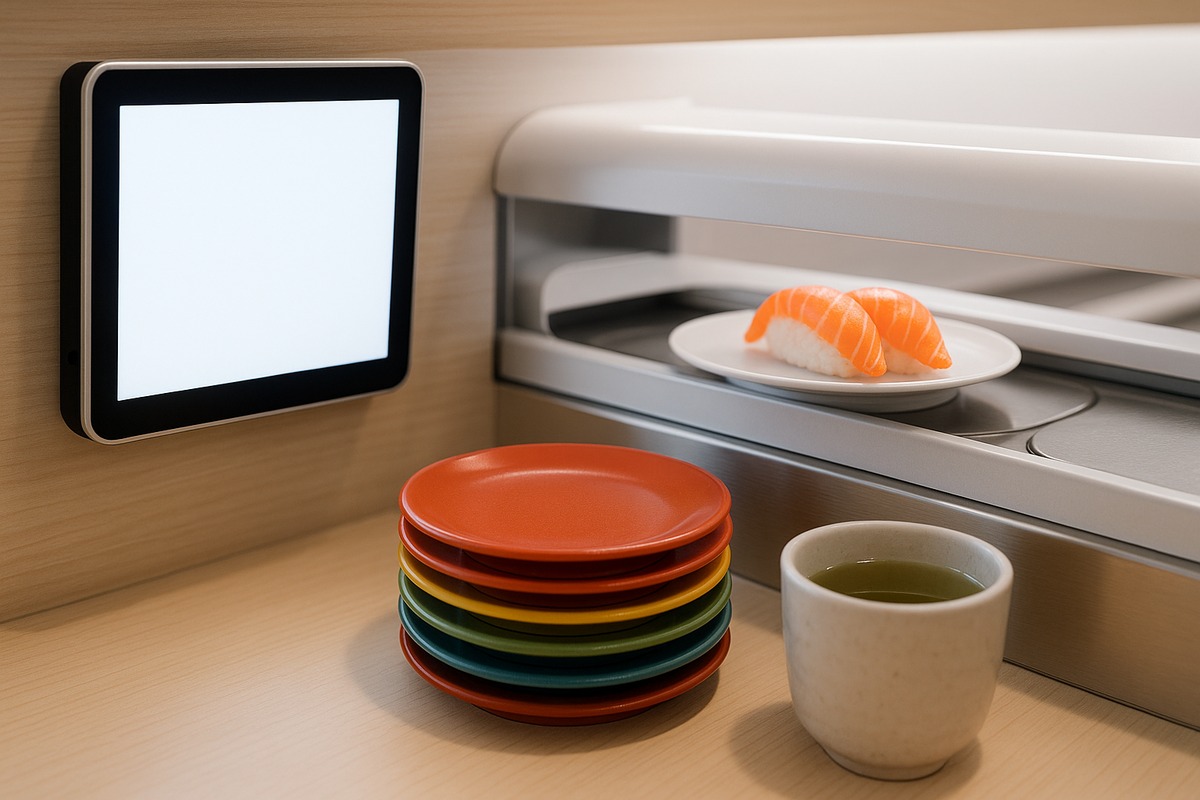
For a Japanese operator the policy is also just natural. Tipping does not exist in Japanese restaurants. The entire Sushiro service model is built around minimising the interactions that American tipping culture pays for. Customers order through a touchscreen. Dishes arrive by conveyor or an express lane that stops at the booth. Staff clear plates and refill the tea, but there is no waiter taking orders or presenting a bill with a line for gratuity. In New York the company will use a large-display ordering system. It is the same logic scaled up for a flagship.
What remains to be seen is how the economics absorb it. In a no-tipping restaurant the cost of paying staff a competitive wage has to sit inside the menu price. That is one more reason the plate prices look the way they do. American diners who have been primed to compare a menu price with a total bill including an 18% to 20% tip may find Sushiro cheaper than it looks. Diners who compare it with Tokyo will not.
Why Times Square, of All Places
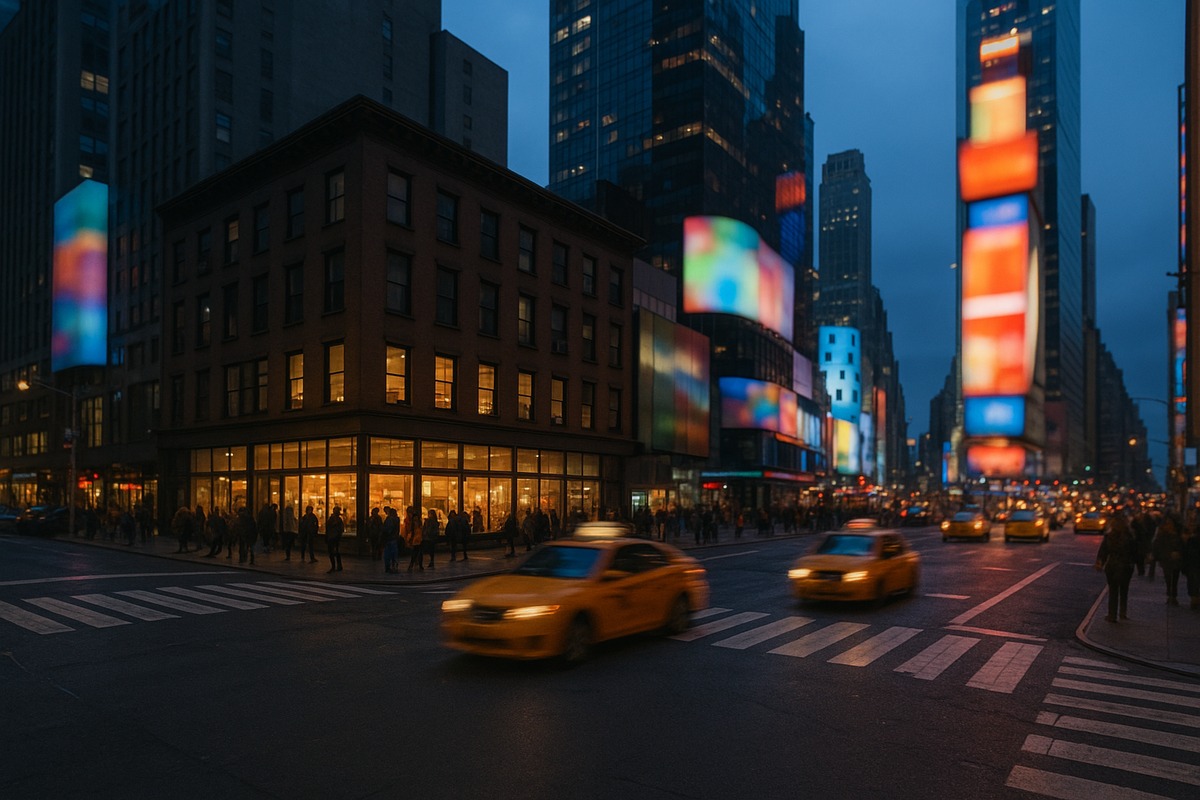
Seasoned New York restaurateurs will tell you that Times Square is an odd place to open a restaurant if your goal is to build a loyal local following. Rents are punishing, the customer base skews heavily to tourists, and many New Yorkers avoid the area on principle.
That is almost certainly not Sushiro’s goal. F&LC’s president, Masahiro Yamamoto, said at the New York press briefing that the company wanted to make a success in New York because it is the world’s largest city and a place from which information spreads across the globe. That is a description of a billboard, not a neighbourhood restaurant.
A flagship at Eighth Avenue and 42nd Street does a job no suburban mall location can do. Millions of tourists pass through it, including large numbers from Asia who already know the brand from home. Media, investors and potential landlords all watch it. If it works, the American rollout that follows can sign better leases in better locations. If it underperforms, the rest of the plan gets harder. Some Japanese analysts have already asked, in effect, whether the store risks ending up as nothing more than a giant advertisement.
There is a precedent worth noting. Japanese consumer brands have repeatedly used a single high-profile American flagship as their calling card, then learned that the real business is built far away from it, in suburban centres and secondary cities. Kura Sushi’s own American footprint runs through Texas, Georgia, Florida and California. It does not run through Manhattan. The question for Sushiro is not whether Times Square draws a crowd in its first year. It is whether the crowd tells the company anything useful about opening restaurants in places like Houston, New Jersey and suburban Chicago.
What Operators Should Take From This
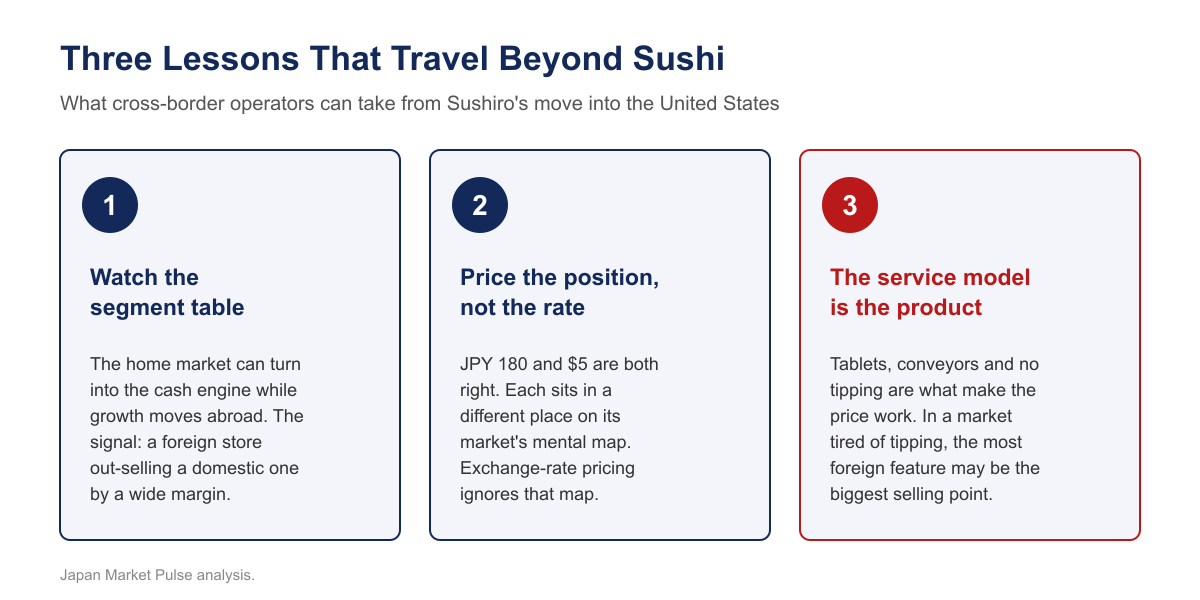
Three lessons travel well beyond sushi.
First, the home market can become the cash engine rather than the growth engine, and the transition happens quietly. F&LC did not announce that it had become an overseas company; its segment table simply started showing it. Any business that has built an efficient system in a saturated domestic market should watch for the moment when a foreign store starts out-selling a domestic one by a wide margin — at Sushiro it is now about 50%. That is the signal that the brand is worth more abroad than at home.
Second, price is a positioning decision, not an exchange-rate calculation. A ¥180 plate and a $5 plate are both correct, because they sit in different places on their respective markets’ mental maps. Foreign brands entering Japan make the mirror-image error all the time. They translate their home price at the prevailing rate and never ask where the product sits in the Japanese customer’s frame of reference.
Third, the service model is part of the product. The tablet ordering, the conveyor, the absence of a waiter and the no-tipping policy are not incidental features. They are what allows a Japanese system to deliver quality at a price, and in New York they have become a selling point. The American market is openly tired of tipping culture. The thing that looks most foreign about the Japanese model may turn out to be the thing Americans want most.
Frequently Asked Questions
Q. When and where does Sushiro’s first US restaurant open?
A. Sushiro is scheduled to open its first American restaurant in October 2026 at Eighth Avenue and 42nd Street, near Times Square in Manhattan. The three-storey site, roughly 9,000 square feet and previously a McDonald’s according to Time Out New York, will have about 150 seats with conveyor belts on the first and second floors and private dining rooms on the lower level.
Q. How do Sushiro’s New York prices compare with Japan?
A. In New York, plates of bigeye tuna and shrimp will cost $5, bluefin fatty tuna $10 and a shrimp double-cheese roll designed for the US market $14, with no tipping. In Japan, following a price revision on 22 July 2026, selected lean tuna starts at ¥150 at suburban branches and ¥180 in city branches, while salmon and shrimp start at ¥120. At ¥150 to ¥160 to the dollar, the New York tuna plate is roughly four times the Tokyo city-branch price.
Q. Is Sushiro the first Japanese conveyor-belt sushi chain in the United States?
A. No. Kura Sushi has operated in the US since 2009 through its Nasdaq-listed subsidiary Kura Sushi USA, which had 91 restaurants at the end of May 2026 and 94 across 24 states and Washington, DC, by early July. Zensho, the owner of Hama-zushi, entered the US market in 2018 by acquiring Advanced Fresh Concepts, which runs sushi counters in American supermarkets rather than Hama-zushi restaurants. Sushiro’s arrival means all three groups behind Japan’s biggest conveyor-belt chains now have a stake in the US market, each through a different route.
Q. How big is Sushiro’s overseas business?
A. FOOD & LIFE COMPANIES reached 300 overseas stores in June 2026, across markets including mainland China, Hong Kong, Taiwan, South Korea, Thailand, Singapore, Indonesia and Malaysia. In the six months to March 2026, overseas Sushiro’s segment profit of ¥12.76 billion edged past domestic Sushiro’s ¥12.30 billion for the first time, according to the company’s interim financial report. On the pre-royalty operating basis used in its results presentation, overseas (¥15.63 billion) was still slightly behind Japan (¥16.63 billion), so the fairest summary is that the two are now roughly level. The company targets ¥1 trillion in sales by fiscal 2035, with 55% from outside Japan.
Conclusion
The easy story about Sushiro in Times Square is a cultural one: Japan’s favourite everyday sushi arrives in the world’s most famous intersection, and New Yorkers get to find out what Japanese families have known for years.
The more useful story is structural. A company built on selling sushi at the lowest possible price in a shrinking, price-obsessed home market has discovered that the same system is worth much more almost everywhere else. Its overseas business now earns roughly as much as its Japanese one, from far fewer stores. It is taking that model to the most expensive, most competitive and most tipping-fatigued restaurant market in the United States, pricing the plates roughly four times higher, and removing the tip.
Whether the Times Square flagship becomes the start of an American chain or an expensive billboard will take a couple of years to judge. But the direction of travel is already settled, and it is not unique to sushi. For a growing number of Japanese consumer companies, Japan is where the product gets perfected. It is no longer where the growth comes from.
If you’re interested in this topic, the Japanese market more broadly, or what KETCHUPs is working on, we’d love to hear from you — please reach out via our contact form.
Japan Market Pulse is a weekly read on what the Japanese consumer-tech, food, and mobility markets are choosing to do, written for international operators who want to know what is happening before it shows up in the global trade press.
Subscribe at ketchups.co/japan-market-pulse.