

On Tuesday, 22 September 2026, most of Japan will stop. Government offices will be shut and schools will be closed. Most workplaces will be off, and transport and leisure operators will run to holiday demand rather than to a working Tuesday. It will be, in the fullest legal sense, a national holiday.
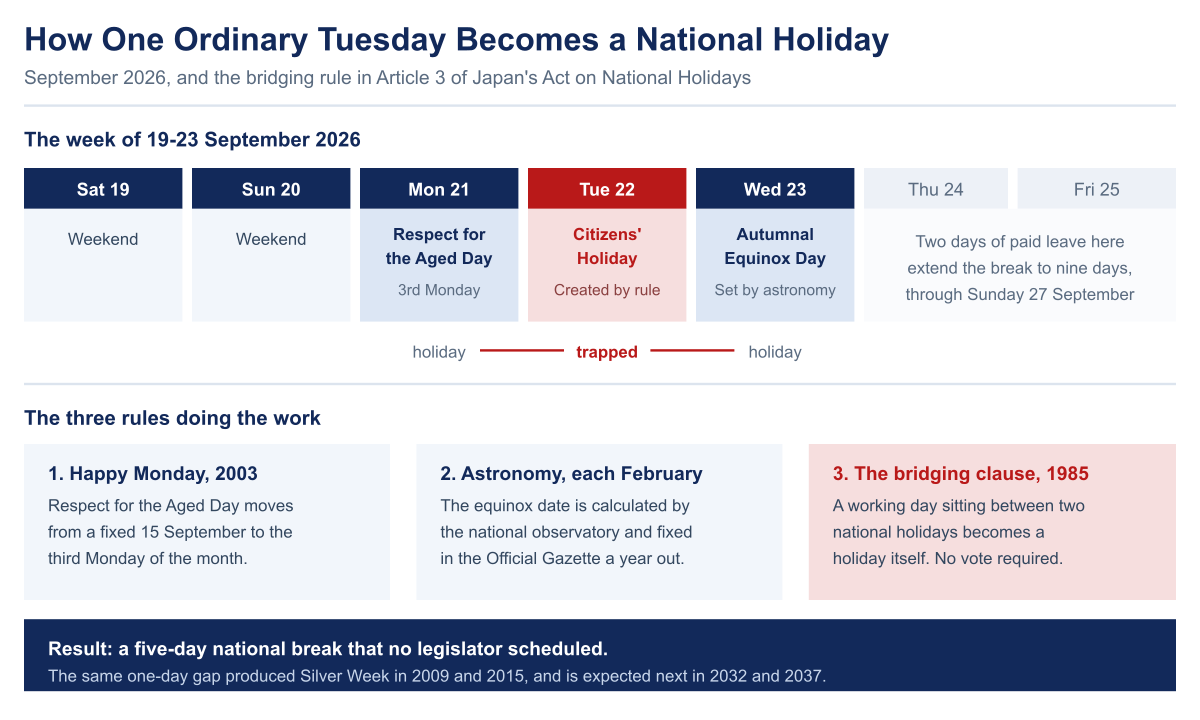
And yet there is nothing to celebrate. The day commemorates no person, no harvest, no constitution, no emperor, no war, no founding. It has no name of its own beyond the flatly administrative one the statute gives it: kokumin no kyujitsu, Citizens’ Holiday. It exists for one reason only — because the day before it and the day after it are both holidays, and Japanese law says that a working day trapped between two holidays stops being a working day.
That single provision is what turns 19 to 23 September 2026 into a five-day national break: Saturday, Sunday, Respect for the Aged Day on Monday the 21st, the manufactured Citizens’ Holiday on Tuesday the 22nd, and Autumnal Equinox Day on Wednesday the 23rd. The Japanese press calls it Silver Week, the autumn sibling of the famous Golden Week in spring. It has happened exactly twice before in this five-day form — in 2009 and 2015 — and after next week it is not expected again until 2032.
I have lived in Japan long enough to have worked through both of the previous ones, and the thing that still strikes me as an American is not the holiday itself. It is that the country’s autumn consumption calendar, the peak load on its rail and air networks, the annual revenue plan of every hotel in every hot-spring town, and the staffing rosters of tens of thousands of retailers all hinge on an astronomical calculation and a sentence in a 1948 statute. Demand in Japan is not merely seasonal. In several important weeks of the year it is legislated.
For an operator selling into Japan, that is not trivia. It is the difference between a forecast that works and one that does not.
The Law That Turns a Tuesday Into a Holiday
Japan’s holidays are governed by the Act on National Holidays, first passed in 1948. Most of it reads the way you would expect: a list of dates, each with a stated purpose. New Year’s Day. Culture Day. Labour Thanksgiving Day. Sixteen of them in total, which is more than any other large developed economy — the United States has eleven federal holidays, and England and Wales have eight bank holidays.
The interesting part is Article 3. Its first paragraph says the listed days are holidays. Its second paragraph is the substitute-holiday rule: if a holiday falls on a Sunday, the next non-holiday day becomes one instead, which is why some Japanese Mondays are quietly empty. Its third paragraph is the one that matters here. If a day that is not itself a holiday is sandwiched between two days that are, that day also becomes a holiday.
The clause was added in 1985, and for most of its life it did one job: it converted 4 May into a holiday, sitting as it did between Constitution Memorial Day on 3 May and Children’s Day on 5 May. That is how Golden Week became a genuine block rather than two separate long weekends. In 2007 the law was amended to give 4 May a name and purpose of its own — Greenery Day — so the sandwich clause lost its most famous application and went back to being a piece of dormant machinery.
Dormant, but not dead. Every few years the calendar lines up so that a Monday holiday and a Wednesday holiday fall in the same week, and the clause fires again. When it does, Japan gets a five-day weekend that no legislator specifically voted for and no ministry planned. It is an emergent property of the statute.
That is an unusual way to run a national calendar, and it produces an unusual commercial pattern: a demand spike that is completely predictable in principle, because the rules are public and the astronomy is known, and yet is treated by much of the market as a surprise, because it arrives at irregular intervals with long gaps in between.
Why It Took Eleven Years to Come Back

The reason Silver Week is intermittent comes down to a detail I have never been able to explain to an American colleague without being asked to repeat it.
Autumnal Equinox Day has no fixed date. The Act on National Holidays does not say “23 September.” It says, in effect, the day the autumnal equinox falls. The equinox is an astronomical event — the moment the sun crosses the celestial equator — and the calendar date on which it lands drifts between 22 and 23 September depending on the year and the leap-year cycle.
So Japan does something that has no real analogue in American law. The National Astronomical Observatory of Japan calculates the equinox, and the date is formally fixed when it is published in the Rekiyoko, the official calendar and ephemeris, in the first Official Gazette issued each February for the following year. Until that gazette appears, the date of a national holiday roughly eleven months away is, in the strictest legal sense, not yet settled. In practice everyone knows what the astronomy will say. But the mechanism is real, and it is the reason no Japanese law can simply schedule Silver Week in advance.
The five-day version requires exactly one condition: a single working day between Respect for the Aged Day, which floats with the third Monday of September, and the equinox. In 2026 that means the holiday on Monday the 21st and the equinox on Wednesday the 23rd, with Tuesday the 22nd trapped between them. In 2032 the same one-day gap appears a notch earlier — Monday the 20th and Wednesday the 22nd, with the 21st converted. Widen the gap to two days, or close it to none, and the week collapses back into an ordinary three-day weekend.
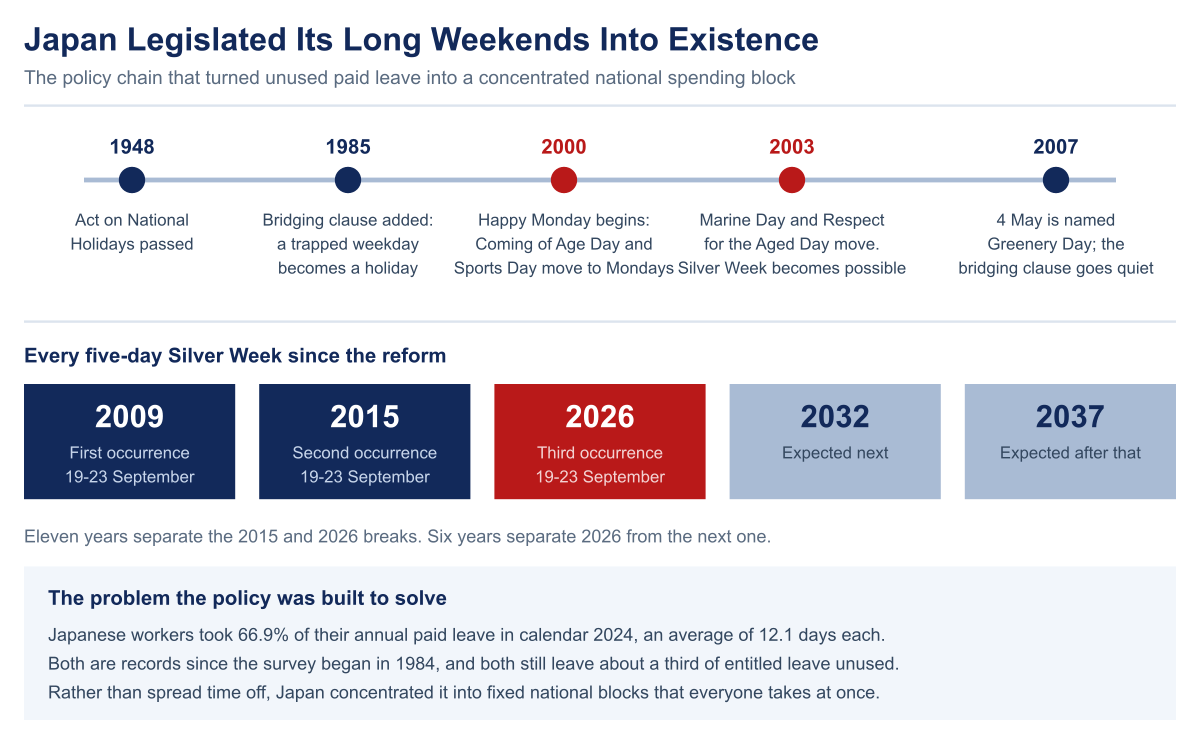
That alignment produced Silver Week in 2009 and again in 2015. It then failed for a decade. It succeeds in 2026, and is expected next in 2032 and 2037. Eleven years is a long enough gap that an entire cohort of category managers, hotel revenue teams and inbound marketers have never planned for one.
The Reform That Made the Whole Thing Possible
Silver Week is often described as a quirk of the calendar. It is more accurate to call it a downstream consequence of deliberate economic policy.
In the late 1990s Japan went looking for ways to stimulate domestic leisure spending without spending public money. The answer was the Happy Monday System: move selected fixed-date holidays to a designated Monday, and manufacture three-day weekends on purpose. Coming of Age Day and Health and Sports Day moved first, in 2000. Marine Day and Respect for the Aged Day followed in 2003.
Respect for the Aged Day had been anchored to 15 September. Moving it to the third Monday of September was, at the time, a straightforward tourism measure. It was also the act that created Silver Week, because a September holiday that floats with the third Monday, and can therefore come to rest a single working day ahead of a drifting equinox, is the precondition for the sandwich clause to fire. Nobody appears to have designed that outcome. It fell out of the policy.
There is a second thing worth noticing about the Happy Monday reform, and it is the part that matters most for anyone modelling Japanese consumer behaviour. Japan chose to concentrate leisure rather than distribute it. Instead of encouraging workers to take days off when they liked, it built fixed national blocks — New Year, Golden Week, the Obon period in August, and now occasionally Silver Week — and let almost the entire workforce move at the same time.
That was a rational response to a real constraint. Japanese employees have long been entitled to substantial paid leave and historically reluctant to use it. The situation has improved markedly: the take-up rate for annual paid leave reached 66.9% for calendar 2024, an average of 12.1 days per worker, both the highest since the survey began in 1984, helped by a 2019 rule requiring employers to ensure that eligible workers actually take at least five days a year. But roughly a third of entitled leave still goes unused, and the cultural default is to take days off when everyone else does rather than when it suits you.
The result is a market where a large share of annual discretionary leisure spending is compressed into four or five known windows. The calendar is not a backdrop to demand. It is the demand curve.
What the Booking Data Already Shows
The 2026 numbers make the point better than the theory does.
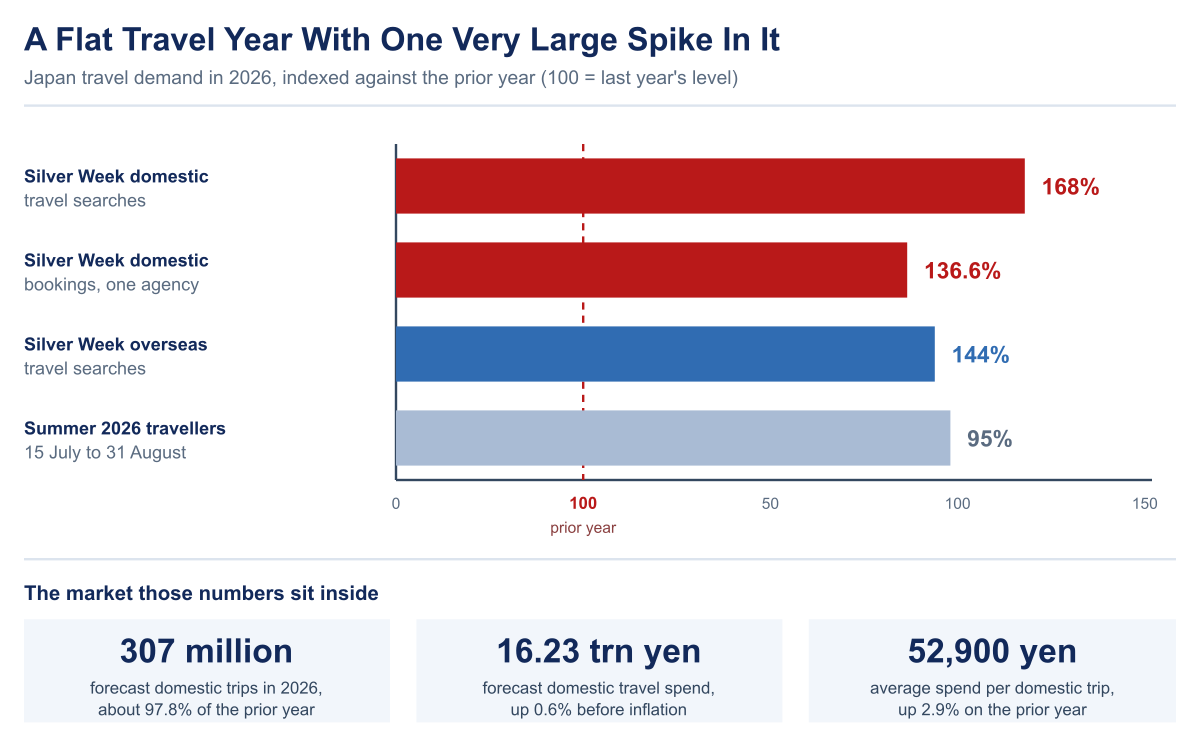
Travel search volume for the Silver Week window — 19 to 27 September, the full nine days available to anyone who takes the Thursday and Friday afterwards as leave — was running at roughly 168% of the prior year for domestic trips and roughly 144% for overseas trips, according to comparison-site data published in June. The travel agency HIS reported that Silver Week domestic bookings alone were up 136.6% year on year, and that Silver Week demand was strong enough to pull its combined summer-and-autumn overseas booking total above the previous year, at 102.5%, in a season that was otherwise soft.
Otherwise soft is the important qualifier. This is not a booming travel year in Japan. JTB’s forecast for calendar 2026 puts domestic travellers at 307 million, about 97.8% of the prior year, with average spend per trip at ¥52,900 and total domestic travel spending at ¥16.23 trillion — up only 0.6%, which in a period of food and energy inflation is a real-terms decline. Its summer forecast, covering 15 July to 31 August, put travellers at 71.17 million, down about 5%, and attributed part of the softness to households economising and to travellers shifting dates away from the crowded, expensive peak.
Shifting to where, exactly? To the shoulders. And in 2026 the biggest shoulder available is Silver Week.
So the pattern for the year is a market that is spending cautiously, avoiding the traditional August peak, and then concentrating hard into a five-day block that appears once in eleven years. Softening demand and a violent spike are not contradictory here. They are the same behaviour seen from two angles.
The Compression Problem

Every operator who has worked a Golden Week knows what happens next, and it is not uniformly good news.
When a whole country moves in the same five days, the constraint stops being demand and becomes capacity. Expressways jam in predictable directions on predictable days — outbound on the first morning, inbound on the last afternoon. Shinkansen reserved seats for the peak departures sell out when the booking window opens a month in advance. Hotel rates in the well-known destinations move to their annual ceiling, and the inventory that clears at those rates is the inventory that was contracted months earlier.
For retailers and consumer brands the mirror image applies. Urban office districts empty out and their lunchtime and after-work trade collapses. Suburban shopping centres, roadside stores, resort-town retail and the convenience stores along the expressway routes take a corresponding surge. Same country, same week, opposite signs — and if your Japanese distributor is allocating stock on a national average, both halves of that are wrong.
The staffing problem is sharper again. A five-day national holiday means five days when part-time staff want to be off, when cover is hardest to hire, and when — depending on the contract and the shift pattern — labour costs rise, all landing in the same week that footfall in some formats doubles. Japan’s retail and food-service employers are already navigating a record statutory minimum wage, and a holiday week is where a thin roster becomes a closed store.
None of this is unforeseeable. All of it sits on a calendar that was legally fixed in February 2025. The failure mode is not ignorance of the rules; it is that an eleven-year gap breaks the institutional habit of planning for them.
Why America Cannot Do This
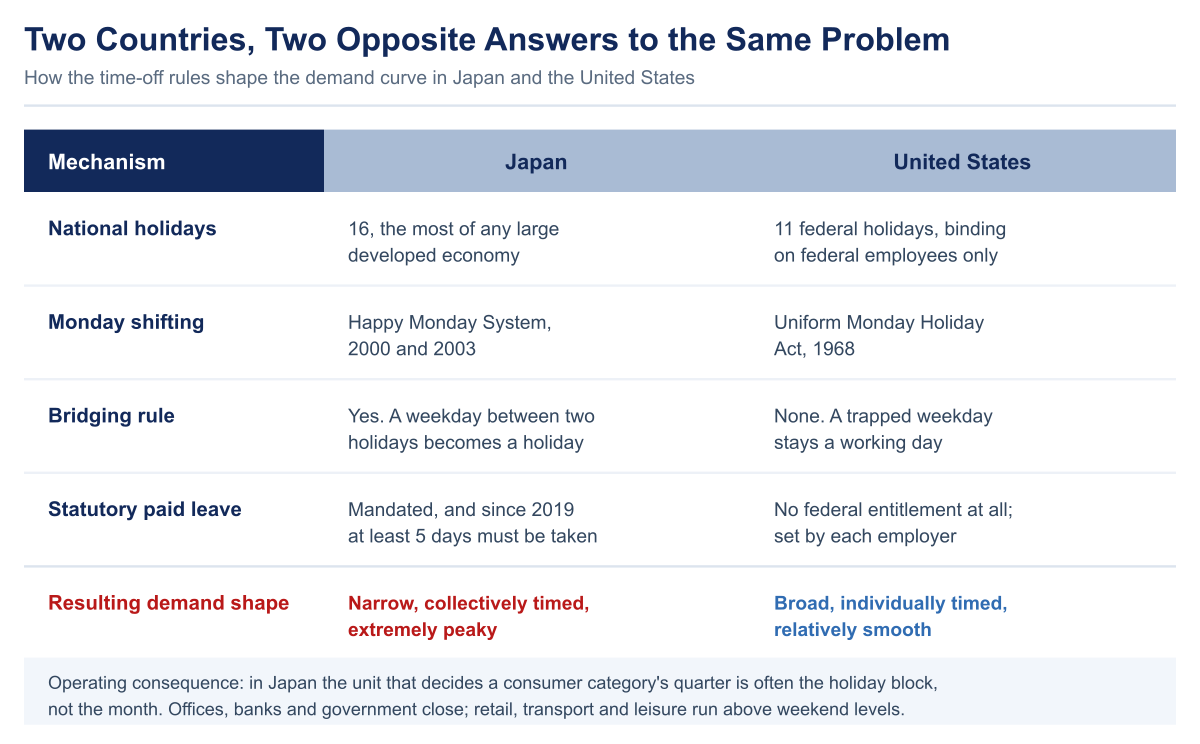
An American reader is entitled to ask why the United States does not simply build the same machinery. The honest answer is that the two countries solved the same problem in opposite directions, and the American answer makes national synchronisation impossible.
The United States has eleven federal holidays. Several were shifted to Mondays by the Uniform Monday Holiday Act of 1968, which is the closest American analogue to Happy Monday and predates it by three decades. But federal holidays bind federal employees; they are not a national mandate for private employers, and there is no bridging clause that converts a trapped weekday into a day off. There is also no federal statutory paid leave at all — the United States is the only large advanced economy without one — so the amount of time an American worker gets is set by their employer, and the timing is set by their manager.
That produces the opposite structure. In broad terms, American leisure demand is individually timed and relatively smooth, punctuated by a handful of genuine mass-movement peaks: Thanksgiving above all, then Memorial Day, Independence Day and Labor Day. Japanese leisure demand is narrow, collectively timed and extremely peaky.
Neither is better. But they reward completely different operating models, and this is where I have watched foreign brands get Japan wrong most consistently. A US-headquartered team plans Japanese promotions on a monthly cadence because that is how their reporting works, then finds that a month’s entire performance was decided in five days they did not staff for. Or they treat a Japanese holiday week as a soft period because in the American mental model holidays mean shops are shut, when in Japan a national holiday is a shopping and travel day and the closure applies to offices, banks and government.
The practical translation is simple: in Japan, the unit that matters for consumer categories is often the holiday block, not the month.
The Inbound Complication

Silver Week 2026 also lands on a Japanese travel market that has, for the first time in years, stopped growing.
Inbound arrivals reached 3.442 million in July 2026, a record for the month of July, but growth was essentially flat at 0.1% year on year. The cumulative January-to-July figure was 24.527 million, down 1.7% on the same period of 2025, after a first half of 21.084 million that was down 2.0%. These are enormous absolute numbers by any historical standard, and they are no longer rising.
That matters for Silver Week in a specific way. In 2015 the five-day break was overwhelmingly a domestic event competing for domestic capacity. In 2026 it lands inside a market that recorded 3.442 million foreign arrivals in July alone, many of them occupying hotel rooms, rail seats and restaurant tables in exactly the destinations Japanese families want for a five-day trip.
The competition for capacity is therefore tighter than the domestic booking figures alone imply, and pricing behaviour follows. Anyone whose Japan business depends on hotel inventory, tour capacity, event venues or logistics slots in that week should assume the effective constraint is worse than a 137% domestic booking increase suggests.
There is also a quieter irony in the anchor holiday itself. Respect for the Aged Day honours a population that, as of the Statistics Bureau’s September 2025 count, numbered 36.19 million people aged 65 and over — 29.4% of the entire country, the highest share on record and the highest of any nation with a population above 40 million, ahead of Italy at 25.1%, Germany at 23.7% and France at 22.5%. The holiday named for Japan’s oldest citizens has become the anchor of its most compressed autumn travel and consumption event. That tells you something true about the market: the ageing that dominates every long-term forecast about Japan coexists with intense, calendar-driven, short-term consumer intensity, and firms that only model the first miss most of the revenue.
What Operators Should Take From This
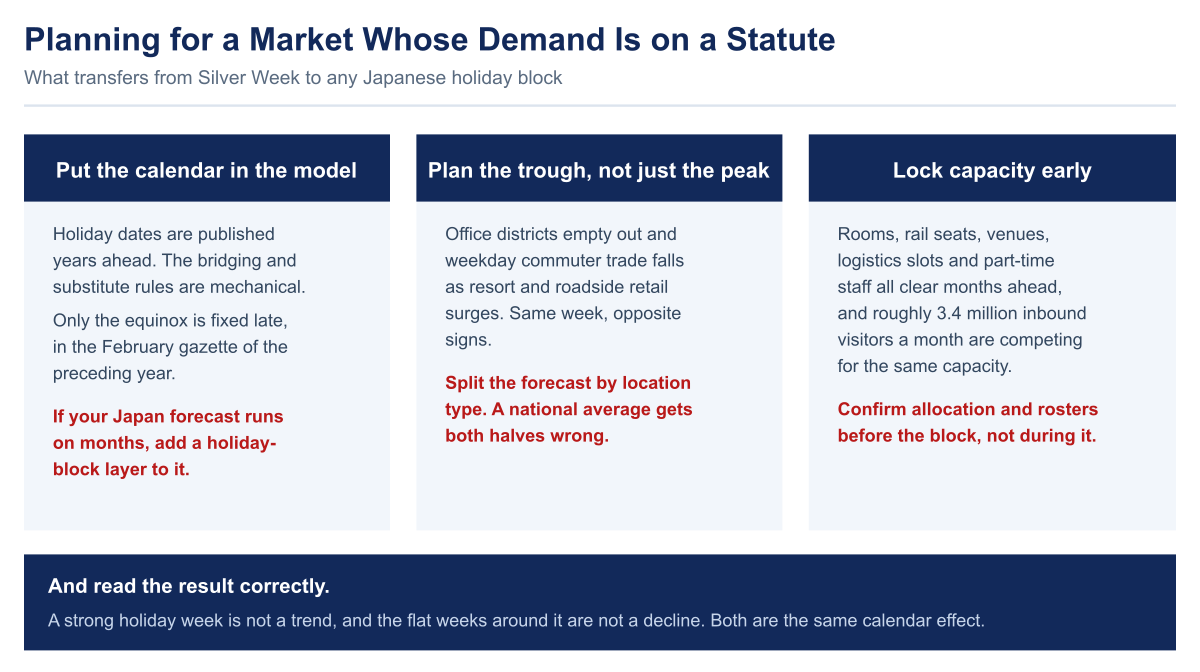
Three things, and none of them are about Silver Week specifically.
First, treat the Japanese holiday calendar as a planning input with the same status as a promotional calendar. The dates are published years ahead, the substitute-holiday and bridging rules are mechanical, and the only genuinely late-fixed variable is the equinox, which is settled in the February gazette of the preceding year. There is no excuse for being surprised. If your Japan forecast model runs on months, add a holiday-block layer to it.
Second, plan the trough as carefully as the peak. Most foreign teams that do prepare for a Japanese holiday week prepare only for the upside — extra stock, extra ad spend, extra staff. The offsetting collapse in office-district and weekday-commuter demand is just as large and much less often modelled, and it is where inventory goes stale and where campaign efficiency quietly falls apart.
Third, remember what the machinery is actually for. The Happy Monday reform was an attempt to convert unused paid leave into consumption, and it worked well enough that a quarter-century later the country’s autumn spending peak is a by-product of it. Japan’s consumer market rewards operators who understand that a lot of behaviour here is coordinated by institutions — holiday law, school terms, the corporate fiscal year ending in March, the twice-yearly bonus cycle — rather than emerging from millions of independent decisions. That is the actual structural difference from the United States, and Silver Week is simply its most legible example.
Frequently Asked Questions
Q. When exactly is Silver Week 2026, and how long is it?
A. It runs from Saturday 19 September to Wednesday 23 September 2026, five consecutive days. Monday the 21st is Respect for the Aged Day, Wednesday the 23rd is Autumnal Equinox Day, and Tuesday the 22nd becomes a Citizens’ Holiday under the bridging rule in Article 3 of the Act on National Holidays. Taking Thursday the 24th and Friday the 25th as paid leave extends the break to nine days, through Sunday the 27th.
Q. Why doesn’t Silver Week happen every year?
A. Because it requires exactly one working day to fall between Respect for the Aged Day, which moves with the third Monday of September, and Autumnal Equinox Day, whose date is astronomical and drifts between 22 and 23 September. In 2026 the pair lands on the 21st and the 23rd; in 2032 it lands on the 20th and the 22nd. In most years the gap is the wrong width and September produces an ordinary three-day weekend instead. The five-day version occurred in 2009 and 2015, occurs in 2026, and is expected next in 2032 and 2037.
Q. Are shops and restaurants closed during Japanese national holidays?
A. Generally the opposite of the American pattern. Offices, banks, government agencies, schools and many B2B services close, while retail, restaurants, transport and entertainment operate at or above weekend levels. Department stores and shopping centres treat holiday weeks as peak trading periods. Assuming a Japanese holiday is a dead retail week is one of the more expensive mistakes a foreign brand can make.
Q. How much is this actually worth in commercial terms?
A. There is no single official Silver Week figure, because it is not an annual event with a continuous series. The useful scale markers are the surrounding ones: JTB forecasts about 307 million domestic trips and ¥16.23 trillion of domestic travel spending across calendar 2026, and travel sellers reported Silver Week domestic bookings up 136.6% with domestic search volume for the window at roughly 168% of the prior year. The signal is concentration, not aggregate growth — 2026 is a flat-to-declining travel year with one very large spike in it.
Q. What should a company selling into Japan do differently in a holiday-block market?
A. Build the holiday calendar into demand planning rather than treating it as a generic seasonality adjustment; split forecasts between office-district and leisure-destination locations, because they move in opposite directions in the same week; confirm stock allocation and staffing with Japanese distributors and retail partners well before the block, not during it; and resist reading a strong holiday week as a trend, or the flat weeks around it as a decline. Both are the same calendar effect.
Conclusion
A national holiday that exists only because of the two days on either side of it, whose date depends on an observatory’s calculation of when the sun crosses the celestial equator, and which shows up roughly three times in three decades, is the kind of thing that reads as a charming curiosity when you first encounter it.
It stops being charming the first time you watch a quarter’s Japan numbers turn on it.
Japan built a consumer market in which a large share of leisure demand is coordinated by statute, because it was trying to solve a labour-culture problem it could not solve directly. The side effects — the mass simultaneous movement, the capacity ceilings, the emptied office districts, the eleven-year gaps — are all still with us, and they are more visible next week than they have been since 2015.
If you sell into Japan, the useful takeaway is not that Silver Week is coming. It is that the Japanese calendar is an economic instrument, that its rules are published and mechanical, and that most foreign operators are still treating the output as weather.
If you’re interested in this topic, the Japanese market more broadly, or what KETCHUPs is working on, we’d love to hear from you — please reach out via our contact form.
Japan Market Pulse is a weekly read on what the Japanese consumer-tech, food, and mobility markets are choosing to do, written for international operators who want to know what is happening before it shows up in the global trade press.
Subscribe at ketchups.co/japan-market-pulse.