

Otsuka has owned an American bottling company since 1991. It waited thirty-two years to use it for the drink it is actually famous for.
In 2023, the United States recorded 119,605 emergency department visits for heat-related illness, according to the Centers for Disease Control and Prevention figures cited by Otsuka America. In Japan, in a single week between 20 and 26 July 2026, ambulances carried 18,591 people to hospital for heatstroke — up from 10,857 the week before, in a country with roughly a third of the American population.
Two countries, the same problem, and two entirely different commercial answers to it.
America answered with sport. In 1965 a research team at the University of Florida built a drink for football players, and everything that followed — Gatorade, Powerade, BodyArmor — inherited that DNA: performance, athletes, the sideline cooler. Japan answered with medicine. In 1980, a pharmaceutical company that had been making intravenous drips since 1946 put a drink on the shelf that was explicitly designed to be a drinkable version of an IV bag, and spent the next four decades embedding it in schools, construction sites, hospitals and heat-safety guidelines rather than in stadiums.
For forty-five years those two answers stayed in their own hemispheres. Then, in the last three years, the American market did something that made the Japanese answer suddenly legible: it fell in love with electrolytes. Liquid I.V. became Unilever’s largest wellbeing brand. LMNT, DripDrop and Nuun built cult followings around sachets of salt. CNN put the American obsession with hydration at roughly $1.5 billion in 2025. Gatorade itself launched a lower-sugar line in 2026 to answer the challengers.
And this summer, quietly, in ten Costco warehouses in California and on H-E-B shelves across Texas, the original showed up.
The Drink That Was Invented to Be Drunk After Surgery
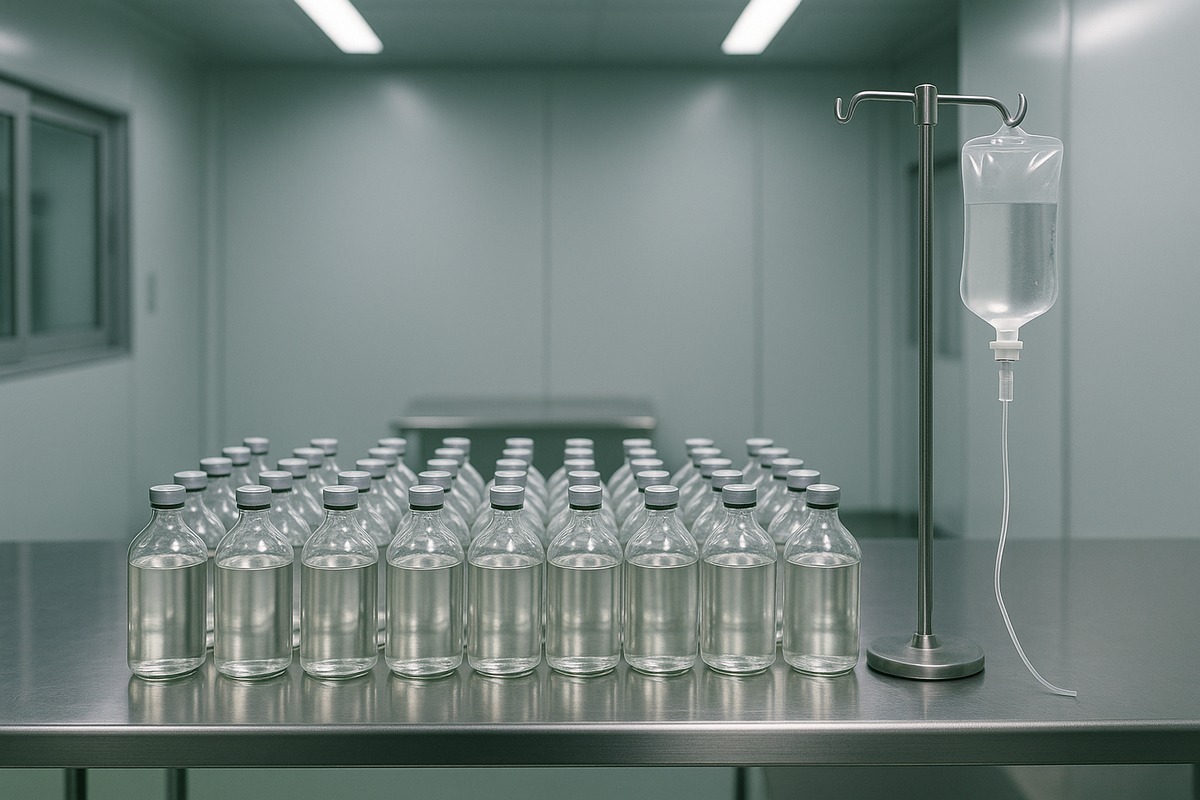
Otsuka was founded in 1921 as a chemical raw material manufacturer and moved into intravenous solutions in 1946. That business — sterile fluids, electrolyte balance, absorption rates — is the entire reason Pocari Sweat exists.
Company accounts of the product’s origin describe researchers noticing something ordinary and strange at the same time: doctors, after long operations, would sometimes drink intravenous solution to rehydrate themselves. The story that circulates in Japan adds a business trip to Mexico, a bad case of dehydration, and an employee who came home with a question — why is there no drink built the way an IV drip is built?
What Otsuka launched in 1980 was not a sports drink. It was a beverage formulated with an electrolyte balance close to that of body fluids, engineered for absorption rather than for taste. The name paired an invented word with the English word “sweat” because the concept it wanted to sell was replacement, not refreshment.
Japanese consumers hated it. They had never seen or tasted anything like it, the sweetness was low by the standards of a soft drink, and the word “sweat” on a can did the product no favours. Otsuka’s response was not a rebrand. It was distribution as education: staff handed out samples anywhere people were already sweating — saunas, baseball grounds, shop entrances — and in 1980 alone gave away roughly 30 million bottles. Two years later, in the summer of 1982, it became a genuine hit.
That is a two-year, thirty-million-unit education campaign for a single SKU, undertaken by a pharmaceutical company whose beverage experience was the nutritional tonic Oronamin C, not a mainstream soft drink. It is worth holding that number in mind when we get to what a market entry costs.
What “Ion Supply” Means, and Why America Never Had a Word for It
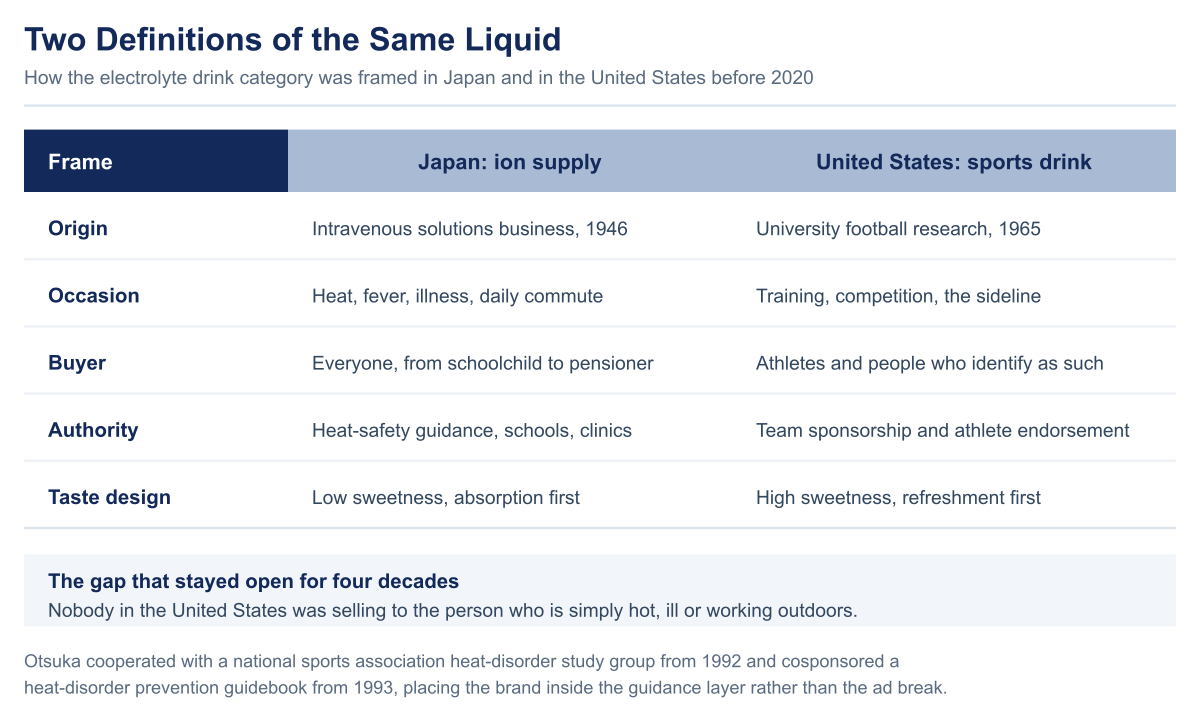
Ask a Japanese consumer what Pocari Sweat is and you will rarely hear “sports drink.” You will hear that it is what you drink when you have a fever, when you have been sweating, when you wake up dehydrated, when a doctor tells you to take fluids, when it is 36 degrees outside and you have to walk to the station.
The Japanese category label is ion supply — a functional description of what the liquid does to your bloodstream. It sits in a conceptual space that American retail never built: not medicine, not sport, but everyday physiological maintenance.
Otsuka did not get that positioning for free. It bought it with institutional work over decades. From 1992 the company cooperated with the Japan Amateur Sports Association’s study group on preventing heat disorders, and from 1993 it began cosponsoring the production of a guidebook on preventing heat disorders in sports activities. When a Japanese school, a sports club or a site foreman needs a rule about when to drink and what to drink, the guidebook that chain leans on has carried Otsuka’s cosponsorship for over thirty years.
The commercial consequence is that in Japan the product does not have to win a taste test against a cola. It has to be the thing the coach, the school nurse, the site manager and the pharmacist all name when the temperature climbs. That is a much more durable position than flavour preference, and it is almost impossible to attack with a marketing budget alone.
The Category Japan Built at Home While America Built Gatorade
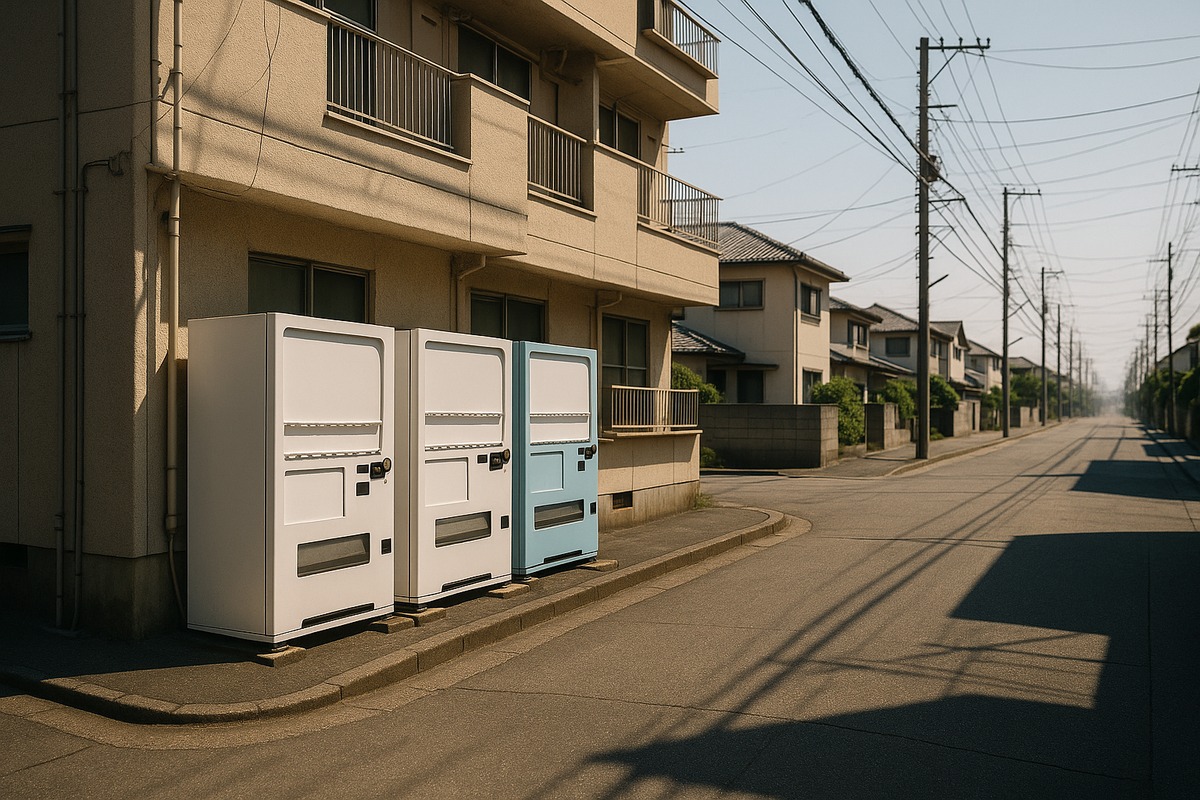
By the time American brands were fighting over the sideline, Japan had built something closer to public infrastructure.
The cumulative unit numbers tell the story of a slow, compounding domestic habit rather than a boom. Otsuka counted three billion units sold by 1987, ten billion by 1993, twenty billion by 1998 and thirty billion by 2008, on a 340ml unit basis. Meanwhile the product line spread sideways: powder sachets for mixing at home, a lower-calorie Ion Water variant, and in July 2026 a powder stick sized to make 500ml in a reusable bottle — the format American challenger brands are currently celebrating as an innovation.
The United States, meanwhile, consolidated. Industry estimates put Gatorade, Powerade and BodyArmor together at roughly 85 to 90 percent of the American ready-to-drink sports drink category in recent years — a PepsiCo brand and two Coca-Cola brands owning almost the entire shelf. That concentration is exactly why the American category could be blindsided: when the three incumbents all define the occasion as exercise, nobody is serving the person who is simply hot, ill, hungover, pregnant, elderly or working outdoors.
Japan has been serving that person since 1980.
Then America Rediscovered Electrolytes
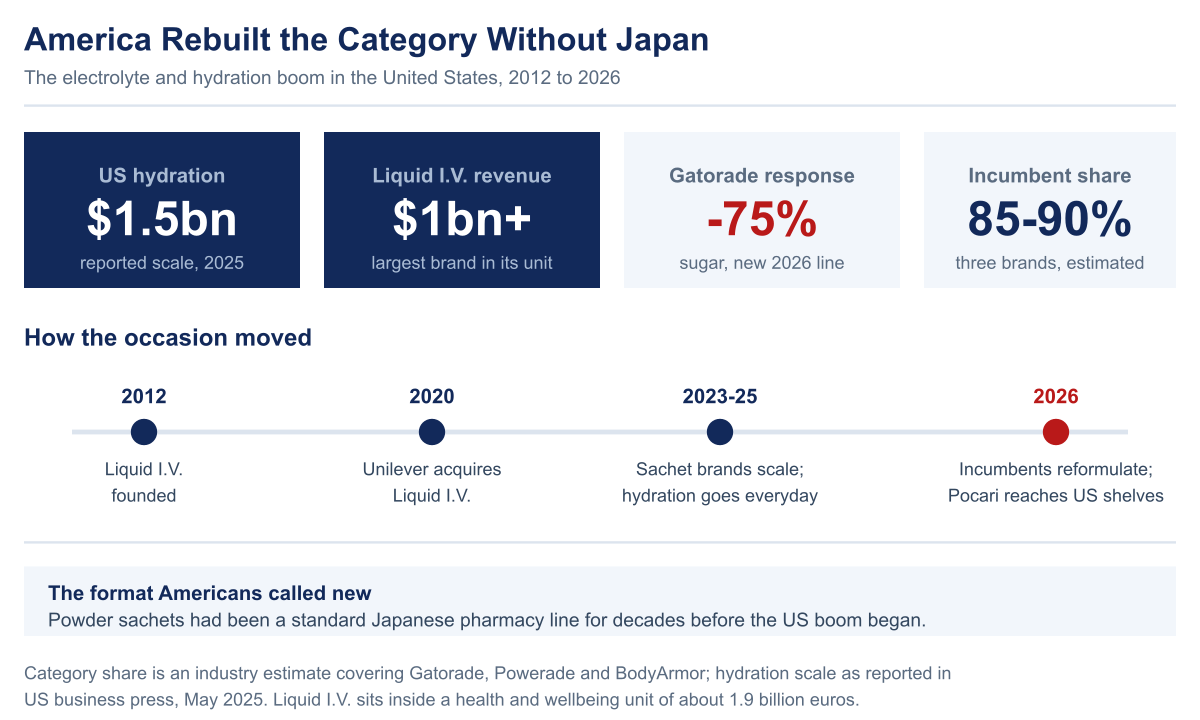
The last three years rewrote the American shelf.
Liquid I.V., founded in 2012 and acquired by Unilever in 2020, is the largest brand inside Unilever’s health and wellbeing business, a unit Unilever has sized at about €1.9 billion. LMNT built a following on a high-sodium, zero-sugar sachet and a founder story rather than a sponsorship budget. DripDrop came in through medical and military channels; Nuun through endurance sport. CNN, surveying the phenomenon in May 2025, described American hydration as a business worth around $1.5 billion.
What changed was not the science. It was the occasion. Americans stopped treating electrolytes as something you consume because you played a sport and started treating them as something you consume because you exist — after a flight, after drinking, during a heat wave, on a hangover, at a desk. That is precisely the frame Japan has used since 1980.
The incumbents noticed. Gatorade launched a lower-sugar version in 2026 with 75 percent less sugar than its Thirst Quencher line and no artificial flavours, sweeteners or colours — a defensive move aimed squarely at the cleaner-label positioning that let the challengers in.
So the American market has, without any help from Japan, spent three years constructing the exact consumer understanding that Pocari Sweat requires in order to make sense. A drink whose entire pitch is “absorbs like an IV drip, less sweet than a soda, drink it when you are hot rather than when you are winning” was commercially illegible in the United States in 2005. In 2026 it is simply a premium entrant in a category people already believe in.
The Numbers Behind Otsuka’s Move
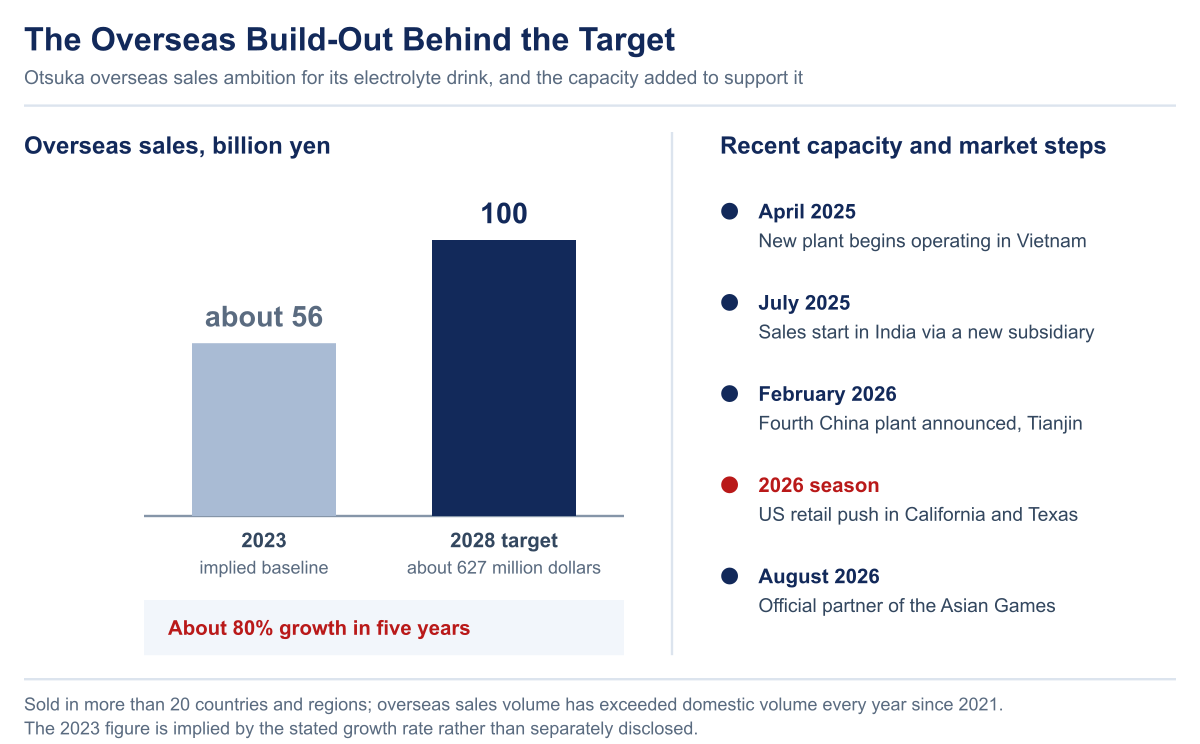
This is not a nostalgia play. It is a growth problem.
In the first half of its 2025 financial year, Otsuka’s Pocari Sweat business generated ¥99.2 billion, down 0.5 percent year on year, inside a nutraceutical business of ¥276.1 billion that grew 1.6 percent. A flat core brand in a shrinking, ageing home market is a specific kind of pressure, and the company has been explicit about where the answer is: overseas.
Pocari Sweat entered its first overseas market in 1982 and is now sold in more than 20 countries and regions. Overseas sales volume has exceeded domestic volume every year since 2021. Indonesia, where local sales began in 1989, has long been the largest market outside Japan.
The recent build-out has been physical, not promotional. A plant in Vietnam started operating in April 2025. Sales began in India in July 2025 through a newly established local subsidiary. In February 2026 the group announced a new Pocari Sweat plant in Tianjin — its fourth manufacturing site in China — with operations from April. In August 2026 the brand signed on as an official partner of the Asian Games in Aichi-Nagoya.
The target that sits on top of all of this: overseas sales of ¥100 billion, roughly $627 million, by 2028 — about 80 percent above the 2023 level. You do not get an 80 percent increase out of markets you already lead. You get it by adding the two largest premium beverage markets on earth, which is why the company has started talking publicly about American and European heat as an opportunity rather than a disaster.
Costco, H-E-B, and a Science Advisory Board

Here is the part that operators should study, because it is not the marketing.
Otsuka took a controlling interest in Crystal Geyser Water Company in 1991. For thirty-two years, that American asset made bottled water and Tejava tea. It is now also the distribution and bottling backbone for Pocari Sweat in the United States, with production at Bakersfield, California. Full-scale American sales began in 2023.
The 2026 retail push was deliberately narrow. Pocari Sweat ran a staggered Costco roadshow across ten California warehouses — Oxnard, Garden Grove, Huntington Beach, Culver City, Inglewood, Santa Maria, Los Feliz, Hawthorne, Lakewood and Eastvale — with dates rolling from 1 May to 22 June. In Texas it went onto H-E-B shelves across Dallas, Houston, San Antonio and Austin. Alongside that sits a direct-to-consumer site.
Two states. One warehouse club, one regional grocer. Both chosen in the hottest, most demonstrably heat-aware parts of the country, and both formats where a demo table and a sampling budget do the work that thirty million free bottles did in Japan in 1980.
Then there is the part that no beverage marketer would think of, and every pharmaceutical company would. In July 2025 Otsuka America established a Pocari Sweat Science Advisory Board of specialists in heat stress, hydration, sports medicine and occupational health. On 23 June 2026 it published heat illness prevention guidance built by that board, framed around what the company calls “Caring Hydration” — the idea that you hydrate properly and make sure the people around you do too, particularly outdoor workers, students and athletes.
That is the 1992 Japan Amateur Sports Association playbook, exported. Build the guidance layer first, so that when the category conversation happens, your brand is already inside the sentence.
Why the Medical Framing Is the Whole Strategy — and the Whole Risk
The asymmetry that makes this interesting is that Otsuka’s greatest asset in Japan is the hardest thing to transplant.
In Japan, forty-five years of consistent messaging plus a pharmaceutical parent equals implicit authority: people believe the drink does something to their body because the company also makes the drip in the hospital. In the United States, that authority has to be rebuilt inside a regulatory environment where a beverage cannot make medical claims, in a market where every third product on the shelf already claims to be functional, and against consumers who have learned to discount health language on packaging entirely.
There is also the taste problem, which cuts both ways. Pocari is markedly less sweet than Gatorade and considerably sweeter than LMNT. That places it in an unoccupied middle — which is either a gap or a no-man’s land, depending on how the sampling goes. Americans who encounter it usually describe it as light and faintly grapefruit-like; the ones who do not like it usually wanted either more flavour or none.
And the incumbents are no longer asleep. A lower-sugar Gatorade, an expanding BodyArmor, and private-label electrolyte sticks in every warehouse club mean the window in which “clean, functional, foreign” is a differentiator will not stay open indefinitely. Otsuka is entering a category that has already had its disruption; it is arriving as the fourth or fifth story in a market that likes new stories.
The counterweight is patience, and it is a real one. This is a company that spent two years and thirty million samples convincing its own country, and that has been selling in Indonesia since 1989. Its American plan does not appear to require a fast win.
What Operators Should Take From This
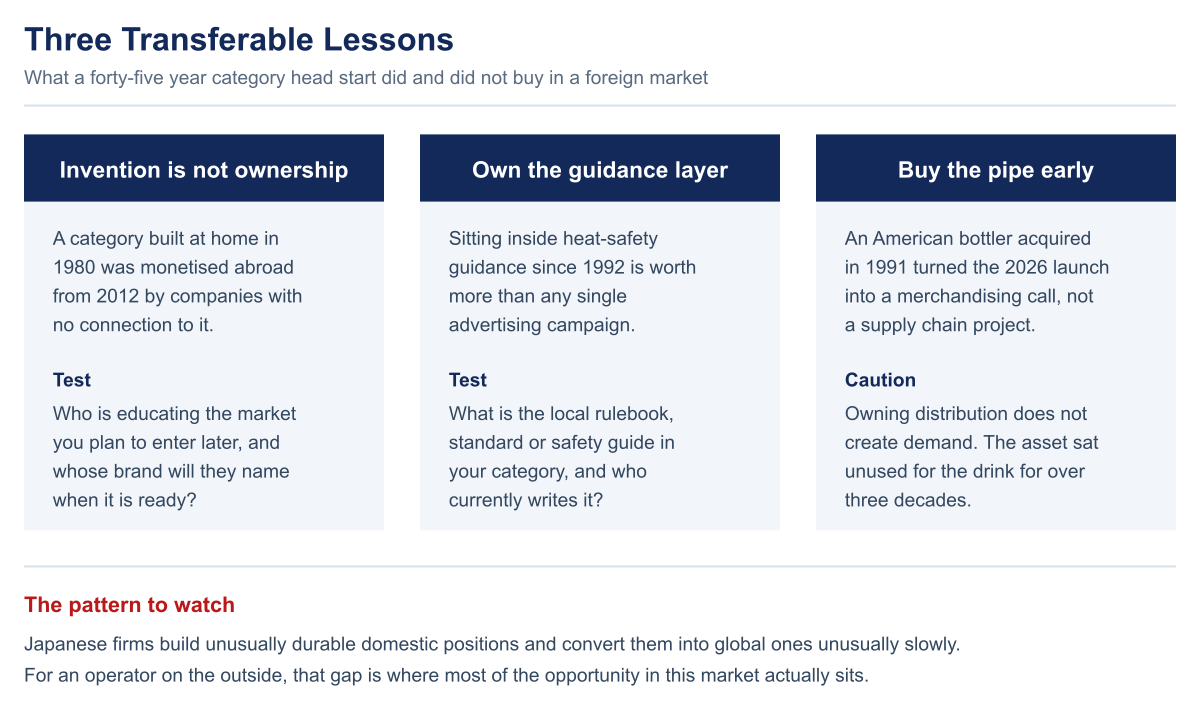
Three things, and none of them are about beverages.
An occasion you invented is not a category you own. Otsuka built the electrolyte-hydration occasion four decades before Americans adopted it, and then watched a 2012 startup and a 2019 challenger brand monetise that occasion in the United States without it. Being early in your home market confers no rights anywhere else. The window opens when the destination market’s own consumers construct the frame — and if you are not standing there when it opens, someone else sells them your idea.
Own the guidance layer, not just the shelf. The most transferable thing Otsuka does is not a formula. It is thirty years of sitting inside the documents that tell coaches, teachers and site managers what to do when it is hot. That work is slow, cheap relative to advertising, and nearly impossible for a competitor to buy back once it is established. Any B2B or B2C operator entering a market with a safety, health or compliance dimension should ask what the local equivalent of that guidebook is, and who currently writes it.
Buy infrastructure early, use it when the market is ready. The Crystal Geyser stake is the quiet masterstroke and the quiet warning. Otsuka has held American bottling and distribution since 1991, which is why the 2026 launch could be a merchandising decision rather than a five-year supply chain project. It is also why the entry took until 2026 — because owning the pipe does not create the demand that flows through it.
The Japanese case is generally the reverse of what foreign operators expect. The lesson is not that Japan is a hard market to enter. It is that Japanese companies are extraordinarily good at building durable domestic positions and extraordinarily slow at converting them into global ones — which means the ideas are frequently available, in plain sight, for anyone willing to move faster than the inventor.
Frequently Asked Questions
Q. Where can I buy Pocari Sweat in the United States?
A. It is stocked at H-E-B in Texas and appeared in a staggered Costco roadshow across ten California warehouses between 1 May and 22 June 2026, alongside a direct-to-consumer site. Outside those states, the most reliable route is online — the Pocari Sweat powder sachets and the 740g powder pouch that makes 10 litres are both available on Amazon, as are Asian grocery chains in most major cities.
Q. How is Pocari Sweat different from Gatorade or Liquid I.V.?
A. It is formulated around an electrolyte balance close to that of human body fluids, with the design goal of absorption rather than flavour or performance. In practice it is noticeably less sweet than Gatorade and less sodium-forward than LMNT or Liquid I.V., and it is sold ready-to-drink as a default rather than as a concentrate — although powder formats have existed in Japan for decades.
Q. Why is it called “sweat”?
A. Because the product concept is replacing what you lose, not rewarding exertion. The name reads as functional in Japanese, where the English word carries none of the connotations it has for native speakers. Otsuka has kept the name unchanged in every market, including the United States, on the view that explaining it is cheaper than rebuilding forty-five years of recognition.
Q. How big is Otsuka’s overseas ambition for the brand?
A. The company is targeting overseas sales of ¥100 billion, about $627 million, by 2028 — roughly 80 percent above its 2023 level. Pocari Sweat is sold in more than 20 countries and regions, and overseas volume has exceeded domestic volume every year since 2021.
Q. Is the American electrolyte boom actually large enough to matter?
A. Yes, and it is the reason the timing works. Liquid I.V. is Unilever’s largest wellbeing brand, CNN put American hydration at roughly $1.5 billion in 2025, and Gatorade launched a lower-sugar line in 2026 in response to challenger positioning. A category that big with that much recent movement is precisely where a credible foreign entrant can find shelf space.
Conclusion
The neat version of this story is that a Japanese classic is finally going to America. That version misses what is actually instructive.
Otsuka did not fail to enter the United States for forty-five years because it lacked distribution — it has owned an American bottler since 1991. It did not lack a product, a formula, or manufacturing capacity. What it lacked was an American consumer who understood why anyone would drink electrolytes on a Tuesday afternoon without having exercised.
That understanding got built anyway, between 2020 and 2025, by companies that had never heard of ion supply, using powder sachets Otsuka had been selling in Japanese pharmacies for decades. By the time the market was ready, the category had four American brands in it and a defensive product from PepsiCo.
For anyone sitting on a strong domestic position and a foreign market that “isn’t ready yet,” that is the whole lesson in one sentence: the market will get ready without you, and it will do it with somebody else’s brand.
This article contains affiliate links. If you purchase through these links, we may earn a small commission at no extra cost to you.
If you’re interested in this topic, the Japanese market more broadly, or what KETCHUPs is working on, we’d love to hear from you — please reach out via our contact form.
Japan Market Pulse is a weekly read on what the Japanese consumer-tech, food, and mobility markets are choosing to do, written for international operators who want to know what is happening before it shows up in the global trade press.
Subscribe at ketchups.co/japan-market-pulse.