

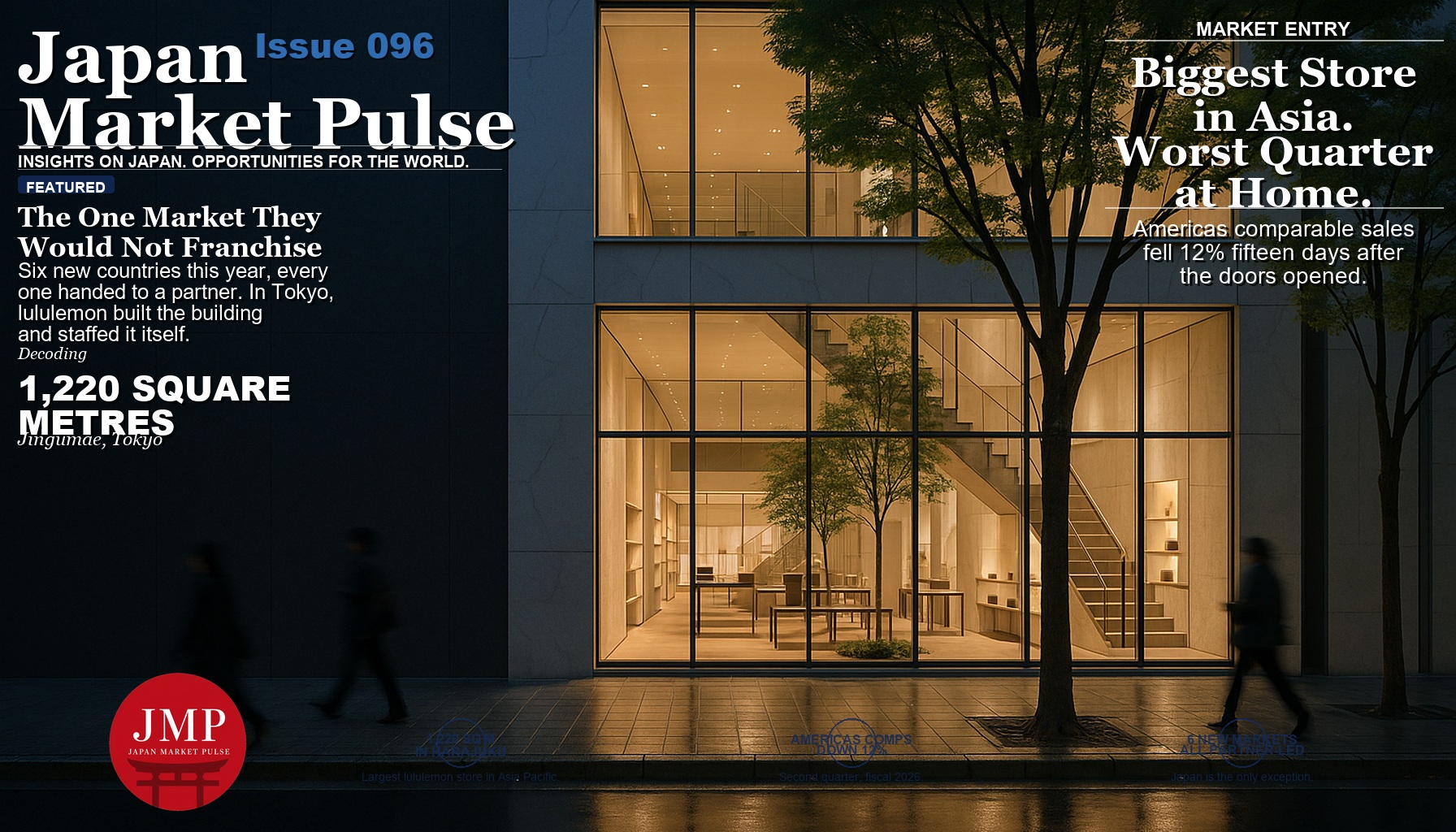
On 19 August 2026, lululemon opened a multi-level store in a three-storey building at 1-13-12 Jingumae, a short walk from Harajuku Station, and called it the company’s first global flagship in Japan. At 1,220.23 square metres it is the largest lululemon store anywhere in Asia Pacific, featuring collaborations with the Aichi furniture maker Karimoku and the Tokyo studio Torafu Architects, wrapped in custom stone panels and glass, and organised around a sculptural version of the company’s logo.
Fifteen days later, on 3 September, the company told investors that its Americas comparable sales had fallen 12 percent, that total revenue had dropped 4 percent to $2.4 billion, and that full-year revenue would now come in 5 to 7 percent below last year. It cut its new-store plan from about forty locations to about thirty-five. It cut its pop-up count from sixty-five to roughly forty. Five days after that, on 8 September, a Nike veteran named Heidi O’Neill was due to take over as chief executive of a company that has been without a permanent leader since 31 January, that spent the first half of the year in a proxy contest with its own estranged founder, and that has a billion-dollar activist investor on the register.
I have lived in Japan for two decades and I have watched a long parade of foreign brands arrive in Harajuku with a big lease and a bigger press release. Most of them were arriving because things were going well at home and Japan looked like a trophy. This one is different. Lululemon is spending its scarcest resource — capital, management attention, and the patience of an angry shareholder base — on a country where about one person in twenty belongs to a gym, at the exact moment its home market is contracting.
That is either a mistake or a thesis. I think it is a thesis, and I think it is the most instructive thing any Western consumer brand has done in Japan this year. Here is what it actually says.
A Three-Storey Building in Jingumae
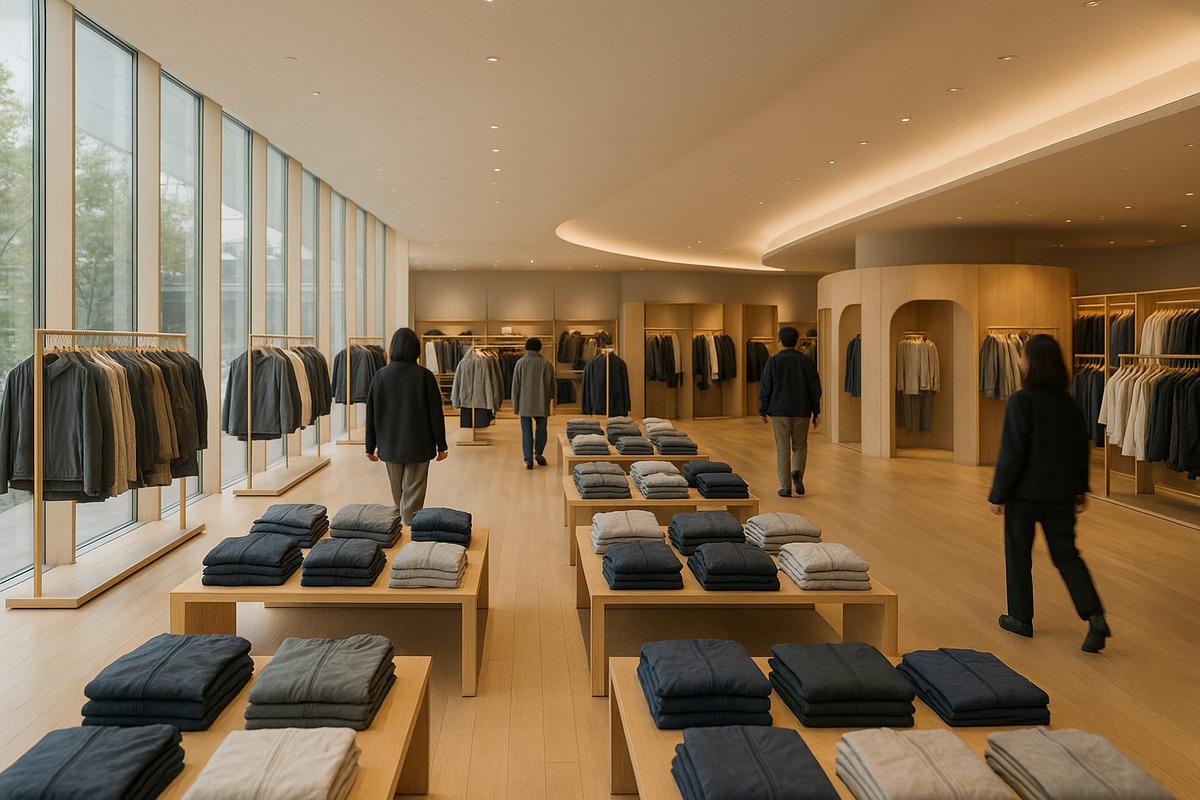
The address matters. Jingumae 1-chome is the wedge of Tokyo between Harajuku Station, the Meiji Shrine approach and the top of Omotesando, and it is one of the few places in the country where a retail lease is genuinely scarce rather than merely expensive. The building has three storeys with the retail space across two of them — a reported 9,600 square feet of actual product space inside a 13,130 square foot envelope. That ratio is the first thing worth noticing. On the reported figures, close to a third of the building is not selling anything.
What is in that space instead is a set of decisions that read, to anyone who has watched foreign retail in Japan, as unusually well-briefed. The interior features work by Karimoku, the Aichi wood furniture manufacturer that has spent decades making the kind of chair that Japanese design magazines put on the cover, and Torafu Architects, a studio that is known here for exactly the sort of quiet spatial trick that does not photograph well but changes how a room feels when you walk through it. The ceilings flow rather than grid. The fitting rooms curve. There are no columns chopping the floor into departments, which in a Japanese specialty retail context is a deliberate refusal — the standard here is a tightly zoned floor where every category has its own visual box.
There are commissioned artworks referencing Meiji Shrine, Yoyogi Park and Ura-Harajuku, the back-street grid behind the main drag where Tokyo’s streetwear scene actually lives. There is furoshiki gift wrapping, the cloth-wrapping technique that any Japanese department store offers and almost no foreign brand bothers to. And there is the company’s first in-store personalisation service in Japan, starting with custom options on the Everywhere Belt Bag.
The product mix is broader than the brand’s reputation. Yoga is there, obviously, but so are running, training, golf, tennis and commuting. Commuting is the interesting one. In Tokyo, a very large share of the technical apparel sold is bought by people who will never use it for the sport it was designed for; it is bought because it survives a rush-hour Yamanote Line carriage in August. The company has also merchandised Asia Fit cuts, its regional sizing, on the floor rather than treating them as a special order.
Elliot Harris, lululemon’s senior vice president and general manager for Asia Pacific, has been explicit about the reasoning. Japanese shoppers, he has said, value “craftsmanship, longevity and versatility” and bring “exceptionally high expectations” — and the size of the store is a response to how much explaining that demands. “Our goal is never to replicate experiences market by market,” he has said of the flagship strategy.
I went on a weekday afternoon. The thing that struck me was not the crowd, which was steady rather than heaving, but the staffing ratio and what the staff were doing with it. Nobody was folding. People were explaining fabric. In a market where the average Japanese customer will read a hangtag the way an American customer reads a price tag, that is not hospitality theatre. It is the product education that Harris described, and it is expensive, and it is the actual reason to build a store this large.
The Number That Arrived Two Weeks Later
Then came the quarter. Lululemon reported the second quarter of fiscal 2026 on 3 September, covering the period that ended on 2 August — meaning the Harajuku store opened after the books closed and will not show up in the numbers until the third quarter.
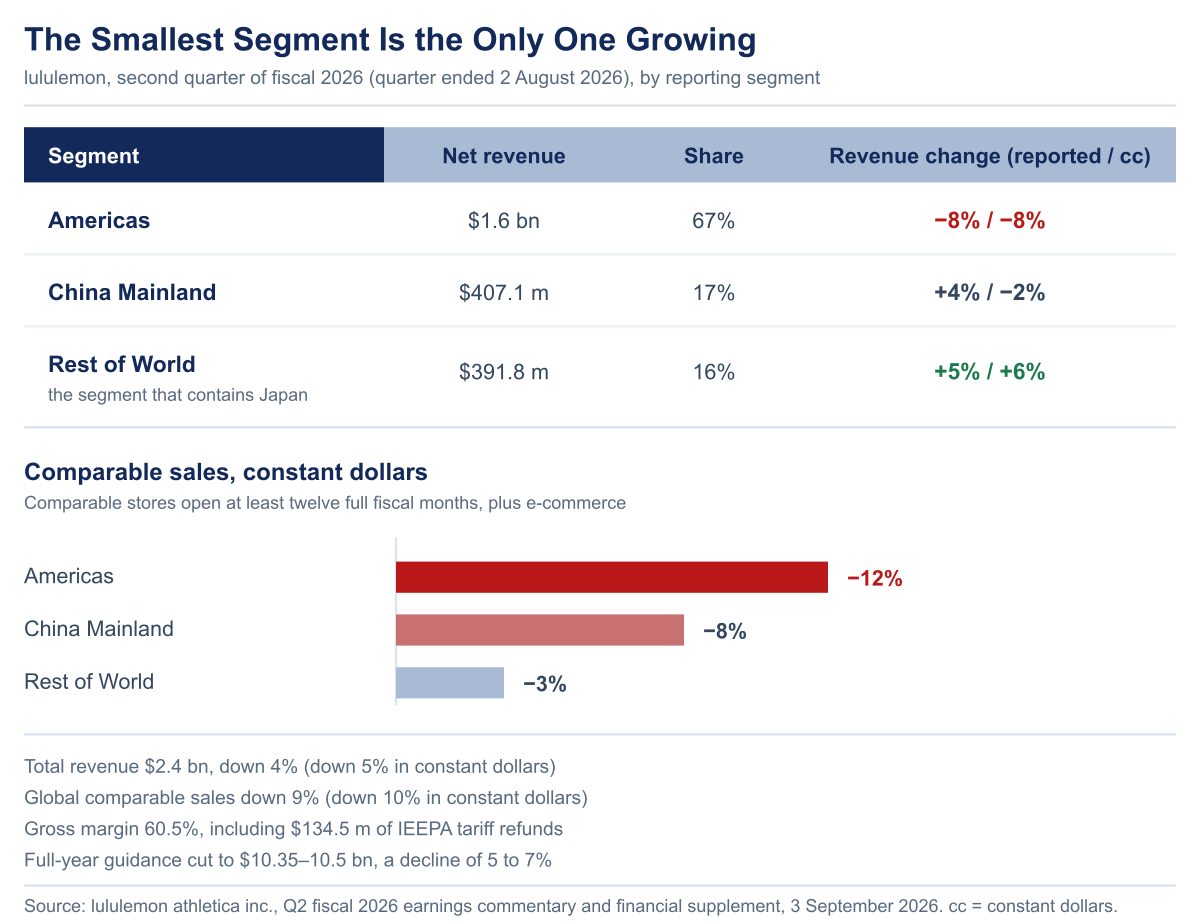
Total net revenue was $2.4 billion, down 4 percent, or 5 percent on a constant dollar basis. Global comparable sales fell 9 percent, or 10 percent in constant dollars. Underneath that headline, the split was stark.
The Americas produced $1.6 billion, 67 percent of the company’s revenue, down 8 percent from $1.8 billion and 70 percent a year earlier. Americas comparable sales fell 12 percent. The United States was down 8 percent on revenue; Canada, the company’s founding market, was down 11 percent.
China Mainland produced $407.1 million, 17 percent of revenue, up 4 percent as reported — but down 2 percent in constant dollars, with comparable sales down 2 percent as reported and 8 percent in constant currency. In other words, the China number was flattered by the currency and is not growing on a constant-currency basis.
Rest of World — the segment that contains Japan — produced $391.8 million, 16 percent of revenue, up 5 percent as reported and 6 percent in constant dollars, against $374.1 million and 15 percent a year earlier. Its comparable sales were down 4 percent as reported and down 3 percent in constant currency, the smallest decline of the three segments.
That last paragraph is the whole strategic argument in one line. Rest of World is the only segment where revenue grew faster in constant currency than it did on paper, and, on a constant-currency basis, it is the only segment whose comparable-sales decline is in the low single digits rather than high single or double digits. It is also, at 16 percent of revenue, the smallest.
The rest of the quarter was a study in how a company buys time. Gross margin rose 200 basis points to 60.5 percent, but that included $134.5 million of tariff refunds received under the International Emergency Economic Powers Act, plus $4.1 million of associated interest — together worth $0.86 of the $2.92 in diluted earnings per share the company reported, against $3.10 a year earlier. Strip the refund out and the earnings picture is considerably worse. Selling, general and administrative expenses rose 400 basis points to 41.7 percent of revenue, driven by fixed-cost deleverage, continued investment in store labour hours, brand spend, and — a line item you do not often see — fees related to the proxy contest. Operating income fell to $453.7 million from $523.8 million.
The company ended the quarter with 825 company-operated stores against 784 a year earlier, having opened seven new stores in the Americas, one net new store in China Mainland and exactly one in Rest of World during the quarter. It repurchased 2.7 million shares for $330 million. And it cut guidance: full-year revenue of $10.35 billion to $10.5 billion, a decline of 5 to 7 percent, with the third quarter guided down 10 to 11 percent.
So: a business shrinking at home, propped up at the margin line by a one-time tariff refund, cutting its store programme, paying legal fees to fight its own founder — and simultaneously cutting the ribbon on the largest store it has ever built in Asia, in a country that sits inside its smallest reporting segment.
Six New Countries, Two Partners, and One Exception
Here is the part that most coverage missed, and it is the part that actually tells you what lululemon thinks Japan is.
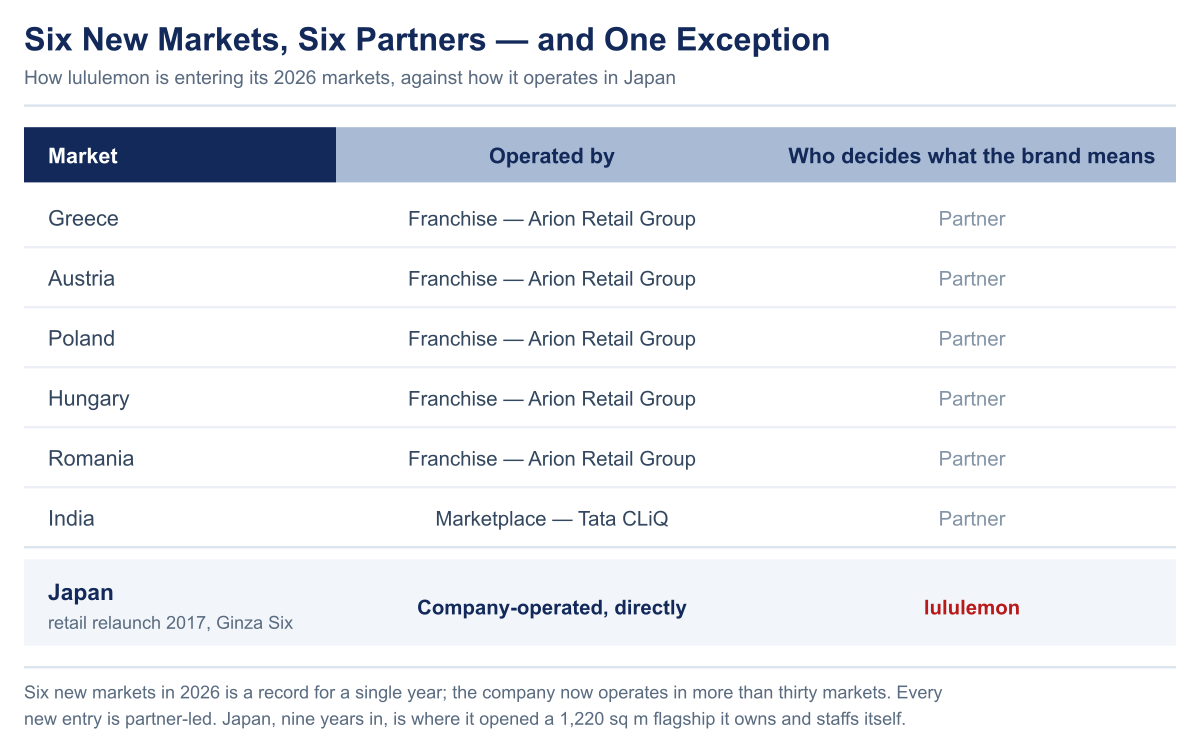
In December 2025 the company announced that it would enter six new markets in 2026 — a record number for a single year, taking it past thirty markets worldwide. The six are Greece, Austria, Poland, Hungary, Romania and India.
It is not opening those stores itself. The five European markets will run through franchise agreements with Arion Retail Group, with customers buying online through eu.lululemon.com. India will launch through a partnership with Tata CLiQ, selling through Tata’s luxury and fashion marketplaces. Sarah Clark, the company’s senior vice president for EMEA, framed it as growing “presence and communities” across Europe and Asia Pacific.
Franchise. Franchise. Franchise. Franchise. Franchise. Marketplace partnership.
And then Japan, where the company has been operating its own stores since its 2017 relaunch at Ginza Six, where it employs its own people, holds its own leases, runs its own e-commerce, and has just spent whatever a three-storey building in Jingumae costs to open a 1,220-square-metre flagship with bespoke furniture from a domestic manufacturer.
Six new markets in a single year, every one of them handed to a partner. One old market, nine years in, taken deeper and more expensively into direct operation. That is not a contradiction. That is a portfolio with two entirely different theories in it, and the difference between them is the single most useful thing in this story for anyone thinking about their own Japan entry.
The franchise markets are distribution plays. The company is buying reach cheaply, accepting that a partner will control the customer relationship, and treating the market as an addressable revenue pool. The Japan flagship is a definition play. The company is buying the right to decide what the brand means in a market where it believes the meaning has to be established before the volume can be, and it is willing to carry the fixed cost of doing that itself.
You can argue about whether that is correct. You cannot argue about which one is more expensive.
Why Japan Is Normally a Licensing Market
To see how unusual lululemon’s choice is, look at how the two most successful foreign sportswear brands in Japan actually got here.
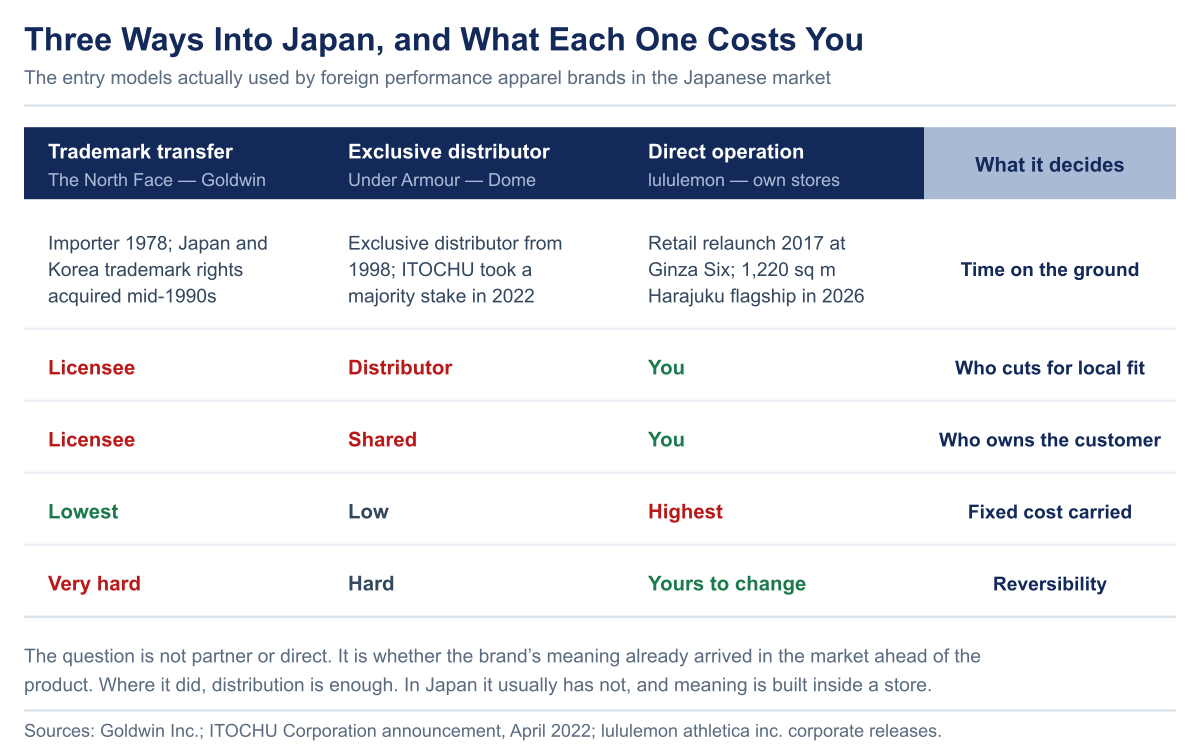
The North Face is not, in Japan, an American company’s Japanese subsidiary. It is Goldwin. Goldwin, a manufacturer from Toyama Prefecture on the Sea of Japan side of the country, became The North Face’s importer when the brand first arrived in Japan in 1978. In the mid-1990s Goldwin acquired the trademark rights for Japan and South Korea outright — the company’s own corporate history dates the acquisition to 1995, while other accounts give 1994. Today, the overwhelming majority of The North Face product sold in Japan — roughly 95 percent — is product Goldwin handles, and a great deal of it is product Goldwin designed. In 2003 it created The North Face Purple Label, a Japan-exclusive line aimed at urban styling rather than alpinism, which has arguably done more to define what the brand means to a Tokyo twenty-something than anything designed in California. Goldwin runs the same playbook with Helly Hansen, Ellesse and Danskin.
Under Armour arrived in Japan in 1998 through Dome Corporation as its exclusive distributor and licensee. Dome built the brand here through baseball and university sport, the two channels that actually move performance apparel in Japan, and in April 2022 ITOCHU — one of the general trading houses that quietly own a slice of nearly everything imported into this country — announced it was acquiring a majority of Dome’s shares.
This is the template. A foreign performance brand arrives in Japan, hands the market to a domestic partner with manufacturing depth, distribution relationships and an understanding of the sizing, and in exchange gives up control of what the brand becomes. It works. It works so well that in The North Face’s case the Japanese interpretation has been exported back out, and Japanese consumers are frequently surprised to learn the brand is American at all.
The cost is that you do not own the outcome. If the licensee’s interpretation is brilliant, you get a market you could not have built. If it is mediocre, you get a mediocre market and a contract that is very difficult to unwind. And you never, in either case, learn anything about the Japanese consumer directly, because everything you know about them arrives through a partner who has an interest in what you know.
Lululemon has looked at that trade and declined it — in Japan specifically, while accepting it in five European countries and India in the same twelve months.
The Gyms Nobody Joins
Now the number that makes the whole thing look insane on first reading.
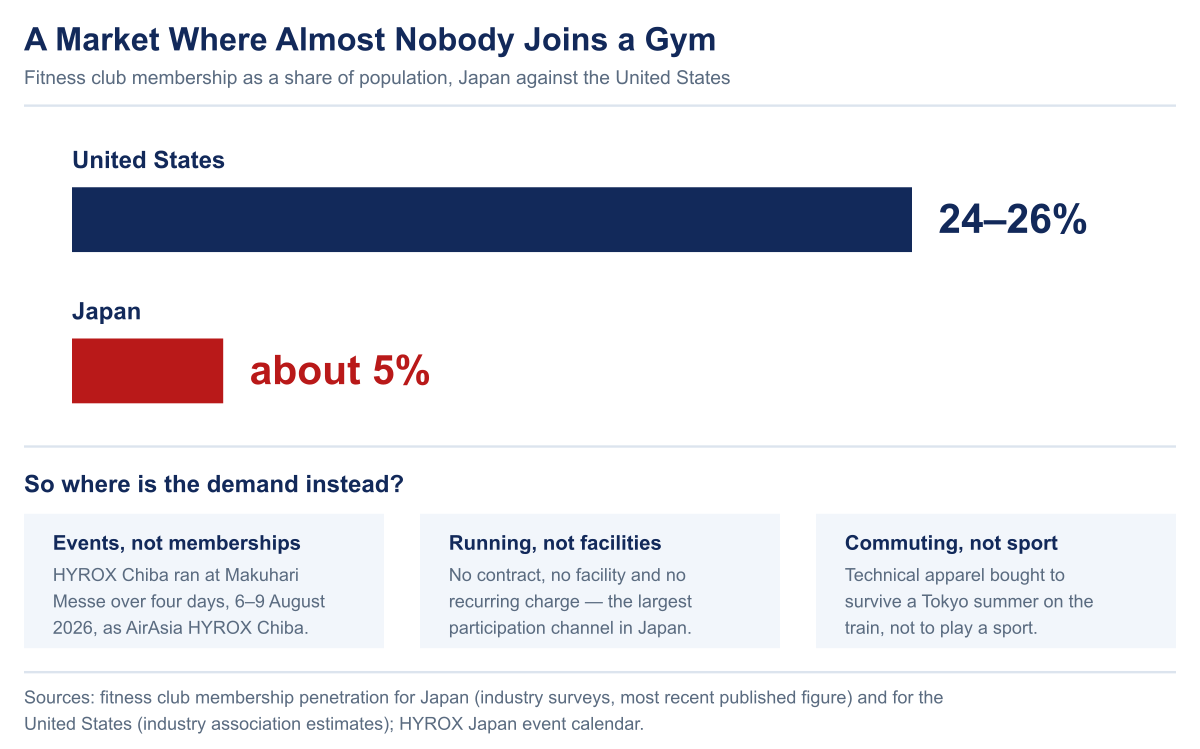
Fitness club membership penetration in Japan sits at roughly 5 percent of the population. In the United States it is somewhere between 24 and 26 percent. Japan has roughly forty percent of America’s population and something like a fifth of its gym membership rate. If your model of an athletic apparel market is “count the gym members and multiply”, Japan is a rounding error and lululemon has just built its biggest Asian store in the wrong country.
That model is wrong, and understanding why it is wrong is most of what a foreign operator needs to know about selling anything active in Japan.
Japanese fitness participation is not organised around a monthly membership. It is organised around events, seasons, clubs and commuting. The running population here is enormous relative to gym membership because running requires no facility, no contract and no explanation to a spouse about a recurring charge. Corporate and university sports clubs absorb a large share of serious athletic participation and buy their apparel through completely different channels. And an enormous volume of technical apparel is bought for a use case that is not sport at all: getting to work in a country where the summer is now routinely lethal and the trains are not air-conditioned enough for a wool suit.
Then there is what is happening at the top of the participation pyramid. Hyrox — the fitness racing format built from eight one-kilometre runs, each followed by a functional workout station: SkiErg, sled push, sled pull, burpee broad jumps, rowing, farmers carry, sandbag lunges, wall balls — ran at Makuhari Messe in Chiba, just outside Tokyo, from 6 to 9 August 2026 as AirAsia HYROX Chiba, a year after the format first reached Japan in Yokohama. Four days of racing, thirteen days before lululemon opened Harajuku. That is not a coincidence of the calendar. It is the same customer.
What Hyrox represents in Japan is a category of athlete that did not have a retail home: people training seriously, in a structured way, for a specific competitive event, who are not members of a traditional Japanese fitness club and who do not see themselves in the baseball-and-university world that Dome built Under Armour on. They are also, demographically, exactly the urban late-twenties-to-forties professional that Jingumae is built to catch.
Lululemon’s answer to this is community programming — group runs, in-store events, the “Hatsu Run” first-run-of-the-year format that maps neatly onto the Japanese practice of doing a symbolic first version of everything in January. A flagship with a third of its floor area not selling product is a venue. In a market where the gym is not the gathering point, the store becomes one.
That is the bet. Not “Japan has lots of gym members.” The bet is “Japan has lots of athletes and nowhere for them to belong, and we can be the place.”
What Asia Fit Quietly Admits
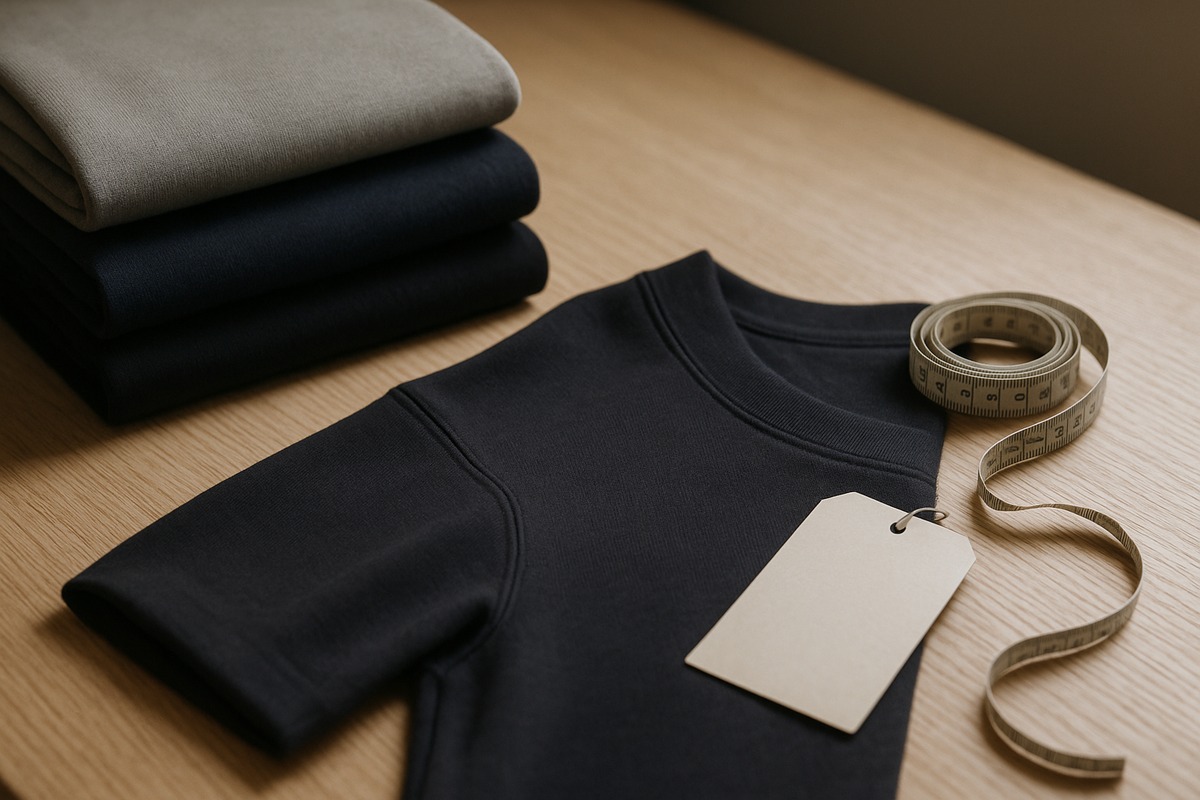
There is a smaller detail in the Harajuku store that carries more strategic weight than the architecture: Asia Fit is merchandised on the floor.
Asia Fit is lululemon’s regional sizing and cut adjustment. Putting it out on the selling floor of a global flagship rather than treating it as a variant is an admission with two parts. The first part is straightforward: the company’s standard blocks do not fit the Japanese body well enough to sell at Japanese price points against Japanese competitors who have been cutting for this market for decades. Every foreign apparel brand that has failed in Japan has failed at least partly here, and most of them failed while insisting the problem was brand awareness.
The second part is more interesting. Localised fit is normally the licensee’s job. It is the single clearest thing Goldwin does for The North Face and Dome did for Under Armour — take the foreign design and re-cut it for the domestic body and the domestic use case. By building Asia Fit in-house and putting it at the centre of a directly operated flagship, lululemon is doing the licensee’s highest-value work itself.
That is what a definition play looks like operationally. It is not just holding the lease. It is absorbing the localisation function that most foreign brands outsource, because whoever does the localisation is the one who actually decides what the brand means in the market.
The same logic runs through the rest of the store. Product education delivered by your own staff rather than a distributor’s. Personalisation, which requires you to control inventory at the unit level. Furoshiki wrapping, which is a small thing that signals you understand gift-giving in a country where a meaningful share of apparel purchases are gifts. Local design partnerships with Karimoku and Torafu, which buy domestic credibility that no amount of global campaign spend can.
Each of those is a cost line that a franchise partner would have carried. Each is also a decision that a franchise partner would have owned.
The Rent on a Plateau

Here is the risk, and it deserves to be stated plainly rather than buried.
The last three years of foreign retail investment in Tokyo have been underwritten, explicitly or otherwise, by inbound tourism and a weak yen. Open on Omotesando, catch the visitor flow, book the revenue. That trade is no longer obviously working.
Japan National Tourism Organization figures show 21.1 million international visitors in the first half of 2026 — about 2 percent below the same period of 2025. July 2026 delivered 3,442,100 visitors, up 0.1 percent year on year, technically a record for the month of July and effectively flat. The first quarter did set a record, with 10,683,500 arrivals, the first time the January-to-March period has cleared ten million, up 1.4 percent. South Korea has become the largest single source market, at roughly 5.7 million visitors in the first half, up 18.6 percent, with Taiwan and Western markets covering for softer Chinese demand.
Read that series honestly and it says: inbound has stopped compounding. It is enormous, it is not collapsing, and it is no longer the growth engine it was in 2023 and 2024. A retail investment underwritten on tourist growth in 2026 is underwritten on a plateau.
Which means the Harajuku flagship has to work on domestic demand. And that is, I think, the actual reason the company built a venue rather than a shop. Tourist revenue is transactional and does not require you to be part of anyone’s week. Domestic revenue in Japanese specialty retail is relational — it is repeat visits, staff who remember you, events you show up to, and a slow accumulation of trust that a Japanese consumer extends only after being given several reasons to. You cannot buy that with a lease. You can only buy the room in which to earn it.
The cost of being wrong is high. A 1,220-square-metre flagship in Jingumae is a fixed cost that does not flex when comparable sales are down 9 percent globally, and lululemon is carrying it into a year it has already guided down 5 to 7 percent, under a chief executive who takes over on 8 September and inherits both the aftermath of a proxy contest with founder Chip Wilson — who nominated three directors in late December 2025, and who signed a cooperation agreement with the company in May 2026 — and Elliott Investment Management’s stake of more than a billion dollars. New chief executives under activist pressure do not have long grace periods, and flagship stores in expensive districts are the most legible thing on a cost-cutting list.
What This Means If You Are the One Trying to Enter Japan
Strip out the brand and there is a general lesson here, and it is not the one most foreign operators take away.
The usual framing is “should we enter Japan through a partner or directly?”, answered on the basis of cost and speed. That framing produces a predictable outcome: almost everyone takes a partner, because a partner is cheaper, faster and lower-risk, and because the alternative requires headcount and a lease before you have any revenue. Then, three to five years later, roughly half of those brands discover they have a Japanese business they do not recognise, cannot direct, and cannot easily take back.
Lululemon’s 2026 is a demonstration that the question is not partner-versus-direct. It is: in which markets does the brand’s meaning need to be controlled, and in which markets is distribution enough?
Greece, Austria, Poland, Hungary and Romania are markets where lululemon’s meaning already arrived ahead of it. Consumers there have seen the brand through global media, travel and adjacent markets; the job is to put product within reach. A franchise partner does that competently and cheaply. India, through Tata CLiQ, is the same logic at larger scale — access first, definition later.
Japan is the opposite case, and it is worth being precise about why. Japanese consumers do not import brand meaning from global media at anything like the rate consumers elsewhere do. The domestic media environment is strong, the domestic competitive set is excellent, and the consumer’s default assumption about an unfamiliar foreign brand is that it is probably worse-made than the Japanese equivalent until proven otherwise. Proof, here, is delivered through product education, material specificity, fit, service and time. Those are all things that happen inside a store, performed by people you employ.
So the sequence lululemon has actually run — and this is the part worth copying — is: restart the Japanese retail presence small in 2017 at Ginza Six with a store of a bit over 2,400 square feet; operate directly for nine years at modest scale; learn the market with your own people; and only then build the venue. It did not lead with the flagship. It led with nine years of unglamorous direct operation and then spent the money once it knew what to spend it on.
The mistake most foreign brands make is the inverse: a splashy Omotesando opening as the entry move, funded by optimism, followed by a quiet retreat to a licensing deal three years later when the fixed costs meet the actual demand curve. Harajuku is not the entry. Harajuku is what year nine looks like if the first eight went well enough.
The second lesson is about timing, and it is uncomfortable. Lululemon is making this investment while its home market shrinks, not while it booms. That is the harder version and it is probably the correct one. Japan rewards brands that are present through a downturn and punishes brands that arrive at the top of a cycle and leave at the bottom — the market has a long memory for withdrawal, and a re-entry after an exit is meaningfully more expensive than the original entry was. A brand that commits capital to Japan in a bad year is making a legible statement to Japanese partners, landlords and consumers, all of whom are watching to see whether you are serious.
The third lesson is the one nobody wants: you cannot outsource the part that matters and then complain that you do not control it. Goldwin’s stewardship of The North Face is a genuine success story and it made both parties a great deal of money. It also means that if the American company ever wanted to define The North Face in Japan on its own terms, the answer would be that it cannot, and it has not been able to since the mid-1990s.
Frequently Asked Questions
Q. Where is lululemon’s Japan flagship and when did it open?
A. It is at 1-13-12 Jingumae in Shibuya, Tokyo, a short walk from Harajuku Station and Meiji-jingumae Station along the Omotesando route, and it opened on 19 August 2026. Trade coverage of the opening ran across late August and early September, so you will see a few different dates cited. At 1,220.23 square metres — about 13,130 square feet across a three-storey building, with the selling floor on two levels — it is lululemon’s largest store in Asia Pacific and its first designated global flagship in Japan.
Q. Is lululemon actually doing well in Japan, or is this a vanity project?
A. The company does not break out Japan separately. Japan sits inside the Rest of World segment, which in the second quarter of fiscal 2026 produced $391.8 million, 16 percent of total revenue, up 5 percent as reported and 6 percent in constant dollars — the only segment growing in constant currency. Its comparable sales were down 4 percent, the smallest decline of the three segments, against Americas comparable sales down 12 percent. So the honest answer is that Japan sits in the healthiest part of a business that is currently unhealthy overall.
Q. Why does lululemon operate directly in Japan but use franchise partners for its 2026 market entries?
A. All six of its new 2026 markets are partner-led: Greece, Austria, Poland, Hungary and Romania through franchise agreements with Arion Retail Group, and India through a partnership with Tata CLiQ. Those are distribution decisions in markets where the brand’s meaning largely preceded it. Japan is a market where brand meaning has to be built locally through product education, fit and service — work that is normally the licensee’s, and that lululemon has chosen to do itself, including running its Asia Fit sizing in-house rather than through a partner.
Q. How big is Japan’s sportswear market, and is it growing?
A. Estimates vary widely by research house and definition. One frequently cited projection puts Japanese sports apparel at around US$15 billion by 2032; another sizes the sportswear market at about US$7.2 billion in 2025 growing to roughly US$11.9 billion by 2034, a compound rate near 5.7 percent. Treat all of them as directional. The more useful number for planning is that fitness club membership penetration in Japan is around 5 percent against roughly 24 to 26 percent in the United States — which means demand here is organised around events, running, commuting and clubs rather than gym memberships.
Q. What is the biggest risk to this strategy?
A. Fixed cost meeting a soft cycle. Lululemon has guided fiscal 2026 revenue down 5 to 7 percent and the third quarter down 10 to 11 percent, cut its new-store plan from about forty to about thirty-five, and is operating under a chief executive who takes over on 8 September, following a proxy contest from founder Chip Wilson that was settled by a cooperation agreement in May 2026, and with an activist stake of more than a billion dollars from Elliott Investment Management. Japanese inbound tourism has also plateaued at about 21.1 million visitors in the first half of 2026, roughly 2 percent below 2025, so the store cannot be underwritten by visitor growth. It has to work on domestic demand, and it has to work reasonably soon.
Conclusion
The easy reading of the last three weeks is that lululemon opened a beautiful store in Tokyo and then had a bad quarter, and that the two facts are unrelated because corporate calendars are what they are.
The more useful reading is that they are the same decision. A company whose American business is contracting 12 percent has to answer a question about where the next decade of growth comes from, and it has answered it twice in the same year, in two completely different registers. In Europe and India, growth is a distribution problem, and it handed the problem to partners. In Japan, growth is a meaning problem, and it built a three-storey building and hired the people to stand in it.
For any operator looking at Japan right now, the transferable part is not the flagship. It is the nine years before the flagship, the decision to keep the localisation function in-house, and the willingness to commit capital in a market during a bad year rather than a good one. Those are the expensive, unglamorous, non-photogenic choices, and they are the ones that determine whether the beautiful store on Jingumae is the beginning of something or the most expensive press release of 2026.
I will be walking past it regularly. Ask me in three years.
—
If you’re interested in this topic, the Japanese market more broadly, or what KETCHUPs is working on, we’d love to hear from you — please reach out via our contact form.
Japan Market Pulse is a weekly read on what the Japanese consumer-tech, food, and mobility markets are choosing to do, written for international operators who want to know what is happening before it shows up in the global trade press.
Subscribe at ketchups.co/japan-market-pulse.